The Ecommerce Returns Management Process: A Strategic Guide for 2026
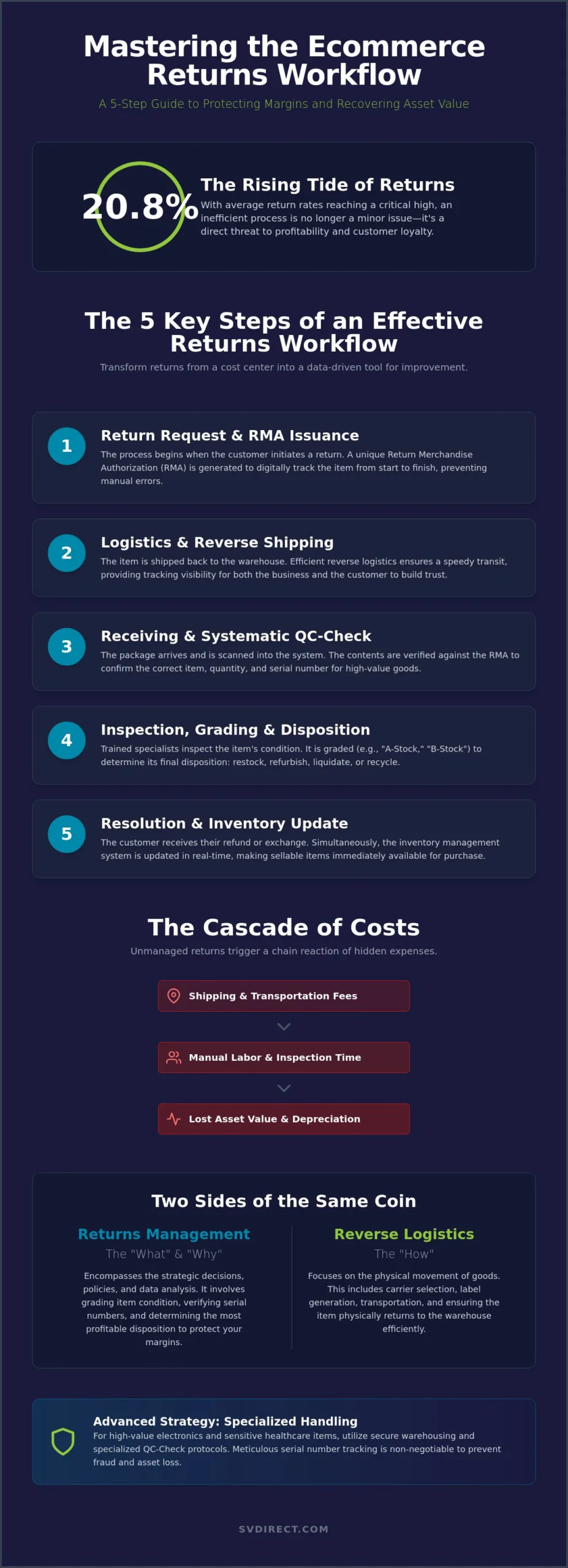
With average ecommerce return rates now reaching as high as 20.8%, the financial impact of a fragmented ecommerce returns management process is no longer just a minor operational hurdle; it’s a strategic threat to your profitability. You’ve likely felt the strain of rising labor costs and the frustration of inventory inaccuracies that stem from poor grading. As the 2026 EU “Withdrawal Button” law sets a new global standard for one-click returns, the pressure to maintain a precise and efficient reverse logistics chain has never been more intense.
We understand that a return is a high-stakes moment in the customer journey that requires a steady, professional hand. This guide provides a roadmap to help you master every stage of the workflow, from the initial request to the final restocking of sellable items. You’ll learn how to implement a transparent system that protects your margins, recovers asset value, and uses precise data to reduce return rates over time. We’ll examine the technical integrations and human expertise needed to turn your warehouse operations into a reliable engine for long-term loyalty and growth.
Key Takeaways
- Distinguish between customer-facing policies and physical logistics to build a more resilient ecommerce returns management process.
- Implement a standardized five-step workflow to move items from the initial request to final disposition without losing asset value.
- Quantify the “Cascade of Costs” so you don’t overlook how labor, inspection time, and “bracketing” habits impact your margins.
- Utilize specialized secure warehousing and QC-Check protocols to safely manage high-value electronics and sensitive healthcare materials.
- Harness real-time reporting via systems like Remote Control™ to pinpoint return trends and proactively improve product descriptions.
What is the Ecommerce Returns Management Process?
The ecommerce returns management process is a comprehensive, end-to-end strategy that governs every touchpoint of a returned item. It starts the second a customer initiates a request and only ends once the product reaches its final disposition, whether that is being restocked, refurbished, or recycled. In 2026, this process is no longer a secondary concern; it is a critical component of your brand’s operational integrity. Success requires a marriage of digital transparency and physical precision to ensure that margins are protected and customers remain satisfied.
Modern standards demand that this process be proactive rather than reactive. By utilizing 24/7 real-time visibility into inventory, businesses can maintain a high level of trust with their audience. This involves more than just issuing a refund. It means using return data to identify trends, such as recurring defects or inaccurate product descriptions, and fixing those root causes to prevent future returns. When you treat returns as a strategic data source, you transform a cost center into a tool for continuous improvement.
Returns Management vs. Reverse Logistics
It’s vital to understand that while these terms are related, they aren’t identical. Reverse logistics focuses on the “how,” which is the physical movement of goods from the consumer back to the distribution center. This includes carrier selection, shipping labels, and the actual transportation of the package. Returns management is the “what” and the “why.” It encompasses the strategic decisions, such as grading the item’s condition, verifying serial numbers for high-value tech, and determining the most profitable next step for the inventory.
A reliable 3PL partner must be a master of both realms. Without efficient logistics, returns take too long to arrive. Without sophisticated management, those items sit in a warehouse gathering dust instead of being processed. For high-value goods, meticulous serial number tracking during the return journey is a non-negotiable safeguard against fraud and asset loss. This level of oversight ensures that the exact unit sold is the one being returned and inspected.
The Business Impact of an Optimized Workflow
An inefficient workflow creates a “cascade of costs” that can quickly erode your profits. These include the obvious shipping fees, but also the hidden expenses of manual labor, dedicated warehouse space, and lost asset value. The longer an item stays in the return cycle, the less likely it is to be sold at its original price. A fast return-to-shelf cycle is essential for maintaining healthy inventory turnover and recovering value before a product becomes obsolete.
Strategic Silicon Valley 3PL fulfillment services help brands compress these timelines. By automating the grading process and integrating it with real-time data systems, you ensure that sellable items are back on the digital shelf within hours, not weeks. This level of speed protects your bottom line and keeps your supply chain lean and responsive to market demands.
The 5 Key Steps of an Effective Returns Workflow
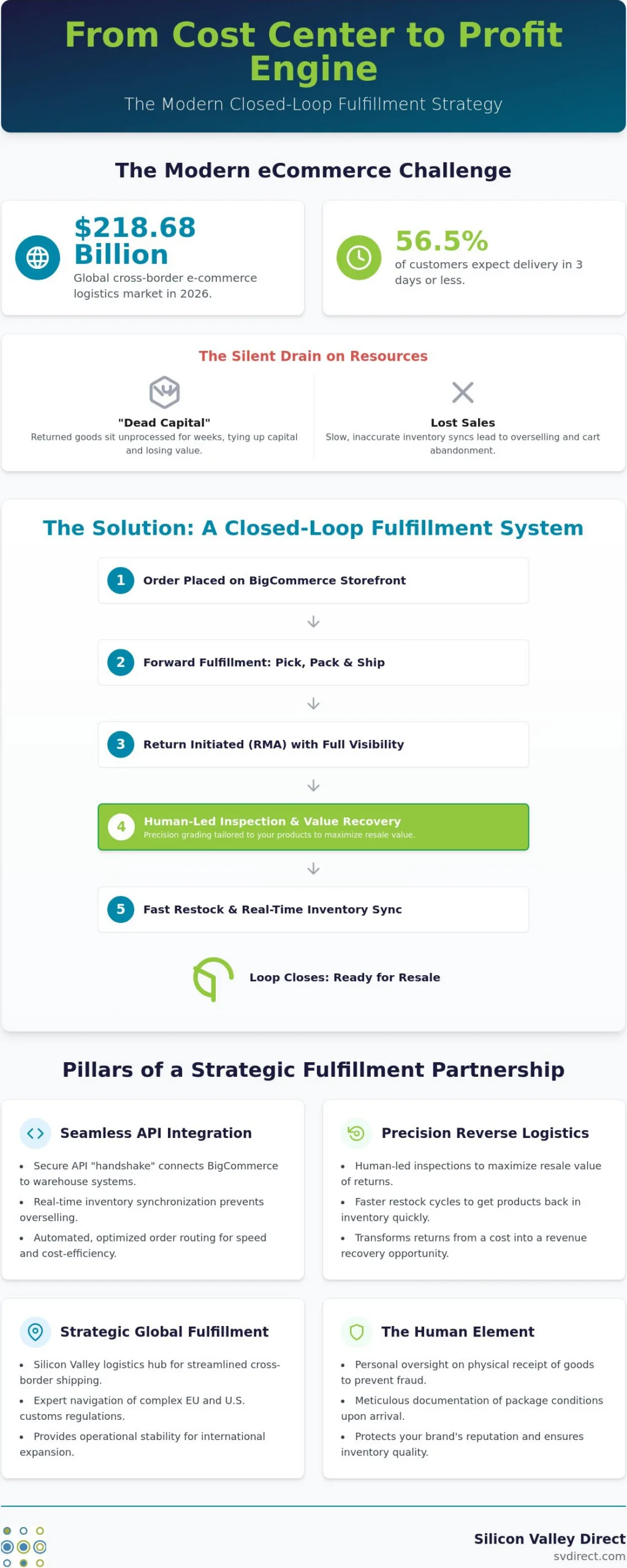
Building a high-performance ecommerce returns management process requires more than just a digital “refund” button. It demands a structured, physical workflow that treats every returned item as a valuable asset rather than a burden. A well-executed cycle ensures that items don’t just sit in a corner; they move through a series of checkpoints designed to recover value and restore customer trust. The following five steps represent the standard for operational excellence in 2026.
- Step 1: Return Request and RMA Issuance. The customer initiates the process, and the system issues a Return Merchandise Authorization (RMA) to track the intent.
- Step 2: Logistics and Reverse Shipping. The item travels back via a selected carrier with active tracking enabled for both the brand and the customer.
- Step 3: Receiving and Systematic QC-Check. The package arrives at the warehouse for a physical entry process to verify the contents against the RMA.
- Step 4: Inspection, Grading, and Disposition. Specialists inspect the item to determine if it is sellable, needs refurbishment, or must be recycled.
- Step 5: Final Resolution and Inventory Update. The customer receives their refund or exchange while the inventory system updates in real-time to reflect available stock.
The Crucial Role of RMA and Data Integration
Manual returns are the primary cause of warehouse errors. When staff rely on paper trails or disconnected spreadsheets, items get lost or misidentified. Integrating your storefront with a remote order management system ensures an instant data sync between the customer’s home and the fulfillment floor. An RMA serves as the digital handshake between customer intent and warehouse readiness. This integration allows for proactive problem solving, as warehouse teams know exactly what is arriving before the truck even docks.
Inspection and Grading Standards
Physical evaluation is the most critical stage of the ecommerce returns management process. We categorize items into Grade A (like-new), Grade B (open box), or Grade C (damaged) to ensure they are listed correctly for resale. To maintain this level of precision, we utilize a “Quiet Facility” methodology. This approach allows our team to focus entirely on the nuances of grading without the chaos of a disorganized environment. We also employ serial number tracking to identify fraudulent returns, ensuring the unit coming back is the exact one we shipped out. If you are looking to refine your own physical grading standards, you can request a free quote to see how our team handles complex reverse logistics.
Calculating the Real Cost of Returns in 2026
Every returned package triggers a “Cascade of Costs” that extends far beyond the initial shipping label. To truly understand the ecommerce returns management process, you must account for the cumulative impact of reverse logistics, manual labor, and administrative overhead. In 2026, industry research shows that return rates for online purchases hover between 19% and 20.8%. This is significantly higher than the single-digit rates seen in physical retail. This volume represents a massive portion of the projected $849.9 billion in total U.S. retail returns. Cost containment is now a primary objective for growing brands.
A significant driver of these costs is the consumer habit known as “bracketing.” This occurs when a customer orders multiple sizes, colors, or styles of the same item with the intent of keeping only one. Research indicates that sizing, fit, or color issues account for approximately 45% of all returns. Bracketing doesn’t just increase shipping expenses; it effectively removes sellable inventory from your shelves for weeks at a time. This creates an “Obsolescence Risk,” where seasonal goods or high-tech electronics lose significant market value while they are stuck in the return cycle. Every day counts. Every day a unit spends in transit or waiting for inspection is a day its potential for full-price resale diminishes.
Some retailers implement restocking fees to offset these burdens. While this can recover some processing costs, it is a delicate balance. If the fee feels punitive, it can damage customer loyalty and drive shoppers toward more flexible competitors. A more sustainable approach involves using data from systems like Remote Control™ to identify why items are coming back and addressing those issues at the source. Since our founding in 1999, we have seen that transparency in data is the best defense against rising costs.
Labor and Processing: The Silent Profit Killer
The physical handling of a return is a labor-intensive endeavor. Our team spends dedicated minutes on every unit. They perform a meticulous sequence of opening, inspecting, re-folding, re-bagging, and re-labeling. This granular level of care is necessary to maintain brand standards. We operate a Quiet Facility to ensure this grading is done with absolute precision. However, these steps add up quickly across thousands of orders. To help recover asset value, our kitting and assembly services can be used to refurbish items to their original quality. This ensures they are ready for immediate resale. We treat every return with a “make-it-right” attitude. It is an opportunity to salvage a sale and a relationship.
Environmental and Sustainability Costs
Shipping items twice, once to the customer and once back to the warehouse, nearly doubles the carbon footprint of a single transaction. In 2026, consumers are increasingly sensitive to these environmental impacts. Waste adds up quickly. An efficient disposition strategy aligns with modern “Green Printing” and sustainable brand values. This includes responsible donating or recycling. We utilize high-end technology like the HP Indigo 5500 liquid ink system and follow industry-leading models for hardware recovery to minimize waste. By streamlining the ecommerce returns management process, you aren’t just saving money. You are reducing the physical waste and energy consumption of your entire supply chain.
Advanced Strategies for Specialized Returns Management
A standard ecommerce returns management process often falls short when applied to specialized industries. While a basic apparel return is relatively straightforward, handling medical devices or high-value tech requires a much higher level of operational precision. These sectors demand more than just warehouse space; they require a partner capable of maintaining a rigorous chain of custody and serialized tracking throughout the entire reverse journey. When items are sensitive or regulated, the physical handling must be as disciplined as the digital tracking.
High-Value and Regulated Goods
For brands utilizing healthcare mailing services, the return of medical kits or pharmaceutical-adjacent materials involves strict compliance standards. It isn’t just about restocking; it’s about verifying that the integrity of the product remains intact. Similarly, tech companies rely on secure warehousing to prevent asset loss and ensure that returned units are thoroughly inspected before being reintroduced to inventory. Our systematic QC-Check process ensures that every component of a high-value kit is accounted for, allowing us to refurbish and re-kit these items for resale with total confidence.
Leveraging Print-on-Demand to Reduce Future Returns
Data gathered during the ecommerce returns management process is a goldmine for reducing future overhead. If customers consistently return an item due to “fit” or “confusing assembly,” you can act immediately. By integrating print on demand capabilities, you can update user manuals or “quick start” guides based on real-world feedback without waiting for a new production run. Our HP Indigo 5500 liquid ink technology provides 230-line screen resolution printing, which allows re-packaged goods to look brand new and professionally curated. We also use Variable Data Printing (VDP) to include personalized “Sorry it didn’t work” cards in exchange shipments, turning a potential loss into a high-touch customer loyalty moment.
Proactive communication remains your best tool for reducing customer anxiety. By providing 24/7 data access via our Remote Control™ system, you keep your customers informed of their return status at every stage. This transparency reduces the burden on your customer service team and reinforces the idea that your brand is a reliable, high-performance partner. We believe that physical operations should be just as organized and accessible as your digital storefront. This steady approach alleviates the stress of business growth through precision and personal commitment.
Why Silicon Valley Direct is Your Returns Partner
Silicon Valley Direct has refined the ecommerce returns management process since 1999. Our history provides a stable foundation that few others can match. We operate from a strategic location that serves as a symbol of global connectivity and innovation. This allows us to integrate high-tech efficiency with a deeply reliable, human-centric service. We don’t believe in impersonal, automated-only interactions. Instead, we position ourselves as a high-performance partner that remains grounded and accessible.
Transparency Through Remote Control™
Our proprietary Remote Control™ data management system is the backbone of our operational transparency. It provides you with 24/7 access to real-time inventory and return status from any device. We offer over 120 standard reports. These allow you to perform deep-dive analysis on return trends and identify exactly why items are coming back. For technical stakeholders, our system utilizes programmatic interfaces like XML and SOAP for a seamless integration with your existing eCommerce platform. This ensures that your digital communication and physical operations remain perfectly synchronized. If your development team needs to stress-test these financial integrations, they can learn more about specialized digital transaction simulation systems. Automated email alerts also act as a safety net. They notify you immediately if high return rates cause inventory levels to drop below your comfort zone.
The ‘Extension of Your Team’ Philosophy
We view our relationship with clients as a long-term partnership. Our proactive problem-solving approach identifies return patterns before they can disrupt your peak seasons or high-volume deadlines. We utilize a “Quiet Facility” methodology to manage these workflows. By maintaining an organized and focused environment, we ensure that every inspection and grading task is handled with absolute precision. This eliminates the chaos often found in traditional warehouses and protects your bottom line. Our team is a dedicated, team-oriented organization where collective experience is a point of pride.
You can see the results of this personal commitment by exploring our customer testimonials. We promise total flexibility and bespoke problem-solving to ensure your ecommerce returns management process remains a competitive advantage. Our goal is to alleviate the stress of business growth through physical infrastructure and human expertise rather than just marketing abstractions.
Transform Your Reverse Logistics into a Strategic Advantage
Mastering the ecommerce returns management process is about more than just moving boxes. It’s about capturing granular data to prevent future losses and using high-resolution kitting to restore asset value. By moving beyond manual spreadsheets and embracing a system that prioritizes physical precision, you protect your margins while building a more resilient brand. This transition allows you to treat every returned item as a potential recovery rather than a total loss.
We’ve provided this level of steady, professional oversight since 1999. Our proprietary Remote Control™ system offers 24/7 real-time reporting to ensure you never lose sight of your inventory status or return trends. This marriage of high-tech efficiency and human expertise turns a complex operational challenge into a seamless extension of your own team. It’s a proactive approach designed to alleviate the stress of rapid business growth through precision and personal commitment.
You don’t have to navigate these high-volume deadlines and technical integrations alone. With a dedicated partner and the right physical infrastructure, you can confidently turn every return into a new opportunity for long-term customer loyalty.
Frequently Asked Questions
What is the difference between returns management and reverse logistics?
Returns management is the strategic decision-making framework, while reverse logistics is the physical transportation of the product. Management involves setting policies, grading items, and determining the final disposition of inventory. Logistics focuses on the “how,” including carrier selection and package tracking. A successful operation requires both to work in harmony to protect your margins and maintain a steady flow of inventory back into sellable stock.
How can I reduce the cost of ecommerce returns?
You can reduce costs by analyzing return data to identify why customers are dissatisfied and addressing those root causes. If a specific product has a high return rate due to fit issues, updating the digital product page with precise measurements can prevent future errors. Using high-resolution digital printing for clearer user manuals also helps. These proactive steps reduce the volume of items entering your reverse logistics chain and save on labor.
Should I offer free returns to my customers in 2026?
Offering free returns in 2026 is a strategic choice that depends on your specific product category and customer loyalty goals. While the EU “Withdrawal Button” law simplifies the initiation process, retailers are increasingly using tiered policies. You might offer free returns for high-value VIP members while charging a small fee for others to discourage “bracketing.” This balanced approach helps offset rising shipping costs without alienating your most dedicated customers.
How long does the average ecommerce return process take?
The average ecommerce returns management process typically spans 7 to 14 days from the moment the customer ships the item to the final resolution. This timeline includes transit, warehouse receiving, and a systematic QC-Check inspection. Working with a 3PL that provides 24/7 real-time reporting can significantly compress this window. Faster processing means sellable items are restocked sooner, reducing the risk of obsolescence for seasonal or high-tech goods.
What is an RMA and why is it necessary for fulfillment?
A Return Merchandise Authorization (RMA) is a critical tracking number that serves as the digital handshake between a customer’s intent and your warehouse team. It’s necessary because it allows fulfillment staff to expect and identify incoming packages before they arrive. Without an RMA, returns become disorganized “blind shipments” that lead to processing delays and inventory inaccuracies. This system ensures every item is accounted for from the start of the cycle.
How can a 3PL help with fraudulent returns?
A 3PL helps combat fraud by performing meticulous inspections and utilizing serialized tracking to ensure the correct unit is returned. Our team checks for signs of “switch fraud,” where a customer might attempt to return an older or different model. By having a seasoned expert physically verify every item against the original order data, you add a layer of human oversight that automated systems simply cannot provide on their own. For businesses that need to take further action against persistent fraud or other civil disputes, Final Demand provides specialized resources to resolve these matters independently.
What happens to items that cannot be restocked?
Items that fail inspection are typically diverted to secondary channels such as refurbishment, donation, or recycling. We use specialized kitting and assembly services to restore kits or salvage valuable components for future use. If an item is truly unsellable, we follow responsible recycling protocols to minimize environmental impact. This approach ensures you recover as much asset value as possible while adhering to sustainable brand values and environmental standards.
Can automated returns management software integrate with my warehouse?
Yes, modern platforms integrate directly with warehouse systems through programmatic interfaces like XML or SOAP. This connectivity ensures that your ecommerce returns management process is fully transparent and visible 24/7. When your storefront and warehouse speak the same language, data syncs instantly. This allows for automated email alerts regarding inventory levels and provides your customers with real-time updates on their refund or exchange status throughout the journey.