


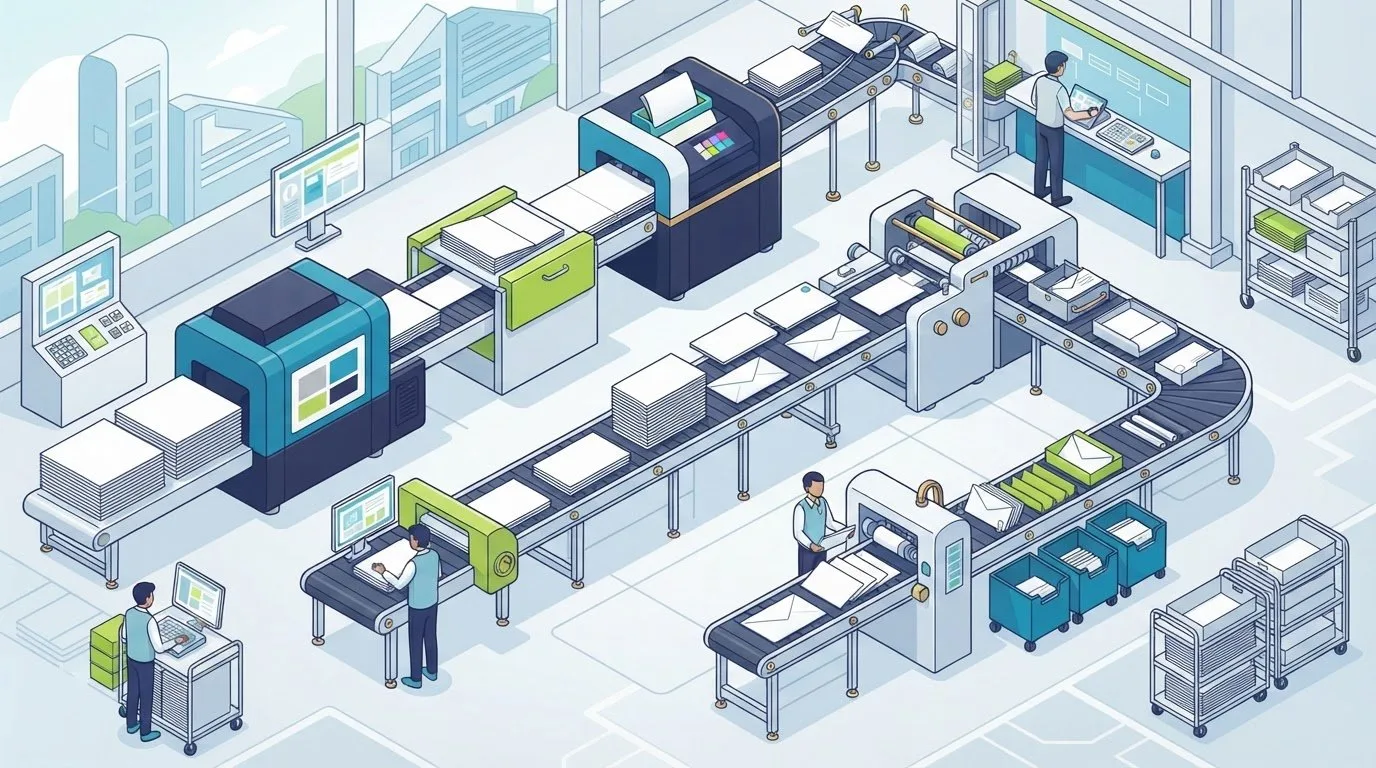
Lettershop Services in San Jose for Postcards, Letters and Mail
A polished mail piece depends on more than good design: each production step needs to work together. Lettershop services in San Jose can include printing and personalizing postcards, letters, and envelopes, then folding, addressing, inserting, and preparing them for mailing. The workflow connects the finished design to a properly assembled mail piece.
It’s easy to focus on the message and overlook the details that make a campaign ready to mail. Format, personalization, addressing, and assembly all affect how the job moves from print production to postal processing.
This guide explains what lettershop providers do, how machine and hand processing differ, and which project details influence the workflow and cost. You’ll also learn how to plan a mailing from print files and recipient data through final mail preparation, so you can make informed decisions about postcards, letters, and envelopes for your campaign.
Key Takeaways
- Match the postcard, letter, or envelope format to your campaign goals and the message you need to deliver.
- Understand how targeting, print choices, and mail preparation shape a direct mail workflow.
- See when machine processing suits a mailing and when hand assembly may better fit its requirements.
- Use variable data and digital printing to tailor mail pieces to different recipients or audiences.
- Plan folding, addressing, and inserting as connected steps to keep each mailing organized and ready for processing.
Postcard, letter, and envelope printing and mailing
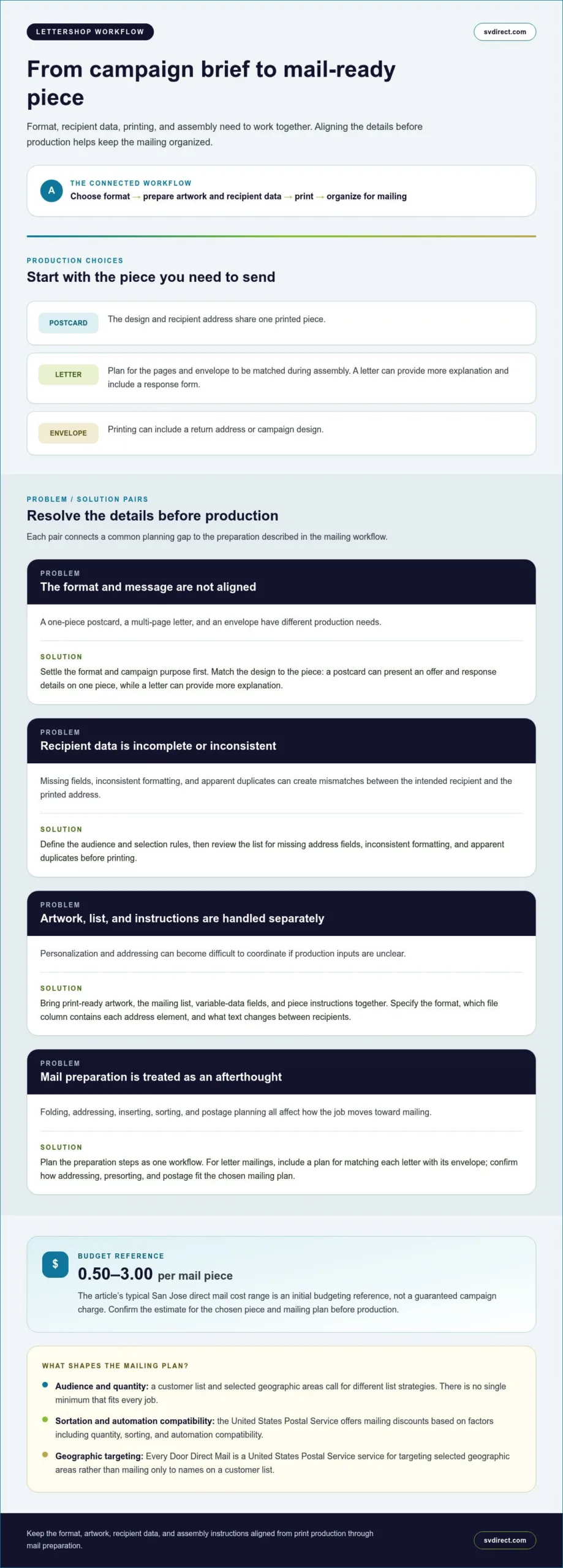
A mail campaign moves through connected steps: choose a format, prepare artwork and recipient data, print, then organize the pieces for mailing. The format, list quality, and postal sortation all affect how the job is prepared.
Mailpiece Printing and Mailing
For a postcard, the design and recipient address share one printed piece. A letter mailing adds pages and an envelope, so the workflow needs a plan for matching each letter with its envelope. Envelope printing can include a return address or campaign design. Before production, settle the format, artwork, personalization, mailing list, and intended delivery area.
Every Door Direct Mail is a United States Postal Service service for targeting geographic areas with marketing campaigns. It can suit a business that wants to reach households in selected areas rather than mail only to names on its customer list. The United States Postal Service offers mailing discounts based on factors such as quantity, sorting, and automation compatibility. These factors make list preparation and sortation part of the postage plan, not just back-office details.
Minimum Mailing Quantity
There is no single minimum that fits every mailing job. The practical threshold depends on the mailpiece format, processing method, list preparation, and postage approach. A short run of personalized letters has different production needs from a geographically targeted postcard campaign. Define the audience and piece first, then assess how quantity affects sorting and mailing.
Start compiling a mailing list by defining the audience, such as existing customers, a selected business segment, or addresses in chosen neighborhoods. A customer list gives the mailing team a starting point, while selection rules identify who should receive the piece. Address hygiene means reviewing data for missing fields, inconsistent formatting, and apparent duplicates before printing. Clean inputs help prevent mismatches between the intended recipient and the printed address.
Prepare a practical job package with print-ready artwork, the mailing list, any variable-data fields, and instructions for the piece. Specify the format, such as a postcard or letter, and explain how recipient details should appear. For example, identify which file column contains each address element and which text changes between recipients. Agreeing on these inputs before printing helps keep personalization, addressing, and assembly aligned.
For San Jose businesses coordinating direct mail with broader regional logistics, Silicon Valley fulfillment and logistics services connect local operations with distribution needs.
For San Jose mailings, the typical direct mail company cost is 0.50 to 3.00 per mail piece. Use that range as an initial budgeting reference, not as a guaranteed charge for a particular campaign. The final estimate should be confirmed for the chosen piece and mailing plan before production begins. Keeping the format, artwork, recipient data, and assembly instructions settled gives the company a clearer basis for pricing the job. It also helps you compare estimates on a consistent scope: the same mailpiece, audience, and preparation requirements. Once the details are agreed, confirm what the estimate covers and how any changes to the quantity or job specifications would affect the total.
San Jose direct mail and lettershop providers
A direct mail campaign links audience selection, creative, production, and mailing preparation. In San Jose, define who should receive the piece and what response you want before planning those steps.
Presorting, Addressing, and Postage
A provider handles USPS presorting, addressing, and postage when those tasks are part of its mailing workflow. Presorting organizes mail according to the mailing plan, while addressing applies recipient information to each piece. Ask how these steps fit into production and how postage is prepared for the campaign. A postcard mailing to selected neighborhoods may need a different approach from named letters sent to customers.
Direct mail consulting can help align campaign goals with the audience, format, and production choices. The review should account for the selected mailpiece and the information printed on it. For example, confirm that the address area, return information, and personalization fields fit the planned format. Keep the approved artwork and final mailing data together so production uses the same versions.
Provider Selection Criteria
Before hiring a San Jose lettershop, map the work you need from campaign design through mailing preparation. Check whether the workflow covers audience targeting, artwork coordination, list processing, addressing, sortation, and postage handling. Ask for a clear sequence of steps and identify who approves the mailpiece and recipient data before production begins.
Turnkey direct mail campaigns bring these stages together in one coordinated project. They can include selecting an audience, preparing a design, printing, personalizing pieces, and organizing mail for dispatch. A campaign promoting an event might target households near its venue, while a customer announcement may use a supplied customer list. The audience informs the list strategy; the message guides design and format.
Design decisions should support the campaign’s purpose and the recipient’s next step. A postcard can present an offer and response details on one piece; a letter can provide more explanation and include a response form. Review the proof for readable text, accurate campaign details, and consistent branding. Then match the approved design to the mailing list and production instructions to reduce avoidable differences between the plan and the printed pieces.
For a coordinated project, bring the campaign objective, audience criteria, artwork, and mailing data together in one brief. A direct mail quote can help define the scope before production planning begins.
Machine and hand mail processing
After printing and addressing, mailpieces need to be assembled, checked, and prepared for mailing. The choice between machine and hand processing depends on the piece’s format, contents, and assembly steps. A uniform postcard mailing follows a different workflow from a letter package with several inserts. These differences affect how the work is organized before dispatch.
Machine processing suits mailings with consistent dimensions and repeatable tasks. Equipment can handle steps such as feeding, folding, inserting, sealing, and sorting when the pieces fit the planned workflow. For example, a batch of identical letters with one standard insert has predictable assembly. Alignment between the printed address and the mailpiece also matters, since the address must remain visible after folding or insertion.
Hand processing supports jobs that need individual attention during assembly. A package with varied inserts, unusual contents, or recipient-specific combinations may require workers to match components piece by piece. A staff member can follow instructions such as placing a particular brochure with a letter for a selected audience. Clear assembly notes help keep those combinations consistent across the mailing.
Before production, map the mailing into distinct operations. Identify which tasks repeat across every piece and which require a person to make a selection or inspect contents. Then group materials by the steps they share. For instance, sort the letters by insert type before assembly, and keep each group’s instructions with its materials. This makes the workflow easier to follow and helps catch mismatches before completed pieces are prepared for mailing.
Automation can sometimes reduce campaign processing to a few days, depending on the campaign. The relevant factors include how uniform the mailpieces are, how many assembly steps they require, and whether recipient data changes the contents. A straightforward run of standard pieces can move through repeatable machine steps. A mailing with mixed inserts or special handling needs may require manual work within the process.
Quality checks should match the specific task. For a machine-assembled letter, inspect samples for correct folding, insertion, and address visibility. For hand-assembled pieces, compare the contents against the assembly instructions and recipient group. If the job combines both methods, check the transition point: verify that the correct components reach the hand-assembly station after machine processing.
In San Jose, a useful production plan names each processing step, its inputs, and its inspection point. Confirm the final piece format, sequence of inserts, and addressing placement before the run begins. Those details help determine which operations can be automated and where hands-on handling fits best.
Variable data and digital printing
Variable data printing changes selected content across pieces within one mailing. A San Jose campaign can use the same design while tailoring names, offers, or images to recipient groups. Digital printing applies those changes during production, connecting the approved artwork with prepared data.
Start by deciding which elements vary and which remain fixed. For example, a community organization might keep its logo and event details consistent while changing the recipient name and neighborhood information. A retailer could use one postcard design with separate messages for new and returning customers. A clear content plan prevents changing fields from competing with the central message.
Prepare the data so each field has a defined purpose. A mailing file might contain a recipient name, postal address, audience category, and selected offer. Use consistent column labels and make sure each field maps to the intended place in the design. If “first name” supplies the greeting, identify that field explicitly rather than relying on ambiguous labels.
Audience segments help determine which version each recipient receives. A local event organizer, for instance, could create separate messages for residents near different venues. Each segment needs a clear selection rule and matching content. Keep the segment definition aligned with the campaign objective, so personalization supports a relevant message instead of adding decoration.
Review a proof before releasing the full job. Inspect examples representing each content variation, not only the standard version. Check names, addresses, offers, line breaks, and image choices in context. A long business name may wrap differently from a short one, while an empty field can leave awkward spacing. Correcting the data or layout at proof stage protects consistency across versions.
Digital printing can produce personalized pieces from a shared design and data file. On-demand digital printing is relevant when a campaign needs print production tied to current content or recipient information. A postcard with a personalized greeting and a group-specific offer is one practical example.
Keep production inputs organized: approved artwork, final data, field definitions, and version instructions. If the design has a fixed message plus personalized sections, label those areas clearly. When campaign details change, update the correct source file and review a new proof. This reduces the risk of mismatched copy and recipient data.
After approval, use a sample check to compare printed pieces against the intended versions. Confirm that the right name, message, and address appear together. For a campaign with multiple audience groups, check a sample from each group before mailing preparation. That final review connects data accuracy with the physical piece recipients will receive.
Lettershop folding, addressing, and inserting
Folding, addressing, and inserting turn printed pages into assembled mailpieces. The sequence depends on the format and contents. A single-page letter may need one fold and one envelope, while a multi-page packet needs its pages collated before folding. Define the finished piece first, then map each handling step to its components.
Choose a fold that fits both the page layout and envelope. A letter designed for a tri-fold must place its greeting, message, and response details where folds won’t obscure them. A half-fold may suit a program or announcement with a broad interior panel. Review a folded sample before production to confirm the intended panels appear in the right order.
Address placement needs to work with the folded piece and envelope. For a letter inserted into an envelope with a viewing window, align the recipient address so it shows clearly through the opening. For an envelope printed directly, compare the address area with the artwork and return information. Check a sample after folding and insertion, not just the flat page proof.
Insertion instructions should identify every component and its sequence. A customer letter might include a reply form and a separate information sheet. State which item goes first, which side faces outward, and whether all recipients receive the same contents. If different audience groups receive different inserts, label each group and its corresponding assembly instructions clearly.
Collation keeps pages and inserts together before they enter an envelope. For a two-page letter with an enclosure, confirm the pages stay in reading order and the enclosure accompanies the correct recipient’s letter. Use a consistent assembly plan for each version. Clear instructions reduce confusion when a mailing contains multiple letter variations or insert combinations.
Address data and physical pieces must stay matched throughout assembly. Organize recipient records in the same sequence as the corresponding variable letters or insert groups. Then inspect samples from each version. Compare the name on the letter with the envelope address, and verify the planned inserts are present. This check can catch a mismatch before completed mailpieces move forward.
Before the run, provide the final page files, envelope artwork, address data, and written assembly sequence. Identify the fold, envelope type, insert order, and any recipient-specific differences. A sample assembled from those materials gives the team a practical reference. Review it for correct folding, visible addressing, complete contents, and consistent orientation.
A final production check should follow the same sequence as the job. Confirm the page order, fold, address visibility, and insert contents on a completed sample. For a campaign with multiple versions, inspect one sample from every version before processing the full mailing. This keeps the approved instructions connected to the finished mailpiece.
Silicon Valley Direct: eCommerce Order Fulfillment
Silicon Valley Direct supports businesses with eCommerce Order Fulfillment and related print and distribution workflows. When a direct mail campaign connects with product orders, Warehousing and Distribution and Inventory Management can help coordinate inventory with fulfillment needs. On-Demand Digital Printing supports print projects that require variable or updated content.
This is a natural next step when your mailing is part of a broader customer or order experience, rather than a standalone campaign. For example, a business may coordinate printed materials with stored inventory and eCommerce orders through related operations. Choose the services that match your workflow and business needs.
Visit svdirect.com to learn more about Silicon Valley Direct’s services.
Set Your Next Mailing Up for Success
Make the next step a clear production brief. Define the campaign’s purpose, audience, desired response, and who will approve the final materials. This gives your team a practical starting point for turning a mailing idea into a project with clear decisions and responsibilities.
For lettershop services in San Jose, connect print decisions to the customer experience you want to create. A postcard, letter, or tailored mailpiece should encourage a deliberate next action, such as visiting a location, responding to an offer, or learning more. Clear goals keep creative and production choices focused.
Silicon Valley Direct can help you discuss how your mailing fits your broader business needs. Bring your campaign goals and project details to start a focused conversation.
A well-planned mailing starts with a useful decision. Take that step to move your next campaign forward with confidence.
Frequently Asked Questions
What lettershop services are available in San Jose, California?
Lettershop services in San Jose can include printing, personalization, addressing, folding, inserting, and mailing preparation. Direct mail marketing may also involve coordinating campaign materials with recipient data. For example, a nonprofit could prepare an event announcement for supporters, while a business could send product information to selected customers. The right workflow depends on the mailpiece, audience, and campaign objective.
Which San Jose lettershops offer mailing list rental, printing, and direct mail fulfillment?
Silicon Valley Direct offers Direct Mail Marketing, On-Demand Digital Printing, and Healthcare Mailing Services. These services can support campaign and print needs, including informational mail prepared by a healthcare organization for its audience. Mailing list rental is a separate audience-sourcing requirement, so account for it separately from printing and mailing tasks. Define the recipient group and the role of personalization before preparing production materials.
Which San Jose lettershops serve nearby cities in Santa Clara County?
Silicon Valley Direct serves customers nationally, supporting businesses with mailing and fulfillment needs that extend beyond one municipality. For a campaign reaching recipients across multiple communities, organize the mailing data by destination and keep each audience segment connected to its intended materials. A national service footprint can be useful when direct mail ties into inventory or eCommerce order fulfillment across multiple locations.
How do San Jose lettershops compare for turnaround time and service quality?
A direct mail campaign usually takes 2-3 weeks from design approval to mailing, while automation can sometimes reduce processing to a few days, depending on the campaign. Service quality can be assessed by checking samples for correct folding, insertion, address visibility, and contents matched to instructions.