



Direct Mail Marketing Services: The Strategic Guide to Physical Engagement in 2026
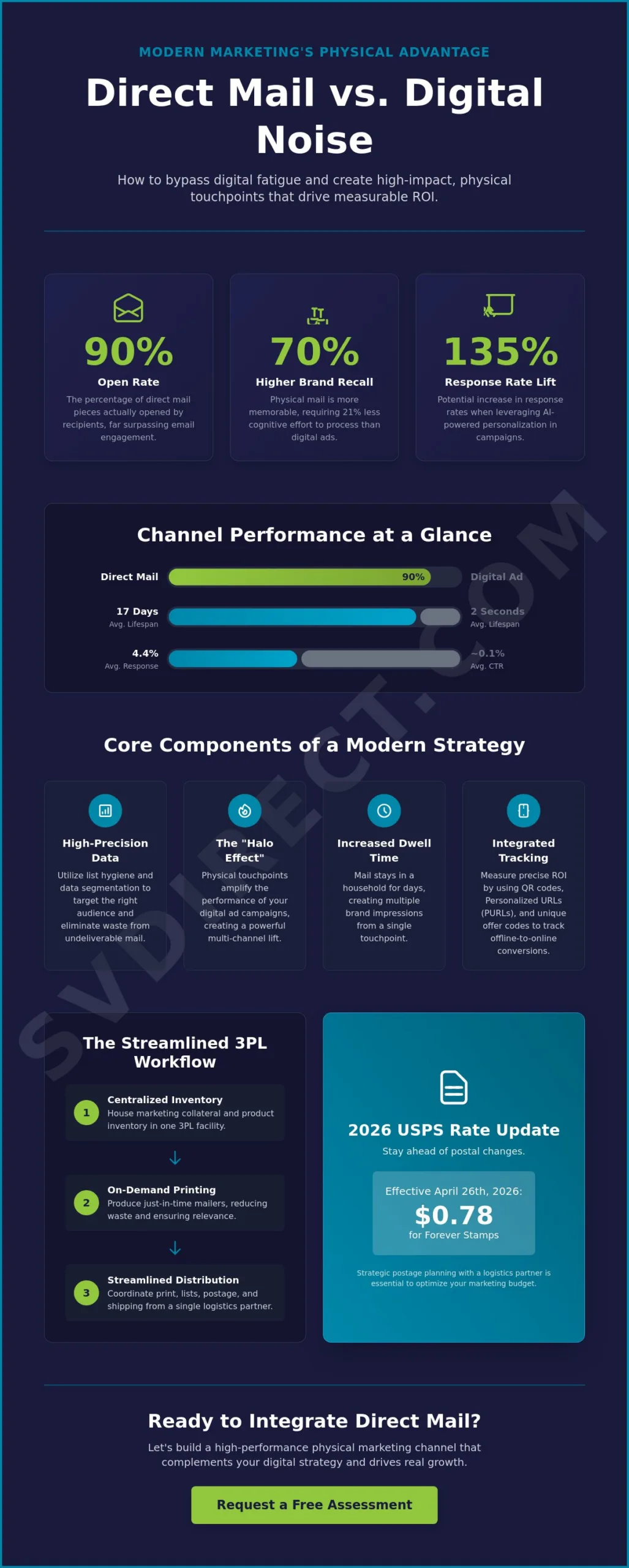
While digital inboxes are overflowing with ignored notifications, a staggering 90% of direct mail pieces are actually opened by recipients. You likely feel the pressure of rising customer acquisition costs on digital platforms where every click feels more expensive and less personal than the last. It’s frustrating to watch your marketing budget disappear into an overcrowded digital space without the engagement your brand deserves. This guide shows you how to leverage modern direct mail marketing services to bypass digital fatigue and create high-impact, physical touchpoints that drive measurable ROI.
By treating mail as a premium, data-integrated channel rather than a relic of the past, you can achieve response rates that significantly outperform email. We’ll explore the latest USPS rate shifts for 2026, including the April 26th increase to $0.78 for Forever stamps, and show you how AI-powered personalization can increase your response rates by up to 135%. We’ll also examine how a strategic logistics partner handles the complex coordination of print, lists, and postage so you can focus on scaling your growth.
Key Takeaways
- Learn why modern direct mail marketing services act as a precision tool for multi-channel engagement rather than a standalone broadcast.
- Discover how on-demand digital printing allows for just-in-time production, reducing waste and ensuring your message remains relevant.
- Understand the “Halo Effect” and how physical touchpoints amplify the performance of your existing digital advertising campaigns.
- Explore the operational advantages of housing your marketing collateral and inventory within a single, centralized 3PL facility to streamline distribution.
- Master high-precision data segmentation to transform your mailing list into a valuable asset for both customer acquisition and retention.
The Resurgence of Direct Mail Marketing Services in a Digital-First 2026
Modern direct mail marketing services represent a sophisticated, integrated physical communication strategy that bridges the gap between digital discovery and tangible brand experience. In a year where digital noise has reached its peak, high-performance brands are returning to the mailbox to secure the attention they can’t buy on a screen. If we examine the history of direct mail, it’s clear the industry has evolved from broad, impersonal broadcasts into a data-driven science. This renaissance is fueled by the psychology of touch; physical mail generates 70% higher brand recall because it requires 21% less cognitive effort to process than digital advertisements.
To better understand how to modernize your approach and drive these results, watch this helpful video:
Physicality builds a level of trust that pixels simply cannot match. While a digital ad disappears the moment a user scrolls past, a physical mailer possesses “dwell time,” often staying in a household for several days. This persistence turns a single piece of mail into a recurring brand impression, acting as a strategic bridge that guides a customer from an initial online search to a final, confident conversion.
Bypassing the Digital Noise
An average marketing email survives for only a few seconds before it’s archived or ignored. In contrast, a high-quality postcard or catalog has a lifespan measured in days. This shift from bulk “junk” to high-value, personalized collateral is a direct response to widespread digital fatigue. Because physical mail doesn’t require an internet connection or a screen, it has become the unblockable inbox for 2026, ensuring your message is seen without competing against a dozen browser tabs or notification banners.
The ROI of Physical Engagement
The financial case for physical engagement is stronger than ever. While digital display ads struggle with ad-blockers and declining click-through rates, direct mail marketing services deliver an average response rate of 4.4%. This performance is especially vital for high-LTV customer acquisition, where the cost of a physical piece is balanced by the long-term loyalty it builds. By integrating these services into your attribution models, you can see exactly how a physical touchpoint influences an online purchase. For more insights on scaling these complex operations through integrated logistics, you can explore our latest updates on the SV Direct blog.
Core Components of a Modern Direct Mail Strategy
Execution in 2026 requires a shift from bulk distribution to precision engineering. Direct mail marketing services succeed or fail based on the quality of the underlying data. Your mailing list isn’t just a collection of addresses; it’s a dynamic asset that requires constant maintenance to remain effective. Modern strategies prioritize list hygiene to eliminate undeliverable-as-addressed (UAA) mail, which prevents wasted postage and production costs. The U.S. Small Business Administration has highlighted the effectiveness of direct mail when compared to the volatility of digital ad algorithms, particularly for businesses that value long-term customer relationships.
To maximize your return, you must optimize postage by choosing between First Class and Marketing Mail rates. First Class offers speed and return-to-sender services, while Marketing Mail provides significant cost savings for high-volume campaigns. Tracking these investments is no longer a guessing game. By integrating QR codes, Personalized URLs (PURLs), and unique offer codes, you can monitor exactly when a recipient moves from their mailbox to your digital checkout. If you’re ready to see how these components fit your specific business goals, you can request a tailored project assessment.
Targeting and List Management
Precision targeting involves choosing the right tool for the job. Every Door Direct Mail (EDDM) is ideal for local saturation, but targeted mailing lists allow for deeper segmentation. You can now use CRM data to trigger physical mailers based on digital behavior, such as a high-value cart abandonment or a specific milestone in the customer lifecycle. Verifying your data before printing ensures your message reaches the right hands every time.
Personalization through Variable Data Printing (VDP)
Modern printing has moved beyond static templates. Variable Data Printing (VDP) allows you to customize imagery, offers, and text for every individual recipient within a single print run. This level of personalization significantly boosts response rates because the content feels bespoke rather than mass-produced. To understand how to fully leverage your first-party data for maximum impact, our strategic guide to personalized direct mail and boosting response rates walks through the mechanics of transforming CRM insights into high-performing physical campaigns. Silicon Valley Direct integrates these digital printing capabilities directly into our fulfillment workflows, ensuring that every personalized piece is accurate and high-quality.
Secure and Healthcare-Specific Mailing
Regulated industries face unique challenges that standard printers aren’t equipped to handle. Handling sensitive information requires more than just a printer; it demands a partner with a deep understanding of Healthcare Mailing Services and the protocols necessary to maintain HIPAA compliance. We treat sensitive data with the highest level of security, ensuring that medical and healthcare marketing reaches patients safely and accurately. This commitment to precision bridges the gap between mechanical operations and the high-stakes needs of the healthcare sector.
Direct Mail vs. Digital Advertising: Finding the Strategic Balance
The relationship between digital ads and physical mail is often framed as a competition, but the most successful brands treat them as a unified force. This synergy, often called the “Halo Effect,” occurs when a physical touchpoint reinforces a digital message, leading to higher trust and better conversion rates. Insights from the U.S. Small Business Administration on the resurgence of direct mail confirm that consumers often find physical mail more trustworthy than digital-only communications. By utilizing direct mail marketing services alongside your social and search campaigns, you create a multi-dimensional brand presence that is harder to ignore.
When analyzing cost-per-acquisition (CPA), it’s easy to focus solely on the initial postage and printing costs. However, a deeper look at the data reveals that direct mail often produces a higher quality lead with a better lifetime value. While a digital click might cost pennies, it often results in a quick bounce. A physical mailer requires a higher upfront investment but delivers engagement that significantly stabilizes your acquisition costs in an increasingly expensive digital auction. By using sustainable paper and highly targeted distribution, you reduce waste and ensure your materials only reach those most likely to engage, improving both your environmental footprint and your bottom line.
The Omni-Channel Workflow
Strategic integration starts with your digital data. You can set up automated triggers that send a physical postcard to a website visitor who spent significant time on a specific product page but didn’t complete a purchase. This retargeting strategy “warms up” the audience, making the physical mailer feel like a timely, relevant follow-up rather than a random intrusion. You can also use direct mail marketing services to re-engage “lapsed” digital customers who have stopped opening your emails. A physical piece of mail bypasses the spam folder and puts your brand back in their hands, literally. You can find more strategies for merging these channels on our latest blog updates.
Measuring Success in a Physical World
Success in direct mail isn’t just about how many pieces you send; it’s about how you measure the response. We recommend setting up tracking dashboards that combine digital metrics with physical response data. This allows you to see the full journey of a customer who received a mailer and later converted on your website. A/B testing is equally critical. By testing different layouts, offers, and even paper weights, you can refine your approach based on what resonates with your specific audience. This methodical process ensures that your marketing budget is spent on proven strategies that drive long-term brand recall and measurable ROI.
Building a Streamlined Direct Mail Workflow
High-performance physical engagement isn’t the result of luck. It’s the byproduct of a methodical, five-step operational process. The workflow begins with strategic goal setting, where you must define whether your campaign focuses on customer acquisition or retention. This decision dictates your offer, your creative direction, and your budget allocation. Once your objectives are set, you move into data sourcing and segmentation. High-precision targeting ensures your message reaches the specific demographic most likely to respond, which protects your ROI from the start.
The middle stages of the workflow focus on high-impact design and production. Copywriting for physical formats requires a different psychological approach than digital ads; you’re writing for a tactile experience. On-demand digital printing provides the maximum flexibility needed for modern campaigns, allowing for smaller, more frequent batches that respond to real-time market shifts. Finally, the logistics phase involves sorting and batch delivery to carriers. Professional direct mail marketing services handle these technical complexities, ensuring your mail enters the USPS system in the most cost-effective manner. This is particularly vital following the April 26, 2026, postage increase that brought Forever stamps to $0.78.
From Design to Distribution
Effective design for physical formats follows the “3-second rule.” Your postcard or mailer must communicate its primary value proposition almost instantly to avoid being discarded. You can explore our detailed guide on Direct Mail Printing and Mailing to see how specific design choices impact delivery and engagement. Beyond standard postcards, kitting and assembly services can elevate a simple letter into a premium, multi-sensory experience that builds immediate brand authority. If you’re ready to build a more efficient physical outreach strategy, contact our team for a project review today.
Managing Bulk and Catalog Mailings
Large-scale distribution requires a higher level of operational rigor than a standard postcard drop. Strategic Catalog Order Fulfillment is essential for brands that manage extensive product lines and high-volume seasonal campaigns. Timely delivery is non-negotiable during peak marketing windows when carrier networks are under significant pressure. By utilizing integrated direct mail marketing services, you ensure that your catalogs are printed, sorted, and mailed according to a strict schedule that aligns with your broader digital promotions. This level of coordination removes the burden of logistics from your internal team, allowing you to focus on the creative strategy that drives growth.
Why Integrated 3PL Fulfillment is the Future of Direct Mail
The future of physical engagement lies in the consolidation of marketing and logistics. While many agencies treat direct mail as a standalone creative product, the most efficient brands in 2026 recognize it as a core component of their 3PL ecosystem. Housing your marketing collateral within the same facility as your inventory management system eliminates the friction of multi-vendor coordination. When your direct mail marketing services are integrated with your warehousing and distribution, you gain the ability to launch reactive, trigger-based campaigns that ship alongside your eCommerce orders or as high-precision standalone mailers.
A centralized Silicon Valley hub provides a strategic launchpad for global shipping and logistics, reducing transit times and postage waste. By keeping your collateral and inventory under one roof, you simplify the kitting and assembly process for premium mailers. This structural efficiency doesn’t just save time; it ensures that your brand’s physical touchpoints are as organized and data-driven as your digital ads. Transitioning from fragmented in-house mailing to a professional 3PL partner allows your team to focus on high-level strategy while we handle the messy physical logistics with precision. Before making that transition, it’s worth consulting a comprehensive 3PL checklist to vet your fulfillment partner and ensure they offer the scalability, transparency, and technology your campaigns demand.
The Silicon Valley Direct Advantage
Success in a tech-saturated market requires more than just automation; it requires personal oversight. We reject the “black box” approach of purely automated platforms that treat your brand like a line of code. Silicon Valley Direct offers a stable hand, grounded in over 25 years of operational history in the heart of the world’s most innovative region. Our secure warehousing supports your high-value marketing assets, ensuring they’re stored in a climate-controlled environment and ready for on-demand distribution. We believe in bespoke problem-solving, which is why we favor direct human connection over impersonal, automated interactions.
Next Steps for Your 2026 Campaign
To scale your physical outreach, you must first audit your current mailing costs and operational efficiency. Ask your potential partner how they handle data security and whether they can provide the flexibility of on-demand digital printing. It’s also vital to understand their carrier relationships and how they navigate the shifting USPS rate landscape. If you’re ready to move beyond “junk mail” and create high-impact physical touchpoints, you can consult with Silicon Valley Direct for a bespoke direct mail strategy. Our team is ready to help you navigate the complexities of 2026 with confidence and precision.
Mastering the Physical Touchpoint in a Digital World
Direct mail has evolved into a precision instrument that cuts through the noise of 2026. By aligning your physical outreach with a robust 3PL infrastructure, you don’t just send mail; you create a seamless extension of your brand’s digital presence. Success in this landscape requires a focus on high-precision data and the flexibility of on-demand printing to ensure your message arrives exactly when it’s needed most. This tactical shift allows you to reclaim the attention that digital channels often lose.
Silicon Valley Direct has been a steady hand in the direct mail marketing services industry since 1999. We combine the security of our Silicon Valley warehouse with a commitment to human-led customer support. We don’t hide behind automated bots because we know that growing a business requires personal oversight and seasoned expertise. If you’re ready to elevate your strategy and bypass digital fatigue, Partner with Silicon Valley Direct for precision direct mail services. Let’s turn your physical engagement into a measurable engine for sustainable growth.
Frequently Asked Questions
What is the average response rate for direct mail marketing services in 2026?
The average response rate for direct mail marketing services is 4.4%, which significantly outperforms the 0.12% typical of email. For businesses utilizing house lists of existing customers, these rates often climb to between 5% and 9%. This high engagement is driven by the fact that 90% of physical mail is opened, compared to the much lower engagement seen in digital inboxes.
How does Every Door Direct Mail (EDDM) differ from targeted direct mail?
Every Door Direct Mail is a geographic saturation tool that delivers a mailer to every address on a specific postal route. It’s highly effective for local businesses seeking broad awareness at a lower postage rate. Targeted direct mail uses specific consumer or business lists to reach individuals based on demographic or behavioral data, allowing for much higher precision and personalization.
Can I integrate my Shopify or WooCommerce data with direct mail services?
You can absolutely integrate your Shopify or WooCommerce data with modern direct mail marketing services. By using API connections or webhooks, you can set up automated triggers that send physical mailers based on specific customer actions. For example, a customer who abandons a high-value cart or reaches a loyalty milestone can automatically receive a personalized direct mail piece within days.
What makes a direct mail service HIPAA compliant?
HIPAA compliance in direct mail requires strict adherence to physical and digital security protocols to protect Protected Health Information (PHI). This includes secure data transfer, restricted access to production areas, and the signing of a Business Associate Agreement (BAA). A compliant partner ensures that sensitive medical communications are handled with the same level of care as the healthcare services themselves.
How much does it cost to start a direct mail campaign with a 3PL?
The cost of starting a campaign with a 3PL partner depends on several variables, including your total volume, the complexity of kitting, and current postage rates. Major factors include the choice between First-Class and Marketing Mail, as well as the level of personalization required through variable data printing. We recommend auditing your current mailing lists to reduce waste and optimize your total investment.
What are the best sizes and formats for high-impact direct mailers?
High-impact direct mailers often utilize 6×9 or 6×11 postcards to stand out in the mailbox without the higher costs of a full envelope package. For brands with extensive product lines, catalogs remain a powerful format for driving long-term engagement and high brand recall. The best choice depends on whether your goal is a quick promotional touchpoint or a deeper brand exploration.
How do you track the ROI of a physical mail campaign?
Tracking ROI in a physical campaign is achieved through digital bridges like QR codes, Personalized URLs (PURLs), and unique coupon codes. These tools allow you to attribute a specific online conversion to a physical touchpoint in your CRM. By combining these metrics with traditional response data, you can calculate the total ROI that factors in both immediate sales and long-term brand recall.
Is direct mail still effective for B2B marketing?
Direct mail remains exceptionally effective for B2B marketing because it bypasses digital gatekeepers like spam filters and ad-blockers. In an era of AI-generated digital outreach, a high-quality physical piece builds immediate trust and credibility with decision-makers. B2B campaigns often see higher engagement because the tangible nature of the mailer provides a professional experience that digital ads can’t replicate.