img not found!
Healthcare Document Management and Mailing Guide 2026

Healthcare Document Management and Mailing Guide 2026

What if a mailing error started well before a document reached the printer? In healthcare, disconnected files, recipient data, personalization, and mail preparation can create handoffs where mistakes are harder to catch and responsibilities are less clear. Reliable healthcare document management and mailing depends on coordinating the full workflow, not just getting pieces into the mail.

Accuracy and patient trust matter, but evaluating a mailing partner also means understanding who owns each step, how you’ll see progress, and how issues will be resolved. This guide walks through the process from approved files and data to printing, preparation, mailing, and fulfillment. It also explains how to compare providers based on practical controls, visibility, and fit with your workflow.

You’ll find the key requirements to clarify before requesting a scoped proposal, including how recipient data is handled, how personalized documents are checked, and what reporting or tracking is available. With a clear view of the workflow and its ownership, you can ask specific questions and assess whether a potential partner can support your needs.

Key Takeaways

  • See how healthcare document management and mailing connects approved files, recipient data, production, mail preparation, and delivery.
  • Use an adaptable workflow to clarify approvals, data validation, inspection, dispatch, and who owns each handoff.
  • Compare providers by workflow scope, data handling, quality checks, visibility, and how they manage exceptions.
  • Prepare a checklist of document types, volumes, personalization needs, schedules, approval owners, and reporting requirements before requesting proposals.
  • Compare internal coordination with outsourcing selected production steps, while keeping client oversight and process ownership clear.

Healthcare document management and mailing: what the workflow includes

Healthcare document management and mailing coordinates document data, production, mail preparation, and delivery as a connected workflow. It may include approved files, recipient data, production steps, and records that help teams understand what was prepared and where handoffs occur. Because the scope varies by organization and project, define the process instead of assuming what a service includes.

This work sits within the broader field of Health information management (HIM), which encompasses the management of health information. A mailing service may handle specific production and dispatch tasks. A connected workflow coordinates the transitions between approved content, data, printing, and mail preparation, with clear responsibility at each step.

Which healthcare communications may enter a mailing workflow?

Patient communications, statements, forms, and educational materials may each follow a different path. For billing statements generated through upstream billing workflows, providers often rely on revenue cycle specialists like Meridian RCM to handle claims management before data is exported for mailing. Treat every document type as its own workflow. Identify its approved content, intended audience, data source, and required production steps. This keeps the scope clear and separates document production from clinical content creation, medical advice, or healthcare software.

Where document management ends and mailing operations begin

The production handoff typically begins when approved files and recipient data are ready for print. From there, operational steps may include printing, addressing, label generation, insertion, tabbing, and dispatch. Confirm who owns each handoff, what files or information they need, and how completion or exceptions will be communicated.

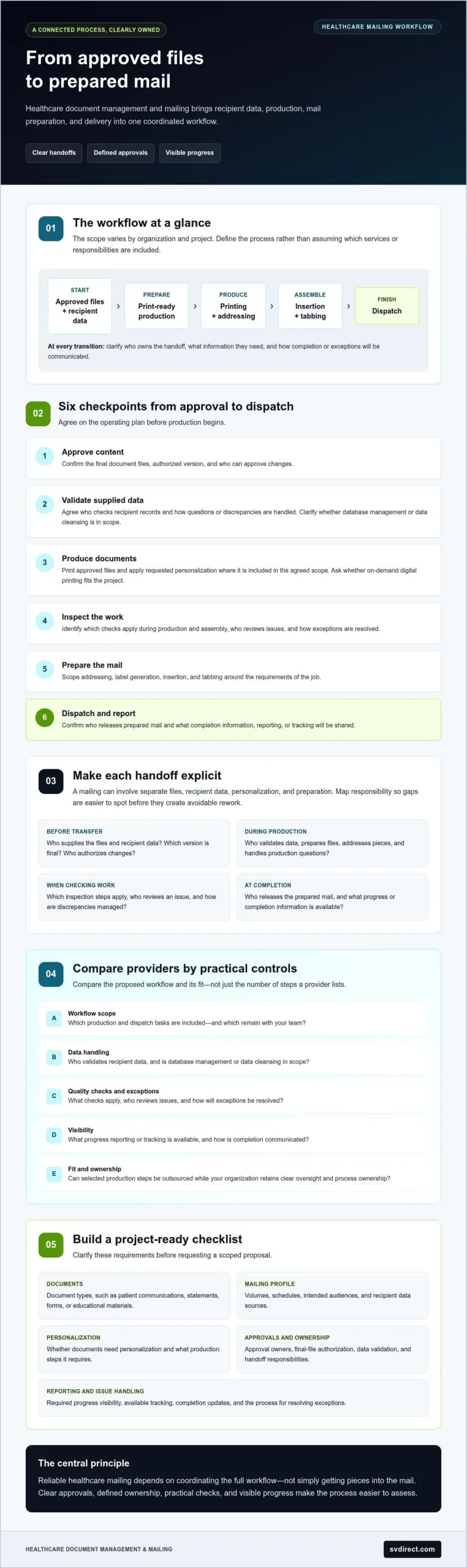
Workflow at a glance:

Approved files and recipient data → Print-ready production → Printing and addressing → Insertion and tabbing → Dispatch

For example, a team might approve a statement file and its recipient data, then transfer both for production. Before work begins, agree who validates the supplied data, who prepares the files, and who handles addressing and insertion. This ownership map can expose gaps before they lead to avoidable rework.

Silicon Valley Direct documents capabilities including digital and variable data printing, addressing, label generation, insertion, and tabbing, alongside healthcare mailing services. Its online order management page describes order placement and progress tracking. Confirm which functions apply to the healthcare mailing workflow you’re considering. The useful measure is not how many steps a provider lists, but whether the proposed workflow and responsibilities fit the documents being mailed.

How healthcare documents move from approved data to prepared mail

A dependable production flow starts with clear approvals, not with a print run. Before transferring files or recipient data, agree who supplies them, who reviews them, which version is final, and who can authorize changes. Define who handles data validation, production questions, and exceptions. These decisions give the healthcare organization and service provider a shared operating plan.

Prepare approved files and recipient data

Confirm that document content and mailing data are ready for the intended production process. Ask whether database management or data cleansing is included in the project scope, and clarify what each party will review. If the workflow needs printed materials produced as required, ask whether on-demand digital printing fits the project.

Coordinate printing, inspection, and mail preparation

Map the production work in order. The sequence can vary by document and mailing, but this adaptable flow helps identify approvals and handoffs:

  • 1. Approve content: Confirm the final document files and authorized version.
  • 2. Validate supplied data: Agree who checks recipient records and how questions or discrepancies are handled.
  • 3. Produce: Print the approved files, applying personalization where requested and included in the scope.
  • 4. Inspect: Identify the checks that apply during production and assembly, and who reviews any issue.
  • 5. Prepare: Scope addressing, labeling, insertion, and tabbing based on the job’s requirements.
  • 6. Dispatch: Confirm who releases prepared mail and what completion information will be shared.

Variable data printing places different copy or images on individual printed sheets to support personalized mailings. It can tailor a communication to its recipient, provided the data, content, and personalization rules have been approved for the project.

Silicon Valley Direct documents digital and variable data printing, addressing, label generation, machine insertion, and tabbing. Its QC-Check process provides systematic inspection during assembly. Treat this as a documented assembly process, not a guarantee of accuracy across every mailing step. Confirm which checks apply to your job, where they occur, and how exceptions are raised. The American Health Information Management Association (AHIMA) offers broader professional context on health information management and the document lifecycle.

A practical next step is to record the file owner, data reviewer, approval authority, and provider contact for each handoff. When defining the project scope, you can request a quote for healthcare mailing services and outline the workflow requirements for discussion.

How to compare healthcare document management and mailing providers

Compare providers against your actual workflow, not a broad list of capabilities. Ask what each provider performs, what your team retains, and how information moves between steps. For healthcare document management and mailing, fit depends on clear ownership, documented processes, and visibility into exceptions, not simply the number of services listed in a proposal.

Use this comparison framework to guide conversations. Record what a provider can document now and what needs to be confirmed for your project.

Evaluation area

Questions to ask

What to verify

Workflow scope

Which steps are included, from receiving approved files to dispatch?

Documented capabilities and any out-of-scope handoffs.

Data handling

How are files and recipient data received, validated, accessed, retained, and disposed of?

Project-specific procedures and substantiation for any privacy, security, or compliance statements.

Quality checks

What inspections and approval checkpoints occur, and how are exceptions handled?

The steps actually covered by the documented checks.

Visibility

Which milestones, records, and reports can your team access?

Availability and relevance of each tracking or reporting function for this workflow.

Accountability and integration

Who owns each handoff, and how would the process connect with your existing systems or procedures?

Named contacts, escalation steps, and any proposed integration details in writing.

What to ask about data handling and quality checks

Request a clear description of how files and recipient data move through the provider’s process. Ask who can access them, how long they are retained, and how they are disposed of. Ask the provider to substantiate each privacy, security, or compliance statement and specify which controls apply to your project. A general assurance is not a substitute for written, project-specific detail.

What to ask about tracking and accountability

Identify which order milestones, order histories, inventory visibility, and standard reports are available, then confirm which apply to healthcare mailings. Silicon Valley Direct’s online order management visibility includes order placement and progress tracking. Confirm whether these functions apply to your project and who responds when an order encounters an exception.

Assess service integration carefully. A provider may coordinate several production steps, but don’t assume it can connect to a particular platform or accept a specific data format without confirmation. Ask the provider to explain how its proposed process would fit your existing procedures and what information it needs from your team.
Healthcare Document Management and Mailing Guide 2026

Build a healthcare mailing checklist around your documents and process

A clear project brief helps turn healthcare document management and mailing requirements into a workflow a provider can scope. Start with the documents and decisions involved, then record owners, handoffs, and open questions. This makes proposals easier to assess and helps prevent important requirements from surfacing only after production planning begins.

Define the project scope before requesting proposals

For each document type, capture its format, approximate volume, recipient-data source, mailing frequency, personalization needs, and required production steps. Note whether print on demand, variable data printing, or recurring fulfillment may be relevant. Separate confirmed requirements from items that need review by your organization’s legal, privacy, or security stakeholders. Confirm project-specific privacy and security expectations with qualified internal stakeholders instead of making assumptions.

Project checklist

  • Document types and file formats
  • Volumes and mailing schedule or frequency
  • Recipient-data source and validation owner
  • Personalization requirements and approved content
  • Production steps needed, such as printing, addressing, insertion, or tabbing
  • Approval owners and points where files or data change hands
  • Privacy and security questions assigned for internal review
  • Exception contacts and preferred method for raising issues
  • Order status updates, records, and reports decision-makers need

Make the checklist specific. “Personalized statement” is less useful than noting which fields or content vary, who approves those variations, and what source supplies the data. Also distinguish a recurring schedule from a one-time mailing so providers can respond to the actual workflow rather than a broad description.

Set expectations for exceptions and reporting

Before seeking proposals, agree how incomplete files, data questions, or production concerns should be raised and resolved. Name the client-side decision-maker and provider contact for each type of issue. Specify the order-status updates and reports your team needs, then ask providers to confirm what they can provide for the project. Clear expectations make accountability easier to assess.

Use the completed checklist as a working brief. It doesn’t replace internal review. Instead, it gives your team and prospective provider a shared starting point for clarifying scope, responsibilities, and open questions.

When a connected healthcare document and mailing partner makes sense

Keeping print and mailing in-house can offer direct control, but it also means assigning staff, capacity, and expertise to each step. A partner may suit your operation when several teams coordinate recurring production or when specific capabilities are difficult to manage internally. Compare both approaches using the same criteria: who controls approvals, whether capacity matches the schedule, what expertise the workflow requires, and how clearly you can see progress.

Outsourcing selected production steps can bring printing, addressing, insertion, or other mailing tasks into a more coordinated workflow. It doesn’t transfer ownership of approved content, recipient data, or organizational decisions. Your team still needs to oversee requirements, approve the work, and clarify who will address questions or exceptions.

Signs your team may benefit from connected support

Consider outside support if recurring print, data, and mailing work passes between multiple internal groups, or if your current capacity doesn’t match the production schedule. Then assess the specific need: Would variable data printing support approved personalized communications? Is print on demand a fit? Do the mailing steps require capabilities your team doesn’t maintain? These questions help define a useful scope without assuming that outsourcing automatically reduces costs, prevents errors, or ensures compliance.

What to include in a first conversation with Silicon Valley Direct

Bring representative document examples, expected workflow steps, volume and schedule estimates, audience-data responsibilities, and questions about status reporting. Ask which steps Silicon Valley Direct can support through its healthcare document management and mailing, digital and variable data printing, database management, and fulfillment services. Confirm what remains client-owned and which capabilities or claims need project-specific verification, including any privacy, security, or compliance statements.

Use the conversation to assess fit rather than assume every service applies to every project. Discuss how approved files and data would move through the proposed workflow, which milestones you need to see, and who would be your point of contact for production questions. If online order placement or progress tracking is relevant, confirm whether those Remote Control functions are available for the healthcare document management and mailing workflow you’re discussing.

A well-scoped conversation gives both teams a clearer basis for defining responsibilities and a proposal. If your requirements are ready to discuss, request a free quote and scope your healthcare document management and mailing needs with Silicon Valley Direct.

Make your next healthcare mailing easier to scope

A reliable healthcare document management and mailing workflow starts with clear ownership, approved files, and recipient data that’s ready for production. Map each handoff, then evaluate providers on the services they document, the checks they perform, the visibility they offer, and how they handle exceptions. A practical project checklist helps your team turn those priorities into specific questions before work begins.

Silicon Valley Direct provides printing, mailing, and fulfillment services, including documented digital printing, variable data printing, and mail preparation capabilities. Remote Control supports online order placement and progress tracking. Confirm which functions apply to your healthcare project. The right next step is a conversation about your documents, workflow, and responsibilities, with project-specific details clearly confirmed.

With the scope in focus and the right people involved, you can move forward with greater clarity and confidence.

Frequently Asked Questions

What does healthcare document management and mailing include?

Healthcare document management and mailing can coordinate approved document files, recipient data, printing, addressing, insertion, and mail preparation for dispatch. The scope depends on the organization and project. Before work begins, establish who approves content, validates data, handles exceptions, and owns each handoff. Ask the provider to confirm its responsibilities in writing so the project scope is clear, rather than relying on a broad service label.

Is healthcare document management the same as healthcare mailing?

No. Healthcare mailing focuses on producing and preparing physical communications for dispatch. Document management can also include file approval, data coordination, version control, and process records. The services may overlap, but their boundaries vary by project. Ask the provider to map which tasks it performs and which stay with your organization. Be especially clear about who manages data handling, approvals, and exception resolution.

Can a mailing provider personalize healthcare documents?

Yes. Variable data printing can place different copy or images on individual printed sheets, which may support personalized mailings. Whether it fits a particular healthcare communication depends on approved content, accurate recipient data, and your organization’s requirements. Before adding personalization, confirm who prepares and reviews the files, how data is handled, and which quality checks apply. Define these responsibilities with the provider before production begins.

How do I evaluate a healthcare document mailing provider?

Compare providers on the workflow they can support, file and data handoffs, documented quality checks, exception communication, reporting, and project-specific security requirements. Ask who owns each step and what order visibility is available. Have qualified internal stakeholders review and substantiate any privacy, security, or compliance statements. Focus on documented capabilities and operational fit, not broad assurances that don’t explain how the provider’s process applies to your project.

What information should I prepare before requesting a healthcare mailing quote?

Prepare the document types, project scope, required production steps, mailing frequency, personalization needs, and approval owners. Note who supplies and validates recipient data, what reporting your team needs, and how exceptions should be raised. Don’t send sensitive information until the provider has confirmed appropriate intake procedures for the project. A clear brief helps the provider identify which services may fit and which questions need further review.

What happens if recipient data or print files contain errors?

Agree in advance how the workflow handles incomplete files, data issues, and production questions. Clarify who can pause or approve production, how corrections are recorded, and which client and provider contacts should be notified. Ask what checks the provider performs on supplied materials and what those checks cover. Don’t assume a provider’s review replaces your organization’s own data validation or approval process.

Does Remote Control provide visibility into healthcare mailing orders?

Silicon Valley Direct describes Remote Control as providing online order placement, progress tracking, order histories, inventory visibility, and standard reports. Confirm which features apply to your proposed healthcare mailing workflow. Ask which order milestones and records users can access, what reporting is relevant to the project, and how access is arranged. This helps your team understand what visibility is available without assuming every feature applies to every mailing.

HIPAA Compliant Mailing Services: The 2026 Strategic Guide to Secure Healthcare Fulfillment

HIPAA Compliant Mailing Services: The 2026 Strategic Guide to Secure Healthcare Fulfillment

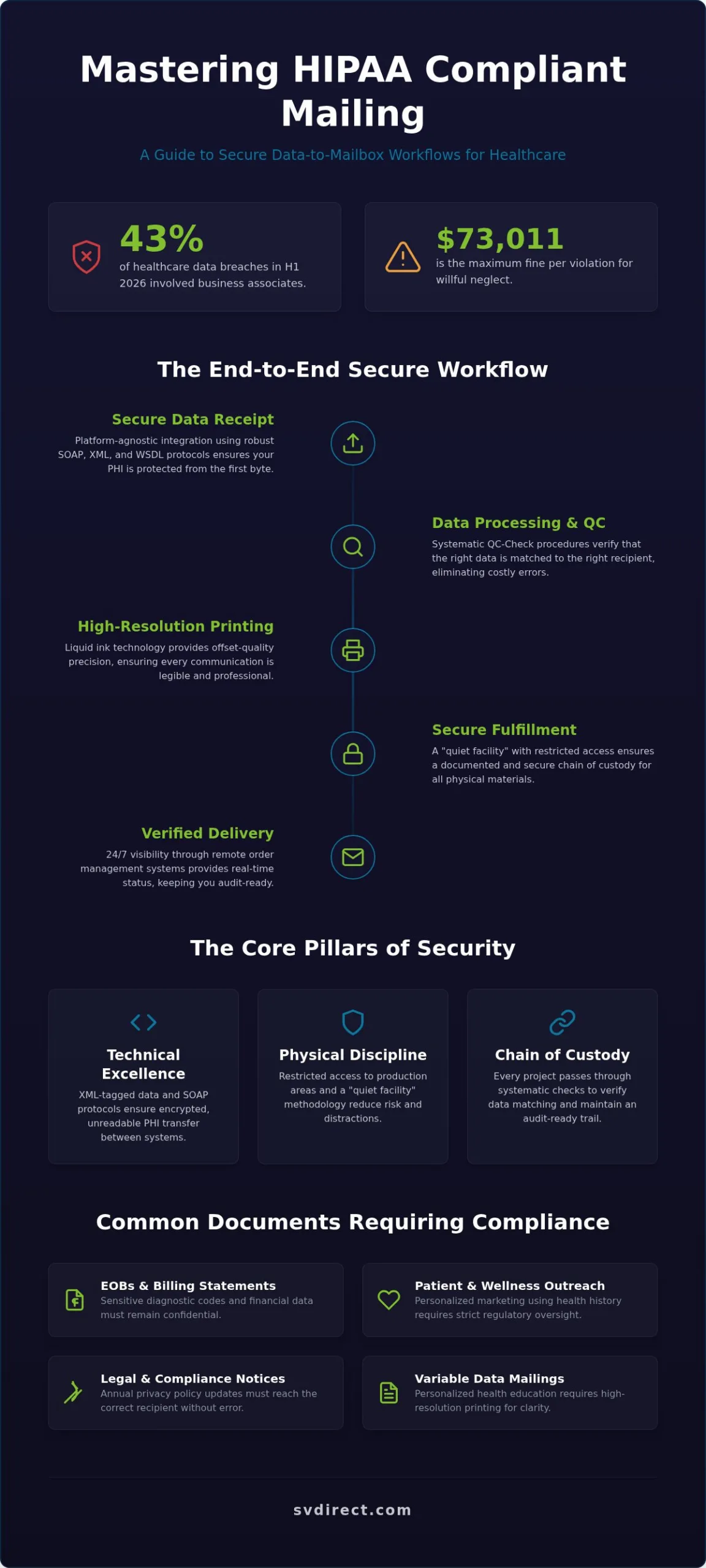
Did you know that in the first half of 2026, business associates were involved in 43% of all reported healthcare data breaches? This staggering figure highlights why choosing the right partner for HIPAA compliant mailing services is no longer just a logistical choice; it’s a critical defensive strategy for your brand’s reputation and financial health.

You’ve likely felt the mounting pressure of rising federal fines, which now reach up to $73,011 per violation for willful neglect. It’s exhausting to balance the need for high-resolution, personalized patient communications with the constant fear that a single data leak or a misfiled envelope could trigger a multi-million dollar audit. We understand that you need a steady hand to manage these risks without sacrificing the quality of your outreach.

This guide will show you how to master the complexities of secure printing and mailing while achieving offset-quality precision that reflects the excellence of your healthcare brand. We’ll explore how to integrate a seamless data-to-mailbox workflow, leverage real-time inventory visibility through advanced tracking, and maintain a rigorous chain of custody that keeps your organization audit-ready at every turn.

Key Takeaways

  • Learn how to evaluate HIPAA compliant mailing services based on their ability to secure Protected Health Information from the moment of digital receipt through to final delivery.
  • Discover how platform-agnostic technical integrations like XML and SOAP protocols eliminate custom coding and streamline your data-to-mailbox workflow.
  • Understand the critical link between high-resolution print quality and compliance, using liquid ink technology to ensure every patient communication is legible and professional.
  • Master the onboarding process by moving from a discovery phase to a mapped implementation that aligns with your specific regulatory and branding goals.
  • Gain 24/7 visibility into your inventory and mailing status using proprietary reporting systems that keep your organization audit-ready at all times.

What Are HIPAA Compliant Mailing Services?

HIPAA compliant mailing services represent the specialized intersection of high-security data management and precision physical fulfillment. At its core, this service ensures the secure handling of Protected Health Information (PHI) across every touchpoint, from the initial digital receipt of a patient file to the moment a physical envelope reaches a mailbox. This isn’t a mere transactional exchange; it’s a rigorous adherence to the Health Insurance Portability and Accountability Act (HIPAA). For healthcare organizations, these services act as a vital safeguard against the staggering financial and reputational risks associated with data breaches.

A professional 3PL partner doesn’t just print and mail; they operate as a seamless extension of your internal team. This partnership model is essential for mitigating the risk of expensive federal violations. With inflation-adjusted fines in 2026 reaching $73,011 for a single instance of willful neglect, the stakes have never been higher. By utilizing a provider that prioritizes a “make-it-right” attitude and proactive oversight, healthcare brands can focus on patient care while their communications remain secure and compliant.

Common Healthcare Documents Requiring HIPAA Compliance

Any document containing PHI requires a secure chain of custody. Precision is mandatory. Common materials include:

  • Explanation of Benefits (EOB) and billing statements: These documents often contain sensitive diagnostic codes and financial data that must remain confidential.
  • Patient acquisition and wellness outreach: Marketing materials that utilize demographic data or health history to personalize messages fall under strict regulatory oversight.
  • Legal and compliance notices: Annual privacy policy updates and required regulatory disclosures must reach the correct recipient without error.
  • Variable data mailings: Personalized healthcare education and post-visit instructions require high-resolution printing to ensure clarity and accuracy.

The Core Pillars of Secure Medical Mailing

True security is built on a foundation of technical excellence and physical discipline. It starts with data encryption during transfer, utilizing robust SOAP and XML protocols to ensure information remains unreadable to unauthorized parties. Within the facility, security must be absolute. This includes restricted access to production areas and a “quiet facility” methodology that reduces distractions during high-volume deadlines.

Finally, a documented chain of custody is non-negotiable. Every project should pass through systematic QC-Check procedures to verify that the right data is matched to the right recipient. When combined with remote order management systems, these pillars provide the 24/7 transparency needed to stay audit-ready in a high-stakes industry.

Data Security and Technical Integration for Healthcare

Modern healthcare fulfillment requires a digital infrastructure that is as robust as its physical counterpart. To achieve true security, HIPAA compliant mailing services must employ platform-agnostic integration. This allows for seamless communication between disparate health systems without the friction of custom coding. By utilizing Web Services (WSDL), your internal IT team can connect directly to a fulfillment partner’s production environment. This ensures that Protected Health Information (PHI) is handled with surgical precision, reducing the manual overhead that often leads to data entry errors.

XML and SOAP: The Standards for Secure Data Transfer

Technical rigor is the first line of defense in patient data protection. XML-tagged data acts as a universal language, maintaining the integrity of complex patient records across different databases. While XML structures the information, SOAP provides the secure envelope for its journey. It transfers sensitive PHI across standard internet protocols safely, ensuring that data remains encrypted and unreadable to unauthorized parties. This level of protection is mandatory because fulfillment providers operate as HIPAA Business Associates. They are legally bound to protect your data with the same intensity as your own organization. To ensure accuracy before a large mailing begins, developers can use a dedicated system testing page to verify transaction data in real time.

24/7 Transparency with Remote Order Management

Transparency should not end once a file is transmitted. Real-time visibility is the antidote to compliance anxiety. A proprietary online management system like “Remote Control” provides 24/7 access to your inventory and mailing status. Through specific methods like ‘AddOrder’ and ‘GetOrderInfo’, transactions are processed as they happen. This allows your team to retrieve order status and shipping activity summaries programmatically, ensuring you maintain an audit-ready posture for any sudden compliance reviews.

Having access to over 120 standard reports means you are never in the dark about the location or status of sensitive communications. Learn more about our Remote Order Management system to see how this level of visibility can stabilize your operations. If you’re ready to modernize your patient outreach with a partner that values technical precision, you can request a free quote to discuss your specific integration requirements.

The Physical Advantage: Print Quality and Accuracy

In the healthcare industry, print quality is a matter of safety and regulatory compliance. When patient instructions or billing details are blurry or smudged, the risk of misinterpretation increases. HIPAA compliant mailing services must prioritize legibility to ensure that every recipient can clearly read sensitive information. High-resolution printing isn’t just about aesthetics; it’s about fulfilling the requirements of the HIPAA Privacy Rule by ensuring that Protected Health Information (PHI) is delivered accurately and professionally.

To achieve this, we utilize the HP Indigo 5500 Digital Press. Unlike standard laser printers that use dry toner, this technology employs real liquid ink. This distinction is critical for healthcare communications. Liquid ink binds to the paper fibers more effectively, resulting in offset-quality prints that won’t flake or smear. This ensures that every Explanation of Benefits (EOB) or clinical record remains pristine from the production floor to the patient’s doorstep. We operate at a 230 line screen resolution, providing sharp, detailed text and imagery that reflects the high standards of your healthcare brand.

Accuracy is further protected by our “Quiet Facility” methodology. Most fulfillment centers are hectic, loud environments where distractions lead to manual errors. We’ve intentionally designed an organized, focused atmosphere to ensure high-volume deadlines are met with surgical precision. This calm environment allows our team to maintain total focus on your project’s specific requirements, ensuring that the physical handling of PHI is as secure as the digital transfer.

Variable Data Digital Printing (VDP) for Personalization

Effective patient outreach requires personalization, and Variable Data Printing (VDP) is the engine that drives it. VDP allows for unique copy, barcodes, and images on every single sheet in a print run. This ensures that each patient receives the exact information intended for them without the risk of data mismatching. There’s a common myth that this level of customization is prohibitively expensive. In reality, modern digital workflows mean VDP costs not much more than static, one-size-fits-all printing. Explore our Print on Demand and VDP capabilities to see how personalized communications can improve your patient engagement metrics.

The QC-Check: Systematic Inspection for Zero Errors

A proactive “make-it-right” attitude is baked into our production process. Our systematic QC-Check procedure involves anticipating potential conflicts before they reach the press. Because our liquid ink technology ensures sheets emerge dry and ready for immediate handling, we can perform real-time inspections without the risk of smudging or data errors. To maintain this high-resolution precision, we require 300 dpi files for all healthcare literature. This ensures that every chart, logo, and line of text is rendered with the clarity your patients deserve.

HIPAA Compliant Mailing Services: The 2026 Strategic Guide to Secure Healthcare Fulfillment

Onboarding and Implementation Checklist

Successful onboarding is the foundation of long-term security. It begins with a dedicated discovery phase where we listen to your specific compliance goals. We act as a steady hand, ensuring that your transition to professional HIPAA compliant mailing services is methodical and transparent. During this phase, our team works to understand the nuances of your patient data and the specific regulatory hurdles your organization faces. This collaborative approach allows us to function as a seamless extension of your internal team rather than just a third-party vendor. The onboarding process shouldn’t be a stressful experience; it’s a chance to build a stable, reliable workflow.

Once goals are established, we map out unique data requirements and integration points for the fulfillment system. This stage bridges the gap between legacy healthcare databases and modern production environments. We then execute a comprehensive test run to validate XML responses and physical print output quality. Validating these technical transactions ensures that when we move to live production, every automated notification for inventory and receipts is accurate and audit-ready. This proactive stance ensures that your organization remains prepared for any compliance reviews from the very first day.

Integrating Kitting and Assembly

Healthcare fulfillment often extends beyond the envelope. We manage complex healthcare kits, such as medical device packages or comprehensive patient welcome kits, with the same level of security as our mailings. Accuracy in these projects relies on serial number tracking for product fulfillment and inventory management. This ensures every component is accounted for throughout the assembly process. For a deeper look at our methodology, see this Guide to Kitting and Assembly Services.

Database Management and List Hygiene

Precision in mailing starts with the list. Data cleansing is a necessity to improve direct mail deliverability and reduce wasted postage. We handle list procurement and management while adhering to strict privacy standards, ensuring your data remains protected. By using campaign effectiveness reporting, we provide the insights needed to refine future healthcare outreach. This turns raw data into a strategic asset for patient engagement, allowing you to reach patients with personalized, high-quality communications that meet all regulatory standards.

Choosing a Partner for Healthcare Mailing Excellence

Selecting HIPAA compliant mailing services is a decision that impacts your organization’s legal standing and its brand reputation. You shouldn’t settle for “cookie-cutter” vendors that offer rigid, automated interactions. Instead, look for a partner that prioritizes custom-fit project needs and treats your deadlines with personal commitment. A provider located in a global innovation hub like Silicon Valley offers a distinct advantage, as they’re positioned to leverage the latest logistics technology and digital integration standards. This geographic identity isn’t just about location; it’s a symbol of a proactive, forward-thinking approach to secure fulfillment.

Stability is another critical marker of a reliable partner. Evaluate the longevity of their client relationships and the retention of their staff. A team with a multi-decade history provides an anchor of trust that newer, purely digital startups can’t match. When you find a provider where the same experts oversee your data year after year, you’ve found a steady hand capable of navigating the fast-paced changes in healthcare regulations. This continuity ensures that the “make-it-right” attitude is ingrained in every level of the operation, from the data analysts to the staff on the production floor.

The Silicon Valley Direct Partnership Model

We believe a fulfillment provider should act as a seamless extension of your company. This means moving beyond a mere transaction to a true partnership grounded in transparency. Our relationship is anchored by “Nine Promises” that define our operational culture, including a commitment to active listening and a proactive stance on problem-solving. By rejecting the impersonal nature of modern business models, we ensure that you always have direct human connection and oversight for your sensitive mailings. Read our customer testimonials and success stories to see how this high-touch approach has stabilized the growth of other healthcare organizations.

Sustainability in Healthcare Fulfillment

Modern healthcare organizations often prioritize environmental responsibility alongside data security. Our digital printing processes are inherently greener than traditional methods because they eliminate the need for physical plates, film, and harsh processing chemicals. We utilize chemical-free digital workflows and participate in responsible recycling programs for all hardware and production materials. We also offer FSC-certified papers and options for 30% recycled content, allowing you to send sensitive communications that are both professional and sustainable. This commitment to green printing ensures that your brand values are reflected in every piece of mail you send, without compromising the high-resolution precision your patients expect.

Securing the Future of Patient Communications

Mastering the complexities of patient data fulfillment requires a partner that values precision as much as you do. You’ve seen how integrating secure SOAP and XML protocols creates a stable bridge between your data and the production floor. True HIPAA compliant mailing services go beyond digital safety; they demand the offset-quality results of the HP Indigo 5500 liquid ink technology and 230 line screen resolution. This ensures every patient document is legible, professional, and reflects the high standards of your healthcare brand.

With 24/7 Remote Control™ online access, you maintain total visibility into your inventory and mailing status, keeping your organization audit-ready at all times. This proactive approach alleviates the stress of regulatory deadlines while protecting your brand’s reputation for excellence. We’re here to act as a steady, reliable hand in your growth, ensuring your communications reach the right mailbox with surgical accuracy.

We look forward to helping you build a more secure, transparent, and efficient patient outreach program that stands the test of time.

Frequently Asked Questions

What makes a mailing service HIPAA compliant?

A mailing service becomes HIPAA compliant by implementing rigorous technical and physical safeguards to protect patient data. This includes signing a Business Associate Agreement and using secure file transfer protocols like SOAP and XML. Within our facility, a documented chain of custody and systematic QC-Check procedures ensure that Protected Health Information remains confidential. Our HIPAA compliant mailing services focus on maintaining this high-security environment from the initial digital file receipt to the final physical delivery.

How does digital print quality compare to traditional offset for healthcare?

Digital print quality is now equal to, and often superior to, traditional offset printing. By utilizing the HP Indigo 5500 with real liquid ink technology, we achieve a 230 line screen resolution that produces sharp, detailed images and text. Unlike dry toner used in most digital presses, liquid ink binds deeply to paper fibers. This results in offset-quality prints that are essential for legible, professional medical literature and billing statements.

Is variable data printing (VDP) expensive for medical mailings?

Variable data printing is surprisingly affordable and costs not much more than producing static color printing jobs. Because our digital workflow prints directly from your files to the press, we eliminate the expensive setup costs associated with traditional plates and film. This efficiency allows you to personalize every sheet with unique patient data or images. It’s a cost-effective way to improve engagement through highly relevant, customized healthcare communications.

How long does it take for digital prints to be ready for mailing?

Digital prints are ready for mailing almost immediately after leaving the press. Unlike traditional offset printing, which often requires up to 24 hours of drying time before handling, our HP Indigo press sheets emerge completely dry. This allows our team to move straight to kitting, assembly, or mailing steps without delay. You don’t have to wait for ink to stabilize before starting the next production phase, making it ideal for time-sensitive notices.

Can I track my healthcare inventory in real-time?

You can track your inventory and order status 24/7 through our proprietary Remote Control system. This online interface provides real-time visibility into current stock levels, order histories, and shipping activity summaries. When utilizing HIPAA compliant mailing services, this level of transparency ensures you always know the exact status of your sensitive materials. With access to over 120 standard reports, your team stays informed and audit-ready at all times.

What file resolution is required for high-quality medical literature?

For optimal results in medical literature, we request that clients supply 300 dpi files containing high-quality images. This resolution ensures that every diagnostic chart, medical illustration, and line of text is rendered with the sharpest possible detail. When combined with our 230 line screen printing resolution, these high-fidelity files help maintain the professional integrity of your healthcare brand and ensure all patient information is perfectly legible.

Do you offer kitting for medical devices or patient kits?

We provide specialized kitting and hand assembly services for complex projects like medical device packages and patient welcome kits. Our dedicated team uses a systematic QC-Check process to ensure every component is included and correctly placed. We also offer serial number tracking for inventory management, providing a secure and accurate way to distribute medical products. This meticulous approach removes the hectic atmosphere often found in fulfillment centers, ensuring zero-error results.

How do you handle data security during the file transfer process?

Data security during transfer is managed through standardized integration platforms using XML and SOAP protocols. These industry-recognized standards allow different applications to communicate securely without custom coding. By tagging data with XML and transferring it via SOAP over standard internet protocols, we ensure that Protected Health Information remains encrypted and protected. It’s platform-agnostic, meaning it integrates seamlessly with your existing databases regardless of your operating system.

HIPAA Compliant Direct Mail Services: The 2026 Guide to Security and Precision

HIPAA Compliant Direct Mail Services: The 2026 Guide to Security and Precision

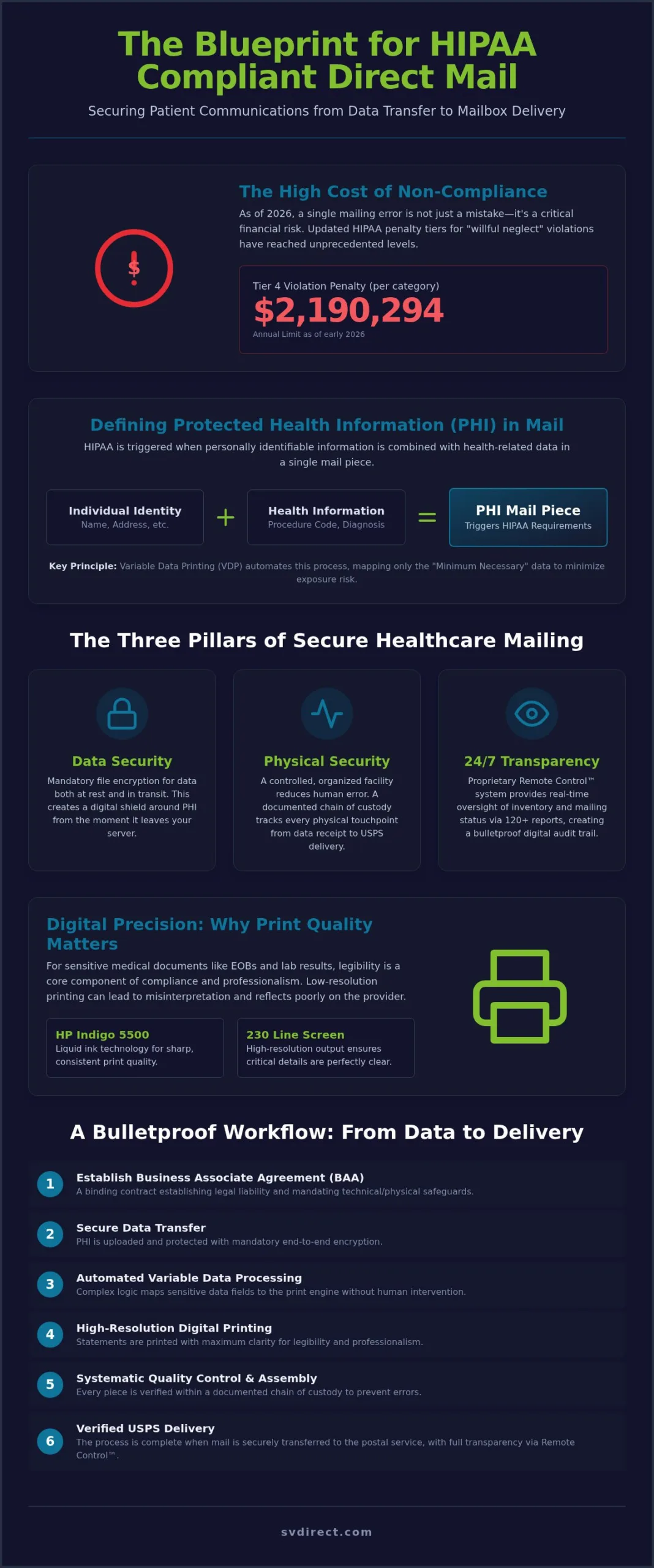
With Tier 4 HIPAA violations now reaching $2,190,294 per category as of early 2026, a single mailing error is no longer just a mistake; it’s a potential existential threat to your organization. You understand that managing Protected Health Information (PHI) is a high-stakes balancing act where a lack of transparency in the mailing chain of custody leads to unnecessary risk. Finding a partner that provides truly HIPAA compliant direct mail services shouldn’t mean sacrificing the high-resolution quality your patient communications require to remain professional and clear.

We’ll show you how to navigate these complexities with a framework that balances rigorous compliance with high-resolution digital print technology. You’ll learn how to establish a bulletproof audit trail for every piece of mail while ensuring a zero-disruption transition to a more secure, high-performance operational model. This guide provides the roadmap to precision, security, and the peace of mind that comes from a dedicated partnership that values your data as much as your growth.

Key Takeaways

  • Understand how to mitigate the risk of updated 2026 penalty tiers by integrating HIPAA compliant direct mail services into your patient communication strategy.
  • Explore the mandatory technical safeguards, including file encryption and a documented chain of custody, that protect sensitive data from transfer to delivery.
  • Learn why HP Indigo 5500 liquid ink technology and 230 line screen resolution are critical for the legibility and professionalism of medical statements.
  • Discover how to maintain 24/7 transparency over your mailing inventory with the Remote Control™ system, providing a bulletproof audit trail.
  • Gain a clear framework for executing Business Associate Agreements (BAAs) and validating complex variable data logic for personalized patient mailings.

What Are HIPAA Compliant Direct Mail Services?

At its core, HIPAA compliant direct mail services represent a specialized fusion of high-resolution digital printing and rigorous data security protocols. This isn’t just about mailing letters; it’s a comprehensive ecosystem designed to protect Protected Health Information (PHI) from the moment a data file is uploaded until the physical piece reaches the patient’s mailbox. These services are governed by the Health Insurance Portability and Accountability Act (HIPAA), ensuring that every touchpoint in the mailing chain of custody meets federal standards for privacy and security.

For healthcare providers and insurers, these services are non-negotiable. The legal framework rests on the Business Associate Agreement (BAA). This document is more than a formality; it’s a binding contract that establishes legal liability and mandates that the service provider maintains specific technical and physical safeguards. Whether you’re sending Explanation of Benefits (EOBs), billing statements, or laboratory test results, a BAA ensures your mailing partner acts as a secure extension of your own compliance team. It’s a partnership built on transparency and a shared commitment to patient privacy.

The Legal Stakes: Fines and Reputation

The cost of non-compliance has never been higher. As of January 28, 2026, the Office for Civil Rights (OCR) updated the penalty tiers, with “willful neglect” violations now reaching an annual limit of $2,190,294 per category. Beyond the financial impact, a single mailing error, like a misaligned window envelope revealing a diagnosis code, can trigger a systemic data breach. This destroys patient trust and tarnishes brand integrity. With the February 16, 2026, deadline for updating Notice of Privacy Practices (NPP) regarding substance use disorder records, the scrutiny on how you handle sensitive data in transit is at an all-time high.

Protected Health Information (PHI) in Direct Mail

Understanding what constitutes PHI is the first step in secure mailing. A mail piece triggers HIPAA requirements when it combines an individual’s identity, such as a name or address, with health-related information like a procedure code or even the department name on the return address. We adhere to the “Minimum Necessary” principle, ensuring that only the essential data required for the mailing’s purpose is included. To manage this safely, Variable Data Printing (VDP) uses advanced logic to map sensitive data fields directly to the print engine without human intervention, maintaining a secure, automated workflow that minimizes the risk of exposure.

The Technical Pillars of Secure Healthcare Mailing

Secure data transfer is the foundational entry point for HIPAA compliant direct mail services. In 2026, encryption for data both at rest and in transit is no longer just a recommendation; it’s a mandatory safeguard under updated federal regulations. We ensure that your PHI remains protected from the moment it leaves your server until the digital press begins its run. This creates a digital shield around sensitive patient information, preventing unauthorized access during the most vulnerable stages of the workflow. Our technical framework is built to exceed these standards, providing a secure environment for every file we handle.

Physical security is often overlooked in digital conversations, yet it remains a critical pillar of compliance. We operate out of a facility designed for maximum focus and minimal distraction. A quiet, organized environment is essential for reducing the risk of human error during the complex kitting and assembly stages. We document every touchpoint in the chain of custody, from the initial data receipt to the final USPS delivery. This physical oversight ensures that sensitive medical statements never sit unattended or become disorganized, maintaining the integrity of your mailing at every step.

Proprietary Data Management and Visibility

Transparency is the best defense against compliance anxiety. Our proprietary Remote Control™ system provides you with 24/7 oversight into your projects. You don’t have to wonder if a file was received or if the mail has dropped. With access to over 120 specialized reports, you can monitor inventory levels and mailing statuses in real time. This level of visibility acts as a digital audit trail, making internal tracking and external compliance audits straightforward and stress-free. You stay in control of your data without needing to manage the mechanical details.

Systematic Quality Control (QC-Check)

Accuracy in healthcare mailing requires more than just good intentions. It demands a systematic “QC-Check” process. This multi-stage inspection begins before the first piece of paper touches the press. We proactively identify data conflicts or logic errors in your variable data printing templates. By catching these issues early, we prevent systemic errors that could compromise patient privacy. Our commitment to 100% accuracy extends to machine insertion, where each piece is verified for correct matching and secure sealing. If you’re ready to see how a more organized approach can protect your communications, you can request a free quote to discuss your specific compliance needs.

Digital Precision: Why Print Technology Matters for PHI

While many providers focus solely on the digital handshake of data transfer, the physical execution of your mailing is where patient trust is truly solidified. In HIPAA compliant direct mail services, the quality of the print is a security feature in itself. If a patient receives a billing statement with smudged toner or illegible procedure codes, the risk of misinterpretation increases. We utilize liquid ink technology rather than standard dry toner. Liquid ink creates a sharper, more durable bond with the paper fibers. This ensures that every sensitive detail remains crisp and clear from our facility to the patient’s front door, preventing the flaking or blurring common with lesser technologies.

Precision in medical documentation often requires the reproduction of complex charts or fine-print legal disclosures. Our 230 line screen resolution provides a level of detail that standard commercial presses simply can’t match. This high-resolution output ensures that every character is rendered with mathematical accuracy. When combined with our on-demand digital printing capabilities, you get the speed of a digital workflow with the aesthetic and functional quality of traditional offset printing. This consistency in color and clarity maintains your brand integrity across even the highest volume healthcare runs.

The HP Indigo 5500 Advantage

The HP Indigo 5500 serves as the technical heart of our facility. It produces dry sheets that allow for immediate handling, which is vital for maintaining the integrity of PHI. There’s no waiting for ink to set, which means there’s no chance for data to smudge during the high-speed kitting and assembly process. For organizations running complex wellness campaigns, our 7-color digital printing capability ensures vibrant, high-impact visuals that drive engagement. We also prioritize sustainability; this digital process eliminates the need for traditional films and toxic chemicals, reducing your environmental footprint while maintaining elite quality.

Variable Data for Personalized Care

HIPAA Compliant Direct Mail Services: The 2026 Guide to Security and Precision

Implementing a Compliant Workflow: From Data to Delivery

Transitioning your sensitive communications to a partner requires a methodical approach that prioritizes both security and operational speed. Effective HIPAA compliant direct mail services rely on a structured five step workflow to eliminate the possibility of human error. This starts with the execution of a Business Associate Agreement (BAA) and the setup of secure data transfer protocols. Once the legal and technical foundation is set, we move into template design. Here, we validate the logic for Variable Data Printing (VDP) to ensure every data field aligns perfectly with your patient records. This isn’t just a technical task; it’s a critical safety check.

  • Step 1: Secure Data Transfer and BAA Execution. Establishing the legal framework and encrypted pipelines for PHI.
  • Step 2: Template Design and VDP Logic Validation. Mapping data fields to ensure accuracy in personalized messaging.
  • Step 3: Systematic QC-Check and Sample Approval. A physical and digital review of production samples before the full run.
  • Step 4: Secure Production and Automated Mailing. Printing and inserting in a controlled facility with documented custody.
  • Step 5: Real-Time Reporting and Audit Trail Archiving. Maintaining a permanent record of every mail piece for future compliance reviews.

Streamlining the Onboarding Process

Moving from an in house operation to a professional 3PL partner doesn’t have to be disruptive. We collaborate directly with your IT teams to establish seamless XML or SOAP integrations. This technical alignment allows for automated data exchange that reduces manual handling and the risk of data exposure. By identifying and resolving potential data conflicts during this initial setup phase, we prevent delays during active production. It’s a proactive partnership model that views our team as a steady, reliable extension of your own operations.

Managing Complex Kitting and Literature

Healthcare mailing often involves more than just a single letter. Many programs require the integration of kitting and assembly services to manage medical device kits or complex pharmaceutical literature. We ensure that these bundled items maintain the same rigorous HIPAA compliance standards as our printed mailings. Whether you’re distributing patient education packets or diagnostic components, our team handles the physical assembly with the same precision and oversight used in our digital print facility. This unified approach simplifies your supply chain and ensures a consistent audit trail across all materials.

Silicon Valley Direct: An Extension of Your Compliance Team

When selecting HIPAA compliant direct mail services, you’re choosing a partner that acts as a physical extension of your organization’s compliance team. Founded in 1999, Silicon Valley Direct (SVD) has built its reputation on “The Nine Promises,” a set of core principles that prioritize active listening and proactive problem solving. This partnership-first approach to healthcare mailing services ensures that we don’t just execute tasks; we collaborate to safeguard your reputation. Our location in the heart of Silicon Valley serves as a constant catalyst for innovation, allowing us to integrate the latest digital print technologies into a secure, physical workflow.

Accuracy in high-volume healthcare mailing is rarely the result of automation alone. It requires a deliberate operational environment. We utilize a “Quiet Facility” methodology, which creates a highly organized and focused atmosphere for our staff. This focus is the secret to maintaining precision across complex kitting and assembly projects where human oversight is vital. By minimizing distractions, we ensure that every medical statement and patient education packet is handled with the deliberate care it deserves. This methodical approach reflects our commitment to being a steady hand in an industry that demands absolute reliability.

Beyond ‘Cookie-Cutter’ Fulfillment

We reject the impersonal, one-size-fits-all models that dominate the fulfillment industry. Instead, we provide custom-fit solutions designed to meet unique healthcare project goals, from pharmaceutical literature distribution to complex medical device kitting. Our team’s collective experience allows us to anticipate potential data conflicts or logistical hurdles before they ever impact a patient. In regulated industries, the value of a long-term partnership cannot be overstated. We pride ourselves on high staff retention, which means your projects are managed by seasoned experts who understand your specific compliance requirements and brand standards.

Transparency Through Remote Control™

Transparency is the cornerstone of trust in a business associate relationship. Our proprietary Remote Control™ system gives you 24/7 access to your data, inventory, and mailing status. You can access over 120 specialized reports to track a project’s progress or audit a specific mailing’s chain of custody. Remote Control™ is a proprietary integration of technology and customer service that provides a seamless window into our operations. We can even customize web interfaces to match your existing corporate healthcare portals, ensuring that your team has the information they need in a familiar, accessible format.

Securing Your Patient Communications for 2026 and Beyond

The landscape of healthcare mailing continues to evolve, but the core requirements of security and precision remain constant. You’ve seen how the marriage of high-resolution liquid ink technology and rigorous data encryption creates a protective shield around your sensitive communications. By utilizing a 230 line screen resolution, your documents achieve a level of clarity that supports both brand integrity and patient understanding. With 24/7 visibility provided by the Remote Control™ system, you’re never left in the dark regarding your inventory or mailing status.

Choosing HIPAA compliant direct mail services is about more than just checking a box; it’s about establishing a partnership with a seasoned expert who understands the high stakes of your industry. With decades of experience in high-stakes fulfillment, we provide the steady hand you need to manage complex regulations and updated penalty tiers. You can move forward with the confidence that your data is secure and your physical mailings are handled with absolute precision.

We look forward to helping you streamline your workflow and protect your organization’s reputation. Let’s build a secure future for your patient communications together.

Frequently Asked Questions

What does HIPAA compliant direct mail mean for my business?

HIPAA compliant direct mail means your physical communications are handled within a secure, audited framework that meets federal privacy standards. This process encompasses everything from encrypted data transfers to physical facility security and documented disposal of waste. It ensures that your organization avoids the updated 2026 penalty tiers while maintaining the highest level of patient privacy throughout the mailing process.

Do I need a Business Associate Agreement (BAA) for mailing services?

A Business Associate Agreement (BAA) is absolutely necessary whenever a vendor handles Protected Health Information (PHI) for your organization. This legal contract establishes liability and mandates that the service provider maintains specific technical and physical safeguards. We execute these agreements as a standard part of our onboarding for HIPAA compliant direct mail services to ensure total legal and operational alignment.

Can I send PHI like test results or billing statements through direct mail?

You can securely send sensitive documents like test results, billing statements, and Explanation of Benefits through the mail by following strict privacy protocols. These mailings must adhere to the “minimum necessary” rule, ensuring that only essential information is included. We use specialized window envelopes and precise folding techniques to ensure that no sensitive data is visible from the outside of the mail piece.

How does digital printing ensure data security for healthcare?

Digital printing enhances security by creating a closed-loop system where data flows directly from secure servers to the printing equipment without manual intervention. This automated workflow reduces the number of touchpoints and minimizes the risk of human error or data exposure. Our systems use advanced logic to validate every record, ensuring that the right information reaches the right patient every time.

What is the difference between toner and liquid ink for medical mailing?

The primary difference lies in durability and legibility; liquid ink bonds with the paper fibers while toner merely sits on the surface. For medical documents where fine print and barcodes must be perfectly clear, liquid ink provides a superior, smudge-proof finish. This technology ensures that sensitive data remains legible throughout the entire postal journey, which is critical for patient understanding and compliance.

How do you track the chain of custody for sensitive healthcare mail?

We track the chain of custody through a systematic series of checkpoints that document the handling of your materials at every stage. From the moment we receive your data to the final hand-off at the USPS, every movement is recorded. You can monitor these touchpoints in real time through our proprietary system, providing a comprehensive audit trail that is essential for regulatory reviews.

Is variable data printing (VDP) more expensive for HIPAA mailers?

Variable data printing (VDP) is highly cost-efficient because it allows us to customize every mail piece in a single production run. It eliminates the need for separate static printings and manual matching, which reduces both labor costs and the potential for errors. When utilizing HIPAA compliant direct mail services, VDP provides a sophisticated way to personalize patient communications without the premium price tag of traditional methods.

How long does it take to set up a new HIPAA compliant mailing program?

Launching a new program typically involves a methodical onboarding process that can take anywhere from two to four weeks depending on the technical integration required. This timeframe allows us to execute the BAA, establish secure data pipelines, and rigorously test your variable data logic. We prioritize a steady and thorough setup to ensure a zero-disruption transition for your critical patient communications.