


The Dangers of Poor Inventory Management: Protecting Your Bottom Line in 2026
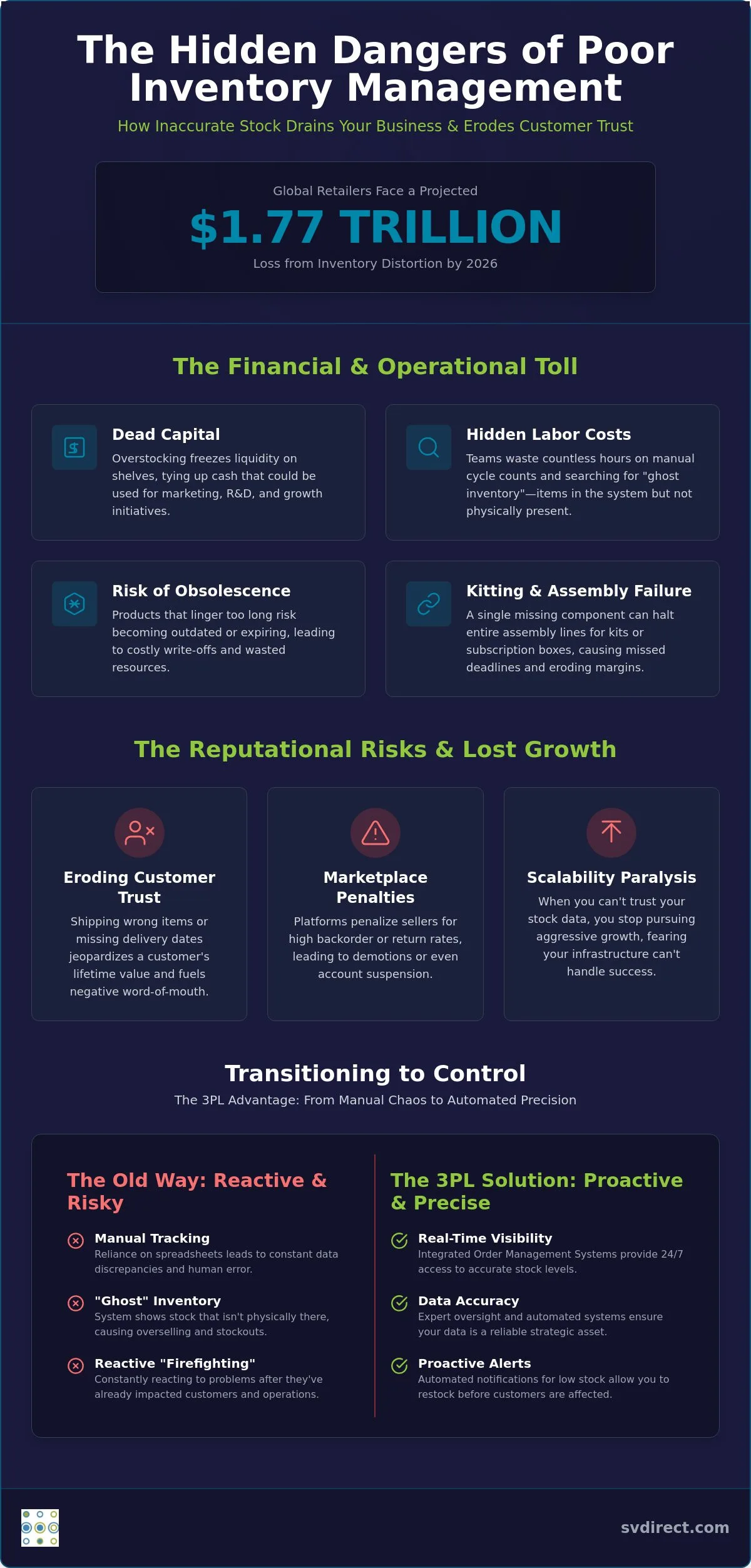
Did you know that inventory distortion, the combined cost of overstocks and out-of-stocks, is projected to drain $1.77 trillion from global retailers in 2026? It’s a staggering figure that highlights the silent, daily drain on your business resources. You’ve likely felt the frustration of capital tied up in stagnant stock or the sting of a loyal customer walking away because of a preventable backorder. These are the immediate and visible dangers of poor inventory management, but the long-term impact on your brand’s reputation and operational agility can be even more damaging.
We believe that inventory shouldn’t be a source of stress, but a strategic asset for your growth. In this article, you’ll discover the critical risks associated with inefficient inventory control and how a proactive 3PL partnership can safeguard your bottom line. We’ll provide a clear roadmap to help you transition from the errors of manual tracking to the precision of automated systems. By the end, you’ll understand how to improve order accuracy and rebuild the customer trust that drives long-term success. Let’s explore how to turn your warehouse operations into a steady hand for your business.
Key Takeaways
- Learn how to unlock dead capital by identifying overstocking patterns that drain liquidity needed for marketing and growth.
- Understand the long-term impact of fulfillment errors on customer retention and how to avoid performance penalties on major eCommerce marketplaces.
- Identify the hidden labor costs associated with manual warehouse searches and the operational drag of managing ghost inventory.
- Discover how a proactive 3PL partnership mitigates the dangers of poor inventory management through expert oversight and precision.
- Explore the transition to real-time visibility using integrated Order Management Systems that provide 24/7 access to your stock levels.
The Financial and Operational Toll of Inaccurate Inventory
Inaccurate data isn’t just a clerical error; it’s a financial anchor. When you overstock items based on flawed forecasts, you create “dead capital.” This is liquidity that’s effectively frozen on your warehouse shelves. Instead of funding aggressive marketing campaigns or critical R&D, your cash sits in cardboard boxes. Effective inventory management ensures that every dollar is working toward your growth. The dangers of poor inventory management often manifest as a slow bleed of capital that many businesses don’t notice until their cash flow tightens unexpectedly.
Labor costs compound these issues. Warehouse teams spend countless hours on manual cycle counts or searching for “ghost” inventory, which are items that appear in the system but aren’t physically present. This wasted effort drives up operational overhead while increasing the risk of stockouts. When demand exceeds your poorly tracked supply, you lose immediate revenue. Products that linger too long also risk obsolescence. This leads to painful write-offs as items reach the end of their shelf life before they ever reach a customer.
This challenge is even more pronounced for businesses dealing with perishable goods. Companies like Shift 2 Fresh must maintain impeccable inventory accuracy to ensure that fresh fruits and vegetables imported from the Philippines and South Asia reach UAE consumers before their shelf life expires.
The Ripple Effect on Specialized Services
For businesses relying on kitting and assembly services, inventory errors are catastrophic. A subscription box or a promotional kit is only as complete as its rarest component. If your tracking fails to account for a single missing insert or product, the entire assembly line grinds to a halt. This disruption causes missed shipping deadlines and forces expensive, last-minute course corrections that erode your margins and frustrate your partners.
Operational Friction and Warehouse Morale
A “hectic” warehouse is rarely a productive one. It’s usually a symptom of poor inventory control. When staff are constantly reacting to discrepancies rather than following a streamlined process, morale suffers. We prioritize a quiet, organized facility. This environment is essential for managing high-volume deadlines with precision. High-performance operations require a steady hand and clear data, not a frantic search for misplaced stock. Precision in the warehouse translates directly to confidence in the front office.
Beyond the Balance Sheet: Reputational Risks and Lost Growth
Financial losses are quantifiable, but the damage to your brand identity is often irreversible. One of the most significant dangers of poor inventory management is the steady erosion of customer trust. Shipping the wrong item or missing a promised delivery window doesn’t just cost you a single sale; it jeopardizes the customer’s lifetime value. Research into Reputational Risks confirms that stockouts lead to immediate dissatisfaction and negative word-of-mouth that can haunt your brand for years. In a market where competitors are only a click away, you can’t afford to give shoppers a reason to look elsewhere.
The stakes are even higher on digital marketplaces. Platforms like Amazon and Shopify utilize strict fulfillment metrics to rank and prioritize sellers. Frequent backorders or high return rates triggered by inventory errors can lead to search ranking demotions or total account suspension. This isn’t just a minor hurdle; it’s a loss of access to your primary revenue streams. The dangers of poor inventory management extend to your psychological ability to scale. When you don’t trust your stock data, you experience scalability paralysis. You stop pursuing aggressive growth because you aren’t certain your infrastructure can handle the success.
The Cost of Customer Churn
Calculating the true cost of an error requires looking beyond the immediate shipping fee. You have to consider the high cost of customer acquisition and the revenue that person would have generated over several years. Our customer testimonials reflect how precision in fulfillment transforms one-time buyers into loyal brand advocates. A single bad shipment can destroy that potential in an instant, turning a profitable relationship into a deficit.
The Proactive Solution: Anticipating Problems
We believe in moving away from the “firefighting” mentality common in smaller, manual operations. Our approach focuses on identifying potential conflicts before they impact your project. Instead of reacting to a stockout after it happens, we utilize automated notifications for low inventory levels and potential backorders. This allows you to restock and plan your marketing spend before a customer ever encounters an “out of stock” message. If you’re ready to move from reactive stress to proactive growth, you can consult with our logistics experts to see how we safeguard your brand reputation.
Transitioning to Control: The 3PL Advantage in 2026
Reclaiming control over your supply chain requires more than just a software subscription. It demands a partnership that combines high-tech visibility with physical precision. Moving away from the dangers of poor inventory management starts with real-time data. Our proprietary Remote Control system provides 24/7 inventory access, allowing you to monitor stock levels from any location. This transparency ensures that you aren’t making critical business decisions based on outdated reports or manual spreadsheets.
True efficiency comes from seamless integration. By connecting your eCommerce storefront directly to a professional Order Management System (OMS), you eliminate the communication gaps that cause shipping delays. You also benefit from a scalable infrastructure. Instead of managing the overhead of long-term warehouse leases, you gain access to secure, professional facilities that grow alongside your order volume. This flexible model allows you to invest your capital where it matters most: in your product and your customers.
Technology Meets Human Expertise
Software can track a barcode, but it can’t verify the physical quality of a delicate component. Software alone isn’t enough to guarantee a perfect customer experience. Our “QC-Check” process adds a vital layer of human oversight to every project. By utilizing Silicon Valley 3PL fulfillment services, you bridge the gap between digital clicks and physical delivery. Our team treats your stock as an extension of your own company, ensuring that every kit is assembled correctly and every shipment is accurate.
Strategic Growth through Outsourcing
Outsourcing your logistics frees up your internal resources to focus on brand building and high-level strategy. You don’t need to spend your afternoons counting boxes or troubleshooting backorders. Instead, you can focus on expanding your market reach. Global shipping services become significantly more efficient when your local inventory is managed with precision. This proactive approach mitigates the dangers of poor inventory management and transforms your warehouse from a source of stress into a steady hand that supports your long-term success.
Securing Your Operational Future
Protecting your business in 2026 requires a shift from reactive troubleshooting to proactive precision. We’ve explored how dead capital and marketplace penalties represent the primary dangers of poor inventory management, but these risks are entirely avoidable with the right partnership. Transitioning to a professional 3PL model provides the structural stability needed to scale without the stress of operational friction.
At Silicon Valley Direct, we’ve supported business growth since 1999 through a blend of advanced technology and personal oversight. Our proprietary Remote Control™ system gives you 24/7 real-time visibility, while our rigorous QC-Check process maintains a 99.9% order accuracy rate. This level of detail ensures that your inventory remains an asset, not a burden. Ready to streamline your supply chain? Explore our 3PL solutions today. Let’s build a more resilient future for your brand together.
Frequently Asked Questions
What are the most common signs of poor inventory management?
The most common signs include frequent backorders, high storage costs for slow-moving items, and consistent discrepancies between your digital records and physical stock. You might also notice a rise in customer complaints regarding shipping delays or incorrect items. These symptoms indicate the dangers of poor inventory management and suggest your current tracking methods aren’t keeping pace with your business growth.
How does inventory accuracy affect eCommerce fulfillment costs?
Inventory accuracy directly impacts fulfillment costs by reducing the labor hours spent on manual warehouse searches and cycle counts. When your data is precise, order pickers can locate items instantly, which lowers the cost per order. In contrast, inaccurate data leads to expensive returns management and expedited shipping fees to correct errors, both of which erode your profit margins over time.
Can a 3PL help with inventory management for specialized industries like healthcare?
Yes, a specialized 3PL provides the precision and compliance necessary for healthcare mailing and literature fulfillment. We manage sensitive materials with a focus on traceability and quality control. This expertise is critical because the dangers of poor inventory management in healthcare can include regulatory non-compliance or the distribution of outdated information, making a seasoned partner essential for maintaining industry standards.
What is the difference between reactive and proactive inventory control?
Reactive inventory control involves responding to problems after they occur, such as rushing to restock after a sell-out. Proactive control uses real-time data and automated notifications to anticipate demand and adjust stock levels before issues arise. This forward-looking approach allows you to maintain a steady operational rhythm, ensuring that your capital is always invested strategically rather than spent on emergency fixes.