img not found!
Marketing Collateral Fulfillment: The Strategic Guide to Precision and Speed in 2026

Marketing Collateral Fulfillment: The Strategic Guide to Precision and Speed in 2026

In a year where paper prices are forecasted to rise by 3.4%, every kitting error or mismanaged brochure is a direct hit to your bottom line. You’ve likely felt the frustration of high bulk shipping costs or the panic of a lead response that’s anything but fast. It’s exhausting to manage global logistics when you don’t have real-time visibility into your inventory. We believe that effective marketing collateral fulfillment isn’t just about moving boxes. It’s about the precision of high-resolution digital printing meeting the speed of a proactive, quiet logistics facility.

This guide will show you how to bridge the gap between digital assets and physical delivery to ensure your materials reach global prospects with absolute accuracy. You’ll learn how to integrate print-on-demand services with automated warehousing to reduce waste and gain 24/7 visibility into your collateral usage. We’re moving beyond the chaos of traditional mailrooms to a sophisticated, data-driven approach that acts as a true extension of your team. By the end of this article, you’ll have a roadmap for a seamless fulfillment strategy that protects your brand and respects your budget.

Key Takeaways

  • Discover why high-resolution physical assets continue to drive superior engagement in 2026 and how to integrate them into a digital-first marketing strategy.
  • Learn how on-demand digital printing via HP Indigo technology streamlines marketing collateral fulfillment by eliminating costly inventory stockpiles while maintaining offset quality.
  • Explore the “Quiet Facility” methodology and systematic QC-Check processes that ensure zero-error kitting and assembly for complex global distributions.
  • Gain 24/7 visibility into your inventory and order status through proprietary data management systems that offer over 120 standard reports.
  • Understand how to transition from a vendor-client relationship to a strategic partnership where your fulfillment provider acts as a seamless extension of your internal team.

What is Marketing Collateral Fulfillment in the Digital-First Era?

Marketing collateral fulfillment is the end-to-end process of storing, kitting, and distributing physical sales and marketing assets. It’s the physical heartbeat of your brand’s outreach. While digital channels are saturated, understanding What is Marketing Collateral remains vital for brands looking to break through the noise. In 2026, physical touchpoints provide a tactile reality that digital-only campaigns often lack. When everyone else is sending an automated email, a high-resolution, perfectly kitted package on a prospect’s desk commands attention.

The industry has moved away from the era of dusty bulk storage. We’ve seen a decisive shift toward “just-in-time” literature fulfillment. This model prioritizes precision and speed over sheer volume. Instead of printing thousands of brochures that might become obsolete in months, modern systems allow for smaller, high-resolution runs that ship exactly when a lead shows interest. This evolution transforms fulfillment from a back-office chore into a strategic extension of your sales and marketing departments.

Types of Marketing Assets Managed

A sophisticated fulfillment partner handles a diverse array of physical goods. This includes traditional literature like brochures, data sheets, and user manuals. It also extends to trade show and event materials, where pre-show assembly and post-show returns must be handled with care. Branded merchandise and premium items also fall under this umbrella. Each item represents your brand’s commitment to quality. We treat every piece as a critical touchpoint in the customer journey.

The Cost of Inefficient Fulfillment

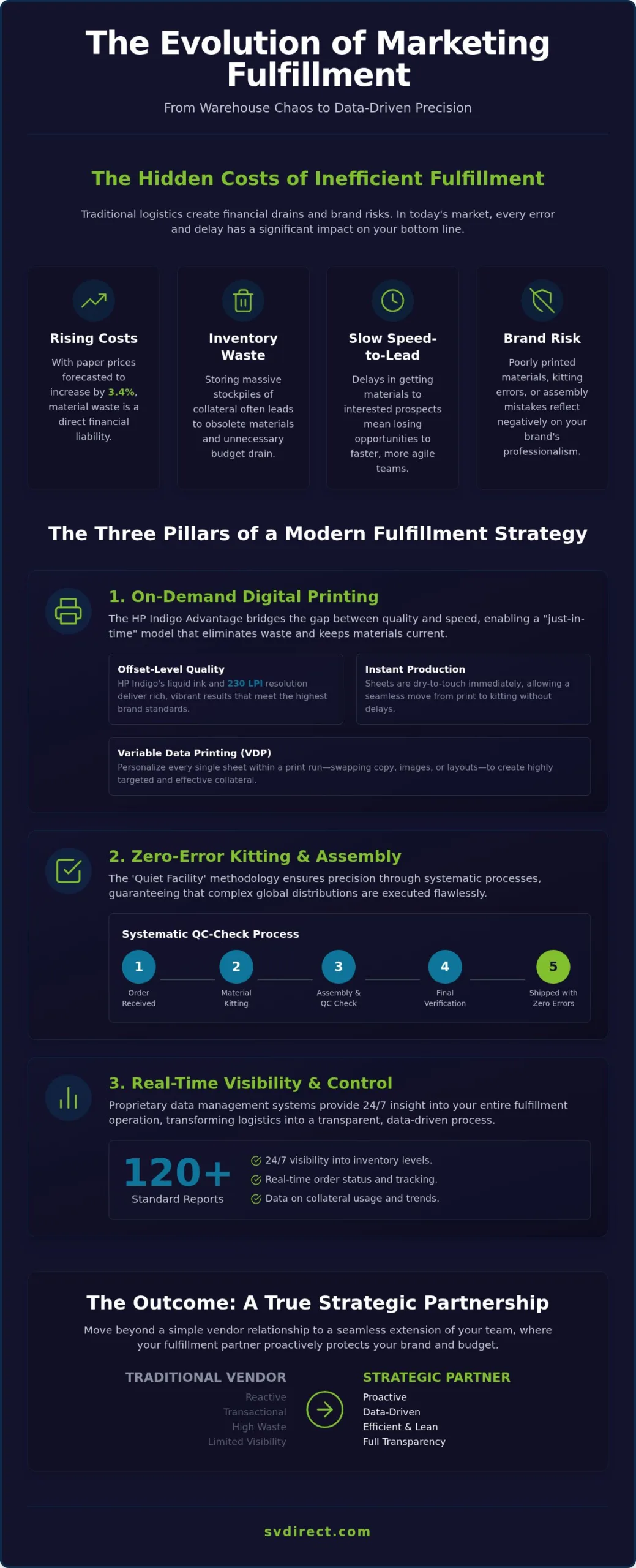
Inefficiency carries a heavy price tag. Beyond obvious shipping fees, hidden expenses like the storage of obsolete materials can drain your budget. In 2026, with paper prices rising by 3.4%, waste is no longer a minor inconvenience; it’s a financial liability. If your “speed to lead” is slow, you’re losing prospects to faster competitors. Brand damage is another silent killer. Poorly printed materials or kitting errors reflect poorly on your professionalism. Precision in marketing collateral fulfillment ensures your first impression is the right one. It’s about being first to the prospect’s desk with a message that looks and feels premium.

We don’t just ship boxes. We manage the physical manifestation of your brand’s promise. By integrating high-tech oversight with human expertise, we eliminate the chaos of traditional warehousing. This proactive approach allows your team to focus on growth while we handle the intricate details of logistics and assembly.

The HP Indigo Advantage: Integrating Digital Printing into Fulfillment

Modern marketing collateral fulfillment demands more than just storage. It requires a production engine that can keep pace with real-time leads. By utilizing HP Indigo technology, we’ve bridged the gap between high-end quality and logistical speed. Unlike traditional offset methods that require weeks of lead time, the digital printing industry has evolved to support immediate, on-demand production. This shift eliminates the need for massive inventory stockpiles that often end up in a recycling bin when brand messaging changes. We focus on a “just-in-time” model that keeps your materials current and your warehouse lean.

The technical difference lies in the ink. While many digital presses use dry toner, which can look “plastic” and sit on top of the paper fibers, HP Indigo uses liquid ink. This technology delivers a 230 line screen resolution, providing offset-quality results that satisfy even the most demanding brand standards. The sheets are dry-to-touch the moment they leave the press. This allows us to move directly from the print tray to the kitting table without waiting for ink to set. It’s a critical advantage for high-end marketing kits that need to ship within hours of an order being placed. You don’t have to choose between beauty and speed.

Variable Data Printing (VDP) for Personalization

Personalization is no longer a luxury. It’s an expectation. VDP allows us to swap copy, images, or entire layouts on every single sheet within a print run. When you integrate VDP into your personalized direct mail workflow, you’re not just sending a brochure; you’re sending a targeted sales tool. This level of customization significantly increases conversion rates by speaking directly to the prospect’s unique pain points. By merging marketing collateral fulfillment and production under one roof, we ensure that these personalized assets move into the fulfillment stream without delay.

Sustainability in Modern Printing

Precision printing is inherently more sustainable. By moving to a digital workflow, we eliminate the need for film, plates, and the harsh chemicals associated with traditional offset setups. We prioritize the use of FSC-certified papers and offer 30% recycled content options to help our partners meet their environmental goals. The greatest environmental benefit, however, is the reduction of waste. Printing only what you need, when you need it, ensures that your marketing budget isn’t spent on materials that will eventually become obsolete. If you’re ready to modernize your production, you can consult with our specialists on a sustainable print strategy.

Mastering Kitting and Assembly: The ‘Quiet Facility’ Methodology

Precision is a byproduct of environment. While many logistics providers operate in a state of constant, reactive chaos, we maintain a ‘Quiet Facility’ methodology. This isn’t just about noise levels; it’s a systematic approach to marketing collateral fulfillment that prioritizes focus and error reduction. In a quiet facility, every movement is deliberate. This atmosphere allows our staff to execute complex kitting projects, such as multi-component software packages or high-end promotional kits, with a level of detail that a hectic warehouse simply cannot match. Scalability shouldn’t mean a drop in quality. Whether we’re assembling 50 high-touch executive kits or 50,000 lead inquiry responses, we scale by replicating our systematic checks rather than rushing them.

The core of this methodology is our systematic QC-Check process. We don’t believe in ‘good enough’ when your brand reputation is at stake. Every kit undergoes a rigorous verification before it leaves our dock. This ensures the right brochure meets the right premium item every single time. It’s especially critical when executing strategic marketing during uncertainty, where physical assets like case studies and white papers must demonstrate your brand’s stability and expertise without a single error. Our proactive stance turns the fulfillment center into a reliable safeguard for your brand standards.

Specialized Kitting Services

Our facility is designed to handle the nuances of various specialized industries. For trade shows, we pre-assemble packets and ship them directly to the event floor, ensuring your team has everything they need the moment they arrive. We also manage Point of Purchase (POP) distribution with precise inventory control for retail environments. In the healthcare sector, we provide specialized handling and serial number tracking for medical device fulfillment, ensuring compliance and accuracy in high-stakes environments where errors aren’t an option.

Inventory Control and Obsolescence Prevention

Effective marketing collateral fulfillment requires more than just picking and packing. It demands proactive inventory management. Our proprietary system provides real-time tracking of serial numbers and batch lots, giving you total visibility into your assets. We set automated alerts for low inventory levels so you never miss a lead response due to a stockout. By managing the full lifecycle of your literature fulfillment services, we help you identify slow-moving items before they become obsolete. This proactive stance reduces waste and ensures your budget is always focused on materials that drive results.
Marketing Collateral Fulfillment: The Strategic Guide to Precision and Speed in 2026

Remote Control™: Leveraging Technology for Real-Time Visibility

Effective marketing collateral fulfillment relies on more than just physical space; it requires digital transparency. Our proprietary Remote Control™ system serves as the central nervous system for your logistics. It provides 24/7 access to your inventory, allowing you to place orders and track progress in real-time from any location. This platform isn’t a generic portal. It’s a sophisticated data management tool that generates 120+ standard reports, enabling your team to make data-driven decisions based on actual collateral usage and freight expenses. You gain the clarity needed to optimize your budget and eliminate waste.

We understand that your brand identity must remain consistent across every touchpoint. That’s why we offer customized web interfaces that mirror your corporate branding or company store. This creates a seamless experience for internal teams or field sales reps who need to order materials on the fly. You receive the power of a global logistics engine with an interface that feels like a natural part of your internal tech stack. Our commitment to a “quiet facility” extends to our digital tools, providing an organized and methodical way to manage your physical assets.

Programmatic Integration via Web Services

Automation is the key to scaling your operations without increasing administrative headcount. Our system supports programmatic integration via XML and SOAP web services, allowing for a direct conversation between your ERP or CRM and our fulfillment center. By utilizing methods like AddOrder and GetOrderInfo, you can automate the entire fulfillment cycle. This platform-agnostic approach ensures that your operating system or existing software stack never limits your logistics capabilities. It bridges the gap between your digital sales triggers and our physical shipping docks with absolute precision.

Security and Compliance in Data Management

Handling sensitive information requires a steady, experienced hand. We utilize credential-based access to ensure every order submission is secure and traceable. This level of oversight is vital for industries with strict regulatory requirements. We maintain rigorous standards for healthcare mailing services, ensuring HIPAA compliance throughout the data lifecycle. You receive real-time reporting on shipment activity and freight charges, providing total accountability for every dollar spent on marketing collateral fulfillment.

Choosing a Strategic Partner for Marketing Fulfillment

Choosing the right partner for marketing collateral fulfillment is a decision that goes far beyond simple logistics. It’s about finding a team that acts as a seamless extension of your own company. A true strategic partner doesn’t just react to orders; they anticipate needs through a proactive, “quiet facility” approach. We believe that world-class fulfillment is built on a foundation of nine core promises, including absolute accuracy, real-time transparency, and a commitment to human oversight. These aren’t just goals. They are the operational standards that protect your brand reputation in a fast-paced market. Precision is not optional.

Our location in the heart of Silicon Valley drives our culture of innovation. This geographic identity isn’t just a symbol; it’s a connection to the global technology hub that informs our proprietary systems and high-resolution production capabilities. While some providers force you into rigid, “cookie-cutter” procedures, we prioritize total flexibility. Your business is unique. Your fulfillment strategy should be custom-fit to your specific workflows and growth targets rather than a one-size-fits-all model. We bridge the gap between mechanical operations and the personal nature of growing your business.

Transitioning from In-House to a Professional 3PL

Knowing when to transition from in-house management to a professional 3PL is critical for scaling. Many organizations reach a tipping point where the volume of literature and promotional kits outpaces their internal capacity. When your marketing team is spending more time on assembly than on strategy, your ROI is suffering. Outsourcing these tasks to a dedicated partner saves significant time, physical space, and labor costs. We’ve seen national brands scale their impact by offloading the complexities of global shipping and inventory management to our specialized teams. This move allows your internal staff to focus on high-value creative work while we handle the intricate details of the physical supply chain.

Next Steps for Your Marketing Supply Chain

The first step toward a more efficient future is a thorough audit of your current collateral management process. Look for hidden costs in storage, shipping errors, and obsolete materials that haven’t moved in six months. Once you’ve identified these gaps, we invite you to explore how technology can solve them. Requesting a demo of the Remote Control™ system will show you the power of 120+ standard reports and 24/7 inventory visibility. It’s time to move beyond the chaos of traditional warehousing and embrace a more precise, data-driven methodology. Our team is ready to help you streamline your operations and improve your speed to market.

Contact Silicon Valley Direct for a custom fulfillment quote

Modernizing Your Physical Brand Strategy

The landscape of marketing collateral fulfillment is evolving toward a model where precision and speed are inseparable. By integrating the HP Indigo 5500 Digital Press directly into your supply chain, you eliminate the waste of bulk inventory while achieving offset-quality results. Our systematic QC-Check process ensures that every kit is perfect, protecting your brand’s integrity at every global touchpoint. We provide the stability you need to grow without the chaos of traditional logistics.

Managing these operations doesn’t have to be a source of stress. With the proprietary Remote Control™ system, you gain 24/7 visibility into your assets through over 120 standard reports. This transparency allows you to make data-driven decisions that respect both your timeline and your budget. We act as a steady hand and a proactive extension of your team, ensuring your materials reach prospects with absolute accuracy.

Your brand deserves a partner that values precision as much as you do. We’re ready to help you turn your fulfillment strategy into a powerful competitive advantage that drives measurable results.

Frequently Asked Questions

What is marketing collateral fulfillment?

Marketing collateral fulfillment is the end-to-end process of managing, kitting, and distributing physical sales and marketing assets. It encompasses everything from the initial storage of brochures to the final delivery of complex trade show kits. By centralizing these operations, businesses ensure that their physical brand touchpoints reach prospects with speed and precision. This systematic approach reduces administrative overhead and eliminates the logistical bottlenecks that often delay lead responses.

How does on-demand digital printing reduce fulfillment costs?

On-demand digital printing reduces costs by eliminating the need for massive inventory stockpiles that often become obsolete. By printing only what you need when you need it, you avoid the hidden expenses associated with storing and eventually recycling outdated materials. This “just-in-time” model ensures that your marketing budget is spent on current, relevant assets rather than aging stock. It also allows for smaller, high-resolution runs that maintain brand quality without high minimums.

Can you handle complex kitting projects with multiple components?

We specialize in complex kitting and assembly projects that involve multiple components and intricate packaging requirements. Our systematic QC-Check process ensures that every item is correctly placed and verified before the kit leaves our facility. Whether you’re distributing software packages or high-end promotional bundles, we handle the manual labor with technical precision. This proactive oversight prevents kitting errors that could damage your brand’s reputation or lead to costly returns.

What is the difference between liquid ink and toner for marketing materials?

The primary difference lies in the application and visual quality; liquid ink technology provides offset-quality results that toner-based systems can’t match. Toner often sits on top of the paper fibers, creating a “plastic” look, while liquid ink is absorbed for a more professional finish. With 230 line screen resolution, our printing ensures that your high-end marketing collateral fulfillment projects meet the most rigorous brand standards for clarity and color accuracy.

How do I integrate my existing CRM or ERP with your fulfillment system?

Integration is achieved through our proprietary Remote Control™ system, which supports programmatic communication via XML and SOAP web services. This allows your existing CRM or ERP to talk directly to our fulfillment engine, automating the entire order cycle. By using standard methods like AddOrder, you can trigger shipments automatically based on sales activity. Our platform-agnostic approach ensures that your current tech stack remains a seamless part of the logistics workflow.

Do you provide real-time inventory tracking for trade show materials?

Yes, we provide 24/7 visibility into your trade show materials and general inventory through our online management portal. You can track serial numbers, batch lots, and shipment status in real-time from any location. Our system generates over 120 standard reports, giving you the data needed to manage event logistics and monitor asset usage. This transparency ensures you always know exactly what’s in stock and where your materials are headed before the show floor opens.

What security measures are in place for sensitive healthcare or financial mailings?

We maintain strict security protocols, including HIPAA compliance, to handle sensitive healthcare and financial mailing services. Our facility utilizes credential-based access for all order submissions and data transfers, ensuring that personal information is protected throughout the fulfillment lifecycle. We provide real-time reporting on shipment activity, which offers a clear audit trail for compliance purposes. This methodical approach to data management provides the security and transparency required for high-stakes industries.

How does the ‘Quiet Facility’ methodology improve accuracy?

The ‘Quiet Facility’ methodology improves accuracy by replacing warehouse chaos with a steady, methodical environment where staff can focus on precision. In an organized facility, every movement is deliberate, which significantly decreases the likelihood of errors during kitting and distribution. This proactive stance allows us to manage high-volume deadlines without the reactive stress that leads to mistakes. It ensures that your marketing collateral fulfillment project reflects the professional standards of your brand.

3PL vs 4PL: Choosing the Right Logistics Model for Your Business in 2026

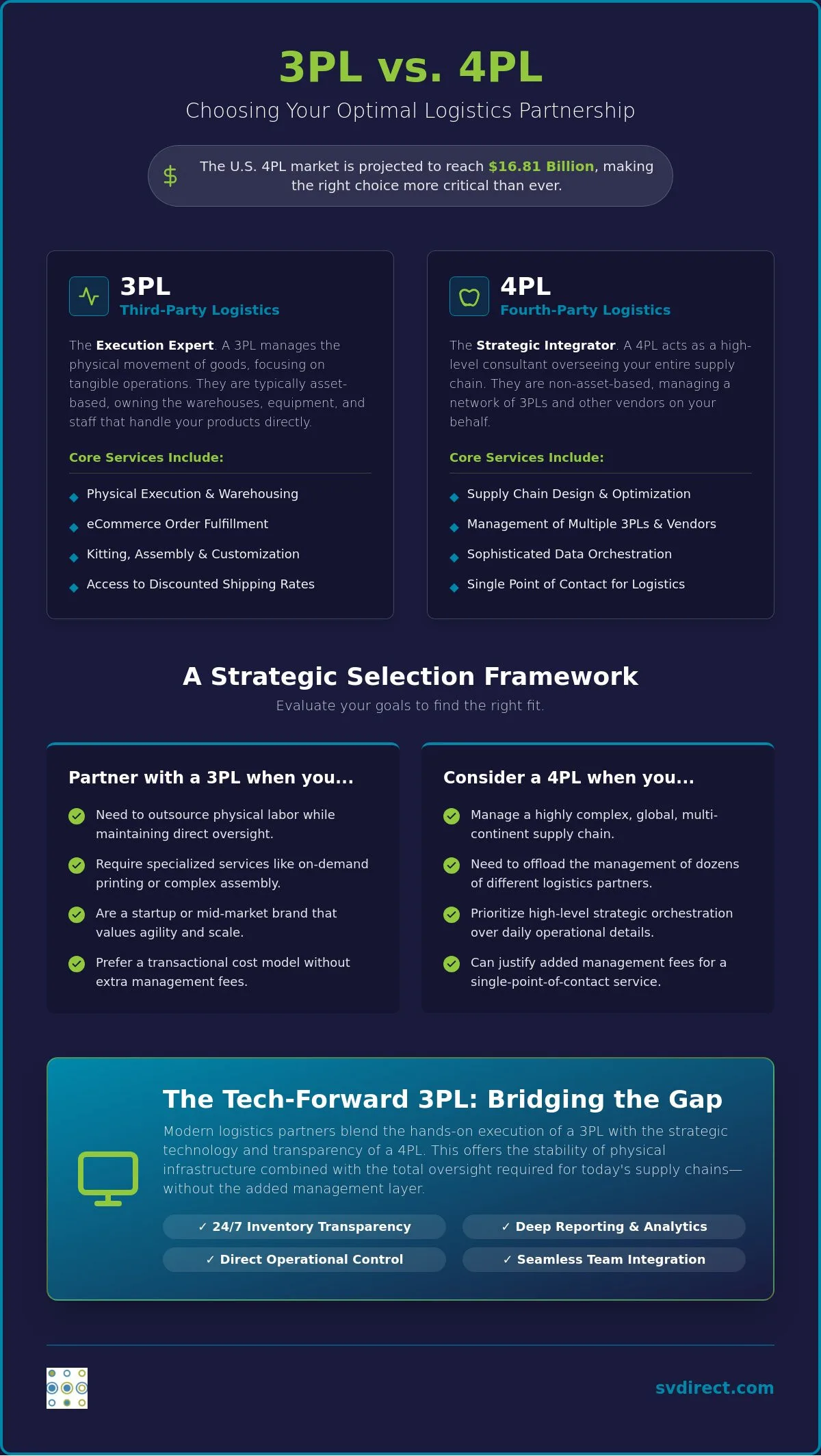
What if the biggest risk to your supply chain in 2026 isn’t choosing the wrong provider, but choosing the wrong category of partnership? As the U.S. 4PL market reaches a projected $16.81 billion this year, many leaders feel pressured to choose between the hands-on execution of a 3PL and the strategic oversight of a 4PL. The debate over 3pl vs 4pl often leaves businesses caught between the fear of losing inventory visibility and the worry of absorbing high management fees. You need a solution that offers the stability of physical infrastructure without sacrificing the high-tech transparency required for modern global trade.

We understand that logistics is more than just moving boxes; it’s about the personal commitment to your brand’s growth. You likely want a partner that acts as a seamless extension of your team rather than a distant vendor. This article provides a clear decision-making framework to help you understand the ROI of each model and determine which path will best scale your operations. We’ll explore how the right integration can offer the strategic control you crave while maintaining the operational precision your customers expect.

Key Takeaways

  • Differentiate between physical execution and strategic integration to resolve the 3pl vs 4pl dilemma for your unique supply chain needs.
  • Evaluate your business volume and growth trajectory to select a logistics model that scales efficiently without inflating management costs.
  • Determine when specialized requirements, like integrated digital printing or healthcare mailing, benefit from the direct control of an asset-based partner.
  • Discover how proprietary technology provides the 24/7 transparency and reporting depth needed to maintain total oversight of your inventory.
  • Learn to identify a partner that prioritizes human connection and operational stability to act as a true extension of your internal team.

3PL vs 4PL: Understanding the Core Differences in Logistics Models

Deciding between a 3PL and a 4PL is a foundational choice for your business’s operational future. A Third-party logistics (3PL) provider manages the physical movement of goods from warehouse to customer. This model focuses on the tangible side of the business, such as physical execution, warehousing, and shipping. In contrast, a 4PL acts as a strategic integrator that oversees the entire supply chain, often managing multiple 3PLs on your behalf. The primary differentiator lies in asset ownership; 3PLs typically own or manage the warehouse facilities and equipment, while 4PLs are often non-asset-based consultants who focus on high-level orchestration.

What is a 3PL (Third-Party Logistics)?

A 3PL specializes in the heavy lifting of your daily operations. They provide secure warehousing and eCommerce order fulfillment, ensuring your inventory is received and stored with precision. By leveraging their physical infrastructure, you gain immediate operational efficiency and access to discounted shipping rates that are difficult to secure independently. Beyond basic storage, these partners offer specialized value through kitting and assembly, allowing you to customize products close to the point of distribution. This model is built for brands that value a direct, hands-on relationship with the people actually touching their product.

What is a 4PL (Fourth-Party Logistics)?

While a 3PL executes, a 4PL designs. This model provides a single point of contact for complex, global, multi-node supply chains. Their core services include supply chain design, vendor management, and sophisticated data orchestration. A 4PL doesn’t usually own the trucks or the racks. Instead, they use their expertise to manage the network of providers you’ve hired. This strategic layer is designed to alleviate the burden of managing multiple logistics partners, though it often comes with higher management fees and a step back from the daily operational details. Understanding the nuances of 3pl vs 4pl ensures you select a partner that aligns with your internal team’s capabilities.

Choosing Between 3PL and 4PL: A Strategic Selection Framework

Selecting the ideal partner in the 3pl vs 4pl debate requires a clear-eyed look at your internal resources and operational goals. For many growth-oriented brands, the choice hinges on the level of direct involvement they wish to maintain. Startups and mid-market companies often find that 3PLs provide the perfect balance of scale and agility. These providers allow you to outsource the physical labor while you keep a steady hand on the pulse of your business through direct communication with the facility floor.

Specialized requirements often dictate the model. If your workflow includes on-demand digital printing or complex healthcare mailing services, a specialized 3PL is typically more responsive. They possess the specific equipment and trained staff in-house. A 4PL would merely act as a middleman between you and another vendor. This direct connection reduces the risk of communication gaps and ensures higher quality control over sensitive projects.

Cost structures also diverge significantly. A 3PL focuses on transactional pricing; you pay for the storage you use and the orders you ship. Conversely, a 4PL introduces a layer of management fees that can significantly impact your bottom line. You must decide if the strategic orchestration they offer justifies the added expense or if a high-performing 3PL can meet those needs more efficiently. If you’re ready to see how a high-touch partnership can protect your bottom line, consult with our team today.

When to Partner with a 3PL

Partner with a 3PL when you need to outsource physical labor while maintaining direct oversight of your inventory management. This is the right path for brands requiring custom kitting, subscription box assembly, or precision-driven mailing. It allows your team to focus on marketing and product development while experts handle the daily fulfillment logistics with a personal touch.

When to Consider a 4PL

Consider a 4PL when your organization manages a global, multi-continent supply chain with dozens of different logistics vendors. This model suits businesses willing to trade higher management overhead for a completely hands-off strategy. It’s a choice for enterprise-level entities where a single integrator handles the complexities of vendor selection and high-level network design across vast geographies.

To further mitigate risks in these complex international networks, many brands integrate pre shipment inspection services Asia to ensure manufacturing standards are met before products are handed off to their logistics providers.

3PL vs 4PL: Choosing the Right Logistics Model for Your Business in 2026

The Tech-Forward 3PL: Bridging the Gap Between Execution and Oversight

Proprietary systems like Remote Control™ are the engine behind this evolution. These platforms provide 24/7 access to your orders and inventory, backed by over 120 standard reports. This level of detail ensures your logistics partner acts as a true extension of your team. Our “Quiet Facility” methodology reinforces this precision. Instead of the chaotic energy found in traditional warehouses, our deliberate organization creates a stable environment where errors are caught before they ever reach your customer. This proactive stance protects your brand’s reputation and your bottom line.

Real-Time Visibility Without the 4PL Overhead

Web-based interfaces and XML/SOAP integrations have made remote order management a standard expectation. You no longer need an expensive middleman to tell you what is happening on the warehouse floor. Automated notifications for low inventory, receipts, and backorders provide the immediate feedback required for agile decision-making. This direct access to data removes the communication lag often found in 4PL models, giving you total control without the added management fees.

Custom-Fit Solutions vs. Cookie-Cutter Logistics

Flexibility is the most important asset in a 2026 logistics partnership. A tech-forward partner combines physical infrastructure with marketing-savvy services to solve bespoke challenges. For instance, integrating variable data printing with direct mail marketing allows you to personalize customer engagement while your inventory is being packed. This holistic approach ensures that your logistics strategy supports your broader business goals rather than just checking a box for fulfillment.

Future-Proof Your Logistics with a Scalable Partnership

Choosing the right model in the 3pl vs 4pl landscape requires balancing your need for operational control with your desire for strategic growth. You’ve learned that while 4PLs offer high-level orchestration, a tech-forward 3PL provides the same digital transparency without sacrificing direct contact with the team handling your inventory. This approach ensures you maintain visibility over every SKU while avoiding the heavy management fees that often accompany non-asset-based models. By focusing on a partner that acts as an extension of your team, you protect your bottom line and your customer experience.

With over 25 years of fulfillment excellence, we focus on providing the stability and precision your brand deserves. Our proprietary Remote Control™ system delivers real-time reporting, giving you the data you need to make informed decisions 24/7. From specialized kitting to integrated digital printing, we build solutions that adapt to your specific requirements. It’s time to move past confusing jargon and partner with a team that values your success as much as you do.

Streamline your supply chain with Silicon Valley Direct’s 3PL solutions. We look forward to helping your business reach its next milestone with confidence and ease.

Frequently Asked Questions

Is a 3PL or 4PL better for a growing eCommerce business?

A 3PL is usually the superior choice for growing eCommerce brands because it provides direct execution and asset-based reliability. This model allows you to scale physical operations like pick and pack and warehousing without the heavy management overhead of a 4PL. By working directly with the facility, you maintain better control over quality and kitting accuracy as your volume increases. The 3pl vs 4pl decision for growth often comes down to wanting a partner that actually touches your product.

Do 4PLs own their own warehouses and trucks?

No, 4PLs are typically non-asset-based providers that act as strategic consultants and integrators. They don’t own the physical infrastructure like warehouses or vehicle fleets. Instead, they manage the relationships and contracts with multiple 3PLs and carriers on your behalf. This makes them a strategic layer rather than an operational one, which is a fundamental distinction when evaluating your logistics needs.

What are the hidden costs of hiring a 4PL provider?

The most common hidden costs involve management fees and pass-through charges that can inflate your total logistics spend. Because a 4PL adds a layer between you and the physical service provider, you often pay for their strategic oversight on top of the actual shipping and storage costs. This can lead to a higher total cost of ownership compared to a direct partnership where you only pay for the services you consume.

Can a 3PL handle international shipping and global logistics?

Yes, many established 3PLs specialize in global shipping and logistics, managing everything from customs documentation to international carrier selection. A 3PL with a strong geographic hub, such as Silicon Valley, can leverage its proximity to major ports and airports to offer efficient global reach. This provides the international scale you need while keeping your operational team close to the product for better quality control.

How does technology like Remote Control™ change the 3PL vs 4PL debate?

Advanced technology like the Remote Control™ system bridges the gap by offering the 24/7 visibility once only found with 4PLs. When a 3PL provides 120+ real-time reports and XML integrations, you get strategic oversight and physical execution in one place. This proprietary digital transparency eliminates the need for an expensive 4PL manager to act as a data middleman, giving you direct access to your inventory status.

What is a Lead Logistics Provider (LLP) in relation to 4PL?

A Lead Logistics Provider (LLP) is another term for a 4PL that takes primary responsibility for managing your entire supply chain network. The LLP coordinates all other logistics vendors and focuses on high-level optimization and network design. While they provide a single point of contact, they often prioritize network-wide strategy over the specific, hands-on details of individual order fulfillment and specialized kitting projects.

3PL Service Level Agreement Template: A Guide to Precision Logistics (2026)

3PL Service Level Agreement Template: A Guide to Precision Logistics (2026)

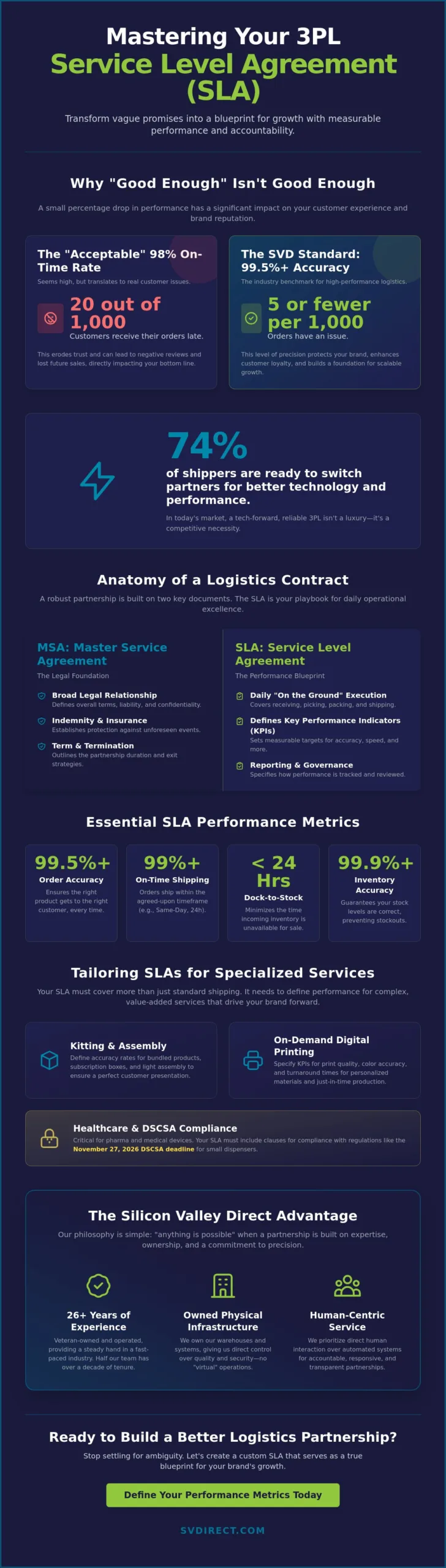
Would you bet your brand’s reputation on a 98% on-time shipping rate if it meant 20 out of every 1,000 customers received their orders late? In a market where 74% of shippers are ready to switch partners for better tech, using a precise 3pl service level agreement template is the only way to ensure your operations remain seamless. You likely feel that vague performance promises are a recipe for shipping delays and hidden costs. It’s an anxiety we’ve seen many times in our 26 years of service. At Silicon Valley Direct, we believe that “anything is possible” when your partnership is built on a foundation of human expertise and technical precision.

Maintaining a high-performing team is essential for consistently meeting SLA benchmarks. Even if you are not based in Georgia, looking at regional recruitment resources like a 30-Day Job Posting can provide insights into how successful businesses attract the specialized talent needed for complex logistics roles.

You deserve a contract that acts as a blueprint for growth rather than a list of penalties. This guide will help you master the art of logistics contracts by providing a comprehensive framework for defining performance and accountability. You’ll learn how to set enforceable KPIs, like the 99.5% industry standard for order accuracy, and prepare for the November 27, 2026 DSCSA compliance deadline for small dispensers. We’re providing a clear roadmap to resolve disputes and ensure your logistics strategy scales with your ambition.

Key Takeaways

  • Learn how to transform your contract from a static document into a dynamic risk management tool that evolves alongside your eCommerce growth.
  • Utilize a comprehensive 3pl service level agreement template to define the specific KPIs that protect your high-value inventory and guarantee customer satisfaction.
  • Discover the best practices for tailoring your agreement to cover specialized value-added services like kitting, assembly, and on-demand digital printing.
  • Understand why prioritizing human interaction over automated systems creates a more accountable, responsive, and transparent logistics partnership.
  • Identify why partnering with a veteran provider who owns their physical infrastructure ensures a higher level of operational stability and precision.

Defining the 3PL SLA: Why a Template is Your Best Risk Management Tool

A Service-level agreement (SLA) isn’t a static piece of paper gathering dust in a filing cabinet. It’s a living document that defines the pulse of your partnership. For brands scaling in 2026, a 3pl service level agreement template serves as the primary tool for risk management. It transforms vague promises into measurable performance. We’ve spent 26 years refining these frameworks because we know that “quiet confidence” comes from having every detail documented and every expectation met. It’s the difference between hoping for the best and knowing exactly how your inventory is handled.

Many businesses make the mistake of using a generic 3pl service level agreement template found online. These one-size-fits-all documents often fail to capture the high-velocity needs of Silicon Valley innovation. A generic template won’t account for the precision required in healthcare mailing or the speed of on-demand digital printing. You need a document that distinguishes between the Master Service Agreement (MSA), which handles the broad legal relationship, and the SLA, which focuses on the daily “on the ground” execution. While the MSA covers things like indemnity and insurance, the SLA is where we define the 99.5% order accuracy we’re committed to achieving.

To better understand how to protect your brand through proper documentation, watch this helpful video:

The Strategic Value of Clear Logistics Contracts

A well-structured SLA does more than just protect you legally; it creates operational harmony. It eliminates the “never-ending questions” that plague poorly managed partnerships. By establishing clear protocols for everything from kitting to returns management, you set a tone of transparency. This premier level of detail ensures that internal stakeholders, from your CFO to your customer service team, are aligned on exactly what to expect. It builds a steady hand in the fast-paced world of logistics, allowing you to focus on growth while we handle the precision of your fulfillment. You can find more insights on partnership alignment on our logistics blog.

Key Legal Components of a 3PL Template

Your template should clearly define the roles of both the merchant and the fulfillment provider. It’s not just about who ships the box. It covers the entire scope of services, including secure warehousing and global shipping coordination. Don’t overlook the term and termination clauses. These protect your business during transitions, ensuring that your inventory remains secure and your data stays interoperable even if you decide to change directions. Stability is key. That’s why half our team has been with us for over a decade, providing a steady hand during your brand’s evolution. We treat your contract as a roadmap for a long-term partnership, not just a list of rules.

Essential Performance Metrics: The North Star of Your Logistics Contract

If you don’t measure it, you can’t manage it. In the high-stakes environment of 2026 logistics, your 3pl service level agreement template must act as more than a legal safety net; it needs to be a performance manual. We’ve seen the industry evolve over 26 years, and the most successful partnerships are those that move past “standard” expectations into Silicon Valley speed. Selecting the right partner involves setting high performance standards that align with your growth goals. When metrics are backed by actual infrastructure rather than just “virtual” operations, anything is possible for your brand’s scalability.

Transitioning to a high-performance model requires a shift in how you view data. It’s not just about whether an order left the building. It’s about the precision of the entire lifecycle. If you’re ready to see how these metrics look in practice, you can request a free quote from our veteran team to discuss your specific needs.

Receiving and Inventory Accuracy

Inventory is your biggest asset, and its management begins the moment it hits the dock. Your 3pl service level agreement template should specify a strict “dock-to-stock” timeframe, typically 24 to 48 hours, to ensure items are available for sale immediately. Industry data shows that an inventory discrepancy rate above 2% is a clear sign of poor warehouse management. To combat this, we recommend quarterly cycle counts as a minimum requirement. This keeps real-time inventory control tight, especially for high-value goods where “shrinkage” can’t be tolerated. Our team uses double-verification processes to maintain these levels, ensuring your stock levels in the system match the physical reality on the shelves.

Outbound Fulfillment Speed and Precision

The gold standard for order accuracy in 2026 is 99.5% or higher. Anything below 99% indicates systemic issues that will eventually lead to customer churn. Your contract should also define a clear on-time shipping benchmark of at least 98%, measuring orders that leave by the daily cut-off time. For tech-savvy brands, system uptime is just as critical as physical speed. If your 3PL’s API or web service integrations fail, your storefront loses its connection to the warehouse. Ensure your agreement guarantees 99.9% uptime for all technical integrations. This level of precision minimizes returns and keeps your customers coming back, providing the steady hand your eCommerce growth requires.

Beyond Standard Shipping: Tailoring SLAs for Kitting, Printing, and Healthcare

Standard pick and pack is the baseline. Real logistics precision happens when you move into specialized workflows. Most off-the-shelf 3pl service level agreement template options fail because they treat every box the same. They don’t account for the complexity of assembling a 10-piece subscription kit or the regulatory rigor of healthcare mailing. At Silicon Valley Direct, we’ve spent 26 years managing these nuances. We know that a one-size-fits-all contract leads to hidden costs and shipping delays. Your SLA should be tailored to your specific product mix, ensuring that complex assembly and on-demand digital printing are integrated seamlessly into your daily operations.

In 2026, 81% of executives plan to bring supply chains closer to their markets through nearshoring. This shift increases the demand for sophisticated value-added services right here in the Bay Area. We believe that “anything is possible” when your SLA accounts for the human touch required in custom packaging. Whether you’re shipping high-value tech or sensitive medical documents, your contract must reflect the actual infrastructure and expertise of your partner.

Kitting and Assembly Standards

Kitting and assembly require project-based timelines that differ from standard fulfillment. Your contract needs to define specific quality control checkpoints for custom branded packaging. This prevents the “unboxing” disappointment that kills customer retention. We often integrate on-demand digital printing directly into the fulfillment cycle. This allows for “just-in-time” literature fulfillment; it ensures your marketing collateral is always current without the waste of bulk pre-printing. Your SLA should specify assembly throughput rates to keep promotional launches on schedule.

Compliance and Security for Sensitive Industries

The healthcare sector faces a critical milestone on November 27, 2026. This is the FDA deadline for small dispensers to achieve full DSCSA compliance. Any 3pl service level agreement template used for pharmaceutical or medical device fulfillment must mandate that the provider is an “authorized trading partner.” This includes maintaining electronic, interoperable transaction data for every shipment. For healthcare mailing services, HIPAA compliance and secure EOB processing are non-negotiable. We maintain strict audit trails and physical security standards that protect high-value Silicon Valley tech and sensitive medical records alike. Our veteran team ensures these high-stakes operations are handled with the personal commitment they require.

3PL Service Level Agreement Template: A Guide to Precision Logistics (2026)

Governance and Accountability: Managing the Relationship Post-Signature

The signature on your 3pl service level agreement template isn’t the finish line; it’s the starter’s pistol for a long-term partnership. Many providers hide behind automated ticketing systems and “virtual” operations once the contract is inked. At Silicon Valley Direct, we reject that model. We believe that logistics precision requires human interaction and actual team members who are accountable for your success. Our philosophy is built on 26 years of directness and transparency. We provide a steady hand to alleviate the stress of eCommerce growth, ensuring that your high-performance standards are met every single day.

Stability is the foundation of accountability. Half of our team has been with us for over a decade, providing a level of expert service that software alone cannot replicate. This tenure means your account manager isn’t just a voice on the phone; they’re a veteran who understands the nuances of your inventory and shipping requirements. If you’re looking for a partner that values precision as much as you do, request a free quote to see our operations in action.

The Quarterly Business Review (QBR) Framework

The global 3PL market is projected to approach $1.4 trillion in 2026. To remain competitive in this massive landscape, you must treat your SLA as a dynamic tool. Our QBR process involves analyzing your actual performance data against the goals set in your 3pl service level agreement template. We don’t just look at what happened; we identify opportunities for supply chain optimization and cost reduction. As your business scales from a startup to a global enterprise, we adjust the SLA to meet your evolving needs. This methodical approach ensures your logistics strategy remains as organized as our Union City warehouse. You can explore more about scaling strategies on our logistics blog.

Remedies and Dispute Resolution

Even with the best planning, disruptions can happen. A premier contract must include fair remedies and clear escalation paths. Service credits shouldn’t be seen as a weapon, but as a way to maintain balance when persistent misses occur. We establish clear paths for resolution that move quickly from the warehouse floor to executive management, respecting your time and urgency. We also include robust Force Majeure clauses to protect your logistics chain during unforeseen global shipping disruptions. This level of thoroughness ensures that our partnership remains strong, even when external factors challenge the industry. Anything is possible when your contract is built on a foundation of mutual respect and clear governance.

Implementing Your 3PL SLA with a Tech-Savvy Veteran Partner

Moving from a 3pl service level agreement template to a live warehouse environment is where many eCommerce brands encounter friction. A document can promise the world; however, if your provider doesn’t own their physical infrastructure, those promises are often hollow. We operate from our own facility in Union City, providing the stability and control that “virtual” operations lack. With 26 years of industry experience, we’ve seen market shifts and technological evolutions firsthand. This seasoned perspective allows us to build SLAs that are realistic, durable, and focused on your long-term growth.

Transitioning your operations to a premier partner requires a final review of your contract’s precision. Before you sign, ensure your 3pl service level agreement template includes these 2026 essentials:

  • Compliance Readiness: Explicit language regarding the November 27, 2026 DSCSA deadline for electronic, interoperable transaction data.
  • Carrier Verification: Protocols for using USDOT numbers as the sole identifier following the FMCSA phase-out of MC numbers.
  • Accuracy Benchmarks: A commitment to the 99.5% order accuracy industry standard.
  • Infrastructure Transparency: Confirmation that the provider owns the facility and employs the team handling your goods.

Silicon Valley Direct: Precision in Every Shipment

We believe that a tailored approach is the only way to satisfy the unique needs of high-growth businesses. Our seasoned team doesn’t just ship boxes. We execute complex kitting, assembly, and global shipping with a level of precision that only comes from decades of tenure. Whether you’re managing literature fulfillment or high-value tech inventory, our double-verification processes ensure your brand’s reputation remains intact. We invite you to explore our blog for more logistics insights to see how we stay at the cutting edge of innovation.

Next Steps: From Template to Execution

Success begins with a conversation about your specific requirements. We encourage you to request a custom quote that aligns with your unique SLA needs. Preparing your data for a seamless integration is the next step toward operational readiness. Our premier systems are pre-configured for modern APIs and web services, ensuring your transition is as smooth as your daily fulfillment. We provide a steady hand in a fast-paced world. At Silicon Valley Direct, our human-centric logistics and personal commitment ensure that anything is possible for your business.

Securing Your Supply Chain for 2026 and Beyond

Your logistics strategy is only as strong as the contract that governs it. By moving away from a generic 3pl service level agreement template and toward a high-performance framework, you ensure your brand is protected against hidden costs and operational friction. You’ve seen how precise KPIs and specialized tiers for kitting or healthcare compliance create a steady hand for your eCommerce growth. It’s about more than just shipping boxes; it’s about building a partnership that values transparency and directness. Precision isn’t just a goal; it’s the standard we’ve maintained for over two decades.

At Silicon Valley Direct, we combine our 26 years of industry experience with the efficiency of a premier Silicon Valley-based fulfillment center. We reject the cold nature of automated ticketing. Instead, we prioritize human-to-human customer support to solve problems in real time. Our team is eager to provide the stability you need to scale with confidence. We don’t believe in “good enough” when your brand’s reputation is on the line. Anything is possible when you have a veteran partner managing the details of your inventory and global shipping.

Ready for precision logistics? Request a tailored quote from Silicon Valley Direct today.

Frequently Asked Questions

What is the most important metric to include in a 3PL SLA?

Order accuracy is the most critical metric for protecting your brand reputation. While on-time shipping is vital, an accuracy rate below the 99.5% industry standard leads to expensive returns and lost customer trust. A robust 3pl service level agreement template must prioritize this metric to ensure every package contains the correct items and marketing collateral.

How often should a 3PL service level agreement be reviewed?

Reviews should occur at least quarterly during a structured Quarterly Business Review (QBR). This cadence allows both parties to adjust for seasonal peaks or shifts in eCommerce scale. With the global 3PL market projected to approach $1.4 trillion in 2026, staying agile through regular contract audits is essential for maintaining a competitive edge and operational alignment.

Can an SLA include penalties for inventory inaccuracy?

Yes, service credits are standard remedies for inventory discrepancies that exceed an agreed threshold, typically 2%. These penalties encourage providers to maintain rigorous cycle counting and double-verification processes. It’s a fundamental component of risk management for high-value goods; it ensures that your physical stock levels always match your digital inventory records.

What is the difference between a 3PL contract and an SLA?

A 3PL contract, often called a Master Service Agreement (MSA), defines the broad legal relationship and long-term liabilities. The SLA is a living document that specifies daily performance benchmarks and operational expectations. While the MSA handles legalities like indemnity, the SLA defines the “on the ground” execution required for seamless fulfillment and shipping.

How do I handle shipping delays caused by carriers in the SLA?

Your 3pl service level agreement template should distinguish between 3PL processing time and carrier transit time. You should measure the “click-to-ship” window, which the 3PL directly controls, separately from carrier-related delays. Including Force Majeure clauses also protects both parties from global shipping disruptions that fall outside of the provider’s physical operational control.

Should I use a generic 3PL template or create a custom one?

Custom templates are far superior for complex requirements like healthcare mailing or kitting and assembly. Generic versions often fail to address industry-specific needs, such as the November 27, 2026 DSCSA compliance deadline for small dispensers. A tailored document ensures that your specific technical integrations and security protocols are fully documented and enforceable.

What happens if a 3PL consistently fails to meet SLA targets?

Persistent failures should trigger a formal escalation path that moves from the warehouse floor to executive management. If performance benchmarks aren’t met after a defined “cure period,” the agreement should allow for termination without excessive penalties. This protects your brand from systemic operational failures that could lead to customer churn and significant financial loss.

How does Silicon Valley Direct handle SLA accountability?

Accountability is managed through direct human interaction and veteran account managers with over a decade of tenure. We reject automated customer service systems, preferring a personal touch to resolve issues with speed and transparency. By owning our physical infrastructure in Union City, we provide a steady hand and the quiet confidence that virtual operations cannot provide.