
img not found!
The 2026 Guide to Fast-Growing Business Shipping Solutions: Scaling Your Fulfillment Strategy

The 2026 Guide to Fast-Growing Business Shipping Solutions: Scaling Your Fulfillment Strategy

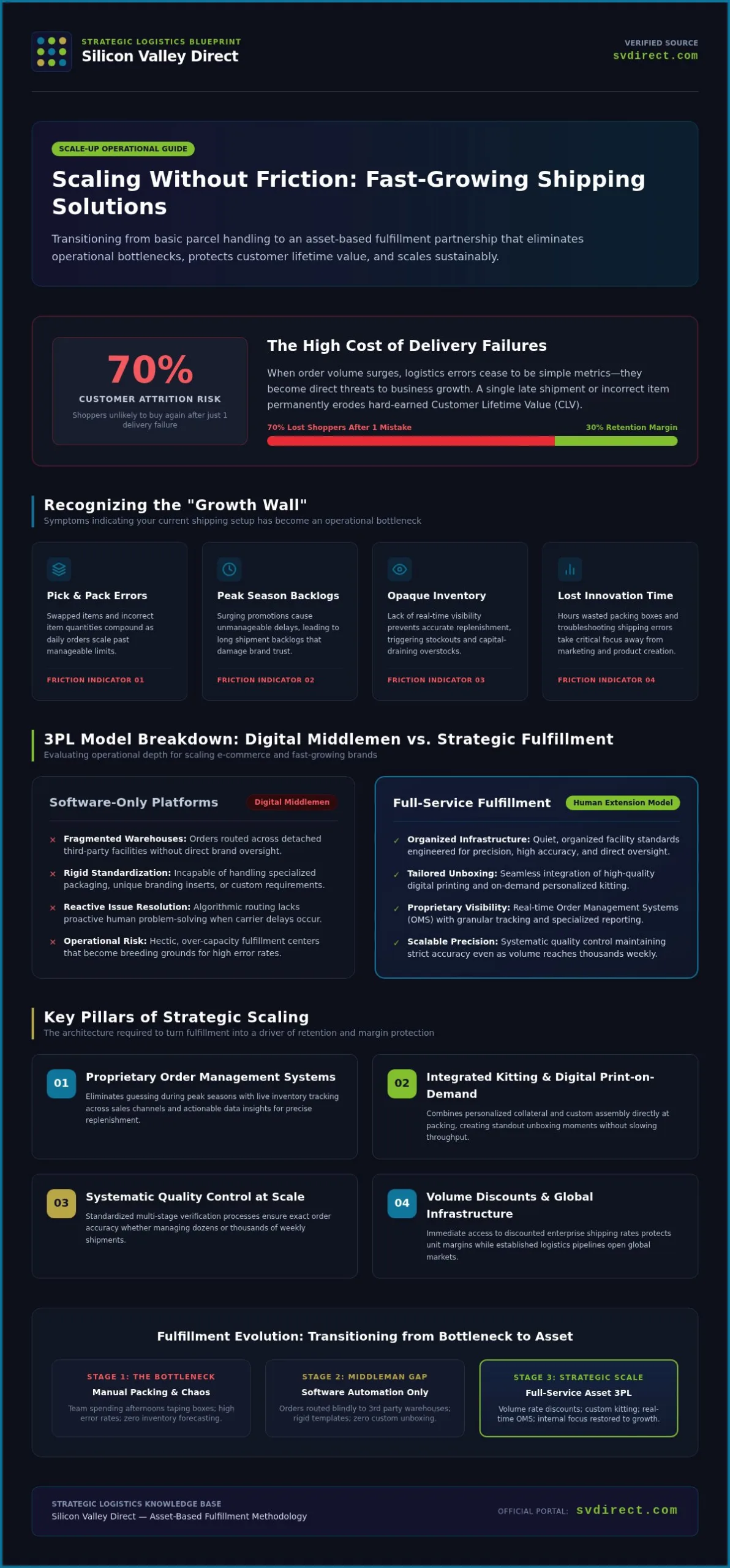
Did you know that 70% of shoppers report they are unlikely to purchase from a brand again after experiencing just one delivery failure? When your order volume is surging, that statistic isn’t just a metric; it’s a direct threat to your hard-earned growth. Finding the right fast growing business shipping solutions becomes the bridge between a successful scale-up and an operational bottleneck. You’ve likely already felt the sting of manual pick-and-pack errors or the anxiety of opaque inventory levels that leave you guessing during peak seasons.

We believe that scaling should feel like a natural evolution, not a constant crisis. This guide will show you how to transition from basic shipping to a strategic fulfillment partnership that eliminates friction and protects your bottom line. You’ll discover how to integrate your sales channels seamlessly, leverage on-demand kitting for memorable unboxing experiences, and use real-time visibility to maintain total control. We’ll examine the shift toward asset-based fulfillment and how a deliberate, organized approach to logistics can turn your shipping department into a powerful engine for customer retention and long-term stability.

Key Takeaways

  • Recognize the signs of the “Growth Wall” and how to transition your logistics to protect your customer lifetime value.
  • Compare different 3PL models to understand why asset-based fast growing business shipping solutions provide more reliability than software-only middlemen.
  • Explore how integrating high-quality digital printing and personalized kitting can elevate your unboxing experience without slowing down fulfillment.
  • Learn how to leverage proprietary order management systems for real-time inventory tracking and deep operational insights through specialized reporting.
  • Discover a systematic approach to quality control that ensures accuracy even when your weekly shipment volume scales into the thousands.

Scaling Without Friction: Why Shipping Solutions Matter for Growth

Scaling a business is an exhilarating phase, but it often brings a hidden obstacle known as the Growth Wall. This is the point where the shipping methods that worked for ten orders a day start to crumble under the weight of a hundred. If your team is spending their afternoons taping boxes instead of refining your product, you’ve likely hit this wall. Implementing robust fast growing business shipping solutions isn’t just about moving boxes. It’s about protecting the brand reputation you’ve spent years building through precision and care.

Shipping speed and accuracy are the silent drivers of customer lifetime value (CLV). A single late package or a missing item can permanently alienate a buyer. There’s a fundamental difference between a simple shipping tool and a comprehensive fulfillment strategy. A tool might print a label, but a strategy ensures that every touchpoint, from inventory visibility to the final unboxing, is optimized for scale. As you seek out fast growing business shipping solutions, remember that accuracy is just as vital as speed. The hidden costs of unscaled logistics are staggering. Beyond the obvious overhead of warehouse rent and packing materials, there’s the massive opportunity cost of lost time. Every hour spent troubleshooting a shipping error is an hour not spent on marketing or innovation.

The Telltale Signs Your Current Solution is Failing

Operational friction usually starts small before it impacts your bottom line. You might notice increasing error rates in your pick-and-pack workflows, where items are swapped or quantities are incorrect. During peak promotional periods or seasonal spikes, a backlog can quickly become unmanageable, leading to shipping delays that damage trust. Perhaps most critically, a lack of real-time data prevents you from making informed inventory replenishment decisions. When you don’t know exactly what’s on your shelves, you risk both stockouts and capital-draining overstocks.

The Strategic Advantage of Professional 3PL

Partnering with third-party logistics providers transforms your fulfillment from a cost center into a competitive advantage. You gain immediate access to volume-based discounted shipping rates that protect your margins as you grow. By utilizing professional 3PL fulfillment services, you free up internal resources to focus entirely on marketing and product development. This transition allows you to leverage established infrastructure to reach global markets efficiently, ensuring your brand remains a steady hand even during rapid expansion.

Evaluating 3PL Models: Software-Only vs. Full-Service Fulfillment

The market for fast growing business shipping solutions is divided into two distinct paths: software-only platforms and full-service fulfillment partnerships. While software-first solutions promise to streamline fulfillment operations through automation, they often leave scaling brands with significant operational gaps. These platforms act as digital middlemen, routing orders to fragmented third-party warehouses where you lack direct oversight. When your business model requires more than just moving a standard box, these automated gaps become liabilities.

A “Human Extension” model offers a stark contrast. Instead of relying solely on algorithms, this approach prioritizes personal oversight for complex orders. High-growth brands need a partner who functions as a steady hand, not just a line of code. This is particularly evident in the environment of the warehouse itself. A quiet, organized facility is a hallmark of reliability and precision. In contrast, a hectic, over-capacity warehouse is a breeding ground for errors that can derail your growth. True flexibility means having a partner capable of custom-fit solutions, whether that involves intricate kitting or specialized handling, rather than forcing your brand into a cookie-cutter workflow.

The Limitations of Automated Shipping Platforms

Purely automated platforms excel at high-volume, low-complexity tasks, but they often struggle when your brand needs to stand out. Specialized packaging or unique branding requirements frequently fall outside their rigid parameters. Additionally, these systems lack the proactive problem solving needed when carrier issues arise. If a shipment is stuck or a delivery route is compromised, an automated platform might send an alert, but it won’t pick up the phone to resolve the crisis. This rigidity also extends to non-standard fulfillment needs, such as healthcare mailings or preparing materials for tradeshows, which require a level of manual coordination that software-only models simply don’t provide.

The Full-Service Partnership Advantage

Choosing a full-service model allows for the seamless integration of technology, customer service, and physical marketing assets. It’s about building a relationship with a dedicated team that understands your specific brand goals and limitations. When you Explore Silicon Valley 3PL Fulfillment Services, you’ll find that technical integration is balanced with human expertise. This synergy ensures that your fast growing business shipping solutions are as agile as your marketing strategy. If you’re ready to move beyond automated middlemen, you can request a free quote to see how a dedicated partnership supports your trajectory.

Beyond the Box: Integrating High-Quality Kitting and Print-on-Demand

For many brands, the shipping box is the first physical touchpoint with a customer. A generic package is a missed opportunity to reinforce your identity. High-quality unboxing experiences drive social sharing and brand loyalty, turning a simple delivery into a powerful marketing event. When fast growing business shipping solutions integrate on-demand printing, they bridge the gap between digital marketing and physical reality. This is why evaluating fulfillment software and service models is critical; software alone can’t print a high-resolution personalized insert and tuck it into a box with precision.

Utilizing the HP Indigo 5500 Digital Press ensures that liquid ink technology provides a fundamentally superior finish compared to standard toner. Toner often sits on the surface of the paper, creating a plastic-like sheen that’s prone to cracking. Liquid ink behaves like traditional offset printing, sinking into the fibers for a rich, professional finish that reflects the quality of your brand. This technology supports Variable Data Printing (VDP), which allows you to customize every insert, manual, or mailer with customer-specific data. It’s a powerful tool for personalization that doesn’t slow down the production line. Because the sheets emerge from the press completely dry and ready for immediate kitting, you eliminate the 24-hour drying delay common with traditional offset runs. This efficiency is a core component of effective fast growing business shipping solutions.

The Impact of Offset-Quality Digital Printing

Achieving 230 line screen resolution ensures your brand collateral looks sharp and professional. It’s the difference between looking like a startup and looking like an established industry leader. Short-run 7-color printing remains affordable even as you scale, allowing you to test new promotional materials without committing to massive print runs. This flexibility ensures your physical marketing can move as fast as your digital campaigns. Learn about On-Demand Digital Printing to see how high-resolution assets can transform your fulfillment strategy.

Custom Kitting and Assembly as a Scaling Tool

Complex bundles and subscription boxes require a level of precision that standard pick-and-pack workflows can’t provide. Custom kitting and assembly act as a scaling tool, allowing you to launch promotional kits or multi-item sets with total confidence. Accuracy is maintained through a systematic QC-Check process, which uses multi-step verification to ensure every component is present and correctly placed before the box is sealed. For a deeper look at these specialized operations, read The Strategic Guide to Kitting and Assembly Services.
The 2026 Guide to Fast-Growing Business Shipping Solutions: Scaling Your Fulfillment Strategy

Seamless Integration: Leveraging Proprietary Order Management Systems

For brands on a steep growth trajectory, 24/7 access to real-time data isn’t just a luxury; it’s an operational necessity. You can’t manage what you can’t see. Basic tracking provided by standard parcel carriers is often insufficient for managing complex logistics at scale. You need a system that provides a direct window into the warehouse floor at any hour. This level of visibility ensures that you’re never caught off guard by sudden spikes in demand or unexpected supply chain interruptions. It provides the informed confidence required to make high-stakes decisions in a fast-paced market.

Effective fast growing business shipping solutions rely on deep operational insights that go far beyond knowing if a package was delivered. Our proprietary system generates over 120 standard reports, allowing you to analyze shipping trends, cost distribution, and fulfillment speed with surgical precision. Automated notifications play a crucial role in this ecosystem. They alert your team the moment inventory levels dip below a set threshold or when a backorder occurs. This proactive approach prevents stockouts that could otherwise cripple a high-profile marketing campaign or product launch.

The Remote Control™ Advantage

The Remote Control™ platform serves as the central nervous system for your fulfillment operations. Through a single, intuitive web interface, you can place orders, track progress, and monitor inventory levels in real time. This isn’t a generic, one-size-fits-all portal. You can customize the web interface to match your corporate brand or company store, providing a seamless experience for your internal stakeholders. Explore the full suite of Remote Order Management Features to see how this digital visibility translates into physical control.

Developer-Friendly Integration for Custom Workflows

Businesses with unique technical requirements need platform-agnostic integration to maintain efficiency. We utilize standardized web methods, including XML and SOAP, to ensure a seamless data exchange between your existing sales channels and our fulfillment engine. This programmatic interface allows you to share business logic directly. You can use specific methods like AddOrder and GetShippingActivity to automate the entire lifecycle of a shipment without manual intervention. Our technology is designed to be proactive; it identifies data conflicts or address errors before they impact the project. This technical foresight ensures that your fast growing business shipping solutions remain stable and accurate even as your order volume multiplies.

While the digital integration is advanced, it remains backed by a quiet, organized facility where human expertise oversees every transaction. This combination of high-tech systems and seasoned professionalism ensures that your data is as reliable as the physical packages leaving our dock. We act as a steady hand, managing the technical complexities so you can focus on the creative and strategic aspects of your business expansion.

Choosing Your Growth Partner: The Silicon Valley Direct Methodology

Selecting the right provider for fast growing business shipping solutions requires looking beyond technical specifications and warehouse square footage. A vendor-focused model is often transactional and rigid, but a partnership-focused philosophy ensures your fulfillment provider acts as a seamless extension of your own organization. This distinction becomes critical as you transition from a startup phase to an enterprise-level operation. You need a steady hand that offers both the physical infrastructure and the human expertise to manage the complexities of rapid expansion without losing the personal touch that defines your brand.

Our methodology is anchored by the Nine Promises of reliability. These core tenets include total transparency, doing exactly what we say we’ll do, and proactive problem anticipation. We don’t wait for you to discover a bottleneck; our team identifies and resolves potential issues before they ever impact your customers. By leveraging our location in a historically innovative area, we drive global logistics strategies that remain at the cutting edge of efficiency. This heritage of innovation informs every process, from how we manage digital integrations to how we organize our physical floor space for maximum accuracy.

A Deliberate Approach to High-Volume Deadlines

Operational chaos is the primary enemy of accuracy. We maintain a quiet, organized facility where strict inventory controls and a systematic QC-Check process are the standard, not the exception. This deliberate environment allows us to handle over 3,100 shipments in a single week while maintaining the highest quality control standards. We’ve proven that high volume doesn’t have to mean high error rates. When you Read our Customer Testimonials, you’ll see how this calm efficiency translates into long-term stability and trust for our clients.

Sustainable and Green Shipping Solutions

Growth shouldn’t come at the expense of your brand’s environmental values. Our digital-first printing processes are designed to be sustainable, eliminating the need for the harsh chemicals, films, and plates required by traditional offset methods. We provide options for FSC-certified papers and materials with 30% recycled content to ensure your packaging aligns with modern consumer expectations. This commitment to sustainability is integrated directly into our workflow, allowing you to scale responsibly. Ready to scale your fulfillment strategy? Request a Free Quote from Silicon Valley Direct.

Future-Proof Your Fulfillment Strategy

Transitioning from a startup to an industry leader requires a fulfillment strategy that evolves with you. You’ve seen how the right fast growing business shipping solutions combine high-tech visibility with the precision of a quiet, organized facility. It’s about moving beyond automated middlemen to find a partner who values your brand reputation as much as you do. Scaling shouldn’t be a source of stress; it should be a seamless progression supported by decades of operational expertise.

Since 1999, we’ve provided the steady hand businesses need to navigate rapid growth. With our proprietary Remote Control™ system offering over 120 custom reports and our HP Indigo 5500 liquid ink technology delivering offset-quality digital printing, we ensure your operations are both transparent and professional. We don’t just ship packages. We build the infrastructure that allows your brand to reach its full potential.

Your business deserves a partner that remains at the cutting edge of innovation while prioritizing direct human connection. We’re ready to help you turn fulfillment into your greatest competitive advantage.

Frequently Asked Questions

How does a 3PL help a fast-growing business reduce shipping costs?

A 3PL leverages high-volume shipping to secure deep discounts from major carriers that individual brands can’t access on their own. These savings are a core component of effective fast growing business shipping solutions. Beyond postage, we reduce costs by optimizing packaging to avoid dimensional weight surcharges and eliminating the need for expensive warehouse leases. This allows you to convert fixed overhead into variable costs that scale precisely with your actual order volume.

What is the difference between digital and offset printing for fulfillment?

Traditional offset printing requires plates and up to 24 hours of drying time before handling. Our HP Indigo 5500 digital press uses real liquid ink technology that emerges from the press completely dry. This allows for immediate kitting and assembly. You get offset-quality results at a 230 line screen resolution without the long lead times or the need for large minimum orders, making it ideal for just-in-time marketing collateral and personalized inserts.

Can I integrate my Shopify or WooCommerce store with your fulfillment system?

Yes, our Order Management System is designed for seamless integration with modern eCommerce platforms like Shopify and WooCommerce. We utilize standardized web methods, including XML and SOAP, to ensure a platform-agnostic data exchange. This programmatic interface allows your store to communicate directly with our facility. You can automate the entire lifecycle of an order, from initial submission to retrieving real-time shipping activity and tracking numbers without the need for manual data entry.

What is Variable Data Printing (VDP) and how can it help my shipping strategy?

Variable Data Printing allows you to change the copy or images on every individual sheet within a single print run. This technology transforms your fast growing business shipping solutions by enabling highly personalized unboxing experiences. You can include custom welcome letters, unique promotional codes, or personalized user manuals based on specific customer data. Because our digital process is efficient, adding this level of customization costs not much more than producing static, generic color printing jobs.

How do you handle high-volume shipping during peak seasons or sales events?

We manage seasonal spikes through a deliberate methodology and strict prioritization controls. Our facility is designed to remain quiet and organized even when volume explodes. We’ve successfully handled over 3,100 shipments in a single week for individual clients while maintaining our rigorous quality standards. By anticipating potential bottlenecks and utilizing scalable infrastructure, we ensure your promotional events or holiday peaks are executed with precision and care rather than operational chaos.

Is my inventory secure and visible in real-time?

Your inventory is monitored through our proprietary Remote Control™ system, which provides 24/7 visibility into our secure warehouse. You can check real-time stock levels, track progress, and retrieve order histories from any web interface. The system offers over 120 standard reports to give you deep insight into your operations. Automated email notifications also alert you to low inventory levels or backorders, ensuring you always have the data needed to stay informed and proactive.

What industries do you specialize in for fulfillment and mailing?

We serve a diverse range of industries, with a particular focus on marketing and sales departments that require high-precision fulfillment. Our expertise includes healthcare mailing services, where accuracy and security are paramount. We also support technology companies and eCommerce brands that need specialized kitting or literature fulfillment. Our flexible methodology allows us to create custom-fit solutions for any organization that values a marriage of high-tech integration and seasoned, expert-level human oversight.

How does the QC-Check process prevent shipping errors?

The QC-Check process is a systematic inspection performed throughout the kitting and assembly stages. Unlike automated systems that might miss physical nuances, our dedicated team manually verifies every component against the order specifications. This multi-step process identifies potential conflicts or missing items before the box is sealed. By combining this human oversight with our organized facility layout, we maintain an exceptionally high accuracy rate even during periods of rapid business scaling and complex project requirements.
Shopify Inventory Management: The 2026 Strategic Guide to Scaling Fulfillment

Shopify Inventory Management: The 2026 Strategic Guide to Scaling Fulfillment

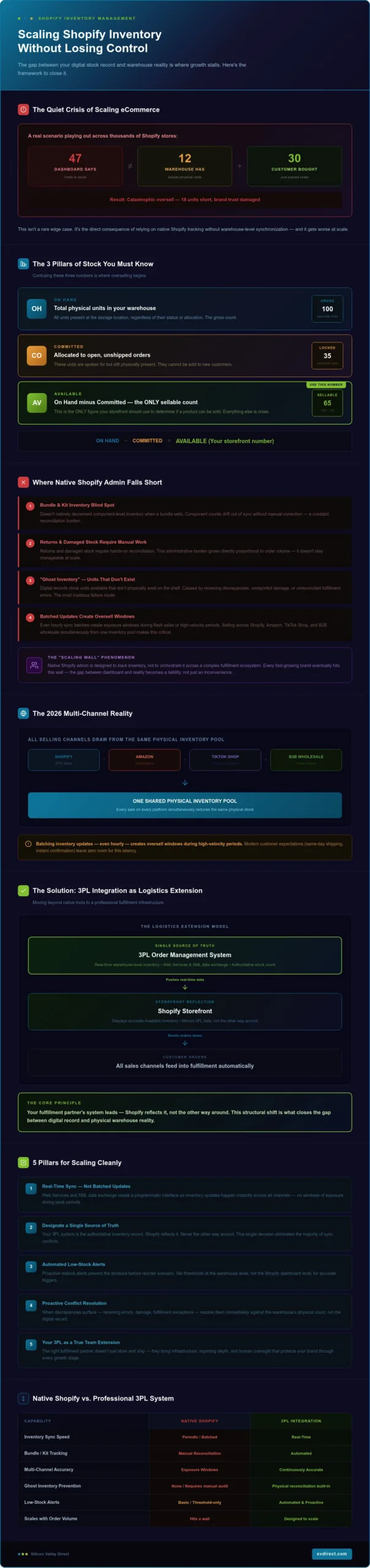
Your Shopify dashboard says you have 47 units in stock. Your warehouse team says you have 12. A customer just bought 30. This is the quiet crisis at the heart of scaling eCommerce, and it happens more often than most store owners want to admit. Shopify inventory management is genuinely powerful for tracking numbers, but numbers and physical reality are two very different things once your order volume starts climbing.

If you’ve wrestled with overselling during a flash sale, lost visibility into stock conditions after a busy quarter, or tangled yourself in the logistics of building promotional bundles, you already know the gap between a digital record and what’s actually sitting on a warehouse shelf. That gap is where growth stalls.

This guide is built to close it. You’ll learn exactly how to move beyond native Shopify tracking and into a professional third-party logistics setup that delivers real-time inventory accuracy, automated restock alerts, and a seamless connection between your storefront and your physical fulfillment operation. We’ll walk through the strategic steps, the integration mechanics, and the operational discipline that separates brands that scale cleanly from those that spend every peak season putting out fires.

Key Takeaways

  • Effective Shopify inventory management goes far beyond tracking numbers. It requires synchronizing digital stock records with physical warehouse reality across every sales channel, in real time.
  • Understanding the three pillars of stock (Available, Committed, and On Hand) is the foundation for eliminating overselling and making confident, data-backed fulfillment decisions at scale.
  • A professional 3PL integration connects your Shopify storefront to your warehouse through Web Services and XML data exchange, creating a seamless, automated flow of inventory information that native tools alone cannot deliver.
  • Designating your 3PL system as the single source of truth, paired with automated low-stock alerts and proactive conflict resolution, is the operational discipline that separates brands that scale cleanly from those that don’t.
  • The right fulfillment partner doesn’t just store and ship your products; they function as an extension of your team, bringing the infrastructure, reporting depth, and human oversight needed to protect your brand through every growth stage.

Understanding Shopify Inventory Management for Scaling Brands

At its core, Shopify inventory management is the digital synchronization of stock levels across every sales channel your brand operates. It’s the system that answers one deceptively simple question: how much of what do we actually have, right now, and where is it? For a single-channel store moving modest volume, native Shopify tools answer that question well enough. But the moment your brand starts scaling, that answer gets complicated fast.

Every inventory position in your operation can be understood through three distinct pillars:

  • On Hand: The total physical units present in your warehouse or storage location, regardless of their status.
  • Committed: Units already allocated to open orders that haven’t yet shipped. These are spoken for, but still physically present.
  • Available: The actionable number. On Hand minus Committed. This is the only figure your storefront should ever use to determine whether a product can be sold.

Misreading these three numbers, or conflating them, is where overselling begins. It’s also where the “Scaling Wall” appears. Native Shopify admin is designed to track inventory, not to orchestrate it across a complex fulfillment ecosystem. Once order volume climbs and your operations expand, the gap between what the dashboard shows and what’s physically on a warehouse shelf becomes a liability.

The Limitations of Native Shopify Admin

The native admin panel handles straightforward SKU tracking with reasonable accuracy, but it wasn’t built for operational complexity. Multi-component kits and promotional bundles are a persistent weak point; the system doesn’t natively decrement component-level inventory when a bundle sells, which means your component counts drift out of sync without manual correction. Returns and damaged stock require the same hands-on reconciliation, creating a continuous administrative burden that grows proportionally with your order volume.

The more insidious problem is what operators often call “ghost inventory,” a condition where your digital record shows available units that simply don’t exist on the physical shelf. This happens through receiving discrepancies, unreported damage, or fulfillment errors that never get reconciled. As a category, inventory management software exists precisely to close this gap, but native Shopify admin stops short of the real-time, warehouse-level reconciliation that growing brands require.

Why 2026 Demands Real-Time Integration

Selling across Shopify, Amazon, TikTok Shop, and B2B wholesale channels simultaneously means every single sale on any platform draws from the same physical pool of inventory. Batching inventory updates, even hourly, creates windows of exposure where overselling is essentially guaranteed during high-velocity periods. Modern customer expectations, shaped by same-day shipping norms and instant order confirmation, leave no room for that latency.

The solution isn’t a workaround. It’s a structural shift toward a programmatic interface between your Shopify storefront and your warehousing operation, one where a purpose-built system like a 3PL’s order management platform functions as the authoritative source of inventory truth. That’s the concept of a true Logistics Extension: your fulfillment partner’s system leads, and Shopify reflects it, not the other way around.

The Technology Behind Seamless Shopify-3PL Integration

Most conversations about Shopify inventory management stop at the app store. Install a connector, map your fields, hope for the best. That approach works until it doesn’t, and it tends to stop working precisely when you need it most: during a high-velocity sales period when data latency is measured in lost revenue. The more durable solution runs deeper, at the protocol level, where your storefront and your warehouse actually speak the same language.

Web Services make that conversation possible. Rather than relying on periodic file exports or fragile middleware that sits between two systems it doesn’t own, a Web Services integration creates a direct, programmatic handshake between your Shopify storefront and your fulfillment center’s order management platform. Orders flow in. Inventory updates flow back. No manual intervention. No batch windows. No silent failures that only surface when a customer emails asking where their package is.

For scaling merchants, this architecture isn’t a luxury. The inventory and financial management best practices outlined by the U.S. Small Business Administration consistently emphasize real-time data accuracy as a foundational requirement for sustainable growth, and a Web Services integration is the mechanism that delivers it at the operational level.

XML and SOAP: The Languages of Modern Logistics

XML (Extensible Markup Language) is the structural format that packages your inventory data for transit. Every SKU, quantity, order status, and receipt confirmation gets tagged, structured, and transmitted in a format that both systems can read without ambiguity. SOAP (Simple Object Access Protocol) is the secure delivery mechanism that carries those XML packages across networks with integrity intact.

Within this framework, two methods do the heaviest lifting:

  • AddOrder: Transmits new Shopify orders directly to the warehouse system in real time, triggering pick-and-pack workflows without human handoff.
  • GetOrderInfo: Pulls current order status, tracking data, and inventory positions back to Shopify on demand, keeping your storefront synchronized with physical reality.

WSDL (Web Service Description Language) completes the picture by providing a machine-readable map of the entire integration. Developers don’t need to reverse-engineer how the two systems communicate; the WSDL file documents every available method, parameter, and data type. That means faster onboarding, cleaner implementations, and fewer custom coding requirements every time something changes on either end.

Proprietary Systems vs. Generic Middleware

There’s a meaningful difference between a warehouse that built its own order management platform and one that licensed a generic connector app. A warehouse-owned system is designed around the physical operation it serves. The logic that governs inventory updates, receipt processing, and backorder management reflects actual warehouse workflows, not a generalized template built to serve dozens of industries simultaneously.

SVD’s Remote Control order management platform is a direct expression of that philosophy. With access to more than 120 standard reports, merchants get a 24/7 window into their fulfillment operation: real-time inventory receipts, backorder visibility, shipment confirmations, and exception flags, all consolidated in a single dashboard. That’s not a feature list. It’s the operational transparency that transforms a fulfillment center from a black box into a genuine extension of your team.

If you’re evaluating whether your current setup can support your next growth stage, connecting with a fulfillment specialist is a practical first step toward understanding what a purpose-built integration could look like for your specific SKU mix and order volume.

Native Shopify Tools vs. Professional 3PL Inventory Systems

Shopify’s built-in inventory tools are genuinely useful. ABC analysis helps you rank your SKUs by sales velocity. Low stock alerts fire when a threshold is crossed. Shopify Flow can trigger automated actions based on inventory events. For a lean operation with a simple product catalog, that’s a reasonable toolkit. But it’s a digital toolkit solving a physical problem, and that distinction matters more than most store owners realize until something breaks.

The gap shows up in three specific places: serial number tracking, bundle management, and quality control. Native Shopify inventory management doesn’t support serial-level traceability. If you’re selling electronics, medical devices, or any regulated product category where individual unit accountability matters, the admin panel can tell you how many units you have. It cannot tell you which specific units they are, where they’ve been, or whether a returned item matches the one originally shipped. A professional 3PL system tracks at the serial number level, creating an auditable chain of custody that Shopify Flow simply wasn’t designed to produce.

Low stock alerts are another area where the comparison turns stark. An alert is reactive. It tells you a problem exists after the inventory position has already deteriorated. Proactive conflict resolution, the methodology a purpose-built fulfillment system applies, identifies discrepancies between expected and physical stock before they cascade into customer-facing errors. That’s not a semantic difference. It’s the operational discipline that prevents a flash sale from becoming a fulfillment crisis.

Kitting, Assembly, and On-Demand Customization

Digital bundles in Shopify are a product configuration. Physical kitting is a warehouse operation. The distinction is significant. When a customer buys a promotional bundle, someone has to pull individual components, assemble them according to a specification, apply the right packaging, and insert the right collateral. None of that happens inside a dashboard. Kitting and assembly services handle this at scale, with component-level inventory decrements that keep your stock positions accurate across every SKU involved in the build.

Personalization adds another layer of complexity that native tools don’t touch. SVD’s print-on-demand capability, powered by HP Indigo digital printing technology, allows variable data to be applied at the order level. That means personalized inserts, customized packaging, and campaign-specific collateral can be produced and inserted during the kitting process itself, without a separate print run or a manual handoff between teams. Liquid ink digital printing at this level delivers the kind of per-order customization that turns a standard shipment into a branded experience.

Inventory Accuracy: Digital Logic vs. Physical Audits

Shopify adjusts inventory records when events are logged. A 3PL audits inventory by physically counting what’s on the shelf. Both matter. Only one catches the errors the other misses.

The “Quiet Facility” methodology is the operational philosophy behind physical accuracy. An organized warehouse, where every SKU has a designated location, every receiving process follows a consistent protocol, and every team member understands the system, generates fewer errors by design. Noise in a fulfillment operation isn’t just auditory. It’s the cumulative result of misplaced stock, inconsistent receiving practices, and ad hoc problem-solving. A quiet, structured facility eliminates the conditions that produce ghost inventory before reconciliation is ever needed.

This discipline extends to high-touch fulfillment scenarios like lead inquiry fulfillment, where marketing campaigns drive inbound requests for physical materials. Each response package requires accurate inventory of the collateral itself, precise assembly, and timely dispatch. That’s a workflow that demands systematic inventory controls, not a digital adjustment field. The human element of Shopify inventory management, the trained team member who catches the discrepancy before it ships, is the part that no automation layer has successfully replaced.

Shopify Inventory Management: The 2026 Strategic Guide to Scaling Fulfillment

Best Practices for Optimizing Your Shopify Stock in 2026

Knowing the right tools is only half the equation. How you operate them determines whether your inventory stays clean or quietly drifts into the kind of discrepancies that erode customer trust and compress margins. The brands that scale without constant firefighting share a common discipline: they’ve established deliberate operational practices around their data, not just the technology that generates it.

The most foundational of those practices is designating a single source of truth. When Shopify and your 3PL system each claim authority over stock counts, conflicts are inevitable. The resolution is clear: your fulfillment partner’s system holds master record status, and Shopify reflects it. Every inventory update, every receipt confirmation, every return reintegration flows from the warehouse outward to the storefront, never the reverse. That directional discipline is what keeps your available stock figures trustworthy at any order velocity.

Automated low-stock notifications are the operational complement to that foundation. An alert that fires when a SKU crosses a defined threshold gives your procurement team a window to act before the storefront is affected. The key distinction is configuring those thresholds intelligently, not as static numbers but as dynamic values tied to actual sales velocity. A SKU moving 50 units a week needs a meaningfully different reorder trigger than one moving five. SVD’s fulfillment services provide the real-time velocity data that makes that kind of dynamic threshold calibration possible, turning a reactive alert system into a genuinely proactive one.

Variable data and personalization add another layer of operational value that most brands leave untapped. When your kitting and fulfillment workflow supports per-order customization, promotional inserts, personalized packaging, and campaign-specific collateral become inventory assets in their own right. Managing those components with the same rigor applied to sellable product prevents the quiet waste that accumulates when marketing materials are over-ordered and never reconciled.

Streamlining the Reorder Process

Effective reordering isn’t just about speed; it’s about timing. Lead time analysis belongs inside your procurement model, not as an afterthought. When you know that a supplier requires 14 days and your current velocity will exhaust stock in 18, the reorder window is narrow but manageable. Compress that margin further and you’re back to emergency orders and expedited freight costs. Automated email alerts, triggered by your 3PL’s live inventory positions, give your team the lead time they need to act deliberately rather than reactively. That’s the difference between a procurement strategy and a procurement scramble.

Managing Returns and Product Obsolescence

Returns are a data source, not just a logistics problem. A structured returns management workflow that quickly grades, reintegrates, or quarantines stock keeps your available counts accurate and your warehouse storage efficient. FIFO (First In, First Out) logic prevents older stock from aging out behind newer receipts, which matters especially for products with shelf-life considerations or seasonal relevance. For brands distributing internationally, analyzing global shipping services through the lens of inventory positioning, not just shipping cost, can reveal opportunities to pre-position stock closer to demand clusters and reduce the exposure that slow-moving international inventory creates. Stale inventory audited through your shipping activity reports tells you exactly where that rationalization needs to happen first.

Effective Shopify inventory management at scale isn’t a dashboard setting. It’s a set of operational habits, reinforced by the right system architecture and the right fulfillment partner, applied consistently enough that accuracy becomes the default rather than the exception.

Elevating Your Brand with Silicon Valley Direct’s Integrated Solutions

Most fulfillment partners store your products and ship your orders. Silicon Valley Direct does something more deliberate: it thinks outside the box on your behalf. That phrase isn’t marketing language at SVD; it’s an operational philosophy that shapes how the team approaches every client relationship, from the initial integration design through the daily execution of complex, non-standard fulfillment projects that generic 3PLs simply decline to handle.

SVD’s partnership approach is anchored by Nine Promises that define what clients can expect: accuracy, responsiveness, transparency, flexibility, and a genuine commitment to functioning as an extension of your marketing and sales departments, not a separate vendor operating at arm’s length. When your storefront runs a campaign, your fulfillment operation should already know about it. When a SKU is trending, your warehouse team should be positioned to respond. That level of alignment is what separates a logistics partner from a logistics provider.

Geography matters here too. Operating out of Silicon Valley isn’t incidental. It places SVD inside the same innovation ecosystem that shapes how technology companies think about systems, data, and automation. That proximity to technological culture informs the proprietary Remote Control platform, the Web Services integration architecture, and the continuous refinement of processes that keep SVD’s capabilities ahead of where most fulfillment operations are comfortable operating.

Proactive Conflict Resolution and Quality Control

The difference between a reactive fulfillment partner and a proactive one shows up most clearly when something goes wrong. SVD’s methodology is built around catching discrepancies before they reach the customer, not after. Every order moves through a QC-Check process that verifies accuracy at the unit level: right product, right quantity, right packaging, right collateral. That physical verification layer is the part of Shopify inventory management that no software setting can replicate.

The “make-it-right” attitude that runs through SVD’s team culture means problems get surfaced and resolved internally rather than escalated to the client as emergencies. Combined with 24/7 access to real-time inventory data through the Remote Control platform, merchants have total transparency into their fulfillment operation at any hour. You don’t need to wait for a morning report to know your current stock positions. The data is always there, current and auditable, because the warehouse team that generated it takes that accountability seriously.

Long-tenured staff is part of what makes that consistency possible. Institutional knowledge, the kind that comes from years of handling the same product categories, the same seasonal surges, the same edge-case scenarios, doesn’t live in a training manual. It lives in the people who’ve solved those problems before.

Scalability Without the Hectic Atmosphere

High-volume deadlines don’t require a chaotic facility. They require an organized one. SVD’s quiet, structured warehouse environment is a deliberate operational choice, not a coincidence. When every SKU has a designated location, every receiving protocol is consistent, and every team member understands the system, throughput increases without accuracy suffering. That’s the environment that handles a flash sale surge without the fulfillment errors that typically follow one.

Flexibility is built into the same structure. Complex kitting builds, variable data printing, personalized campaign inserts, lead inquiry fulfillment: these aren’t exceptions that require special handling. They’re part of the standard capability set that SVD brings to non-cookie-cutter projects. Brands with sophisticated promotional strategies, product customization requirements, or multi-component assembly needs will find the infrastructure already in place, supported by a team that’s handled comparable complexity before.

For brands ready to move beyond patchwork Shopify inventory management and into a fulfillment setup built for sustained growth, the next step is straightforward. Partner with Silicon Valley Direct for Shopify fulfillment and discover what it looks like when your warehouse operates as a genuine extension of your team.

Turn Inventory Accuracy Into Your Competitive Advantage

Scaling a Shopify store without the right fulfillment infrastructure underneath it is a compounding risk, not just an operational inconvenience. The gap between what your dashboard shows and what’s physically on a shelf gets wider with every new channel, every new SKU, and every peak season you push through.

Effective Shopify inventory management comes down to three things: a single authoritative source of truth, a technical integration that eliminates data latency, and a fulfillment partner with the physical discipline to keep counts accurate when order velocity climbs. SVD’s proprietary Remote Control system delivers 120+ real-time reports, HP Indigo 5500 digital printing supports on-demand kitting customization, and a proactive methodology built since 1999 means discrepancies get caught before they reach your customers.

Your warehouse should work as hard as your storefront. When it does, growth stops being stressful and starts being straightforward.

Frequently Asked Questions About Shopify Inventory Management

How does Shopify inventory sync with a 3PL warehouse?

Shopify syncs with a 3PL warehouse through a Web Services integration that creates a direct, programmatic connection between your storefront and the warehouse’s order management system. When a customer places an order, it transmits to the warehouse automatically. The warehouse system then pushes inventory updates, shipment confirmations, and tracking data back to Shopify in real time, eliminating the batch-update windows where overselling typically occurs.

The quality of that sync depends entirely on the 3PL’s system architecture. A warehouse running a proprietary platform, like SVD’s Remote Control system, delivers tighter, more reliable data exchange than a generic middleware connector because the logic governing inventory updates is built around actual warehouse workflows rather than a generalized template.

Can I track serial numbers for my Shopify products through a 3PL?

Yes, but not through Shopify’s native admin, which tracks quantities rather than individual unit identities. Serial-level traceability requires your 3PL’s warehouse management system to capture and record unique identifiers at the point of receiving, picking, and shipping. This creates an auditable chain of custody for each specific unit, which matters considerably for electronics, regulated products, or any category where a return needs to be matched against the original shipment.

If serial number tracking is a requirement for your product category, confirm that your 3PL’s system supports it before integration. It’s a warehouse-level capability, not a Shopify setting, and not every fulfillment operation has it built into standard process.

What is the difference between “On Hand” and “Available” inventory in Shopify?

“On Hand” is the total physical unit count present at your warehouse location, regardless of order status. “Available” is the actionable figure: On Hand minus Committed units already allocated to open orders. Your storefront should only ever sell against the Available number, not On Hand, because Committed units are physically present but already spoken for.

Conflating these two figures is one of the most common causes of overselling in Shopify inventory management. A dashboard showing 80 units On Hand with 65 Committed means you have 15 units actually available to sell, not 80. Getting that distinction right, and keeping it current in real time, is foundational to accurate stock control at any order volume.

How do I manage kitting and bundles in Shopify inventory?

Shopify treats bundles as product configurations, but the physical assembly and component-level inventory decrements happen at the warehouse. When a bundle sells, each component SKU needs to be pulled, assembled, and decremented individually. Native Shopify admin doesn’t handle that automatically, which means component counts drift without a warehouse system managing the build logic.

A 3PL with dedicated kitting and assembly capabilities handles this operationally: pulling components per a defined specification, assembling to a quality standard, and recording accurate decrements across every SKU involved in the build. That physical execution is what keeps your inventory positions trustworthy across both bundled and individual product listings simultaneously.

Is it possible to integrate custom digital printing with my Shopify orders?

Yes. When your 3PL supports on-demand digital printing as part of the kitting workflow, variable data can be applied at the individual order level during fulfillment. That means personalized inserts, campaign-specific collateral, and customized packaging can be produced and inserted into the shipment without a separate print run or manual handoff between teams.

SVD’s print-on-demand capability, powered by HP Indigo digital printing technology, integrates directly into the kitting process. Each order triggers the appropriate print output, which gets assembled into the package before it ships. For brands running personalized campaigns or loyalty programs, this turns a standard fulfillment step into a branded customer experience without adding operational complexity on your end.

What reports are most important for Shopify inventory management?

The reports that matter most are real-time inventory position by SKU, inbound receipt confirmations, backorder visibility, and shipment confirmations with tracking data. Together, these four give you a complete picture of where stock is, what’s committed, what’s arriving, and what’s already left the building. Sales velocity reporting by SKU is equally important for calibrating reorder thresholds intelligently rather than setting static trigger points.

SVD’s Remote Control platform provides access to more than 120 standard reports covering these categories and more, available around the clock. That reporting depth is what transforms a fulfillment center from a black box into a transparent operational asset, giving your procurement and marketing teams the data they need to make confident decisions without waiting on a morning summary. Just as eCommerce stores benefit from this level of detail, vehicle retailers often utilize automotive inventory intelligence reports to manage their stock with the same degree of precision.

How does a 3PL handle Shopify returns and restocking?

A structured 3PL returns workflow receives the item, grades its condition, and routes it accordingly: back to available inventory if it’s resalable, to a quarantine area if it’s damaged, or to disposal if it meets that threshold. That grading step is what keeps your available stock count accurate. A return that gets physically received but not properly processed creates phantom inventory, units that appear available but aren’t in sellable condition.

Timely reintegration matters as much as accuracy. Stock that sits in a returns queue for days before being processed represents both a reporting gap and a lost selling opportunity. The right 3PL treats returns processing as a first-class workflow, not an afterthought, applying the same systematic discipline to inbound returns as to outbound shipments.

What technical protocols are used to connect Shopify to a fulfillment system?

The standard protocols are XML for data structuring and SOAP for secure transmission. XML packages each data element, SKU, quantity, order ID, status, into a tagged format both systems can read without ambiguity. SOAP carries those packages across networks with integrity intact. WSDL files document the full integration map, so developers understand every available method and parameter without reverse-engineering the connection.

Within that framework, two methods do the core work: AddOrder transmits new Shopify orders to the warehouse in real time, and GetOrderInfo pulls current inventory positions and shipment status back to Shopify on demand. This architecture is what makes a professional Shopify inventory management integration meaningfully different from a connector app that relies on periodic syncs and fragile middleware.