



Global Shipping Services: The Strategic Reference Guide for 2026
What if the logistics strategy that carried your business through 2025 is now the very thing stalling your growth? With the U.S. de minimis threshold suspended and a 10% global surcharge now in effect, the old rules for global shipping services have been completely rewritten. You’re likely feeling the pressure of these shifting regulations, alongside unpredictable fuel surcharges that can climb as high as 38.5% when energy prices spike. It’s a complex environment where traditional methods often lead to stalled inventory and depleted margins.
We understand that managing international logistics feels like a constant battle against customs documentation and hidden fees. This guide is here to help you reclaim control. You’ll learn how to transform these operational hurdles into a scalable growth engine by mastering modern compliance and real-time visibility. We’ll analyze the shift toward a shipper’s market, the impact of Section 122 surcharges, and how precision-led fulfillment keeps your business agile in an era of unprecedented change.
Key Takeaways
- Learn why modern global shipping services require a shift from simple freight forwarding to an integrated 3PL model that combines physical transport with sophisticated digital oversight.
- Discover how to leverage the digital layer of logistics, including API integrations and real-time tracking, to eliminate blind spots in your international inventory.
- Master the essential documentation requirements, from commercial invoices to certificates of origin, to navigate the evolving complexities of international customs with precision.
- Identify high-efficiency shipping lanes and learn how to utilize strategic 3PL carrier relationships to access volume discounts that protect your profit margins.
- Understand the competitive advantage of partnering with a logistics provider that blends high-tech Silicon Valley innovation with direct human oversight and personal commitment.
What Are Global Shipping Services in the Modern Economy?
At its core, global shipping services represent the end-to-end movement of goods across international borders. It’s a complex dance of physical transport, regulatory compliance, and digital intelligence. In 2026, this isn’t just a back-office utility; it’s a front-line competitive advantage. For eCommerce brands, a robust global shipping network provides the infrastructure needed to reach customers in emerging markets without sacrificing delivery speed or reliability.
To better understand how these systems interact within international trade, watch this helpful video:
The Evolution of International Logistics
Logistics has moved far beyond the era of analog freight forwarding. Digital transformation has replaced manual spreadsheets with smart automation and real-time API integrations. We leverage Silicon Valley innovation to streamline supply chains, ensuring that data moves as fast as the cargo itself. While automation handles the repetitive tasks, the human element remains our most valuable asset. Technology provides the data, but seasoned experts provide the intuition needed to manage unexpected geopolitical shifts or port congestions. This synergy between high-tech tools and human oversight ensures your growth remains steady even when the global market is volatile.
Key Players in the Global Shipping Ecosystem
Understanding the distinction between carriers, freight forwarders, and 3PL providers is essential for a scalable strategy. Carriers own the ships and planes. Freight forwarders act as intermediaries. However, an integrated 3PL acts as the operational quarterback for your entire supply chain. They don’t just book space. They manage everything from warehousing and distribution to returns management. They coordinate with customs brokers to ensure your documentation is flawless, preventing costly delays at the border.
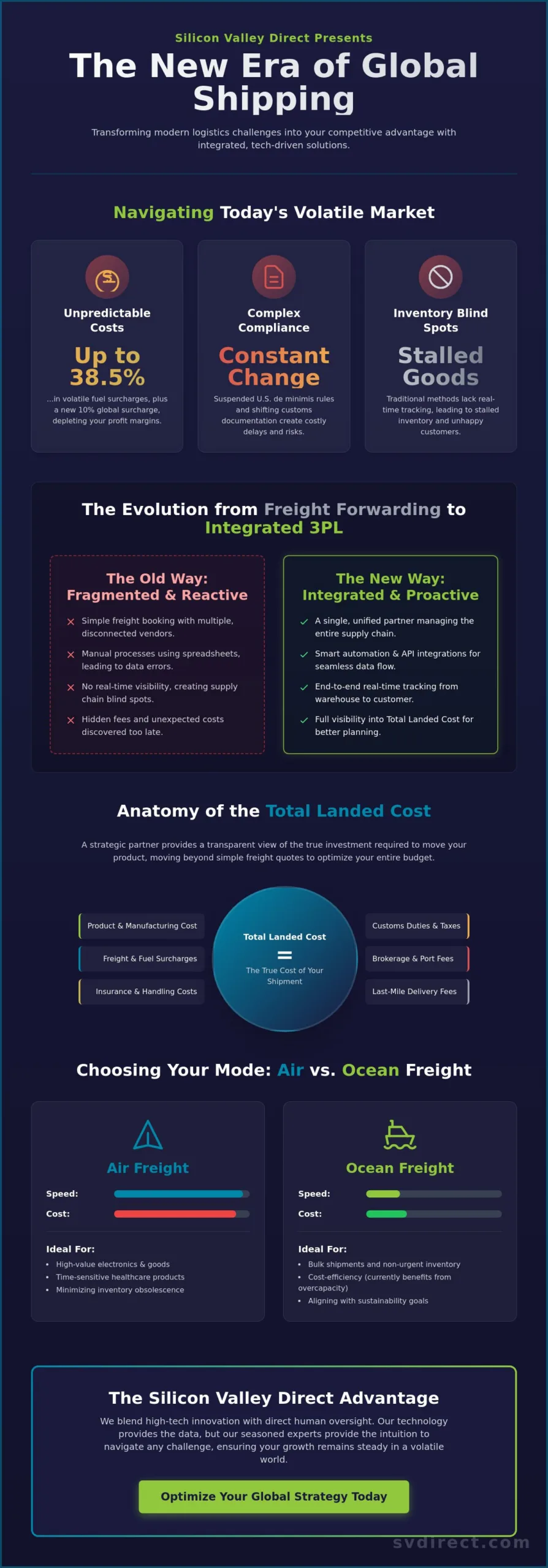
A primary metric for success in this modern ecosystem is the “Total Landed Cost.” This goes beyond the initial freight quote. It provides a transparent view of the true investment required to move product. Key components include:
- Original product cost and manufacturing fees.
- International freight charges and fuel surcharges.
- Customs duties, taxes, and brokerage fees.
- Insurance and handling costs.
- Last-mile delivery to the final customer.
By focusing on this comprehensive figure, you can identify the most cost-effective shipping lanes. A strategic partner helps you leverage carrier relationships to access deep volume discounts, ensuring you get the most value from your global shipping services while protecting your margins as you scale.
The Core Components of Comprehensive Global Logistics
Effective global shipping services aren’t just about moving containers from one port to another. They represent a sophisticated integration of physical infrastructure and digital intelligence. While many providers focus solely on freight forwarding, a strategic partner looks at the entire lifecycle of a shipment. This includes everything from secure warehousing in global distribution hubs to the final mile of delivery. By treating logistics as a unified system, you can eliminate the silos that traditionally lead to delays and increased costs.
Air vs. Ocean Freight: Choosing the Right Speed
Selecting the appropriate mode of transport is a balance of cost, speed, and product requirements. Air freight remains the gold standard for high-value electronics and healthcare products where speed is non-negotiable. It minimizes the risk of inventory obsolescence and ensures that sensitive materials reach their destination in peak condition. Conversely, ocean freight is currently benefiting from significant vessel overcapacity in 2026. This oversupply has put downward pressure on spot rates, making it an ideal choice for bulk shipments and non-urgent inventory. Modern ocean strategies also align with sustainability goals, as the industry continues to adhere to the IMO 2020 sulfur cap, which limits sulfur content in fuel oil to 0.50%.
The Digital Layer: Visibility and Status Tracking
In the modern economy, data is just as important as the physical cargo. The digital layer of your supply chain provides the transparency needed to manage customer expectations and inventory levels. Real-time tracking and API integrations allow you to monitor shipments at every stage. This visibility is crucial when interpreting complex updates, such as the batch delivery to carrier meaning, which indicates a shipment has been processed and is awaiting pickup by the final transporter. When your inventory management software connects directly to your global shipping services, you gain a proactive stance that prevents stockouts across different regions. This level of precision is a hallmark of Navigating International Trade in a tech-driven market.
Beyond simple transport, the physical handling of goods within a 3PL facility adds immense value. For example, kitting and assembly services allow for product localization just before the final shipment. This means you can customize packaging or insert region-specific literature without maintaining separate inventories in every country. If you’re ready to see how these components can work for your business, you can consult with our logistics experts to build a bespoke strategy. This approach ensures your global reach is backed by both physical reliability and high-tech efficiency.
Navigating International Trade: Customs, Compliance, and Documentation
Many businesses view international customs as an impenetrable nightmare. It doesn’t have to be. While the regulatory environment has grown more complex, especially with the U.S. de minimis threshold suspension that took effect on August 29, 2025, clear documentation remains the ultimate antidote to delays. Every successful shipment relies on a precise triad of records: commercial invoices, packing lists, and certificates of origin. When these documents are accurate, your global shipping services operate with the efficiency of a well-run facility. Accuracy prevents the friction that leads to stalled inventory and frustrated customers.
Understanding the division of responsibility is equally vital. In the modern eCommerce era, choosing between DDP (Delivered Duty Paid) and DAP (Delivered at Place) defines your brand’s relationship with the end consumer. DDP is often the preferred choice for brands acting as a strategic partner for global success. It ensures the customer isn’t surprised by unexpected fees at their doorstep. By handling these complexities on the back end, you provide a seamless experience that mirrors the reliability of domestic shipping.
Understanding Duties, Taxes, and Tariffs
Calculating duties requires a precise understanding of HS codes and product valuation. In 2026, this task is more critical than ever. As of February 24, 2026, the U.S. implemented a 10% global surcharge on most imports, which sits on top of existing duties. Because the de minimis exemption for shipments valued at $800 or less is suspended, all commercial shipments now require formal customs entry. This shift makes strategic warehouse positioning essential. By utilizing regional distribution hubs, you can mitigate some tax liabilities and keep your global shipping services cost-effective despite rising tariff rates.
Compliance for Sensitive Industries
Sensitive industries like healthcare and pharmaceuticals require a higher standard of oversight. We provide specialized healthcare mailing services that adhere to strict HIPAA requirements, ensuring patient data remains secure throughout the logistics chain. High-tech components also demand specialized care, often requiring climate-controlled storage to maintain integrity. A major compliance game-changer is the use of on-demand digital printing for localized literature. Instead of shipping massive quantities of pre-printed manuals, you can print region-specific instructions at the point of fulfillment. This ensures your literature fulfillment is always up to date with local regulations while reducing waste and shipping weight.
Optimizing Your Global Strategy for Growth and Cost-Efficiency
In the high-stakes environment of 2026, simply finding a carrier isn’t enough. True optimization requires a granular analysis of shipping lanes to identify the most cost-effective routes for your specific product mix. By leveraging established 3PL carrier relationships, you gain access to deep volume discounts that are typically out of reach for individual brands. These global shipping services work best when they aren’t just a transaction but a strategic extension of your team. You can find more expert insights on these evolving trends and operational best practices by visiting Silicon Valley Direct’s blog.
One powerful method to reduce overhead is implementing “zone skipping.” This involves consolidating individual packages into a single large shipment that bypasses several intermediate carrier hubs, moving directly to a regional distribution center closer to the final destination. This strategy significantly reduces last-mile costs, which often account for a disproportionate share of the total shipping budget. It’s an approach that prioritizes precision over simple speed, ensuring your margins remain healthy as you expand. When combined with regional distribution, this method allows you to compete with local brands on their own turf. For a deeper dive into tactics like these, our guide on how to reduce shipping costs for eCommerce outlines proven strategies for protecting your margins in the current rate environment.
Scaling from Startup to Global Enterprise
Transitioning from local success to international reach requires a methodical three-step approach. First, audit your current domestic fulfillment to ensure your packaging and weight calculations are optimized for international transit. Second, select priority international markets based on hard demand data rather than guesswork. Finally, integrate your eCommerce platform, such as Shopify or WooCommerce, directly with a global 3PL. This integration ensures that inventory levels and tracking numbers sync automatically, providing the real-time visibility your customers expect. If you’re ready to modernize your approach, request a free quote from our logistics team to start building your roadmap.
Managing the Global Returns Challenge
A transparent international returns policy is a critical trust-builder for global customers. However, the logistics of reverse logistics can be daunting without a clear plan. Consolidating global returns into regional hubs before shipping them back to a central facility helps save significant costs. Within an integrated inventory management system, these items can be efficiently assessed for restocking or refurbishing. This ensures that your global inventory remains accurate and that returned goods don’t become dead capital. Handling returns with the same precision as outbound shipments is what separates a world-class operation from a standard shipping vendor. To build a truly resilient reverse logistics process, our comprehensive guide on returns management logistics provides a complete 2026 audit checklist to help you transform this challenge into a competitive advantage.
Choosing a Strategic Partner for Global Success
Selecting the right provider for your global shipping services is the most critical decision in your international expansion journey. In an industry often dominated by faceless corporations and automated ticketing systems, your business needs more than just a vendor. You need a strategic partner who views your supply chain as a unified engine for growth. This partnership extends beyond simple freight. It encompasses a holistic approach where eCommerce order fulfillment, inventory management, and warehousing and distribution work in perfect synchronization. By consolidating these functions with a single provider, you eliminate the communication gaps that lead to costly errors and stalled inventory.
The most efficient global strategies leverage all-in-one providers. When your partner handles on-demand digital printing, kitting and assembly, and global shipping and logistics under one roof, you gain unprecedented agility. This integration allows for real-time localization of products and marketing materials, ensuring your brand remains relevant in every market you enter. It transforms your logistics from a back-office cost center into a front-line competitive advantage that scales alongside your ambitions. To further amplify your brand’s reach in each new market, pairing your physical distribution with direct mail marketing services can create high-impact, physical touchpoints that drive measurable customer engagement alongside your shipping operations.
The Silicon Valley Direct Advantage
Our location in the heart of Silicon Valley serves as a symbol of our commitment to innovation and global connectivity. We bridge the gap between high-tech digital integration and the personalized care that a growing business requires. With a history of providing stability for over 25 years, we offer a steady hand in a fast-paced market. While we utilize advanced systems for route optimization and tracking, we explicitly reject the impersonal “voicemail” culture that has become standard in logistics. When you contact us, you speak with a seasoned expert who understands your specific operational history. This direct human oversight ensures that bespoke problem-solving is always a priority, not an afterthought.
Next Steps: Your Global Launchpad
Transitioning from in-house fulfillment to a professional global 3PL is a significant milestone for any enterprise. It begins with a comprehensive logistics audit to identify hidden opportunities for cost savings and efficiency gains. We help you map out this transition to ensure no disruption to your daily operations or customer experience. Whether you’re scaling a startup or optimizing a mature enterprise, we provide the technical infrastructure and human expertise needed to navigate the complexities of 2026. Your next step is to request a customized quote tailored to your unique global requirements. This allows you to move forward with the informed confidence that your physical operations are as organized as your digital strategy.
Mastering Your Global Growth Engine
We’ve explored how global shipping services have evolved from a simple freight utility into a sophisticated competitive advantage. By mastering the digital layer of tracking and navigating the complexities of modern customs compliance, your business can turn logistical hurdles into scalable opportunities. Success in 2026 depends on balancing high-tech precision with the human intuition needed to manage global volatility.
Since 1999, we’ve provided this stability from our Silicon Valley base, placing your brand at the heart of global innovation. We believe in direct human connection; it’s why you’ll never encounter an automated voicemail system when you need expert guidance. This personal commitment ensures your supply chain remains resilient and responsive. If you’re ready to transform your international reach, streamline your global logistics with Silicon Valley Direct today.
Your international expansion is a bold step toward future-proofing your brand. We’re ready to provide the steady hand and technical expertise you need to succeed on the world stage.
Frequently Asked Questions
What is the difference between a freight forwarder and a global shipping service?
A freight forwarder typically acts as an intermediary that books space on ships or planes without handling the physical product. In contrast, comprehensive global shipping services provided by a 3PL manage the entire lifecycle of the goods. This includes eCommerce order fulfillment, secure warehousing, and the final mile of delivery. While a forwarder moves the cargo, a strategic partner manages the inventory and the customer experience.
How much does it cost to ship products internationally for an eCommerce business?
International shipping costs depend on several variables, including package weight, dimensions, and the final destination. Beyond the base freight rate, you must account for fluctuating fuel surcharges and the 10% global surcharge currently applied to most U.S. imports. Because the de minimis exemption is suspended, every shipment also incurs formal entry fees. We recommend calculating the total landed cost to understand your true margin on every international sale. To further protect your profitability, explore our detailed breakdown of how to reduce shipping costs for eCommerce businesses facing today’s rate pressures.
What are Incoterms, and which ones should I use for my shipments?
Incoterms are standardized rules that define the responsibilities of buyers and sellers in international trade. For eCommerce, DDP (Delivered Duty Paid) is generally the best choice because the seller handles all duties and taxes. This prevents your customers from receiving unexpected bills at their doorstep. DAP (Delivered at Place) is an alternative where the buyer pays duties, but it often leads to higher return rates due to customer dissatisfaction with hidden fees.
How do I handle customs documentation for high-value or sensitive goods?
High-value or sensitive items require meticulous documentation to avoid seizure or delays. You must provide an accurate commercial invoice, a detailed packing list, and the correct HTS classification for every item. For sensitive healthcare products, we ensure compliance with specialized mailing regulations and maintain the integrity of the goods through climate-controlled storage. Precision in this documentation is the only way to ensure global shipping services remain efficient and reliable.
What is ‘Total Landed Cost’ and why is it important for my margins?
Total Landed Cost is the sum of all expenses required to get a product from the manufacturer to the customer’s hands. This includes the original manufacturing price, international freight, insurance, customs duties, and last-mile delivery fees. Understanding this figure is vital because it reveals your actual profit. If you only track freight costs, you might overlook the taxes and surcharges that can quickly erode your margins in the 2026 regulatory environment.
Can a 3PL help me reduce my international shipping rates?
A 3PL reduces your rates by leveraging deep volume discounts through established relationships with major global carriers. Because we aggregate shipments from multiple clients, we access pricing tiers that individual businesses often cannot reach on their own. We also implement cost-saving strategies like zone skipping and regional consolidation. These methods move your products closer to the end user more efficiently, significantly lowering the overhead for each individual package sent abroad.
How do I manage returns for customers located outside of the United States?
Managing international returns requires a dedicated reverse logistics strategy to keep costs manageable. Instead of shipping individual items back to the U.S. immediately, we consolidate returns at regional hubs. Once a sufficient volume is reached, the goods are shipped back in bulk for assessment, restocking, or refurbishing. This methodical approach ensures that your returns management logistics remains cost-effective while still providing a reliable and transparent experience for your global customer base.
What does ‘batch delivery to carrier’ mean for my international customers?
This status indicates that the fulfillment center has processed a group of orders and they are now staged and ready for the carrier to pick them up. It is a common milestone in the global shipping services workflow, showing that the physical preparation, such as kitting and assembly, is complete. For your international customers, this means their package is moving from the warehouse phase into the transit phase of its journey across borders.