HIPAA Compliant Direct Mail Services: The 2026 Guide to Security and Precision
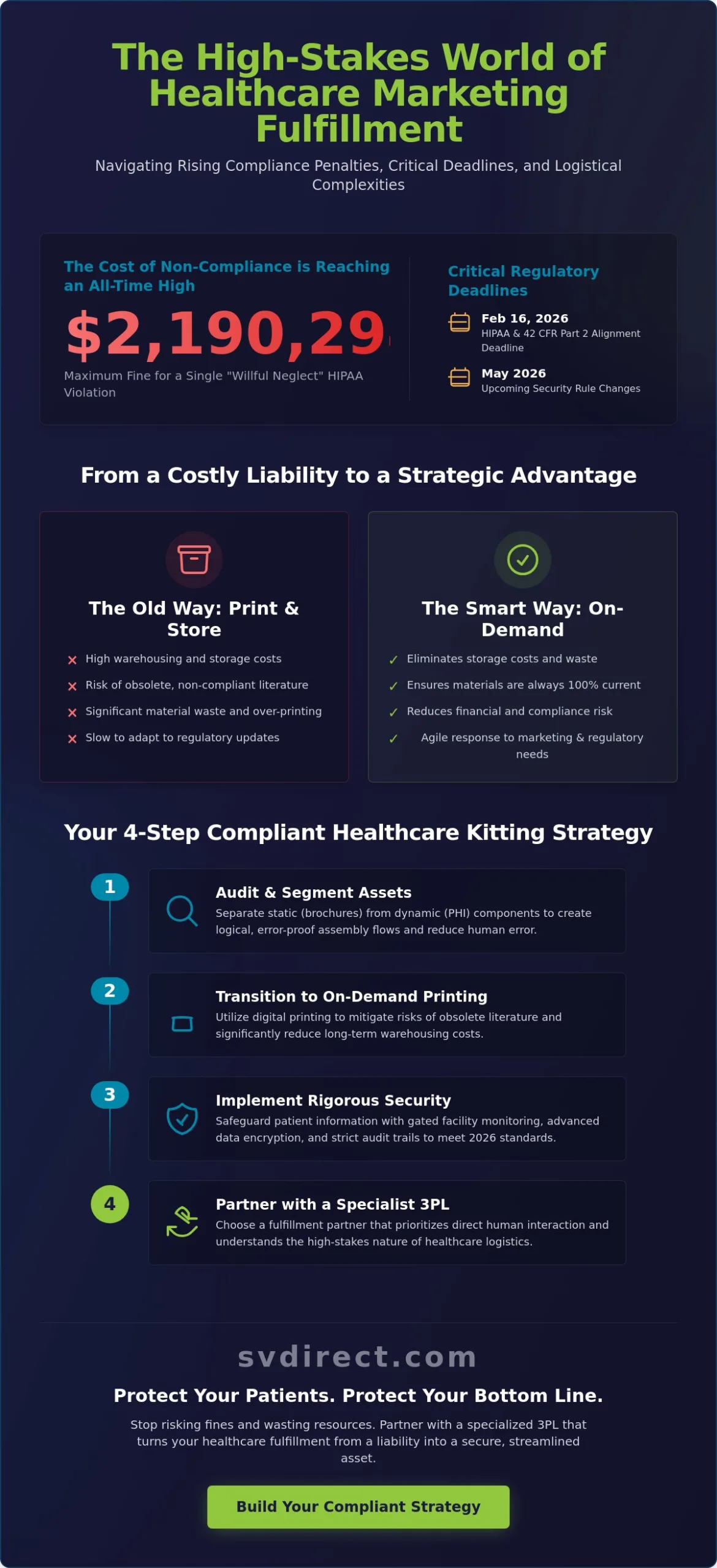
With Tier 4 HIPAA violations now reaching $2,190,294 per category as of early 2026, a single mailing error is no longer just a mistake; it’s a potential existential threat to your organization. You understand that managing Protected Health Information (PHI) is a high-stakes balancing act where a lack of transparency in the mailing chain of custody leads to unnecessary risk. Finding a partner that provides truly HIPAA compliant direct mail services shouldn’t mean sacrificing the high-resolution quality your patient communications require to remain professional and clear.
We’ll show you how to navigate these complexities with a framework that balances rigorous compliance with high-resolution digital print technology. You’ll learn how to establish a bulletproof audit trail for every piece of mail while ensuring a zero-disruption transition to a more secure, high-performance operational model. This guide provides the roadmap to precision, security, and the peace of mind that comes from a dedicated partnership that values your data as much as your growth.
Key Takeaways
- Understand how to mitigate the risk of updated 2026 penalty tiers by integrating HIPAA compliant direct mail services into your patient communication strategy.
- Explore the mandatory technical safeguards, including file encryption and a documented chain of custody, that protect sensitive data from transfer to delivery.
- Learn why HP Indigo 5500 liquid ink technology and 230 line screen resolution are critical for the legibility and professionalism of medical statements.
- Discover how to maintain 24/7 transparency over your mailing inventory with the Remote Control™ system, providing a bulletproof audit trail.
- Gain a clear framework for executing Business Associate Agreements (BAAs) and validating complex variable data logic for personalized patient mailings.
What Are HIPAA Compliant Direct Mail Services?
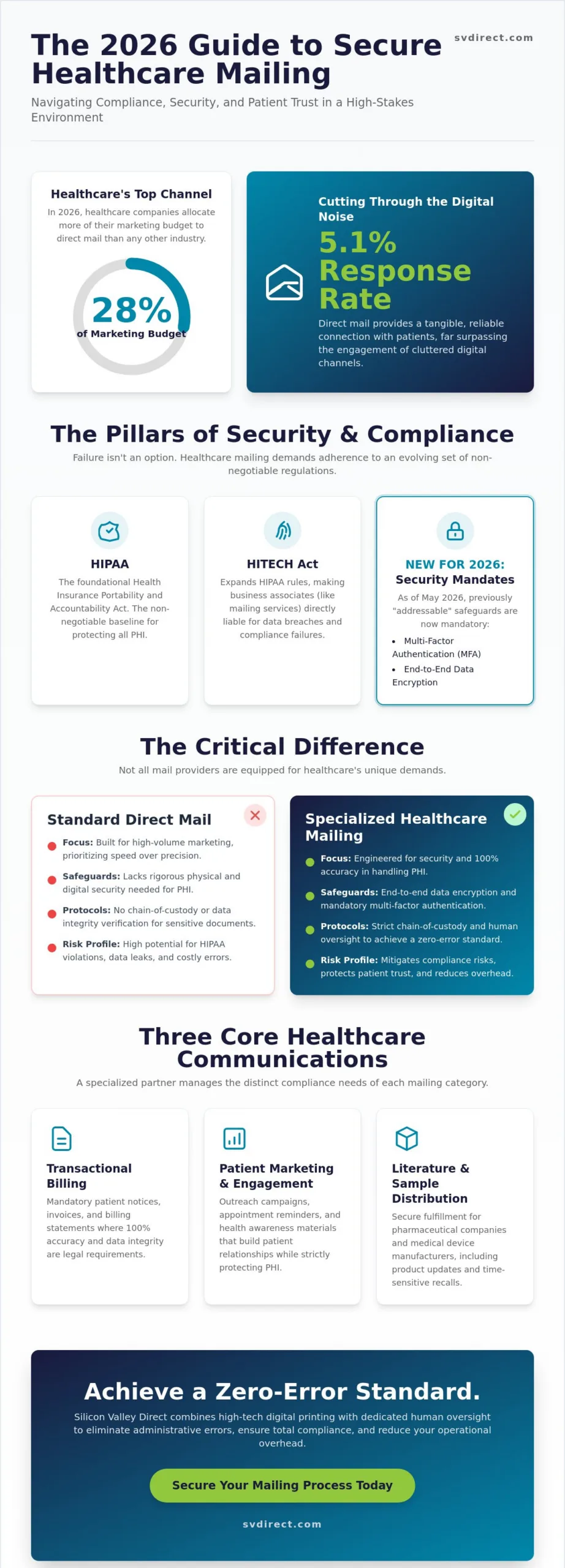
At its core, HIPAA compliant direct mail services represent a specialized fusion of high-resolution digital printing and rigorous data security protocols. This isn’t just about mailing letters; it’s a comprehensive ecosystem designed to protect Protected Health Information (PHI) from the moment a data file is uploaded until the physical piece reaches the patient’s mailbox. These services are governed by the Health Insurance Portability and Accountability Act (HIPAA), ensuring that every touchpoint in the mailing chain of custody meets federal standards for privacy and security.
For healthcare providers and insurers, these services are non-negotiable. The legal framework rests on the Business Associate Agreement (BAA). This document is more than a formality; it’s a binding contract that establishes legal liability and mandates that the service provider maintains specific technical and physical safeguards. Whether you’re sending Explanation of Benefits (EOBs), billing statements, or laboratory test results, a BAA ensures your mailing partner acts as a secure extension of your own compliance team. It’s a partnership built on transparency and a shared commitment to patient privacy.
The Legal Stakes: Fines and Reputation
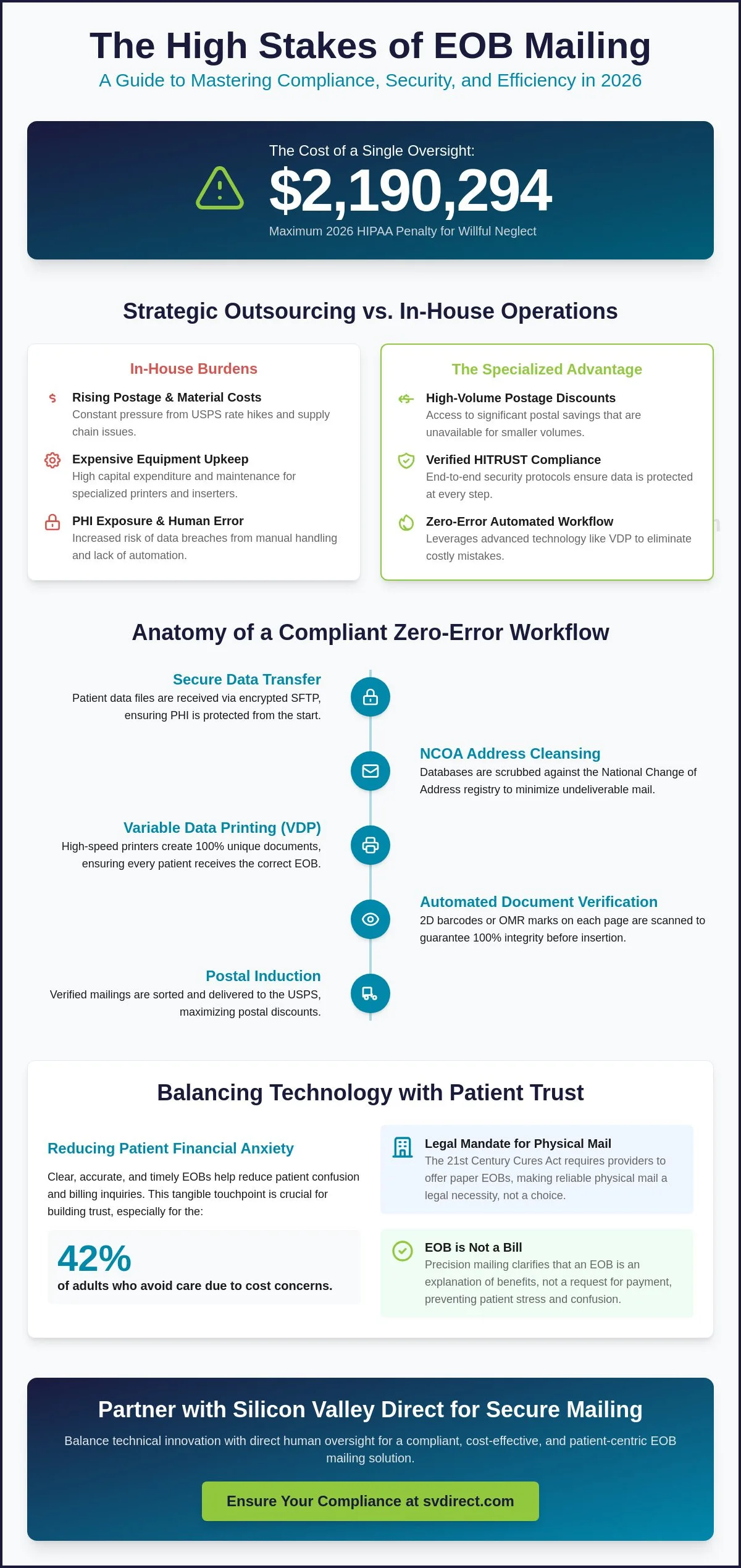
The cost of non-compliance has never been higher. As of January 28, 2026, the Office for Civil Rights (OCR) updated the penalty tiers, with “willful neglect” violations now reaching an annual limit of $2,190,294 per category. Beyond the financial impact, a single mailing error, like a misaligned window envelope revealing a diagnosis code, can trigger a systemic data breach. This destroys patient trust and tarnishes brand integrity. With the February 16, 2026, deadline for updating Notice of Privacy Practices (NPP) regarding substance use disorder records, the scrutiny on how you handle sensitive data in transit is at an all-time high.
Protected Health Information (PHI) in Direct Mail
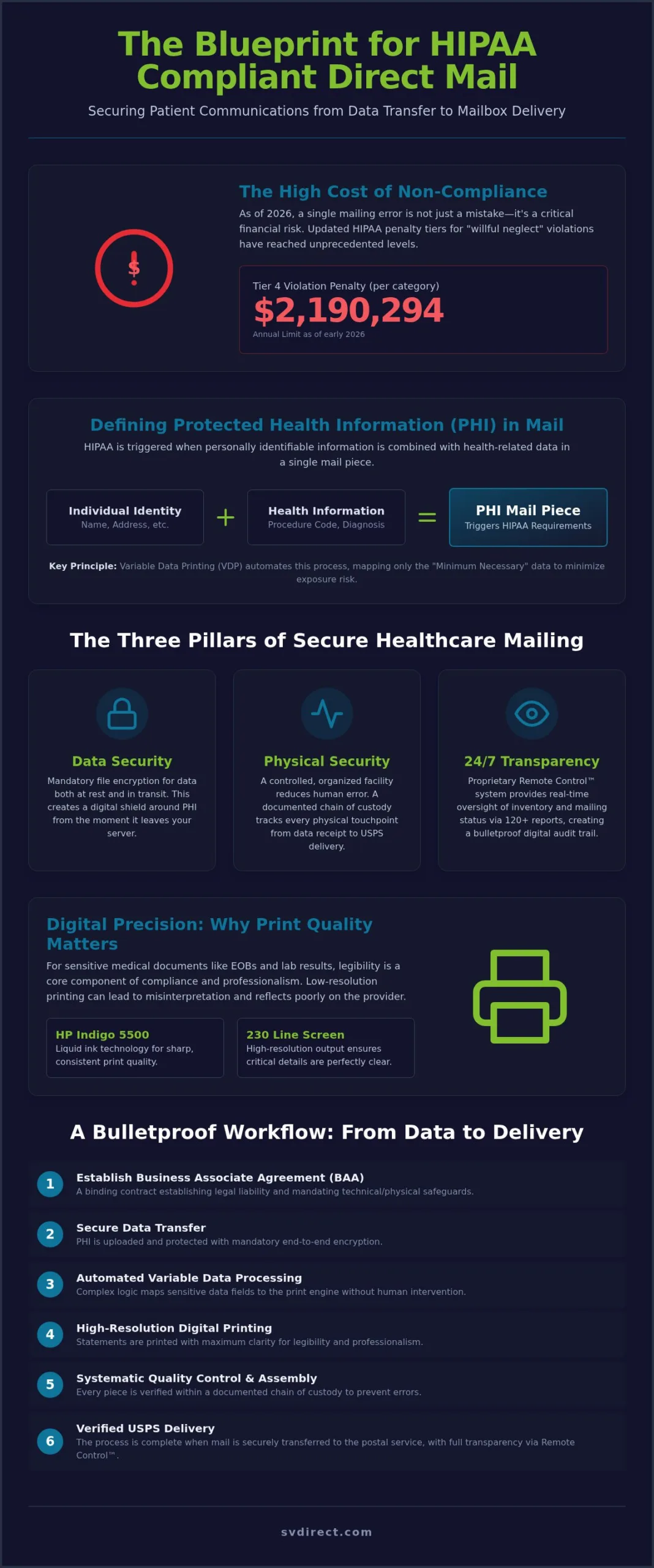
Understanding what constitutes PHI is the first step in secure mailing. A mail piece triggers HIPAA requirements when it combines an individual’s identity, such as a name or address, with health-related information like a procedure code or even the department name on the return address. We adhere to the “Minimum Necessary” principle, ensuring that only the essential data required for the mailing’s purpose is included. To manage this safely, Variable Data Printing (VDP) uses advanced logic to map sensitive data fields directly to the print engine without human intervention, maintaining a secure, automated workflow that minimizes the risk of exposure.
The Technical Pillars of Secure Healthcare Mailing
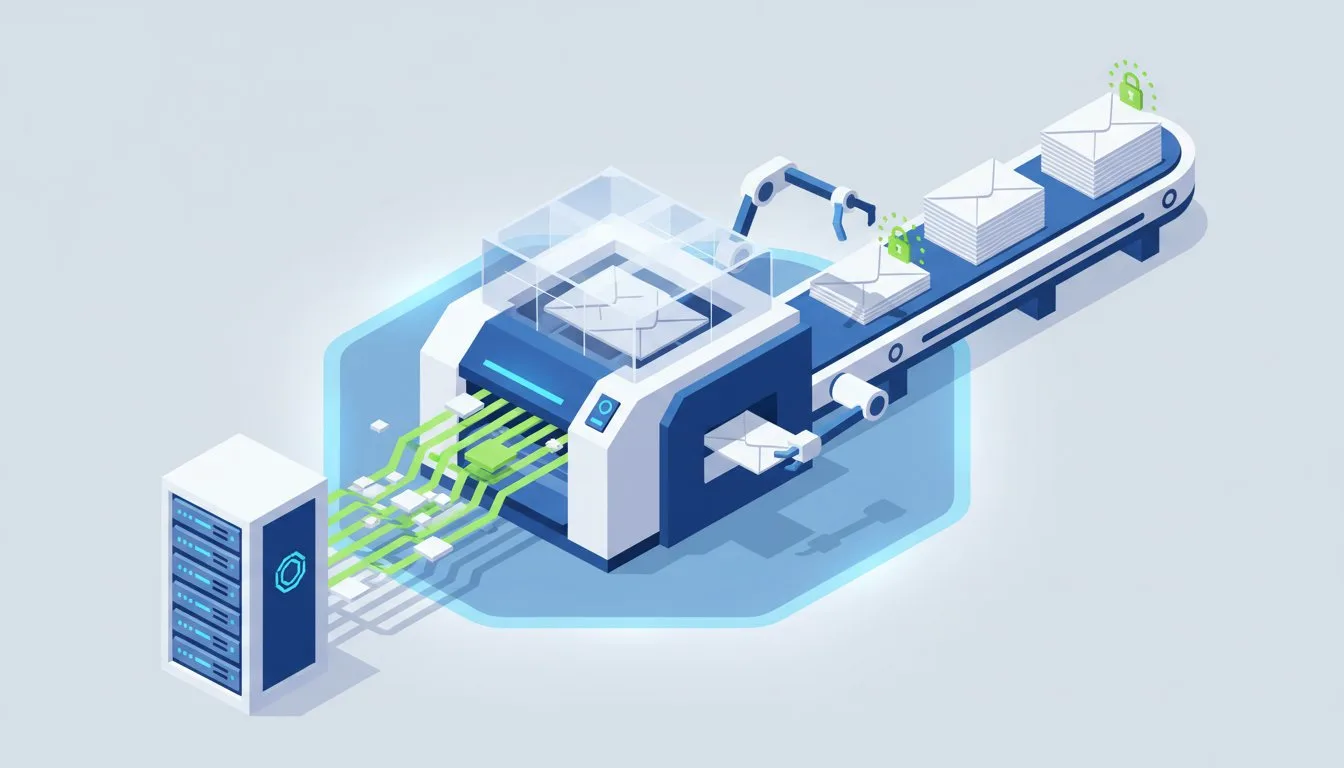
Secure data transfer is the foundational entry point for HIPAA compliant direct mail services. In 2026, encryption for data both at rest and in transit is no longer just a recommendation; it’s a mandatory safeguard under updated federal regulations. We ensure that your PHI remains protected from the moment it leaves your server until the digital press begins its run. This creates a digital shield around sensitive patient information, preventing unauthorized access during the most vulnerable stages of the workflow. Our technical framework is built to exceed these standards, providing a secure environment for every file we handle.
Physical security is often overlooked in digital conversations, yet it remains a critical pillar of compliance. We operate out of a facility designed for maximum focus and minimal distraction. A quiet, organized environment is essential for reducing the risk of human error during the complex kitting and assembly stages. We document every touchpoint in the chain of custody, from the initial data receipt to the final USPS delivery. This physical oversight ensures that sensitive medical statements never sit unattended or become disorganized, maintaining the integrity of your mailing at every step.
Proprietary Data Management and Visibility
Transparency is the best defense against compliance anxiety. Our proprietary Remote Control™ system provides you with 24/7 oversight into your projects. You don’t have to wonder if a file was received or if the mail has dropped. With access to over 120 specialized reports, you can monitor inventory levels and mailing statuses in real time. This level of visibility acts as a digital audit trail, making internal tracking and external compliance audits straightforward and stress-free. You stay in control of your data without needing to manage the mechanical details.
Systematic Quality Control (QC-Check)
Accuracy in healthcare mailing requires more than just good intentions. It demands a systematic “QC-Check” process. This multi-stage inspection begins before the first piece of paper touches the press. We proactively identify data conflicts or logic errors in your variable data printing templates. By catching these issues early, we prevent systemic errors that could compromise patient privacy. Our commitment to 100% accuracy extends to machine insertion, where each piece is verified for correct matching and secure sealing. If you’re ready to see how a more organized approach can protect your communications, you can request a free quote to discuss your specific compliance needs.
Digital Precision: Why Print Technology Matters for PHI
While many providers focus solely on the digital handshake of data transfer, the physical execution of your mailing is where patient trust is truly solidified. In HIPAA compliant direct mail services, the quality of the print is a security feature in itself. If a patient receives a billing statement with smudged toner or illegible procedure codes, the risk of misinterpretation increases. We utilize liquid ink technology rather than standard dry toner. Liquid ink creates a sharper, more durable bond with the paper fibers. This ensures that every sensitive detail remains crisp and clear from our facility to the patient’s front door, preventing the flaking or blurring common with lesser technologies.
Precision in medical documentation often requires the reproduction of complex charts or fine-print legal disclosures. Our 230 line screen resolution provides a level of detail that standard commercial presses simply can’t match. This high-resolution output ensures that every character is rendered with mathematical accuracy. When combined with our on-demand digital printing capabilities, you get the speed of a digital workflow with the aesthetic and functional quality of traditional offset printing. This consistency in color and clarity maintains your brand integrity across even the highest volume healthcare runs.
The HP Indigo 5500 Advantage
The HP Indigo 5500 serves as the technical heart of our facility. It produces dry sheets that allow for immediate handling, which is vital for maintaining the integrity of PHI. There’s no waiting for ink to set, which means there’s no chance for data to smudge during the high-speed kitting and assembly process. For organizations running complex wellness campaigns, our 7-color digital printing capability ensures vibrant, high-impact visuals that drive engagement. We also prioritize sustainability; this digital process eliminates the need for traditional films and toxic chemicals, reducing your environmental footprint while maintaining elite quality.
Variable Data for Personalized Care
Personalized patient care shouldn’t be a logistical burden. Variable Data Printing (VDP) enables us to print unique instructions, specific clinic locations, or tailored health education on every single mailer in a single pass. We’ve designed our logic systems to ensure this variable data is mapped with 100% accuracy, providing a bespoke experience for the recipient without compromising speed. Because we’ve integrated these systems so deeply into our operations, this level of personalization is highly cost-efficient. You can move beyond generic mailings to communications that actually drive better health outcomes and improve patient adherence.
Implementing a Compliant Workflow: From Data to Delivery
Transitioning your sensitive communications to a partner requires a methodical approach that prioritizes both security and operational speed. Effective HIPAA compliant direct mail services rely on a structured five step workflow to eliminate the possibility of human error. This starts with the execution of a Business Associate Agreement (BAA) and the setup of secure data transfer protocols. Once the legal and technical foundation is set, we move into template design. Here, we validate the logic for Variable Data Printing (VDP) to ensure every data field aligns perfectly with your patient records. This isn’t just a technical task; it’s a critical safety check.
- Step 1: Secure Data Transfer and BAA Execution. Establishing the legal framework and encrypted pipelines for PHI.
- Step 2: Template Design and VDP Logic Validation. Mapping data fields to ensure accuracy in personalized messaging.
- Step 3: Systematic QC-Check and Sample Approval. A physical and digital review of production samples before the full run.
- Step 4: Secure Production and Automated Mailing. Printing and inserting in a controlled facility with documented custody.
- Step 5: Real-Time Reporting and Audit Trail Archiving. Maintaining a permanent record of every mail piece for future compliance reviews.
Streamlining the Onboarding Process
Moving from an in house operation to a professional 3PL partner doesn’t have to be disruptive. We collaborate directly with your IT teams to establish seamless XML or SOAP integrations. This technical alignment allows for automated data exchange that reduces manual handling and the risk of data exposure. By identifying and resolving potential data conflicts during this initial setup phase, we prevent delays during active production. It’s a proactive partnership model that views our team as a steady, reliable extension of your own operations.
Managing Complex Kitting and Literature
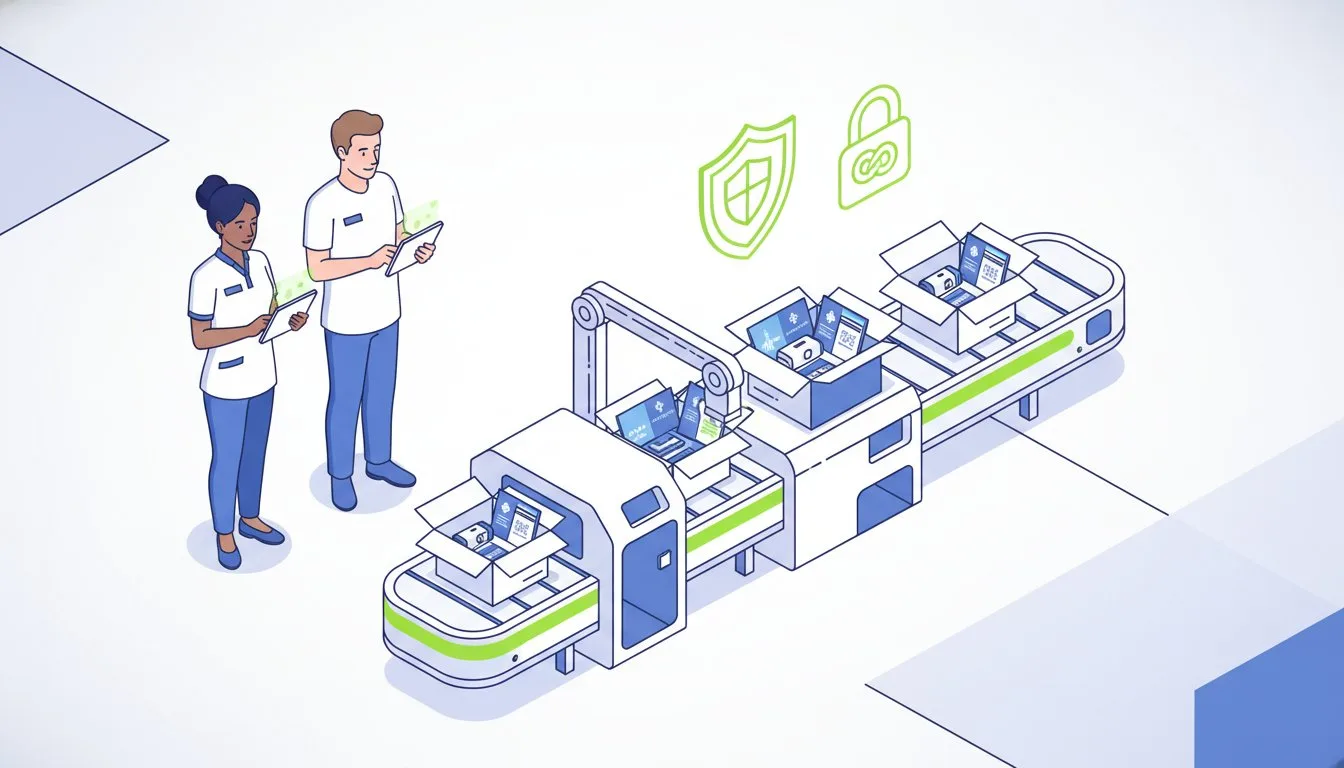
Healthcare mailing often involves more than just a single letter. Many programs require the integration of kitting and assembly services to manage medical device kits or complex pharmaceutical literature. We ensure that these bundled items maintain the same rigorous HIPAA compliance standards as our printed mailings. Whether you’re distributing patient education packets or diagnostic components, our team handles the physical assembly with the same precision and oversight used in our digital print facility. This unified approach simplifies your supply chain and ensures a consistent audit trail across all materials.
Silicon Valley Direct: An Extension of Your Compliance Team
When selecting HIPAA compliant direct mail services, you’re choosing a partner that acts as a physical extension of your organization’s compliance team. Founded in 1999, Silicon Valley Direct (SVD) has built its reputation on “The Nine Promises,” a set of core principles that prioritize active listening and proactive problem solving. This partnership-first approach to healthcare mailing services ensures that we don’t just execute tasks; we collaborate to safeguard your reputation. Our location in the heart of Silicon Valley serves as a constant catalyst for innovation, allowing us to integrate the latest digital print technologies into a secure, physical workflow.
Accuracy in high-volume healthcare mailing is rarely the result of automation alone. It requires a deliberate operational environment. We utilize a “Quiet Facility” methodology, which creates a highly organized and focused atmosphere for our staff. This focus is the secret to maintaining precision across complex kitting and assembly projects where human oversight is vital. By minimizing distractions, we ensure that every medical statement and patient education packet is handled with the deliberate care it deserves. This methodical approach reflects our commitment to being a steady hand in an industry that demands absolute reliability.
Beyond ‘Cookie-Cutter’ Fulfillment
We reject the impersonal, one-size-fits-all models that dominate the fulfillment industry. Instead, we provide custom-fit solutions designed to meet unique healthcare project goals, from pharmaceutical literature distribution to complex medical device kitting. Our team’s collective experience allows us to anticipate potential data conflicts or logistical hurdles before they ever impact a patient. In regulated industries, the value of a long-term partnership cannot be overstated. We pride ourselves on high staff retention, which means your projects are managed by seasoned experts who understand your specific compliance requirements and brand standards.
Transparency Through Remote Control™
Transparency is the cornerstone of trust in a business associate relationship. Our proprietary Remote Control™ system gives you 24/7 access to your data, inventory, and mailing status. You can access over 120 specialized reports to track a project’s progress or audit a specific mailing’s chain of custody. Remote Control™ is a proprietary integration of technology and customer service that provides a seamless window into our operations. We can even customize web interfaces to match your existing corporate healthcare portals, ensuring that your team has the information they need in a familiar, accessible format.
Securing Your Patient Communications for 2026 and Beyond
The landscape of healthcare mailing continues to evolve, but the core requirements of security and precision remain constant. You’ve seen how the marriage of high-resolution liquid ink technology and rigorous data encryption creates a protective shield around your sensitive communications. By utilizing a 230 line screen resolution, your documents achieve a level of clarity that supports both brand integrity and patient understanding. With 24/7 visibility provided by the Remote Control™ system, you’re never left in the dark regarding your inventory or mailing status.
Choosing HIPAA compliant direct mail services is about more than just checking a box; it’s about establishing a partnership with a seasoned expert who understands the high stakes of your industry. With decades of experience in high-stakes fulfillment, we provide the steady hand you need to manage complex regulations and updated penalty tiers. You can move forward with the confidence that your data is secure and your physical mailings are handled with absolute precision.
We look forward to helping you streamline your workflow and protect your organization’s reputation. Let’s build a secure future for your patient communications together.
Frequently Asked Questions
What does HIPAA compliant direct mail mean for my business?
HIPAA compliant direct mail means your physical communications are handled within a secure, audited framework that meets federal privacy standards. This process encompasses everything from encrypted data transfers to physical facility security and documented disposal of waste. It ensures that your organization avoids the updated 2026 penalty tiers while maintaining the highest level of patient privacy throughout the mailing process.
Do I need a Business Associate Agreement (BAA) for mailing services?
A Business Associate Agreement (BAA) is absolutely necessary whenever a vendor handles Protected Health Information (PHI) for your organization. This legal contract establishes liability and mandates that the service provider maintains specific technical and physical safeguards. We execute these agreements as a standard part of our onboarding for HIPAA compliant direct mail services to ensure total legal and operational alignment.
Can I send PHI like test results or billing statements through direct mail?
You can securely send sensitive documents like test results, billing statements, and Explanation of Benefits through the mail by following strict privacy protocols. These mailings must adhere to the “minimum necessary” rule, ensuring that only essential information is included. We use specialized window envelopes and precise folding techniques to ensure that no sensitive data is visible from the outside of the mail piece.
How does digital printing ensure data security for healthcare?
Digital printing enhances security by creating a closed-loop system where data flows directly from secure servers to the printing equipment without manual intervention. This automated workflow reduces the number of touchpoints and minimizes the risk of human error or data exposure. Our systems use advanced logic to validate every record, ensuring that the right information reaches the right patient every time.
What is the difference between toner and liquid ink for medical mailing?
The primary difference lies in durability and legibility; liquid ink bonds with the paper fibers while toner merely sits on the surface. For medical documents where fine print and barcodes must be perfectly clear, liquid ink provides a superior, smudge-proof finish. This technology ensures that sensitive data remains legible throughout the entire postal journey, which is critical for patient understanding and compliance.
How do you track the chain of custody for sensitive healthcare mail?
We track the chain of custody through a systematic series of checkpoints that document the handling of your materials at every stage. From the moment we receive your data to the final hand-off at the USPS, every movement is recorded. You can monitor these touchpoints in real time through our proprietary system, providing a comprehensive audit trail that is essential for regulatory reviews.
Is variable data printing (VDP) more expensive for HIPAA mailers?
Variable data printing (VDP) is highly cost-efficient because it allows us to customize every mail piece in a single production run. It eliminates the need for separate static printings and manual matching, which reduces both labor costs and the potential for errors. When utilizing HIPAA compliant direct mail services, VDP provides a sophisticated way to personalize patient communications without the premium price tag of traditional methods.
How long does it take to set up a new HIPAA compliant mailing program?
Launching a new program typically involves a methodical onboarding process that can take anywhere from two to four weeks depending on the technical integration required. This timeframe allows us to execute the BAA, establish secure data pipelines, and rigorously test your variable data logic. We prioritize a steady and thorough setup to ensure a zero-disruption transition for your critical patient communications.