



Health and Wellness Product Fulfillment for Ecommerce Brands
Health and wellness product fulfillment brings inventory storage, order processing, packing, and shipping together so products reach customers accurately. Costs depend on factors such as storage needs, order volume, product handling, packaging, and shipping destinations. There is no single price that fits every brand.
Shipping is only one part of the work. Products with lot numbers or expiration dates also need careful inventory controls. A well-defined process keeps stock organized and supports custom packaging and subscription orders as a business grows.
This guide explains what health and nutrition fulfillment includes, which factors shape its cost, and how lot tracking, compliant processes, kitting, and recurring orders fit into day-to-day operations. You’ll also learn what to consider when choosing a fulfillment setup for your brand.
Key Takeaways
- Estimate fulfillment costs by looking at storage needs, order volume, handling, packaging, and shipping destinations.
- Record lot and expiration details as inventory arrives, then use FEFO rotation to prioritize products with the earliest expiration dates.
- Plan custom packaging and kits around product protection, accurate assembly, and the unboxing experience you want customers to have.
- Make subscription orders easier to manage by defining their recurring contents, pick-and-pack steps, and inventory requirements.
- Compare fulfillment operations by their inventory controls, product-specific storage, quality checks, and approach to returns.
How Does Lot Tracking and Expiration Management Work?
Lot tracking connects inventory units to their production batch, while expiration management controls which units are available for orders. Together, these records support accurate picking, product traceability, and timely stock decisions.
Inventory Visibility
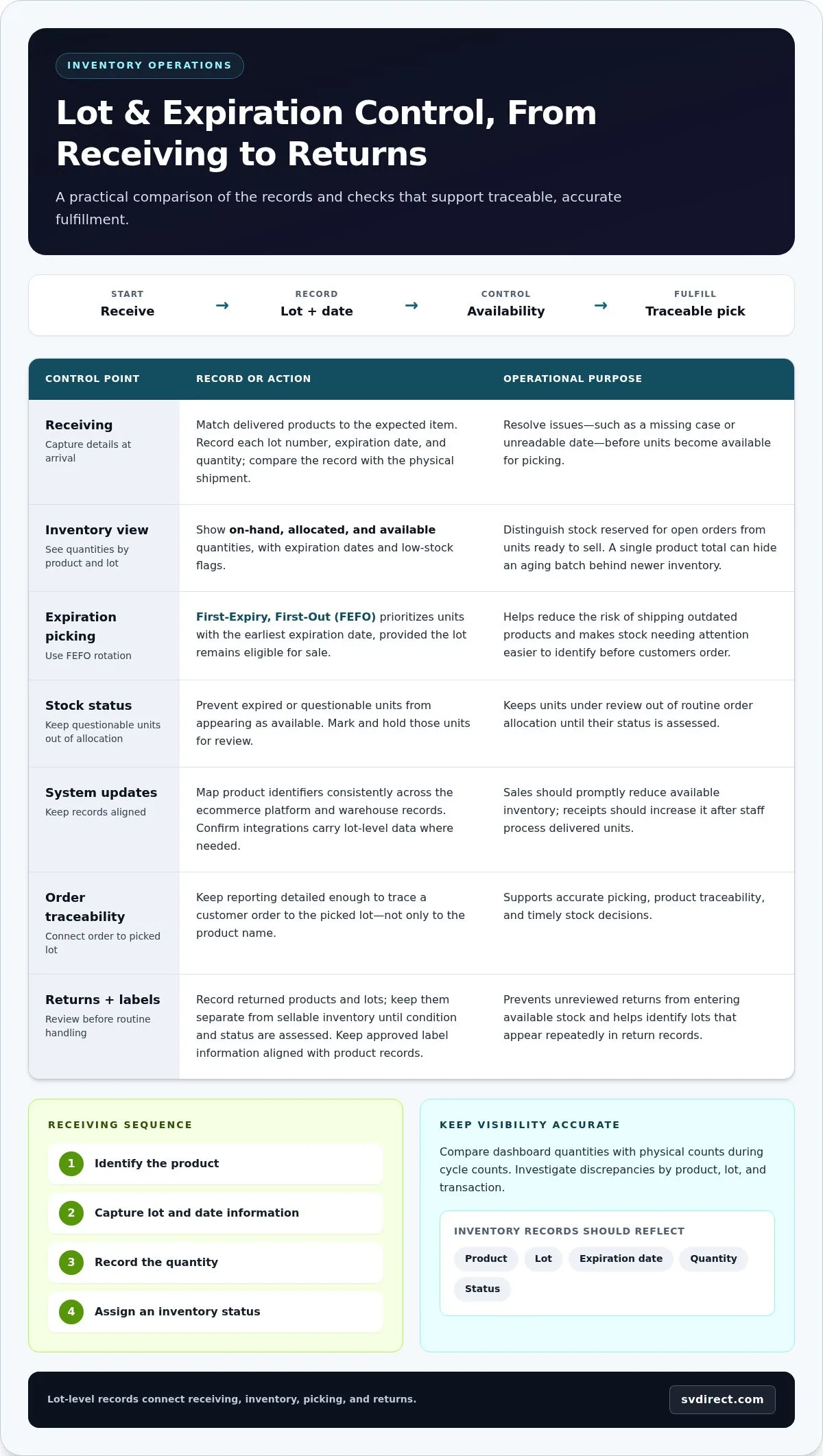
A useful inventory dashboard shows on-hand, allocated, and available quantities by product and lot. For example, staff can distinguish stock reserved for open orders from units ready to sell. Check whether the system flags low stock and displays expiration dates. A single product total can hide an aging batch behind newer inventory.
Real-time visibility depends on consistent updates across sales channels and warehouse records. An order should promptly reduce available inventory, while a receipt should increase it only after staff process the delivered units. Compare dashboard quantities with physical counts during cycle counts, then investigate discrepancies by product, lot, and transaction.
Expiration-Date Management
For products with printed expiration dates, record the lot number and date when inventory arrives. Use First-Expiry, First-Out (FEFO) picking to prioritize units with the earliest expiration date. If two lots of the same supplement have different dates, pick from the earlier-dated lot first, provided it remains eligible for sale.
Set inventory rules that prevent expired or questionable units from appearing as available stock. Mark and hold those units for review rather than allowing routine order allocation. FEFO helps reduce the risk of shipping outdated products, and clear date records help teams identify stock that needs attention before customers order.
Receiving and Inventory Processing
At receiving, match delivered products to the expected item and record each lot number and expiration date. Scan or enter the details into the inventory system, then compare recorded quantities with the physical shipment. Resolve discrepancies, such as a missing case or unreadable date, before making those units available for picking.
Use a consistent receiving sequence: identify the product, capture lot and date information, record the quantity, and assign an inventory status. Keep newly received units distinct from stock already processed. This creates a traceable record from delivery through storage and fulfillment, and gives staff a clear basis for resolving inventory questions.
Integrations connect warehouse records with the ecommerce platform, so sales and stock changes appear in the right systems. Map each product identifier consistently, then confirm the integration carries lot-level data where needed. Reporting should let staff trace a customer order to the picked lot, rather than showing only the product name. For brands operating in highly regulated wellness sectors such as cannabis, integrated ERP platforms like proteus420.com unify inventory tracking, distribution, and point-of-sale data across the entire supply chain.
Returns also need traceable handling. Record the returned product and its lot, then keep it separate from sellable inventory until its condition and status are assessed. This prevents returned units from being added to available stock without review and helps teams spot lots that appear repeatedly in return records.
Label accuracy matters alongside inventory accuracy. Section 7(1) prohibits dealers from applying or selling prepackaged products with labels containing false or misleading representations about the product, according to Department of Justice Canada. Keep approved label information aligned with each product record, and review packaging details during receiving before stock enters the order workflow.
Kitting and custom packaging
Custom packaging combines product protection, presentation, and packing steps in a repeatable ecommerce workflow. Shipping requirements can vary by product classification, ingredients, destination, and carrier limits. Sort supplements, cosmetics, and over-the-counter products by category, then apply the relevant labeling and handling instructions to each shipment.
Branded Packaging and Inserts
Branded packaging puts a product’s visual identity into the parcel, while inserts can explain product use, introduce related items, or share a welcome message. A skincare order might include a printed care card beside the product, while a supplement kit could include an insert identifying each item. Keep copy aligned with approved product labeling.
For consistent presentation, document the packing sequence for each order type. Specify the mailer or box, product placement, insert position, and protective wrap. A fulfillment partner can follow these instructions to reduce variation between orders. Review a packed sample whenever artwork, packaging dimensions, or contents change.
Sensitive Product Handling
Match packaging to the shape and closure of jars, bottles, and pouches. Place a glass jar in a snug protective insert, separate multiple bottles with dividers, and prevent flexible pouches from shifting beneath heavier items. A test pack can reveal whether caps loosen, corners crush, or products move during ordinary handling.
Temperature-sensitive products need extra attention to transit conditions. Insulated packaging can help protect them from heat fluctuations, and the packing plan should reflect the product’s handling needs. For instance, keep a sensitive item from touching cold packs directly, using a barrier when the product’s packaging instructions call for separation.
Kitting combines separate items into a prepared set, such as a bottle, measuring scoop, and printed guide packed together. Define each kit’s contents by product identifier and provide a pick sequence so staff can assemble it consistently. If a component changes, update the kit instructions before the revised bundle enters the packing workflow.
Packaging choices also affect material use. Right-size the outer box to limit empty space, then choose cushioning that protects the item without unnecessary layers. Brands seeking recyclable or paper-based materials should specify each component’s material and ensure it meets the product’s protection needs. Avoid sustainability claims that the packaging cannot support.
Before launch, run a sample order through the complete process: select the items, assemble the kit, add inserts, close the package, and inspect the parcel. Record the materials and sequence in a packing guide. This reference helps a fulfillment partner handle repeat orders accurately and maintain a consistent customer experience as order patterns change.
Kitting, bundles, and subscription fulfillment
Recurring orders and product bundles require more coordination than picking individual items. A clear kit specification, replenishment plan, and packing sequence help ensure each shipment matches the customer’s order.
Bundle Assembly
Start with a defined bill of materials for each bundle. A wellness starter set might include a supplement, shaker bottle, and printed guide. Record each component by product identifier, along with the packing sequence and any permitted substitutions. This gives the assembly team a consistent reference when items are replenished or updated.
Review how bundles affect inventory availability. If a bottle appears in several kits, stock assigned to bundle orders should be visible alongside demand for individual products. This helps prevent overselling and supports planning when order volume changes. Keep bundle records current whenever a component, label, or package changes.
Kitting and Unboxing Experience
Kitting shapes a customer’s first impression of an order. Place items in a deliberate sequence, such as the main product first and the instruction card on top. Use dividers or fitted inserts to keep components in place during transit. A sample shipment shows whether the contents arrive neatly and the intended presentation withstands handling.
Document details that affect repeatability: insert position, label orientation, protective materials, and how the outer package closes. A dedicated packing guide helps staff reproduce the same experience for routine orders and seasonal kits. Keep the presentation practical so decorative materials do not interfere with product protection.
Subscription fulfillment adds a schedule to the kit plan. Map each subscription option to its contents, order frequency, and packing instructions in the order system. A monthly wellness box, for example, might include the same core product with a rotating accessory. The order record should identify the correct version before warehouse picking begins.
Plan inventory around upcoming subscription runs, not just orders already released for picking. Forecast component needs from the active subscription list, then compare them with available stock and expected receipts. This helps identify a shortfall in one kit component before the full order batch reaches the packing area.
Manage changes through a controlled handoff. If a subscriber changes a product choice or pauses an order, update the order record before assembling the kit. Set a clear cutoff for modifications, then separate completed kits from orders still awaiting changes. This reduces rework and keeps packed contents aligned with each customer’s selection.
Include logistics requirements in the subscription plan. Group orders by destination and shipping method, and handle temperature-sensitive products according to their instructions. Review component expiration status before a scheduled run, especially when a kit remains active over time. A repeatable process connects customer selections, inventory, assembly, and dispatch without relying on memory.
Health and wellness ecommerce fulfillment
For wellness brands, ecommerce fulfillment connects inventory, order processing, packing, and delivery. Choose a 3PL by mapping product needs, comparing its controls and systems, then testing the workflow during onboarding.
Ecommerce Fulfillment Services
Fulfillment services typically cover receiving products, storing inventory, picking orders, packing parcels, and coordinating shipment. For a skincare brand selling online, the workflow should connect each order to the correct item, packaging instructions, and destination. Check how inventory updates move between the warehouse system and ecommerce storefront.
Order accuracy depends on clear product records and repeatable handling steps. Distinct product identifiers, for example, help separate a daily moisturizer from its travel-size version. Review how the operation handles peak order volume, stock changes, and returns, and whether its process supports both direct-to-consumer and business shipments.
Provider Comparison Criteria
Compare operations by product handling, inventory controls, quality checks, and visibility. Some skincare products may need temperature-controlled storage, while some supplements may require humidity-controlled conditions. Review receiving inspections, procedures for separating damaged or returned stock, and how inventory status appears in reports.
Look for processes that match the products, not just general warehouse capacity. A provider should be able to explain its inbound checks, order verification, and separation of returns or quarantined goods. The distinction matters: 68% of health brands face compliance issues when using non-specialized warehouses. For US wellness products, also understand that the FDA’s general wellness policy distinguishes low-risk products intended solely for general wellness from products subject to device or drug regulation.
Choosing and Onboarding a 3PL
Start by documenting product types, order patterns, packaging instructions, sales channels, and destination mix. Compare fulfillment operations against those requirements, review sample workflows, and agree on how inventory and order data will move. During onboarding, provide product identifiers, packing directions, and handling instructions in a shared format.
Test the setup before routing routine orders. A sample order can confirm that the storefront sends the right item details, the warehouse receives the order correctly, and shipment status returns to the sales system. Resolve mismatched identifiers or incomplete instructions before launch, since those errors can affect multiple orders.
Keep the launch controlled. Start with a defined product range or order group, then review inventory records, order exceptions, and returns with the operations team. Use the findings to update product data or packing instructions before expanding the workflow. This staged approach makes gaps visible while the process is still manageable.
Give data exchange as much attention as physical handling. Map each ecommerce product identifier to its warehouse record, define how cancellations and order edits flow, and decide which system controls inventory updates. For example, a canceled order should no longer be allocated in warehouse records. Clear system rules help wellness brands avoid overselling and give staff a shared view of order status.
Set practical review points for the initial operating period: compare order records with shipped items, inspect exception reports, and look for recurring issues in returns. These checks reveal whether fulfillment processes match the products and customer experience the brand intends to deliver.
How do fulfillment providers compare for supplements and wellness brands?
Compare fulfillment operations by how well their storage, receiving, quality checks, and systems fit your products. A supplement range with lot-controlled products has different needs from a personal care line with temperature-sensitive items. Start with your product mix and follow each item from inbound receipt through customer delivery.
Look beyond general warehouse capacity. Some skincare products may need temperature-controlled storage, while some supplements may require humidity-controlled conditions. Review how product-specific storage needs appear in daily procedures, inventory records, and staff instructions. The process should connect each product’s handling needs to its storage location and order workflow.
Receiving controls are another useful comparison point. Review how inbound inspections identify damaged packaging, quantity mismatches, or product details that differ from shipment records. Then examine how questionable inventory is handled. Quality assurance systems, inbound inspections, and separate returns and quarantine areas help reduce risks of loss, damage, or spoilage while supporting compliance processes.
Use a consistent scorecard when reviewing operations:
- Product handling: Compare storage and packing processes against each product’s needs.
- Quality checks: Review how receiving, picking, and order packing errors are identified.
- Inventory visibility: Assess whether teams can see stock status and investigate order exceptions.
- Returns control: Find out how returned or questionable goods remain separated from sellable inventory.
- Systems fit: Check how ecommerce orders, inventory updates, and shipment records connect.
Order accuracy depends on the whole process, not just a final inspection. A picking error, for example, can start with similar-looking product records and go unnoticed if packing checks do not compare the item with the order. Compare how operations validate product identifiers, record exceptions, and review recurring mistakes. Ask to see the workflow using an order representative of your catalog.
Compare how the operation handles assortment and demand changes, too. A supplement brand adding a new flavor needs product records and picking instructions that distinguish it from existing options. Review how updates move from product data into warehouse workflows and how the team manages a temporary stockout or revised bundle. Clear ownership prevents outdated instructions from lingering on the floor.
Finally, assess communication during routine operations. Identify who handles inventory discrepancies, damaged receipts, and order exceptions, and agree on how those issues are reported. Focus on observable workflows and clear records rather than broad claims. Before deciding, match the operating model to your product requirements, ecommerce channels, and expected order patterns.
Silicon Valley Direct: eCommerce Order Fulfillment
Silicon Valley Direct provides ecommerce order fulfillment, warehousing and distribution, and inventory management. These services can help when order processing, stock coordination, and shipping start taking time away from product and customer priorities.
For wellness businesses, organized inventory records and dependable order workflows matter for both direct-to-consumer and business shipments. On-demand digital printing can also provide printed materials to accompany orders. Together, these services support storage, inventory, fulfillment, and customer communications.
If your operations need more coordinated fulfillment and inventory support, contact Silicon Valley Direct to discuss your needs.
Build a Fulfillment Model That Can Grow With You
As your product range and sales channels evolve, treat health and wellness product fulfillment as an operating system that needs deliberate updates. Keep product records, handling instructions, and customer-facing promises aligned whenever your assortment or sales process changes. Clear ownership helps prevent small updates from becoming recurring order issues.
Use operational feedback to guide improvements. Review recurring exceptions, customer comments, and return patterns, then decide which process needs attention first. A focused review helps teams prioritize meaningful adjustments instead of changing several workflows at once. Share priorities across ecommerce, inventory, and fulfillment teams so everyone works from the same plan.
A steady improvement process gives your brand room to grow while keeping daily operations organized. When you are ready to discuss the next step, contact Silicon Valley Direct to talk through your fulfillment needs.
Keep building with clarity and confidence, one thoughtful operational improvement at a time.
Frequently Asked Questions
What Is Health and Nutrition Fulfillment and How Much Does It Cost?
Health and nutrition fulfillment covers storing products, processing orders, packing shipments, and coordinating delivery. There is no single cost for every brand. The price depends on the specific operation and is provided after a quote request. Key factors include storage needs, order volume, items per parcel, special handling, packaging or kitting work, returns, and shipping destinations. A useful estimate starts with a clear picture of your products and expected order mix.
What Types of Health Products Can a 3PL Handle?
A 3PL may handle supplements, vitamins, nutrition powders, skincare, cosmetics, and over-the-counter health products, depending on its operation and each product’s handling needs. A protein powder, glass serum bottle, and OTC package have different storage, picking, and packing considerations. Share product formats, packaging details, handling instructions, and destination mix when assessing operational fit. Include kits and replenishment orders in the picture.
Does my wellness product need lot and expiration tracking?
Use lot and expiration tracking for products with batch identifiers or printed expiration dates. These records connect inventory and shipments to a particular batch. If a customer reports an issue with one lot, for example, staff can identify related stock and orders more precisely. Store lot details with product records and make them available in receiving, picking, and returns workflows.
What is FEFO and why does it matter for wellness brands?
FEFO means First-Expiry, First-Out: pick eligible inventory with the earliest expiration date before later-dated stock. This matters because two units of the same product can have different dates. A picking process that sees only the product name may select a later-dated unit while older stock remains. Recording dates by lot and applying FEFO helps teams prioritize inventory and avoid shipping outdated products.
What is health and wellness product fulfillment?
Health and wellness product fulfillment coordinates inventory storage, order processing, packing, and shipment for wellness goods. It covers moving sale-ready products from warehouse receipt to the customer’s order, rather than manufacturing goods or providing health advice. For example, a brand may partner with Harmony Pharma Lab for custom supplement formulation and production, while relying on dedicated fulfillment workflows to handle storage, packing, and customer delivery.
What products are included in health and wellness fulfillment?
Common product categories include vitamins, minerals, botanical supplements, nutrition powders, skincare, cosmetics, personal care goods, and over-the-counter products. Some brands also ship curated wellness kits containing several product types. The right fulfillment workflow depends on the product’s packaging, handling instructions, and order format. A catalog combining powders, liquids, and fragile containers may need separate packing procedures for different items.
What are the FDA requirements for storing and shipping health and wellness products?
Applicable requirements depend on a product’s category and intended use. The FDA’s general wellness policy distinguishes low-risk products intended solely for general wellness from products subject to device or drug regulation. Fulfillment operations must account for applicable FDA and good manufacturing practice requirements. Keep product labels and handling instructions aligned with the item, and maintain clear records through storage and shipment.
What certifications should a health and wellness fulfillment provider have, such as cGMP or NSF?
No single certification answers every operational question. Credentials can cover different areas, so assess what each covers, which organization or process it applies to, and whether its scope matches your products and fulfillment tasks. Also evaluate day-to-day controls, such as receiving inspections, inventory records, and separation of returns. A credential should complement, not replace, a review of actual operating procedures.