


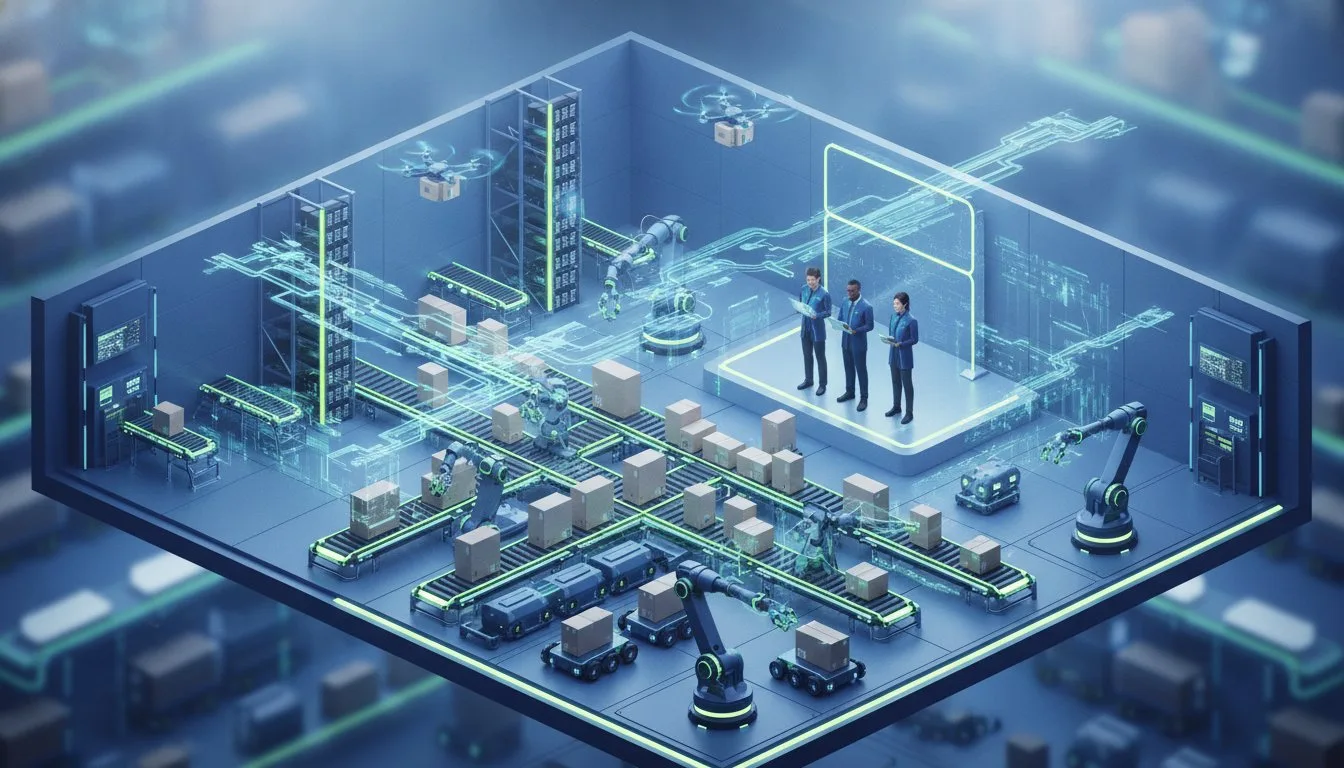
How to Scale eCommerce Fulfillment: The Strategic 2026 Guide
If your growth strategy relies on manual data entry and “good enough” visibility, you aren’t scaling; you’re just accelerating toward a breaking point. With major carriers raising base rates by 5.9% and the suspension of the $800 de minimis exemption adding new layers of customs complexity, the margin for error has vanished. You likely feel the weight of every manual shipping error or the anxiety of blind spots in your inventory. Learning how to scale ecommerce fulfillment in this environment requires more than just extra warehouse space. It demands a sophisticated marriage of technology and physical precision.
We believe your brand identity is tied to every unboxing experience, and losing that personal touch as volume grows is a valid concern. This guide will show you how to transition from reactive, manual processes to a scalable, tech-driven model that preserves your unique brand voice at any scale. We will explore how seamless software integration and on-demand digital printing provide 24/7 visibility while reducing transit times. You’ll gain a strategic roadmap to turn your fulfillment operations into a predictable, high-performance extension of your team.
Key Takeaways
- Learn to distinguish between linear growth and exponential scaling to prevent operational breaking points and rising error rates as your order volume increases.
- Discover how to scale ecommerce fulfillment by moving beyond simple plugins toward robust API integrations that provide 24/7 visibility into your inventory.
- Maintain a premium unboxing experience at any volume by leveraging on-demand digital printing and bespoke kitting that preserves your unique brand identity.
- Adopt a “quiet facility” methodology to ensure accuracy and predictability through proactive inventory management and methodical warehouse workflows.
- Identify the critical criteria for selecting a fulfillment partner that operates as a high-performance, seamless extension of your own professional team.
Scaling vs. Growing: Identifying Your eCommerce Fulfillment Breaking Point
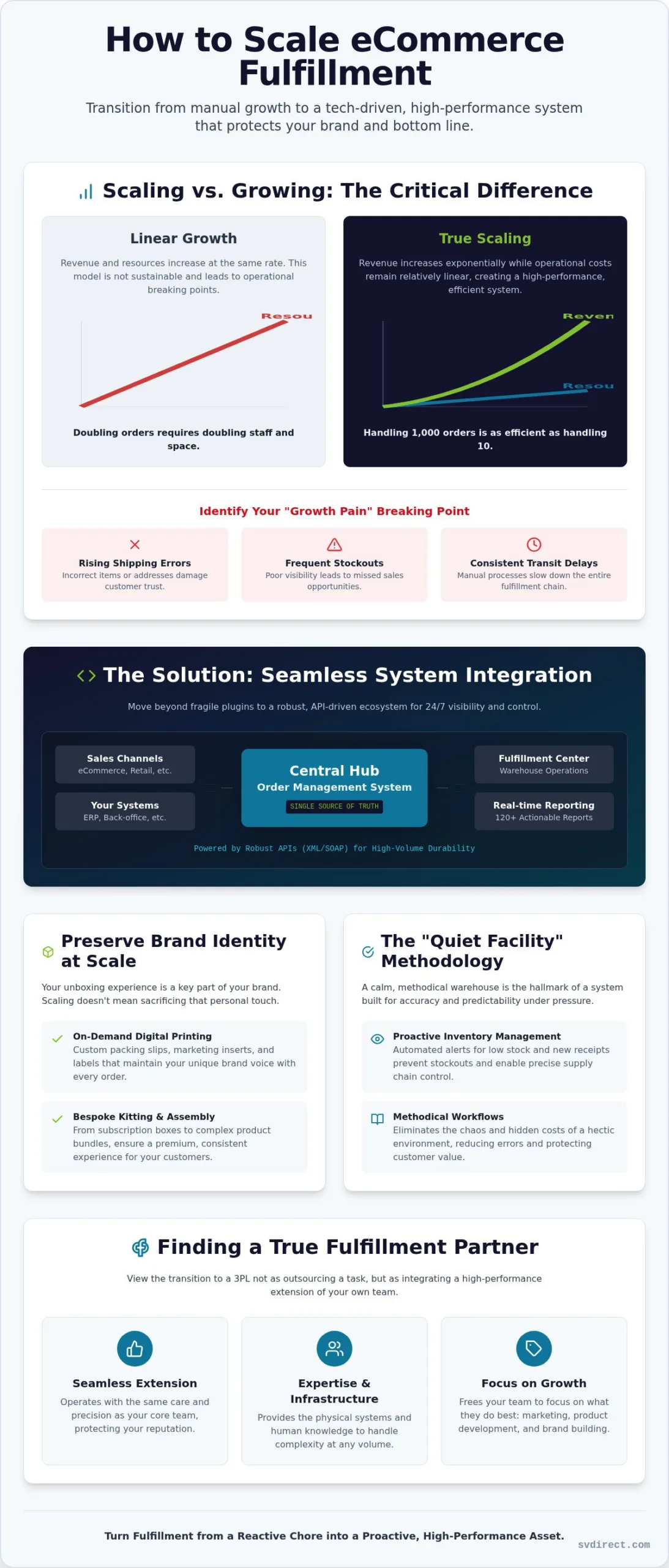
Growth and scaling are often used interchangeably, but in logistics, the distinction is vital for survival. Growth refers to increasing revenue at the same rate you add resources. If you double your orders and have to double your staff and warehouse space, you’re growing, but you aren’t scaling. True scaling occurs when your revenue increases exponentially while your operational costs remain relatively linear. Understanding how to scale ecommerce fulfillment effectively means building a system that handles 1,000 orders as accurately as it handles ten, without a proportional spike in overhead.
You can identify your breaking point by watching for “Growth Pain” indicators. These typically manifest as rising shipping error rates, frequent stockouts despite having inventory, and consistent delays in transit times. When your core team spends more time taping boxes than developing marketing strategies, you’ve hit the In-House Ceiling. Fulfillment scaling is the transition from manual labor to integrated systems. This shift moves your order fulfillment process from a reactive chore to a proactive asset.
The Hidden Costs of In-House Scaling
Many brands underestimate the financial drag of managing their own warehouse. Beyond the obvious lease commitments, you must account for labor management, specialized equipment depreciation, and the cost of packaging waste. A hectic environment often leads to “hidden” errors like incorrect items or poor packing, which directly erode customer lifetime value. High stress in the warehouse also impacts staff retention, creating a cycle of constant training that distracts from your business goals. A quiet, methodical facility is the hallmark of a system ready for high-volume deadlines.
When to Transition to a 3PL Partner
The decision to outsource usually arrives when SKU complexity or order volume exceeds your internal bandwidth. If your team is struggling with kitting requirements or international shipping regulations, it’s time to evaluate a professional partner. You should view this move as a strategic extension of your brand rather than a simple vendor transaction. A high-performance partner acts as a steady hand, providing the physical infrastructure and human expertise needed to protect your reputation. Understanding the transition to professional 3PL services allows you to regain focus on your brand’s creative and commercial growth.
Bridging the Digital Divide: Scaling Through Seamless System Integration
Standard “app-to-app” plugins often fail when transaction volumes spike. They’re designed for convenience, not high-volume durability. To truly understand how to scale ecommerce fulfillment, you must look toward robust API integrations. Your Order Management System (OMS) acts as the central brain of the operation, coordinating inventory across all your sales channels. By establishing a single “Source of Truth,” you eliminate the risk of overselling and backorders. This real-time data exchange ensures that what the customer sees on your storefront matches the physical reality in the warehouse.
Programmatic Scaling via Web Services
High-growth brands require platform-agnostic solutions that don’t break during peak seasons. Leveraging XML and SOAP protocols allows for secure, high-speed data transfer between your storefront and our facility. We utilize specific methods like the “AddOrder” function to automate transaction submissions without human intervention. This programmatic approach extends to your back-office needs through methods like “GetShippingActivity” and “GetOrderInfo.” These tools allow you to pull 120+ standard reports instantly, turning raw data into actionable business intelligence.
Achieving 24/7 Operational Visibility
Scaling requires a proactive stance that’s only possible with total transparency. Our proprietary Remote Control™ system provides a dedicated interface where you can monitor every stage of the fulfillment cycle. You don’t have to wait for business hours to check stock levels or order statuses. Automated email alerts keep you informed about low inventory thresholds and new receipts, allowing you to manage your supply chain with precision. How to manage orders remotely with 24/7 visibility is no longer a luxury but a requirement for modern brands.
If you’re ready to move beyond basic plugins and build a more resilient digital infrastructure, you can request a custom quote to see how our systems integrate with your brand.
Maintaining Brand Identity at Scale: Kitting and On-Demand Printing
Scaling often threatens the very thing that made your brand successful: the personal connection with your customer. As order volumes climb, the temptation to move toward a generic, “cookie-cutter” fulfillment model increases. However, high-growth lifestyle brands cannot afford to sacrifice the unboxing experience. Understanding how to scale ecommerce fulfillment involves more than just speed; it requires a commitment to aesthetic consistency. Your packaging is a physical touchpoint that should reflect the same quality as your digital presence, regardless of whether you’re shipping ten orders or ten thousand.
Bespoke kitting and assembly allow you to maintain this premium feel at scale. By integrating specialized assembly workflows, you can include custom inserts, promotional items, or multi-component kits without slowing down the shipping cycle. We maintain a rigorous QC-Check process during high-speed assembly to ensure that every box meets your specific brand standards. This proactive attention to detail prevents the “hidden” errors that often plague rapid growth, ensuring that your customers receive a perfect package every time.
High-Resolution Personalization: The HP Indigo Advantage
Premium branding requires a level of precision that standard toner-based printers simply can’t achieve. We utilize HP Indigo 5500 liquid ink technology to provide offset-quality results at digital speeds. This system achieves a 230 line screen resolution, ensuring that your logos and marketing images remain sharp and vibrant. When you provide 300 dpi high-resolution files, the output is indistinguishable from traditional commercial printing. This high-resolution personalization allows you to scale your marketing efforts alongside your physical inventory without compromising on visual impact.
On-Demand Printing and Variable Data (VDP)
Managing a massive inventory of pre-printed manuals or brochures is often inefficient and leads to significant waste. A more sustainable approach is “Just-In-Time” printing, where literature is produced exactly when it’s needed for an order. This method is powered by Variable Data Digital Printing (VDP), which allows for unique copy or personalized messaging on every sheet. You can scale your brand with on-demand digital printing to reduce storage costs while increasing the relevance of your customer communications. This level of flexibility ensures your collateral is always current and tailored to the individual recipient.
Proactive Inventory Management: Achieving Accuracy and Predictability
A high-performance warehouse shouldn’t feel like a crisis center. Our “quiet facility” methodology is a deliberate operational choice that prioritizes focus and precision, which are essential when learning how to scale ecommerce fulfillment. In a calm, methodical environment, our team can identify subtle discrepancies before they become shipping errors. This atmosphere reduces the stress of high-volume deadlines and transforms your inventory management from a reactive struggle into a proactive asset that supports your brand’s growth.
Transitioning from reactive to proactive problem solving is a hallmark of operational maturity. Instead of merely responding to stockouts or shipping delays, a proactive system identifies potential issues in real-time. For example, implementing serial number tracking for high-value or sensitive products is a critical step in understanding how to scale ecommerce fulfillment while maintaining total accuracy. We provide access to over 120 standard reports through our proprietary Remote Control™ system. These analytics allow you to pinpoint supply chain bottlenecks, such as slow-moving SKUs or recurring delivery delays, with surgical precision.
The Nine Promises of Scalable Logistics
We believe that successful scaling is built on a foundation of trust and clear communication. Our logistics framework is guided by nine core promises that emphasize transparency and total accountability. We don’t just wait for an order conflict to happen; we work to anticipate it through rigorous internal audits and human oversight. If a discrepancy arises, our “Make-it-Right” attitude ensures we find a bespoke solution that protects your brand’s reputation. This flexibility allows a fulfillment provider to act as a high-performance, seamless extension of your professional team.
Sustainable Scaling and Green Initiatives
Scaling responsibly also means considering your environmental impact. Our on-demand digital printing process is inherently more sustainable because it eliminates the need for physical films or plates, which reduces chemical waste. We utilize FSC-certified papers and participate in responsible hardware recycling programs to minimize our operational footprint. Integrating these green initiatives into your brand’s scaling narrative shows your customers that growth doesn’t have to come at the expense of the planet. It builds a narrative of responsible, long-term success that resonates with modern consumers.
Choosing a 3PL Partner: Scaling as an Extension of Your Team
Selecting a partner is the final, most critical step in learning how to scale ecommerce fulfillment. You aren’t just looking for a vendor to move boxes; you’re looking for a high-performance extension of your own team. A true partner understands your brand’s nuances and adapts their workflows to fit your specific needs. While many providers offer rigid, cookie-cutter procedures, scaling requires total flexibility. You need a steady hand that can pivot as your order volume fluctuates or as your marketing strategies evolve.
The technological infrastructure of a potential partner is just as important as their physical warehouse. Ensure they offer programmatic compatibility, specifically via XML and SOAP web services. This depth of integration allows for the seamless data exchange discussed earlier, moving beyond simple plugins to a resilient digital backbone. Beyond tech, prioritize organizations with a history of innovation and long-term staff retention. Experienced personnel provide a level of oversight and problem-solving that automated systems simply cannot replicate. This human element is what ensures your brand identity remains intact as you learn how to scale ecommerce fulfillment successfully.
Questions to Ask Your Potential Fulfillment Partner
Direct communication is a powerful differentiator in a tech-saturated market. When evaluating a potential partner, move beyond marketing abstractions and ask specific questions about their operational reality:
- How do you maintain a quiet, methodical facility during high-volume deadlines to prevent errors?
- Can your proprietary systems integrate programmatically with our specific CRM or ERP through secure web services?
- What specific, systematic QC-Check processes do you have in place for complex kitting or assembly?
- How does your team proactively identify and resolve order conflicts before they reach the end customer?
The Roadmap to a Successful 3PL Partnership
A successful transition starts with clear, measurable Key Performance Indicators (KPIs). You should establish benchmarks for order accuracy, processing speed, and predictable cost-per-order from day one. These metrics provide an objective way to measure the health of your logistics operations as you grow. Establishing a steady communication rhythm is also vital. Look for a partner that prioritizes proactive alerts over reactive troubleshooting. When your fulfillment team identifies a low inventory level or a shipping delay before you do, they’ve truly become an extension of your brand. Read our customer testimonials on successful scaling to see how this partnership model works in practice. This collaborative approach turns your supply chain into a competitive advantage, allowing you to focus on the creative growth of your business while we handle the precision of the physical operations.
Secure Your Brand’s Future through Operational Precision
Scaling your business in 2026 requires a shift from reactive firefighting to proactive, technology-led precision. You’ve learned that true success involves bridging the digital divide through robust API integrations and maintaining your unique brand identity with high-resolution, on-demand printing. By prioritizing a partnership based on human oversight and technical expertise, you ensure your fulfillment remains a steady hand during periods of rapid growth.
At Silicon Valley Direct, we’ve spent over 25 years perfecting the art of high-touch logistics. Our proprietary Remote Control™ technology provides you with 120+ standard reports for total transparency, while our on-site, offset-quality digital printing ensures your marketing collateral always meets premium standards. Knowing how to scale ecommerce fulfillment is about more than just moving inventory. It’s about building a resilient, adaptable foundation that grows with you.
We’re ready to help you turn your operational challenges into a competitive advantage. Let’s build a scalable future together.
Frequently Asked Questions
What is the difference between scaling and growing an eCommerce business?
Scaling involves increasing revenue exponentially while operational costs remain linear. In contrast, growth usually means your expenses and resources increase at the same rate as your sales. To successfully navigate how to scale ecommerce fulfillment, you need a system that handles 1,000 orders as accurately as ten. This requires moving away from manual labor toward integrated digital systems that allow your business to expand without a proportional spike in overhead.
How do I know when it is time to outsource my fulfillment to a 3PL?
You should consider outsourcing when your internal team spends more time packing boxes than focusing on core marketing and sales strategies. Rising error rates, delayed shipments, and frequent stockouts are clear indicators that you’ve reached an “In-House Ceiling.” Transitioning to a partner allows you to leverage established infrastructure and expertise. This shift ensures your operations remain a steady asset rather than a bottleneck during periods of rapid brand expansion.
Can a 3PL handle custom kitting and branded packaging at high volumes?
Yes, a high-performance partner can manage complex kitting and branded packaging even at extreme volumes. The key is a systematic QC-Check process that inspects every component throughout the assembly cycle. This level of precision ensures your unique brand identity is preserved in every unboxing experience. By using methodical assembly workflows, you can provide the personal touch of a boutique brand while maintaining the speed and efficiency of a global enterprise.
What are the technical requirements for integrating my store with a 3PL?
Integrating your storefront with a professional 3PL typically requires standardized protocols like XML and SOAP for secure data transfer. These systems are platform agnostic, meaning they work with any development environment or operating system. By using programmatic interfaces rather than traditional GUIs, developers can create custom workflows that share business logic and data in real time. This technical foundation is essential for anyone looking to understand how to scale ecommerce fulfillment through seamless system integration.
Is variable data printing (VDP) expensive for personalized inserts?
Variable Data Digital Printing is an affordable way to add personalized marketing inserts or unique copy to every sheet in a print run. It doesn’t cost significantly more than static color printing because it eliminates the need for physical plates or films. This flexibility allows you to produce “Just-In-Time” literature that is tailored to individual customers. You can reduce waste and storage costs while significantly increasing the relevance of your brand’s physical communications.
How does a “quiet facility” methodology improve fulfillment accuracy?
A “quiet facility” methodology removes the hectic, high-stress atmosphere common in many warehouses. By maintaining a calm and organized environment, staff can prioritize focus and strict inventory controls. This deliberate approach allows for more accurate management of high-volume deadlines and reduces the likelihood of shipping errors. It transforms the warehouse from a place of crisis management into a steady, reliable extension of your professional team that supports long-term growth.
What is the benefit of liquid ink digital printing over traditional offset?
Liquid ink digital printing provides the quality of traditional offset with the speed and efficiency of a digital press. Unlike offset, which requires plates and up to 24 hours of drying time, liquid ink prints emerge dry and ready for immediate handling. This technology supports a 230 line screen resolution for sharp, detailed images. It also offers superior control over color density and dot gain, ensuring your branding remains consistent throughout the entire production run.