img not found!
3PL Pricing Models: The 2026 Strategic Guide to Fulfillment Costs

3PL Pricing Models: The 2026 Strategic Guide to Fulfillment Costs

When you compare different 3pl pricing models, why does the most “competitive” quote often result in the most expensive monthly invoice your business has ever seen? It’s a common frustration for growing brands that find themselves buried under unexpected fees or paying for warehouse space they aren’t even using. You deserve a logistics partnership built on clarity rather than complex fine print. We know that unpredictable expenses make it nearly impossible to forecast your margins with confidence.

This guide helps you master the complexities of third-party logistics to ensure your fulfillment costs actually align with your operational needs. You’ll discover how to identify a structure that rewards efficiency and scales seamlessly with your seasonal peaks. We’ll examine the four primary pricing frameworks used in 2026, the data-driven systems that provide real-time visibility, and the specific factors that determine your long term ROI. By the end of this article, you’ll have the tools to choose a partner that acts as a steady hand for your business growth.

Key Takeaways

  • Identify which 3pl pricing models align with your specific growth trajectory to prevent margin creep and ensure predictable monthly expenses.
  • Uncover the reality of hidden contract fees, from technology integrations to account management, and learn how to negotiate for total transparency.
  • Explore how integrating specialized services like on-demand digital printing and precision kitting can streamline your supply chain and lower total costs.
  • Leverage high-tech visibility tools to access real-time data, allowing you to manage inventory and fulfillment with the precision of an in-house team.
  • Transition to a partnership-driven logistics model that replaces automated interactions with personal oversight and bespoke problem-solving.

What are 3PL Pricing Models? Defining the Logistics Landscape

A well-defined logistics strategy depends on understanding 3pl pricing models as more than just a monthly bill. These frameworks dictate how a Third-party logistics (3PL) partner charges for labor, space, and the technical infrastructure required to manage your data. When you evaluate a quote, you’re essentially looking at a roadmap for how your partner will support your growth. Historically, these agreements were purely transactional; however, in 2026, the industry has shifted toward integrated service partnerships that prioritize long-term stability over simple pick-and-pack tasks.

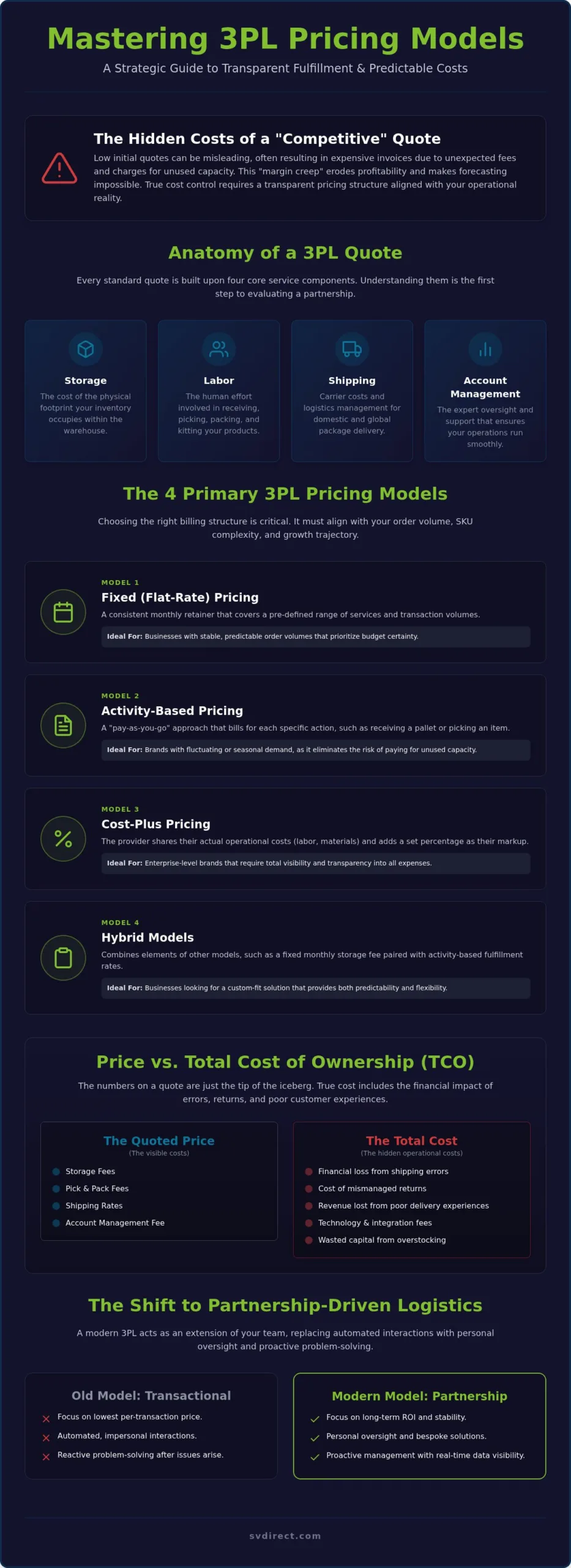
Choosing the wrong 3pl pricing models often leads to “margin creep.” This happens when your logistics costs grow at a faster rate than your order volume, slowly eroding your profitability. A proactive partner helps you avoid this by ensuring the billing structure remains flexible and transparent. Every standard quote includes four core components:

  • Storage: The cost of the physical footprint your inventory occupies within the facility.
  • Labor: The human effort involved in receiving, picking, packing, and kitting.
  • Shipping: The carrier costs and logistics management for domestic and global delivery.
  • Account Management: The oversight and personal support that ensures your operations run smoothly.

The Evolution of Fulfillment Costs in 2026

Rising labor costs have fundamentally changed how activity-based pricing functions. To maintain accuracy without passing excessive costs to clients, sophisticated facilities now lean heavily on technology to reduce administrative overhead. While some providers offer “cheap” per-order rates, these often hide significant service gaps. You might save pennies on a pick fee but lose dollars through slow response times or a lack of personal oversight. We believe that efficiency is driven by a quiet, organized facility where precision is the standard rather than an add-on.

The Difference Between Price and Total Cost of Ownership

Smart operators look beyond the base price to the Total Cost of Ownership (TCO). This includes the heavy financial burden of shipping errors, mismanaged returns, and the permanent loss of customers due to poor delivery experiences. Our approach focuses on proactive problem solving to catch issues before they reach your customer. By utilizing our Remote Control™ system, you gain real-time data access that prevents overstocking and reduces waste. When your warehouse data syncs perfectly with your sales channels, you aren’t just paying for a service; you’re investing in a high-performance extension of your own team.

The 4 Primary 3PL Pricing Models Explained

Selecting from the various 3pl pricing models requires a deep understanding of your own order profiles and growth targets. It’s not merely a matter of finding the lowest per-transaction fee; it’s about aligning your billing structure with your operational reality. The complexities of logistics pricing often mean that a model that works for a low-SKU startup will become a financial burden for a high-volume enterprise. Most providers utilize one of four core frameworks to manage these costs.

  • Fixed (Flat-Rate) Pricing: You pay a consistent monthly retainer that covers a specific range of services. This model is ideal for businesses with stable, predictable volumes that prioritize budget certainty.
  • Activity-Based Pricing: This “pay-as-you-go” approach bills you for each specific action, from receiving a pallet to picking an individual item. It offers high transparency for businesses with fluctuating seasonal demand.
  • Cost-Plus Pricing: The provider shares their actual operational costs and adds a set percentage as their markup. This is frequently used by enterprise brands that require total visibility into labor and material expenses.
  • Hybrid Models: Many modern partnerships combine these elements, such as a fixed monthly storage fee paired with activity-based fulfillment rates to ensure maximum flexibility.

Activity-Based Pricing: Precision for E-commerce

Startups and rapidly scaling brands often favor activity-based structures because they eliminate the risk of paying for unused warehouse capacity. The “Pick and Pack” fee is the heartbeat of this model. It’s usually broken down into a base order fee plus a smaller charge for each additional item. To maintain accuracy, you should regularly audit these invoices against your own sales data. We’ve found that a “quiet facility” methodology, which emphasizes organized physical space and human oversight, naturally keeps these activity costs lower by reducing the time required for each task.

Fixed Rate vs. Cost-Plus: Which Scales Better?

Enterprise-level brands are increasingly moving toward cost-plus models because they remove the “black box” of traditional logistics billing. While fixed monthly retainers offer simplicity, they can lack the incentive for the provider to improve efficiency. In contrast, a cost-plus model creates a transparent partnership where both parties work to trim operational waste. We reject “cookie-cutter” constraints that force you into a rigid box. Instead, we focus on bespoke solutions that adapt as your SKU complexity grows. If you’re looking for a partner that prioritizes precision over automated templates, you can explore our logistics fulfillment services to see how a tailored approach protects your margins.

The Impact of Specialized Services on Fulfillment Costs

Standard 3pl pricing models often struggle to account for projects requiring more than just moving a box from a shelf to a carton. When your business involves intricate assembly or highly regulated materials, a “one-size-fits-all” fee structure quickly falls apart. Specialized logistics, such as healthcare mailing and literature fulfillment, require a level of precision that automated, high-volume warehouses simply aren’t built to provide. These projects demand a partnership-driven approach where costs are calculated based on the specific human oversight and technical accuracy required for success. You aren’t just paying for labor; you’re investing in a system that protects your brand’s integrity.

Integrating Print-on-Demand to Reduce Storage

One of the most effective ways to optimize your logistics budget is by eliminating the need to store massive quantities of pre-printed materials. By integrating on-demand digital printing directly into your workflow, you can significantly reduce your physical inventory footprint and the associated storage fees. We utilize the HP Indigo 5500 to produce high-resolution, offset-quality prints on a short-run basis. Unlike traditional offset printing, this technology eliminates the “drying time” delay. This allows us to move from print to pack almost instantly, ensuring your collateral is always current and relevant. You can learn more about our Print on Demand services to see how this technical capability transforms your supply chain efficiency.

Kitting and Assembly: The QC-Check Advantage

Projects involving subscription boxes, promotional kits, or multi-item bundles rely on labor-based charges that must be managed with extreme care. A common mistake in many 3pl pricing models is underestimating the human effort and quality control needed for complex assembly. We solve this through our systematic QC-Check process, which ensures every kit is inspected for accuracy before it leaves our facility. This proactive stance prevents the high cost of re-work and customer returns, which often dwarf the initial assembly fee. You can explore our kitting and assembly services to understand how precision labor protects your margins.

Choosing a partner that understands the nuances of specialized services means you’re choosing a steady hand in a fast-paced market. Whether you’re managing sensitive healthcare mailings or complex literature fulfillment, the goal is a seamless transition from data to delivery. This level of customization requires a facility that values quiet organization over chaotic volume. By prioritizing accuracy at every stage, we help you avoid the hidden costs of errors that impersonal, automated models often ignore.
3PL Pricing Models: The 2026 Strategic Guide to Fulfillment Costs

Avoiding Hidden Costs in 3PL Contracts

Many businesses fall into the trap of selecting a logistics provider based on a low per-package rate, only to realize later that their 3pl pricing models include a labyrinth of hidden surcharges. These opaque costs often appear as generic account management fees or technology maintenance line items that provide little visible value. When you partner with a logistics expert, you should expect total transparency regarding the human effort and technical infrastructure required to keep your business running. A steady hand in this industry doesn’t hide behind fine print; it leads with clarity.

Account management shouldn’t be a generic fee you pay just to talk to an automated bot. It represents the personal commitment of a seasoned professional who oversees your inventory and anticipates problems before they reach your customers. Similarly, technology and integration fees for connecting your eCommerce store should be clearly defined upfront. We reject the idea of impersonal, automated service. Instead, we favor direct human connection and personal oversight to ensure your specific operational needs are met without surprise monthly invoices.

Receiving and inbound logistics represent the hidden labor of getting products on shelves. If this process is disorganized, it leads to stockouts and lost revenue. Returns management, or reverse logistics, is another often-forgotten cost center that can erode your margins if not handled with precision. A proactive partner treats returns with the same urgency as outbound orders, ensuring items are inspected and restocked efficiently to preserve your capital. This methodical approach turns a potential loss into a recovered asset.

The Cost of Data Visibility

Opaque data is one of the most expensive hidden costs in logistics. If you can’t see your inventory in real-time, you can’t make informed purchasing or marketing decisions. We believe that 24/7 access to order history and inventory levels is a non-negotiable requirement for modern growth. Our proprietary Remote Control™ system provides 120+ standard reports without hidden surcharges. This high-tech visibility ensures you have the clarity needed to scale your operations without the stress of data gaps or administrative overhead.

Shipping and Postage Management

Shipping costs represent a massive portion of your total fulfillment spend, yet they’re often the least transparent part of a contract. A stable partner leverages discounted carrier rates to help offset other fulfillment fees, passing those savings directly to you. When managing strategic global shipping services, administrative handling of customs and international regulations must be exact. This prevents costly border delays and ensures a seamless experience for your global customers, protecting your brand’s reputation for reliability.

The Silicon Valley Direct Approach: Partnership-Driven Pricing

Many logistics providers treat your business as a series of automated tickets within a rigid system. We reject these impersonal 3pl pricing models in favor of custom-fit solutions that treat fulfillment as a strategic partnership. Since our founding in 1999, we’ve focused on being a steady hand for brands that require precision rather than just volume. Our “Nine Promises” of accountability ensure that every interaction is grounded in transparency and direct human connection. We don’t believe in “cookie-cutter” templates because your growth trajectory is unique. Instead, we offer bespoke problem-solving that anticipates conflicts before they impact your bottom line.

Our operational philosophy is built on the “Quiet Facility” methodology. While many warehouses are defined by frantic, disorganized energy, our facility operates with a methodical rhythm. This organization is a primary driver for accuracy and lower error-related costs. By maintaining a quiet, structured environment, we reduce the overhead associated with chaos and re-work. This proactive stance allows us to provide high-performance service that remains accessible and grounded, regardless of how complex your inventory becomes.

A Marriage of Technology and Human Oversight

True efficiency requires a seamless blend of high-tech capabilities and seasoned human expertise. We provide proprietary web services for XML and SOAP integration, ensuring your sales channels and warehouse data sync without friction. This technical infrastructure is managed by a dedicated, long-term staff. Our high staff retention rate acts as a unique hallmark of internal stability, providing you with project consistency that automated models can’t replicate. You can Read our Customer Testimonials to see how this personal commitment translates into long-term client success.

Scaling with Confidence

Transitioning from a startup to an enterprise-level organization requires a fulfillment partner that adapts to your changing needs. We manage high-volume deadlines and seasonal spikes without a hectic atmosphere, ensuring that your brand’s reputation for reliability remains intact. Whether you need precision kitting with our QC-Check process or high-resolution printing via the HP Indigo 5500, we provide the physical infrastructure and human oversight necessary for global reach. We invite you to collaborate with a partner that values your time and respects your margins.

Contact us for a custom fulfillment quote

Future-Proof Your Fulfillment Strategy for 2026

Mastering the complexities of 3pl pricing models ensures your business maintains healthy margins as you scale. You’ve seen how the right framework turns fulfillment from a cost center into a strategic lever for growth. Whether you require precision kitting or the liquid ink quality of our HP Indigo 5500, the goal is always a seamless transition from order to delivery.

With over 25 years of fulfillment expertise, we provide the stability your brand deserves. Our proprietary Remote Control™ system offers 24/7 data visibility, ensuring you’re never left in the dark about your inventory or expenses. We reject the impersonal nature of automated logistics in favor of a partnership built on direct human connection and bespoke problem-solving.

We look forward to helping you build a more efficient, transparent, and successful supply chain. Your business growth is our personal commitment.

Frequently Asked Questions

How much does the average 3PL charge per order?

Total order costs typically depend on your monthly volume, SKU complexity, and specific service requirements. Most 3pl pricing models calculate a base fulfillment fee for the first item, with incremental charges for each additional unit in the same carton. Variables like packaging materials and carrier surcharges also impact the final total. High-volume businesses often see lower per-order rates as they scale, moving beyond initial monthly minimums into more negotiable territory.

What is the difference between pick and pack fees and kitting fees?

Pick and pack fees cover the standard labor of retrieving a finished product and boxing it for shipment to a customer. Kitting fees are project-based charges for specialized assembly, such as bundling multiple items into a promotional set or subscription box. While picking is a routine task, kitting requires the extra oversight of our strict QC-Check process. This systematic inspection ensures accuracy for complex, multi-component projects before they leave our facility.

Are there monthly minimums for 3PL pricing?

Most mid-size logistics providers establish a monthly billing floor to cover the administrative and technical overhead of managing a dedicated account. These minimums ensure the facility can maintain a professional team and high-tech infrastructure for every client, regardless of seasonal fluctuations. For brands with steady growth, these floors provide a baseline for budget predictability while allowing for total flexibility during peak sales periods when order volumes naturally exceed the stated minimum.

How do 3PL warehousing fees work for pallet vs. shelf storage?

Pallet storage is generally charged on a per-unit basis and is ideal for bulk inventory or oversized items. Shelf and bin storage are typically calculated by the square or cubic foot, providing a more efficient solution for small, high-turnover SKUs. Your choice depends on your inventory footprint and how quickly you move through stock. Our organized “quiet facility” methodology ensures that every storage location is optimized to reduce unnecessary space costs and improve retrieval speed.

Is variable data digital printing more expensive than static printing?

Variable data printing involves a different technical setup than static printing, but it significantly reduces costs by eliminating pre-printed inventory waste. By using our HP Indigo 5500, we can produce high-resolution, customized collateral on-demand for every order. This approach prevents the need for large-scale storage of generic materials that may become outdated. The precision of liquid ink technology ensures offset-quality results for every unique piece, from healthcare mailings to literature fulfillment.

Can a 3PL help reduce my international shipping costs?

A professional logistics partner leverages high-volume carrier relationships to access discounted international rates that are difficult for individual brands to negotiate. Beyond base postage, we manage the administrative complexities of customs and global regulations to prevent border delays. This proactive oversight reduces the risk of expensive return-to-sender fees and ensures a seamless experience for your global customers. Efficient logistics management turns global shipping into a reliable growth driver rather than a financial burden.

What should I look for in a 3PL contract to avoid hidden fees?

You should look for a clear breakdown of all line items, including receiving, storage, pick and pack, and account management. Be wary of generic “technology fees” that don’t specify the level of data access provided. Transparent 3pl pricing models should explicitly state how returns, kitting projects, and carrier surcharges are handled. We prioritize direct human connection over automated bots to ensure every contract detail is understood and aligns with your business growth.

How does real-time inventory tracking impact my fulfillment costs?

Real-time tracking through our proprietary Remote Control™ system prevents the hidden costs of overstocking and missed sales opportunities. By accessing 120+ standard reports, you gain the clarity needed to manage inventory levels with precision. This data visibility reduces administrative overhead and allows you to make informed purchasing decisions based on actual warehouse data. Seamless integration between your sales channels and our facility ensures that your fulfillment expenses remain predictable and highly efficient.
3PL Pricing Models: The Strategic Guide to Fulfillment Costs in 2026

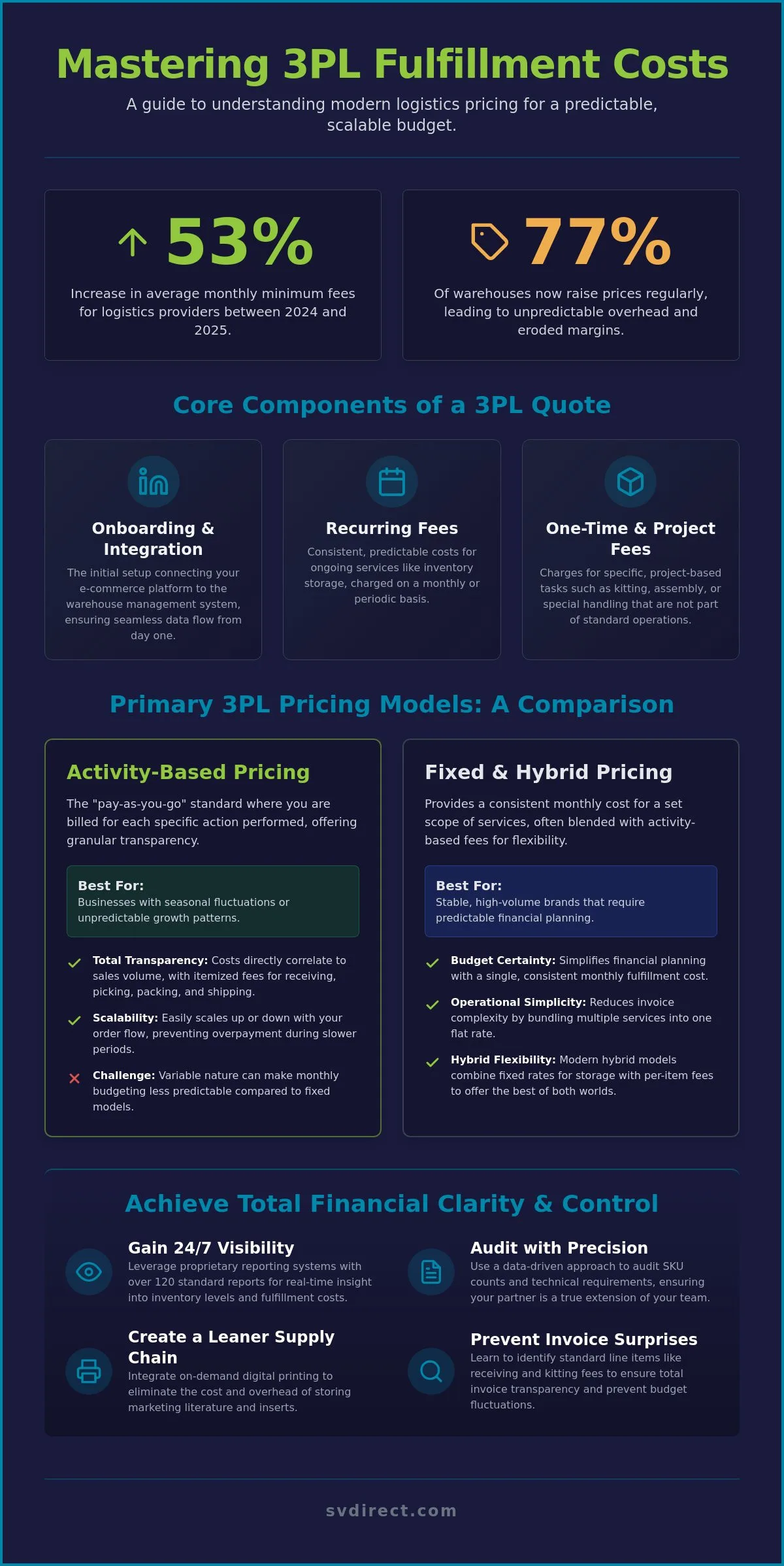
If you feel like your logistics invoices are growing faster than your order volume, you aren’t alone. The average monthly minimum fee for logistics providers jumped 53 percent between 2024 and 2025, leaving many brands struggling with unpredictable overhead. It’s frustrating to scale your operations only to find your margins eroded by surcharges or complex kitting fees that weren’t clear in the initial quote. You deserve a partnership grounded in precision and transparency, not one that hides costs behind confusing jargon. For those looking to decode industry terms, Delgate provides a helpful resource on warehouse abbreviations. Understanding the nuances of different 3pl pricing models is the first step toward reclaiming control over your bottom line.

This guide will help you master the complexities of modern fulfillment costs so you can secure a predictable budget and a partnership that acts as a seamless extension of your company. We will break down the shifting cost structures of 2026, expose the fees that often hide in the fine print, and show you how to leverage real-time data for total financial clarity. Our goal is to move you from a state of uncertainty to a state of informed confidence. You will learn how to choose a model that supports your growth while maintaining the high-tech efficiency your customers expect.

Key Takeaways

  • Understand the critical differences between activity-based and flat-rate 3pl pricing models to determine which structure offers the highest return on investment for your specific volume.
  • Learn to identify standard line items like receiving and kitting fees to prevent unexpected budget fluctuations and ensure total invoice transparency.
  • Use a data-driven approach to audit your SKU counts and technical requirements, ensuring your logistics partner acts as a true extension of your team.
  • Gain 24/7 visibility into your inventory and costs through proprietary reporting systems that offer over 120 standard reports for better decision-making.
  • Reduce the overhead of literature storage by integrating on-demand digital printing into your fulfillment workflows for a leaner, more responsive supply chain.

What is 3PL Pricing? Understanding the Mechanics of Fulfillment Costs

At its core, 3PL pricing represents the fee structure logistics providers use to manage warehousing, labor, and shipping operations. While it sounds straightforward, the reality in 2026 is far more nuanced. As global supply chains grow more complex, Third-party logistics has evolved from a back-office cost center into a primary growth engine for eCommerce brands. You aren’t just paying for shelf space; you’re investing in the infrastructure that allows your business to scale without the friction of physical limitations. Recent data from The Fulfillment Advisor’s 2025 Costs and Pricing Survey shows that average monthly minimum fees jumped 53 percent in a single year. This volatility makes choosing the right 3pl pricing models essential for long-term stability.

The variety of 3pl pricing models available today reflects the diversity of the businesses they serve. A “one-size-fits-all” approach rarely works because your SKU complexity and order volume are unique. A startup with five high-velocity SKUs has vastly different needs than an enterprise shipping thousands of unique, kitted items. To truly understand your expenses, you must look beyond simple pick-and-pack rates and focus on the Total Cost of Fulfillment (TCOF). This metric accounts for every touchpoint, from receiving a pallet to processing a return, providing a realistic view of your profitability. It helps you see the bigger picture of how logistics impacts your customer experience and repeat purchase rates.

The Core Components of a 3PL Quote

A comprehensive quote begins with onboarding and integration. This is the digital handshake where your online store connects with our warehouse management system. It ensures that data flows accurately from the moment a customer clicks “buy.” Beyond initial setup, you will encounter recurring fees, such as monthly storage, alongside one-time costs for project-based tasks like kitting and assembly. Modern logistics partners use sophisticated technology to automate these fee calculations. This automation eliminates manual errors and provides a clear, itemized view of exactly where your capital is going, allowing you to plan your growth with precision.

Why 3PL Pricing Transparency Matters in 2026

Transparency is the bedrock of a healthy partnership. In an era where 77 percent of warehouses now raise prices regularly, hidden surcharges can quickly erode the margins of a scaling business. You need to know that your invoices reflect actual activity without surprise “account management” or “peak season” fees that weren’t discussed upfront. High-performance partners provide 24/7 data access through systems like Remote Control™, allowing you to monitor real-time costs and inventory levels. This level of visibility ensures there are no shocks at the end of the month. 3PL pricing is a strategic investment in scalability rather than a mere operational expense.

Primary 3PL Pricing Models: A Comparative Analysis

Selecting the right framework for your logistics expenses isn’t just about finding the lowest number; it’s about finding a structure that aligns with your operational DNA. The landscape of 3pl pricing models has shifted significantly, offering brands more ways to balance risk with reward. Whether you are a high-growth startup or an established enterprise, your choice will dictate your ability to maintain healthy margins during seasonal spikes.

Activity-Based Pricing: The Pay-As-You-Go Standard

This model is the industry standard for its granular transparency. You pay exactly for the work performed, such as receiving, picking, and packing. Each line item is clearly defined; per-order and per-item fees provide a direct correlation between sales and fulfillment costs. It’s particularly effective for businesses experiencing seasonal fluctuations or unpredictable growth phases. While the high level of transparency is a major benefit, the variable nature of monthly budgeting can be a challenge for those who prefer absolute cost certainty.

Fixed and Hybrid Models for Established Enterprises

For stable, high-volume brands, the predictability of flat-rate or fixed pricing is often more attractive. These models provide a consistent monthly cost, which simplifies financial planning. However, many modern providers are moving toward hybrid models to offer maximum flexibility. A hybrid approach often combines fixed storage rates with activity-based labor. This protects your margins during peak seasons, such as the Q4 holidays, by ensuring that your baseline costs remain steady while labor scales only when orders do. Our eCommerce order fulfillment services are designed to adapt to these shifts, providing the stability you need to grow.

Cost-plus models add another layer of transparency by revealing the actual operational costs of the facility and adding a pre-negotiated management fee. This ‘open book’ approach is ideal for complex partnerships where deep technical integration or specialized kitting is required. It allows you to see the logic behind every expense, ensuring your model matches your SKU count and order frequency precisely. If you are unsure which structure suits your current SKU profile, you can consult with our logistics experts to find the most efficient path forward. Choosing the right 3pl pricing models ensures that your logistics partner acts as a steady hand, allowing you to focus on innovation while we manage the precision of your physical operations.

Breaking Down 3PL Fee Structures and Common Line Items

Understanding the specific line items within 3pl pricing models requires a granular look at the activities that populate your monthly invoice. Every piece of inventory begins its journey with inbound shipping and receiving. This phase involves unloading, inspecting, and logging stock into a warehouse management system to ensure 24/7 visibility. Industry data suggests receiving fees typically range from $5 to $15 per pallet. Once received, warehousing and storage costs apply. These are often calculated by the pallet or cubic foot. Storage in major metropolitan areas often carries a 30 to 50 percent premium over secondary markets, making efficient space utilization a priority for your bottom line.

Standard pick and pack fees generally range from $3.50 to $8.00 for a single-item order. Each additional item usually adds a fee between $0.50 and $1.50. While these labor costs are consistent, your logistics partner should also provide significant value through postage management. By aggregating high shipping volumes, a 3PL can help you leverage carrier discounts that are difficult to access as an independent shipper. This allows you to maintain competitive shipping rates even as national postage costs continue to fluctuate.

Specialized Project Fees: Kitting and Assembly

Moving beyond the standard box requires specialized attention and a steady hand. Whether you are building subscription kits or promotional bundles, these projects demand a higher level of oversight than a simple pick. We utilize a systematic kitting and assembly QC-Check process to ensure every package meets your exact specifications. This meticulous approach reduces errors that lead to costly returns and damaged brand reputation. Precision here prevents the high cost of rework and keeps your customers satisfied from the moment they open their delivery.

Integrated Printing and Literature Fulfillment

A major inefficiency in many supply chains is the storage of bulk printed materials that quickly become outdated. Traditional offset printing often leads to “dead” inventory when marketing details or product specifications change. By integrating on-demand digital printing directly into your fulfillment workflow, you can adopt a just-in-time model. Variable data printing (VDP) allows for personalized inserts or personalized mailings without the overhead of massive storage fees. This integration ensures your literature is as agile as your digital presence, reducing waste and allowing you to pivot your messaging instantly.

3PL Pricing Models: The Strategic Guide to Fulfillment Costs in 2026

How to Evaluate and Choose the Right 3PL Pricing Model

Choosing between various 3pl pricing models isn’t just about comparing numbers on a spreadsheet. It requires a methodical evaluation of your operational reality and future goals. You must look at your logistics partner as a steady hand that guides your growth through precision and personal commitment. To find the most profitable structure, you need to look beyond the surface and analyze how each fee impacts your long-term scalability.

Start by auditing your current fulfillment data. You need precise figures for monthly order volume, SKU counts, and the average number of items per order. These metrics directly influence labor and storage costs. Next, define your technical requirements. The choice between API and Web Service integration is pivotal. While APIs are common, platform-agnostic XML/SOAP web services often reduce long-term IT overhead by providing more stable connections across diverse platforms. This technological foundation ensures that your data remains accurate as you scale.

Factor in specialized needs like healthcare mailing or literature fulfillment. These services require specific compliance or kitting expertise that standard providers may lack. Always request a transparent quote that explicitly includes account management and technology fees. Finally, evaluate the human element. A high-performance partner provides a dedicated contact who understands your business, ensuring your logistics provider acts as a true extension of your team. This personal oversight is a powerful differentiator in a tech-saturated market.

Assessing Technology and Integration Costs

Real-time visibility is essential for modern business. A proprietary system like Remote Control™ provides 24/7 access to your inventory and order status. This eliminates the need for manual data exports, which are prone to error and time lag. When evaluating 3pl pricing models, consider the long-term value of this data access. Real-time reporting allows for proactive decision-making that can save thousands in mismanaged stock or missed deadlines. It transforms your supply chain into a transparent, data-driven asset.

Calculating the ROI of a Strategic Partnership

Look past the ‘per-pick’ fee to see the true impact of error reduction and quality control. A partner that emphasizes a “Quiet Facility” approach provides a higher ROI by preventing the costly mistakes associated with chaotic environments. Proactive problem-solving, where your partner anticipates shipping conflicts before they reach the customer, saves significant money on returns and customer service labor. The most expensive 3PL model is often the one with the lowest upfront price but the highest error rate.

The Silicon Valley Direct Advantage: Profitability Through Precision

Profitability in logistics is built on a foundation of deliberate organization rather than sheer speed. Our “Quiet Facility” methodology is designed to eliminate the chaos often found in high-volume warehouses, ensuring that every movement is intentional. By prioritizing a calm and structured environment, we drastically reduce the error rates that lead to expensive returns and customer dissatisfaction. This precision allows us to offer a level of reliability that stabilizes your bottom line, providing a refreshing alternative to the unpredictable costs found in many 3pl pricing models. We don’t just move boxes; we manage your brand’s reputation with a steady hand.

A primary differentiator of our service is the seamless integration of logistics with on-demand digital printing. Most providers treat printing and fulfillment as separate silos, which creates unnecessary shipping legs and storage fees. We utilize HP Indigo 5500 technology to print marketing materials, inserts, or manuals right when they’re needed. This just-in-time approach reduces “dead” inventory and streamlines your entire supply chain. It’s a level of vertical integration that offers financial transparency often missing from standard 3pl pricing models, allowing you to pivot your marketing strategy without worrying about wasting thousands of pre-printed items.

The Nine Promises we make to our partners serve as a constant anchor of trust. These commitments focus on total flexibility, proactive problem-solving, and a rejection of automated interactions in favor of direct human connection. Our location in the heart of Northern California drives constant innovation in our 3PL fulfillment services, giving you access to global connectivity and tech-forward solutions. We act as a true extension of your company, backed by decades of operational data and a team that takes personal pride in your success.

Bespoke Solutions vs. Cookie-Cutter Pricing

We reject the cookie-cutter approach that forces unique businesses into rigid procedures. Instead, we prioritize bespoke solutions that adapt to the specific requirements of your most complex projects. Our seasoned staff has an exceptionally high retention rate, which translates to deep institutional knowledge and operational stability for your brand. This collective experience was recently demonstrated when our team managed over 3,000 shipments in a single week with 100 percent accuracy. You won’t find that level of precision in a facility that relies on temporary labor and automated scripts.

Scaling with Confidence in 2026

Using the proprietary Remote Control™ system, you gain 24/7 visibility into your operations with access to over 120 standard reports. This real-time data ensures you can manage high-volume deadlines and peak season surges with informed confidence. Whether you’re a startup finding your footing or an established enterprise expanding your reach, we provide the flexibility to grow alongside you. Our commitment to direct communication means you’ll always have a dedicated expert overseeing your account. You can see the impact of this personal commitment for yourself on our customer testimonials page.

Securing Your Growth with Logistics Precision in 2026

The logistics environment in 2026 demands more than just a warehouse; it requires a strategic partnership that prioritizes long-term stability over short-term savings. You have learned that the true value of 3pl pricing models lies in their ability to offer transparency and scalability without the burden of hidden fees. By focusing on the Total Cost of Fulfillment and leveraging real-time data through proprietary systems, you can transform your logistics from a variable expense into a predictable growth engine.

Silicon Valley Direct brings over 25 years of operational history to your supply chain, ensuring that every order is handled with the precision of a seasoned expert. Our integrated digital printing services and Remote Control™ system provide the visibility you need to make informed decisions 24/7. We act as a steady hand in a fast-paced market, allowing you to focus on innovation while we manage the complexities of physical distribution with personal commitment.

We are ready to become the seamless extension of your team that your business deserves. Let’s build a future where your fulfillment is as agile and precise as your vision.

Frequently Asked Questions

What is the most common 3PL pricing model for eCommerce?

Activity-based pricing is the most prevalent structure for eCommerce brands because it aligns costs directly with sales volume. In this model, you pay for specific tasks such as receiving, picking, and packing. It offers high transparency for businesses with fluctuating volumes, ensuring you only pay for the work performed each month without committing to heavy fixed overhead.

Are there hidden fees in 3PL contracts I should watch out for?

Brands should be vigilant regarding account minimums, long-term storage surcharges, and peak-season fees that may not be obvious in initial quotes. Some providers also charge separate SKU management fees or integration maintenance costs. Requesting a complete fee schedule upfront is the best way to ensure your 3pl pricing models remain transparent and predictable throughout the year.

How much does 3PL storage typically cost in 2026?

Standard pallet storage typically ranges from $8.00 to $25.00 per month based on current industry data. However, facility location plays a major role in these costs. Warehouses in major metropolitan areas often carry a 30 to 50 percent premium compared to secondary markets. Shelf and bin storage are usually calculated by the cubic foot for smaller items or high-velocity stock.

What is the difference between a pick fee and a pack fee?

A pick fee covers the labor required to retrieve an item from its designated storage location. In contrast, a pack fee accounts for the time and materials needed to secure those items in a shipping container. While some providers combine these into a single line item, others separate them to provide more granular data on labor utilization and packaging costs.

How do 3PLs charge for returns management?

Returns are generally charged as a flat processing fee per order plus an additional per-item rate for inspection and restocking. If an item requires cleaning, repackaging, or disposal, extra labor fees may apply. Efficient returns management is a critical component of 3pl pricing models, as it helps recover inventory value quickly while maintaining customer satisfaction through fast processing.

Does 3PL pricing include shipping and postage costs?

Shipping and postage are typically treated as pass-through costs and are billed separately from fulfillment labor and warehousing. High-volume logistics partners often provide access to discounted carrier rates, which helps offset the impact of national postage increases. These costs are calculated based on package weight, dimensions, and the destination zone for each individual shipment.

Why is kitting charged separately from standard fulfillment?

Kitting is billed as a separate project because it involves pre-assembling multiple items into a single unit before they are ready for final fulfillment. This process requires specialized labor and quality control checks that go beyond a standard pick. Separating these fees allows for better cost tracking on promotional bundles, subscription box projects, or complex assembly requirements.

Is there a minimum monthly volume required for most 3PL pricing models?

Most providers require a monthly minimum fee to cover the overhead of account management, technology integrations, and dedicated facility space. The average monthly minimum has climbed to over $500 as providers adjust to rising operational costs. If your order volume falls below the threshold, you’ll still be billed the minimum amount to maintain your partnership and real-time data access.

Average Pick and Pack Fees 2026: A Strategic Guide to Fulfillment Cost Benchmarking

Average Pick and Pack Fees 2026: A Strategic Guide to Fulfillment Cost Benchmarking

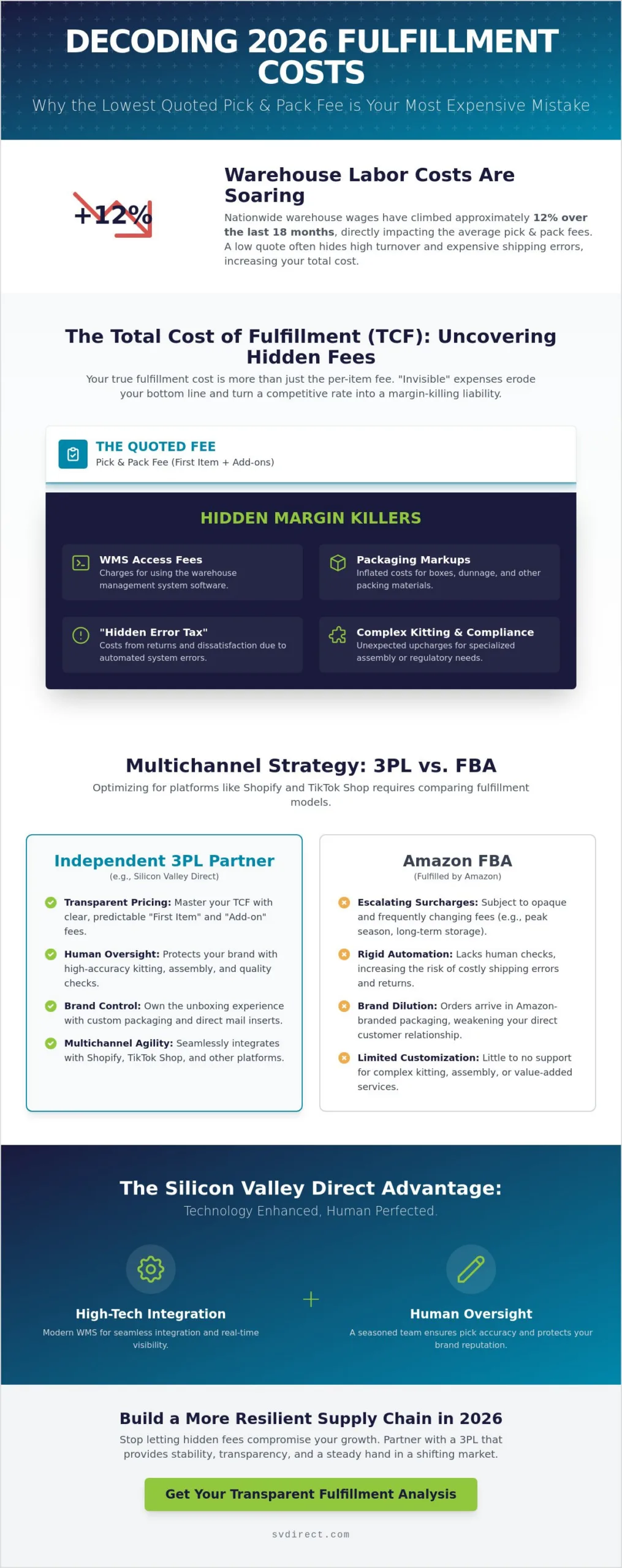
In 2026, the lowest quoted pick and pack fee on your spreadsheet is often the most expensive mistake your eCommerce brand will make. It’s a frustrating reality many high-growth founders face as they scale across platforms like Shopify and TikTok Shop. You probably feel the weight of rising warehouse labor costs, which have climbed 12% over the last 18 months, making it vital to understand the average pick and pack fees 2026 standards before signing your next contract. It’s exhausting to manage opaque pricing models where hidden surcharges turn a competitive rate into a margin-killing expense.

We’re here to help you regain control with a steady hand and clear data. This guide empowers you to master the fulfillment landscape through precise benchmarks and a strategic framework for calculating your total cost of fulfillment. You’ll discover how to identify the complexity tax of multichannel orders and why a partner who prioritizes human oversight over total automation is the ultimate safeguard for your brand’s reputation and financial health. By the end of this article, you’ll have the tools to protect your profitability and build a more resilient supply chain.

Key Takeaways

  • Benchmark your logistics spend against the average pick and pack fees 2026 standards to protect your eCommerce margins from rising operational costs.
  • Master the Total Cost of Fulfillment (TCF) framework to identify “invisible” expenses, such as WMS access fees and packaging markups, that erode your bottom line.
  • Compare escalating Amazon FBA surcharges against independent 3PL models to optimize your multichannel strategy across Shopify and TikTok Shop.
  • Discover how human oversight in kitting and assembly services eliminates operational friction and protects your brand’s physical unboxing experience.
  • Integrate direct mail marketing with your order fulfillment to drive physical engagement and build long-term customer loyalty.

The 2026 Fulfillment Landscape: Why Pick and Pack Fees Are Shifting

The logistics sector is undergoing a fundamental recalibration. Energy price volatility and a tightening labor market have pushed operational overhead to new heights. For brands attempting to benchmark their expenses, the average pick and pack fees 2026 data shows a clear departure from the low-cost models of the previous decade. This shift isn’t just about rising numbers; it’s about a structural change in how value is delivered within the order fulfillment process. We are seeing a market where transparency and reliability are becoming the primary currencies of successful partnerships.

Multichannel complexity adds significant pressure to the warehouse floor. Managing simultaneous surges from TikTok Shop and Shopify requires more than just shelf space. It demands a level of agility that automated systems often struggle to maintain without human intervention. As order volume scales across diverse digital storefronts, the labor requirements for accurate sorting and kitting become more specialized. This has led many high-growth brands to move away from automated-only fulfillment toward models that prioritize human-centric precision to protect their customer experience.

To better understand the current shifts in fulfillment pricing, watch this helpful video analysis:

Labor Trends and the 2026 Warehouse Economy

Nationwide warehouse wages have climbed approximately 12% over the last 18 months, directly impacting the average pick and pack fees 2026 landscape. While some providers try to mask these costs with lower entry fees, cheap labor often results in expensive shipping errors and high turnover. We believe that stability is a competitive advantage. Long-term staff retention ensures that pick accuracy remains high, which ultimately lowers the total cost of fulfillment for our partners. When a team knows the inventory and the brand’s specific standards, they work with a level of care that machines simply cannot replicate.

Technology vs. Human Oversight in Fulfillment

Modern Warehouse Management Systems (WMS) are no longer a luxury; they are a standard expectation for any serious brand. However, technology alone creates a “Hidden Error Tax.” When automated systems lack human checks, the cost of returns and customer dissatisfaction skyrockets. Silicon Valley Direct bridges this gap by combining high-tech digital integration with the personal commitment of a seasoned team. This balance ensures that innovation serves the client rather than complicating the operation. We view digital tools as a way to enhance our human expertise, not replace the watchful eye that ensures every package is perfect.

Our location in the heart of the world’s most innovative ecosystem allows us to see these trends before they hit the national market. Silicon Valley’s focus on efficiency and scalability sets the pace for 3PL pricing standards across the country. By staying at the cutting edge of logistics technology while maintaining a dedicated workforce, we provide a steady hand for brands navigating these shifting costs.

Benchmarking Average Pick and Pack Fees in 2026: A Comparative Analysis

Understanding the numbers is the first step toward reclaiming your margins. While our previous analysis highlighted why costs are shifting across the industry, this section focuses on the specific benchmarks brands encounter when auditing their logistics spend. In 2026, the average pick and pack fees 2026 data indicates that a tiered pricing structure remains the most effective way to balance warehouse labor with client value. This model ensures you pay for the actual work performed rather than a flat average that might overcharge for simpler orders.

The ‘First Item’ vs. ‘Add-on’ Pricing Model

Most 3PL providers utilize a “First Item” fee because the initial pick carries the bulk of the operational weight. This covers the time a team member spends traveling to a location and the initial system scan. Current industry benchmarks suggest you’ll see rates between $2.50 and $5.00 for that first item. Additional items typically cost significantly less, often ranging from $0.50 to $1.00 each. These figures are tied directly to the BLS Unit Labor Costs for Warehousing, which tracks the investment required for every unit of warehouse output. By optimizing your product bundles or kits, you can effectively lower your per-unit fulfillment cost and protect your bottom line.

Independent 3PL vs. FBA: The 2026 Reality

The choice between Amazon FBA and an independent 3PL has never been more consequential. Amazon’s 2026 storage hikes are significant, with peak season storage fees reaching $2.40 per cubic foot for standard items. When you factor in “low-inventory” surcharges and algorithmic penalties, the convenience of FBA often comes with a steep price tag that erodes gross margins. We’re seeing a steady migration of high-growth brands toward independent 3PL models. These brands aren’t just looking for lower fees; they’re seeking the brand control and personalized oversight that a human-centric partner provides. Our ongoing analysis of logistics trends on our fulfillment blog suggests that brands prioritizing this flexibility are better equipped to handle the volatility of multichannel commerce.

Your SKU volume and order frequency will always play a role in your final negotiated rate. High-volume brands with consistent order profiles often move toward flat-fee models in 2026 to ensure total cost predictability. This transparency eliminates the guesswork from your monthly financial planning. If you’re ready to move beyond generic benchmarks and see how these figures apply to your specific SKU profile, you can request a personalized quote to start a more detailed conversation. We believe in providing a steady hand and clear data so you can grow your business with confidence.

Average Pick and Pack Fees 2026: A Strategic Guide to Fulfillment Cost Benchmarking

The Complexity Tax: How Specialized Kitting and Compliance Affect Per-Order Rates

Standard benchmarks provide a necessary baseline for financial planning, but they rarely account for the operational nuances of specialized industries. While the average pick and pack fees 2026 data suggests a range for simple eCommerce orders, brands in the healthcare, medical device, and high-tech sectors face a different reality. These industries operate under a “complexity tax” where the stakes of a fulfillment error extend far beyond a negative review. In these environments, precision is the primary driver of value, and the fulfillment logic must adapt to accommodate rigorous quality control and technical assembly.

This complexity is particularly evident when integrating on-demand digital printing into the fulfillment workflow. By printing collateral only when an order is placed, brands significantly reduce inventory carrying costs and eliminate the risk of dead stock. However, this shifts the labor logic from a simple “pick” to a more involved “prepare and pack” process. The warehouse team isn’t just grabbing a pre-printed item; they’re ensuring the right digital asset is produced and married to the physical shipment with total accuracy.

Kitting and Custom Assembly Fees

For brands utilizing kitting and assembly services, per-order fees reflect the manual labor required to create a bespoke unboxing experience. Whether it’s assembling a subscription box or bundling promotional kits for a product launch, these tasks require human dexterity that automated systems cannot match. Just-in-time assembly allows you to keep your components as individual SKUs, optimizing warehouse space and providing the flexibility to pivot your marketing strategy without re-labeling thousands of pre-packed units. Many of our partners also find success by integrating literature fulfillment services directly into their physical shipments, ensuring that every customer receives the most current assembly guides or promotional inserts.

Regulatory and Compliance Surcharges

Security and compliance represent another layer of the complexity tax. Handling sensitive medical materials or high-value electronics requires specialized facility protocols and staff training that go beyond standard 3PL capabilities. For example, healthcare mailing services and fulfillment must adhere to strict HIPAA guidelines to protect patient confidentiality. This isn’t just about a secure server; it’s about a physical infrastructure designed to prevent unauthorized access and a team that understands the legal weight of their work. While these requirements may push rates above the average pick and pack fees 2026 baseline, the long-term ROI is found in the total elimination of regulatory risk and the preservation of your brand’s integrity. Choosing a partner with a multi-decade history of compliance provides a steady hand in an increasingly regulated market.

Calculating Your Total Cost of Fulfillment (TCF): Identifying Hidden Margin Killers

Focusing solely on the average pick and pack fees 2026 data provides only a partial view of your brand’s financial health. True profitability requires a comprehensive understanding of the Total Cost of Fulfillment (TCF). This metric represents the sum of every operational touchpoint, from the moment inventory arrives at our facility until the final package reaches the customer’s doorstep. Beyond standard labor fees, TCF includes storage, outbound shipping, and the administrative overhead required to maintain a seamless operation. Many brands overlook “invisible” costs such as account management fees or dunnage markups, which can silently erode margins if left unchecked.

Expanding into international markets introduces additional layers of complexity that must be carefully modeled. Our global shipping services provide the infrastructure to manage these variables, but they must be factored into your landed cost per order. Administrative coordination for B2B and B2C logistics often carries a hidden time cost that manual systems fail to capture. Additionally, unoptimized returns management can effectively double your fulfillment spend. Reverse logistics requires the same, if not more, human oversight as the initial pick to ensure inventory is correctly processed, inspected, and restocked without friction.

Storage and Warehousing Fee Benchmarks

Selecting the right storage medium is a balance of accessibility and expense. For high-volume SKUs, pallet storage offers the lowest per-unit cost, while shelf storage is essential for picking efficiency in smaller, diverse inventories. We’ve observed a significant 2026 trend toward “secure warehousing” for brands handling high-value electronics or sensitive materials. This specialized environment impacts insurance premiums and facility protocols but offers essential protection for your most valuable assets. For a deeper look at these specific requirements, refer to our guide on secure warehousing for high-value electronics.

Shipping Management and Carrier Rates

The administrative burden of logistics coordination is a major component of your TCF. A seasoned 3PL leverages its collective volume to secure discounted carrier rates with UPS, FedEx, and DHL that individual brands simply cannot access on their own. It’s also vital to acknowledge that “free shipping” for the consumer is never free for the brand. Factoring actual postage and carrier surcharges into your TCF calculation is the only way to maintain a realistic view of your profitability. If you suspect hidden fees are draining your revenue, you can request a free quote to receive a transparent breakdown of your potential fulfillment costs and identify where your margins are most at risk.

Optimizing Your 2026 Logistics Strategy with Silicon Valley Direct

Navigating the volatility of the current market requires more than just a software integration. It demands a partnership built on operational stability and a refusal to settle for the status quo. While the average pick and pack fees 2026 benchmarks provide a necessary starting point for your budget, the true value of a logistics partner is found in their ability to eliminate friction before it reaches your customer. Silicon Valley Direct offers a steady hand, backed by over 25 years of experience in high-stakes fulfillment. We understand that behind every SKU is a brand promise, and our mission is to ensure that promise is kept through every shipment, kit, and delivery.

One of the most effective ways to differentiate your brand in a digital-first world is by merging the digital and physical customer journeys. By integrating direct mail marketing services with your eCommerce fulfillment, you create multiple touchpoints that drive physical engagement. This holistic approach allows you to include personalized promotional materials or high-quality literature directly in your outgoing orders, turning a standard delivery into a powerful marketing event. This synergy is particularly effective for high-growth startups and established enterprises that need to maintain a premium brand image while scaling rapidly.

A Partnership Beyond the Transaction

We explicitly reject the industry trend of replacing dedicated account managers with automated chatbots. In a crisis, a direct human connection out-performs an algorithm every time. Our commitment to personal oversight is matched by our investment in our team. We believe that our long-term staff retention is the primary reason we maintain a 99.9% pick accuracy rate. When the same experienced professionals handle your inventory year after year, they develop an intuitive understanding of your brand’s standards. Our location in the heart of Silicon Valley acts as a hub for global connectivity, allowing us to leverage local innovation to solve complex logistics challenges for our partners worldwide.

Next Steps: Auditing Your Current 3PL

As you move through the remainder of the year, it’s vital to conduct a thorough audit of your current fulfillment expenses. Use the average pick and pack fees 2026 data we’ve discussed to evaluate whether you are receiving fair value or if hidden surcharges are quietly eroding your profitability. Reach out to your current provider and ask specific questions about their 2026 labor cost adjustments and how they handle multichannel complexity across platforms like TikTok Shop. Transparency should be a requirement, not a request.

If you find that your current provider lacks the transparency or the human oversight your brand deserves, it may be time for a strategic shift. We invite you to contact Silicon Valley Direct for a personalized fulfillment consultation. We will provide a clear, transparent quote that accounts for your specific kitting, printing, and distribution needs. Let us show you how a partnership grounded in precision and personal commitment can protect your margins and accelerate your growth in 2026 and beyond.

Future-Proofing Your eCommerce Growth in a Shifting Market

Mastering your supply chain in 2026 requires looking beyond the sticker price of a single pick. While understanding the average pick and pack fees 2026 provides a baseline for your budget, true profitability comes from identifying hidden margin killers and leveraging specialized kitting to enhance the customer experience. We’ve explored how a strategic focus on Total Cost of Fulfillment (TCF) and regulatory compliance can transform your logistics from a cost center into a powerful competitive advantage.

Silicon Valley Direct has provided this steady hand since 1999. We offer specialized HIPAA-compliant fulfillment and integrated on-demand digital printing to ensure your brand remains agile in a fast-paced economy. Most importantly, we provide direct human oversight on every account, rejecting automated interactions to give your business the personal attention it deserves. It’s time to move toward a more transparent and reliable operational future. Streamline your 2026 fulfillment with Silicon Valley Direct and reclaim your margins today. We’re ready to help you scale with confidence and precision.

Frequently Asked Questions

What is the average pick and pack fee for a single-item order in 2026?

Industry data for 2026 indicates that a standard single-item order typically costs between $3.15 and $3.85. This range accounts for standard eCommerce volume and assumes a non-fragile item. For lighter goods or higher-volume operations, the average pick and pack fees 2026 benchmark can drop as low as $2.50, while heavier or more complex items may reach $5.50.

How much should I expect to pay for additional items in a multi-unit order?

Additional items in a single order are generally priced at 40% to 60% less than the first-item fee. Most 3PL providers charge between $0.50 and $1.00 for each add-on unit. This tiered structure reflects the reduced labor required because the picker is already at the location and the packing station is already prepared for that specific shipment.

Are there extra fees for kitting or custom packaging in 2026?

Yes, specialized kitting and assembly services incur additional costs based on the labor hours required for the specific project. These fees cover tasks like bundling multiple SKUs, applying custom labels, or building subscription boxes. While standard pick fees are predictable, kitting projects are usually quoted as a bespoke service to ensure every detail of your brand’s unboxing experience is handled with precision.

What is a standard monthly account management fee for a 3PL?

Monthly account management fees typically range from $250 to over $1,000 depending on the complexity of your technical integration and support needs. These fees cover the cost of dedicated account oversight, WMS access, and regular reporting. High-performance partners prioritize direct human connection over automated ticketing systems, ensuring you have a steady hand to manage your logistics strategy as you grow.

How do 2026 warehousing fees compare to previous years?

Warehousing costs have seen a steady increase due to a 12% climb in labor costs over the last 18 months. Pallet storage rates in 2026 generally hover between $15 and $25 per month. In contrast, Amazon FBA storage fees have become significantly more expensive during peak seasons. They reach up to $2.40 per cubic foot for standard items, making independent 3PL storage a more stable alternative for many brands.

Can specialized industries like healthcare expect higher pick and pack fees?

Industries requiring HIPAA compliance or specialized medical handling often face higher per-order rates. This complexity reflects the need for rigorous staff training, secure facility protocols, and meticulous quality control measures. While these fees exceed the average pick and pack fees 2026 baseline for standard retail, the investment protects your brand from significant regulatory risks and ensures the safety of sensitive materials.

What are the common hidden costs in a 3PL fulfillment quote?

Hidden costs often include surcharges for SKU complexity, dunnage markups, and returns management fees. Many brands also encounter unexpected “low-inventory” penalties or peak season surcharges when using algorithmic fulfillment models. A transparent partner will provide a clear breakdown of the Total Cost of Fulfillment (TCF). This prevents invisible expenses from eroding your margins and allows for more accurate financial planning.

How does location, like Silicon Valley, affect pick and pack pricing?

Geographic hubs like Silicon Valley influence pricing by acting as centers for global connectivity and high-tech innovation. While local labor markets are competitive, these locations offer superior access to logistics infrastructure and seasoned talent. Choosing a partner in an innovation hub ensures your brand benefits from advanced technical integrations and a proactive approach to supply chain efficiency that stabilizes long-term costs.

3PL Pricing Models Explained: A 2026 Guide to Fulfillment Costs

3PL Pricing Models Explained: A 2026 Guide to Fulfillment Costs

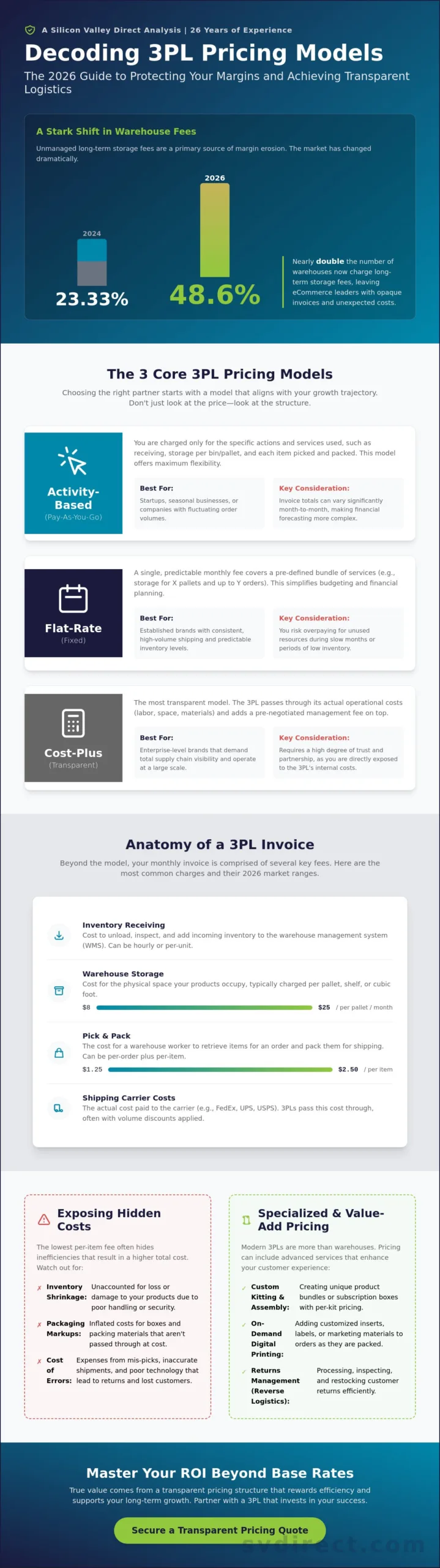
Did you know that 48.6% of warehouses now charge long-term storage fees, nearly double the 23.33% rate recorded in 2024? It’s a stark shift that leaves many eCommerce leaders staring at opaque invoices filled with peak season surcharges and costs for unused space. Having 3pl pricing models explained with total transparency is the only way to protect your margins as you scale. You deserve a logistics partner that operates with the same precision you bring to your product development. We understand that unpredictable monthly expenses are more than just a line item; they’re a barrier to your global reach.

This guide leverages our 26 years of industry experience to help you master complex fee structures, from the $8 to $25 pallet storage range to the $1.25 to $2.50 pick and pack fees that define modern fulfillment. We will show you how to secure predictable logistics expenses and a pricing structure that rewards your growth. We are going to analyze current 2026 market data, compare hybrid and behavior-based models, and help you find the clear ROI your business deserves through a human-centric approach to high-performance shipping.

Key Takeaways

  • Identify the structural differences between fixed, activity-based, and cost-plus models to choose a partner that aligns with your specific scaling trajectory.
  • Navigate the complexities of modern logistics with 3pl pricing models explained to ensure every line item on your invoice translates into measurable operational value.
  • Uncover the impact of hidden costs, such as inventory shrinkage and packaging markups, which can silently erode your margins if left unmanaged.
  • Evaluate how specialized services like on-demand digital printing and custom kitting can be integrated into your fulfillment workflow for a more seamless customer experience.
  • Master the art of calculating true ROI by looking beyond base rates to find a transparent pricing structure that rewards efficiency and supports long-term growth.

Understanding the Core 3PL Pricing Models in 2026

Third-party logistics (3PL) pricing is far more than a simple shipping rate. It is a multi-layered financial framework that accounts for physical warehouse space, expert human labor, and the advanced technology required to sync with your eCommerce platform. In 2026, the industry has moved away from the basic “storage and shipping” mindset. Today, pricing reflects a complex ecosystem of value-added services, from kitting to real-time inventory tracking via API integrations. Silicon Valley Direct has spent 26 years observing this evolution, shifting from manual processes to high-performance, tech-driven environments where precision is the standard.

Relying on a simple “flat fee” is no longer sustainable for most brands. Carrier volatility and shifting consumer demands mean your logistics partner must be agile. This section provides 3pl pricing models explained through the lens of operational efficiency rather than just raw numbers. A transparent structure ensures that your provider’s profit is tied to your success, creating a genuine partnership.

To better understand how these structures impact your bottom line, watch this helpful video:

Many businesses fall into the trap of choosing the provider with the lowest per-item fee. However, the cheapest entry point often results in the highest total cost of ownership. When 3pl pricing models explained are viewed only through the lens of the lowest bid, you miss the cost of errors. Hidden inefficiencies, lack of double-verification for accuracy, and poor technology stacks can lead to costly returns or lost customers. These expenses far outweigh a few cents saved on a pick fee. True value comes from a partner that treats your inventory with a personal touch and precision, ensuring that your growth is never hampered by logistical friction.

The Flat-Rate (Fixed) Model

The flat-rate model offers a predictable monthly cost, making it a favorite for established brands with consistent, high-volume SKU performance. You pay a set price for a bundle of services regardless of minor volume shifts. While this provides extreme predictability for your financial forecasting, it carries risks. During slow months or periods of low inventory, you might find yourself overpaying for resources you aren’t actually using. It is vital to review your historical data before committing to a fixed contract to ensure the “all-in” price actually benefits your margins.

The Activity-Based (Transactional) Model

Often called the “pay-as-you-go” approach, this model charges you only for the specific actions taken within the warehouse. It is ideal for startups or seasonal businesses where order volumes fluctuate significantly from month to month. In this structure, the definition of a “pick and pack” fee is critical. You want a partner who is transparent about how they count items and orders to avoid surprises on your monthly statement. This model rewards efficiency, as you only pay for the exact level of support your business requires at any given moment. You can find more insights on managing these operational shifts on our blog.

Comparing 3PL Pricing: Fixed vs. Activity-Based vs. Cost-Plus

Selecting the right financial structure requires a deep understanding of how your costs will shift as your order volume matures. A model that works for a brand shipping 500 orders per month often becomes a bottleneck when that same brand reaches 50,000 orders. When we look at 3pl pricing models explained for high-growth brands, the focus must shift from simple unit costs to long-term scalability. Data shows that meaningful volume discounts generally begin to appear once a business surpasses 5,000 orders per month. At this stage, the efficiency of your partner’s internal processes becomes just as important as the base rate they quote you.

The Cost-Plus model is a transparent pass-through of actual costs plus a management fee. This approach is gaining significant popularity among enterprise-level brands that demand total supply chain visibility. Instead of wondering about hidden markups on packaging or labor, you see the raw expenses. For example, since 3PLs often negotiate carrier discounts 15% to 30% below published rates, a cost-plus model ensures these savings are clearly accounted for in your favor. It creates a high-performance environment where both parties are incentivized to reduce waste and improve accuracy.

Many of our partners prefer a hybrid approach. This combines the predictability of fixed storage fees with the scalability of transactional labor. You might pay a steady rate for your pallet or shelf space while your pick and pack fees fluctuate based on actual daily activity. This balance protects you from overpaying during seasonal dips while ensuring you have the capacity to handle sudden spikes in demand. If you’re unsure which structure aligns with your current trajectory, you can request a free quote to see a tailored breakdown of these options.

Which Model Fits Your Business Stage?

For startups, activity-based models are often the safest bet. They prevent early-stage cash flow issues by ensuring you only pay for the exact fulfillment work performed. As you move into the mid-market space, transitioning to hybrid models allows for better storage efficiency and more aggressive shipping discounts. Enterprise organizations typically leverage cost-plus structures to gain the granular data needed for global logistics management and precise ROI calculations.

The Role of Technology in Pricing Efficiency

Modern 3pl pricing models explained must account for the digital infrastructure supporting the physical work. Advanced API and Web Services integrations eliminate the need for manual data entry, which significantly reduces administrative fees. When your inventory management system syncs in real-time with our warehouse, you prevent over-storage costs and stockouts. We believe pre-configured integrations should be a one-time setup investment, typically ranging from $0 to $1,000, rather than a recurring monthly tax on your growth. This tech-savvy approach ensures your logistics are as fast and efficient as the rest of your Silicon Valley stack, often including automated channel management solutions from Computer Market Research for global enterprises.

3PL Pricing Models Explained: A 2026 Guide to Fulfillment Costs

The Anatomy of a 3PL Invoice: Breaking Down the Fees

Every monthly invoice tells a detailed story about your operational efficiency. While the broad 3pl pricing models explained in previous sections provide the framework, the actual line items determine your final ROI. Understanding these fees starts the moment your product arrives at the warehouse. Receiving and inbounding charges typically range from $25 to $50 per pallet. If you ship floor-loaded containers instead of palletized goods, your entry costs will rise because of the additional manual labor required for unloading and inspection. These hourly labor charges often sit between $35 and $60, making palletization a key strategy for reducing upfront expenses.

Once your inventory is settled, pick and pack fees become the primary driver of your transactional costs. Most providers use a tiered logic: a base fee for the “first item” in an order and a significantly lower fee for each “additional item.” This base fee generally ranges from $1.25 to $2.50. If your customers typically buy multiple SKUs per transaction, this structure works in your favor. It rewards brands that can increase their average order value without doubling their fulfillment labor costs. Precision during this phase is paramount; our 26 years of experience have shown that double-verification at the packing station is the only way to prevent the expensive returns that erode profit margins.

Storage Logic: Pallets, Bins, and Cubic Feet

Storage is no longer a static expense. With 48.6% of warehouses now charging long-term storage fees, managing your “dead stock” is a financial necessity. Pallet storage typically costs between $8 and $25 per month, while smaller items might be billed at $0.43 to $0.78 per cubic foot. High-velocity items should be placed in easily accessible bins to minimize labor time, whereas long-tail inventory is better suited for high-density pallet racking. If you deal with sensitive electronics or healthcare products, the premium for climate-controlled or high-security zones is a vital investment to protect product integrity and brand reputation.

Postage and Global Logistics Coordination

Postage often represents the largest single expense on a fulfillment invoice. Leveraging a partner with a Silicon Valley hub provides a strategic advantage for global connectivity and optimized shipping zones. Because 3PLs negotiate carrier discounts 15% to 30% below published rates, these savings should be a transparent part of your postage management. You must also account for Dimensional Weight (DIM), where carriers charge based on package volume rather than just physical weight. For international fulfillment, your provider should offer seamless coordination of duties and taxes to ensure cross-border administrative fees don’t surprise your end customers. This level of detail ensures your global reach remains both affordable and reliable.

Exposing the “Hidden” Costs of Budget Fulfillment

Budget fulfillment often presents an attractive entry point, but the true cost of ownership is frequently buried in the fine print. When 3pl pricing models explained by discount providers seem too good to be true, they usually are. These hidden costs often manifest as inventory shrinkage allowances. Many low-cost operations include a standard 1% or 2% shrinkage allowance in their contracts. This clause means the provider isn’t financially responsible for lost or damaged goods until the loss exceeds that threshold. For a brand managing $500,000 in inventory, a 2% allowance is essentially a $10,000 hidden tax on your bottom line. We believe in extreme accountability, rejecting the idea that your inventory should simply disappear as a cost of doing business.

Packaging materials also serve as a common profit center for budget providers. While a provider might offer low labor rates, they frequently apply a 3% to 8% markup on standard dunnage and boxes. Over thousands of orders, these small percentages accumulate into significant expenses that could’ve been reinvested into your brand’s growth. When comparing 3pl pricing models explained by different providers, you must also account for the total cost of reverse logistics. With returns processing fees ranging from $3 to $7 per unit, a budget partner with a high error rate can quickly become your most expensive liability.

The Accuracy Penalty: Mis-picks and Mis-ships

Mis-picks and mis-ships are the silent killers of eCommerce margins. The true cost of a wrong order isn’t just the labor fee. It includes the original shipping cost, the return shipping, the processing of the return, and the potential loss of a customer’s lifetime value. Our 26 years of experience have taught us that double-verification processes in the warehouse pay for themselves by eliminating these systemic errors. We emphasize human interaction over automated systems to ensure that precision remains at the heart of every shipment, protecting your brand reputation from avoidable mistakes.

Account Management and Support Fees

The most frustrating hidden cost is the “automation tax.” Many tech-heavy 3PLs rely on generic ticketing systems that leave you waiting days for a response. When a critical shipping error occurs during peak season, silence is expensive. We provide actual team members who know your brand’s specific needs and are eager to solve problems in real-time. This level of partnership is a powerful differentiator in a tech-saturated market. To understand how to vet these qualities, Check out our guide on choosing a fulfillment partner. If you’re ready for a partner that values transparency and personal commitment, request a free quote today to see our tailored approach.

Specialized Pricing: Beyond Standard Pick and Pack

Most 3pl pricing models explained in online guides treat every product as a standard eCommerce widget. This narrow focus ignores the reality of complex kitting, subscription box assembly, and highly regulated sectors like healthcare. Kitting fees generally range from $1 to $3 per kit, depending on the number of components and the complexity of the assembly. Unlike a standard pick, these projects often require dedicated staging areas and specialized labor. We approach these tasks with a “can-do” attitude, ensuring that even the most intricate bundles are assembled with the precision your brand requires.

On-demand digital printing is another area where traditional pricing models often fail to capture true value. By integrating literature fulfillment and “just-in-time” printing into your workflow, you eliminate the need to store thousands of pre-printed brochures that might become obsolete. This reduces your monthly storage footprint. It’s a critical strategy since 48.6% of warehouses now penalize slow-moving inventory with long-term fees. Whether you’re utilizing healthcare mailing services or direct mail marketing, combining production with distribution creates a seamless, cost-effective cycle that rewards your efficiency.

Project-Based Labor vs. Recurring Fees

Budgeting for seasonal surges or one-time promotional kits requires a shift from recurring fees to project-based labor models. These bespoke projects often fall under hourly labor charges, which typically sit between $35 and $60. This rate covers everything from custom labeling to compliance documentation. It’s a transparent way to handle the “Anything is possible” requests that don’t fit into a standard transactional box. High-touch marketing collateral and literature fulfillment benefit from this flexibility, allowing you to scale up for a major launch without being locked into high fixed costs year-round.

The Silicon Valley Advantage

Our location in Union City, CA, provides a strategic anchor for North American and global distribution. Being situated in a global innovation hub means your logistics partner is as tech-savvy as your internal team. This geographic advantage directly impacts your shipping zones, often reducing the transit time and cost for high-density customer bases. With a 26-year veteran team, we’ve seen the industry evolve and understand how to optimize even the most complex supply chains. We reject the “virtual operation” model in favor of actual infrastructure and human expertise. If you’re ready for a partnership grounded in transparency, you can Request a transparent, tailored quote from Silicon Valley Direct.

Empower Your Growth Through Pricing Clarity

Mastering your logistics expenses starts with a commitment to transparency. We’ve seen how 3pl pricing models explained in this guide, from activity-based structures to cost-plus models, provide the foundation for scalable eCommerce success. By identifying hidden costs like packaging markups and inventory shrinkage allowances, you can protect your margins and reinvest in your brand’s future. The right partnership isn’t just about the lowest bid; it’s about finding a steady hand that offers the flexibility your growth demands. For many scaling enterprises, this flexibility also extends to how they manage their physical transportation assets, where partners like Alliance Fleet Solutions help optimize fleet operations alongside warehouse fulfillment.

With 26 years of experience as a tech-savvy veteran in the industry, Silicon Valley Direct bridges the gap between mechanical logistics and personal commitment. Our team utilizes redundant human-verification to maintain a 99.9% accuracy rate, ensuring your customers receive exactly what they ordered. Whether you require specialized HIPAA-compliant mailing or on-demand digital printing, we’re eager to prove that anything is possible with the right partner. Take the next step toward predictable, high-performance fulfillment today.

Get a Transparent Fulfillment Quote from the Experts at Silicon Valley Direct

Fulfillment Pricing: Frequently Asked Questions

What is the average cost per order for 3PL fulfillment in 2026?

The total cost per order is a combination of pick and pack fees, which typically range from $1.25 to $2.50, plus packaging materials and postage. To find your true cost of ownership, you must also factor in returns processing fees of $3 to $7 per unit and any applicable storage overhead. Calculating the true cost per order is the only way to ensure your pricing model supports your growth targets.

How do 3PL storage fees work for small vs. large items?

Storage fees are structured to match the physical footprint of your inventory. Large items generally incur pallet storage costs between $8 and $25 per month. Small eCommerce items are typically billed by the cubic foot, with rates between $0.43 and $0.78, or through bin and shelf pricing. This ensures you only pay for the specific warehouse volume your products occupy.

Are there hidden fees I should look for in a 3PL contract?

You should carefully review contracts for inventory shrinkage allowances, which often sit at 2%, and markups of 3% to 8% on packaging materials. These are common methods used by budget providers to offset lower base rates. When you have 3pl pricing models explained in detail, ensure that peak season surcharges and account maintenance fees are also transparently disclosed.

What is the difference between pick and pack fees and shipping fees?

Pick and pack fees represent the physical labor required to move an item from a warehouse shelf into a shipping box. Shipping fees are the actual postage costs paid to carriers like UPS, FedEx, or DHL. While pick and pack rates are determined by the 3PL’s labor efficiency, shipping fees are influenced by carrier volume discounts and current fuel surcharges.

How does dimensional weight affect my 3PL pricing?

Dimensional weight (DIM) allows carriers to charge based on a package’s volume rather than just its physical weight. If you ship large, lightweight items, the carrier applies a divisor to the box dimensions to determine the billable weight. We help minimize this impact by optimizing packaging sizes and using accurate dunnage to prevent you from paying for shipping air.

Can a 3PL help me reduce my international shipping costs?

A high-performance 3PL reduces international costs by leveraging carrier discounts that are often 15% to 30% below published rates. Our Silicon Valley location acts as a strategic hub for global connectivity, helping you navigate complex duties and taxes. This expertise ensures that cross-border administrative fees don’t become a surprise expense for your business or your customers.

Why do some 3PLs charge an initial setup or integration fee?

Setup fees, which can range from $0 to $1,000, cover the expert labor required to sync your eCommerce platform via API or Web Services. This initial investment ensures that order data flows seamlessly and accurately between your store and the warehouse. It eliminates the need for manual data entry, which is the primary cause of systemic fulfillment errors.

What happens to my pricing if my order volume fluctuates significantly?

If your volume is seasonal, an activity-based model is usually the most cost-effective because you only pay for the fulfillment actions performed. However, most 3PLs include minimum monthly charges to cover their fixed operational costs and staffing readiness. Understanding how these 3pl pricing models explained apply to your specific sales cycles helps you maintain predictable logistics expenses year-round.