
img not found!
Medical Device Fulfillment Services: A Strategic Guide to Compliance and Precision in 2026

Medical Device Fulfillment Services: A Strategic Guide to Compliance and Precision in 2026

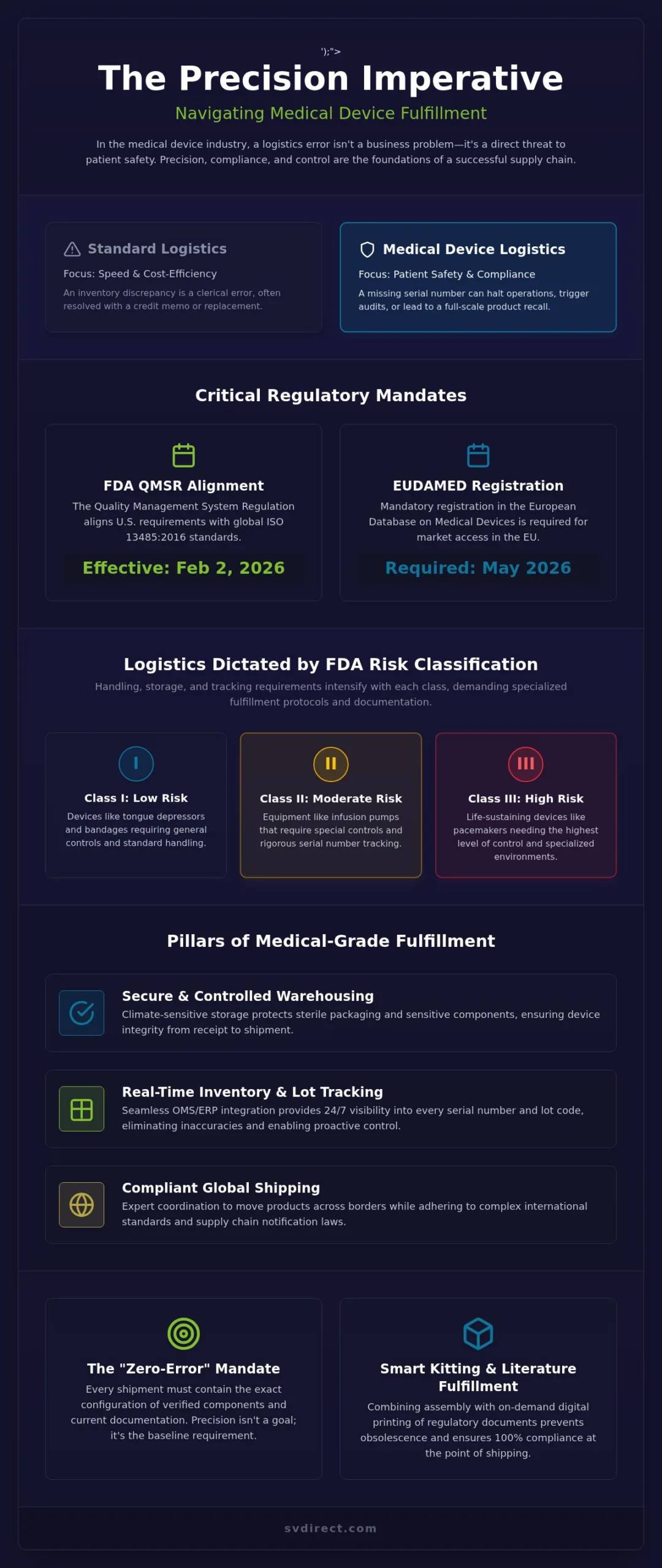
A single inventory error in the medical device industry isn’t just a logistics failure; it’s a direct threat to patient safety and your regulatory standing. With the FDA Quality Management System Regulation (QMSR) now fully effective as of February 2, 2026, the margin for error has vanished. You likely feel the constant pressure of maintaining perfect lot tracking while managing the mandatory EUDAMED registrations that became a requirement in May. It’s a high-stakes environment where slow shipping or a missing serial number can halt operations and trigger costly compliance audits.

Finding reliable medical device fulfillment services means choosing a partner that treats your inventory with the same precision you used to design it. We understand that you need more than a warehouse; you need a steady hand to navigate the complexities of cyber device guidance and strict supply chain notification laws. This guide explores how to achieve seamless integration with your existing ERP systems and ensure zero-error kitting for even the most complex medical components. We’ll show you how real-time visibility and proactive serial number tracking can transform your supply chain from a source of anxiety into a strategic advantage.

Key Takeaways

  • Understand how FDA device classifications dictate specific logistics requirements and why HIPAA-compliant shipping is essential for protecting sensitive patient data.
  • Learn how combining on-demand digital printing with kitting processes prevents document obsolescence and ensures every device includes the most current regulatory literature.
  • Discover how specialized medical device fulfillment services provide 24/7 visibility into serial numbers and lot tracking to eliminate inventory inaccuracies and backorders.
  • Identify why an organized, methodical facility environment is a critical indicator of the precision needed for complex medical assembly and zero-error logistics.
  • Evaluate the importance of seamless OMS and ERP integration to maintain real-time control over your global supply chain while scaling to meet high-volume deadlines.

What Are Medical Device Fulfillment Services?

At its core, medical device fulfillment services represent a specialized branch of third-party logistics (3PL) dedicated to the storage, handling, and distribution of regulated healthcare products. While standard eCommerce fulfillment focuses on speed and cost-efficiency for consumer goods, medical-grade logistics operates under a rigorous set of rules. It is a high-stakes environment where every action is governed by strict regulatory frameworks like the FDA’s Quality Management System Regulation (QMSR), which became effective on February 2, 2026. This regulation aligns U.S. requirements with international ISO 13485:2016 standards, making compliance a global necessity.

Standard logistics providers might treat a minor inventory discrepancy as a simple clerical error. In our world, a missing serial number or an incorrectly tracked lot can lead to a full-scale recall or a denial of market authorization. This Medical Logistics Overview highlights how these specialized services must integrate seamlessly with clinical workflows. Precision isn’t just a goal; it’s a baseline requirement for patient safety. When you choose a partner, you’re looking for someone who understands that a device sitting on a shelf represents a patient waiting for a diagnosis or treatment.

The speed and accuracy of your fulfillment partner directly impact patient outcomes and the success of clinical trials. If a critical component for a trial arrives late or without the correct documentation, the entire study can be compromised. Proactive logistics ensures that life-saving devices reach their destination on time, every time, while maintaining the data integrity needed for regulatory review.

Core Components of Healthcare Logistics

Effective medical device fulfillment services rely on three foundational pillars. First, secure warehousing must include climate-sensitive options to protect sensitive electronic components and sterile packaging from degradation. Second, an inventory management system like our proprietary Remote Control™ platform provides 24/7 visibility into every serial number and lot code. Finally, global shipping coordination ensures that your products move across borders while remaining compliant with international standards like EUDAMED, which saw mandatory module implementation on May 28, 2026.

The High Stakes of Accuracy

In the medical device industry, accuracy is the difference between a successful procedure and a catastrophic failure. The “zero-error” requirement in medical fulfillment dictates that every shipment must contain the exact configuration of verified components and current regulatory documentation to ensure absolute patient safety. Proactive problem-solving anticipates issues like supply chain interruptions before they affect patient care. This level of precision is best achieved in a quiet, organized facility where focus and methodology replace the hectic pace of traditional warehouses. Our Union City facility is designed specifically for this type of high-volume, high-accuracy work, ensuring that every kit is assembled with the care your technology deserves.

Compliance isn’t just about following rules; it’s about protecting the integrity of your brand and the safety of the end user. When choosing medical device fulfillment services, you need a partner that understands the nuance between different regulatory tiers. The logistics strategy for a simple tongue depressor is vastly different from that of a life-sustaining implant. Every step of the process must be documented to ensure that your products remain within the strict bounds of federal law.

The FDA categorizes devices based on the risk they pose to patients, which dictates the level of control required during storage and transport. Class 1 devices, like bandages or surgical gloves, are generally low-risk and require standard handling and general controls. However, Class 2 and Class 3 devices represent a significant leap in complexity. These often include sophisticated equipment like infusion pumps or cardiac pacemakers that require specialized storage environments and rigorous serial number tracking. Advanced medical device fulfillment services provide the necessary infrastructure to manage these high-risk assets without compromising their functional integrity.

Your 3PL must operate as a seamless extension of your quality team. This means adhering to FDA Medical Device Supply Chain Regulations to ensure your product’s certification remains intact from the moment it enters the warehouse until it reaches the clinician. Audit readiness is a daily reality, not a quarterly goal. We maintain this readiness through our “QC-Check” process and the Remote Control™ system, which allows us to provide documentation on demand. Every movement, serial number, and lot code is recorded with surgical precision, giving you peace of mind during regulatory inspections.

Data Security and Information Integrity

Beyond the physical device, the data surrounding its distribution is equally sensitive. HIPAA compliance is a cornerstone of our operation, especially when handling patient-sensitive materials or personalized medical kits. Protecting personal health information (PHI) requires more than just locks on doors; it requires encrypted web interfaces and secure data handling protocols that safeguard every order record. Our Remote Control™ inventory management system ensures that your data is as secure as your physical inventory.

Our specialized Healthcare Mailing Services are designed to manage these complexities, ensuring that critical patient information and device literature are handled with the highest level of security. By maintaining a quiet, highly organized facility in Union City, we reduce the noise and chaos that lead to data entry errors or privacy breaches. If you’re ready to see how a dedicated compliance partner can streamline your operations, you can request a free quote to discuss your specific regulatory requirements.

The Synergy of Kitting and Literature Fulfillment

In the medical device industry, a product isn’t truly complete until the correct Instructions for Use (IFUs) and user manuals are included in the package. These documents are as critical as the hardware itself. If a surgeon or technician receives a device with outdated or missing literature, the clinical risk increases and your regulatory standing is jeopardized. Many providers treat logistics and printing as separate silos, but our approach integrates these functions to eliminate the friction that often leads to errors.

By housing high-resolution printing and fulfillment under one roof, we significantly reduce the risk of document obsolescence. Traditional offset printing often forces brands into large minimum orders, resulting in stacks of manuals that become useless the moment a regulatory update occurs. Our on-demand model allows for short-run production that aligns perfectly with your current inventory levels. This integration is a vital component of maintaining Distribution Chain Compliance, ensuring that every kit leaving the facility contains the most recent, approved version of your technical literature.

Integrated On-Demand Printing

We utilize HP Indigo liquid ink technology to produce offset-quality medical literature with sharp, high-resolution diagrams. This level of clarity is essential for complex medical devices where every line on a technical drawing matters. Through On-Demand Digital Printing, we also offer Variable Data Printing (VDP). This allows us to serialize manuals or personalize patient kits with specific data, bridging the gap between the physical device and the digital record. This capability is especially valuable for clinical trials where localized marketing or specific trial identifiers must be printed in small, controlled batches.

Complex Kitting and Hand Assembly

Complex medical kits often require the bundling of devices with disposables, sterile components, and promotional items. While some 3PLs rely on automated lines that can miss subtle discrepancies, we lean on a dedicated hand-assembly team. Our “QC-Check” process is a systematic inspection protocol designed for the high-stakes nature of Kitting and Assembly Services. Every component is verified against your bill of materials before the kit is sealed. This human-centric oversight, backed by our technical infrastructure, ensures that your medical device fulfillment services deliver a zero-error product to the end user every time.
Medical Device Fulfillment Services: A Strategic Guide to Compliance and Precision in 2026

Real-Time Visibility and Inventory Control

Information lag in the medical device industry is more than a nuisance; it’s a significant operational liability. You must know exactly where your inventory stands at any given second to ensure patient safety and regulatory compliance. Our medical device fulfillment services prioritize total transparency by providing immediate, 24/7 access to your data. This visibility allows you to maintain a steady, reliable supply chain for critical care products without the stress of manual tracking or delayed updates.

We provide automated notifications for every critical milestone. You receive alerts for new receipts, stock level changes, and backorder statuses as they happen. If your inventory dips below a defined threshold, the system triggers a proactive warning so you can restock before a crisis occurs. You also gain access to over 120 standard reports designed for deep supply chain optimization. These tools allow you to analyze fulfillment trends and manage your business with the precision of a seasoned expert.

Connecting your existing ERP or OMS to our infrastructure is a straightforward process. We utilize a proprietary web interface that supports XML and SOAP protocols to facilitate seamless data exchange. This technical integration eliminates the need for manual data entry and reduces the risk of human error. It creates a cause-and-effect environment where an order placed in your system is instantly visible in our Union City facility, ensuring operational readiness at all times.

The Remote Control™ Advantage

The Remote Control™ system provides real-time tracking of every order from the initial pick-slip to the final delivery confirmation. This programmatic interface is built on robust Web Services, which significantly reduces the amount of custom coding your IT team needs to perform. It’s a high-tech solution that mirrors the efficiency of your own digital products. You can explore the full features of our Remote Order Management system to see how it streamlines your operations through direct digital connectivity.

Inventory Accuracy and Expiration Management

Managing regulated medical products requires a strict First-In, First-Out (FIFO) methodology to prevent product expiration and minimize waste. Serial number tracking is an integral part of our fulfillment workflow, which simplifies warranty management and ensures you are always prepared for a potential recall. Automated inventory alerts proactively monitor your stock levels to ensure that life-saving equipment and critical components are always available when healthcare providers need them most.

Choosing Your Medical Device Fulfillment Partner

Selecting a partner for medical device fulfillment services is a high-stakes decision that extends far beyond finding a place to store boxes. It’s about finding a culture of precision. You should evaluate the atmosphere of a facility before signing a contract. A hectic warehouse environment is often a breeding ground for clerical errors and shipping mistakes. Instead, look for a partner that employs a deliberate methodology. Our Union City facility is designed as a quiet, organized space where focus is the priority. This environment allows our team to handle high-volume deadlines with a level of care that chaotic facilities simply cannot match.

Scalability shouldn’t come at the cost of quality. When your brand experiences a surge in demand, your logistics partner must anticipate the strain and adjust accordingly. We believe in proactive communication, which means we identify potential supply chain conflicts or inventory bottlenecks before they ever reach your customers. This proactive stance is mirrored in our commitment to environmental responsibility. By using high-resolution digital printing for technical literature, we eliminate the waste associated with bulk offset printing. We also manage hardware recycling initiatives to ensure your medical technology is handled responsibly at every stage of its lifecycle.

The Nine Promises of Quality

Quality is a human commitment. Our “Nine Promises of Quality” begin with a thorough understanding of your unique operational goals. We don’t believe in one-size-fits-all solutions. Our team maintains a “make-it-right” attitude toward every kit and shipment we process. This personal oversight is a powerful differentiator in a market saturated with impersonal automation. Our long-term staff retention ensures that the experts handling your devices have years of collective experience. You can see the results of this dedication by reviewing our Customer Testimonials.

The Silicon Valley Direct Commitment

Since 1999, we’ve provided a stable anchor for high-tech and healthcare brands. With over 25 years of experience, we understand that we’re more than a vendor; we’re a seamless extension of your sales and marketing departments. Whether you’re shipping to a local clinic or navigating the complexities of global logistics, our team provides the steady hand you need to grow. We combine national reach with a personalized touch, ensuring that your medical device fulfillment services are as innovative as the products you create. Our history is a testament to our reliability, and our physical infrastructure is built to support your most ambitious growth targets.

Elevating Your Regulatory Strategy for 2026 and Beyond

The evolution of the healthcare supply chain in 2026 demands a partner that views logistics as a direct extension of your quality management system. You’ve seen how the integration of high-resolution HP Indigo digital printing for technical literature and our proprietary Remote Control™ system creates a foundation of absolute transparency. By prioritizing specialized medical device fulfillment services that offer 24/7 visibility and a zero-error kitting environment, you protect both your patients and your brand’s regulatory standing.

Since 1999, we’ve focused on providing a stable, high-tech environment where precision is the only standard. Our methodical approach ensures that every serial number is tracked and every complex kit is verified before it leaves our facility. We’re ready to help you navigate the complexities of global distribution while maintaining the personal touch and proactive communication your growing business requires.

Your innovation deserves a logistics strategy that’s as sophisticated as the technology you develop. We look forward to ensuring your critical medical components reach their destination with 100% accuracy and complete compliance.

Frequently Asked Questions

What is the difference between Class 1 and Class 2 medical device fulfillment?

Class 1 devices like surgical masks require general controls and standard handling because they pose the lowest risk to patients. Class 2 devices represent a moderate risk and demand special controls, which often include more rigorous performance standards and specific labeling requirements. Our medical device fulfillment services ensure that Class 2 items receive the enhanced tracking and documentation necessary to maintain compliance with these stricter federal guidelines.

How does HIPAA affect medical device shipping and logistics?

HIPAA mandates the secure handling of any personal health information (PHI) that is linked to a device order or patient shipment. We maintain strict data security protocols to ensure that this sensitive information remains confidential throughout the fulfillment process. This involves utilizing encrypted data transfers and secure labeling practices that protect patient privacy from the moment an order is received until it reaches its final destination.

Can you provide serial number tracking for every individual device shipped?

Yes, we provide comprehensive serial number tracking for every individual unit that leaves our facility. This granular level of detail is captured within our inventory management system to facilitate easy audits and warranty management. It ensures that you can trace any specific device back through the supply chain instantly if you ever need to address a quality inquiry or regulatory request.

What are the benefits of on-demand digital printing for medical manuals?

On-demand digital printing eliminates the waste and high storage costs associated with traditional bulk offset printing. It allows you to update your technical manuals or Instructions for Use (IFUs) immediately to reflect the latest regulatory changes or product revisions. This agility ensures that you never ship obsolete literature, which is a critical factor in maintaining distribution chain compliance and patient safety.

Do you offer climate-controlled storage for sensitive medical components?

We provide climate-sensitive storage options designed to protect the functional integrity of delicate medical components and electronic devices. Maintaining a stable environment prevents the degradation of materials that are sensitive to temperature or humidity fluctuations. This specialized warehousing is a foundational part of our medical device fulfillment services, ensuring that your products remain in peak condition until they are needed by a healthcare provider.

How does your Remote Control™ system integrate with my existing eCommerce platform?

Our Remote Control™ system connects to your eCommerce platform or ERP via secure XML and SOAP protocols. This programmatic interface allows for a seamless, real-time exchange of data without the need for manual entry or custom coding. It ensures that every order placed on your site is instantly visible to our operations team, allowing for immediate processing and accurate inventory updates across your entire network.

What is your process for handling medical device returns and recalls?

We utilize a structured Returns Management process that includes thorough inspections and dedicated quarantine protocols for any returned medical products. If a recall occurs, our serial number tracking allows us to identify and isolate specific affected lots with absolute precision. We act as a steady hand during these high-stakes events, helping you execute the necessary logistics quickly to minimize risk and protect your brand reputation.

Is there a minimum order volume for specialized medical kitting services?

We don’t impose rigid minimum order volumes for our kitting and assembly work. Our facility is designed for total flexibility, which allows us to support both small-scale clinical trials and high-volume commercial product launches. This bespoke approach ensures that you can access professional healthcare logistics at any stage of your brand’s growth without being restricted by arbitrary volume requirements.
Healthcare Fulfillment Services: Navigating Compliance and Precision in 2026

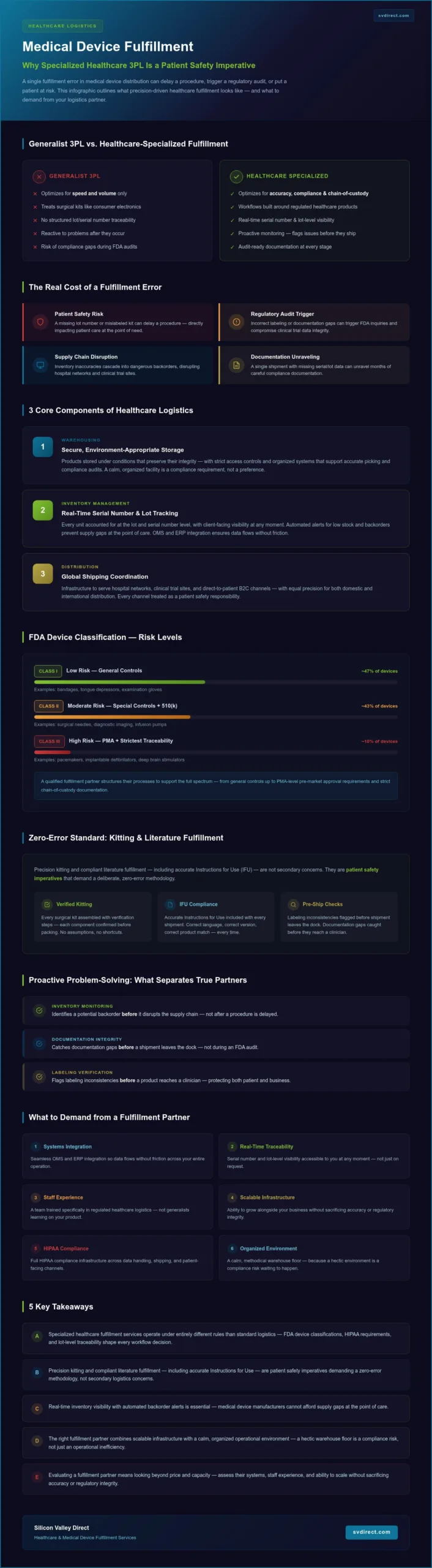
A single fulfillment error in medical device distribution isn’t just an operational headache; it can delay a procedure, trigger a regulatory audit, or put a patient at risk. That’s the reality that makes healthcare fulfillment services fundamentally different from any other logistics category. And yet, too many medical device companies are still partnering with generalist 3PLs that treat a surgical kit the same way they’d treat a box of consumer electronics.

You already know the pressure you’re under. Regulatory compliance isn’t optional, inventory inaccuracies can cascade into dangerous backorders, and a single shipment with missing lot or serial number data can unravel months of careful documentation. The stakes are simply too high for a fulfillment partner that’s learning on the job.

This article walks you through what precision-driven healthcare fulfillment actually looks like in 2026: from seamless OMS and ERP integration to zero-error kitting, real-time serial number visibility, and the compliance-ready processes that protect both your business and your patients. If you’re evaluating your current logistics setup, what follows will give you a clear framework for what to demand from a fulfillment partner.

Key Takeaways

  • Specialized healthcare fulfillment services operate under an entirely different set of rules than standard logistics – FDA device classifications, HIPAA requirements, and lot-level traceability all shape how products must be stored, handled, and shipped.
  • Precision kitting and compliant literature fulfillment – including accurate Instructions for Use – are not secondary concerns; they are patient safety imperatives that demand a deliberate, zero-error methodology.
  • Real-time inventory visibility, including automated alerts for low stock and backorders, is essential for medical device manufacturers who cannot afford supply gaps at the point of care.
  • The right fulfillment partner combines scalable infrastructure with a calm, organized operational environment – because in regulated healthcare logistics, a hectic warehouse floor is a compliance risk waiting to happen.
  • Evaluating a fulfillment partner means looking beyond price and capacity to assess their systems, staff experience, and ability to grow alongside your business without sacrificing accuracy or regulatory integrity.

What Are Medical Device Fulfillment Services?

Medical device fulfillment services are a specialized category of third-party logistics (3PL) designed specifically to handle, store, and distribute regulated healthcare products. That definition sounds straightforward, but the operational reality behind it is anything but. Unlike standard eCommerce fulfillment, where the primary concern is getting a package from point A to point B on time, healthcare fulfillment operates within a dense framework of regulatory requirements, traceability mandates, and patient safety obligations that shape every single workflow decision.

The distinction matters enormously. A generalist 3PL optimizes for speed and volume. A healthcare-specialized fulfillment partner optimizes for accuracy, compliance, and chain-of-custody integrity, often simultaneously. When a surgical instrument ships without a verified lot number, or a diagnostic kit arrives with incorrect labeling, the consequences extend far beyond a customer service complaint. They can trigger FDA inquiries, compromise clinical trial data, or delay a procedure that a patient is counting on.

Serial number tracking and lot control sit at the absolute center of this discipline. Every regulated medical device must be traceable from the moment it enters a warehouse to the moment it reaches its destination. This isn’t a best practice; it’s a baseline requirement that shapes how inventory systems are built, how staff are trained, and how fulfillment partners are evaluated. Silicon Valley Direct’s Remote Control™ system provides clients with real-time serial number visibility precisely because that level of traceability is non-negotiable in this space.

Fulfillment speed also carries clinical weight. Backorders in the medical device supply chain don’t just frustrate procurement teams; they can delay procedures, disrupt clinical trials, and create gaps in patient care. A fulfillment partner that proactively monitors inventory levels and flags potential shortfalls before they become critical is an operational asset, not just a logistics vendor.

Core Components of Healthcare Logistics

Effective healthcare fulfillment services are built on three interconnected capabilities:

  • Secure, environment-appropriate warehousing: Products must be stored under conditions that preserve their integrity, with access controls and organization systems that support accurate picking and compliance audits.
  • Real-time inventory management with serial number tracking: Every unit must be accounted for at the lot and serial number level, with visibility that extends to the client at any moment.
  • Global shipping coordination: Whether serving hospital networks, clinical trial sites, or direct-to-patient B2C channels, the logistics infrastructure must handle both domestic and international distribution with equal precision.

The High Stakes of Accuracy

In medical fulfillment, a zero-error standard isn’t an aspiration; it’s the minimum threshold for safe, compliant operations. Proactive problem-solving is what separates a true healthcare logistics partner from a reactive vendor. Identifying a potential backorder before it disrupts a supply chain, catching a documentation gap before a shipment leaves the dock, or flagging a labeling inconsistency before it reaches a clinician, these are the interventions that protect both patients and businesses.

The physical environment where this work happens also matters. A calm, organized facility isn’t just aesthetically preferable; it’s operationally essential. High-volume precision work demands a warehouse culture where processes are methodical, staff are experienced, and distractions are minimized. That’s not a soft consideration. It’s a compliance variable.

Compliance in medical device logistics isn’t a single checkbox. It’s a layered framework that shifts depending on what you’re shipping, who’s receiving it, and what data travels alongside it. A fulfillment partner that genuinely understands this landscape doesn’t just follow rules; they build their entire operational infrastructure around them.

FDA Class 1, 2, and 3 Requirements

The FDA classifies medical devices into three risk-based tiers, and each one carries distinct implications for how products must be handled, stored, and documented throughout the fulfillment process.

  • Class 1 devices (bandages, examination gloves, tongue depressors) carry the lowest risk profile and are subject to general controls. Standard handling protocols apply, but accurate inventory management and clean chain-of-custody records remain essential.
  • Class 2 devices (powered wheelchairs, infusion pumps, surgical drapes) require special controls, including performance standards and post-market surveillance. Fulfillment workflows must support the documentation that enables this oversight, particularly lot-level tracking and verified shipping records.
  • Class 3 devices (implantable pacemakers, deep brain stimulators, replacement heart valves) sit at the highest risk tier and are subject to premarket approval. The traceability requirements here are stringent. Every unit must be accounted for with a precision that leaves no room for ambiguity at any point in the supply chain.

Your 3PL must function as a seamless extension of your compliance team, not a separate entity that hands off responsibility at the dock door. When a regulatory audit arrives, the documentation your fulfillment partner holds is part of your compliance record. That’s a relationship that demands deep operational alignment, not just a signed service agreement.

Data Security and Information Integrity

Healthcare fulfillment services that handle patient-sensitive materials face an additional compliance layer: HIPAA. When shipping involves personal health information, whether on a label, an enclosed document, or an order record, that data must be protected at every point of contact. Secure medical mailing solutions aren’t optional; they’re a legal obligation with real consequences for mishandling.

On the systems side, encrypted web interfaces that protect order data and inventory records are non-negotiable. Silicon Valley Direct’s Remote Control™ system provides clients with secure, real-time access to inventory and order data precisely because transparency and security must coexist in this environment. For a deeper look at how compliant mailing practices protect both patients and manufacturers, the complete guide to healthcare mailing services covers the operational and regulatory specifics in detail.

Audit readiness is the practical test of all of this. Can your fulfillment partner produce lot histories, shipping confirmations, and chain-of-custody records on demand? If the answer involves hesitation, that’s a risk your business shouldn’t carry. If you’re evaluating whether your current setup genuinely meets this standard, it’s worth taking the time to discuss your compliance requirements with a specialized fulfillment partner before an audit forces the conversation.

The Synergy of Kitting and Literature Fulfillment

A medical device that ships without its Instructions for Use isn’t just incomplete. It’s potentially dangerous, and almost certainly non-compliant. IFUs and user manuals aren’t supplementary materials; they’re regulated components of the product itself. Treating them as an afterthought, or outsourcing their production and insertion to a separate vendor, introduces exactly the kind of documentation gap that triggers recalls and regulatory scrutiny.

Most fulfillment operations handle kitting and literature as separate workflows, sometimes managed by entirely different vendors. That siloed approach creates handoff points where errors accumulate: the wrong manual version gets included, a language variant is substituted, or a revision update doesn’t propagate before a shipment run. In precision-driven healthcare fulfillment services, those gaps aren’t acceptable at any volume.

The answer is integration. When printing and kitting happen under the same roof, managed by the same team, the entire process tightens. Version control becomes a single-point responsibility. Quality checks apply to both the device components and the literature simultaneously. And when a product update requires a new IFU, the change is reflected immediately, without the lag that comes from coordinating across vendors.

Integrated On-Demand Printing

Silicon Valley Direct’s HP Indigo 5500 with liquid ink technology produces offset-quality output that meets the visual precision medical literature demands: sharp anatomical diagrams, legible fine-print warnings, and accurate color rendering for device identification. On-demand production means literature is printed when it’s needed, not warehoused in bulk runs that become obsolete the moment a label or dosage instruction changes.

Variable Data Printing extends this further. Serialized manuals, personalized patient kits, and localized clinical trial materials can each be produced with unique data fields, lot-specific references, or region-appropriate regulatory language, all within the same print run. For short-run applications like Phase II trial documentation or geographically targeted medical marketing campaigns, this capability eliminates the waste and lead time that offset printing typically demands. Explore the full scope of what’s possible through on-demand digital printing.

Complex Kitting and Hand Assembly

Assembling a surgical or diagnostic kit isn’t a pick-and-pack operation. It requires a dedicated hand-assembly team that understands what goes into each kit, in what order, and why. Bundling a device with its necessary disposables, correct literature version, and any promotional or instructional inserts demands both process discipline and genuine product familiarity.

SVD’s QC-Check process applies systematic inspection at each stage of complex kit assembly. Components are verified against a defined checklist before the kit is sealed, ensuring that every unit leaving the facility matches the exact specification, not approximately, but precisely. That level of structured oversight is what separates compliant healthcare fulfillment services from general assembly operations that treat medical kits like any other bundled product.

  • Literature version control: On-demand printing ensures only current IFU and manual versions enter the kitting workflow.
  • Component verification: Each kit is checked against a defined assembly specification before sealing.
  • Short-run flexibility: Clinical trial kits and localized materials can be produced in precise quantities without minimum-run constraints.
  • Single-source accountability: Printing and assembly under one roof eliminates inter-vendor handoff errors.

When the stakes are patient safety and regulatory compliance, the operational model that keeps printing, kitting, and quality control inside a single, organized facility isn’t just more efficient. It’s the only model that consistently holds.

Healthcare Fulfillment Services: Navigating Compliance and Precision in 2026

Real-Time Visibility and Inventory Control

Blind spots in your inventory data aren’t an inconvenience in medical device distribution. They’re a liability. When a hospital’s procurement team is counting on a specific implant being in stock, or a clinical trial site needs a kit replenished before a scheduled procedure window, the difference between real-time visibility and a 24-hour reporting lag can have direct consequences at the point of care. Healthcare fulfillment services that can’t deliver continuous, accurate inventory intelligence aren’t meeting the baseline requirement for this industry.

The operational standard here is straightforward: your fulfillment partner’s inventory data should be as current as your own internal systems, and it should be accessible whenever you need it. Not during business hours. Not after a manual report is generated. Now. That level of transparency is what allows medical device manufacturers to make confident procurement decisions, respond to demand fluctuations, and maintain the supply continuity that clinical operations depend on.

Automated notifications close the gap between data and action. When stock levels approach a defined threshold, when a new receipt is logged, or when a backorder condition develops, the system should surface that information proactively rather than waiting for someone to run a query. Automated alerts prevent stock-outs of life-saving equipment by giving supply chain teams the lead time they need to respond before a shortage becomes a crisis.

Reporting depth matters just as much as real-time access. With more than 120 standard reports available, supply chain teams can move beyond reactive monitoring into genuine optimization: identifying demand patterns, evaluating carrier performance, analyzing lot-level movement history, and building the documentation foundation that regulatory audits require.

The Remote Control™ Advantage

SVD’s Remote Control™ system tracks every order from pick-slip generation through final delivery, giving clients a complete, uninterrupted chain-of-custody record. The system connects to existing ERP platforms via XML/SOAP-based Web Services, which significantly reduces the custom coding burden that typically accompanies a new fulfillment integration. Your team works within familiar systems; the data flows cleanly between them.

Inventory Accuracy and Expiration Management

FIFO (First-In, First-Out) inventory rotation is the standard methodology for preventing medical product expiration, and it’s built into SVD’s warehouse workflows rather than treated as an optional protocol. Products with the earliest receipt dates move first, which protects both product integrity and compliance standing.

  • Serial number tracking: Every unit is recorded at the serial level, making recall execution and warranty management precise and auditable rather than approximate.
  • Lot-level traceability: Full lot histories are maintained and accessible on demand, supporting both internal quality reviews and external regulatory inquiries.
  • Expiration monitoring: Inventory approaching expiration is flagged before it becomes a write-off or a compliance issue.

Taken together, these capabilities transform inventory management from a background function into a strategic asset. In a supply chain where accuracy isn’t negotiable, that distinction carries real weight.

Choosing Your Medical Device Fulfillment Partner

Most vendor evaluations start with price and capacity. Those matter, but in medical device distribution, they’re table stakes. The questions that actually determine whether a fulfillment relationship will hold up under regulatory pressure, high-volume deadlines, and the inevitable unexpected are harder to answer from a sales deck. What does the warehouse floor actually feel like? How does the team respond when a conflict surfaces? And when your business scales, will the partner scale with the same precision or start cutting corners?

Facility atmosphere is a legitimate evaluation criterion. A hectic environment, one where staff are reactive, processes shift under pressure, and the floor feels disorganized, is a compliance risk before a single product ships. Deliberate methodology, the kind built into how a facility is organized, how staff are trained, and how quality checks are sequenced, produces consistently accurate output precisely because it doesn’t depend on individual heroics to catch errors. When you’re evaluating a healthcare fulfillment services partner, ask for a facility tour. What you observe will tell you more than any SLA document.

Scalability deserves the same scrutiny. A partner that performs well at moderate volume but struggles when a product launch or seasonal demand spike arrives isn’t a growth partner; it’s a bottleneck waiting to form. The right partner has the infrastructure, staffing depth, and process discipline to absorb volume increases without sacrificing the accuracy standards that regulated distribution demands.

Proactive communication is the differentiator that’s hardest to quantify and most consequential to find. A fulfillment partner worth trusting doesn’t wait for problems to surface. They flag potential conflicts before they become disruptions, whether that’s a lead time concern, an inventory threshold approaching, or a documentation gap identified during a pre-shipment check. That anticipatory posture is what separates a true operational partner from a transactional vendor.

Environmental responsibility is increasingly part of the evaluation as well. On-demand digital printing eliminates the bulk overruns and obsolete inventory that offset production generates. Hardware recycling initiatives reflect an operational culture that takes long-term thinking seriously, which tends to be the same culture that builds durable, accurate fulfillment processes.

The Nine Promises of Quality

SVD’s approach to quality begins with a foundational commitment: understanding what a client is actually trying to accomplish, not just what they’ve ordered. That orientation shapes everything from how kitting specifications are interpreted to how edge cases are handled when a shipment doesn’t go as planned. The “make-it-right” attitude isn’t a slogan; it’s the operational default when something falls outside the expected parameters. Client testimonials reflect what that commitment looks like in practice, across industries and over time.

The Silicon Valley Direct Commitment

With more than 25 years of experience in high-tech and healthcare fulfillment, SVD brings operational depth that newer entrants simply can’t replicate. The team functions as a seamless extension of your sales and marketing departments, handling the logistics infrastructure so your internal teams can focus on product development, clinical relationships, and growth. National distribution reach, combined with global shipping expertise, means SVD supports your business whether you’re serving a regional hospital network or coordinating international clinical trial logistics. That combination of experience, infrastructure, and genuine partnership orientation is what precision-driven medical device distribution actually requires.

Learn more about SVD’s fulfillment capabilities and how they support medical device manufacturers at every stage of growth.

Precision Is the Standard. Make Sure Your Partner Meets It.

Medical device distribution doesn’t leave room for approximation. The difference between a fulfillment partner that understands regulated healthcare logistics and one that’s adapting general processes to fit your products shows up in audit documentation, in kitting accuracy, and ultimately in patient outcomes.

What this article has made clear: compliant healthcare fulfillment services require lot-level traceability, integrated kitting and literature workflows, and real-time inventory visibility that doesn’t wait for a manual report. Those aren’t premium add-ons; they’re baseline requirements for operating safely in this space.

Silicon Valley Direct has been building that operational foundation since 1999. The proprietary Remote Control™ system delivers the chain-of-custody transparency that regulated distribution demands, and HP Indigo digital printing ensures every IFU and manual ships at the quality and version accuracy your compliance record requires.

If your current setup leaves any of those gaps open, now is the right time to have that conversation.

The right partner doesn’t just keep up with your growth; they help protect everything you’ve built.

Frequently Asked Questions About Healthcare Fulfillment Services

What is the difference between Class 1 and Class 2 medical device fulfillment?

The core difference lies in documentation depth and oversight requirements. Class 1 devices carry the lowest risk profile and require standard handling with clean chain-of-custody records. Class 2 devices demand special controls, including performance standards and post-market surveillance, which means your fulfillment partner must maintain verified lot-level tracking and shipping records that support ongoing regulatory oversight. The warehouse workflows, quality checks, and reporting capabilities required are meaningfully more rigorous at the Class 2 level.

Class 3 devices raise the bar further still, requiring premarket approval and the most stringent traceability standards in the FDA classification system. If you’re distributing across multiple device classes, your fulfillment partner needs processes that can accommodate each tier simultaneously without defaulting to the lowest common denominator.

How does HIPAA affect medical device shipping and logistics?

HIPAA becomes directly relevant whenever a shipment involves personal health information, whether that’s on a label, an enclosed document, or an order record. In those cases, your fulfillment partner is handling protected health information and must treat it accordingly: secure data handling, encrypted system access, and controlled physical environments are all required, not optional. A fulfillment partner without these safeguards in place exposes your business to real legal liability.

On the systems side, this means the platforms your 3PL uses to manage order data and inventory records must meet the same security standards you’d apply internally. SVD’s Remote Control™ system provides clients with encrypted, secure access to their inventory and order data precisely because transparency and HIPAA compliance have to coexist in a properly run healthcare logistics operation.

Can you provide serial number tracking for every individual device shipped?

Yes. Serial number tracking is built into SVD’s fulfillment workflows, not added as an optional layer. Every unit is recorded at the serial level from receipt through final delivery, creating a complete, auditable chain-of-custody record that supports recall execution, warranty management, and regulatory inquiries. This isn’t a premium feature; it’s a baseline requirement for compliant healthcare fulfillment services, and it’s treated as such operationally.

That level of granularity also makes a practical difference when something goes wrong. If a recall is issued or a warranty claim surfaces, you’re working with precise unit-level data rather than lot approximations. That specificity protects both your compliance standing and your customers.

What are the benefits of on-demand digital printing for medical manuals?

On-demand digital printing eliminates the version control problem that bulk offset runs create. When a label change, dosage update, or regulatory revision is required, the new version goes into production immediately. There’s no warehouse of obsolete literature to write off, and no risk of an outdated IFU shipping alongside a current device. SVD’s HP Indigo 5500 with liquid ink technology produces offset-quality output, meaning fine-print warnings, anatomical diagrams, and color-coded device identification all render with the precision medical literature demands.

Short-run flexibility is the other major advantage. Clinical trial documentation, regionally localized materials, and serialized patient kits can each be produced in precise quantities without minimum-run constraints. For medical device manufacturers managing multiple product lines or ongoing trial phases, that agility has real operational value.

Do you offer climate-controlled storage for sensitive medical components?

Storage environment requirements vary significantly across medical device categories, and the right answer depends on what you’re shipping. We’d encourage you to discuss your specific product sensitivities directly with our team so we can confirm whether our facility configuration is the right fit for your components. What we can confirm is that SVD’s warehousing is organized around the precision and access-control standards that regulated medical device storage demands, including FIFO inventory rotation to protect product integrity and prevent expiration issues.

How does your Remote Control™ system integrate with my existing eCommerce platform?

Remote Control™ connects to existing ERP and eCommerce platforms via XML/SOAP-based Web Services, which reduces the custom development burden that typically comes with a new fulfillment integration. Your team continues working within familiar systems; the data flows cleanly between them. Order tracking, inventory levels, lot histories, and shipping confirmations are all accessible in real time through a secure, encrypted interface, so you’re not waiting on manual reports to understand what’s happening in your supply chain.

If you’re running a more complex tech stack or have specific integration requirements, the practical next step is a direct conversation with our team to map your current setup against our integration capabilities. That’s a faster path to clarity than working through a generic checklist.

What is your process for handling medical device returns and recalls?

Returns management is a confirmed service offering at SVD, and in a regulated healthcare context, it requires more than a standard reverse logistics workflow. Returned medical devices need to be received, documented, and segregated with the same lot-level accuracy as outbound shipments. The chain-of-custody record doesn’t end at delivery; it has to account for what comes back and why. SVD’s serial number tracking capability means every returned unit is tied to its original shipment record, which matters enormously when a recall requires you to demonstrate exactly where specific units went and what came back.

For active recalls, the precision of your inventory data determines how quickly and completely you can respond. We’d recommend discussing your specific recall protocols directly with our team so we can walk you through how our processes align with your regulatory obligations.

Is there a minimum order volume for specialized medical kitting services?

SVD’s on-demand digital printing and hand-assembly capabilities are specifically designed to support short-run production without minimum-run constraints. Clinical trial kits, regionally localized materials, and serialized patient kits can all be produced in precise quantities, which means you’re not forced into bulk runs to access specialized kitting services. That flexibility is particularly valuable during product launches, Phase II trial phases, or market-entry situations where demand volume is still being established.

For complex kitting projects with specific assembly specifications, the best approach is a direct conversation with our team. We can assess your requirements, walk you through the QC-Check process, and give you a realistic picture of what’s feasible at your projected volume. Request a quote to start that conversation.