



ECommerce Inventory Forecasting: The 2026 Strategic Guide to Demand Planning
What if your inventory levels were so precise that you never had to choose between a stockout and a cash flow crisis again? With the Federal Reserve policy rate currently between 4.00 and 4.25 percent, the financial cost of carrying excess stock has become a significant burden on your bottom line. You probably recognize the sting of watching revenue slip away because of a stockout on a best-seller while capital remains tied up in slow-moving items. Mastering ecommerce inventory forecasting is no longer just a back-office task; it’s a critical strategy for any brand looking to capture its share of the 7.41 trillion dollar global retail market.
This guide will show you how to achieve 95 percent forecast accuracy and implement automated reorder alerts that keep your operations lean. We’ll explore the move toward integrated digital supply chains and the role of real-time data in making smarter purchasing decisions. You’ll discover how to sync your sales channels with physical warehouse reality to reduce costs and scale your business with confidence. Our team believes in providing the steady hand and technical precision you need to replace operational stress with a clear, organized path forward for your supply chain.
Key Takeaways
- Understand how analyzing historical sales velocity and seasonal cycles helps you navigate the complexities of the 2026 omnichannel market.
- Implement a strategic approach to ecommerce inventory forecasting to stop capital from being trapped in slow-moving stock while ensuring your best-sellers remain available.
- Reduce the impact of the Bullwhip Effect by partnering with a fulfillment team that prioritizes a deliberate, organized methodology for inventory accuracy.
- Leverage real-time reporting and 24/7 visibility to transform your inventory management from a reactive chore into a proactive growth engine.
- Follow a proven five-step audit process to ensure your data is complete and your reorder alerts are perfectly timed for maximum efficiency.
What is eCommerce Inventory Forecasting in 2026?
In 2026, ecommerce inventory forecasting is the strategic process of estimating future sales to determine the optimal volume of stock to order and maintain. It’s the difference between a thriving, liquid business and one buried under slow-moving SKUs. With global retail ecommerce sales expected to reach up to 7.41 trillion dollars this year, the margin for error has disappeared. Brands must now navigate a complex omnichannel environment where sales happen across social platforms, marketplaces, and direct sites simultaneously. Demand forecasting has evolved from a simple spreadsheet calculation into a high-stakes operational priority that dictates your brand’s agility.
The industry has shifted from reactive restocking to proactive demand sensing. Waiting for a “low stock” alert is often too late when dealing with volatile global supply chains. Mastering ecommerce inventory forecasting allows you to protect your cash flow. With interest rates sitting between 4.00 and 4.25 percent, the cost of capital is too high to let unsold products gather dust. Accurate planning ensures you have enough liquidity for growth while keeping customer satisfaction high through consistent availability.
Quantitative vs. Qualitative Forecasting
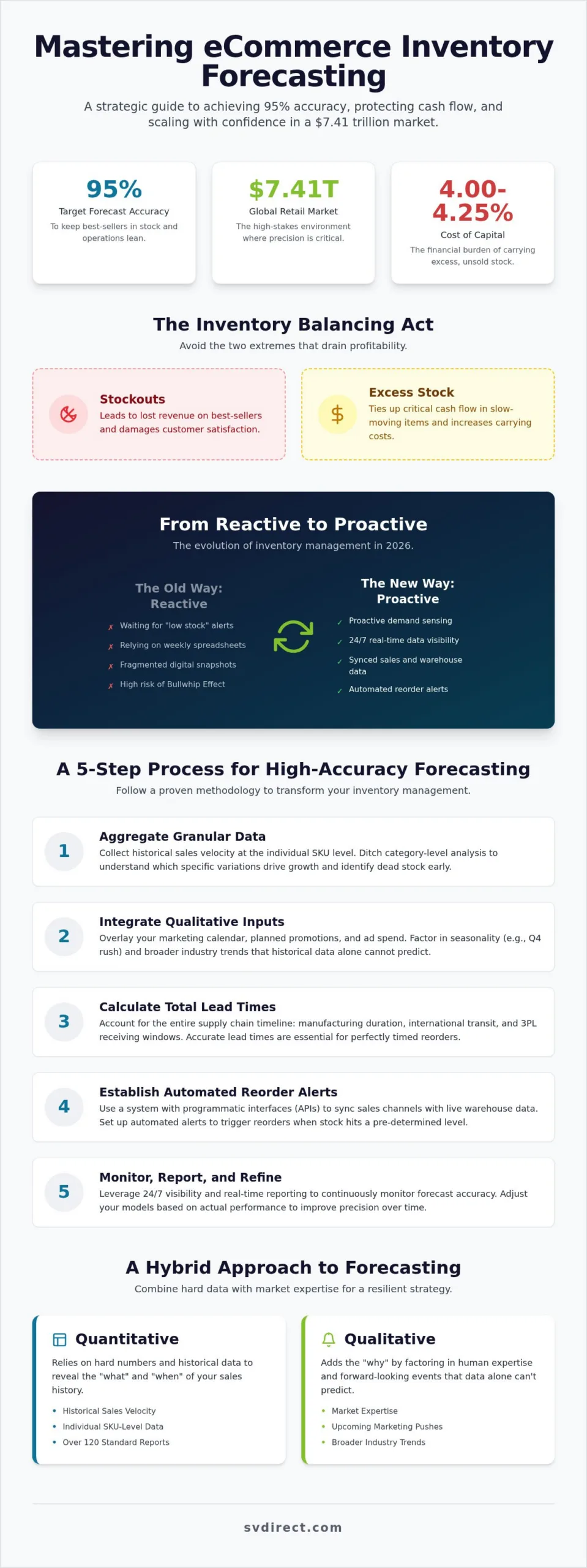
Effective scaling requires a hybrid approach. Quantitative forecasting relies on hard numbers. We use our proprietary Remote Control™ system to pull from over 120 standard reports, identifying historical sales velocity at the individual SKU level. This data reveals the “what” and “when” of your sales history. Qualitative forecasting adds the “why.” It factors in your market expertise, upcoming marketing pushes, and broader industry trends that numbers alone can’t predict. Combining these two methods creates a resilient strategy that adapts to sudden market shifts without overextending your resources.
The Role of Real-Time Data in 2026
The era of the weekly inventory spreadsheet is over. In 2026, 24/7 live inventory visibility is the baseline for success. Programmatic interfaces (APIs) allow your sales channels to communicate directly with our warehouse facility. This integration ensures that the data used for your models is “clean” and reflects actual warehouse reality rather than fragmented digital snapshots. When your sales data and physical stock are perfectly synced, you eliminate the data gaps that lead to over-ordering. This real-time connection acts as the bridge between your digital storefront and our quiet, organized fulfillment center, ensuring precision at every step of the supply chain.
Key Data Inputs for High-Accuracy Demand Planning
High-accuracy demand planning is built on a foundation of granular, multi-dimensional data. It’s not enough to look at high-level revenue totals; you need to analyze historical sales velocity at the individual SKU level. This level of detail allows you to identify which specific product variations are driving your growth and which are stagnating. By understanding the exact movement of every item, you can refine your ecommerce inventory forecasting to ensure your capital is always working where it’s needed most.
You must also overlay your marketing calendar onto these historical trends. If you’re planning a significant influencer campaign or a spike in ad spend, your historical data alone won’t account for that upcoming surge. Seasonality plays a massive role as well. Whether it’s the Q4 rush of Black Friday and Cyber Monday or industry-specific cycles, your forecast must be forward-looking. Finally, you have to account for total lead times. This includes manufacturing duration, international transit, and the 3PL receiving window. At Silicon Valley Direct, our quiet, organized facility ensures that once your stock arrives, it’s processed with precision, reducing the “dark time” between delivery and shipping readiness.
SKU-Level Granularity and Serial Number Tracking
Forecasting at the category level often leads to stock imbalances. You might have plenty of “apparel” in stock but be completely out of the specific “large” size that 80 percent of your customers want. This is why SKU-level data is vital. For high-value electronics or sensitive healthcare products, we utilize serial number tracking to provide an extra layer of security and accuracy. This level of detail helps you identify “dead stock” early. By clearing out slow-moving items, you free up valuable warehouse space for your high-velocity winners. If you’re looking for a partner to help manage these complexities, you can speak with our team about a custom solution.
External Market Signals
In 2026, ecommerce inventory forecasting must also account for external variables. The current high-interest-rate environment, with the Federal Reserve policy rate between 4.00 and 4.25 percent, makes the cost of overstocking particularly painful for your bottom line. Consumer sentiment can shift rapidly, and global supply chain disruptions or carrier delays can extend your lead times overnight. A proactive partner acts as an extension of your team, anticipating these conflicts before they impact your project. We monitor these signals to help you adjust your strategy, ensuring your supply chain remains resilient regardless of market volatility or economic shifts.
Overcoming Common Forecasting Challenges with a 3PL Partner
Even the most advanced software models struggle when they meet the chaotic reality of a disorganized warehouse. Many brands find that their ecommerce inventory forecasting fails not because the math is wrong, but because the physical execution is flawed. When there’s a disconnect between your digital dashboard and the actual shelf count, you’re forced to carry excessive “safety stock” just to sleep at night. This buffer inventory is expensive. With the cost of capital remaining high in 2026, every pallet of stagnant product represents lost opportunity and unnecessary carrying costs.
One of the most persistent hurdles is the Bullwhip Effect. This occurs when small fluctuations in consumer demand create progressively larger swings in inventory orders as they move up the supply chain. Without a steady hand at the fulfillment level, a 10 percent increase in sales can lead to a 50 percent surge in raw material orders, trapping your cash flow in a cycle of overcorrection. A sophisticated partner helps dampen these ripples by maintaining a quiet, organized facility where inventory accuracy is a daily reality rather than a monthly goal. Faster, more precise pick and pack cycles allow you to operate with leaner stock levels because you can trust that orders will move out the door exactly when they should.
Eliminating the ‘Silo Effect’ Between Sales and Logistics
Miscommunication between your marketing team and your fulfillment center is a recipe for stockouts. If your sales team launches a flash promotion without notifying the warehouse, the resulting surge can break your supply chain. We function as a seamless extension of your team, ensuring that logistics and sales are always in sync. By utilizing a web-based fulfillment services platform, all stakeholders gain access to the same “source of truth.” This transparency ensures that your inventory strategy isn’t trapped in a silo, allowing for agile adjustments as market conditions change.
Proactive Conflict Resolution
Technology is a powerful tool, but it lacks the intuition to catch a strange order anomaly before it ships. We prioritize human oversight to identify potential issues before they impact your project or your reputation. If a sudden stockout occurs on a high-velocity item, we help you manage backorders efficiently to maintain customer trust. Our team focuses on finding custom solutions and thinking outside the box to resolve conflicts before they escalate. This proactive stance is essential for successful ecommerce inventory forecasting, as it ensures your data remains clean and your supply chain remains resilient against unexpected disruptions.
Implementing Your Forecasting Strategy: A 5-Step Process
Transitioning from theory to a functional ecommerce inventory forecasting model requires a methodical approach that aligns your digital data with physical warehouse operations. It’s a disciplined cycle that ensures your supply chain remains lean and responsive. By following a structured implementation process, you can move away from guesswork and toward data-driven precision.
- Step 1: Audit your historical data. You must ensure your records are complete. This includes accounting for returns, exchanges, and past stockouts that might have suppressed actual demand.
- Step 2: Establish baseline KPIs. Define your current inventory turnover and carrying costs to create a benchmark for future improvements.
- Step 3: Integrate your sales channels. Connect your storefronts to our proprietary Remote Control™ system for 24/7 visibility.
- Step 4: Set automated low-inventory alerts. Use precise lead time calculations to trigger reorder notifications before you hit critical levels.
- Step 5: Review and adjust monthly. Your forecast shouldn’t be static. Use real-time reporting to calibrate your numbers against actual market performance.
Essential KPIs for Inventory Health
Effective demand planning relies on tracking specific metrics that reveal the health of your supply chain. The Inventory Turnover Ratio tells you how many times you sell through your stock in a year, which is a primary indicator of efficiency. You should also monitor your Stockout Rate to quantify lost revenue opportunities. Finally, calculate your Carrying Cost of Inventory. In a high-interest-rate environment, understanding the true cost of warehousing and insurance is vital for protecting your margins.
Leveraging Just-In-Time (JIT) Strategies
One way to optimize your ecommerce inventory forecasting is to reduce the volume of physical stock you need to hold. We integrate print on demand services into our fulfillment workflow to produce literature and marketing materials only when they’re needed. This eliminates the need for large storage footprints for printed goods.
Our kitting and assembly services further support a JIT approach. By holding raw components and assembling finished goods as orders arrive, you keep your inventory levels lean and your capital liquid. This strategy provides the flexibility required to scale your business without the risk of overextending your resources on pre-assembled stock.
Proactive Inventory Management with Silicon Valley Direct
Successful ecommerce inventory forecasting requires more than just high-level software; it demands a physical operation that can execute with absolute precision. At Silicon Valley Direct, we bridge the gap between your digital sales data and the reality of the warehouse floor. Our proprietary Remote Control™ system provides you with 24/7 real-time access to your inventory, offering over 120 standard reports that give you the granular detail needed to make informed purchasing decisions. You’re never left guessing about your stock levels or order statuses.
Our methodology is built on a quiet, organized facility philosophy. In an industry often defined by a hectic atmosphere, we’ve found that a deliberate and calm operational environment is the only way to maintain high-volume deadlines without sacrificing accuracy. This stability allows us to act as a high-performance partner that remains accessible. We stand by our Nine Promises, which include a commitment to listening to your specific needs, innovating bespoke solutions, and remaining flexible as your business scales. This human element ensures that your supply chain isn’t just a series of automated steps but a collaborative effort aimed at your growth.
Technology That Acts as an Extension of Your Team
We don’t believe in impersonal business models. Our technology is designed to feel like an organic part of your internal workflow. Through our remote order management platform, you get seamless integration between your sales channels and our fulfillment center. You’ll receive automated email notifications for receipts, transactions, and low stock levels, ensuring you’re always ahead of the curve. This proactive communication eliminates the stress of manual tracking and allows your team to focus on marketing and product development while we handle the logistical heavy lifting.
Global Reach with Precision Control
Scaling internationally adds layers of complexity to ecommerce inventory forecasting, from varying customs regulations to fluctuating transit times. Our team brings decades of expertise to your global operations, providing the accurate data you need to navigate international trade. We offer global shipping services that prioritize transparency and reliability. By providing proactive problem solving and clear visibility into every shipment, we earn your trust through performance. Whether you’re shipping across the country or around the world, our infrastructure and human expertise ensure your brand remains a steady hand in a fast-paced market.
Master Your Supply Chain for 2026 and Beyond
Effective ecommerce inventory forecasting is the bridge between market opportunity and operational reality. By moving away from fragmented data and reactive restocking, you protect your brand from the financial strain of overstock and the reputation damage of stockouts. Achieving this level of precision requires a partner that combines technical innovation with physical reliability. It’s about ensuring your capital is always working for you rather than sitting idle on a warehouse shelf.
Silicon Valley Direct brings over 25 years of fulfillment expertise to your operation. Our proprietary Remote Control™ system provides 24/7 visibility into your stock levels, while our human-led approach ensures proactive problem solving before issues impact your bottom line. We aren’t just an automated service; we’re a steady hand dedicated to your growth. Our quiet, organized facility is ready to act as a high-performance extension of your team.
You have the tools and the strategy to scale with confidence. Let’s build a resilient supply chain together that turns your inventory into your greatest competitive advantage.
Frequently Asked Questions
What is the most accurate inventory forecasting method for eCommerce?
The most accurate method for ecommerce inventory forecasting is a hybrid model that combines quantitative historical data with qualitative market insights. You should use a system like Remote Control™ to analyze SKU-level velocity while factoring in upcoming influencer campaigns or planned ad spend. This dual approach ensures your predictions are grounded in past performance but remain flexible enough to adapt to future marketing initiatives and shifting consumer sentiments.
How often should I update my inventory forecasts?
You should review and update your inventory forecasts at least once a month to account for changing market conditions. However, the most successful brands utilize 24/7 visibility to make smaller, programmatic adjustments in real time. Our web-based reporting tools provide 120+ standard reports, allowing you to react immediately to sudden sales surges or supply chain delays. This constant calibration keeps your stock levels lean and your capital liquid.
Can a 3PL help with demand planning and forecasting?
A 3PL acts as an extension of your team by providing the physical data and operational agility needed for demand planning. We provide proactive conflict resolution and real-time tracking that bridges the gap between your sales channels and the warehouse. By identifying order anomalies before they ship, we ensure your forecasting data remains clean and your supply chain stays resilient against unexpected fluctuations.
How do I calculate the correct amount of safety stock?
Calculating safety stock involves multiplying your maximum daily usage and lead time by your average daily usage and lead time. It’s a buffer against uncertainty. We help minimize the need for massive safety stock levels by operating a quiet, organized facility that reduces receiving and processing windows. When your 3PL provides predictable pick and pack cycles, you can lower your buffer stock and reduce your overall carrying costs.
What is the difference between demand forecasting and inventory management?
Demand forecasting is the strategic process of predicting future sales, while inventory management is the physical oversight of stock levels, storage, and fulfillment. Effective ecommerce inventory forecasting informs your management strategy, telling you when to reorder and how much to hold. Our Remote Control™ system provides the 24/7 visibility required to execute these management tasks with precision, ensuring your physical stock always matches your digital projections.
How do I handle seasonal spikes in eCommerce demand?
Handling seasonal spikes requires analyzing historical SKU velocity to predict peak demand periods like Black Friday or Cyber Monday. We support these surges through scalable kitting and assembly services and on-demand digital printing. This allows you to move from raw components to finished goods only when the demand arrives. Our facility is designed to manage high-volume deadlines without the hectic atmosphere that usually leads to inventory errors.
What are the hidden costs of poor inventory forecasting?
Poor forecasting leads to significant hidden costs, including capital trapped in slow-moving dead stock and lost revenue from frequent stockouts on best-sellers. With current Federal Reserve policy rates between 4.00 and 4.25 percent, the cost of holding unsold inventory is higher than ever. These financial burdens can stifle your growth and reduce your ability to invest in new product lines or aggressive marketing campaigns.
How does real-time inventory visibility improve my bottom line?
Real-time inventory visibility improves your bottom line by eliminating data silos and preventing costly overstocking. When your sales channels talk directly to our warehouse through programmatic APIs, you get an accurate view of your actual stock levels. This transparency allows for automated low-stock alerts and faster reorder decisions. It ensures you only spend capital on products that are moving, maximizing your inventory turnover and overall profitability.
