


Strategic Inventory Optimization Techniques for 2026 eCommerce Success
What if the safety stock you rely on to prevent stockouts is actually the very thing quietly draining your company’s liquidity? It’s a common frustration for growing brands. You want to satisfy every customer, yet seeing capital tied up in slow-moving inventory feels like watching your growth potential sit idle on a shelf. Implementing the right inventory optimization techniques is no longer just a back-office task; it’s a critical strategy for survival in a 2026 market where Amazon FBA fees have increased and consumer expectations for precision are higher than ever.
We understand that behind every SKU is a business trying to scale with confidence. This guide will help you master the advanced data-driven frameworks necessary to balance stock levels and reduce carrying costs without sacrificing reliability. You’ll learn how to achieve 100% order accuracy through seamless technical integrations and real-time visibility. We’ll walk through the operational shifts needed to improve your cash flow and build a fulfillment engine that acts as a true extension of your team, ensuring your physical operations are as organized as your digital strategy.
Key Takeaways
- Learn how to maintain the “Goldilocks zone” of stock by balancing customer service levels with working capital and warehouse capacity constraints.
- Master essential inventory optimization techniques like ABC Analysis and demand forecasting to ensure your high-value SKUs are always ready for peak demand.
- Gain 24/7 visibility into your operations through proprietary systems that eliminate the stress of manual tracking and provide real-time data across all channels.
- Reduce pre-printed waste and improve flexibility by integrating Just-In-Time digital printing and strategic kitting into your fulfillment workflow.
- Discover how to transition from a basic service model to a strategic 3PL partnership that acts as a proactive, high-performance extension of your team.
What Is Inventory Optimization? Balancing Service, Cost, and Capacity
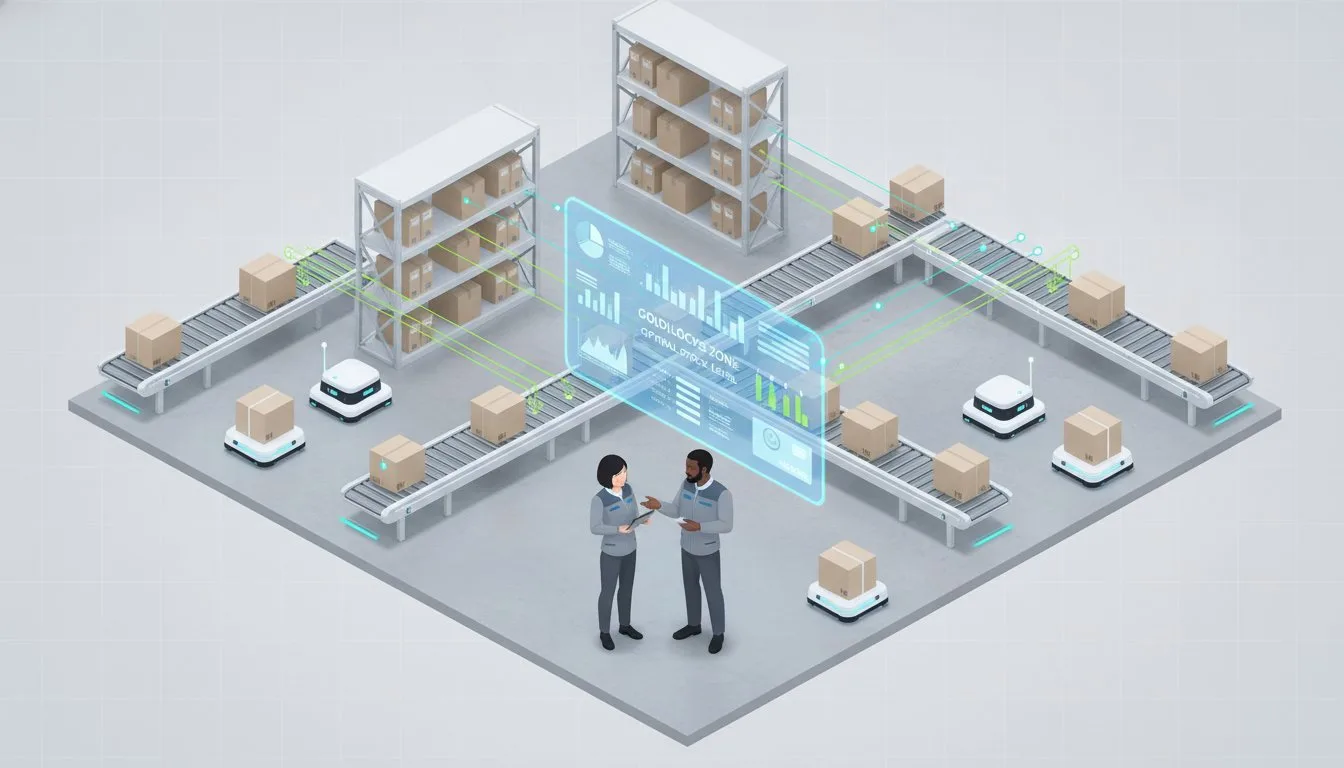
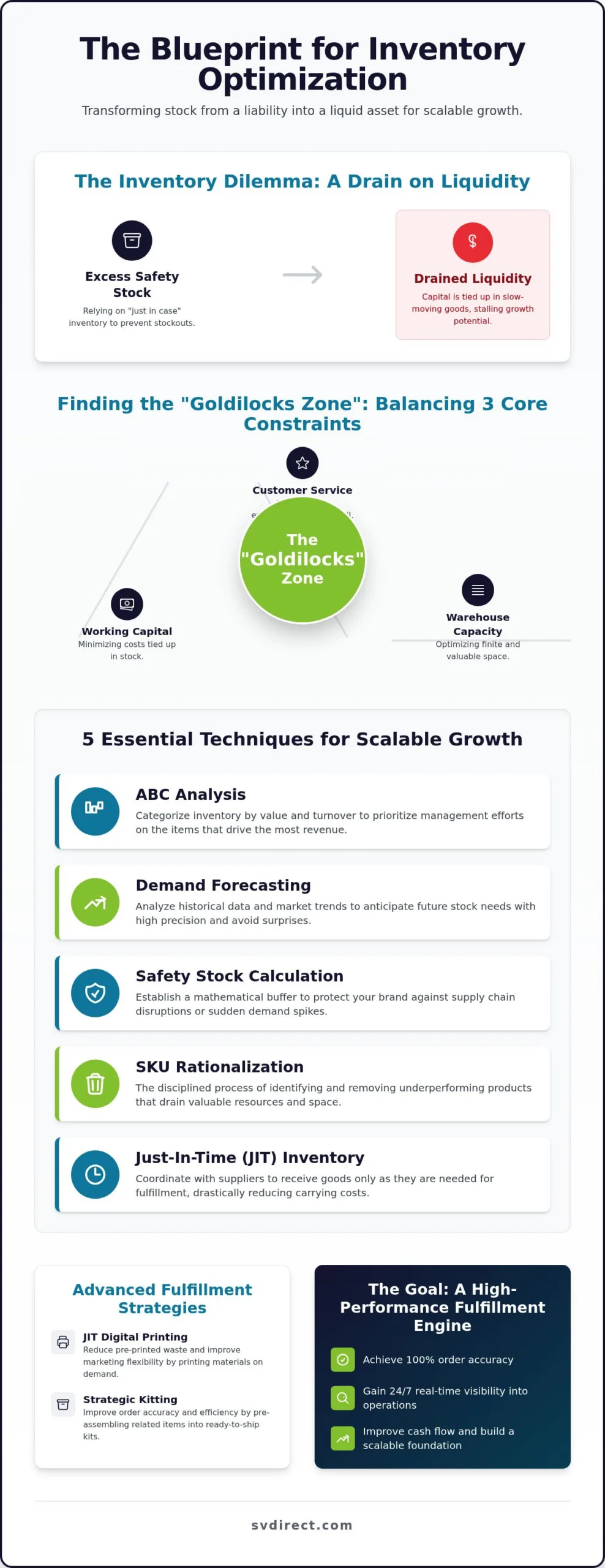
At its core, What Is Inventory Optimization? refers to the process of maintaining the “Goldilocks” zone of stock. It’s the disciplined art of ensuring you never have too much capital gathering dust, yet you never have too little to satisfy a customer’s click. This balance is the heartbeat of a healthy eCommerce operation, turning the warehouse from a simple storage box into a strategic engine for growth.
In 2026, brands face a specific “Triangle” of constraints. High customer service expectations pull in one direction, while rising working capital costs and finite warehouse capacity pull in others. Balancing these requires advanced inventory optimization techniques that move beyond reactive spreadsheets. You can’t simply buy your way out of a stockout by over-ordering anymore. The cost of capital is too high, and warehouse space is too valuable to waste on “just in case” inventory that might never move.
Traditional management often looks in the rearview mirror, reacting to last month’s data. Modern inventory optimization techniques are proactive. They use predictive modeling to anticipate shifts before they happen. This shift is vital for scaling businesses because it frees up essential cash flow. Instead of paying for pallets of slow-moving goods, you can reinvest that capital into marketing or R&D. It transforms your inventory from a liability into a liquid asset.
The True Cost of Excess Inventory
Excess inventory is a silent profit killer. Carrying costs include more than just storage fees; they encompass insurance, taxes, and the constant risk of obsolescence. There’s also the heavy weight of opportunity cost. Every dollar stuck in a slow-moving SKU is a dollar not spent on acquiring new customers or launching new products. Within a professional 3PL environment, optimization means reducing pallet footprints through smarter vertical organization and tighter kitting processes. A quiet, disciplined facility can handle more volume in less space, directly lowering your overhead and improving your bottom line.
Service Levels vs. Stockout Risks
A “Service Level” represents the probability that you’ll meet demand without a stockout. High service levels require more safety stock, which increases costs. Finding the balance means calculating the cost of a lost sale, including the loss of customer lifetime value, against the cost of holding that extra unit. Reliable global shipping services act as a buffer here. When your logistics partner can move goods with precision and speed, you can maintain high service levels with leaner on-hand quantities, protecting your reputation without draining your bank account.
5 Essential Inventory Optimization Techniques for Scalable Growth
Moving from theory to execution requires a toolkit of proven inventory optimization techniques. These aren’t just logistical exercises; they’re the levers that control your cash flow and customer satisfaction. By applying these strategic methods, you transform your warehouse from a static storage space into a high-velocity fulfillment center. These frameworks allow you to make decisions based on mathematical certainty rather than intuition.
- ABC Analysis: Categorizing inventory by value and turnover rate to prioritize management efforts on the items that drive the most revenue.
- Demand Forecasting: Analyzing historical data and market trends to anticipate future stock needs with high precision.
- Safety Stock Calculation: Establishing a mathematical buffer to protect your brand against supply chain disruptions or sudden demand spikes.
- SKU Rationalization: The disciplined process of identifying and removing underperforming products that drain resources.
- Just-In-Time (JIT) Inventory: Coordinating with suppliers to receive goods only as they are needed for fulfillment, significantly reducing carrying costs.
If you’re looking to implement these strategies within a professional framework, you can consult with our team to see how we integrate these techniques into your daily operations.
Implementing ABC Analysis in a 3PL Environment
Successful inventory optimization techniques rely on knowing where to focus your attention. In a 3PL setting, we prioritize ‘A’ items—those high-value, high-frequency products—for rapid picking and prime storage locations. Conversely, we manage ‘C’ items to minimize their storage footprint and cost. A seasoned partner can also use kitting to turn slow-moving ‘C’ components into high-demand ‘A’ finished goods on demand. This flexibility ensures that your warehouse space is always working for your bottom line, not against it.
Refining Demand Forecasting for 2026
Modern forecasting has moved far beyond simple monthly averages. In 2026, brands must account for micro-seasonality and rapid promotional spikes driven by social commerce. Demand forecasting is the predictive engine of the modern supply chain. Achieving this requires total data transparency between your sales channels and your fulfillment partner. When your 3PL can see your real-time sales data, they can proactively adjust labor and space, ensuring you’re prepared for growth without the burden of excess safety stock.
Leveraging Real-Time Visibility and Remote Order Management
In a fast-paced market, relying on weekly spreadsheets or manual stock counts is a recipe for operational friction. Real-time data is the oxygen of 2026 eCommerce. It allows you to make informed decisions at the speed of your customers’ clicks. Our proprietary Remote Control™ system acts as a digital window into the warehouse, effectively removing the “hectic atmosphere” often associated with rapid growth. By providing 24/7 access to your data, you gain the quiet confidence that comes from knowing exactly where every unit sits at any given moment.
This level of visibility is supported by a suite of automated notifications that keep your team proactive. Whether it’s a low-stock alert that triggers a reorder or a receipt confirmation that validates a new shipment, these tools ensure you’re never caught off guard. On the technical side, we utilize XML and SOAP web services to create a seamless bridge between your online storefront and our physical facility. This programmatic handshake allows your store to “talk” to the warehouse, ensuring that inventory optimization techniques are applied with surgical precision across every channel you serve.
The Power of Programmatic Integration
Modern brands require a fulfillment partner that speaks the language of their tech stack. Utilizing remote order management allows for real-time transaction processing that scales with your volume. We employ platform-agnostic web methods, such as AddOrder and GetOrderInfo, which eliminate the delays often caused by custom coding projects. This technical readiness is backed by robust reporting capabilities. With over 120 standard report options available at your fingertips, you can analyze turnover, monitor SKU health, and refine your strategy based on hard data rather than intuition.
Data Transparency and Trust
A quiet, organized facility is a hallmark of disciplined inventory control. This physical order is mirrored by our strict data-entry prioritization. Every movement in the warehouse is recorded immediately, ensuring your digital dashboard reflects physical reality. For high-value product fulfillment, we implement serial number tracking to provide an extra layer of security and accountability. This 24/7 data access fulfills our promise of keeping you “in the loop” at all times. It transforms the fulfillment process from a mysterious back-office function into a transparent, collaborative partnership where collective experience is a point of pride.
Advanced Strategies: Integrating Just-In-Time Printing and Kitting
While many brands view inventory as a purely digital challenge, physical execution remains the final frontier of true efficiency. Integrating inventory optimization techniques into your physical production workflow allows you to maintain a leaner footprint. By utilizing “Print on Demand” as a core strategy, you eliminate the risk of pre-printed waste and the burden of storing outdated literature. This approach transforms your fulfillment center from a static warehouse into a dynamic production hub where materials are created only when a customer places an order.
Personalization is no longer a logistical hurdle thanks to Variable Data Printing (VDP). This technology allows you to include personalized inserts or customized packing slips without holding separate stock for every variation. We utilize the HP Indigo 5500 Digital Press to achieve this level of precision. Its high-resolution, dry-ink output ensures that marketing materials are ready for immediate fulfillment the moment they leave the press. This eliminates the bottlenecks associated with traditional methods and allows your brand to remain agile in a fast-moving market.
Reducing Literature Obsolescence with Digital Printing
Traditional offset printing carries a hidden cost that often goes overlooked: high minimum order quantities and mandatory 24-hour drying times. These requirements force brands into a cycle of over-ordering and eventual obsolescence when branding or product specs change. Switching to print-on-demand allows for just-in-time marketing collateral that mirrors your current inventory levels. 230 line screen resolution is the standard for offset-quality digital printing. This ensures that your JIT materials maintain a premium feel while providing the flexibility to update content on the fly, saving both capital and warehouse space.
Strategic Kitting: The “Virtual Inventory” Approach
Strategic kitting and assembly services offer a powerful way to defer final product configuration. Instead of storing pre-built kits that tie up specific components, we recommend holding individual parts as “virtual inventory.” This allows you to assemble kits only as orders arrive, giving you total flexibility to pivot based on real-time demand. To maintain 100% accuracy in complex assemblies, we implement a systematic QC-Check process. This physical rigor ensures that every kit is perfect before it ships. Beyond flexibility, custom kitting often reduces dimensional weight, which directly lowers your shipping costs and improves your overall margins.
Executing Your Strategy with a Strategic 3PL Partner
Transitioning from the conceptual side of inventory optimization techniques to daily execution requires more than just high-end software. It demands a physical infrastructure and a team that operates as a seamless extension of your own brand. While algorithms can suggest reorder points, it’s the human oversight in a quiet, organized facility that ensures those orders are processed with 100% accuracy. We believe that true optimization is achieved when technical precision meets a deep personal commitment to your growth.
Our “Nine Promises” framework is built on this philosophy. It starts with listening to your specific business pains and ends with proactive problem solving. This deliberate methodology ensures that every SKU is handled with care, translating into fewer errors and a higher ROI for your organization. By closing the loop between data visibility and physical fulfillment, you build the customer trust necessary for global expansion. You aren’t just moving boxes; you’re fulfilling a promise made to your customer, and that requires a steady hand at every stage of the process.
Choosing a Partner, Not Just a Provider
When evaluating Silicon Valley 3PL fulfillment services, look for organizations that prioritize flexibility over rigid, one-size-fits-all procedures. A strategic partner identifies potential order conflicts or address errors before the package ever leaves the dock. This proactive stance is why many of our clients have remained with us for over seven years. Long-term retention isn’t just a point of pride; it’s the ultimate metric of a successful optimization strategy. It shows that the partner can scale and adapt as your business evolves.
Next Steps: Auditing Your Current Inventory Flow
The first step toward mastering inventory optimization techniques is a comprehensive audit of your current stock movement. Evaluate how your tech stack communicates with your warehouse. Are you currently utilizing modern XML or SOAP standards for real-time data exchange? If your current system feels like a “black box” where data goes to disappear, it’s time to rethink your approach. We encourage you to think outside the box regarding your supply chain strategy. A more organized, transparent fulfillment process is within reach, and it starts with a commitment to both digital and physical precision.
Scaling Your Brand with Precision and Confidence
The landscape of 2026 eCommerce demands a sophisticated marriage of digital data and physical execution. By implementing advanced inventory optimization techniques, you move beyond reactive management and into a state of proactive growth. This journey involves more than just software; it requires a steady partner with the physical infrastructure to back up every digital transaction. We’ve spent over 25 years in the heart of Silicon Valley refining this balance, ensuring our clients have the 24/7 visibility and operational precision they need to scale with confidence.
Whether you’re utilizing our proprietary Remote Control™ system for real-time tracking or leveraging the HP Indigo 5500 Digital Press for just-in-time marketing inserts, the goal remains the same: lower carrying costs and higher customer trust. You don’t have to navigate these complexities alone. Our team acts as a strategic extension of your own, turning your supply chain into a powerful competitive advantage. Your business deserves a fulfillment partner that is as innovative and energetic as your own vision.
Let’s build a reliable, efficient future for your brand together.
Frequently Asked Questions
What is the difference between inventory management and inventory optimization?
Inventory management focuses on the day-to-day tracking of stock levels and locations. In contrast, inventory optimization techniques use advanced data to determine the exact amount of stock needed to meet demand while minimizing costs. While management tells you what you have, optimization tells you what you should have. This proactive approach ensures your capital isn’t trapped in excess safety stock that might become obsolete before it ever ships.
How can ABC analysis help reduce my warehouse storage fees?
ABC analysis categorizes your inventory into three groups based on value and turnover frequency. “A” items are your high-velocity products that drive revenue, while “C” items are slow-movers. By identifying these “C” items, you can make informed decisions to liquidate or reduce their stock levels. This strategy directly lowers your monthly storage fees by ensuring you aren’t paying for pallet space occupied by stagnant inventory that doesn’t contribute to your bottom line.
Is demand forecasting accurate for new eCommerce startups?
Demand forecasting for startups relies on market trends and early transaction data rather than years of history. While it’s less precise than for established brands, it’s still vital for preventing early cash flow crises. By monitoring real-time sales through a system like Remote Control™, startups can identify emerging patterns quickly. This allows for agile adjustments to order frequencies, helping new brands avoid the twin traps of early stockouts or excessive initial overhead.
What are the benefits of using a 3PL with a proprietary management system?
A proprietary system like our Remote Control™ provides a level of transparency and 24/7 access that off-the-shelf software often lacks. It allows for bespoke problem-solving and immediate data updates from the warehouse floor. Because the system is built specifically for our facility’s workflow, it eliminates the lag time found in generic platforms. This technical edge ensures you’re always in the loop regarding your stock health and order status without needing manual updates.
How does just-in-time (JIT) printing reduce inventory costs?
Just-in-time (JIT) printing eliminates the need to store large quantities of pre-printed marketing materials or product manuals. By using a digital press like the HP Indigo 5500, we produce these items only when an order is placed. This technique removes the “hidden cost” of literature obsolescence, where outdated brochures end up in the recycling bin. It keeps your warehouse footprint lean and ensures every customer receives the most current information possible.
Can I integrate my Shopify or WooCommerce store directly with a 3PL system?
Yes, you can achieve seamless connectivity using XML and SOAP web services. These protocols allow your Shopify or WooCommerce store to communicate directly with our fulfillment infrastructure in real time. This programmatic handshake automates the order flow and inventory updates, removing the risk of manual entry errors. It creates a “hands-off” operational environment where your digital storefront and physical warehouse are always perfectly synchronized, allowing you to focus on brand growth.
What is the ‘Inventory Optimization Triangle’ and why is it important?
The “Inventory Optimization Triangle” represents the delicate balance between customer service levels, working capital costs, and warehouse capacity. It’s a foundational concept because improving one often stresses the others. For example, increasing service levels to 100% usually requires more safety stock, which raises costs and consumes more space. Mastering this triangle is the key to sustainable scaling, ensuring you remain profitable while keeping your customers satisfied with reliable, accurate fulfillment.
How often should I perform SKU rationalization for my product line?
We recommend performing SKU rationalization at least once a quarter to keep your product line healthy. This “pruning” process identifies items that no longer meet your turnover or profit margin requirements. By removing these underperformers, you free up both capital and shelf space for new, high-velocity products. Regular audits prevent your inventory from becoming bloated with “zombie SKUs” that quietly drain your resources through storage fees and management overhead.
