



Order Fulfillment Costs: The 2026 Strategic Reference Guide for eCommerce
What if the secret to protecting your margins isn’t finding the lowest pick fee, but mastering the hidden variables that drive your total spend? If you feel like your order fulfillment costs are becoming a moving target, you aren’t alone. It’s common to feel the sting of unpredictable monthly invoices and those sudden, hidden fees for kitting or returns that seem to appear out of nowhere. You’ve worked hard to build your brand, and it’s exhausting to see rising labor overhead and complex fee structures eat away at the profits you should be reinvesting into your business.
We’re here to help you regain control of your bottom line. This guide provides a clear, strategic framework to calculate your true Cost Per Order (CPO) so you can protect your margins with precision. We’ll explore the latest shifts in 3PL pricing structures, identify ways to reduce shipping overhead, and demonstrate how a partner capable of handling high-value or regulated goods like healthcare can actually simplify your operations. By the end of this reference, you’ll have the technical insight and operational confidence to turn your logistics from a cost center into a competitive advantage.
Key Takeaways
- Define the full scope of order fulfillment costs to uncover hidden expenses in receiving, inventory storage, and specialized climate-controlled requirements.
- Recognize the “garage trap” and learn when scaling in-house labor becomes more expensive than outsourcing to a professional partner.
- Implement a reliable two-step calculation for your Cost Per Order that accounts for the complex realities of return logistics and failed deliveries.
- Leverage the benefits of kitting and assembly to add value to your shipments without sacrificing operational speed or accuracy.
- Explore how 25 years of human-led expertise provides a more stable foundation for global shipping than the impersonal “black box” models common in the market.
Understanding Order Fulfillment Costs: Beyond the Shipping Label
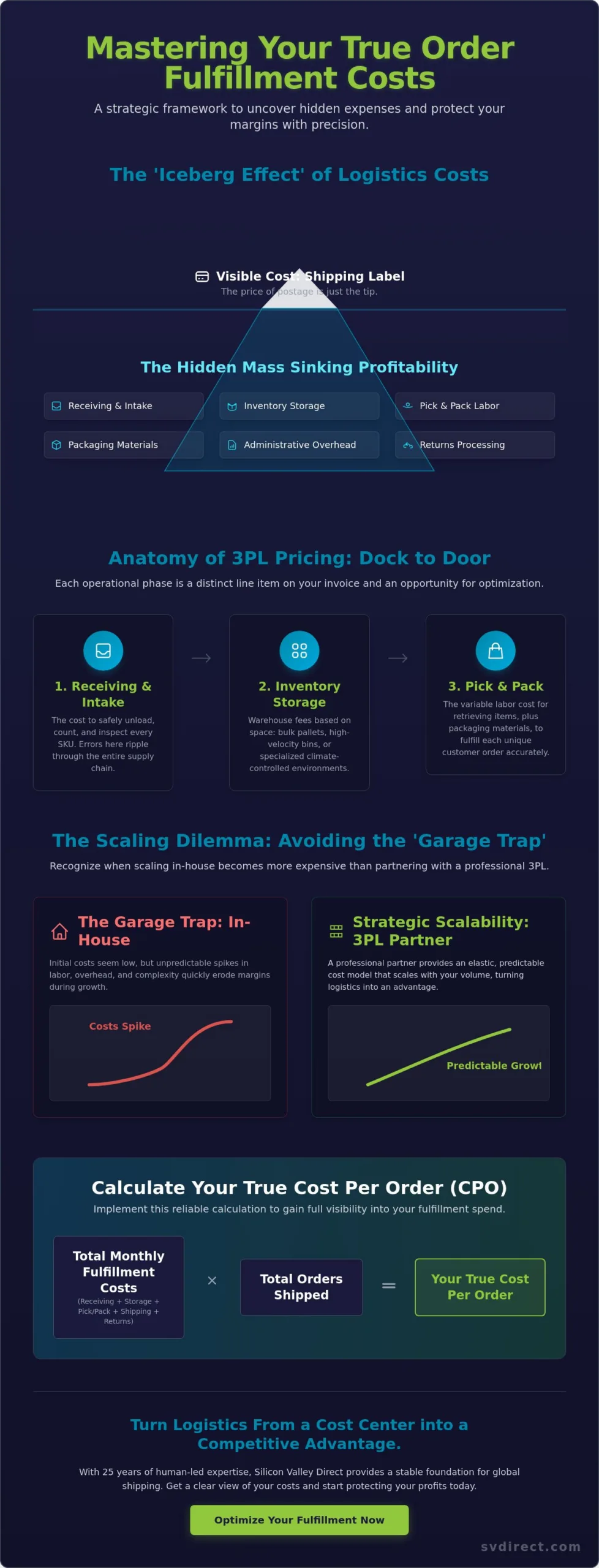
True logistics efficiency requires a perspective that looks past the simple price of a postage stamp. We define order fulfillment costs as the cumulative expense of every touchpoint required to move a product from the manufacturer’s facility to the final customer’s doorstep. This journey includes receiving, storage, pick and pack labor, packaging materials, and the final mile delivery. Gaining a comprehensive Understanding Order Fulfillment allows you to identify where capital is being utilized effectively and where it’s being wasted on avoidable errors.
As we move through 2026, eCommerce margins are under more pressure than ever. Rising labor costs across the logistics sector and fluctuating carrier surcharges have created a volatile environment for growing brands. Many businesses fall into the trap of only looking at the shipping label, but this is often the “Iceberg Effect” of logistics. While shipping is the visible tip, the hidden mass of administrative overhead, storage fees, and kitting expenses can sink a brand’s profitability if left unmanaged. There’s a profound difference between cheap fulfillment and cost-effective logistics; the former often relies on cutting corners that lead to damaged goods, while the latter builds a stable foundation for long-term growth.
To better understand this concept, watch this helpful video:
Fixed vs. Variable Fulfillment Costs
Stabilizing your budget requires a clear distinction between fixed and variable expenses. Fixed overhead typically includes technology fees, account management costs, and dedicated storage space. These remain relatively constant regardless of your daily volume. Variable drivers, such as pick and pack fees, packaging, and shipping, fluctuate with every order. High-growth startups often struggle with variable cost spikes during peak seasons, where a sudden surge in orders can lead to skyrocketing labor expenses if the fulfillment model isn’t designed for elasticity.
The Role of Technology in Cost Visibility
Modern precision relies on digital integration. Real-time inventory management is a critical tool that prevents overstocking costs and reduces the risk of aged inventory penalties. By utilizing advanced 3PL software, brands can significantly reduce order processing errors that lead to expensive returns. Moving away from manual spreadsheets to integrated API fulfillment ensures that data flows seamlessly between your storefront and the warehouse. This transparency allows you to see exactly how order fulfillment costs impact your bottom line in real time, enabling faster, more informed decision-making.
Breaking Down the Primary Components of 3PL Pricing
Understanding the specific line items on a 3PL invoice is the first step toward true margin protection. While many providers offer what looks like a simple flat rate, order fulfillment costs are actually composed of several distinct operational phases. Each phase presents an opportunity for optimization or, if ignored, a risk of significant budget leakage. Professional logistics isn’t just about moving boxes; it’s about the precision of the intake and the strategy behind the storage.
- Receiving and Intake: This is the cost of getting your goods into the warehouse safely. It involves unloading, counting, and inspecting every SKU for damage. High-performance partners prioritize this stage because errors here ripple through the entire supply chain.
- Inventory Storage: Pricing varies based on how your goods are housed. Pallet storage is efficient for bulk items, while shelf or bin pricing is standard for smaller, high-velocity goods. For sectors like healthcare, climate-controlled environments add a layer of necessary protection.
- Pick and Pack Fees: This rate is influenced by item count and handling requirements. Fragile goods or complex orders require more human touch and specialized packaging, which affects the per-order rate.
- Shipping and Postage: Shipping is often the largest variable. By leveraging a 3PL’s established carrier relationships, you can access deep volume discounts that offset rising national rates.
The Strategic Impact of Kitting and Assembly
Bundling products through kitting can significantly lower your total cost per order by reducing the number of individual shipments sent to a single customer. Beyond the math, kitting serves as a powerful marketing tool. A well-executed, branded unboxing experience increases the perceived value of your product without a massive increase in overhead. To see how this works in practice, explore our strategic guide to kitting and assembly services.
On-Demand Printing: A Hidden Cost-Saver
One of the most overlooked ways to manage order fulfillment costs is through just-in-time digital printing. Traditional models require you to print thousands of brochures or instruction manuals, which often end up as obsolete inventory when product specs change. By integrating on-demand printing into the shipping workflow, we eliminate this waste. You only print what you ship. This approach reduces literature fulfillment costs and ensures your marketing materials are always current and accurate. If you’re ready to see how these integrated services can stabilize your margins, request a free quote to discuss a customized plan for your brand.
In-House vs. Outsourced: Calculating the Hidden Costs of Scaling
Starting a business in a garage or a small office is a rite of passage for many eCommerce founders. It feels like a strategic way to keep order fulfillment costs at zero, but this “Garage Trap” is often the most expensive mistake a growing brand can make. The true price of doing it yourself isn’t found in the cost of tape and boxes. It’s found in the opportunity cost of your time. Every hour a founder spends taping cartons is an hour lost to product development, high-level marketing, or strategic partnerships. As your volume increases, the friction of manual labor begins to slow your momentum.
Labor management presents another significant hurdle that many businesses underestimate. Recruiting, training, and managing a warehouse team is a full-time commitment. Seasonal spikes require you to find temporary staff, often at a premium, only to let them go when the rush subsides. This cycle creates internal instability. In high-cost regions like the Bay Area, facility overhead adds another layer of complexity. High rent, rising insurance premiums, and the ongoing maintenance of packing equipment can quickly erode the savings you thought you were gaining by staying in-house.
Perhaps the most damaging hidden cost is the error rate associated with non-professional setups. A mis-pick doesn’t just cost the price of the item. It costs double the shipping, the labor to process the return, and potentially the lifetime value of that customer. In a market where buyers expect perfection, a single shipping error can lead to immediate churn. Professional logistics partners mitigate this risk through established quality control measures and human oversight.
Scalability and Flexibility
A professional 3PL provides the physical infrastructure to handle peak season volume without forcing you to increase your fixed overhead. You transition to a model where you pay only for what you use. In a shared warehouse environment, you share the costs of the facility, security, and equipment with other brands. This flexibility allows you to scale from a startup to an enterprise-grade operation without the risk of signing a long-term commercial lease or purchasing expensive machinery.
Compliance and Specialized Handling
For businesses in specialized sectors, the stakes are even higher. Handling sensitive materials requires more than just a clean workspace; it requires strict adherence to regulatory standards. For example, maintaining HIPAA compliance is essential for healthcare mailing services. The risk of a data breach or a compliance error during in-house fulfillment is a liability that most growing companies cannot afford. Professional partners bring the expertise and the technical infrastructure to ensure that your order fulfillment costs remain predictable while your reputation remains protected.
How to Calculate and Optimize Your Cost Per Order (CPO)
Calculating your Cost Per Order is more than a simple math exercise; it’s a diagnostic tool that reveals the true health of your operations. While a basic formula might suggest dividing total costs by total orders, this often misses the nuanced expenses that erode profitability. To protect your margins, you must look deeper into the data. A precise understanding of order fulfillment costs allows you to move from reactive budgeting to proactive financial management.
Follow these five steps to establish a reliable CPO baseline:
- Step 1: Aggregate all logistics expenses. This includes every line item discussed previously: storage, labor, final mile shipping, and packaging materials. Don’t forget technology fees or account management surcharges.
- Step 2: Factor in ‘Return Logistics.’ Returns are an inevitable part of eCommerce. You must include the cost of processing a failed delivery, including the labor to inspect the item and the potential loss of inventory value.
- Step 3: Divide by total successful shipments. Use a 30-day period to smooth out daily fluctuations. Dividing your total expenses by the number of orders that actually reached a customer provides your true CPO.
- Step 4: Audit for ‘Dimensional Weight’ inefficiencies. Carriers charge based on the space a package occupies, not just its weight. If you’re shipping small items in oversized boxes, you’re paying for air.
- Step 5: Compare against industry benchmarks. In 2026, a healthy direct-to-consumer CPO often falls between $8 and $18 before outbound freight. If your numbers sit significantly higher, it’s time to optimize.
Optimizing Shipping Costs
Carrier negotiation is the most immediate way to lower your CPO. Because 3PLs aggregate volume from hundreds of clients, they secure deep discounts that individual brands cannot access alone. Strategic warehouse placement also plays a vital role. By utilizing zone skipping, you can move goods in bulk to a regional hub closer to the end user, which significantly reduces the final mile transit cost. Our global shipping services are designed to leverage these high-volume lanes to keep your rates competitive.
Reducing Packaging Waste
Precision in packaging is a quiet margin saver. Transitioning from standard oversized mailers to custom box sizing can drastically reduce your DIM weight charges. Furthermore, effective kitting reduces the number of boxes sent to each customer, which lowers both material and postage costs. By using on-demand printing to replace pre-printed marketing inserts, you also eliminate the cost of discarding outdated literature. If you’re ready to see how these optimizations can lower your order fulfillment costs, request a free quote for a customized operational audit.
Strategic Fulfillment with Silicon Valley Direct: Human Precision Meets Global Scale
Selecting a logistics partner involves more than comparing rate cards. It’s about finding a steady hand to guide your brand through the complexities of a global supply chain. Our location in the heart of Silicon Valley provides a distinct advantage, offering immediate proximity to major tech hubs and primary global shipping lanes. This geographic identity isn’t just about a zip code; it’s a symbol of our commitment to innovation and connectivity. While many modern providers rely on “black box” automation that leaves clients guessing, we’ve spent over 25 years refining a model where human oversight and high-tech efficiency work in tandem.
Precision is our hallmark, especially when managing complex kitting projects or sensitive healthcare fulfillment. Automation has its place, but it shouldn’t come at the expense of accountability. Our team provides personal oversight for every account, ensuring that intricate assembly requirements are met with total accuracy. This human element is the ultimate safeguard against the errors that typically drive up order fulfillment costs. We believe in total transparency. You’ll never encounter hidden fees or administrative “surprises.” Instead, you get data-driven logistics backed by a multi-decade history of reliability and staff retention.
Beyond Simple Shipping
We view fulfillment as a holistic process that extends beyond moving a box from point A to point B. By integrating direct mail marketing services with your eCommerce operations, you can create a unified physical touchpoint for your customers. Our Union City facility serves as a sophisticated global distribution hub, capable of managing inventory, on-demand printing, and literature fulfillment under one roof. This centralized approach eliminates the friction of managing multiple vendors and streamlines your entire outbound workflow.
Ready to Scale Your Fulfillment?
Growth shouldn’t be a source of stress. Our onboarding process is designed to be methodical and highly organized, moving you from an initial audit to full execution with minimal disruption. Whether you’re a startup navigating your first major growth spurt, a healthcare provider requiring strict compliance, or an established eCommerce brand looking for better cost visibility, we offer customizable solutions tailored to your specific needs. We invite you to experience a partnership where collective experience and proactive communication are the standard. Take the first step toward a more efficient bottom line and Request a Custom Fulfillment Cost Audit from Silicon Valley Direct today.
Securing Your Margins for Long-Term Growth
Mastering your order fulfillment costs is the definitive step toward building a resilient eCommerce brand. By moving beyond basic shipping labels and embracing a precise Cost Per Order framework, you transform logistics from a liability into a strategic asset. We’ve explored how technical integration, human-led quality control, and the elimination of “black box” automation create a stable environment for scaling. True efficiency isn’t just about speed; it’s about the precision of every pick and the accuracy of every shipment.
Silicon Valley Direct has been serving businesses since 1999, providing a steady hand in an increasingly complex market. Whether you require HIPAA-compliant healthcare mailing or Red Dot-level precision in kitting and assembly, our team ensures your operations remain organized and efficient. We believe your fulfillment partner should be a proactive collaborator that values your time and protects your reputation. It’s time to stop guessing and start growing with confidence. Our experts are ready to help you audit your current workflow and identify immediate opportunities for optimization.
Request a Personalized Fulfillment Quote
We look forward to helping your brand reach its global potential through precision and personal commitment.
Frequently Asked Questions
What is the average cost of order fulfillment for eCommerce?
A healthy direct-to-consumer cost per order in 2026 depends on several factors, including your product size, weight, and monthly volume. This figure covers the aggregate of receiving, storage, labor, and packaging materials. Since every product category has unique handling requirements, your specific order fulfillment costs will depend on your SKU count and order volume. We recommend a full operational audit to determine a fair baseline for your brand.
How do pick and pack fees work?
Pick and pack fees are charged for the physical labor of retrieving items from storage and securing them in shipping containers. Most structures include a base order fee plus a smaller incremental charge for each additional item in the package. Complex orders requiring fragile handling or specific kitting and assembly steps may incur higher rates due to the additional human touch required to ensure accuracy.
Does Silicon Valley Direct offer discounted shipping rates?
Yes, we leverage our long-standing carrier relationships to provide our clients with significant volume discounts on global shipping and logistics. By aggregating shipments across our entire client base, we access tiered pricing that individual brands rarely qualify for on their own. This helps offset the rising surcharges and national rate increases seen throughout 2026, keeping your outbound freight expenses more predictable.
What are ‘hidden’ fulfillment costs I should look out for?
Common hidden expenses include inbound placement fees, long-term storage surcharges, and administrative fees for account management. You should also watch for “the iceberg effect” of returns management, where the labor to inspect and restock failed deliveries is not clearly disclosed. Transparency is vital to managing order fulfillment costs, so we ensure our invoicing clearly outlines every touchpoint without unexpected surcharges.
How does kitting affect my total fulfillment bill?
Kitting and assembly can actually lower your total bill by reducing the number of individual boxes sent to each customer. While there is a labor cost associated with the initial assembly, the savings in postage and packaging materials often outweigh the setup fee. It also serves as a marketing tool that increases perceived value and customer satisfaction without a massive increase in your total overhead.
Can I integrate my Shopify or WooCommerce store with your system?
Our system provides seamless API integrations for major eCommerce platforms, including Shopify and WooCommerce. This digital integration allows for real-time inventory management and automated order processing, which reduces manual entry errors. It’s a high-tech solution designed to simplify your scaling process. Transitioning from spreadsheets to our integrated system ensures that your data flows directly into our warehouse for immediate, precise execution.
What makes Silicon Valley Direct different from large automated 3PLs?
We explicitly reject the “black box” automated model in favor of direct human connection and personal oversight. While we utilize modern technology for precision, our 25 year history is built on having experts who understand the nuances of complex kitting and healthcare mailing services. You get a dedicated partner rather than an impersonal algorithm. This proactive attitude ensures your brand is handled with deliberate care.
Is there a minimum order volume required to work with a 3PL?
We offer customizable solutions that cater to a variety of business stages, from high-growth startups to established enterprise brands. Instead of a rigid “one size fits all” minimum, we provide total flexibility to ensure our services align with your strategic goals. Our onboarding process starts with an audit to ensure we are the right steady hand for your specific growth trajectory and operational needs.