


3PL vs 4PL: Choosing the Right Logistics Model for Your Business in 2026
What if the biggest risk to your supply chain in 2026 isn’t choosing the wrong provider, but choosing the wrong category of partnership? As the U.S. 4PL market reaches a projected $16.81 billion this year, many leaders feel pressured to choose between the hands-on execution of a 3PL and the strategic oversight of a 4PL. The debate over 3pl vs 4pl often leaves businesses caught between the fear of losing inventory visibility and the worry of absorbing high management fees. You need a solution that offers the stability of physical infrastructure without sacrificing the high-tech transparency required for modern global trade.
We understand that logistics is more than just moving boxes; it’s about the personal commitment to your brand’s growth. You likely want a partner that acts as a seamless extension of your team rather than a distant vendor. This article provides a clear decision-making framework to help you understand the ROI of each model and determine which path will best scale your operations. We’ll explore how the right integration can offer the strategic control you crave while maintaining the operational precision your customers expect.
Key Takeaways
- Differentiate between physical execution and strategic integration to resolve the 3pl vs 4pl dilemma for your unique supply chain needs.
- Evaluate your business volume and growth trajectory to select a logistics model that scales efficiently without inflating management costs.
- Determine when specialized requirements, like integrated digital printing or healthcare mailing, benefit from the direct control of an asset-based partner.
- Discover how proprietary technology provides the 24/7 transparency and reporting depth needed to maintain total oversight of your inventory.
- Learn to identify a partner that prioritizes human connection and operational stability to act as a true extension of your internal team.
3PL vs 4PL: Understanding the Core Differences in Logistics Models
Deciding between a 3PL and a 4PL is a foundational choice for your business’s operational future. A Third-party logistics (3PL) provider manages the physical movement of goods from warehouse to customer. This model focuses on the tangible side of the business, such as physical execution, warehousing, and shipping. In contrast, a 4PL acts as a strategic integrator that oversees the entire supply chain, often managing multiple 3PLs on your behalf. The primary differentiator lies in asset ownership; 3PLs typically own or manage the warehouse facilities and equipment, while 4PLs are often non-asset-based consultants who focus on high-level orchestration.
What is a 3PL (Third-Party Logistics)?
A 3PL specializes in the heavy lifting of your daily operations. They provide secure warehousing and eCommerce order fulfillment, ensuring your inventory is received and stored with precision. By leveraging their physical infrastructure, you gain immediate operational efficiency and access to discounted shipping rates that are difficult to secure independently. Beyond basic storage, these partners offer specialized value through kitting and assembly, allowing you to customize products close to the point of distribution. This model is built for brands that value a direct, hands-on relationship with the people actually touching their product.
What is a 4PL (Fourth-Party Logistics)?
While a 3PL executes, a 4PL designs. This model provides a single point of contact for complex, global, multi-node supply chains. Their core services include supply chain design, vendor management, and sophisticated data orchestration. A 4PL doesn’t usually own the trucks or the racks. Instead, they use their expertise to manage the network of providers you’ve hired. This strategic layer is designed to alleviate the burden of managing multiple logistics partners, though it often comes with higher management fees and a step back from the daily operational details. Understanding the nuances of 3pl vs 4pl ensures you select a partner that aligns with your internal team’s capabilities.
Choosing Between 3PL and 4PL: A Strategic Selection Framework
Selecting the ideal partner in the 3pl vs 4pl debate requires a clear-eyed look at your internal resources and operational goals. For many growth-oriented brands, the choice hinges on the level of direct involvement they wish to maintain. Startups and mid-market companies often find that 3PLs provide the perfect balance of scale and agility. These providers allow you to outsource the physical labor while you keep a steady hand on the pulse of your business through direct communication with the facility floor.
Specialized requirements often dictate the model. If your workflow includes on-demand digital printing or complex healthcare mailing services, a specialized 3PL is typically more responsive. They possess the specific equipment and trained staff in-house. A 4PL would merely act as a middleman between you and another vendor. This direct connection reduces the risk of communication gaps and ensures higher quality control over sensitive projects.
Cost structures also diverge significantly. A 3PL focuses on transactional pricing; you pay for the storage you use and the orders you ship. Conversely, a 4PL introduces a layer of management fees that can significantly impact your bottom line. You must decide if the strategic orchestration they offer justifies the added expense or if a high-performing 3PL can meet those needs more efficiently. If you’re ready to see how a high-touch partnership can protect your bottom line, consult with our team today.
When to Partner with a 3PL
Partner with a 3PL when you need to outsource physical labor while maintaining direct oversight of your inventory management. This is the right path for brands requiring custom kitting, subscription box assembly, or precision-driven mailing. It allows your team to focus on marketing and product development while experts handle the daily fulfillment logistics with a personal touch.
When to Consider a 4PL
Consider a 4PL when your organization manages a global, multi-continent supply chain with dozens of different logistics vendors. This model suits businesses willing to trade higher management overhead for a completely hands-off strategy. It’s a choice for enterprise-level entities where a single integrator handles the complexities of vendor selection and high-level network design across vast geographies.
To further mitigate risks in these complex international networks, many brands integrate pre shipment inspection services Asia to ensure manufacturing standards are met before products are handed off to their logistics providers.
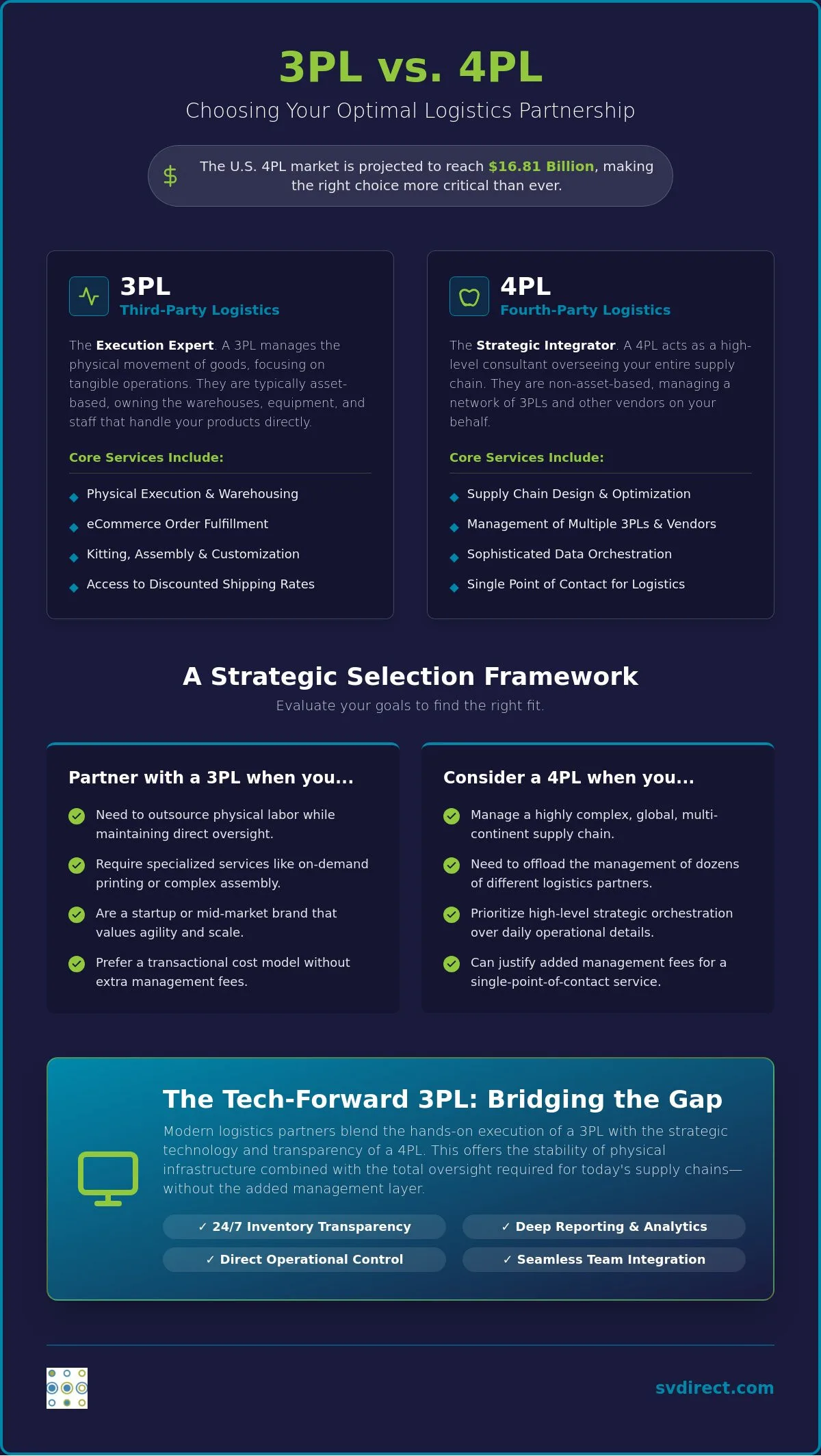
The Tech-Forward 3PL: Bridging the Gap Between Execution and Oversight
Proprietary systems like Remote Control™ are the engine behind this evolution. These platforms provide 24/7 access to your orders and inventory, backed by over 120 standard reports. This level of detail ensures your logistics partner acts as a true extension of your team. Our “Quiet Facility” methodology reinforces this precision. Instead of the chaotic energy found in traditional warehouses, our deliberate organization creates a stable environment where errors are caught before they ever reach your customer. This proactive stance protects your brand’s reputation and your bottom line.
Real-Time Visibility Without the 4PL Overhead
Web-based interfaces and XML/SOAP integrations have made remote order management a standard expectation. You no longer need an expensive middleman to tell you what is happening on the warehouse floor. Automated notifications for low inventory, receipts, and backorders provide the immediate feedback required for agile decision-making. This direct access to data removes the communication lag often found in 4PL models, giving you total control without the added management fees.
Custom-Fit Solutions vs. Cookie-Cutter Logistics
Flexibility is the most important asset in a 2026 logistics partnership. A tech-forward partner combines physical infrastructure with marketing-savvy services to solve bespoke challenges. For instance, integrating variable data printing with direct mail marketing allows you to personalize customer engagement while your inventory is being packed. This holistic approach ensures that your logistics strategy supports your broader business goals rather than just checking a box for fulfillment.
Future-Proof Your Logistics with a Scalable Partnership
Choosing the right model in the 3pl vs 4pl landscape requires balancing your need for operational control with your desire for strategic growth. You’ve learned that while 4PLs offer high-level orchestration, a tech-forward 3PL provides the same digital transparency without sacrificing direct contact with the team handling your inventory. This approach ensures you maintain visibility over every SKU while avoiding the heavy management fees that often accompany non-asset-based models. By focusing on a partner that acts as an extension of your team, you protect your bottom line and your customer experience.
With over 25 years of fulfillment excellence, we focus on providing the stability and precision your brand deserves. Our proprietary Remote Control™ system delivers real-time reporting, giving you the data you need to make informed decisions 24/7. From specialized kitting to integrated digital printing, we build solutions that adapt to your specific requirements. It’s time to move past confusing jargon and partner with a team that values your success as much as you do.
Streamline your supply chain with Silicon Valley Direct’s 3PL solutions. We look forward to helping your business reach its next milestone with confidence and ease.
Frequently Asked Questions
Is a 3PL or 4PL better for a growing eCommerce business?
A 3PL is usually the superior choice for growing eCommerce brands because it provides direct execution and asset-based reliability. This model allows you to scale physical operations like pick and pack and warehousing without the heavy management overhead of a 4PL. By working directly with the facility, you maintain better control over quality and kitting accuracy as your volume increases. The 3pl vs 4pl decision for growth often comes down to wanting a partner that actually touches your product.
Do 4PLs own their own warehouses and trucks?
No, 4PLs are typically non-asset-based providers that act as strategic consultants and integrators. They don’t own the physical infrastructure like warehouses or vehicle fleets. Instead, they manage the relationships and contracts with multiple 3PLs and carriers on your behalf. This makes them a strategic layer rather than an operational one, which is a fundamental distinction when evaluating your logistics needs.
What are the hidden costs of hiring a 4PL provider?
The most common hidden costs involve management fees and pass-through charges that can inflate your total logistics spend. Because a 4PL adds a layer between you and the physical service provider, you often pay for their strategic oversight on top of the actual shipping and storage costs. This can lead to a higher total cost of ownership compared to a direct partnership where you only pay for the services you consume.
Can a 3PL handle international shipping and global logistics?
Yes, many established 3PLs specialize in global shipping and logistics, managing everything from customs documentation to international carrier selection. A 3PL with a strong geographic hub, such as Silicon Valley, can leverage its proximity to major ports and airports to offer efficient global reach. This provides the international scale you need while keeping your operational team close to the product for better quality control.
How does technology like Remote Control™ change the 3PL vs 4PL debate?
Advanced technology like the Remote Control™ system bridges the gap by offering the 24/7 visibility once only found with 4PLs. When a 3PL provides 120+ real-time reports and XML integrations, you get strategic oversight and physical execution in one place. This proprietary digital transparency eliminates the need for an expensive 4PL manager to act as a data middleman, giving you direct access to your inventory status.
What is a Lead Logistics Provider (LLP) in relation to 4PL?
A Lead Logistics Provider (LLP) is another term for a 4PL that takes primary responsibility for managing your entire supply chain network. The LLP coordinates all other logistics vendors and focuses on high-level optimization and network design. While they provide a single point of contact, they often prioritize network-wide strategy over the specific, hands-on details of individual order fulfillment and specialized kitting projects.