img not found!
3PL Transparent Pricing: How to Understand and Compare Fulfillment Quotes

3PL Transparent Pricing: How to Understand and Compare Fulfillment Quotes

Could a lower pick-and-pack rate still lead to a higher fulfillment bill? It can, because storage, shipping coordination, and project-based work also affect the total. When fee definitions vary between quotes, it’s hard to know what you’re comparing. 3pl transparent pricing starts with a clear view of the work behind each charge, not just a headline rate.

It’s reasonable to want predictable costs and to understand how changes in order volume, inventory, or special projects may affect your bill. This guide explains common 3PL fee categories and the operational details that shape them, so you can compare quotes using consistent assumptions and service scopes.

You’ll also learn what to include in a quote request, from order patterns and average items per order to inventory needs and value-added services. With a clearly defined scope, you can assess the full picture and find a fulfillment approach that fits your operation.

Key Takeaways

  • 3pl transparent pricing explains what work a quote covers, what triggers each charge, and which assumptions or exceptions shape the estimate.
  • Look beyond pick-and-pack to see how storage, shipping coordination, and project work can affect fulfillment costs.
  • Compare quotes using the same order profile and service scope to make differences easier to evaluate.
  • Prepare order patterns, item counts, inventory needs, shipping requirements, and project details for a more useful estimate.
  • Silicon Valley Direct’s Remote Control system provides visibility into orders, progress, inventory, order histories, and reporting.

What Does Transparent 3PL Pricing Mean for an eCommerce Business?

Transparent 3PL pricing makes clear which services are covered, what activity triggers each charge, what assumptions shape the estimate, and which exceptions may affect it. In plain language: transparent 3PL pricing shows what work you’re paying for and the conditions that can change the scope. That clarity helps you understand a quote before fulfillment begins, rather than trying to interpret charges after your operation is underway.

A headline rate is only one part of the picture. A per-order pick-and-pack charge, for example, doesn’t explain how storage is measured, whether shipping management is included, or how project work such as kitting is handled. Since third-party logistics (3PL) can encompass several services, a useful quote connects its charges to the activities your business needs. A defined eCommerce fulfillment scope can include recurring storage as well as order-level and project-based work.

Clear terms support planning by helping you budget around expected activity and identify which changes could affect costs. They don’t guarantee an identical bill every month. Order volume, inventory levels, shipping needs, and special projects can change, so an estimate is most useful when its assumptions and exceptions are visible.

What should a transparent 3PL quote make clear?

Look for a clear connection between each service and the activity or resource that drives its charge. The quote should distinguish recurring needs, such as space occupied by inventory, from activity-based work, such as processing orders. It should also identify optional or project-based services separately, so a one-time assembly request isn’t mistaken for routine fulfillment.

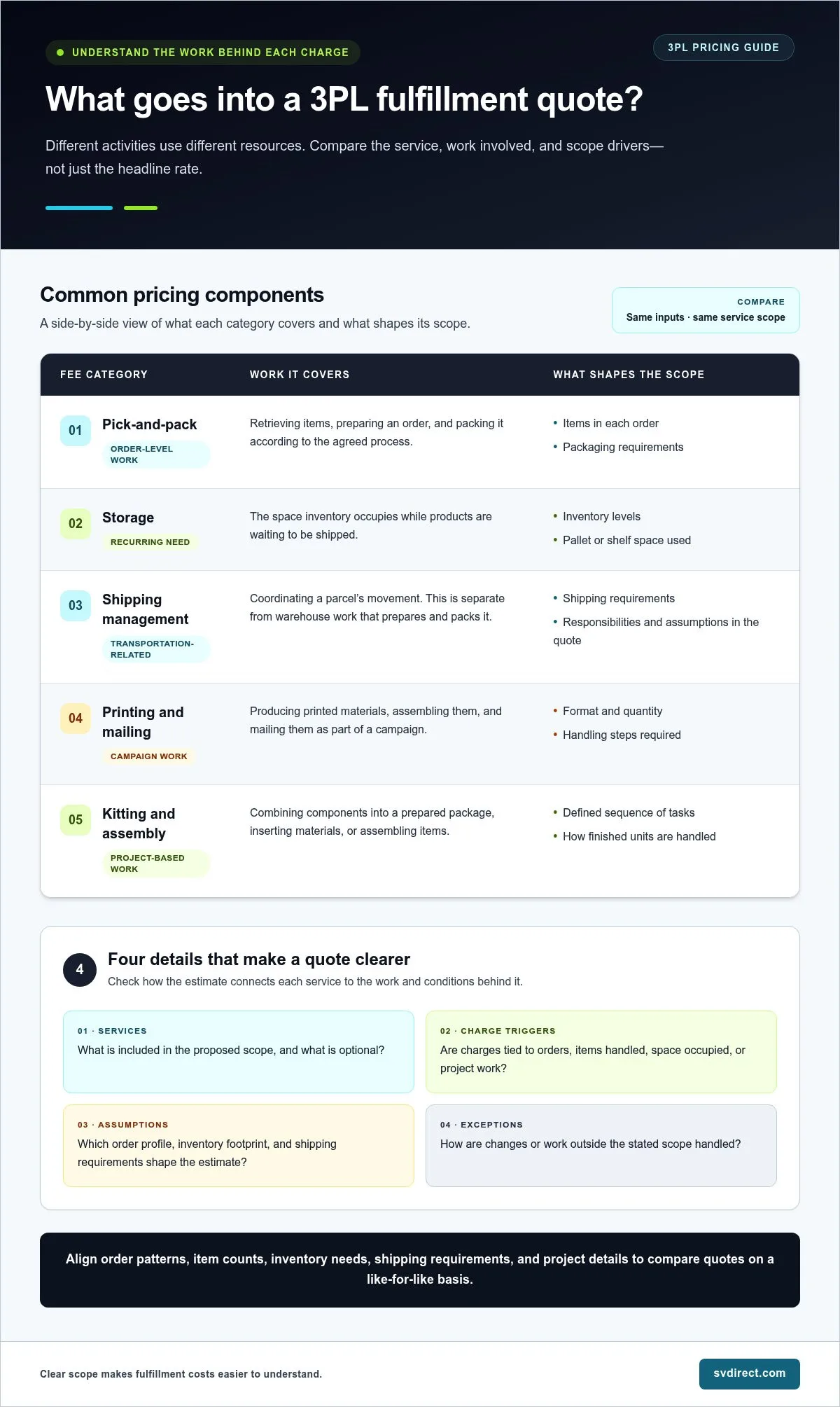
  • Services: Identify the work included in the proposed scope and any optional services.
  • Charge triggers: Explain whether charges relate to orders processed, items handled, space occupied, or project work performed.
  • Assumptions: State the expected order profile, inventory footprint, and shipping requirements used to shape the estimate.
  • Exceptions: Describe how changes or work outside the stated scope are handled, rather than leaving you to infer what may be billed differently.

Why can two fulfillment quotes look similar but differ?

Similar labels don’t always mean the same work is covered. One quote’s pick-and-pack scope might assume a straightforward order, while another may account for additional handling or packaging requirements. Even with the same monthly order count, average items per order can differ. An order with several items may involve more picking and packing activity than a single-item shipment.

Inventory also shapes the scope. A business storing more product, or using different amounts of pallet or shelf space, may have different storage needs. Shipping requirements and project work can further change which services belong in an estimate. To compare quotes fairly, use the same order and inventory inputs, then align service definitions, charge triggers, assumptions, and exclusions. That way, you’re comparing the work behind each quote, not just similar-sounding rates.

Which 3PL Pricing Components Should You Expect to See?

A fulfillment quote may bring together recurring costs, order-level activity, transportation coordination, and work tied to a specific project. A 3PL bill can include several categories because storing inventory, preparing orders, coordinating shipments, and completing special projects use different resources. Seeing those categories separately helps you understand which parts of the operation shape the estimate.

How do pick-and-pack and storage charges differ?

Pick-and-pack relates to handling orders: staff retrieve the items, prepare them for shipment, and pack them according to the agreed process. The number of items in an order and its packaging requirements can affect the work involved. Storage, by contrast, reflects the space inventory occupies, such as pallet or shelf space. These are distinct activities, although agreements may define or group them differently.

That distinction matters when you read a rate card. An order-level charge doesn’t describe the ongoing space needed for products waiting to be shipped. Likewise, a storage charge doesn’t explain the work involved in picking multiple items or using a specific packing method. For a clearer view, identify whether each category is recurring, tied to an order, or dependent on how much inventory is stored. Fee structures vary by agreement, so don’t assume one billing basis applies everywhere.

When can shipping, printing, or assembly affect the quote?

Shipping management is separate from pick-and-pack: preparing a parcel is warehouse work, while coordinating its movement is transportation-related. The U.S. Bureau of Transportation Statistics publishes information about freight and transportation, which provides context for the broader movement of goods. A quote should make the responsibilities and shipping assumptions relevant to your operation clear.

Printing and mailing can add work beyond routine eCommerce orders. For example, a campaign that requires printed materials to be produced, assembled, and mailed involves distinct tasks that should be described as separate service or project requirements. The format, quantity, and handling steps help define the work, beyond the usual order profile.

Kitting and assembly also involve hands-on work. Combining several components into one prepared package, inserting materials, or assembling items can require a defined sequence of tasks. The project scope should capture what needs to be assembled and how the finished units are handled. Clear descriptions distinguish this planned work from everyday picking and packing.

  • Recurring: Inventory storage based on occupied space.
  • Order-level: Picking items and packing customer orders.
  • Transportation-related: Shipping coordination and shipment requirements.
  • Project-based: Printing, mailing, kitting, or assembly tasks.

This breakdown gives you a working map of the operation before comparing estimates. To develop a quote around your fulfillment and project needs, share your operational requirements.

How Can You Compare 3PL Quotes on a Like-for-Like Basis?

A fair comparison starts with one operating profile, then checks how each quote handles the same services and activities. Don’t compare headline rates until you know what work each one includes. A lower visible line item may come with a narrower scope, different assumptions, or fewer reporting capabilities, so price alone won’t tell you which option fits your operation.

Use one sample profile throughout your review: a mix of single-item and multi-item orders, standard packaging, inventory occupying pallet and shelf space, defined shipping requirements, and no special project work unless listed. Share this same profile for each quote. The details matter more than making the example complicated. If your operation includes custom packaging, kitting, or other projects, add those requirements consistently, too.

Which assumptions should stay consistent across quotes?

Keep the order mix, item counts, packaging steps, inventory footprint, and shipping needs aligned. Record whether optional services such as returns processing, kitting, printing, or mailing are included, excluded, or scoped separately. This keeps the comparison focused on differences in service and charging approach, rather than differences in the information each estimate received.

Use a comparison grid to make gaps visible. Enter each quote’s terms rather than assuming similarly named activities mean identical work.

Category Quote A Quote B What to align
Included services List the stated work List the stated work Same operational scope
Charge triggers Record each activity or resource Record each activity or resource Comparable definitions
Assumptions Note order, inventory, and shipping inputs Note order, inventory, and shipping inputs Same sample profile
Exclusions and projects List excluded or separately scoped work List excluded or separately scoped work Same optional needs
Reporting and visibility Describe available information Describe available information Useful operational insight

How do you spot unclear or incomplete pricing terms?

Flag charge names without a plain explanation, activities with no stated trigger, and project work without defined assumptions. Note whether the quote explains how a shift from single-item to multi-item orders could change the work or scope. An unanswered point is a comparison gap, not proof that a charge is hidden. Keep it visible so you can assess the estimates on the same basis.

Operational fit belongs in the review, too. Consider whether the described services match your workflows and whether order, inventory, and progress reporting gives your team useful visibility. Silicon Valley Direct’s Remote Control system provides access to order, progress, and inventory information, along with reporting capabilities. For transportation context, the Federal Motor Carrier Safety Administration provides motor-carrier safety information. Keep that context separate from the scope and assumptions in a fulfillment quote.

With 3pl transparent pricing, the goal isn’t to force every quote into the same format. It’s to compare equivalent work, identify differences clearly, and judge the full operational fit instead of selecting by the lowest visible line item alone.
3PL Transparent Pricing: How to Understand and Compare Fulfillment Quotes

What Information Helps You Forecast 3PL Fulfillment Costs?

A useful forecast begins with a realistic picture of how your operation runs, not just a monthly order total. Order patterns, product mix, inventory levels, shipping needs, and special projects each shape the work involved. Gather the details below before requesting an estimate, then revisit them as your business changes. This gives a fulfillment partner a clearer basis for tailoring the scope to your needs.

Which operating details should you gather first?

Start with information your team can describe or track today. Recent order and inventory records can help you distinguish normal activity from seasonal peaks or one-off projects. Note where estimates are uncertain, too. A range or clear description is more useful than an unsupported guess.

  1. Summarize order patterns. Record order volume over time, including predictable peaks and slower periods. Describe the common mix, such as single-item orders, multi-item orders, or products frequently shipped together.
  2. Describe items and handling. Note the usual number of items per order, product dimensions if available, and any packaging steps beyond standard packing. Include inserts or protective materials if your process requires them.
  3. Estimate the inventory footprint. List the quantities kept on hand, how inventory levels change, and the pallet or shelf space products occupy. If stock levels vary, show typical and peak needs rather than relying on a single snapshot.
  4. Outline shipping requirements. Describe where orders go, the shipping methods your operation uses, and relevant parcel or delivery characteristics. This helps distinguish transportation coordination from warehouse handling.
  5. List special services and returns. Include kitting, assembly, printing, mailing, or returns requirements, along with how often they occur and what steps they involve. These details distinguish regular fulfillment activity from project-specific work.

These inputs also help define the right 3PL fulfillment services for your operation. A complete scope can account for the relationship between order handling, stored inventory, shipping coordination, and additional work, without treating every business as if it has the same workflow.

How can ongoing visibility improve cost planning?

A forecast is a starting point, not a substitute for reviewing actual operations. Order histories can reveal shifts in item counts or order mix, while real-time inventory visibility helps teams see changes in stock levels and space needs. Comparing those patterns with the assumptions behind a quote helps identify when the operating profile has changed.

Silicon Valley Direct’s Remote Control system provides access to order progress, order histories, and real-time inventory, and can generate over 120 standard reports. Those capabilities support operational reviews; they don’t mean the system displays pricing. Explore Remote Control order management in the context of the information your team uses to monitor fulfillment.

Clear inputs and ongoing review make 3pl transparent pricing more useful: estimates can reflect actual operating needs, and changes in the work are easier to recognize and discuss.

How Does Silicon Valley Direct Support a Clearer Fulfillment Quote?

A useful quote begins with the way your business actually operates. Silicon Valley Direct provides eCommerce fulfillment alongside warehousing, inventory management, and shipping coordination, with related services such as printing, mailing, kitting, and assembly. The aim is to connect the proposed services with your documented workflow, rather than assume every business needs the same combination.

How can service scope reflect a company’s actual workflow?

Consider how work moves through your operation: inventory arrives and is stored, orders are processed, shipments are coordinated, and special projects may require additional handling. Sharing the sequence and requirements helps define a scope that fits your goals. If your workflow includes printed materials or assembled kits, describe what those projects involve. If it doesn’t, keep the discussion focused on the services you use.

This is a working relationship, not just a rate comparison. Discussing order patterns, inventory needs, and service requirements together helps clarify what the estimate is built around. It also gives both sides a practical basis for considering how a change in order mix or project scope could affect the work. A tailored scope supports a clearer pricing discussion without promising that costs will remain fixed as operations change.

Operational visibility can support that discussion over time. Silicon Valley Direct’s Remote Control system provides access to order and progress information, order histories, and real-time inventory, along with reporting capabilities. That information can help your team review activity against the needs documented for the fulfillment operation. It provides operational visibility, not a display of pricing. Learn more about Remote Control order management.

What should happen after you prepare your quote inputs?

Bring together your order profile, item counts, inventory requirements, shipping needs, and relevant project details. Identify which figures reflect typical activity and which describe peak periods or occasional work. Clear notes on packaging, printing, mailing, returns, or assembly can keep the conversation grounded in the work your business needs.

Then review the assumptions and service scope together. A useful conversation can clarify what’s included, which activities shape the estimate, and how the proposed services align with your workflow. That shared understanding is central to 3pl transparent pricing: the quote should reflect the operation being discussed and its stated requirements.

Build a Fulfillment Plan You Can Grow With

Clear pricing is most useful when it gives you a practical starting point for decisions, not just a number to file away. Use 3pl transparent pricing to connect your fulfillment requirements with a service scope you understand, then revisit that scope as your order patterns, inventory, or project needs evolve.

Silicon Valley Direct has supported fulfillment operations since 1999. Its Remote Control system provides 24/7 visibility into orders and inventory, helping your team stay informed as daily activity moves forward. With a clearly documented operation and a partner focused on your goals, you can have a more useful conversation about fit and scope.

Bring your requirements into focus and take the next step toward a fulfillment plan tailored to your operation.

Frequently Asked Questions

What does transparent 3PL pricing mean?

Transparent 3PL pricing means you can understand the services in a quote, what activity triggers each charge, and which assumptions or exclusions shape the estimate. It doesn’t mean there’s one universal rate or that the final bill is guaranteed to stay fixed. A useful quote connects charges to the work performed. To compare options, use the same operating details, such as order mix and inventory needs, for each estimate.

How much does a 3PL cost per order?

Per-order charges depend on the work involved, including how many items are in a shipment and whether packaging requires extra handling. A pick-and-pack charge covers order processing, while storage and shipping-related services are separate considerations that may also affect total fulfillment spend. For a meaningful comparison, check how each quote defines order-level work and which assumptions it uses for your products, packaging, and order mix.

Does a 3PL quote include shipping costs?

A 3PL quote may show shipping and fulfillment handling as separate components, so review the definitions rather than assuming what “shipping” covers. Picking items and packing a parcel are warehouse activities; postage or carrier charges relate to transporting it, while shipping coordination describes management of that process. Check which shipping-related activities and assumptions the estimate describes, such as shipment characteristics and delivery needs, before evaluating its total scope.

Can a 3PL quote change when my order volume changes?

Yes, a different order profile can change the amount or type of work needed. A rise in multi-item orders may affect picking and packing activity; new packaging steps, a larger inventory footprint, or a printing or assembly project can also alter the operational scope. Review the assumptions behind your estimate when planning a forecast. If your mix changes, update the profile used to evaluate the quoted services.

Is storage usually charged separately from pick and pack?

Storage and pick-and-pack are different activities, and a quote may show them as separate categories. Storage can relate to the pallet or shelf space occupied by inventory; pick-and-pack relates to processing customer shipments. However, quote structures and definitions vary. Look at what each category covers and how it’s measured in the estimate. Don’t assume two similarly named lines include the same work or use the same basis.

What information should I provide for a 3PL quote?

Share your order patterns, typical item counts, packaging requirements, inventory quantities and space needs, and shipping requirements. Include details of any printing, mailing, returns, kitting, or assembly work your workflow involves. For example, note whether promotional materials are inserted into orders or assembled as kits. Specific, consistent inputs help shape a quote around the work you expect, without requiring one particular order volume or data format.

How can I monitor fulfillment activity after receiving a quote?

Review order progress, order histories, and inventory data alongside the operating assumptions used for planning. Silicon Valley Direct’s Remote Control provides 24/7 access to order and inventory information and can generate over 120 standard reports. These tools can help your team examine operational activity and spot when order patterns or stock levels have shifted. Use those observations to revisit your fulfillment plan, rather than treating an earlier forecast as permanent.

ECommerce Fulfillment Pricing Calculator: A 2026 Strategic Guide to 3PL Costs

ECommerce Fulfillment Pricing Calculator: A 2026 Strategic Guide to 3PL Costs

What if the all-in price you were quoted for fulfillment was actually just the tip of the iceberg? Many brands start their growth journey thinking they’ve secured a great deal, only to find their margins eroded by gotcha fees and opaque billing cycles. It’s frustrating to feel like you’re losing control of your own bottom line because of a lack of transparency. If you’ve been searching for a reliable ecommerce fulfillment pricing calculator, you know that the true cost of logistics involves far more than just a flat rate per box. We understand that you need more than a vendor. You need a partner that acts as a seamless extension of your team.

This guide will help you master the variables of 3PL pricing so you can accurately calculate your total fulfillment investment for 2026. You’ll learn how to identify hidden costs in contracts and gain 24/7 data transparency through systems like our proprietary Remote Control™ technology. We’ll break down the nuances of pick and pack fees, storage requirements, receiving, and complex kitting costs. By the end of this article, you’ll have a clear roadmap to choosing a logistics partner that values precision, human oversight, and the steady reliability we’ve championed since 1999.

Key Takeaways

  • Learn why effective logistics pricing isn’t just a single number but a composite of labor, storage, and technology.
  • Master the variables of an ecommerce fulfillment pricing calculator by understanding how SKU counts and items per order influence your total labor costs.
  • Discover the differences between pallet and shelf storage to accurately forecast your monthly warehousing overhead.
  • See how 24/7 data transparency through systems like Remote Control™ eliminates hidden fees and provides real-time visibility into your inventory.
  • Identify the essential data points you need to provide for a quote that reflects your specific business goals and growth trajectory.

Understanding the Variables of eCommerce Fulfillment Pricing

Logistics isn’t a commodity; it’s a complex ecosystem. When you look at an ecommerce fulfillment pricing calculator, you aren’t just looking at a shipping rate. You’re analyzing a composite of specialized labor, high-density storage space, and the digital infrastructure required to manage it all. A simple online tool might give you a baseline, but these “one-size-fits-all” models often fail because they don’t account for the unique complexity of your specific brand. Whether you require intricate kitting or high-resolution digital printing for your inserts, your costs are dictated by the precision of the operation rather than a generic average.

Instead of the hectic atmosphere common in many in-house warehouses, we view the 3PL relationship as a true partnership. We act as a steady extension of your team, providing a calm, organized facility where proactive problem solving is the standard. By catching potential issues before they leave the dock, we prevent the compounding costs of shipping errors and customer dissatisfaction. Understanding the Order Fulfillment Process is the first step toward realizing that efficiency is earned through deliberate methodology, not just raw speed.

The Core Components of a 3PL Quote

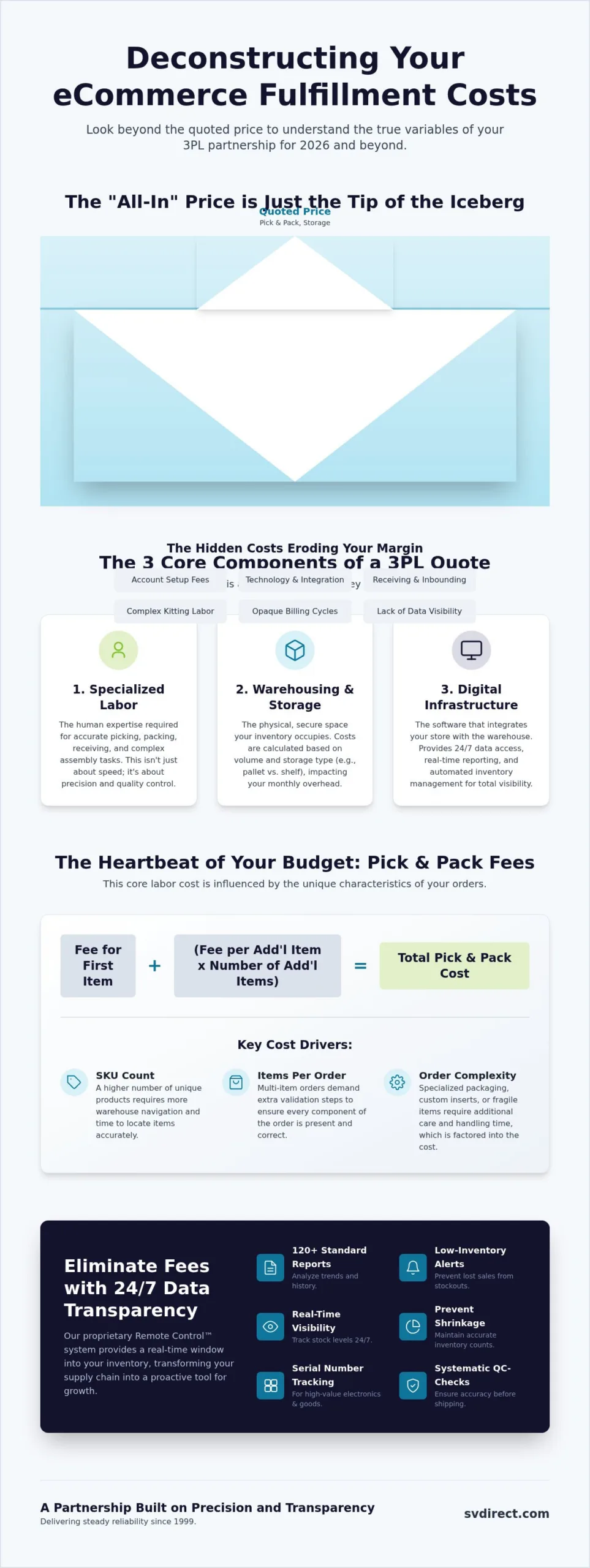
Building a reliable financial forecast starts with the setup. Account management and setup fees aren’t just administrative hurdles; they set the foundation for a seamless system integration. You’re paying for the expertise that ensures your store talks to the warehouse without friction. Technology fees provide the value of 24/7 access to real-time data, which is far more than a “feature.” It’s your window into the facility. When you evaluate labor versus overhead, you’re investing in a team’s collective experience and the physical security of your inventory. This isn’t just about moving boxes; it’s about the precision of the people who handle them every day.

Why Transparency is the Ultimate Cost-Saver

Hidden fees and data lags are the enemies of growth. We use our proprietary Remote Control™ system to offer total transparency, providing over 120 standard reports that help prevent inventory shrinkage. This level of visibility means you aren’t guessing about stock levels or historical trends. Using a sophisticated ecommerce fulfillment pricing calculator allows you to see how these automated notifications and data points protect your profit margins. Automated alerts for low inventory levels act as a safeguard against lost sales, ensuring you’re always ready for the next surge. This approach represents a marriage of technology and marketing, where your supply chain becomes a proactive tool for brand success. We treat your business as our own, ensuring that every data point reflects our commitment to being an extension of your company.

Pick and Pack Fees: The Core of Your Fulfillment Calculator

The pick and pack fee is the heartbeat of your logistics budget. When you use an ecommerce fulfillment pricing calculator, this line item represents the physical labor required to turn a digital order into a physical package. Typically, this structure includes a base fee for the first item and a smaller incremental charge for each additional unit. Your SKU count and the average number of items per order are the primary drivers here. High SKU counts require more warehouse navigation, while multi-item orders demand extra validation to ensure every piece is present.

For high-value electronics or healthcare products, precision is non-negotiable. We implement serial number tracking to provide a digital paper trail for every unit that leaves our facility. This level of oversight, combined with our systematic QC-Check process, ensures that accuracy isn’t a goal but a standard. It’s about being an extension of your brand, where every shipment reflects your commitment to quality and attention to detail.

Calculating Labor Costs for Complex Orders

Order complexity is where generic calculators often fall short. A single-item shipment is straightforward, but multi-SKU orders require a more sophisticated labor calculation. If your products require specialized packaging or custom inserts, the fulfillment speed and cost will naturally adjust to accommodate that extra care. We maintain a quiet, organized facility because we believe a deliberate methodology is superior to a hectic warehouse environment. This organized approach allows our team to handle intricate assembly tasks with the same precision as a standard pick, ensuring your brand’s presentation remains consistent.

The True Cost of Shipping Errors

A mis-pick is a silent profit killer. Industry data suggests that a single shipping error can cost up to three times the original fulfillment fee once you factor in return shipping, restocking labor, and the cost of the replacement shipment. Beyond the immediate financial loss, errors damage your brand’s reputation and erode customer trust. We use quality control as a proactive tool to protect your standing with customers. The QC-Check is a systematic inspection throughout the assembly process to verify order accuracy before a package is sealed. This proactive stance ensures your customers receive exactly what they ordered every time. If you want to see how precision impacts your bottom line, you can request a free quote to get a tailored look at your fulfillment needs.

Storage and Warehousing: Calculating Your Monthly Overhead

Storage fees are often a misunderstood variable in any ecommerce fulfillment pricing calculator. Many brands view warehousing as a static expense, but it’s actually a dynamic cost tied to inventory health and accessibility. If your stock isn’t moving, you aren’t just paying for floor space; you’re losing capital to carrying costs and potential obsolescence. We focus on providing a quiet, organized facility where inventory is managed with surgical precision. This environment ensures that your products are protected and ready for immediate dispatch, rather than being lost in a hectic sea of unorganized pallets.

For brands dealing with sensitive inventory, security is a primary cost driver. Standard warehousing often lacks the specialized infrastructure required for specialized goods. We provide secure warehousing for high-value electronics and healthcare products, ensuring your inventory is housed in a controlled, monitored environment. This level of care prevents the “hidden” costs of inventory shrinkage and damage that generic providers often overlook.

Pallet vs. Shelf: Which Storage Model Fits Your Business?

The choice between pallet and shelf storage depends on your SKU density and pick frequency. Pallet storage is the most efficient model for high-volume, low-SKU brands that ship bulk quantities. It maximizes vertical space and keeps your base storage costs low. Conversely, if you manage a high-SKU catalog with lower volume per item, shelf storage is the more economical choice. It allows for faster, more accurate picking without the need for constant pallet reshuffling. By using our Remote Control™ system, you gain 24/7 visibility into these levels through a web interface, which helps you identify “dead” stock and prevent unnecessary overstocking fees.

Leveraging FIFO to Prevent Product Obsolescence

First-In, First-Out (FIFO) is a critical inventory valuation method that ensures your oldest stock is shipped first. This is especially vital for products with expiration dates or those prone to technological obsolescence. An accurate ecommerce fulfillment pricing calculator should account for the efficiency gained through automated inventory alerts. When we receive new stock or hit a backorder threshold, our system provides immediate notifications. This proactive communication is essential for maintaining a healthy cash flow. In our facility, we prioritize strict controls and methodical organization, ensuring that your storage strategy is an active part of your growth rather than a passive overhead expense. If you’re ready to see how organized storage can impact your margins, we invite you to request a free quote for a tailored assessment.

ECommerce Fulfillment Pricing Calculator: A 2026 Strategic Guide to 3PL Costs

Factoring in Kitting, Printing, and Specialized Services

When building an ecommerce fulfillment pricing calculator, many brands overlook the impact of value-added services. These aren’t just extras; they’re strategic tools that define your brand’s physical presence. Kitting and assembly project fees are typically calculated based on labor time. The complexity of the task, from simple two-item bundles to multi-component subscription boxes, determines the final investment. By integrating on-demand digital printing, you can slash the overhead associated with pre-printing and storing thousands of inserts that might become obsolete.

We utilize the HP Indigo 5500 Digital Press, which employs real liquid ink technology. This is technically superior to the standard toner-based printing found in most warehouses. Liquid ink provides a sharper finish that doesn’t crack or peel when folded. It allows for Variable Data Digital Printing (VDP), enabling you to personalize every insert with a customer’s name or a unique discount code at a minimal extra cost. This turns a standard shipment into a targeted marketing asset, creating a high-performance supply chain that values both precision and personalization.

The ROI of High-Resolution Branded Collateral

Quality is a differentiator in a crowded market. Our equipment delivers 230 line screen resolution, which far exceeds the grainy output of standard digital print. For professional results, we recommend using 300 dpi files as your gold standard. This ensures every color and line is rendered with absolute precision. Because our liquid ink technology requires no 24-hour drying time, we can move printed materials directly into the assembly line. This immediate handling accelerates the entire kitting process, ensuring your promotions launch without delay.

Kitting and Assembly: Beyond the ‘Cookie-Cutter’ Approach

Generic solutions rarely meet the needs of a growing brand. Whether you’re launching promotional kits, subscription boxes, or high-end press kits, you need custom-fit solutions that reflect your brand’s standards. Our kitting and assembly services rely on a systematic QC-Check process. We don’t just pack boxes; we perform rigorous inspections throughout the assembly process to ensure every component is positioned exactly as intended. This level of oversight is a point of pride for our team, serving as a constant anchor of trust for our partners.

How to Request an Accurate Fulfillment Quote

A generic ecommerce fulfillment pricing calculator is an excellent starting point for high-level budgeting, but it can’t capture the nuances of your specific operation. To move from a broad estimate to a reliable financial forecast, you need a quote built on actual data and strategic goals. We believe in finding a partner that listens and understands your unique challenges. At Silicon Valley Direct, we don’t just act as a vendor; we function as a seamless extension of your team. This collaborative approach ensures that the pricing you receive reflects the precision and human oversight your brand deserves.

Data Preparation for Your 3PL Quote

The accuracy of your quote depends on the quality of the information you provide. Start by gathering your historical shipping data, focusing on three key metrics: monthly order volume, total SKU count, and average items per order. It’s also vital to forecast your future growth, as pricing tiers often shift as you scale. Don’t forget to identify any special handling requirements. Whether you need healthcare mailing services or specialized tradeshow support, these details must be included from the start. Being transparent about your budget limitations also helps in finding the best-fit solution, allowing us to prioritize the services that will drive the most value for your business.

A quiet, organized facility is the result of methodical planning. When you share your data, we analyze the labor and storage requirements needed to maintain our high standards of accuracy. This prevents the hidden fees that often arise when a 3PL isn’t fully aware of a project’s complexity. By providing a clear picture of your logistics needs, you enable us to apply our collective experience to your specific supply chain, ensuring that every pick, pack, and shipment is handled with deliberate care. Using an ecommerce fulfillment pricing calculator helps you visualize these costs, but a professional quote solidifies them.

Finalizing Your Partnership

Choosing a fulfillment partner is an investment in your brand’s future. Our philosophy is grounded in our “Nine Promises,” a proactive approach that has served our clients since 1999. This commitment to stability and expert-level service is what turns a transactional relationship into a long-term partnership. Once integrated, you’ll have 24/7 access to our Remote Control™ system. With over 120 standard reports at your fingertips, you’ll see an immediate ROI through total data transparency and inventory control. This isn’t just about moving products; it’s about giving you the peace of mind to focus on growing your business while we handle the physical operations with precision.

Strategic Logistics as Your Growth Engine

Strategic logistics is the foundation of a scalable brand. By mastering the variables of an ecommerce fulfillment pricing calculator, you’ve moved past generic estimates toward a precise financial strategy. You now understand how SKU complexity, storage models, and specialized kitting impact your bottom line. True efficiency isn’t found in a static spreadsheet; it’s built through a partnership that values transparency and human oversight.

We provide the tools you need to stay in control. From the 24/7 visibility of our Remote Control™ system to the superior 230 line screen resolution of our HP Indigo 5500 liquid ink technology, we ensure your operations are as professional as your marketing. Our proprietary QC-Check process acts as a final safeguard, protecting your reputation with every shipment. We’re ready to act as a steady, reliable extension of your team.

The path to a more organized and profitable supply chain starts with a single step. We’re here to help you navigate the complexities of 2026 and beyond with precision and personal commitment.

Frequently Asked Questions

What are the most common hidden fees in eCommerce fulfillment?

Common hidden costs often include account management setup, system integration fees, and unexpected charges for “special handling” like returns or complex kitting. Some providers also bury costs in data lags or poor communication. We eliminate these uncertainties by acting as a proactive extension of your team. Our approach ensures that every variable in your ecommerce fulfillment pricing calculator is visible from the start, preventing the margin-eroding fees that often plague standard logistics contracts.

How do pick and pack fees change as my business scales?

As your order volume increases, pick and pack fees typically shift into more favorable pricing tiers. High-volume shipments allow for greater warehouse efficiency and labor optimization. We analyze your monthly order volume and SKU density to find the best-fit solution for your growth. By forecasting future volume, you can use your ecommerce fulfillment pricing calculator to see how scaling reduces your per-unit investment while maintaining the same high level of precision and human oversight.

Is variable data digital printing significantly more expensive than static printing?

Variable Data Digital Printing (VDP) is not significantly more expensive than producing static color printing jobs. This technology allows you to change copy or images on every sheet within a single run for personalized marketing. It’s an affordable way to add high-value customization to your fulfillment inserts or direct mail. By printing files directly to the digital press, you save both time and money while creating a more targeted experience for your customers.

What is the difference between liquid ink and toner-based digital printing?

Liquid ink technology, utilized by our HP Indigo 5500, is technically superior to the dry toner used in most digital presses. It provides a 230 line screen resolution, resulting in sharp, detailed images that mimic the quality of traditional offset printing. Unlike toner, liquid ink doesn’t crack or peel when the paper is folded. Additionally, liquid ink sheets emerge dry and ready for immediate handling, which significantly accelerates the kitting and assembly timeline.

Can I track my fulfillment costs and inventory in real-time?

You can track every aspect of your logistics through our proprietary Remote Control™ system. This web interface provides 24/7 access to real-time inventory, order histories, and tracking information. You can generate over 120 standard reports to monitor your fulfillment costs and stock levels at any time. Automated email notifications for low inventory levels and backorders ensure you always have total visibility, helping you avoid lost sales and unnecessary carrying costs.

How does the HP Indigo 5500 improve my kitting and assembly timeline?

The HP Indigo 5500 speeds up the assembly process because its prints are dry and ready for handling immediately. Traditional offset printing often requires up to 24 hours of drying time before sheets can be folded or inserted into kits. By eliminating this wait, we can move printed collateral directly into our kitting lines. This seamless integration between our digital press and assembly team ensures that complex promotional projects are completed and shipped without unnecessary delays.

Do you provide specialized fulfillment for healthcare or pharmaceutical industries?

We provide specialized fulfillment solutions for the healthcare industry, including secure warehousing and healthcare mailing services. Our facility is equipped to handle sensitive materials with strict inventory controls and serial number tracking. We understand the high stakes of pharmaceutical and healthcare logistics, which is why we apply a deliberate methodology to ensure every order is accurate. Our systematic QC-Check process provides the extra layer of verification required for these highly regulated sectors.

What is a ‘QC-Check’ and how does it affect my pricing?

A QC-Check is a systematic inspection performed throughout the assembly process to ensure total accuracy. While this human oversight is built into our kitting and assembly project fees, it actually saves you money by preventing costly shipping errors. By catching mistakes before a package leaves the facility, we eliminate the financial losses associated with returns and reshipping. This proactive quality control is a core part of our commitment to acting as a reliable extension of your brand.

3PL Pricing Models: The Strategic Guide to Fulfillment Costs in 2026

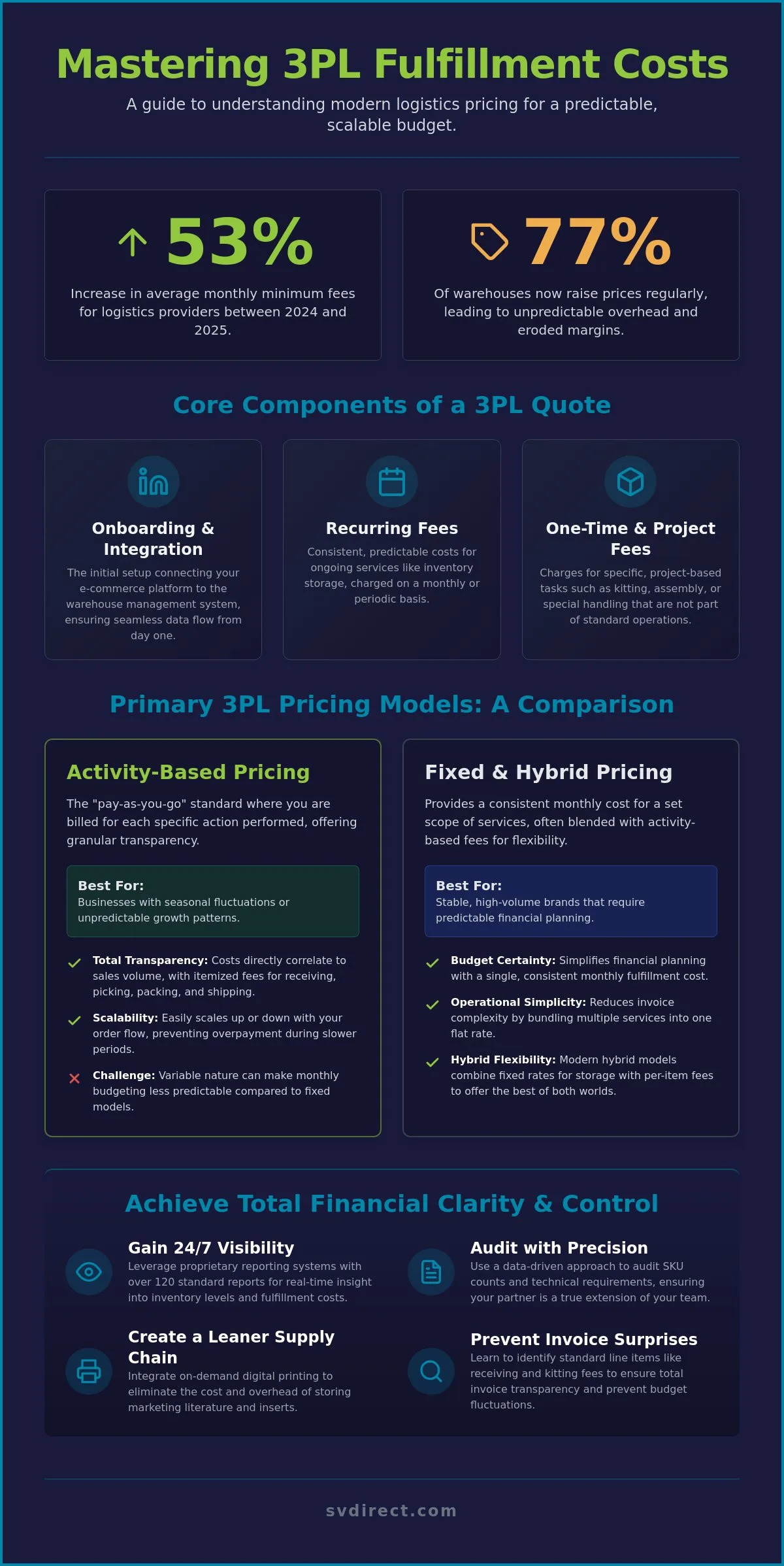
If you feel like your logistics invoices are growing faster than your order volume, you aren’t alone. The average monthly minimum fee for logistics providers jumped 53 percent between 2024 and 2025, leaving many brands struggling with unpredictable overhead. It’s frustrating to scale your operations only to find your margins eroded by surcharges or complex kitting fees that weren’t clear in the initial quote. You deserve a partnership grounded in precision and transparency, not one that hides costs behind confusing jargon. For those looking to decode industry terms, Delgate provides a helpful resource on warehouse abbreviations. Understanding the nuances of different 3pl pricing models is the first step toward reclaiming control over your bottom line.

This guide will help you master the complexities of modern fulfillment costs so you can secure a predictable budget and a partnership that acts as a seamless extension of your company. We will break down the shifting cost structures of 2026, expose the fees that often hide in the fine print, and show you how to leverage real-time data for total financial clarity. Our goal is to move you from a state of uncertainty to a state of informed confidence. You will learn how to choose a model that supports your growth while maintaining the high-tech efficiency your customers expect.

Key Takeaways

  • Understand the critical differences between activity-based and flat-rate 3pl pricing models to determine which structure offers the highest return on investment for your specific volume.
  • Learn to identify standard line items like receiving and kitting fees to prevent unexpected budget fluctuations and ensure total invoice transparency.
  • Use a data-driven approach to audit your SKU counts and technical requirements, ensuring your logistics partner acts as a true extension of your team.
  • Gain 24/7 visibility into your inventory and costs through proprietary reporting systems that offer over 120 standard reports for better decision-making.
  • Reduce the overhead of literature storage by integrating on-demand digital printing into your fulfillment workflows for a leaner, more responsive supply chain.

What is 3PL Pricing? Understanding the Mechanics of Fulfillment Costs

At its core, 3PL pricing represents the fee structure logistics providers use to manage warehousing, labor, and shipping operations. While it sounds straightforward, the reality in 2026 is far more nuanced. As global supply chains grow more complex, Third-party logistics has evolved from a back-office cost center into a primary growth engine for eCommerce brands. You aren’t just paying for shelf space; you’re investing in the infrastructure that allows your business to scale without the friction of physical limitations. Recent data from The Fulfillment Advisor’s 2025 Costs and Pricing Survey shows that average monthly minimum fees jumped 53 percent in a single year. This volatility makes choosing the right 3pl pricing models essential for long-term stability.

The variety of 3pl pricing models available today reflects the diversity of the businesses they serve. A “one-size-fits-all” approach rarely works because your SKU complexity and order volume are unique. A startup with five high-velocity SKUs has vastly different needs than an enterprise shipping thousands of unique, kitted items. To truly understand your expenses, you must look beyond simple pick-and-pack rates and focus on the Total Cost of Fulfillment (TCOF). This metric accounts for every touchpoint, from receiving a pallet to processing a return, providing a realistic view of your profitability. It helps you see the bigger picture of how logistics impacts your customer experience and repeat purchase rates.

The Core Components of a 3PL Quote

A comprehensive quote begins with onboarding and integration. This is the digital handshake where your online store connects with our warehouse management system. It ensures that data flows accurately from the moment a customer clicks “buy.” Beyond initial setup, you will encounter recurring fees, such as monthly storage, alongside one-time costs for project-based tasks like kitting and assembly. Modern logistics partners use sophisticated technology to automate these fee calculations. This automation eliminates manual errors and provides a clear, itemized view of exactly where your capital is going, allowing you to plan your growth with precision.

Why 3PL Pricing Transparency Matters in 2026

Transparency is the bedrock of a healthy partnership. In an era where 77 percent of warehouses now raise prices regularly, hidden surcharges can quickly erode the margins of a scaling business. You need to know that your invoices reflect actual activity without surprise “account management” or “peak season” fees that weren’t discussed upfront. High-performance partners provide 24/7 data access through systems like Remote Control™, allowing you to monitor real-time costs and inventory levels. This level of visibility ensures there are no shocks at the end of the month. 3PL pricing is a strategic investment in scalability rather than a mere operational expense.

Primary 3PL Pricing Models: A Comparative Analysis

Selecting the right framework for your logistics expenses isn’t just about finding the lowest number; it’s about finding a structure that aligns with your operational DNA. The landscape of 3pl pricing models has shifted significantly, offering brands more ways to balance risk with reward. Whether you are a high-growth startup or an established enterprise, your choice will dictate your ability to maintain healthy margins during seasonal spikes.

Activity-Based Pricing: The Pay-As-You-Go Standard

This model is the industry standard for its granular transparency. You pay exactly for the work performed, such as receiving, picking, and packing. Each line item is clearly defined; per-order and per-item fees provide a direct correlation between sales and fulfillment costs. It’s particularly effective for businesses experiencing seasonal fluctuations or unpredictable growth phases. While the high level of transparency is a major benefit, the variable nature of monthly budgeting can be a challenge for those who prefer absolute cost certainty.

Fixed and Hybrid Models for Established Enterprises

For stable, high-volume brands, the predictability of flat-rate or fixed pricing is often more attractive. These models provide a consistent monthly cost, which simplifies financial planning. However, many modern providers are moving toward hybrid models to offer maximum flexibility. A hybrid approach often combines fixed storage rates with activity-based labor. This protects your margins during peak seasons, such as the Q4 holidays, by ensuring that your baseline costs remain steady while labor scales only when orders do. Our eCommerce order fulfillment services are designed to adapt to these shifts, providing the stability you need to grow.

Cost-plus models add another layer of transparency by revealing the actual operational costs of the facility and adding a pre-negotiated management fee. This ‘open book’ approach is ideal for complex partnerships where deep technical integration or specialized kitting is required. It allows you to see the logic behind every expense, ensuring your model matches your SKU count and order frequency precisely. If you are unsure which structure suits your current SKU profile, you can consult with our logistics experts to find the most efficient path forward. Choosing the right 3pl pricing models ensures that your logistics partner acts as a steady hand, allowing you to focus on innovation while we manage the precision of your physical operations.

Breaking Down 3PL Fee Structures and Common Line Items

Understanding the specific line items within 3pl pricing models requires a granular look at the activities that populate your monthly invoice. Every piece of inventory begins its journey with inbound shipping and receiving. This phase involves unloading, inspecting, and logging stock into a warehouse management system to ensure 24/7 visibility. Industry data suggests receiving fees typically range from $5 to $15 per pallet. Once received, warehousing and storage costs apply. These are often calculated by the pallet or cubic foot. Storage in major metropolitan areas often carries a 30 to 50 percent premium over secondary markets, making efficient space utilization a priority for your bottom line.

Standard pick and pack fees generally range from $3.50 to $8.00 for a single-item order. Each additional item usually adds a fee between $0.50 and $1.50. While these labor costs are consistent, your logistics partner should also provide significant value through postage management. By aggregating high shipping volumes, a 3PL can help you leverage carrier discounts that are difficult to access as an independent shipper. This allows you to maintain competitive shipping rates even as national postage costs continue to fluctuate.

Specialized Project Fees: Kitting and Assembly

Moving beyond the standard box requires specialized attention and a steady hand. Whether you are building subscription kits or promotional bundles, these projects demand a higher level of oversight than a simple pick. We utilize a systematic kitting and assembly QC-Check process to ensure every package meets your exact specifications. This meticulous approach reduces errors that lead to costly returns and damaged brand reputation. Precision here prevents the high cost of rework and keeps your customers satisfied from the moment they open their delivery.

Integrated Printing and Literature Fulfillment

A major inefficiency in many supply chains is the storage of bulk printed materials that quickly become outdated. Traditional offset printing often leads to “dead” inventory when marketing details or product specifications change. By integrating on-demand digital printing directly into your fulfillment workflow, you can adopt a just-in-time model. Variable data printing (VDP) allows for personalized inserts or personalized mailings without the overhead of massive storage fees. This integration ensures your literature is as agile as your digital presence, reducing waste and allowing you to pivot your messaging instantly.

3PL Pricing Models: The Strategic Guide to Fulfillment Costs in 2026

How to Evaluate and Choose the Right 3PL Pricing Model

Choosing between various 3pl pricing models isn’t just about comparing numbers on a spreadsheet. It requires a methodical evaluation of your operational reality and future goals. You must look at your logistics partner as a steady hand that guides your growth through precision and personal commitment. To find the most profitable structure, you need to look beyond the surface and analyze how each fee impacts your long-term scalability.

Start by auditing your current fulfillment data. You need precise figures for monthly order volume, SKU counts, and the average number of items per order. These metrics directly influence labor and storage costs. Next, define your technical requirements. The choice between API and Web Service integration is pivotal. While APIs are common, platform-agnostic XML/SOAP web services often reduce long-term IT overhead by providing more stable connections across diverse platforms. This technological foundation ensures that your data remains accurate as you scale.

Factor in specialized needs like healthcare mailing or literature fulfillment. These services require specific compliance or kitting expertise that standard providers may lack. Always request a transparent quote that explicitly includes account management and technology fees. Finally, evaluate the human element. A high-performance partner provides a dedicated contact who understands your business, ensuring your logistics provider acts as a true extension of your team. This personal oversight is a powerful differentiator in a tech-saturated market.

Assessing Technology and Integration Costs

Real-time visibility is essential for modern business. A proprietary system like Remote Control™ provides 24/7 access to your inventory and order status. This eliminates the need for manual data exports, which are prone to error and time lag. When evaluating 3pl pricing models, consider the long-term value of this data access. Real-time reporting allows for proactive decision-making that can save thousands in mismanaged stock or missed deadlines. It transforms your supply chain into a transparent, data-driven asset.

Calculating the ROI of a Strategic Partnership

Look past the ‘per-pick’ fee to see the true impact of error reduction and quality control. A partner that emphasizes a “Quiet Facility” approach provides a higher ROI by preventing the costly mistakes associated with chaotic environments. Proactive problem-solving, where your partner anticipates shipping conflicts before they reach the customer, saves significant money on returns and customer service labor. The most expensive 3PL model is often the one with the lowest upfront price but the highest error rate.

The Silicon Valley Direct Advantage: Profitability Through Precision

Profitability in logistics is built on a foundation of deliberate organization rather than sheer speed. Our “Quiet Facility” methodology is designed to eliminate the chaos often found in high-volume warehouses, ensuring that every movement is intentional. By prioritizing a calm and structured environment, we drastically reduce the error rates that lead to expensive returns and customer dissatisfaction. This precision allows us to offer a level of reliability that stabilizes your bottom line, providing a refreshing alternative to the unpredictable costs found in many 3pl pricing models. We don’t just move boxes; we manage your brand’s reputation with a steady hand.

A primary differentiator of our service is the seamless integration of logistics with on-demand digital printing. Most providers treat printing and fulfillment as separate silos, which creates unnecessary shipping legs and storage fees. We utilize HP Indigo 5500 technology to print marketing materials, inserts, or manuals right when they’re needed. This just-in-time approach reduces “dead” inventory and streamlines your entire supply chain. It’s a level of vertical integration that offers financial transparency often missing from standard 3pl pricing models, allowing you to pivot your marketing strategy without worrying about wasting thousands of pre-printed items.

The Nine Promises we make to our partners serve as a constant anchor of trust. These commitments focus on total flexibility, proactive problem-solving, and a rejection of automated interactions in favor of direct human connection. Our location in the heart of Northern California drives constant innovation in our 3PL fulfillment services, giving you access to global connectivity and tech-forward solutions. We act as a true extension of your company, backed by decades of operational data and a team that takes personal pride in your success.

Bespoke Solutions vs. Cookie-Cutter Pricing

We reject the cookie-cutter approach that forces unique businesses into rigid procedures. Instead, we prioritize bespoke solutions that adapt to the specific requirements of your most complex projects. Our seasoned staff has an exceptionally high retention rate, which translates to deep institutional knowledge and operational stability for your brand. This collective experience was recently demonstrated when our team managed over 3,000 shipments in a single week with 100 percent accuracy. You won’t find that level of precision in a facility that relies on temporary labor and automated scripts.

Scaling with Confidence in 2026

Using the proprietary Remote Control™ system, you gain 24/7 visibility into your operations with access to over 120 standard reports. This real-time data ensures you can manage high-volume deadlines and peak season surges with informed confidence. Whether you’re a startup finding your footing or an established enterprise expanding your reach, we provide the flexibility to grow alongside you. Our commitment to direct communication means you’ll always have a dedicated expert overseeing your account. You can see the impact of this personal commitment for yourself on our customer testimonials page.

Securing Your Growth with Logistics Precision in 2026

The logistics environment in 2026 demands more than just a warehouse; it requires a strategic partnership that prioritizes long-term stability over short-term savings. You have learned that the true value of 3pl pricing models lies in their ability to offer transparency and scalability without the burden of hidden fees. By focusing on the Total Cost of Fulfillment and leveraging real-time data through proprietary systems, you can transform your logistics from a variable expense into a predictable growth engine.

Silicon Valley Direct brings over 25 years of operational history to your supply chain, ensuring that every order is handled with the precision of a seasoned expert. Our integrated digital printing services and Remote Control™ system provide the visibility you need to make informed decisions 24/7. We act as a steady hand in a fast-paced market, allowing you to focus on innovation while we manage the complexities of physical distribution with personal commitment.

We are ready to become the seamless extension of your team that your business deserves. Let’s build a future where your fulfillment is as agile and precise as your vision.

Frequently Asked Questions

What is the most common 3PL pricing model for eCommerce?

Activity-based pricing is the most prevalent structure for eCommerce brands because it aligns costs directly with sales volume. In this model, you pay for specific tasks such as receiving, picking, and packing. It offers high transparency for businesses with fluctuating volumes, ensuring you only pay for the work performed each month without committing to heavy fixed overhead.

Are there hidden fees in 3PL contracts I should watch out for?

Brands should be vigilant regarding account minimums, long-term storage surcharges, and peak-season fees that may not be obvious in initial quotes. Some providers also charge separate SKU management fees or integration maintenance costs. Requesting a complete fee schedule upfront is the best way to ensure your 3pl pricing models remain transparent and predictable throughout the year.

How much does 3PL storage typically cost in 2026?

Standard pallet storage typically ranges from $8.00 to $25.00 per month based on current industry data. However, facility location plays a major role in these costs. Warehouses in major metropolitan areas often carry a 30 to 50 percent premium compared to secondary markets. Shelf and bin storage are usually calculated by the cubic foot for smaller items or high-velocity stock.

What is the difference between a pick fee and a pack fee?

A pick fee covers the labor required to retrieve an item from its designated storage location. In contrast, a pack fee accounts for the time and materials needed to secure those items in a shipping container. While some providers combine these into a single line item, others separate them to provide more granular data on labor utilization and packaging costs.

How do 3PLs charge for returns management?

Returns are generally charged as a flat processing fee per order plus an additional per-item rate for inspection and restocking. If an item requires cleaning, repackaging, or disposal, extra labor fees may apply. Efficient returns management is a critical component of 3pl pricing models, as it helps recover inventory value quickly while maintaining customer satisfaction through fast processing.

Does 3PL pricing include shipping and postage costs?

Shipping and postage are typically treated as pass-through costs and are billed separately from fulfillment labor and warehousing. High-volume logistics partners often provide access to discounted carrier rates, which helps offset the impact of national postage increases. These costs are calculated based on package weight, dimensions, and the destination zone for each individual shipment.

Why is kitting charged separately from standard fulfillment?

Kitting is billed as a separate project because it involves pre-assembling multiple items into a single unit before they are ready for final fulfillment. This process requires specialized labor and quality control checks that go beyond a standard pick. Separating these fees allows for better cost tracking on promotional bundles, subscription box projects, or complex assembly requirements.

Is there a minimum monthly volume required for most 3PL pricing models?

Most providers require a monthly minimum fee to cover the overhead of account management, technology integrations, and dedicated facility space. The average monthly minimum has climbed to over $500 as providers adjust to rising operational costs. If your order volume falls below the threshold, you’ll still be billed the minimum amount to maintain your partnership and real-time data access.