img not found!
JIT Printing for eCommerce: 2026 Lean Fulfillment Guide

JIT Printing for eCommerce: 2026 Lean Fulfillment Guide

The most expensive marketing collateral you’ll ever buy isn’t the high-end brochure; it’s the stack of 5,000 obsolete flyers gathering dust in a warehouse corner because your product specs changed last week. For brands scaling in 2026, the traditional model of bulk printing is a liability that drains capital and stifles agility. Implementing just-in-time printing for ecommerce transforms this static burden into a dynamic asset. By producing only what you need exactly when an order is placed, you’re not just saving on storage fees. You’re gaining the ability to pivot your messaging in real-time.

You likely already feel the pressure of rising postage rates and the constant demand for more authentic customer connections. We understand that the disconnect between a high-tech storefront and a generic packing slip is a missed opportunity for growth. This guide promises to show you how to eliminate print waste while delivering hyper-personalized experiences at scale. We will examine the technical shift from bulk offset to on-demand digital production and how this integration creates a leaner, more responsive fulfillment cycle.

Key Takeaways

  • Identify the hidden costs of bulk inventory and how a lean production model protects your capital from obsolescence.
  • Review the technical benchmarks for digital print quality, including the advantages of liquid ink and high-resolution line screens.
  • Leverage Variable Data Printing (VDP) to personalize every shipment and increase customer lifetime value without increasing production time.
  • Integrate just-in-time printing for ecommerce into your existing 3PL workflow using automated Web Services and API triggers.
  • Monitor your entire production and fulfillment cycle with 24/7 visibility through proprietary remote control systems.

The Shift to Just-In-Time Printing for eCommerce Fulfillment

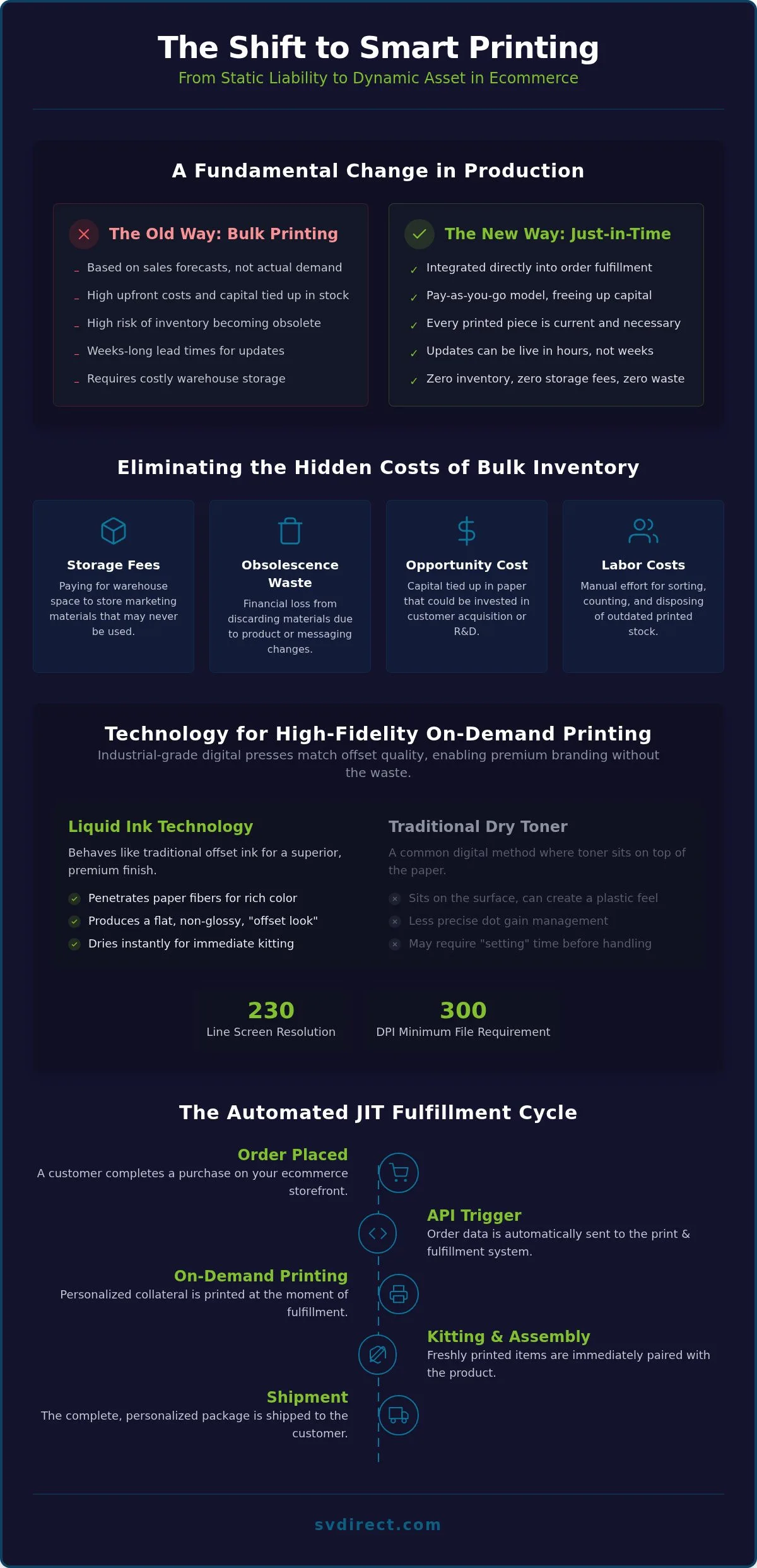
Just-in-time printing for ecommerce represents a fundamental departure from the “print and store” models of the past. Instead of ordering thousands of marketing inserts or manuals based on sales forecasts, digital production is integrated directly into the order fulfillment process. This approach draws heavily from the Just-in-time (JIT) manufacturing philosophy, where materials are produced only as they’re needed to meet actual demand. By aligning print production with real-time order data, brands eliminate the friction between their digital storefronts and their physical shipments.

The traditional model of bulk offset printing relies on high volumes to drive down unit costs. However, this creates a hidden “discard cycle” that often costs more than the initial savings. eCommerce brands in 2026 are realizing that physical inventory is a stagnant asset. When marketing strategies change every quarter, bulk runs become liabilities. JIT printing solves this by ensuring that every piece of paper leaving the facility is current, accurate, and necessary.

Eliminating Inventory Obsolescence

Print inventory obsolescence is the financial loss incurred when pre-printed materials become inaccurate or irrelevant before they ever reach a customer. This is the primary driver for JIT adoption. In a market where product specifications or legal requirements change rapidly, holding six months of pre-printed stock is a high-risk strategy. The costs extend beyond the paper itself. You must also account for:

  • Storage fees: Paying for warehouse rack space for months at a time.
  • Labor costs: The physical effort of sorting, counting, and eventually disposing of outdated stock.
  • Opportunity cost: Capital tied up in paper that could be invested in customer acquisition.

Transitioning to a print-on-demand model removes these burdens entirely. The ROI is found in the capital freed from stagnant inventory and the total elimination of disposal waste.

Agility in a Fast-Paced Market

Traditional offset printing often demands lead times of several weeks for high-quality marketing collateral. In contrast, just-in-time printing for ecommerce reduces that window to mere hours. When your print production lives inside your fulfillment center, an updated PDF file can be live in your next shipment by the afternoon. This speed allows brands to respond to market trends or customer feedback with surgical precision. It also provides a significant boost to working capital. Instead of tying up thousands of dollars in paper that sits on a shelf, businesses pay for production as sales occur. This shift supports a leaner 3PL fulfillment strategy, allowing high-growth companies to scale without the anchor of physical overstock.

The Technology Behind High-Fidelity JIT Digital Printing

While many fulfillment centers rely on basic thermal labels or desktop inkjets, true just-in-time printing for ecommerce requires industrial-grade digital presses. Our facility utilizes the HP Indigo 5500 Digital Press to bridge the gap between digital flexibility and traditional quality. This isn’t just about speed; it’s about matching the aesthetic standards of offset printing while maintaining a lean, on-demand workflow. By utilizing liquid ink instead of dry toner, we ensure that every marketing insert or product manual reflects the premium nature of your brand.

Liquid Ink vs. Traditional Toner

Most digital printers use dry toner, which essentially sits on top of the paper fibers. Liquid ink technology behaves differently. It penetrates the substrate to provide superior color control and precise dot gain management. This results in a “flat” finish that looks and feels like high-end offset printing, without the expensive plate setups. Because the ink is dry the moment it leaves the press, sheets move immediately into kitting and assembly. This immediate handling is a cornerstone of our same-day fulfillment capabilities, as there’s no need to wait for ink to “set” before the next stage of the process.

High-Resolution Standards for Modern Brands

Professional marketing materials require a level of clarity that standard office equipment simply can’t produce. We utilize a 230 line screen resolution as the benchmark for all high-fidelity output. This high-density color control ensures that detailed imagery, fine gradients, and small text remain crisp and legible. To maintain these results, we require that all brand assets are provided as 300 dpi files. Anything lower risks pixelation that can undermine the premium feel of your packaging inserts. This technical precision ensures your brand identity stays consistent across every single order, regardless of the run size.

Efficiency in a high-volume 3PL environment also depends on single-pass duplex printing. This technology allows us to print both sides of a sheet simultaneously. It cuts production time in half while ensuring perfect alignment for double-sided brochures or complex instruction manuals. This mechanical precision allows us to operate as a seamless extension of your company, delivering high-quality materials at the pace of modern commerce. If you’re ready to upgrade your unboxing experience with professional-grade materials, you can request a free quote to see how our technology integrates with your current workflow.

Variable Data Printing: The Key to Personalized eCommerce

Variable Data Printing (VDP) represents the tactical edge of just-in-time printing for ecommerce. While traditional methods require identical copies to remain cost-effective, VDP allows for the customization of every individual sheet within a single print run. This means you can change names, images, or unique discount codes on every packing slip or insert without stopping the press. It bridges the gap between mass production and bespoke craftsmanship, ensuring that your physical touchpoints are as data-driven as your email campaigns.

The psychological impact of a personalized insert is profound. When a customer opens a package and finds a thank-you note addressing them by name, or a QR code leading to a specialized landing page based on their purchase history, it builds immediate brand affinity. This level of attention directly influences customer retention and lifetime value (LTV). Most brands assume this level of customization is prohibitively expensive. In a modern digital workflow, however, VDP costs not much more than static printing. By eliminating the need for separate runs and manual sorting, we integrate these high-impact elements directly into the automated fulfillment flow.

Common use cases for this technology include:

  • Personalized thank-you notes: Addressing the customer by name and referencing their specific purchase.
  • Custom QR codes: Directing users to assembly videos, review pages, or loyalty program sign-ups.
  • Targeted cross-sell offers: Recommending accessories or related products based on the items in the current order.

Personalized Direct Mail and Presentations

Beyond packaging inserts, VDP is a powerhouse for Direct Mail Marketing Services. You can leverage customer data to drive unique copy and imagery on every piece of mail, ensuring that your message resonates with the recipient’s specific interests. This capability is equally valuable for presentation printing and healthcare mailing services, where accuracy and personalization are non-negotiable. By treating every printed page as a dynamic data field, we transform generic collateral into a targeted communication tool that feels personal rather than promotional. This proactive approach ensures we act as an extension of your company, delivering materials that reflect your brand’s commitment to quality.

Increasing Response Rates with Targeted Messaging

There’s a direct relationship between personalization and response rates. Targeted messaging cuts through the noise of generic marketing, making the recipient feel seen and valued. JIT printing allows you to test different offers or creative directions in real-time without the risk of committing to a massive bulk run. If a specific cross-sell offer isn’t performing, you can update the file and have the new version in production within hours. Essentially, VDP allows for one-to-one marketing at the speed of eCommerce. This agility ensures that your marketing budget is always working toward the highest possible ROI while maintaining a zero-waste inventory model. By producing only what’s needed, we help you maintain a lean supply chain that’s ready for rapid growth.
JIT Printing for eCommerce: 2026 Lean Fulfillment Guide

Integrating JIT Printing into Your 3PL Workflow

Integrating just-in-time printing for ecommerce into a 3PL workflow requires a methodical approach that prioritizes data integrity. The bridge between a digital order and a physical shipment is built on precise technical integration. For this model to function at scale, the print queue must be an automated extension of the pick-and-pack workflow. This isn’t a manual process where staff upload files every morning. Instead, it relies on a programmatic connection that triggers production the moment an order is cleared for fulfillment.

The Role of Web Services and API Integration

We establish this connection using XML and SOAP protocols through our Web Services. This digital handshake allows your ecommerce platform to communicate directly with our print systems. By automating the data flow, we eliminate the risks associated with manual entry, which is vital when handling personalized variable data. Every name, unique QR code, or custom offer is pulled directly from the order source. This ensures that the high-fidelity output matches the customer’s data with absolute precision. You can monitor this entire process through our Remote Order Management system, giving you 24/7 visibility into your production queue.

Kitting, Assembly, and QC-Check

Once the materials are printed, they move into the physical assembly phase. This is where just-in-time printing for ecommerce becomes an integral part of Kitting and Assembly Services. For subscription boxes or complex product bundles, the printed collateral must be merged with the correct physical items. We use a proactive QC-Check process to verify that variable data materials are paired with the right recipient. This human oversight ensures that a personalized insert for one customer doesn’t end up in another’s box. Our quiet facility methodology supports this focus, allowing our team to maintain high accuracy rates even during high-volume periods.

Real-time reporting serves as the final step in this integrated workflow. Our proprietary Remote Control system provides over 120 standard reports, allowing you to track inventory levels, order status, and print production in real-time. This level of transparency transforms the fulfillment center from a black box into a manageable part of your business operations. By combining high-resolution digital technology with robust software integration, we provide a stable platform for your brand’s growth.

Scalable Success with Silicon Valley Direct’s Print Solutions

Silicon Valley Direct positions itself as more than a service provider; we operate as a dedicated extension of your company. Success in just-in-time printing for ecommerce depends on transparency and control. Our proprietary “Remote Control” system provides this by offering 24/7 visibility into every facet of your print and fulfillment operations. With access to over 120 standard reports, you’re never left guessing about inventory levels or order status. This data-driven approach ensures that as your brand scales, your logistics infrastructure remains stable and responsive.

Accuracy is the cornerstone of our operational philosophy. We utilize a “Quiet Facility” methodology, which creates a focused environment designed to minimize errors. In high-volume JIT environments, where variable data and complex kitting are the norms, this deliberate atmosphere is essential. It allows our team to maintain precision even when processing thousands of unique shipments. By prioritizing human oversight and a methodical pace, we ensure that every personalized insert reaches the correct destination, protecting your brand’s reputation with every delivery.

Proactive Problem Solving in Fulfillment

A true partnership requires more than just following instructions; it requires anticipating project conflicts before they impact your deadlines. Unlike a cookie-cutter vendor, we take a proactive stance on problem-solving. Whether it’s identifying a file resolution issue or managing a sudden surge in order volume, our team is trained to provide bespoke solutions. We’ve demonstrated this capability by handling thousands of complex shipments in a single week for high-growth clients, ensuring that every kit was assembled accurately and shipped on time. This commitment is captured in our Nine Promises of service, which anchor our role as a steady hand in the fast-paced ecommerce industry.

Eco-Friendly and Sustainable Printing

Transitioning to just-in-time printing for ecommerce is a significant step toward a more sustainable business model. Traditional offset methods involve films, plates, and harsh chemicals that are entirely eliminated in our digital workflow. By producing only what’s needed, you’re naturally reducing paper waste and the carbon footprint associated with storing obsolete materials. We support these efforts by offering FSC-certified substrates and options for 30% recycled content. Our commitment to the environment extends to our hardware recovery partnerships and responsible disposal practices. Aligning with these sustainable logistics practices helps your brand meet the growing consumer demand for eco-conscious operations without sacrificing the quality of your on-demand digital printing.

Future-Proofing Your eCommerce Fulfillment

Adopting just-in-time printing for ecommerce is no longer just a cost-saving measure; it’s a strategic necessity for brands aiming to thrive in 2026. By shifting from static bulk runs to high-fidelity digital production, you eliminate the financial burden of obsolete inventory while gaining the power of hyper-personalization. Our HP Indigo 5500 technology ensures every insert meets offset-quality standards, while the proprietary Remote Control™ system provides the 24/7 visibility required to manage a global supply chain with confidence. This integration allows you to respond to market shifts with surgical precision.

With over 25 years of fulfillment expertise, we understand that your physical touchpoints are vital brand assets. Moving to a lean, on-demand model allows you to pivot your marketing strategy in hours rather than weeks. This level of agility, backed by human oversight and technical precision, transforms your fulfillment center into a proactive growth engine. We’re ready to act as a steady, reliable extension of your team as you scale to new heights. Let’s work together to build a more efficient, waste-free future for your brand.

Frequently Asked Questions

How does digital JIT printing quality compare to traditional offset printing?

Digital JIT printing using liquid ink technology provides results that are virtually indistinguishable from traditional offset printing. By utilizing the HP Indigo 5500 Digital Press, brands achieve a 230 line screen resolution, which is the industry benchmark for high-fidelity marketing materials. This technology eliminates the graininess often associated with dry toner systems. It ensures that fine gradients and detailed product imagery remain crisp, providing professional-grade results for every shipment without the need for large bulk runs.

Is variable data printing (VDP) significantly more expensive than static printing?

Variable data printing (VDP) costs not much more than static printing when integrated into a modern digital workflow. Because the process is entirely programmatic, there are no additional plate charges or setup fees for changing individual data fields. This makes it financially viable to personalize every packing slip or insert with unique customer names and targeted offers. Brands can leverage this technology to increase customer lifetime value while maintaining the same-day speed required for high-volume ecommerce operations.

How quickly can prints be handled after they leave the digital press?

Prints can be handled immediately after they leave the digital press because the ink is dry the moment the sheet is produced. This dry-ink handling capability is a critical component of just-in-time printing for ecommerce. It allows printed materials to move straight from the press to the kitting and assembly line without any waiting period for setting or curing. This seamless transition is what enables our facility to maintain same-day fulfillment even for highly customized orders.

What is the recommended file resolution for just-in-time digital printing?

The recommended file resolution for high-resolution digital printing is 300 dpi at the final output size. Providing assets at this specification ensures that the 230 line screen resolution of the digital press can reproduce imagery with maximum clarity. Files with lower resolutions often result in pixelation or blurry text, which can undermine the premium perception of your brand. Maintaining this technical standard is essential for producing professional marketing inserts that match the quality of your physical products.

Can JIT printing be used for personalized direct mail campaigns?

Just-in-time printing for ecommerce is an ideal solution for personalized direct mail campaigns and targeted marketing inserts. By utilizing customer data, brands can produce unique mailers that feature personalized copy, specific product recommendations, and custom QR codes. This approach significantly increases response rates compared to generic bulk mailings. Since the production is on-demand, you can test different creative versions in small batches to identify which messaging drives the highest return on investment for your brand.

How does JIT printing integrate with my existing eCommerce store?

Integration occurs through a programmatic connection using Web Services and APIs, typically utilizing XML or SOAP protocols. This digital handshake allows your ecommerce platform to trigger print jobs automatically as soon as an order is cleared for fulfillment. The system pulls the necessary data directly from the order source, ensuring that personalized elements are accurate. This automation removes the need for manual file transfers, allowing the print queue to function as a seamless extension of your existing storefront.

What types of materials can be produced using just-in-time printing?

A wide range of high-fidelity materials can be produced, including marketing inserts, product manuals, brochures, and personalized thank-you notes. The digital press handles various substrates, from standard paper stocks to premium heavy-weight materials and FSC-certified options. This flexibility allows brands to create comprehensive unboxing experiences that include everything from assembly instructions to targeted cross-sell catalogs. Each piece is printed on-demand to match the specific items included in the customer’s order, ensuring total relevance.

Does JIT printing help with sustainability goals for eCommerce brands?

JIT printing directly supports sustainability goals by eliminating the waste associated with obsolete pre-printed inventory. Traditional printing often results in thousands of discarded sheets when product specs or branding change; however, the digital model produces only what’s needed. Additionally, the process removes the need for the films, plates, and toxic chemicals used in offset production. Brands can further enhance their eco-friendly profile by choosing recycled substrates and partnering with facilities that prioritize responsible hardware recovery and waste management.
Shopify Inventory Management: The 2026 Strategic Guide to Scaling Fulfillment

Shopify Inventory Management: The 2026 Strategic Guide to Scaling Fulfillment

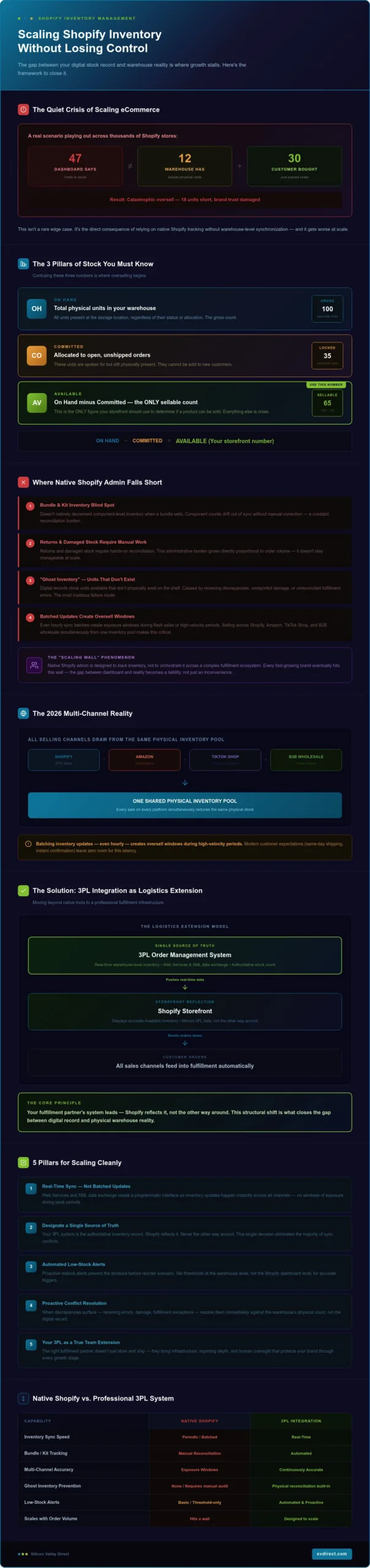
Your Shopify dashboard says you have 47 units in stock. Your warehouse team says you have 12. A customer just bought 30. This is the quiet crisis at the heart of scaling eCommerce, and it happens more often than most store owners want to admit. Shopify inventory management is genuinely powerful for tracking numbers, but numbers and physical reality are two very different things once your order volume starts climbing.

If you’ve wrestled with overselling during a flash sale, lost visibility into stock conditions after a busy quarter, or tangled yourself in the logistics of building promotional bundles, you already know the gap between a digital record and what’s actually sitting on a warehouse shelf. That gap is where growth stalls.

This guide is built to close it. You’ll learn exactly how to move beyond native Shopify tracking and into a professional third-party logistics setup that delivers real-time inventory accuracy, automated restock alerts, and a seamless connection between your storefront and your physical fulfillment operation. We’ll walk through the strategic steps, the integration mechanics, and the operational discipline that separates brands that scale cleanly from those that spend every peak season putting out fires.

Key Takeaways

  • Effective Shopify inventory management goes far beyond tracking numbers. It requires synchronizing digital stock records with physical warehouse reality across every sales channel, in real time.
  • Understanding the three pillars of stock (Available, Committed, and On Hand) is the foundation for eliminating overselling and making confident, data-backed fulfillment decisions at scale.
  • A professional 3PL integration connects your Shopify storefront to your warehouse through Web Services and XML data exchange, creating a seamless, automated flow of inventory information that native tools alone cannot deliver.
  • Designating your 3PL system as the single source of truth, paired with automated low-stock alerts and proactive conflict resolution, is the operational discipline that separates brands that scale cleanly from those that don’t.
  • The right fulfillment partner doesn’t just store and ship your products; they function as an extension of your team, bringing the infrastructure, reporting depth, and human oversight needed to protect your brand through every growth stage.

Understanding Shopify Inventory Management for Scaling Brands

At its core, Shopify inventory management is the digital synchronization of stock levels across every sales channel your brand operates. It’s the system that answers one deceptively simple question: how much of what do we actually have, right now, and where is it? For a single-channel store moving modest volume, native Shopify tools answer that question well enough. But the moment your brand starts scaling, that answer gets complicated fast.

Every inventory position in your operation can be understood through three distinct pillars:

  • On Hand: The total physical units present in your warehouse or storage location, regardless of their status.
  • Committed: Units already allocated to open orders that haven’t yet shipped. These are spoken for, but still physically present.
  • Available: The actionable number. On Hand minus Committed. This is the only figure your storefront should ever use to determine whether a product can be sold.

Misreading these three numbers, or conflating them, is where overselling begins. It’s also where the “Scaling Wall” appears. Native Shopify admin is designed to track inventory, not to orchestrate it across a complex fulfillment ecosystem. Once order volume climbs and your operations expand, the gap between what the dashboard shows and what’s physically on a warehouse shelf becomes a liability.

The Limitations of Native Shopify Admin

The native admin panel handles straightforward SKU tracking with reasonable accuracy, but it wasn’t built for operational complexity. Multi-component kits and promotional bundles are a persistent weak point; the system doesn’t natively decrement component-level inventory when a bundle sells, which means your component counts drift out of sync without manual correction. Returns and damaged stock require the same hands-on reconciliation, creating a continuous administrative burden that grows proportionally with your order volume.

The more insidious problem is what operators often call “ghost inventory,” a condition where your digital record shows available units that simply don’t exist on the physical shelf. This happens through receiving discrepancies, unreported damage, or fulfillment errors that never get reconciled. As a category, inventory management software exists precisely to close this gap, but native Shopify admin stops short of the real-time, warehouse-level reconciliation that growing brands require.

Why 2026 Demands Real-Time Integration

Selling across Shopify, Amazon, TikTok Shop, and B2B wholesale channels simultaneously means every single sale on any platform draws from the same physical pool of inventory. Batching inventory updates, even hourly, creates windows of exposure where overselling is essentially guaranteed during high-velocity periods. Modern customer expectations, shaped by same-day shipping norms and instant order confirmation, leave no room for that latency.

The solution isn’t a workaround. It’s a structural shift toward a programmatic interface between your Shopify storefront and your warehousing operation, one where a purpose-built system like a 3PL’s order management platform functions as the authoritative source of inventory truth. That’s the concept of a true Logistics Extension: your fulfillment partner’s system leads, and Shopify reflects it, not the other way around.

The Technology Behind Seamless Shopify-3PL Integration

Most conversations about Shopify inventory management stop at the app store. Install a connector, map your fields, hope for the best. That approach works until it doesn’t, and it tends to stop working precisely when you need it most: during a high-velocity sales period when data latency is measured in lost revenue. The more durable solution runs deeper, at the protocol level, where your storefront and your warehouse actually speak the same language.

Web Services make that conversation possible. Rather than relying on periodic file exports or fragile middleware that sits between two systems it doesn’t own, a Web Services integration creates a direct, programmatic handshake between your Shopify storefront and your fulfillment center’s order management platform. Orders flow in. Inventory updates flow back. No manual intervention. No batch windows. No silent failures that only surface when a customer emails asking where their package is.

For scaling merchants, this architecture isn’t a luxury. The inventory and financial management best practices outlined by the U.S. Small Business Administration consistently emphasize real-time data accuracy as a foundational requirement for sustainable growth, and a Web Services integration is the mechanism that delivers it at the operational level.

XML and SOAP: The Languages of Modern Logistics

XML (Extensible Markup Language) is the structural format that packages your inventory data for transit. Every SKU, quantity, order status, and receipt confirmation gets tagged, structured, and transmitted in a format that both systems can read without ambiguity. SOAP (Simple Object Access Protocol) is the secure delivery mechanism that carries those XML packages across networks with integrity intact.

Within this framework, two methods do the heaviest lifting:

  • AddOrder: Transmits new Shopify orders directly to the warehouse system in real time, triggering pick-and-pack workflows without human handoff.
  • GetOrderInfo: Pulls current order status, tracking data, and inventory positions back to Shopify on demand, keeping your storefront synchronized with physical reality.

WSDL (Web Service Description Language) completes the picture by providing a machine-readable map of the entire integration. Developers don’t need to reverse-engineer how the two systems communicate; the WSDL file documents every available method, parameter, and data type. That means faster onboarding, cleaner implementations, and fewer custom coding requirements every time something changes on either end.

Proprietary Systems vs. Generic Middleware

There’s a meaningful difference between a warehouse that built its own order management platform and one that licensed a generic connector app. A warehouse-owned system is designed around the physical operation it serves. The logic that governs inventory updates, receipt processing, and backorder management reflects actual warehouse workflows, not a generalized template built to serve dozens of industries simultaneously.

SVD’s Remote Control order management platform is a direct expression of that philosophy. With access to more than 120 standard reports, merchants get a 24/7 window into their fulfillment operation: real-time inventory receipts, backorder visibility, shipment confirmations, and exception flags, all consolidated in a single dashboard. That’s not a feature list. It’s the operational transparency that transforms a fulfillment center from a black box into a genuine extension of your team.

If you’re evaluating whether your current setup can support your next growth stage, connecting with a fulfillment specialist is a practical first step toward understanding what a purpose-built integration could look like for your specific SKU mix and order volume.

Native Shopify Tools vs. Professional 3PL Inventory Systems

Shopify’s built-in inventory tools are genuinely useful. ABC analysis helps you rank your SKUs by sales velocity. Low stock alerts fire when a threshold is crossed. Shopify Flow can trigger automated actions based on inventory events. For a lean operation with a simple product catalog, that’s a reasonable toolkit. But it’s a digital toolkit solving a physical problem, and that distinction matters more than most store owners realize until something breaks.

The gap shows up in three specific places: serial number tracking, bundle management, and quality control. Native Shopify inventory management doesn’t support serial-level traceability. If you’re selling electronics, medical devices, or any regulated product category where individual unit accountability matters, the admin panel can tell you how many units you have. It cannot tell you which specific units they are, where they’ve been, or whether a returned item matches the one originally shipped. A professional 3PL system tracks at the serial number level, creating an auditable chain of custody that Shopify Flow simply wasn’t designed to produce.

Low stock alerts are another area where the comparison turns stark. An alert is reactive. It tells you a problem exists after the inventory position has already deteriorated. Proactive conflict resolution, the methodology a purpose-built fulfillment system applies, identifies discrepancies between expected and physical stock before they cascade into customer-facing errors. That’s not a semantic difference. It’s the operational discipline that prevents a flash sale from becoming a fulfillment crisis.

Kitting, Assembly, and On-Demand Customization

Digital bundles in Shopify are a product configuration. Physical kitting is a warehouse operation. The distinction is significant. When a customer buys a promotional bundle, someone has to pull individual components, assemble them according to a specification, apply the right packaging, and insert the right collateral. None of that happens inside a dashboard. Kitting and assembly services handle this at scale, with component-level inventory decrements that keep your stock positions accurate across every SKU involved in the build.

Personalization adds another layer of complexity that native tools don’t touch. SVD’s print-on-demand capability, powered by HP Indigo digital printing technology, allows variable data to be applied at the order level. That means personalized inserts, customized packaging, and campaign-specific collateral can be produced and inserted during the kitting process itself, without a separate print run or a manual handoff between teams. Liquid ink digital printing at this level delivers the kind of per-order customization that turns a standard shipment into a branded experience.

Inventory Accuracy: Digital Logic vs. Physical Audits

Shopify adjusts inventory records when events are logged. A 3PL audits inventory by physically counting what’s on the shelf. Both matter. Only one catches the errors the other misses.

The “Quiet Facility” methodology is the operational philosophy behind physical accuracy. An organized warehouse, where every SKU has a designated location, every receiving process follows a consistent protocol, and every team member understands the system, generates fewer errors by design. Noise in a fulfillment operation isn’t just auditory. It’s the cumulative result of misplaced stock, inconsistent receiving practices, and ad hoc problem-solving. A quiet, structured facility eliminates the conditions that produce ghost inventory before reconciliation is ever needed.

This discipline extends to high-touch fulfillment scenarios like lead inquiry fulfillment, where marketing campaigns drive inbound requests for physical materials. Each response package requires accurate inventory of the collateral itself, precise assembly, and timely dispatch. That’s a workflow that demands systematic inventory controls, not a digital adjustment field. The human element of Shopify inventory management, the trained team member who catches the discrepancy before it ships, is the part that no automation layer has successfully replaced.

Shopify Inventory Management: The 2026 Strategic Guide to Scaling Fulfillment

Best Practices for Optimizing Your Shopify Stock in 2026

Knowing the right tools is only half the equation. How you operate them determines whether your inventory stays clean or quietly drifts into the kind of discrepancies that erode customer trust and compress margins. The brands that scale without constant firefighting share a common discipline: they’ve established deliberate operational practices around their data, not just the technology that generates it.

The most foundational of those practices is designating a single source of truth. When Shopify and your 3PL system each claim authority over stock counts, conflicts are inevitable. The resolution is clear: your fulfillment partner’s system holds master record status, and Shopify reflects it. Every inventory update, every receipt confirmation, every return reintegration flows from the warehouse outward to the storefront, never the reverse. That directional discipline is what keeps your available stock figures trustworthy at any order velocity.

Automated low-stock notifications are the operational complement to that foundation. An alert that fires when a SKU crosses a defined threshold gives your procurement team a window to act before the storefront is affected. The key distinction is configuring those thresholds intelligently, not as static numbers but as dynamic values tied to actual sales velocity. A SKU moving 50 units a week needs a meaningfully different reorder trigger than one moving five. SVD’s fulfillment services provide the real-time velocity data that makes that kind of dynamic threshold calibration possible, turning a reactive alert system into a genuinely proactive one.

Variable data and personalization add another layer of operational value that most brands leave untapped. When your kitting and fulfillment workflow supports per-order customization, promotional inserts, personalized packaging, and campaign-specific collateral become inventory assets in their own right. Managing those components with the same rigor applied to sellable product prevents the quiet waste that accumulates when marketing materials are over-ordered and never reconciled.

Streamlining the Reorder Process

Effective reordering isn’t just about speed; it’s about timing. Lead time analysis belongs inside your procurement model, not as an afterthought. When you know that a supplier requires 14 days and your current velocity will exhaust stock in 18, the reorder window is narrow but manageable. Compress that margin further and you’re back to emergency orders and expedited freight costs. Automated email alerts, triggered by your 3PL’s live inventory positions, give your team the lead time they need to act deliberately rather than reactively. That’s the difference between a procurement strategy and a procurement scramble.

Managing Returns and Product Obsolescence

Returns are a data source, not just a logistics problem. A structured returns management workflow that quickly grades, reintegrates, or quarantines stock keeps your available counts accurate and your warehouse storage efficient. FIFO (First In, First Out) logic prevents older stock from aging out behind newer receipts, which matters especially for products with shelf-life considerations or seasonal relevance. For brands distributing internationally, analyzing global shipping services through the lens of inventory positioning, not just shipping cost, can reveal opportunities to pre-position stock closer to demand clusters and reduce the exposure that slow-moving international inventory creates. Stale inventory audited through your shipping activity reports tells you exactly where that rationalization needs to happen first.

Effective Shopify inventory management at scale isn’t a dashboard setting. It’s a set of operational habits, reinforced by the right system architecture and the right fulfillment partner, applied consistently enough that accuracy becomes the default rather than the exception.

Elevating Your Brand with Silicon Valley Direct’s Integrated Solutions

Most fulfillment partners store your products and ship your orders. Silicon Valley Direct does something more deliberate: it thinks outside the box on your behalf. That phrase isn’t marketing language at SVD; it’s an operational philosophy that shapes how the team approaches every client relationship, from the initial integration design through the daily execution of complex, non-standard fulfillment projects that generic 3PLs simply decline to handle.

SVD’s partnership approach is anchored by Nine Promises that define what clients can expect: accuracy, responsiveness, transparency, flexibility, and a genuine commitment to functioning as an extension of your marketing and sales departments, not a separate vendor operating at arm’s length. When your storefront runs a campaign, your fulfillment operation should already know about it. When a SKU is trending, your warehouse team should be positioned to respond. That level of alignment is what separates a logistics partner from a logistics provider.

Geography matters here too. Operating out of Silicon Valley isn’t incidental. It places SVD inside the same innovation ecosystem that shapes how technology companies think about systems, data, and automation. That proximity to technological culture informs the proprietary Remote Control platform, the Web Services integration architecture, and the continuous refinement of processes that keep SVD’s capabilities ahead of where most fulfillment operations are comfortable operating.

Proactive Conflict Resolution and Quality Control

The difference between a reactive fulfillment partner and a proactive one shows up most clearly when something goes wrong. SVD’s methodology is built around catching discrepancies before they reach the customer, not after. Every order moves through a QC-Check process that verifies accuracy at the unit level: right product, right quantity, right packaging, right collateral. That physical verification layer is the part of Shopify inventory management that no software setting can replicate.

The “make-it-right” attitude that runs through SVD’s team culture means problems get surfaced and resolved internally rather than escalated to the client as emergencies. Combined with 24/7 access to real-time inventory data through the Remote Control platform, merchants have total transparency into their fulfillment operation at any hour. You don’t need to wait for a morning report to know your current stock positions. The data is always there, current and auditable, because the warehouse team that generated it takes that accountability seriously.

Long-tenured staff is part of what makes that consistency possible. Institutional knowledge, the kind that comes from years of handling the same product categories, the same seasonal surges, the same edge-case scenarios, doesn’t live in a training manual. It lives in the people who’ve solved those problems before.

Scalability Without the Hectic Atmosphere

High-volume deadlines don’t require a chaotic facility. They require an organized one. SVD’s quiet, structured warehouse environment is a deliberate operational choice, not a coincidence. When every SKU has a designated location, every receiving protocol is consistent, and every team member understands the system, throughput increases without accuracy suffering. That’s the environment that handles a flash sale surge without the fulfillment errors that typically follow one.

Flexibility is built into the same structure. Complex kitting builds, variable data printing, personalized campaign inserts, lead inquiry fulfillment: these aren’t exceptions that require special handling. They’re part of the standard capability set that SVD brings to non-cookie-cutter projects. Brands with sophisticated promotional strategies, product customization requirements, or multi-component assembly needs will find the infrastructure already in place, supported by a team that’s handled comparable complexity before.

For brands ready to move beyond patchwork Shopify inventory management and into a fulfillment setup built for sustained growth, the next step is straightforward. Partner with Silicon Valley Direct for Shopify fulfillment and discover what it looks like when your warehouse operates as a genuine extension of your team.

Turn Inventory Accuracy Into Your Competitive Advantage

Scaling a Shopify store without the right fulfillment infrastructure underneath it is a compounding risk, not just an operational inconvenience. The gap between what your dashboard shows and what’s physically on a shelf gets wider with every new channel, every new SKU, and every peak season you push through.

Effective Shopify inventory management comes down to three things: a single authoritative source of truth, a technical integration that eliminates data latency, and a fulfillment partner with the physical discipline to keep counts accurate when order velocity climbs. SVD’s proprietary Remote Control system delivers 120+ real-time reports, HP Indigo 5500 digital printing supports on-demand kitting customization, and a proactive methodology built since 1999 means discrepancies get caught before they reach your customers.

Your warehouse should work as hard as your storefront. When it does, growth stops being stressful and starts being straightforward.

Frequently Asked Questions About Shopify Inventory Management

How does Shopify inventory sync with a 3PL warehouse?

Shopify syncs with a 3PL warehouse through a Web Services integration that creates a direct, programmatic connection between your storefront and the warehouse’s order management system. When a customer places an order, it transmits to the warehouse automatically. The warehouse system then pushes inventory updates, shipment confirmations, and tracking data back to Shopify in real time, eliminating the batch-update windows where overselling typically occurs.

The quality of that sync depends entirely on the 3PL’s system architecture. A warehouse running a proprietary platform, like SVD’s Remote Control system, delivers tighter, more reliable data exchange than a generic middleware connector because the logic governing inventory updates is built around actual warehouse workflows rather than a generalized template.

Can I track serial numbers for my Shopify products through a 3PL?

Yes, but not through Shopify’s native admin, which tracks quantities rather than individual unit identities. Serial-level traceability requires your 3PL’s warehouse management system to capture and record unique identifiers at the point of receiving, picking, and shipping. This creates an auditable chain of custody for each specific unit, which matters considerably for electronics, regulated products, or any category where a return needs to be matched against the original shipment.

If serial number tracking is a requirement for your product category, confirm that your 3PL’s system supports it before integration. It’s a warehouse-level capability, not a Shopify setting, and not every fulfillment operation has it built into standard process.

What is the difference between “On Hand” and “Available” inventory in Shopify?

“On Hand” is the total physical unit count present at your warehouse location, regardless of order status. “Available” is the actionable figure: On Hand minus Committed units already allocated to open orders. Your storefront should only ever sell against the Available number, not On Hand, because Committed units are physically present but already spoken for.

Conflating these two figures is one of the most common causes of overselling in Shopify inventory management. A dashboard showing 80 units On Hand with 65 Committed means you have 15 units actually available to sell, not 80. Getting that distinction right, and keeping it current in real time, is foundational to accurate stock control at any order volume.

How do I manage kitting and bundles in Shopify inventory?

Shopify treats bundles as product configurations, but the physical assembly and component-level inventory decrements happen at the warehouse. When a bundle sells, each component SKU needs to be pulled, assembled, and decremented individually. Native Shopify admin doesn’t handle that automatically, which means component counts drift without a warehouse system managing the build logic.

A 3PL with dedicated kitting and assembly capabilities handles this operationally: pulling components per a defined specification, assembling to a quality standard, and recording accurate decrements across every SKU involved in the build. That physical execution is what keeps your inventory positions trustworthy across both bundled and individual product listings simultaneously.

Is it possible to integrate custom digital printing with my Shopify orders?

Yes. When your 3PL supports on-demand digital printing as part of the kitting workflow, variable data can be applied at the individual order level during fulfillment. That means personalized inserts, campaign-specific collateral, and customized packaging can be produced and inserted into the shipment without a separate print run or manual handoff between teams.

SVD’s print-on-demand capability, powered by HP Indigo digital printing technology, integrates directly into the kitting process. Each order triggers the appropriate print output, which gets assembled into the package before it ships. For brands running personalized campaigns or loyalty programs, this turns a standard fulfillment step into a branded customer experience without adding operational complexity on your end.

What reports are most important for Shopify inventory management?

The reports that matter most are real-time inventory position by SKU, inbound receipt confirmations, backorder visibility, and shipment confirmations with tracking data. Together, these four give you a complete picture of where stock is, what’s committed, what’s arriving, and what’s already left the building. Sales velocity reporting by SKU is equally important for calibrating reorder thresholds intelligently rather than setting static trigger points.

SVD’s Remote Control platform provides access to more than 120 standard reports covering these categories and more, available around the clock. That reporting depth is what transforms a fulfillment center from a black box into a transparent operational asset, giving your procurement and marketing teams the data they need to make confident decisions without waiting on a morning summary. Just as eCommerce stores benefit from this level of detail, vehicle retailers often utilize automotive inventory intelligence reports to manage their stock with the same degree of precision.

How does a 3PL handle Shopify returns and restocking?

A structured 3PL returns workflow receives the item, grades its condition, and routes it accordingly: back to available inventory if it’s resalable, to a quarantine area if it’s damaged, or to disposal if it meets that threshold. That grading step is what keeps your available stock count accurate. A return that gets physically received but not properly processed creates phantom inventory, units that appear available but aren’t in sellable condition.

Timely reintegration matters as much as accuracy. Stock that sits in a returns queue for days before being processed represents both a reporting gap and a lost selling opportunity. The right 3PL treats returns processing as a first-class workflow, not an afterthought, applying the same systematic discipline to inbound returns as to outbound shipments.

What technical protocols are used to connect Shopify to a fulfillment system?

The standard protocols are XML for data structuring and SOAP for secure transmission. XML packages each data element, SKU, quantity, order ID, status, into a tagged format both systems can read without ambiguity. SOAP carries those packages across networks with integrity intact. WSDL files document the full integration map, so developers understand every available method and parameter without reverse-engineering the connection.

Within that framework, two methods do the core work: AddOrder transmits new Shopify orders to the warehouse in real time, and GetOrderInfo pulls current inventory positions and shipment status back to Shopify on demand. This architecture is what makes a professional Shopify inventory management integration meaningfully different from a connector app that relies on periodic syncs and fragile middleware.

The Strategic Guide to 3PL Integration for eCommerce in 2026

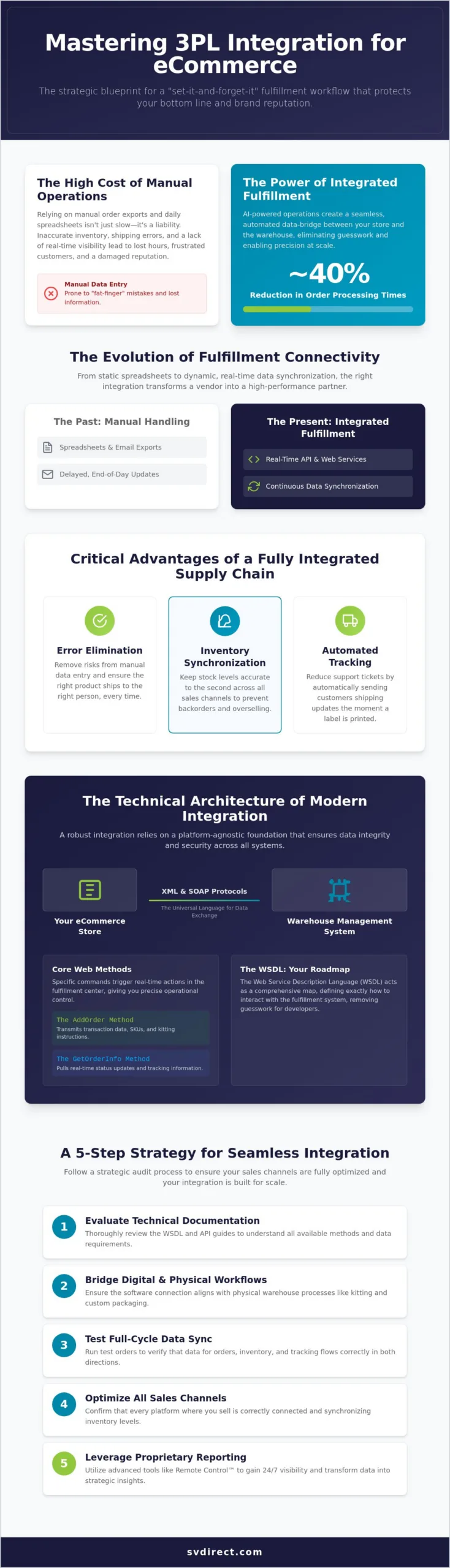
Did you know that AI-powered operations can now reduce order processing times by nearly 40%, yet many brands still lose hours every day to manual data entry? With the 2026 removal of Section 321 de minimis exemptions and new standardized import surcharges, the margin for operational error has effectively vanished. A sophisticated 3pl integration for ecommerce is no longer just a technical checkbox; it’s a strategic necessity to protect your bottom line and your brand’s reputation.

It’s exhausting to manage inaccurate inventory levels that lead to backorders or to feel blind when customers ask for real-time shipping updates. You deserve a fulfillment partner that acts as a steady, reliable extension of your own team rather than a distant vendor. This guide provides the blueprint to master the technical and operational frameworks of integration, moving you toward a “set-it-and-forget-it” workflow. We’ll examine how leveraging proprietary systems and real-time data transparency can transform your logistics into a high-performance engine capable of handling any sales spike with precision.

Key Takeaways

  • Understand how XML and SOAP protocols facilitate a platform-agnostic connection for seamless data synchronization across any operating system.
  • Learn why a successful 3pl integration for ecommerce must bridge the gap between digital software connections and physical warehouse workflows.
  • Follow a strategic five-step audit process to evaluate technical documentation and ensure your sales channels are fully optimized.
  • Discover how to leverage proprietary reporting tools like Remote Control™ to gain 24/7 visibility and transform your supply chain into a transparent extension of your brand.

What is 3PL Integration for eCommerce?

At its core, 3pl integration for ecommerce is the automated synchronization of data between an online store and its fulfillment partner. It serves as a strategic data-bridge between sales and operations, ensuring that every customer click translates into a physical action in the warehouse without human intervention. While the concept of Third-party logistics (3PL) has existed for decades, the integration layer is what transforms a simple vendor relationship into a high-performance partnership.

As we move through 2026, the industry is witnessing a total departure from “Manual Handling” in favor of “Integrated Fulfillment.” Relying on manual order exports or daily spreadsheets isn’t just slow; it’s a liability. With the removal of Section 321 de minimis exemptions increasing shipping complexity, brands need a system that handles data with the same precision used in our eCommerce order fulfillment facility. This digital backbone is what allows a brand to scale during high-volume spikes without sacrificing customer trust.

The Evolution of Fulfillment Connectivity

Key Benefits of a Fully Integrated Supply Chain

The primary value of a deep 3pl integration for ecommerce is the peace of mind that comes from operational transparency. When your systems talk to each other, you gain several critical advantages:

  • Elimination of errors: You remove the risk of “fat-finger” mistakes or lost emails that lead to shipping the wrong product to the wrong person.
  • Inventory synchronization: Real-time updates across all sales channels prevent the dreaded backorder scenario, keeping your stock levels accurate to the second.
  • Automated tracking: Customers receive shipping confirmations and tracking numbers the moment a label is printed, which drastically reduces customer support inquiries.

By automating these touchpoints, your team can stop acting as data entry clerks and start focusing on brand strategy. It’s about creating a workflow that feels like a seamless extension of your company, backed by the physical infrastructure and technical expertise needed to execute perfectly every time.

The Technical Architecture of Modern 3PL Integration

While many guides focus on the simplicity of one-click plugins, a truly robust 3pl integration for ecommerce relies on a deeper technical foundation. High-volume brands require more than a basic connection; they need a sophisticated architecture that ensures data integrity across disparate systems. This is achieved through the use of XML and SOAP (Simple Object Access Protocol) web services. These protocols provide a structured, platform-agnostic language that allows your online store to communicate with our warehouse management system regardless of the operating system or coding language your site uses.

For developers, the efficiency of this architecture is anchored by the Web Service Description Language (WSDL). This acts as a comprehensive roadmap, defining exactly how to interact with the fulfillment system. By utilizing these standardized protocols, we remove the guesswork from the development phase. It creates a stable, predictable environment where data flows are secure and verifiable. If you are ready to see how these technical frameworks can support your specific business model, you can consult with our integration specialists to discuss a tailored approach.

Core Web Methods for eCommerce Success

The heartbeat of a technical integration consists of specific “methods” or commands that trigger actions within the fulfillment center. Understanding these core functions is essential for maintaining operational control:

  • The AddOrder Method: This is the primary gateway for submitting transactions. It doesn’t just send a shipping address; it transmits complex SKU data, specific kitting instructions, and shipping carrier preferences directly into our production queue.
  • The GetOrderInfo Method: This method allows your system to pull real-time updates. It retrieves current order status, specific line-item details, and tracking information, ensuring your customer dashboard is always accurate.
  • The GetShippingActivity Method: Vital for financial transparency, this method manages freight charges and provides a summary of all shipping activity within a defined timeframe.

Data Tagging and Standardized Protocols

XML remains the gold standard for secure data exchange because it is both machine-readable and human-readable. This transparency allows for faster troubleshooting and more precise data tagging. To facilitate the discovery of these services, we utilize UDDI (Universal Description, Discovery, and Integration), which acts as a directory for listing available web services. This structured approach is further supported by manual system testing pages and GUI interfaces. These tools allow your technical team to test connections and verify data packets in a controlled environment before going live, ensuring that the final 3pl integration for ecommerce is flawless from day one.

Software vs. Operational Integration: Bridging the Gap

While the technical protocols discussed earlier provide the digital handshake, they only represent half of the success equation. A deep 3pl integration for ecommerce must extend beyond the server and onto the warehouse floor. Operational integration ensures that your specific brand standards are mirrored in every physical workflow, from the way a box is taped to how items are positioned inside. This alignment turns a standard fulfillment center into a true extension of your business rather than just a remote storage site.

Our “Quiet Facility” methodology is a testament to this philosophy. We believe that an organized, calm physical environment is the only way to maintain the digital accuracy your software expects. When physical spaces are meticulously managed, the data reflected in your systems remains untainted. Our team identifies and resolves inventory discrepancies or shipping conflicts before they ever reach the loading dock. This proactive stance ensures that the high-tech efficiency of your front-end store is never undermined by back-end chaos.

Integrating Specialized Services: Print and Kitting

Modern commerce often requires more than just picking a product off a shelf. By integrating on-demand digital printing directly into the fulfillment flow, we allow brands to personalize shipments at the moment of order. Using HP Indigo technology, we utilize Variable Data Printing (VDP) to include unique copy or customized inserts for every recipient. This level of customization is integrated into the automated workflow, making the “Unboxing Experience” a scalable reality rather than a manual burden. Custom kitting and assembly are treated with the same technical rigor, ensuring that promotional bundles are built with precision and speed.

The QC-Check: Human Oversight in an Automated World

Automation is powerful, but it lacks the nuanced judgment required for complex kitting or high-stakes promotional launches. Systematic human inspection remains a critical component of our quality control process. Even during high-volume deadline spikes, every kit undergoes a rigorous QC-check to verify that the physical output matches the digital order perfectly. This blend of high-tech speed and human oversight is what maintains customer trust. You can learn more about our kitting and assembly services and how they bridge the gap between automated data and physical perfection.

The Strategic Guide to 3PL Integration for eCommerce in 2026

5 Steps to a Seamless 3PL Integration Strategy

Implementing a robust 3pl integration for ecommerce requires more than just a digital handshake. It demands a structured transition from your current manual processes to a fully synchronized operation. While the technical protocols like XML and SOAP provide the foundation, your strategy must account for the unique operational nuances of your brand. Following a methodical implementation plan ensures that your data remains clean and your fulfillment stays fast as you scale.

  • Step 1: Audit your current sales channels and data requirements. Identify every point where an order is generated. You must determine which data fields, such as custom gift messages or specific kitting instructions, are mandatory for successful fulfillment.
  • Step 2: Evaluate the 3PL’s technical documentation and developer resources. A transparent partner provides clear technical documentation upfront. Reviewing the WSDL (Web Service Description Language) allows your developers to understand the system architecture before writing a single line of code.
  • Step 3: Define custom workflows for kitting, assembly, and specialized printing. Automation shouldn’t limit your creativity. Define how specialized tasks, such as variable data printing or healthcare mailing services, are triggered within the integration flow.
  • Step 4: Establish real-time reporting triggers and low-inventory alerts. Use systems that offer proactive notifications. By setting up automated triggers for low stock or shipping delays, you can manage customer expectations before a problem arises.
  • Step 5: Conduct end-to-end testing using a programmatic interface. Never go live without a sandbox phase. Submit test orders through the interface and track them through the entire warehouse lifecycle to verify that every data packet is received and processed correctly.

Evaluating Technical Compatibility

When you speak with a 3PL’s IT team, ask whether they use proprietary systems or third-party software. Our in-house systems are designed for total flexibility, allowing us to adapt to your specific business logic rather than forcing you into a generic template. You need 24/7 access to your order history and inventory levels to make informed decisions. You can explore our Remote Order Management system to see how we provide this level of deep technical visibility.

Setting Up Automated Notifications

Real-time visibility is a powerful asset for your marketing and sales departments. When your team knows exactly when inventory is received or when a backorder is cleared, they can adjust campaigns with confidence. Configuring automated email alerts ensures that your staff stays informed without needing to manually pull reports. This transparency is a hallmark of a true partnership. You can read what our clients say about real-time visibility and how it has transformed their daily operations.

The Silicon Valley Direct Approach: Technology Meets Partnership

Choosing a partner for your 3pl integration for ecommerce is about more than just checking technical boxes; it’s about finding a steady hand that treats your business as its own. We position ourselves as an extension of your company, providing the high-tech infrastructure of Silicon Valley with a human-centric commitment to service. Since 1999, we’ve remained at the cutting edge of logistics innovation while maintaining the personal oversight that pure automation lacks. Our “Nine Promises” serve as the foundation of this partnership, guaranteeing the transparency and bespoke problem-solving your brand requires to thrive in a fast-paced market.

True operational control is only possible when you have access to meaningful data. Our proprietary Remote Control™ system puts over 120 standard reports at your fingertips, offering 24/7 visibility into every corner of your supply chain. This isn’t just a dashboard; it’s a window into our facility that allows you to manage inventory, track orders, and analyze trends in real-time. By combining this digital transparency with our geographic advantage as a hub of global connectivity, we ensure your logistics remain as agile as your marketing strategy.

High-Resolution Fulfillment: The HP Indigo Advantage

Brand perception is often defined by the physical touchpoints of a shipment. We utilize the HP Indigo 5500 Digital Press to deliver high-resolution variable data printing with a 230 line screen resolution. This ensures your brand collateral, literature, and personalized inserts look professional and sharp. The “dry-to-touch” nature of this technology allows for immediate kitting and fulfillment, accelerating your speed to market. We also prioritize sustainability by using a digital process that eliminates the need for plates, films, and harsh chemicals, aligning your fulfillment with modern environmental standards.

Scalability Without the Hectic Atmosphere

A high-performance facility doesn’t have to be a chaotic one. Our methodical approach allows us to handle 3,000+ shipments a week with the same precision and calm we apply to smaller, boutique runs. We’ve found that a quiet, organized workspace is the best environment for maintaining the accuracy required for complex 3pl integration for ecommerce. Whether you are in the technology, healthcare, or consumer goods sector, our facility is designed to scale with your growth spikes without losing the human touch. You can discover our specialized industry solutions to see how we tailor our infrastructure to meet the unique demands of your specific market.

Future-Proof Your Fulfillment Ecosystem

Mastering a 3pl integration for ecommerce is the difference between a reactive supply chain and a proactive growth engine. By aligning technical protocols like XML and SOAP with precise operational standards, you create a workflow that is both scalable and reliable. We’ve spent over 25 years in Silicon Valley refining this balance. This ensures that your digital data always matches the physical truth on our warehouse floor.

Our proprietary Remote Control™ system provides the transparency you need to lead with confidence, offering 120+ standard reports that keep you in command 24/7. When you combine this visibility with our high-resolution digital printing and meticulous kitting services, your brand becomes a seamless experience for every customer. You don’t have to manage the complexities of 2026 logistics alone.

We’re ready to help you transform your operations into a high-performance partnership that scales with your ambition.

Frequently Asked Questions

What is the difference between an API and Web Services for 3PL integration?

Web Services are a specific type of API that utilize standardized network protocols like XML and SOAP to communicate over the internet. While “API” is a broad term for any interface that allows software to interact, our web services provide a more structured, platform-agnostic bridge. This architecture is essential for maintaining secure, readable data exchange between your online store and our warehouse management system.

Do I need a developer to integrate my eCommerce store with a 3PL?

You typically need a developer or a technical lead to manage a sophisticated 3pl integration for ecommerce, especially when your business requires custom logic. While basic plugins exist for simple storefronts, our proprietary XML and SOAP interfaces require a professional to map your specific data fields to our system. We provide comprehensive documentation and WSDL files to make this process efficient for your technical team.

Can I integrate my custom kitting requirements into the automated fulfillment process?

Yes, you can integrate complex kitting and assembly requirements directly into the automated fulfillment flow. By defining specific SKU combinations or assembly triggers within your data packets, our system automatically alerts the warehouse floor to perform these specialized tasks. This ensures that every promotional bundle or custom kit is built with precision the moment the order is received, maintaining your brand standards at scale.

How does 3PL integration improve my inventory accuracy?

Integration improves inventory accuracy by eliminating the need for manual data entry and providing real-time synchronization across all your sales channels. When an order is placed, stock levels are instantly adjusted in our warehouse management system and pushed back to your storefront. This closed-loop communication prevents overselling and backorders, ensuring your digital storefront always reflects the physical reality of the inventory in our facility.

Is variable data printing more expensive to integrate into my shipments?

Integrating variable data printing (VDP) into your shipments is primarily a matter of data mapping rather than increased technical complexity. By including a “personalized copy” field in your order transmission, our HP Indigo digital presses can automatically pull that data to create unique inserts or brand collateral. This process is highly efficient because it is built directly into the standard fulfillment workflow, allowing for rapid, “dry-to-touch” production.

What happens if my eCommerce platform is not a standard one like Shopify?

Our system is platform-agnostic, meaning we can integrate with custom-built eCommerce sites or niche platforms just as easily as standard ones. For example, jewelry and diamond brands utilizing Valigara can connect their specialized management software with our fulfillment systems. Because we utilize XML and SOAP web services, the specific operating system or coding language of your site does not matter, allowing us to establish a seamless 3pl integration for ecommerce that fits your unique infrastructure.

How often is inventory data updated in a fully integrated 3PL system?

Inventory data is updated in real-time as transactions occur within the warehouse. Every time an item is picked, packed, or received, the change is reflected immediately in our proprietary system. You can monitor these levels 24/7 through our Remote Control interface, which provides access to over 120 standard reports. This constant stream of data ensures that your marketing and sales teams always have the most accurate information possible.

Can I track international shipments through the 3PL integration?

Yes, our integration supports full tracking for international shipments through our global shipping and logistics network. Once a shipping label is generated, the tracking number is automatically pushed back to your system via the GetOrderInfo or GetShippingActivity methods. This allows your customers to monitor their packages from our Silicon Valley facility to their doorstep, regardless of their location, providing a transparent and reassuring delivery experience.