



Kitting Fulfillment for Subscription Boxes: 3PL Buying Guide
A subscription box is only as dependable as the assembly process behind each shipment. When products, inserts, or packaging change from cycle to cycle, a small packing error can disrupt the experience subscribers look forward to. Kitting fulfillment for subscription boxes brings repeatable assembly, accurate orders, and shipping coordination together.
If you’re evaluating a 3PL, look beyond a general promise to pack and ship recurring orders. Assess how the operation coordinates inventory, handles changing box contents, checks each kit, and communicates order status and exceptions. A clear workflow can adapt as your volume and assortment evolve.
This guide explains what to assess before choosing a 3PL, from assembly planning and quality control to inventory visibility and shipping coordination. It also covers how warehousing, kitting, fulfillment, and shipping management support a consistent subscriber experience. Silicon Valley Direct provides kitting and hand assembly with systematic QC-Check inspections, bringing a defined quality-control step to each build.
Key Takeaways
- Understand how kitting differs from recurring order fulfillment, and why curated boxes need a defined component list.
- Use a bill of materials to specify the products, inserts, and packaging required for each box version.
- Compare in-house, pre-assembled, and 3PL-managed kitting by ownership, visibility, quality control, and flexibility.
- Prepare clear assembly instructions, box variants, product data, and release dates to support a smoother fulfillment cycle.
- Evaluate kitting fulfillment for subscription boxes as part of a connected workflow that includes warehousing, assembly inspections, and shipping.
What Kitting Fulfillment for Subscription Boxes Actually Involves
Kitting fulfillment for subscription boxes combines two related tasks: assembling specified components into a complete box, then preparing that finished kit for dispatch. The components might include several products, a printed insert, and protective or branded packaging. The exact contents depend on the box plan. Kitting is the assembly step; fulfillment connects the finished kit to an order and shipment.
Recurring orders don’t necessarily mean recurring box contents. A subscription may repeat the same configuration, introduce a new assortment each cycle, or use different versions for different subscribers. In every case, assembly instructions need to match the intended box. A process that treats every order as a simple pick-and-pack task may overlook the work required to bring all components together as one curated shipment.
How subscription box kitting differs from ordinary pick and pack
Ordinary pick and pack generally means selecting ordered items and packing them for shipment. A curated subscription box adds a build requirement: multiple specified components must be combined in the right configuration, with inserts and packaging included where needed. The finished box should match its planned version, not just contain a collection of individually selected products.
Recurring cycles add another layer of control. Teams need to work to a release schedule and repeat the assembly process consistently, even when the contents change between cycles. Some programs may also have multiple box variants at the same time. Clear product and version details help distinguish those builds without assuming every subscriber receives the same selection. This is part of the wider coordination described by Supply Chain Management Principles, where materials, information, and movement need to align.
How the work is managed depends on the operation. In-house assembly puts responsibility for staffing, workspace, instructions, component readiness, and packing oversight on the brand. A managed 3PL workflow can bring kitting together with warehousing and order fulfillment, integrating day-to-day assembly coordination into a broader operation. Neither approach suits every program. The practical choice depends on the team’s capacity, the complexity of the box, and how much operational control it wants to retain.
Where recurring box operations can become difficult
A missing component or ambiguous instruction can interrupt a build or leave a box incomplete. “Include the sample” may not be enough direction if several samples are in stock or different versions are planned. Instructions should identify the intended item and box configuration so the assembly team doesn’t have to guess.
Timing can put additional pressure on the process. If products arrive later than planned, there may be less time to stage components, assemble boxes, inspect the builds, and prepare shipments for the scheduled release. Without a defined workflow, teams may have to reshuffle work at the last minute. As recurring orders grow, informal handoffs and memory-based checks become harder to sustain. A managed approach can coordinate storage and assembly responsibilities, while an in-house team may prefer to keep those controls close. Either way, clear instructions and realistic release planning help protect the intended subscriber experience.
How a 3PL Coordinates Subscription Box Kitting from Inventory to Dispatch
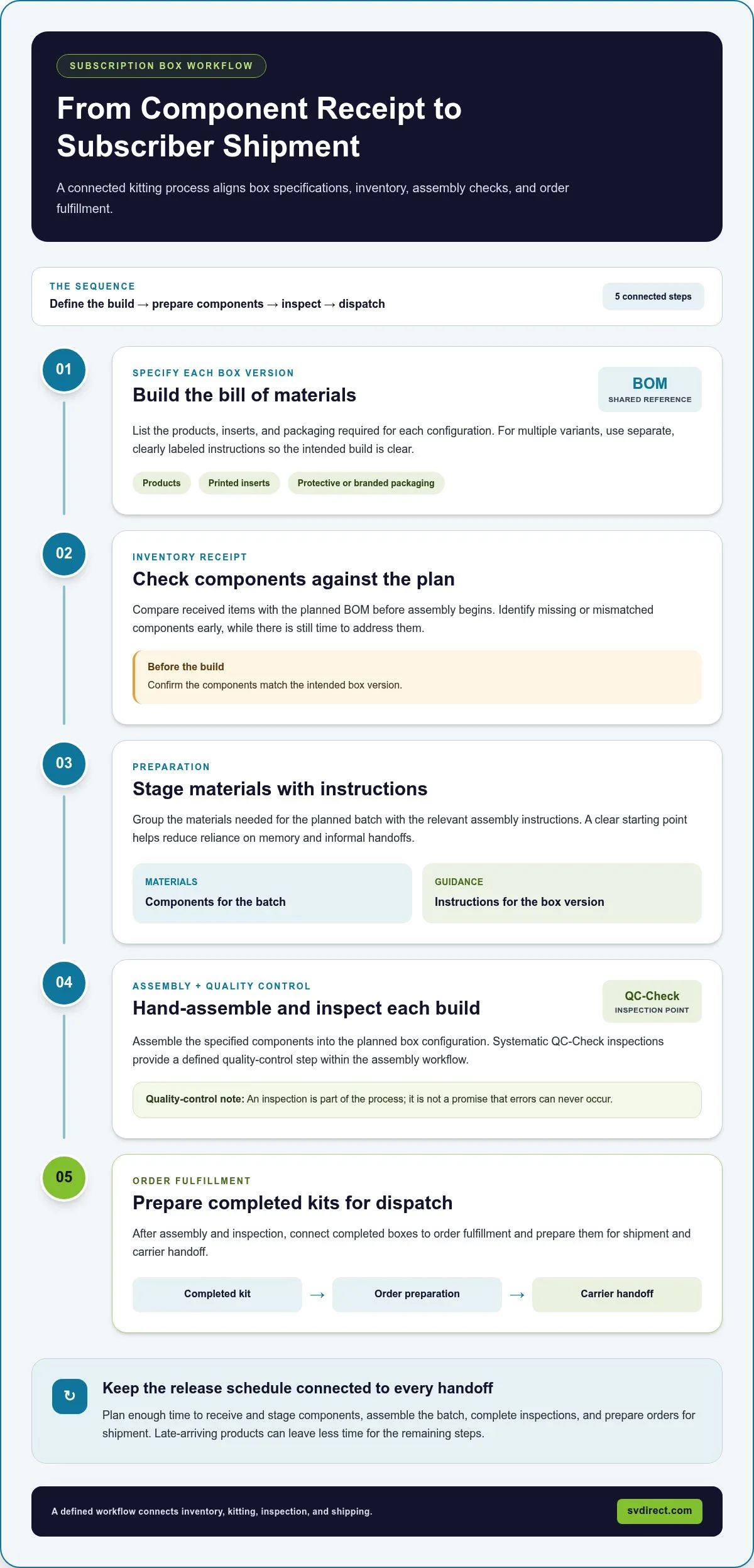
A dependable kitting workflow connects incoming inventory to a defined box build, then connects completed kits to order fulfillment and shipment. Each handoff matters. When product details, assembly instructions, and release timing stay aligned, the team can prepare a recurring batch with a clearer view of what’s ready and what still needs attention.
A bill of materials (BOM) is the working specification for each box version. It identifies the products, inserts, and packaging required so the assembly team has a shared reference. If one cycle includes a sample, a printed card, and protective packaging, the BOM should list those components for that version. For a program with multiple variants, separate, clearly labeled instructions help prevent one configuration from being used for another.
From received components to an approved box build
The workflow starts with inventory receipt. The received components can be compared with the planned BOM to identify missing or mismatched items before assembly begins. Once the components are available, staging groups the materials needed for the planned batch with the relevant instructions. This gives the team a clear starting point and reduces reliance on memory or informal handoffs.
During hand assembly, systematic QC-Check inspections provide a defined quality-control point. The inspection is part of the assembly workflow, not a promise that errors can never occur. When assessing kitting and assembly services, look at how inventory, assembly, inspection, and fulfillment connect rather than treating each as an isolated task. The National Institute of Standards and Technology’s supply chain guidance offers broader context on coordinating supply chain operations.
From completed kits to recurring shipments
After assembly and inspection, completed boxes move into order fulfillment for preparation and shipment. The release schedule should allow time to receive and stage components, assemble the batch, complete inspections, and prepare orders for carrier handoff. If the planned dispatch date arrives before the build is ready, coordinating the cycle becomes more difficult.
Printed inserts also belong in the component plan. Their content and version should match the intended box, particularly when a cycle includes different configurations. On-demand digital printing can support short-run and variable-data printed materials, including personalized pieces, when inserts are part of the box experience.
A 3PL-managed workflow can connect warehousing, inventory coordination, hand assembly, and eCommerce fulfillment within one operation. For subscription programs, this approach helps teams plan each cycle around its components and release date. Brands can outline their subscription box fulfillment needs as they map out a recurring workflow.
How to Compare Subscription Box Kitting and Fulfillment Options
The right operating model depends on what’s in the box, how often it ships, and how much assembly work your team can manage alongside its other responsibilities. Compare the options against the same operational needs rather than assuming outsourcing or in-house assembly is automatically better. For kitting fulfillment for subscription boxes, focus on who owns each handoff and how the process handles changes, exceptions, and recurring deadlines.
| Model | Operational ownership | Visibility and quality control | Flexibility and coordination |
|---|---|---|---|
| In-house assembly | Your team manages component readiness, staffing, assembly, and packing. | Oversight stays internal; visibility depends on your inventory and order processes. | Direct control can help with changing builds, but your team coordinates each cycle. |
| Pre-assembled kits | Your team or an assembly operation builds kits ahead of order release. | Kit readiness and remaining inventory need to be tracked alongside orders. | Can simplify fulfillment for stable box contents; changes may require new versions or rework. |
| 3PL-managed assembly | The 3PL manages assembly as part of an agreed fulfillment workflow. | Visibility and inspection processes depend on the operating setup and communication practices. | Can connect warehousing, assembly, and shipping; instructions and changes still need coordination. |
Which fulfillment model fits your subscription operation?
In-house assembly may suit a team with available staff, space, and the capacity to oversee each build. It can also make sense when the brand wants close control over presentation. Pre-assembly may reduce the work required at order release when box contents remain consistent and finished kits can be managed as inventory. If contents or subscriber variants change often, the operation needs a clear way to distinguish versions and match kits to the right orders.
A 3PL-managed model is worth considering when assembly competes with other priorities or when storage, kitting, and shipping need to work as one process. The decision turns on your product mix, assembly complexity, recurring schedule, and internal capacity. Before choosing, map who owns each task: receiving components, maintaining instructions, assembling kits, inspecting builds, and preparing orders for dispatch.
What to assess in a 3PL’s operating approach
Look for a practical operating conversation, not just a general promise to fulfill orders. Discuss how inventory information, assembly instructions, box versions, and recurring order data are coordinated. Understand how inspections fit into assembly and how exceptions, such as a missing component or changed instruction, are communicated. Clear ownership helps your team know what happens when the plan needs to change.
Also assess whether warehousing, assembly, and shipping can be coordinated through a connected workflow. This can reduce the number of handoffs your team manages, but it still depends on accurate product information and timely communication. Match the model to the work you need done, the visibility your team requires, and the oversight you want to retain.
How to Prepare Your Subscription Box Program for a Smooth Fulfillment Cycle
A smooth recurring cycle starts before assembly. Give everyone involved a consistent set of product details, box specifications, instructions, and dates. This preparation turns kitting fulfillment for subscription boxes into a planned workflow rather than a series of last-minute decisions. Use the checklist below to clarify responsibilities and inputs before the next release.
Prepare inventory, box specifications, and printed materials
Build a current reference for every box version. Use consistent product names and identifiers so inventory records, order data, and assembly instructions refer to the same components. Record required quantities, packaging, and insert details for each version, then align expected inventory arrival with the planned build and release schedule. Version control matters: if an insert or product changes, update the instructions for the relevant box rather than relying on memory or an outdated file.
- Components: List each product and required quantity for every box version.
- Variants: Give each configuration a clear identifier and connect it to the intended orders.
- Packaging: Specify the box and any protective or presentation materials needed.
- Printed pieces: Identify the insert, its approved version, and which box configuration receives it.
- Timing: Set component arrival, assembly, and release dates so the cycle can be planned as a whole.
Before the cycle begins, compare planned requirements with available inventory and expected receipts. If a printed piece changes, update its version and the related assembly instructions together. This helps prevent a correct item from being paired with outdated messaging or the wrong box build.
Set instructions and exception communication before launch
Document the approved assembly sequence in plain, unambiguous language. Explain how to identify each variant and which instructions apply to it. Agree on how the teams handling inventory and assembly will share discrepancies or schedule conflicts, including who needs to know and what information to provide. A defined communication path helps people respond to changes without relying on assumptions.
- What should happen if a component is delayed, short, or damaged?
- Who decides whether to hold the affected build, use an approved alternative, or revise the release plan?
- How will an approved change be recorded so every team works from the current version?
- How will a schedule conflict be raised early enough to plan the next step?
Resolve these questions before launch, not while boxes are being assembled. Keep current product data, versioned instructions, and exception decisions together in the working plan. That gives your team and fulfillment partner a shared reference as the program changes from one cycle to the next.
How Silicon Valley Direct Connects Subscription Box Kitting with Fulfillment
Subscription box assembly works best as part of a broader operating plan. Silicon Valley Direct provides kitting and hand assembly alongside warehousing, eCommerce fulfillment, shipping management, and digital printing. This connected service mix gives brands a way to coordinate box components, order processing, and shipment preparation within one fulfillment relationship.
Assembly includes systematic QC-Check inspections as part of the build process. This is one part of the workflow, alongside organized inventory and clear assembly instructions. For a recurring program, details matter: each cycle may involve different products, packaging, inserts, or order requirements. A consistent operating plan helps the teams handling those details work from the same specifications.
Connect assembly, order data, and shipping
Silicon Valley Direct’s eCommerce fulfillment services connect warehousing and order fulfillment with shipping management. In a subscription workflow, inventory can be stored for planned assembly, kits prepared for fulfillment, and orders processed for shipment. This joined-up approach helps coordinate the physical work with the order information that directs each cycle.
Silicon Valley Direct’s eCommerce integrations include more than 80 platforms, including Shopify, WooCommerce, Amazon, eBay, and Walmart. Integrations can connect store or marketplace order data to fulfillment operations, while accurate product and box-version information remains essential for assembly. Silicon Valley Direct also supports domestic and international shipping, giving brands shipping options as their customer requirements vary.
Printed materials can be part of the same plan. On-demand digital printing supports short-run and variable-data work, including personalized printed pieces. That can help coordinate an insert with the box contents and cycle, rather than treating print as a separate afterthought. Silicon Valley Direct’s Remote Control system provides 24/7 access to place orders, track progress, retrieve order histories, check real-time inventory, and generate standard reports.
Build a subscription fulfillment plan around your requirements
A useful fulfillment plan starts with the particulars of your program. Share what goes into each box, how often orders release, which packaging and inserts are involved, and where shipments need to go. If box contents vary, explain how versions are identified and updates communicated. These details help shape a workflow around the real assembly and fulfillment requirements, rather than a generic template.
Silicon Valley Direct takes a custom-fit, partnership-oriented approach to kitting and fulfillment. The goal is to align warehousing, assembly, order processing, and shipping with your subscription program as it changes, while keeping communication and process details clear. For a new program or a recurring cycle that needs refinement, a clear outline of requirements is a practical starting point for planning fulfillment.
Set Up Your Next Subscription Box Cycle with Confidence
Your next box cycle is an opportunity to turn subscriber expectations into a practical operating plan. Decide which parts of the experience must stay consistent, where contents may change, and how your team will handle updates before the release date. Those decisions give your fulfillment partner a clearer picture of the work and help keep the box experience intentional as your program evolves.
Use your requirements to shape a partnership that can adapt to your assortment and order patterns. A focused conversation about kitting fulfillment for subscription boxes can connect your goals with an appropriate assembly and fulfillment workflow, while keeping the subscriber experience at the center.
Bring your box plans, schedule, and priorities into the next planning step. Silicon Valley Direct provides kitting, hand assembly, warehousing, eCommerce fulfillment, and shipping management to help coordinate recurring subscription box operations.
Frequently Asked Questions
How much does kitting fulfillment for subscription boxes cost?
There isn’t one standard price for kitting fulfillment for subscription boxes. A quote depends on the work involved, including the number and type of components, box variations, assembly requirements, packaging, storage, order fulfillment, and shipping needs. Printed inserts or other project-specific requirements can also affect the scope. Share your box specifications and expected order pattern to receive a quote tailored to your program, rather than relying on a general industry estimate.
Can a 3PL support skipped or paused subscription orders?
A fulfillment workflow can account for skipped or paused orders when order data and release instructions clearly identify them. For example, if a subscriber pauses before a cycle’s orders are released, that status needs to be reflected before the box is assigned for fulfillment. Agree on how updates are submitted, when order details become final, and how changes are communicated so paused orders aren’t treated like active shipments.
What happens if a subscription box component arrives late?
A late component can affect the planned assembly and dispatch schedule, so the team should flag the delay and identify which box builds depend on it. Then decide how to handle the affected orders: hold those builds, adjust the release plan, or use an approved substitute if your program allows one. Record the decision and share the revised instructions with everyone working on the cycle. Don’t let an informal workaround create mismatched box versions.
How early should subscription box inventory arrive before assembly?
There isn’t a universal arrival window. Work backward from the planned dispatch date, allowing time for suppliers to deliver, inventory to be received and reconciled, components to be staged, and boxes to be assembled and inspected. Include planning room for items with uncertain arrival dates or printed materials that need separate production. Set a clear cutoff for component readiness and identify how late arrivals affect the release plan.
Can a subscription box fulfillment program include international shipments?
Yes. Silicon Valley Direct manages domestic and international shipping, so a subscription program can include shipments to destinations outside the United States. Share the expected destination mix, parcel dimensions and weight, and any differences in box configuration early in planning. This helps align the fulfillment workflow with the shipment profile and provides the details needed to coordinate dispatch. Keep destination information current as subscriber orders change between cycles.
What information should I prepare before requesting a subscription box fulfillment quote?
Prepare a sample box specification with each component, quantity, packaging requirement, insert, and variant clearly identified. Include your expected order volume and release schedule, where orders ship, how orders reach fulfillment, and any known exceptions, such as late-arriving items or subscriber-specific versions. If you have assembly instructions or product data, organize the current versions together. A clear project brief helps Silicon Valley Direct understand the workflow and scope your subscription fulfillment needs.