


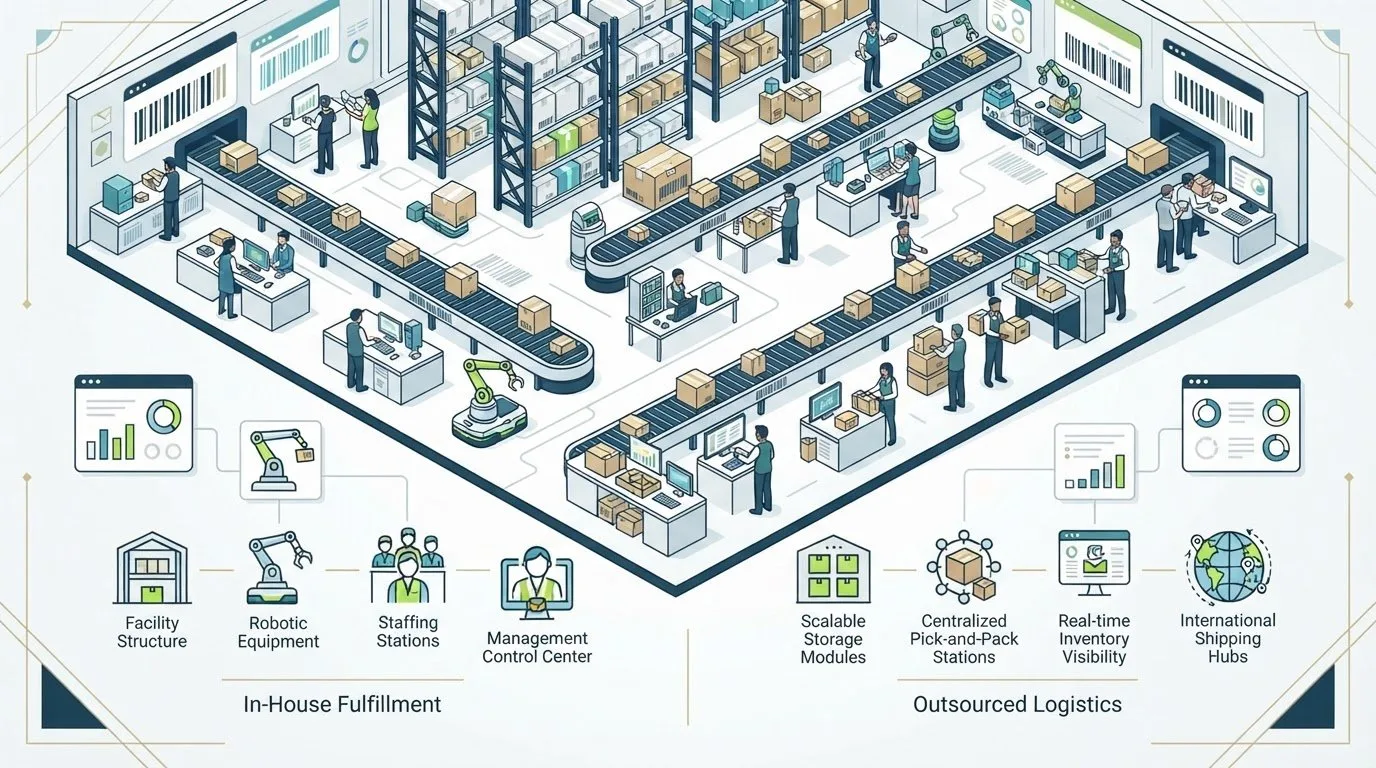
Is Outsourcing Fulfillment Profitable? A Practical 3PL Break-Even Guide
What if the fulfillment bill that looks cheaper is quietly costing your business more? So, is outsourcing fulfillment profitable? It can be, but comparing a 3PL quote with rent and payroll alone won’t give you the full answer. Facility expenses, software, equipment, benefits, management time, and the flexibility to handle changing order volumes all shape the real cost.
It’s also reasonable to consider what you might give up by outsourcing. Direct oversight can help your team protect service quality and the customer experience, while a 3PL can bring warehousing, pick-and-pack, shipping, and inventory visibility together without requiring you to manage every operational detail yourself. The right decision depends on the full value and cost for your business, not a single fee or order-volume rule of thumb.
This guide will help you build a fair in-house versus outsourced cost comparison, identify the business conditions that can make a 3PL financially attractive, and assess operational trade-offs before requesting a tailored quote. You’ll have a clearer basis for deciding whether outsourcing supports your margins and growth.
Key Takeaways
- Answer “is outsourcing fulfillment profitable?” by comparing its full cost and business value with your current in-house operation.
- Use the same timeframe, order scope, and service assumptions to build a fair comparison, including costs that are easy to overlook.
- Identify whether your order patterns, capacity needs, and growth plans favor outsourcing, in-house fulfillment, or a closer analysis.
- Count the value of released team capacity only when your business can put that time and effort to productive use.
- Assess how Silicon Valley Direct’s fulfillment capabilities, including 80+ eCommerce integrations and domestic and international shipping, fit your operating needs.
Is outsourcing fulfillment profitable? Start with the business case
The answer to “is outsourcing fulfillment profitable” depends on more than the fee for each order. Compare the full cost of a defined outsourced operation with the full cost of your current in-house model, then weigh both against the operational value each creates. That value might include capacity for other work, more room for inventory, or a better fit for changing order patterns. It counts only if it supports a real business need.
A 3PL fee on its own can’t establish profitability. The quote covers a particular scope of work, while your current costs may be spread across payroll, space, systems, supplies, and time spent managing daily fulfillment. The comparison is useful only when both models use the same timeframe, order scope, and service expectations. Otherwise, you may compare different operations and mistake an omitted cost for a saving.
Third-party logistics (3PL) is the outsourcing of logistics activities, such as warehousing and order fulfillment, to an external provider. A 3PL fulfills inventory held for a business; dropshipping generally means a supplier ships products directly to the customer after an order, rather than the business’s stock being stored and fulfilled through a 3PL. For broader context, see this overview of Third-party logistics (3PL).
What fulfillment outsourcing changes: what it does not
Outsourcing can move specific operational tasks to a 3PL, including receiving products, storing inventory, picking and packing orders, and shipping them. You don’t have to move every task at once. You can define a scope that fits your needs, such as outsourcing storage and shipping while retaining selected activities in-house.
The arrangement changes who performs the agreed work, not automatically who owns the inventory or makes product decisions. Your business can retain responsibility for what it sells, how it presents the brand, and the customer promise it makes. Clear processes and service expectations connect the fulfillment work with that promise. Silicon Valley Direct brings warehousing, order fulfillment, and shipping together through its 3PL fulfillment services.
Why the answer depends on your operating model
A business with available space, a steady team, and efficient processes may already be using its resources well. In that case, outsourcing could add cost without creating enough value to offset it. By contrast, recurring space constraints, staffing pressure, or process bottlenecks can make an external operation worth evaluating, particularly if they interfere with other priorities.
Order patterns matter, too. Seasonal peaks, uneven demand, product mix, and service requirements affect the work involved and the capacity needed. No single order-volume threshold can determine profitability for every company. The same volume can carry different costs depending on how orders flow and what service customers expect.
Start by identifying the operational problem you want to solve. Then assess whether outsourcing the relevant work would address it and whether the resulting capacity has productive value. That business case sets the foundation for a complete cost comparison.
How to calculate the full cost of outsourced versus in-house fulfillment
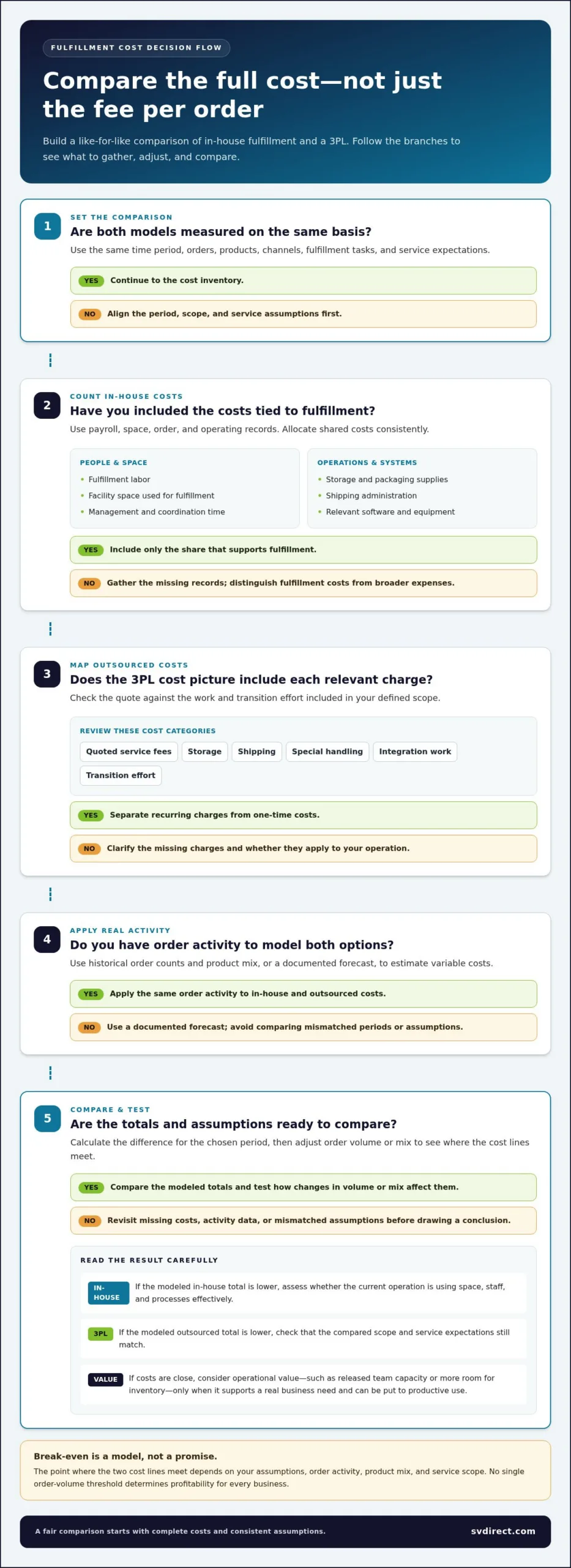
A useful comparison starts with your own operating records, not industry averages. Use the same time period, order scope, and service assumptions for both models. Comparing a busy season in-house with a typical month under a 3PL proposal won’t tell you which model fits your business.
Build a like-for-like cost comparison
Gather invoices, payroll records, space records, order data, and the proposed 3PL fees. Then work through these steps:
- Set the comparison period and scope. Choose a consistent period and define which orders, products, channels, and fulfillment tasks are included. Keep service expectations aligned.
- Total your in-house costs. Include fulfillment labor, the share of facility space used for fulfillment, storage, packaging supplies, shipping administration, relevant systems, and management time.
- Map each 3PL charge. Include quoted service fees, storage, shipping, special handling, integration work, and transition effort where applicable. Separate recurring charges from one-time costs.
- Apply your order activity. Use historical order counts and product mix, or a documented forecast, to estimate variable costs in both models.
- Compare the totals and test the assumptions. Calculate the difference for the period, then adjust order volume or mix to see where the two cost lines meet. This is your modeled break-even point, not a promise of savings. Corporate Finance Institute explains the underlying break-even analysis in business.
Which in-house costs belong in the calculation?
Count the labor directly tied to fulfillment, but distinguish it from broader payroll that would remain after outsourcing. Include facility use through a consistent allocation, such as the proportion of space dedicated to inventory and order work. Add equipment and operating resources only to the extent that they support fulfillment. Include software, packaging, and coordination time when those costs relate to the operation being compared.
Be careful not to treat every existing expense as avoidable. If a role, system, or lease remains in place after outsourcing, its cost may not disappear. Record it separately so the comparison distinguishes cash savings from capacity that has simply been reassigned.
How to compare a 3PL proposal fairly
Match each quoted service to the task or expense it replaces. A storage charge, for example, should be compared with the relevant in-house space and storage resources, not with the entire warehouse budget. Check whether the proposal covers the order profile and service level used in your model. To discuss your operating requirements, request a fulfillment quote.
Keep your assumptions visible: order volume, items per order, storage needs, shipping scope, and transition work. If you’re asking, “is outsourcing fulfillment profitable,” this method gives you a grounded answer for your operation and shows which changes could move the break-even point.
When outsourcing fulfillment can improve profitability, and when it may not
A favorable cost comparison is only part of the decision. Outsourcing can change how reliably orders move, how clearly the business can see inventory, and how much management attention fulfillment consumes. Those effects matter when they address a real operating need and contribute to business goals. Use the conditions below to identify where your case is strong, where in-house may remain suitable, and where you need more evidence.
| Outsourcing may be a better fit when | In-house may be a better fit when | More analysis is needed when |
|---|---|---|
| Space, staffing, or workflow constraints repeatedly limit fulfillment capacity. | Existing space and staff are well utilized, and orders consistently meet service expectations. | Demand fluctuates, but the cost and operational effect of those peaks are unclear. |
| Fulfillment tasks take time away from defined growth or customer work. | Direct operational control supports product handling or service needs that are difficult to delegate. | Transition effort, process complexity, or integration work could offset expected benefits. |
| Connected order and inventory workflows could reduce manual coordination. | The current systems and processes already provide reliable order and inventory visibility. | Service consistency, inventory accuracy, or management workload needs closer measurement. |
Signals that outsourcing may strengthen the business case
Recurring capacity pressure is a stronger signal than one unusually busy period. For example, if the team regularly struggles to find space, schedule fulfillment labor, or clear orders promptly, an outsourced operation may address a persistent constraint. Record when and how often the issue occurs and what it disrupts. A pattern tied to space or staffing is easier to evaluate than a general sense that fulfillment feels demanding.
Then identify where released time would go. If a manager currently spends hours coordinating orders and inventory, specify the work that could take priority instead, such as customer support, sales planning, or product development. Connected workflows may also reduce manual order and inventory coordination, but their value depends on whether they improve a meaningful part of your operation.
Reasons to pause before outsourcing
A well-utilized in-house team that meets customer service needs may not have a compelling operational reason to change. Direct control can also be valuable when fulfillment involves detailed handling instructions, close brand oversight, or processes that are difficult to transfer. Include the effort of transitioning workflows and the attention required to manage the new arrangement in your evaluation.
Variable demand or anticipated growth alone doesn’t prove that outsourcing will pay off. Test whether the 3PL model works across slower periods as well as peaks, and account for how your operation would handle changes in volume. Lower operational workload does not automatically mean higher profit. Released capacity creates financial value only when the business can use it productively and the resulting service and inventory visibility continue to support customer expectations.
So, is outsourcing fulfillment profitable for your business? It may be when the operating constraints are real, the cost case is sound, and the released capacity has a clear use. If those conditions aren’t yet clear, measure them before treating the move as a financial improvement.
How to evaluate the decision using your own orders, capacity, and goals
A decision model is useful only if it reflects the work your business actually handles. Gather order data across representative periods, including order frequency, units per order, product mix, packaging needs, and demand peaks. Document who currently spends time on fulfillment tasks, how much effort those tasks take, and where delays or handoffs occur. Then record customer-facing requirements such as expected processing speed, order accuracy, and communication needs.
Use those inputs to compare your current workflow with a clearly defined outsourced scope. Silicon Valley Direct’s 3PL fulfillment services can be assessed against the specific activities and service expectations in your model, rather than against an abstract idea of outsourcing.
Build a decision model that reflects real operating conditions
Keep each scenario matched. Use the same order types, packaging requirements, product handling assumptions, and service expectations in both models. Compare a conservative case with a higher-demand case using your own historical data or a documented forecast. If the result changes sharply with a small shift in volume or order mix, note that sensitivity instead of relying on a single projection.
Separate direct financial results from benefits that are harder to price. A lower modeled operating cost is measurable. More time for customer support, merchandising, or sales planning may be valuable, but assign it a financial benefit only if you can explain how the capacity will be used and what outcome you expect. This keeps the business case credible.
Plan a transition that preserves visibility
Before implementation, write down how inventory information, orders, reporting, and operational communication need to flow. Define who reviews exceptions, how the team will spot discrepancies, and which measures will show whether the new arrangement is working. Track a focused set of indicators, such as fulfillment workload, inventory accuracy, and total operating cost, using consistent definitions over time.
Silicon Valley Direct’s Remote Control provides 24/7 access to order activity and inventory information. Consider how that visibility fits your team’s day-to-day decisions and reporting needs. An order management system should support clear oversight, not leave your team guessing about order status or stock levels.
Set expectations for transition tasks, ownership, and communication before moving work. Don’t assume a particular transition duration or a guaranteed outcome. Instead, use agreed measures to review actual performance against the assumptions in your model. That gives your team a practical way to revisit the decision if order patterns, workload, or service requirements change.
With your operating profile and requirements documented, you can request a quote grounded in the work you need handled.
How Silicon Valley Direct supports a profitable fulfillment decision
A 3PL should be evaluated as an operating model, not treated as a guaranteed path to higher profit. Silicon Valley Direct connects warehousing, picking, packing, and shipping with eCommerce integrations, giving businesses a defined fulfillment option to compare with their current setup. The fit depends on your order profile, service expectations, inventory needs, and the work you want to shift. A tailored quote can inform your analysis, but your own costs and goals determine the business case.
Connect fulfillment services and visibility to the business case
Look at how each part of fulfillment interacts. Inventory is received and stored, orders are picked and packed, then shipments move through the shipping workflow. Silicon Valley Direct supports 80+ eCommerce integrations, same-day and next-day fulfillment, and domestic and international shipping. These capabilities give you concrete operating details to compare with the tasks, systems, and coordination in your in-house model.
Visibility matters alongside the cost calculation. Remote Control gives teams tools to review order activity and inventory through operational reporting. Use that information to spot patterns, check inventory status, and understand fulfillment activity as you assess the arrangement. An order management system can help bring order and inventory information into the decision process, rather than leaving the comparison dependent on estimates alone.
Service quality still belongs in the evaluation. Consider whether the workflow aligns with your team’s oversight needs and the customer experience you intend to deliver. You can also review customer experiences to learn how businesses describe working with Silicon Valley Direct. Treat those experiences as context, then measure the factors that matter to your own operation.
Request a quote based on your fulfillment requirements
For a useful quote, provide a clear picture of your operating profile. Include order patterns, inventory and storage needs, product mix, required integrations, and service expectations. If demand changes across the year, describe that variation so the proposed scope reflects the work being evaluated. The closer a quote matches your requirements, the more fairly you can compare it with the in-house scenario.
Use the resulting proposal as one input, not as the conclusion. Map its services and charges to the tasks and costs in your current operation, then consider operational benefits separately from direct savings. That gives you a grounded way to decide whether outsourcing supports your business, rather than relying on a general promise of lower costs. The answer to “is outsourcing fulfillment profitable” should come from your requirements and a transparent comparison.
Make your next fulfillment decision with confidence
The most useful answer to “is outsourcing fulfillment profitable” is one grounded in your operation, not a general rule. Treat your comparison as a working business tool: revisit it when order patterns, capacity needs, or customer expectations shift. That way, the decision can keep pace with the business instead of relying on assumptions that no longer fit.
A tailored quote can help you test the outsourced scenario against your own operating costs and priorities. Silicon Valley Direct has provided fulfillment services since 1999. Use the conversation to clarify the work you want handled and the service requirements that matter, then assess the proposal alongside your in-house model. The goal is a considered decision that supports sustainable growth, not a promise that one model will always cost less.
Share your fulfillment requirements with Silicon Valley Direct to request a quote and compare the proposed scope with your in-house model.
Frequently Asked Questions
Is outsourcing fulfillment profitable for a small business?
It can be, but business size alone doesn’t determine whether outsourcing pays off. Compare your current fulfillment costs and workload with a tailored 3PL proposal, then consider what your team could accomplish with any capacity freed up. For example, if fulfillment takes time away from a defined sales or customer initiative, include that opportunity in your assessment. The answer to is outsourcing fulfillment profitable should reflect your actual operations and goals, not a universal order threshold.
Does outsourcing fulfillment guarantee higher profits?
No. Outsourcing changes the cost and operating model, but it can’t guarantee a profit increase. The result depends on the services included, associated fees, order demand, transition effort, and whether your business puts released capacity to productive use. Compare complete, like-for-like scenarios using your own company data. Also consider how service consistency and communication may affect the customer experience, rather than judging the decision by direct costs alone.
Can outsourcing fulfillment reduce shipping costs?
It may, but lower shipping costs aren’t automatic. Carrier management and contracted rates can influence shipping economics, while actual results depend on your shipment profile and the full service arrangement. Compare shipment records by package characteristics, destinations, and service needs, and keep postage separate from fulfillment fees in your analysis. Silicon Valley Direct supports domestic and international shipping and carrier management, which you can assess against your business’s actual shipping activity.
How does a 3PL affect the customer experience?
A 3PL’s fulfillment work can influence order accuracy, dispatch, and the information available when customers ask about an order. Your brand still owns its customer promise and product decisions. Set expectations in the operating plan for order handling, status information, reporting, and how exceptions are escalated. For example, define who follows up if an order record and an inventory count don’t match. Clear responsibilities support oversight without assuming service outcomes.
Can a business outsource only some fulfillment tasks?
Yes. The scope can focus on the work you want handled, such as inventory storage, picking and packing, or shipping. A business might retain a particular internal process while outsourcing other fulfillment activities. Before comparing options, document which party handles each task, where handoffs occur, and how exceptions are managed. A clear division of responsibility helps you evaluate the costs and operational ownership of the selected scope.
What should I include when requesting a fulfillment quote?
Share your order patterns, inventory profile, packaging and handling requirements, shipping destinations, integrations, and service expectations. Include details that shape the work, such as changes in demand across the year or the mix of products in a typical order. Clear inputs help align the proposal with your actual fulfillment needs. Then compare its scope and charges with your complete in-house cost model; a quote alone doesn’t establish profitability.