


How Presorted Mail Improves Campaign ROI for Brands
Direct mail still earns budget because it can produce measurable returns, especially when the mailing operation is built for efficiency from the start. For brands trying to improve campaign ROI, presorted mail is one of the most practical ways to lower cost without weakening reach or response.
That matters because ROI is shaped by more than creative and list quality. Postage, data hygiene, preparation accuracy, entry timing, and tracking all affect whether a campaign generates profitable results or burns money in avoidable waste.
When presort is handled well, brands can cut postage, qualify for USPS discounts, reduce handling errors, and gain cleaner campaign reporting. Those benefits add up quickly across recurring promotions, retention programs, product launches, and acquisition mailers.
Presorted mail lowers campaign cost at the unit level
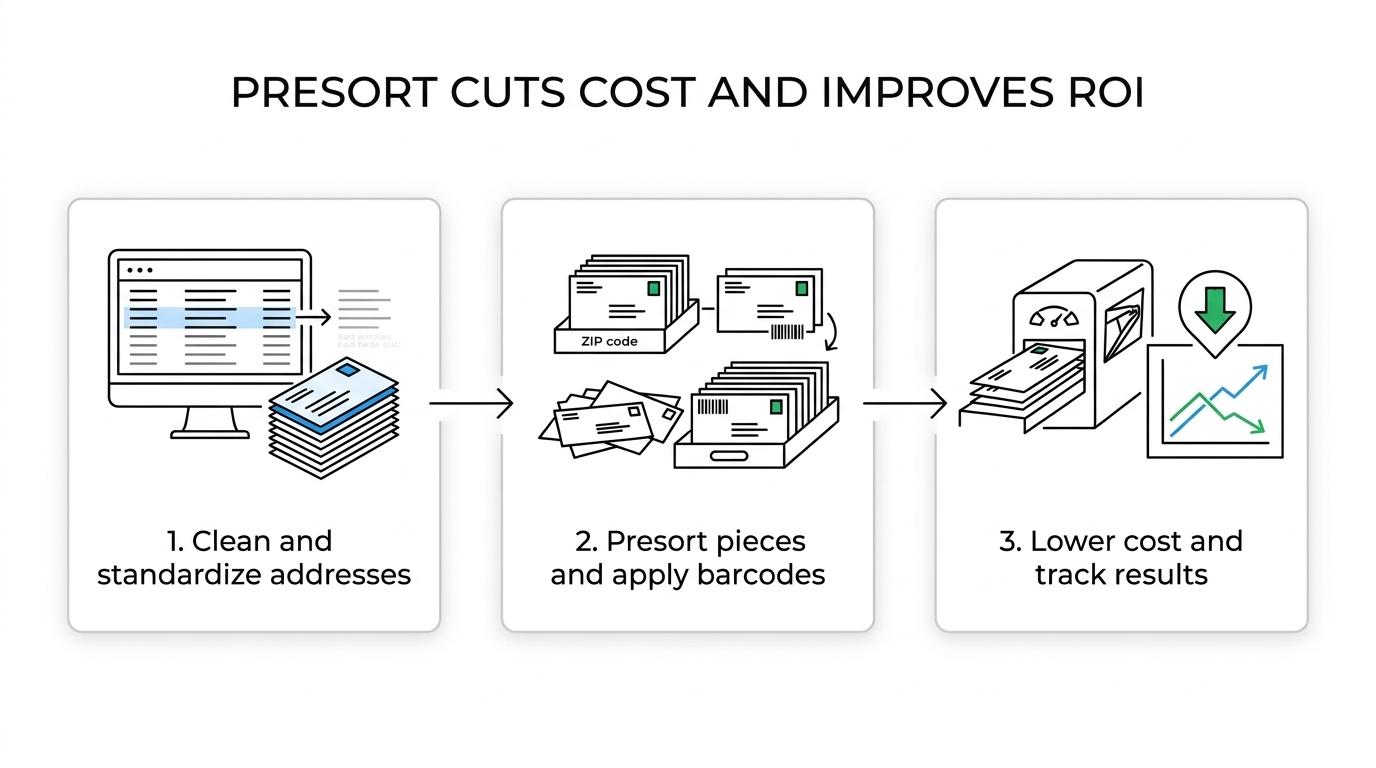
Presorted mail works by organizing pieces according to USPS requirements before induction into the postal network. That usually means sorting by ZIP Code levels, preparing trays or pallets correctly, and applying compliant barcodes and documentation. The better the sortation, the better the postage pricing a mailing may qualify for.
For brands, the first ROI gain is simple: lower cost per piece. If a campaign keeps response steady while postage drops, the return improves immediately. That is why presort is not just a postal tactic. It is a financial strategy.
The effect becomes even stronger at scale. A few cents saved per piece can look minor on a test run of 5,000 records. On a national campaign of 100,000 or 500,000 pieces, those cents become material budget savings that can be redirected into creative testing, list expansion, or higher-frequency mail drops.
According to USPS pricing rules, qualification can change based on how mail is prepared. For flat-size USPS Marketing Mail pieces, the 5-digit price applies when pieces are grouped in qualifying quantities and placed in a full 5-digit or scheme tray. USPS also provides discounts tied to palletization and entry under specific conditions, including the SCF-pallet discount for eligible Marketing Mail pieces.
After the economics are clear, the next question is usually where savings actually come from.
- 5-digit presort
- automation-compatible preparation
- pallet and tray optimization
- fewer manual touchpoints
- cleaner postal documentation
USPS presort rules create real postage savings
USPS incentives are structured to reward preparation that makes processing easier inside the network. When mail is organized to the 5-digit level, barcoded properly, and entered according to USPS standards, brands may access better postage categories than they would with a less disciplined mailing file.
This is where details matter. A campaign can have strong creative and a good audience, yet miss savings because records were not standardized, pieces were not packaged in the right containers, or the mailing did not meet thresholds for deeper presort levels.
A useful way to think about it is this: presort turns postal complexity into a pricing advantage.
| Presort factor | What it affects | ROI impact for brands |
|---|---|---|
| 5-digit presort | Deeper ZIP-level sortation | Lower postage on qualifying pieces |
| SCF-pallet discount | Entry and pallet prep for eligible mail | Better unit economics on larger drops |
| Intelligent Mail Barcode | Automation and tracking | Better visibility and fewer processing issues |
| Accurate address standardization | Deliverability | Less waste and fewer undeliverable pieces |
| Clean mail.dat documentation | Postal acceptance and preparation accuracy | Fewer delays and fewer costly corrections |
USPS Postal Explorer rules show that 5-digit and SCF-related pricing can materially change the economics of Marketing Mail letters and flats. Those are not abstract discounts. They directly affect the net cost of customer acquisition and retention mail.
There is also a strategic timing angle. USPS incentive programs can create added savings for brands using formats like Saturation USPS Marketing Mail. PostalPro has documented marriage-mail incentive discounts for qualifying Saturation mailings, with expansion to additional density levels and larger discount percentages in later price changes. For brands mailing to local trade areas or broad neighborhood audiences, those incentives can improve margin even more.
Direct mail ROI improves when lower postage meets strong formats
Cheaper mail is not enough by itself. The real payoff comes when presort savings are paired with formats and lists that already perform well.
Industry research supports that case. The ANA’s 2021 Response Rate Report found that direct mail remained widely used across campaign types, and reported especially strong ROI for certain formats. Survey respondents reported 112% ROI for letter-sized envelopes to prospect lists, which was the highest ROI among formats in that study. Respondents also reported 92% ROI for postcards on house lists.
Those numbers matter because they show a two-part opportunity:
- high-performing direct-mail formats can already generate attractive returns
- presort discounts can improve the margin on those returns even more
A brand sending Marketing Mail letters to a prospect audience is not only betting on response. It is also managing postage economics, production flow, and time-to-mail. If those operational details are optimized, the campaign has a better chance to outperform alternative channels on a cost-adjusted basis.
That is one reason letter mail remains relevant. Letter-sized envelopes often feel more personal, protect the offer until the recipient opens the piece, and can support longer messaging than a postcard. When paired with a clean prospect list, variable data, and postage optimization, they can become a very efficient acquisition vehicle.
Postcards can also be powerful, especially for house lists where recognition is already established. A lower per-piece production cost, immediate visibility, and strong presort execution can make them highly effective for remarketing, announcements, and seasonal promotions.
Presorted mail reduces waste before the campaign launches
Many brands think of direct-mail waste as a response problem. In reality, a large share of waste happens before the mail ever reaches a household or business.
Bad addresses, duplicate records, poor ZIP formatting, missing apartment data, and inconsistent file structures all create avoidable cost. A presort workflow tends to force discipline into the process. Address hygiene, CASS-style standardization, NCOA processing where applicable, barcode assignment, and postal documentation review all help improve mail quality before postage is paid.
That operational rigor has a direct ROI effect. Every undeliverable piece still carries printing, material, and handling cost. Every duplicate record can create overspend. Every preparation error can delay induction or require corrections.
Strong controls usually include several layers.
- Address validation: Clean, standardized records reduce returns and undeliverable mail.
- Deduplication: One customer should not receive the same piece multiple times unless the campaign design requires it.
- Barcode tracking: Intelligent Mail Barcode data supports visibility into in-home timing and campaign pacing.
- Documentation accuracy: Proper mail.dat files and supporting postal paperwork reduce acceptance issues.
- Production coordination: Print, inkjet, sorting, and handoff processes work better when managed as one system.
This is where integrated mailing operations can outperform fragmented workflows. If printing happens in one location, sorting in another, and induction coordination somewhere else, errors multiply. More handoffs often mean more chances for data mismatch, damaged trays, timing slippage, or freight expense that was never part of the original budget.
By contrast, a unified workflow can compress turnaround and reduce hidden cost. Silicon Valley Direct has stated that integrating printing and mailing under one roof can reduce freight expense between separate vendors, and that a typical direct-mail project can move from data upload to the postal stream in 3 to 5 business days. For brands running frequent campaigns, that speed supports testing and revenue cadence.
Better tracking and attribution make direct mail easier to justify
ROI improves when campaign performance can be measured with confidence. Presorted mail supports that goal because compliant barcodes and disciplined documentation create a cleaner chain of visibility.
The Intelligent Mail Barcode is especially useful here. It helps track mail through the postal system, giving marketers a better read on when pieces are moving and when they are likely to land in-home. That timing can be paired with web traffic, QR scans, promo code redemption, call-center spikes, store visits, or cart activity to sharpen attribution.
This does not turn direct mail into a perfect one-to-one channel. Very few channels are perfect. It does, however, make campaign timing more legible, which is valuable when teams are coordinating mail with email, paid search, SMS, or product launches.
Better attribution can support decisions like:
- Mailing cadence: Which frequency produces the best marginal return?
- Audience strategy: Are house lists outperforming prospect lists by enough to shift spend?
- Format selection: Are letter packages beating postcards on conversion quality, not just response volume?
- Geographic targeting: Are certain ZIP clusters producing stronger order value or lower CAC?
- Offer design: Which incentive creates the best net contribution after postage and production?
When the data is clean, mail becomes easier to scale because finance and marketing teams can see the relationship between cost, timing, and revenue more clearly.
Presorted mail supports speed without sacrificing control
Speed matters in retail calendars. Promotions move fast, inventory positions change, and launch windows can be narrow. A mailing program that takes too long to prepare may miss the moment when demand is strongest.
Presort does not have to slow things down. In a mature operation, it can do the opposite by putting repeatable structure around file intake, list review, production, and postal entry. Once rules are defined, campaigns can move faster with fewer surprises.
That is especially important for brands that mail repeatedly rather than occasionally. Monthly house-list campaigns, triggered win-back mail, local store pushes, and replenishment reminders all benefit from a process that is reliable under pressure.
A few indicators usually show that a brand is ready to treat presort as an ROI driver rather than a back-office task:
- mailing volume is increasing
- postage is becoming a visible line item
- in-home dates matter to promotion performance
- list segmentation is getting more advanced
- the team wants better reporting on campaign timing
For growing brands, this shift is often a sign of maturity. Mail stops being a one-off channel and becomes a managed revenue program.
What brands should ask from a presorted mail partner
The right mailing setup is not just about access to postage discounts. It is about whether the operational model protects margin and supports scale.
Brands usually benefit from asking practical questions early. Can the provider prepare mail to the 5-digit presort level where eligible? Are mail.dat workflows and postal documentation handled internally? Is Intelligent Mail Barcode tracking available? Can the program support both house lists and prospect lists? Are print, presort, and induction coordinated in one workflow?
They should also ask about accuracy controls. A mailing error caught during proofing can prevent wasted postage, wasted print spend, and brand damage. That kind of quality control is easy to overlook until something goes wrong.
Presorted mail rewards discipline. When list quality, postal preparation, and tracking come together, direct mail becomes more efficient, more measurable, and easier to scale. For brands focused on campaign ROI, that is not a minor operational detail. It is part of the growth model.