img not found!

Silicon Valley Direct Reviews: Evaluating Your 3PL Fulfillment Partner in 2026

What if your fulfillment partner treated your inventory with the same precision as your own founding team, rather than just another ticket in an automated queue? It’s a common frustration for growing brands. You’ve likely experienced the stress of high error rates and a total lack of transparency that makes you feel disconnected from your own products. You deserve a partner that catches a problem before the package ever hits the truck.

This review explores why Silicon Valley Direct remains a trusted leader for those seeking a 3pl fulfillment center san jose in 2026. Since 1999, they’ve combined high-end digital printing with a “quiet facility” methodology to eliminate the chaos of traditional warehousing. You’ll discover how their proprietary Remote Control system provides 24/7 visibility and why their Nine Promises framework ensures your orders are handled with personal commitment. We’ll examine the operational excellence and client feedback that proves reliability is built on human expertise; it isn’t just about algorithms.

Key Takeaways

  • Learn how over 25 years of operational history creates a stable foundation for your brand to grow without the risk of fulfillment errors.
  • Gain 24/7 visibility into your inventory and order status through the proprietary Remote Control™ system that puts data back in your hands.
  • Find out how choosing a 3pl fulfillment center san jose that functions as an extension of your team replaces impersonal tickets with proactive human partnership.
  • See how integrating high-end digital printing and systematic quality checks ensures your customers receive perfect orders every time.
  • Discover the strategies that allow for rapid scaling, such as managing over 3,000 shipments in a single week with total precision.

The Silicon Valley Direct Track Record: 25 Years of 3PL Fulfillment Excellence

Established in 1999, Silicon Valley Direct has navigated more than two decades of technological shifts by adhering to a simple principle: prioritize the partnership over the transaction. While many providers focus solely on volume, we view ourselves as a direct extension of your internal marketing and sales departments. This philosophy ensures that your brand’s integrity is maintained from the moment an order is placed until it reaches the customer’s doorstep. By operating as a premier 3pl fulfillment center san jose, we’ve built a reputation for stability in an industry often characterized by high turnover and operational chaos.

Our “quiet facility” methodology is a cornerstone of this reliability. We deliberately remove the frantic, hectic atmosphere found in many automated warehouses to ensure 100% accuracy, even when facing high-volume deadlines. This calm, methodical approach is guided by our Nine Promises, a set of foundational values that dictate how we handle every client interaction. It’s about precision over speed alone.

This focus on precision and uncovering the “hidden details” of a process is a value we share with other local experts; for instance, City Drifts reveals the secret neighborhoods of San Francisco through their unique guided stairway walks.

A Legacy of Reliability in the Silicon Valley Logistics Hub

Longevity in the Third-party logistics (3PL) sector is a rare commodity. Our multi-decade history is anchored by long-term staff retention; many of our team members have been with us for over ten years. This collective experience allows us to take a proactive approach to problem-solving. We don’t just react to errors. Instead, we identify potential supply chain bottlenecks and correct them before they ever impact your customers.

The Marriage of Technology and Human Oversight

We reject “cookie-cutter” solutions because we understand that every business has unique requirements. Instead, we offer custom-fit 3PL fulfillment services that adapt to your specific workflow. Silicon Valley Direct functions as a seamless extension of your brand by mirroring your internal standards and adapting to your specific sales and marketing needs. This blend of sophisticated data management and dedicated human attention makes us a standout 3pl fulfillment center san jose for businesses that value precision over automation alone.

What to Look for in a 3PL Fulfillment Center: Proprietary Tech and Quality Control

Evaluating a 3pl fulfillment center san jose requires looking beneath the surface of basic shipping rates. When selecting the right 3PL partner, you must prioritize infrastructure that offers both physical precision and digital transparency. We’ve built our operations around this dual necessity; combining our systematic QC-Check process with platform-agnostic integrations using XML and SOAP. This ensures your eCommerce platform communicates seamlessly with our warehouse, regardless of which software stack you use. Our proactive stance means we catch data discrepancies before they turn into shipping errors.

Total Transparency with Remote Control™

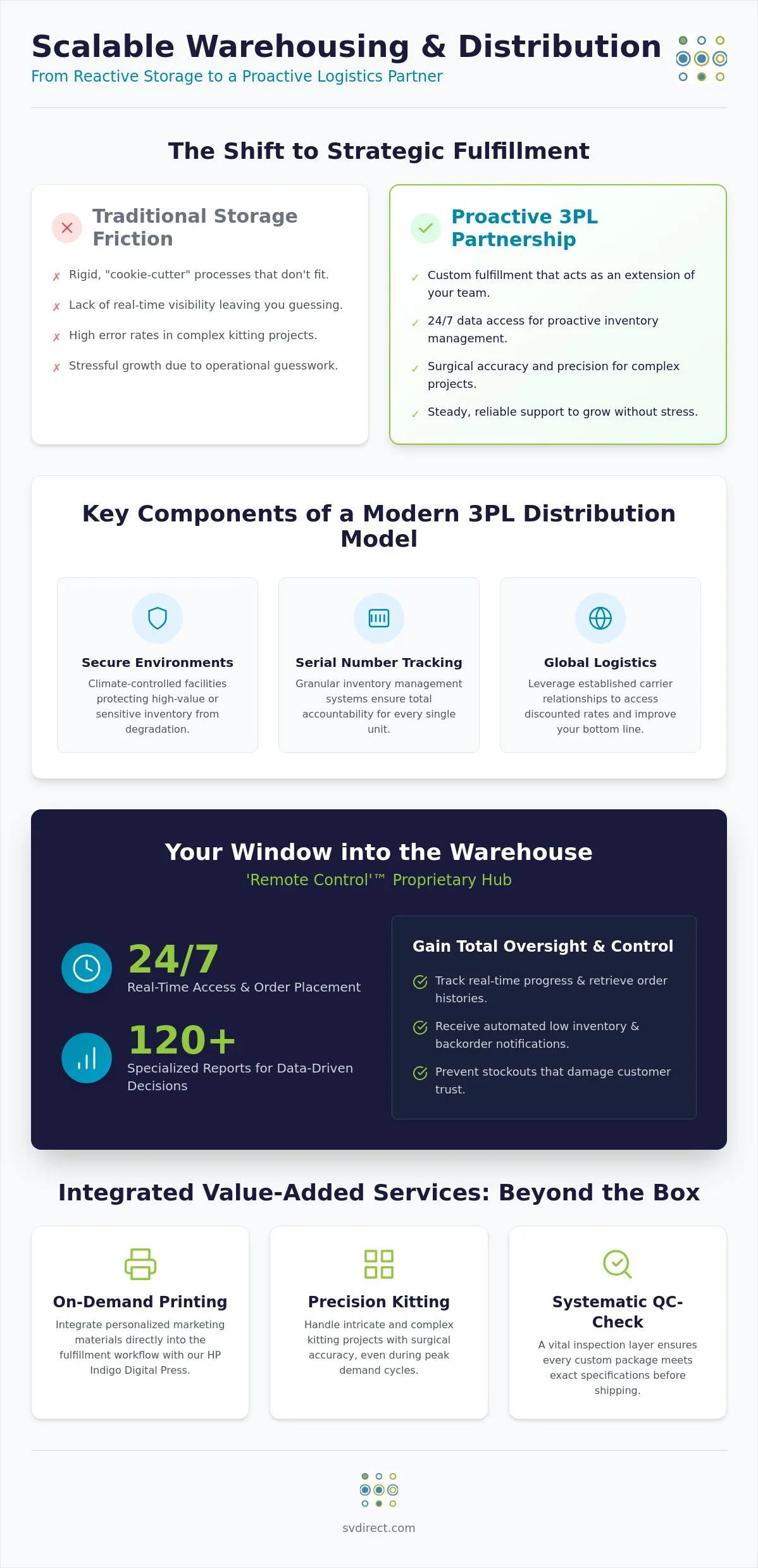
Our proprietary remote order management system, Remote Control™, serves as your eyes on the ground. It offers 24/7 real-time visibility into inventory levels and order history, allowing you to generate over 120 standard reports at a moment’s notice. By receiving automated low-inventory alerts, eCommerce managers can effectively eliminate the “anxiety of growth” and focus on scaling their brand rather than worrying about stockouts. You get the data you need without having to ask for it.

High-Resolution Printing and Variable Data Integration

Unlike many logistics providers that outsource their collateral, we utilize the HP Indigo 5500 Digital Press in-house. This allows us to deliver offset-quality inserts with a 230 line screen resolution, ensuring your brand’s visual standards are never compromised. By leveraging Variable Data Printing (VDP), we personalize the customer experience for every shipment. Our print on demand services also help you reduce waste and eliminate unnecessary storage costs for marketing materials. This specialized approach makes us a unique 3pl fulfillment center san jose, offering capabilities that generic warehouses simply cannot match.

This integration of high-tech printing and rigorous quality control means your packages arrive exactly as intended. If you’re ready to see how this level of detail can transform your operations, you can request a free quote to discuss your specific needs.

Silicon Valley Direct Reviews: Evaluating Your 3PL Fulfillment Partner in 2026

Real-World Results: Why SVD is the Strategic Choice for Scaling Businesses

Scaling a brand requires more than just warehouse space; it demands a partner that can weather the pressure of rapid growth without flinching. Our customer testimonials highlight partnerships that have thrived for over seven years, proving that we prioritize long-term stability over short-term transactions. One major client experienced this firsthand when we managed over 3,000 shipments in a single week. Despite the high volume, our “quiet facility” methodology ensured that every package was accurate and shipped on time, protecting the brand’s reputation during a critical peak period.

Complex project management is where our collective experience truly shines. A 10-month marketing fulfillment case study demonstrated our ability to build a robust operational foundation for future large-scale mail projects. We also integrate sustainability into our daily workflow through green printing processes and a dedicated HP partnership for responsible hardware recycling. This commitment ensures that your growth as a business doesn’t come at an unnecessary cost to the environment or your corporate values.

Scaling with Confidence: From Startups to Enterprises

The Proactive Advantage: Anticipating Supply Chain Conflicts

Our team doesn’t just react to orders; we work to anticipate potential supply chain conflicts before they result in “backorder” surprises. This proactive stance saves our clients significant time and prevents the loss of customer trust that occurs when items are unexpectedly unavailable. To keep your strategy sharp, we invite you to explore the Silicon Valley Direct Blog for the latest industry trends and logistics insights. Finding a 3pl fulfillment center san jose that thinks several steps ahead of the market is the ultimate competitive advantage for a growing brand.

Securing Your Brand’s Future with a Proven Partner

Choosing a 3pl fulfillment center san jose shouldn’t be a gamble based on the lowest bid. It’s an investment in a partnership that treats your inventory with the same care you do. We’ve explored how a “quiet facility” methodology and 25+ years of industry expertise create a foundation for accuracy that automated warehouses often fail to provide. You now understand how real-time visibility and high-end digital printing protect your brand’s reputation at every touchpoint.

Our proprietary Remote Control™ technology ensures you’re never in the dark about your stock levels; meanwhile, our HP Indigo 5500 liquid ink standards keep your inserts looking professional. These tools aren’t just features. They’re the mechanisms that allow you to scale from a few dozen orders to thousands per week with total confidence. We remain dedicated to the human element of logistics, catching problems before they ship and acting as a true extension of your team.

If you’re ready to move away from impersonal ticketing systems and toward proactive, expert oversight, we’re here to help. Partner with Silicon Valley Direct for Seamless Fulfillment and experience the difference that a quarter-century of stability brings to your supply chain. We look forward to supporting your growth through 2026 and beyond.

Frequently Asked Questions

How does Silicon Valley Direct ensure order accuracy?

Silicon Valley Direct ensures order accuracy through our systematic QC-Check process and a “quiet facility” methodology that prioritizes precision over chaotic volume. This approach is anchored by our Nine Promises, which serve as a framework for every shipment we handle. By maintaining a stable, long-term staff, we ensure that the team handling your products has the deep operational knowledge required to catch errors before they ever reach the customer.

Can I integrate my existing eCommerce store with SVD’s system?

Yes, you can seamlessly integrate your existing eCommerce store with our proprietary Remote Control™ system using XML and SOAP protocols. As a leading 3pl fulfillment center san jose, we’ve designed our platform to be entirely agnostic, allowing it to communicate effectively with any modern sales channel. This integration provides you with 24/7 real-time visibility into your inventory and order history without requiring you to overhaul your current digital storefront.

What makes SVD’s digital printing different from standard offset printing?

Our digital printing utilizes the HP Indigo 5500 Digital Press, which uses real liquid ink technology to deliver offset-quality results with the flexibility of digital production. Unlike standard offset printing that requires expensive plates and high minimums, our system supports Variable Data Printing (VDP) for personalized collateral at any volume. This technology achieves a 230 line screen resolution, ensuring that your marketing inserts and literature maintain a high-end, professional appearance.

Does Silicon Valley Direct handle international shipping and global logistics?

Silicon Valley Direct provides comprehensive global shipping and logistics services to help your business reach customers across international borders. Leveraging our strategic location as a 3pl fulfillment center san jose, we utilize established global networks to manage complex international distribution requirements. Our team handles the intricate details of global transit, ensuring that your products move through the supply chain efficiently while maintaining real-time visibility through our data management systems.
3PL vs 4PL: Choosing the Right Logistics Model for Your Business in 2026

What if the biggest risk to your supply chain in 2026 isn’t choosing the wrong provider, but choosing the wrong category of partnership? As the U.S. 4PL market reaches a projected $16.81 billion this year, many leaders feel pressured to choose between the hands-on execution of a 3PL and the strategic oversight of a 4PL. The debate over 3pl vs 4pl often leaves businesses caught between the fear of losing inventory visibility and the worry of absorbing high management fees. You need a solution that offers the stability of physical infrastructure without sacrificing the high-tech transparency required for modern global trade.

We understand that logistics is more than just moving boxes; it’s about the personal commitment to your brand’s growth. You likely want a partner that acts as a seamless extension of your team rather than a distant vendor. This article provides a clear decision-making framework to help you understand the ROI of each model and determine which path will best scale your operations. We’ll explore how the right integration can offer the strategic control you crave while maintaining the operational precision your customers expect.

Key Takeaways

  • Differentiate between physical execution and strategic integration to resolve the 3pl vs 4pl dilemma for your unique supply chain needs.
  • Evaluate your business volume and growth trajectory to select a logistics model that scales efficiently without inflating management costs.
  • Determine when specialized requirements, like integrated digital printing or healthcare mailing, benefit from the direct control of an asset-based partner.
  • Discover how proprietary technology provides the 24/7 transparency and reporting depth needed to maintain total oversight of your inventory.
  • Learn to identify a partner that prioritizes human connection and operational stability to act as a true extension of your internal team.

3PL vs 4PL: Understanding the Core Differences in Logistics Models

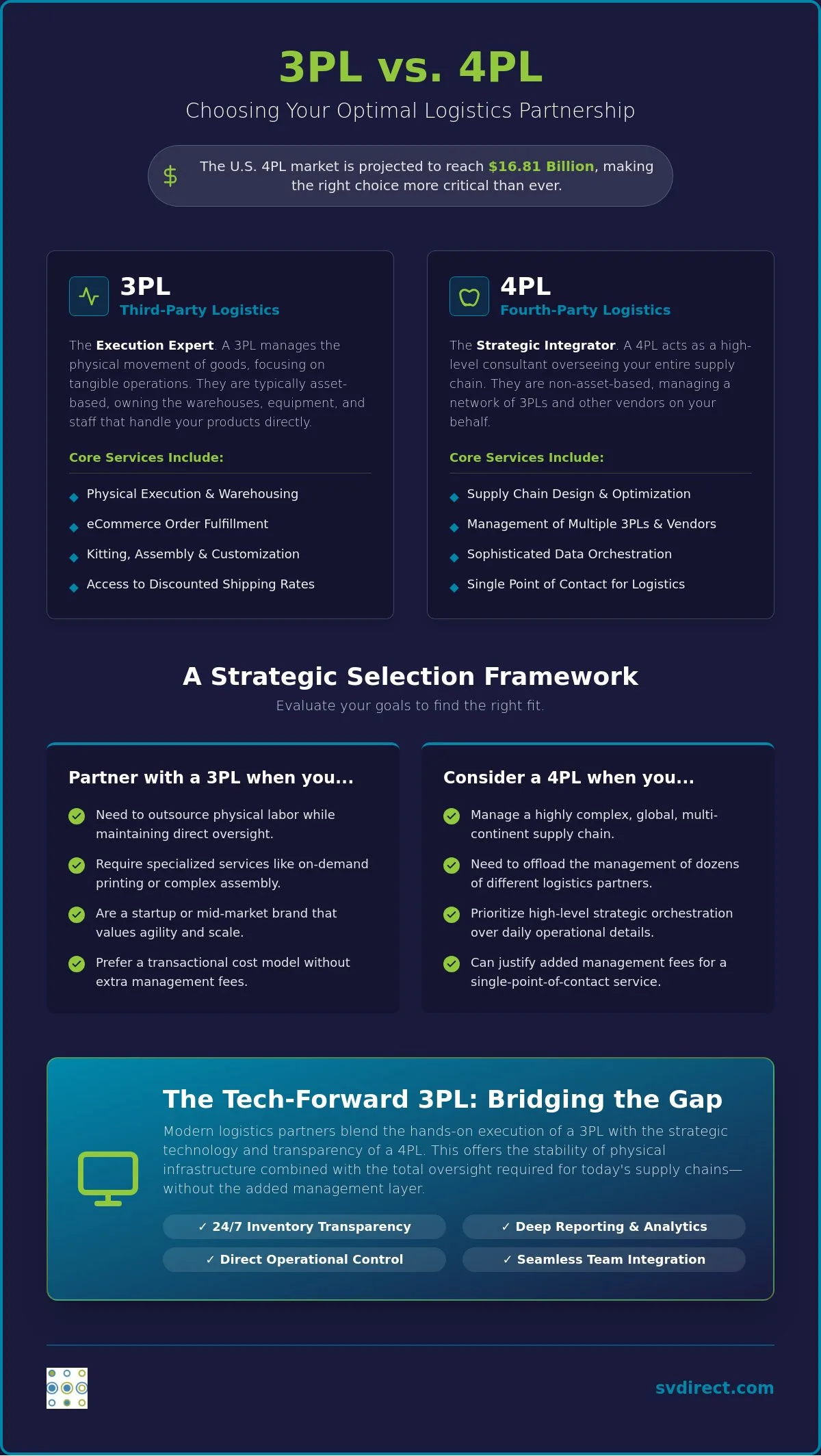
Deciding between a 3PL and a 4PL is a foundational choice for your business’s operational future. A Third-party logistics (3PL) provider manages the physical movement of goods from warehouse to customer. This model focuses on the tangible side of the business, such as physical execution, warehousing, and shipping. In contrast, a 4PL acts as a strategic integrator that oversees the entire supply chain, often managing multiple 3PLs on your behalf. The primary differentiator lies in asset ownership; 3PLs typically own or manage the warehouse facilities and equipment, while 4PLs are often non-asset-based consultants who focus on high-level orchestration.

What is a 3PL (Third-Party Logistics)?

A 3PL specializes in the heavy lifting of your daily operations. They provide secure warehousing and eCommerce order fulfillment, ensuring your inventory is received and stored with precision. By leveraging their physical infrastructure, you gain immediate operational efficiency and access to discounted shipping rates that are difficult to secure independently. Beyond basic storage, these partners offer specialized value through kitting and assembly, allowing you to customize products close to the point of distribution. This model is built for brands that value a direct, hands-on relationship with the people actually touching their product.

What is a 4PL (Fourth-Party Logistics)?

While a 3PL executes, a 4PL designs. This model provides a single point of contact for complex, global, multi-node supply chains. Their core services include supply chain design, vendor management, and sophisticated data orchestration. A 4PL doesn’t usually own the trucks or the racks. Instead, they use their expertise to manage the network of providers you’ve hired. This strategic layer is designed to alleviate the burden of managing multiple logistics partners, though it often comes with higher management fees and a step back from the daily operational details. Understanding the nuances of 3pl vs 4pl ensures you select a partner that aligns with your internal team’s capabilities.

Choosing Between 3PL and 4PL: A Strategic Selection Framework

Selecting the ideal partner in the 3pl vs 4pl debate requires a clear-eyed look at your internal resources and operational goals. For many growth-oriented brands, the choice hinges on the level of direct involvement they wish to maintain. Startups and mid-market companies often find that 3PLs provide the perfect balance of scale and agility. These providers allow you to outsource the physical labor while you keep a steady hand on the pulse of your business through direct communication with the facility floor.

Specialized requirements often dictate the model. If your workflow includes on-demand digital printing or complex healthcare mailing services, a specialized 3PL is typically more responsive. They possess the specific equipment and trained staff in-house. A 4PL would merely act as a middleman between you and another vendor. This direct connection reduces the risk of communication gaps and ensures higher quality control over sensitive projects.

Cost structures also diverge significantly. A 3PL focuses on transactional pricing; you pay for the storage you use and the orders you ship. Conversely, a 4PL introduces a layer of management fees that can significantly impact your bottom line. You must decide if the strategic orchestration they offer justifies the added expense or if a high-performing 3PL can meet those needs more efficiently. If you’re ready to see how a high-touch partnership can protect your bottom line, consult with our team today.

When to Partner with a 3PL

Partner with a 3PL when you need to outsource physical labor while maintaining direct oversight of your inventory management. This is the right path for brands requiring custom kitting, subscription box assembly, or precision-driven mailing. It allows your team to focus on marketing and product development while experts handle the daily fulfillment logistics with a personal touch.

When to Consider a 4PL

Consider a 4PL when your organization manages a global, multi-continent supply chain with dozens of different logistics vendors. This model suits businesses willing to trade higher management overhead for a completely hands-off strategy. It’s a choice for enterprise-level entities where a single integrator handles the complexities of vendor selection and high-level network design across vast geographies.

To further mitigate risks in these complex international networks, many brands integrate pre shipment inspection services Asia to ensure manufacturing standards are met before products are handed off to their logistics providers.

3PL vs 4PL: Choosing the Right Logistics Model for Your Business in 2026

The Tech-Forward 3PL: Bridging the Gap Between Execution and Oversight

Proprietary systems like Remote Control™ are the engine behind this evolution. These platforms provide 24/7 access to your orders and inventory, backed by over 120 standard reports. This level of detail ensures your logistics partner acts as a true extension of your team. Our “Quiet Facility” methodology reinforces this precision. Instead of the chaotic energy found in traditional warehouses, our deliberate organization creates a stable environment where errors are caught before they ever reach your customer. This proactive stance protects your brand’s reputation and your bottom line.

Real-Time Visibility Without the 4PL Overhead

Web-based interfaces and XML/SOAP integrations have made remote order management a standard expectation. You no longer need an expensive middleman to tell you what is happening on the warehouse floor. Automated notifications for low inventory, receipts, and backorders provide the immediate feedback required for agile decision-making. This direct access to data removes the communication lag often found in 4PL models, giving you total control without the added management fees.

Custom-Fit Solutions vs. Cookie-Cutter Logistics

Flexibility is the most important asset in a 2026 logistics partnership. A tech-forward partner combines physical infrastructure with marketing-savvy services to solve bespoke challenges. For instance, integrating variable data printing with direct mail marketing allows you to personalize customer engagement while your inventory is being packed. This holistic approach ensures that your logistics strategy supports your broader business goals rather than just checking a box for fulfillment.

Future-Proof Your Logistics with a Scalable Partnership

Choosing the right model in the 3pl vs 4pl landscape requires balancing your need for operational control with your desire for strategic growth. You’ve learned that while 4PLs offer high-level orchestration, a tech-forward 3PL provides the same digital transparency without sacrificing direct contact with the team handling your inventory. This approach ensures you maintain visibility over every SKU while avoiding the heavy management fees that often accompany non-asset-based models. By focusing on a partner that acts as an extension of your team, you protect your bottom line and your customer experience.

With over 25 years of fulfillment excellence, we focus on providing the stability and precision your brand deserves. Our proprietary Remote Control™ system delivers real-time reporting, giving you the data you need to make informed decisions 24/7. From specialized kitting to integrated digital printing, we build solutions that adapt to your specific requirements. It’s time to move past confusing jargon and partner with a team that values your success as much as you do.

Streamline your supply chain with Silicon Valley Direct’s 3PL solutions. We look forward to helping your business reach its next milestone with confidence and ease.

Frequently Asked Questions

Is a 3PL or 4PL better for a growing eCommerce business?

A 3PL is usually the superior choice for growing eCommerce brands because it provides direct execution and asset-based reliability. This model allows you to scale physical operations like pick and pack and warehousing without the heavy management overhead of a 4PL. By working directly with the facility, you maintain better control over quality and kitting accuracy as your volume increases. The 3pl vs 4pl decision for growth often comes down to wanting a partner that actually touches your product.

Do 4PLs own their own warehouses and trucks?

No, 4PLs are typically non-asset-based providers that act as strategic consultants and integrators. They don’t own the physical infrastructure like warehouses or vehicle fleets. Instead, they manage the relationships and contracts with multiple 3PLs and carriers on your behalf. This makes them a strategic layer rather than an operational one, which is a fundamental distinction when evaluating your logistics needs.

What are the hidden costs of hiring a 4PL provider?

The most common hidden costs involve management fees and pass-through charges that can inflate your total logistics spend. Because a 4PL adds a layer between you and the physical service provider, you often pay for their strategic oversight on top of the actual shipping and storage costs. This can lead to a higher total cost of ownership compared to a direct partnership where you only pay for the services you consume.

Can a 3PL handle international shipping and global logistics?

Yes, many established 3PLs specialize in global shipping and logistics, managing everything from customs documentation to international carrier selection. A 3PL with a strong geographic hub, such as Silicon Valley, can leverage its proximity to major ports and airports to offer efficient global reach. This provides the international scale you need while keeping your operational team close to the product for better quality control.

How does technology like Remote Control™ change the 3PL vs 4PL debate?

Advanced technology like the Remote Control™ system bridges the gap by offering the 24/7 visibility once only found with 4PLs. When a 3PL provides 120+ real-time reports and XML integrations, you get strategic oversight and physical execution in one place. This proprietary digital transparency eliminates the need for an expensive 4PL manager to act as a data middleman, giving you direct access to your inventory status.

What is a Lead Logistics Provider (LLP) in relation to 4PL?

A Lead Logistics Provider (LLP) is another term for a 4PL that takes primary responsibility for managing your entire supply chain network. The LLP coordinates all other logistics vendors and focuses on high-level optimization and network design. While they provide a single point of contact, they often prioritize network-wide strategy over the specific, hands-on details of individual order fulfillment and specialized kitting projects.

Integrating Print and Fulfillment Services: The 2026 Strategic Guide to Agile Marketing

What if your marketing collateral never sat on a shelf long enough to gather dust or become obsolete? You’ve likely felt the frustration of recycling thousands of bulk-printed brochures because a single product spec or compliance detail changed. Managing disconnected vendors for printing, kitting, and global shipping isn’t just a logistical burden; it’s a direct threat to your brand’s agility. We understand that in a fast-paced market, waiting weeks for a shipment to clear a warehouse is no longer an option.

By integrating print and fulfillment services into one seamless workflow, you can finally eliminate inventory waste and accelerate your marketing execution. This guide shows you how to leverage digital presses using liquid ink to achieve 230 line screen resolution on demand. You’ll learn how a unified 3PL system provides 24/7 visibility into your global distribution, ensuring your team always has the right materials at the right time. We’ll explore the transition to a just-in-time collateral system that keeps your marketing as responsive and precise as your business demands.

Key Takeaways

  • Shift from traditional “print-and-store” models to a just-in-time system to eliminate the 25% obsolescence rate common in bulk marketing materials.
  • Discover how integrating print and fulfillment services into a single workflow enables immediate kitting and shipping, removing the need for intermediate warehousing.
  • Achieve offset-quality results with the HP Indigo 5500, utilizing liquid ink technology to deliver sharp 230 line screen resolution on every digital print run.
  • Maintain total oversight of your global distribution with 24/7 access to inventory levels and order status via the proprietary Remote Control™ management system.
  • Learn how a “quiet facility” methodology prioritizes precision and organization to meet high-volume deadlines with zero-error execution.

The Strategic Value of Integrating Print and Fulfillment Services

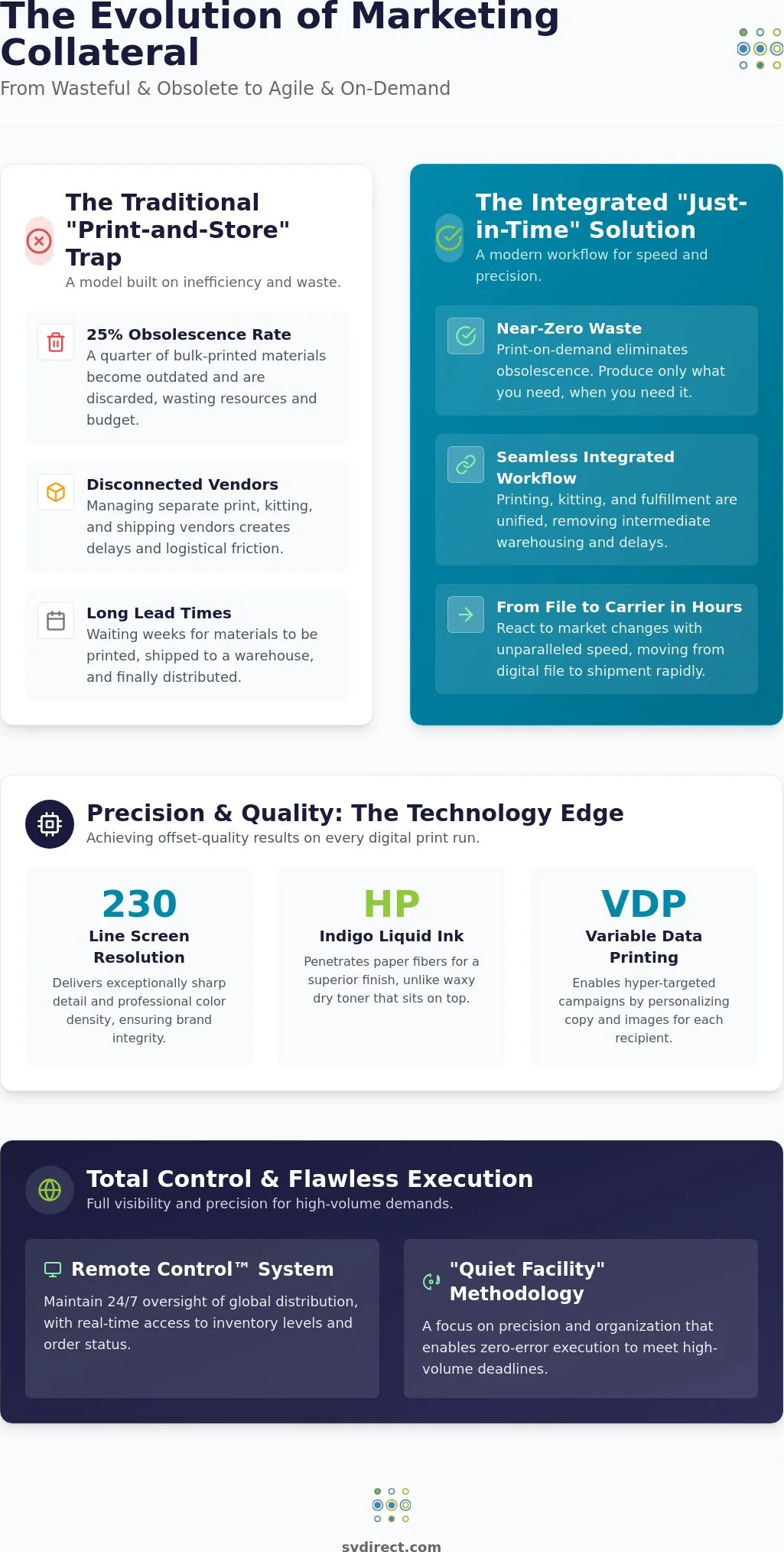
The traditional marketing supply chain is undergoing a fundamental shift. For decades, businesses relied on a “print-and-store” model that required massive upfront investments in bulk materials. Today, the strategic value of order fulfillment process optimization lies in integrating print and fulfillment services into a single, cohesive ecosystem. This unified workflow ensures that digital printing triggers immediate kitting and shipping. By removing the need for intermediate warehousing, you eliminate the friction that usually slows down a campaign.

The era of high-volume storage is ending. Statistics in modern B2B marketing show a nearly 25% obsolescence rate for stored literature. Whether it’s a shifted product spec or a new regulatory requirement in 2026, static inventory quickly becomes a liability. By integrating print and fulfillment services, you gain the agility to update brochures and data sheets in real-time. This approach significantly reduces the Total Cost of Ownership (TCO) by cutting out storage fees and the expensive disposal of outdated collateral.

To further mitigate the risks of obsolescence, some organizations are shifting portions of their content library to digital formats; for example, using DigiFlow to manage ebook distribution ensures that customers always receive the most current information without the costs of physical storage.

This need for dynamic updates extends to the retail floor, where digital labeling technology prevents the same type of obsolescence seen in printed marketing materials—read more about how to improve pricing accuracy in modern retail.

Transitioning to Just-in-Time (JIT) Collateral

Adopting a print-on-demand strategy means you only produce what your customers actually request. It’s a proactive shift from guessing demand to meeting it. The speed advantage is undeniable. You can move from a digital file submission to carrier pickup in just a few hours. This responsiveness allows your marketing team to react to market changes with precision rather than waiting days for a warehouse pull.

Sustainability in Modern Marketing

Precision is the most effective form of sustainability. By printing only what you need, you drastically reduce the environmental footprint of your brand. In 2026, brand standards increasingly demand the use of FSC-certified papers and eco-friendly digital processes. Integrating these steps ensures your marketing materials meet global compliance standards while demonstrating a commitment to responsible resource management.

High-Resolution Quality: Leveraging Liquid Ink and Variable Data

In a professional B2B environment, the quality of your printed materials reflects the quality of your brand. While many providers rely on dry toner, which can appear waxy or sit on top of the paper, the HP Indigo 5500 digital press utilizes real liquid ink. This distinction is vital when integrating print and fulfillment services. Liquid ink penetrates the paper fibers, resulting in a finish that matches or exceeds traditional offset quality. By achieving a 230 line screen resolution, your collateral maintains sharp detail and professional color density across every run, ensuring dot gain control remains consistent for total brand integrity.

Operational efficiency is built into this technology. Sheets emerge from the press completely dry and ready for immediate handling, allowing for a seamless transition to our kitting and assembly services. This immediate readiness means high-volume deadlines are met without the delays typically found in traditional print shops. It’s a proactive approach that ensures your materials are ready for distribution the moment the press stops running.

Variable Data Printing (VDP) for Personalised Engagement

Precision isn’t just about image quality; it’s about relevance. Utilizing Variable Data Printing (VDP) allows you to customize copy, images, and offers for every recipient on a single print run. This level of hyper-targeting is essential for high-impact sales kits. Data shows that personalized collateral significantly boosts engagement in direct mail marketing services, transforming a generic brochure into a powerful, one-to-one communication tool.

Technical Standards for Professional Results

To maximize the capabilities of our digital press, we recommend submitting files at a minimum of 300 dpi. This ensures that the 4-color and 7-color digital printing processes capture every nuance of your design. Liquid ink technology eliminates the 24-hour drying time required by offset presses, which is a massive advantage when integrating print and fulfillment services for time-sensitive campaigns. When you are integrating print-on-demand workflows, maintaining these technical standards ensures your brand integrity remains flawless from the digital file to the physical sheet. If you’re ready to see how this precision can elevate your next project, you can consult with our team for a custom quote.

Integrating Print and Fulfillment Services: The 2026 Strategic Guide to Agile Marketing

The Integrated Workflow: From Digital Press to Global Delivery

The final stage of integrating print and fulfillment services is the transition from the digital press to the hands of your global audience. Operating out of a strategic Silicon Valley hub provides a unique advantage for international shipping and complex trade show logistics. Our proprietary Remote Control™ system offers 24/7 access to your orders and real-time inventory levels. This level of transparency allows you to manage your supply chain with informed confidence. By integrating print into an omnichannel marketing strategy, you bridge the gap between digital speed and physical impact.

Our methodology is rooted in a “Quiet Facility” approach. This isn’t just about noise levels; it’s about a highly organized prioritization system that ensures every project moves through the facility with methodical care. We identify potential order conflicts or inventory shortages before they impact your timeline. This proactive stance is backed by over 25 years of operational history, ensuring that high-volume deadlines are met with zero-error execution. We don’t just react to orders; we oversee the entire lifecycle of your collateral.

Healthcare Mailing and Compliance Precision

Precision is non-negotiable in healthcare mailing services. Maintaining HIPAA compliance requires a seamless, secure link between data and distribution. Our integrated workflow ensures that only the most current, compliant versions of medical literature reach patients and providers. This eliminates the risk of distributing outdated information while maintaining the strict privacy standards required by the industry.

The 3-Step Integration Process

The path to a streamlined supply chain is straightforward when integrating print and fulfillment services with a dedicated partner:

  • Step 1: Digital file submission via a secure web interface with immediate proofing for rapid approval.
  • Step 2: Just-in-time printing on the HP Indigo press, utilizing liquid ink technology for superior resolution.
  • Step 3: Automated kitting, addressing, and global distribution through a single, reliable 3PL partner.

Advancing Your Marketing Agility through Operational Precision

The transition to a just-in-time collateral model is no longer a luxury for B2B brands; it’s a strategic necessity. By integrating print and fulfillment services, you replace the risks of bulk inventory with a responsive, high-resolution digital workflow. You’ve seen how utilizing the HP Indigo 5500 with liquid ink technology delivers offset-quality results without the traditional delays. This approach ensures your brand remains agile, professional, and ready for 2026 market shifts.

Success in global distribution requires more than just high-tech machinery. It demands the steady hand of an experienced partner. With over 25 years of Silicon Valley logistics expertise, we provide the stability and precision your business needs to grow. You’ll maintain 24/7 visibility into every order through our proprietary Remote Control™ system, ensuring your team stays informed and confident. We’re here to manage the logistical complexities so you can focus on building your brand.

Ready to eliminate waste and accelerate your execution? Request a free quote for integrated print and fulfillment services today. We look forward to helping you build a more efficient, high-performance marketing supply chain.

Frequently Asked Questions

How does digital print quality compare to traditional offset printing for B2B materials?

Digital print quality now matches or exceeds traditional offset through the use of liquid ink technology. Our HP Indigo 5500 press achieves a 230 line screen resolution, providing the sharp detail and color depth required for professional B2B literature. Unlike standard digital printers using dry toner, liquid ink penetrates paper fibers for a high-end finish. This ensures your collateral maintains a premium feel while benefiting from a fast digital workflow.

Is variable data printing (VDP) significantly more expensive than standard digital printing?

Variable data printing is a cost-effective solution when you consider the increased engagement and response rates it generates. While there’s a technical setup for personalizing text and images, the ability to run customized sheets as part of a single print job minimizes the price gap. By integrating print and fulfillment services, you avoid the high costs of discarding generic bulk materials that fail to connect with your audience.

How long does it take for integrated print-on-demand materials to be ready for shipping?

Integrated print-on-demand materials are typically ready for shipping within a few hours of file submission. Because our liquid ink technology produces dry sheets instantly, your collateral moves directly from the press to kitting and assembly without a 24-hour drying delay. This streamlined process allows us to meet high-volume deadlines with precision. It’s a proactive approach that ensures your marketing materials are in the carrier’s hands quickly.

Can I track my printed inventory and fulfillment orders in real-time?

Yes, you have total visibility into your distribution through our proprietary Remote Control™ system. This platform provides 24/7 access to your real-time inventory levels and order status, allowing you to manage global distribution from any location. Integrating print and fulfillment services into one dashboard eliminates the need to coordinate between multiple vendors. You’ll always know exactly what’s in stock and where your shipments are in the delivery cycle.

Direct Mail Fulfillment House: The Strategic Guide to Modern Mailing in 2026

Direct Mail Fulfillment House: The Strategic Guide to Modern Mailing in 2026

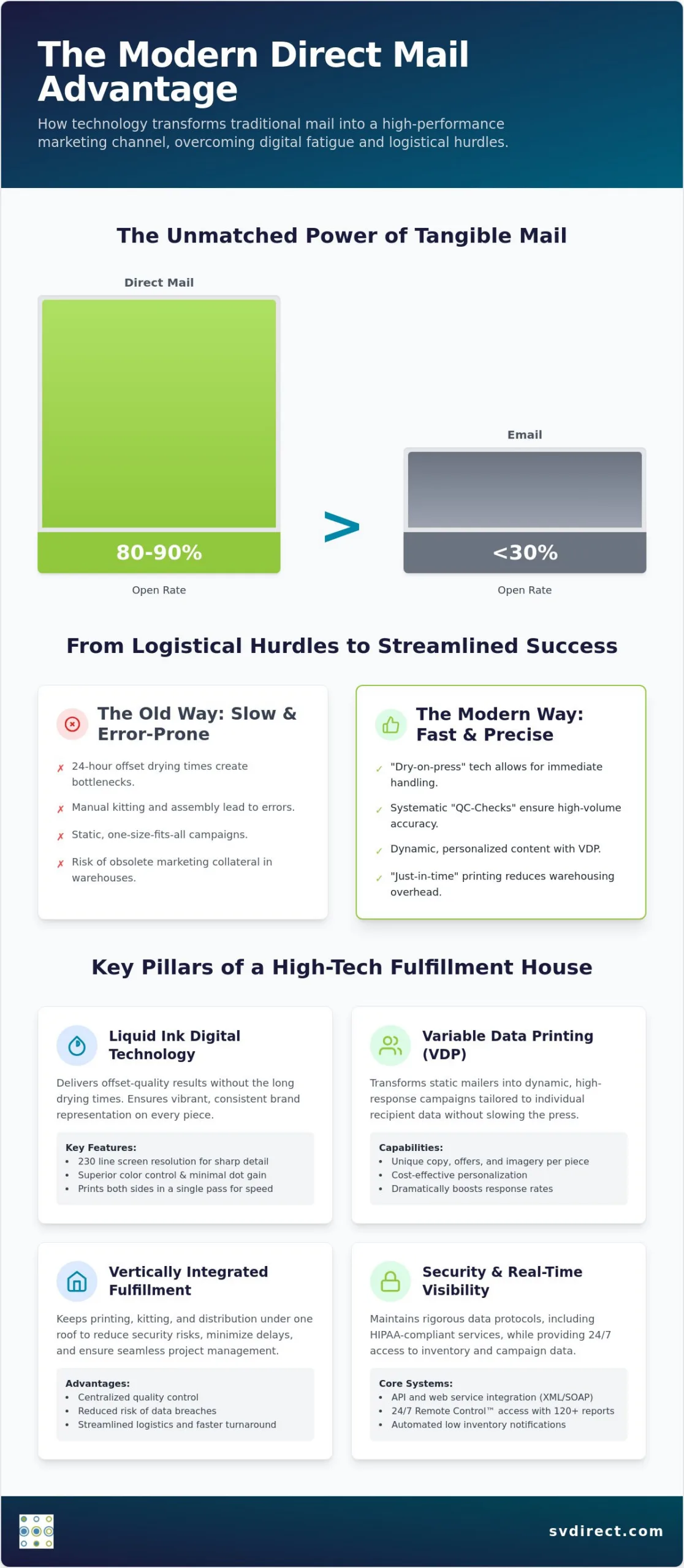
Did you know that direct mail currently boasts a staggering 80 to 90 percent open rate, while email often struggles to reach 30 percent? In an era defined by digital fatigue, the tangible nature of a well-executed mail piece has become a premium differentiator for growing brands. However, the traditional process is often bogged down by slow offset drying times and manual kitting errors that stall your momentum. Finding a modern direct mail fulfillment house is the key to transforming these logistical hurdles into a streamlined competitive advantage.

We understand the pressure of managing complex customer lists while demanding absolute data security and real-time inventory visibility. It’s a high-stakes environment where precision is the only acceptable standard. This guide promises to show you how a marriage of liquid ink technology, API-driven automation, and seasoned human oversight can scale your marketing impact. We’ll preview the shift toward “just-in-time” mailing cycles and personalized, data-driven campaigns that reduce your overhead and build lasting trust with your audience.

Key Takeaways

  • Learn how modern Variable Data Printing (VDP) transforms static mailers into dynamic, high-response campaigns tailored to individual recipient data.
  • Discover why partnering with a vertically integrated direct mail fulfillment house reduces security risks by keeping printing, kitting, and distribution under one roof.
  • Understand the importance of HIPAA-compliant mailing services and rigorous data protocols for protecting sensitive customer information in specialized industries.
  • Explore the technical benefits of liquid ink digital technology, which delivers offset-quality results without the long drying times of traditional printing methods.
  • Identify strategic kitting and literature fulfillment techniques that ensure complex promotional materials and manuals are distributed with global precision.

Beyond the Mailbox: Why Modern Direct Mail Fulfillment Requires a High-Tech Approach

A successful Direct Mail Marketing campaign is only as effective as the infrastructure supporting it. Today, a direct mail fulfillment house acts as a specialized 3PL partner that manages the entire lifecycle of your project, from high-resolution digital printing to global distribution. This high-tech approach replaces the manual, error-prone methods of the past with a streamlined, digital-first workflow.

Speed serves as a primary competitive advantage. Traditional offset printing often requires a 24-hour drying period before materials can be handled, creating a bottleneck in your supply chain. Modern “dry-on-press” technology eliminates this delay, allowing for immediate kitting and assembly. This capability supports “just-in-time” printing, which reduces warehousing overhead and ensures your marketing collateral never becomes obsolete while waiting in a warehouse.

The Liquid Ink Advantage: Quality Meets Efficiency

Liquid ink technology provides a level of precision that standard dry toner simply can’t match. It offers superior color control and minimal dot gain, resulting in vibrant, consistent brand representation across every piece. By utilizing a 230 line screen resolution, we produce sharp, detailed images that rival the quality of traditional offset presses. To maximize operational speed, the HP Indigo press prints both sides of the substrate in a single pass, ensuring your campaign moves from the press to the mailbox without unnecessary pauses.

Variable Data Printing (VDP) and Personalization

The transition from static to dynamic content is the most effective way to boost modern response rates. Variable Data Printing (VDP) allows every sheet to feature unique copy, personalized offers, or specific imagery without interrupting the press run. This level of customization is remarkably cost-effective, as personalized mailings typically cost not much more than static color jobs. Integrating on-demand digital printing into your workflow allows you to scale your impact while maintaining a personal touch with every recipient.

Key Criteria for Evaluating a Direct Mail Fulfillment Partner

As the SBA notes, Direct Mail is Hot Again because it offers a tangible connection that digital channels lack. However, that connection depends on operational precision. High-performance partners don’t just mail items; they provide the infrastructure to manage growth without the stress of manual oversight.

Proprietary Technology and Real-Time Visibility

Marketing leaders shouldn’t have to wait for business hours to check their inventory levels. You deserve 24/7 access to place orders and generate detailed reports. Our Remote Control™ system provides over 120 standard reports, giving you total transparency into your campaign’s progress. Automated notifications for low inventory or backorders prevent costly interruptions. This visibility allows you to make data-driven decisions on the fly. If you’re ready to see how this transparency works, you can request a personalized consultation to discuss your specific needs.

Programmatic Integration (API and Web Services)

Modern workflows demand more than manual data entry. We utilize programmatic web services, including XML and SOAP protocols, to bridge the gap between your business tools and our facility. These platform-agnostic services integrate with any operating system or programming language. We also provide a dedicated system testing page. This allows your developers to verify data methods in real time, ensuring a flawless launch before the first piece of mail ever hits the press. This technical foundation ensures your direct mail fulfillment house is an asset, not a bottleneck.

Direct Mail Fulfillment House: The Strategic Guide to Modern Mailing in 2026

Optimizing Your Campaign with Integrated Logistics and Kitting

A high-performance direct mail fulfillment house should operate as a steady hand for your business growth. We view our role as an extension of your marketing team rather than just a vendor. This partnership is anchored by our “Quiet Facility” methodology, where organized inventory controls and a methodical pace remove the chaos often associated with high-volume mailing projects. By maintaining a calm, disciplined environment, we ensure that every piece of collateral is accounted for and every kit is assembled with absolute precision.

This level of organization is essential for complex literature fulfillment. Whether you’re distributing technical manuals, corporate brochures, or media press kits, our facility manages the entire lifecycle of these materials. For industries such as manufacturing that rely on precise technical records, tools like SOCWeld provide an excellent example of how digital documentation can be automated for maximum accuracy. We don’t just store your items; we actively manage them to prevent obsolescence and ensure that your latest marketing messages are always the ones reaching your customers’ hands.

From Tradeshows to Global Distribution

Managing event logistics requires a proactive stance to maximize ROI. We handle the intricate pre-show assembly of promotional materials and the post-show processing of inventory returns. Navigating international logistics from a central hub requires a deep understanding of global shipping standards. Our team ensures your materials move seamlessly across borders, maintaining brand consistency worldwide. For a deeper look at how these physical touchpoints drive engagement, explore our Direct Mail Marketing Services pillar.

Proactive Problem Solving in Fulfillment

We value transparency and directness in every interaction. A “make-it-right” attitude is essential for identifying potential order conflicts or data discrepancies before they impact your project timeline. Rigid procedures often fail when faced with unique project goals, so we prioritize flexibility and bespoke problem-solving to meet your specific needs. This commitment to high-stakes accuracy is particularly critical for healthcare mailing services, where precision and compliance are the foundation of every campaign.

Future-Proof Your Marketing with Seasoned Operational Excellence

The evolution of physical marketing in 2026 demands a sophisticated blend of technical innovation and human expertise. By prioritizing liquid ink precision and programmatic integration, you can achieve the high-impact response rates your brand deserves. A truly strategic direct mail fulfillment house serves as more than just a vendor; it acts as a steady hand that manages the complexities of global logistics and data security while you focus on high-level strategy.

Silicon Valley Direct has provided this level of dedicated service since 1999. With over 25 years of fulfillment expertise, we combine the offset quality of the HP Indigo 5500 Digital Press with the total transparency of our proprietary Remote Control™ data management system. This ensures your campaigns are executed with surgical accuracy and full visibility from start to finish. We’re ready to help you navigate the future of physical engagement with confidence and ease.

Partner with Silicon Valley Direct for your next campaign and experience the difference that seasoned precision makes. We look forward to helping you scale your impact and build lasting connections with your audience.

Frequently Asked Questions

What is the difference between digital and offset printing for direct mail?

Digital printing provides immediate turnaround because it lacks the 24-hour drying time required by traditional offset methods. While offset is ideal for static, high-volume runs, our HP Indigo 5500 utilizes liquid ink to deliver offset-quality results with the flexibility of a digital workflow. This allows for sharper images at a 230 line screen resolution without the delays of plates or lengthy drying periods.

How does variable data printing (VDP) improve direct mail response rates?

Variable Data Printing (VDP) boosts response rates by allowing for 1:1 personalization of every mail piece. Instead of a generic message, you can tailor copy, images, and offers to the specific needs of each recipient based on your data. This relevance captures attention more effectively than static mailers, which leads to significantly higher engagement levels for your direct mail fulfillment house campaign.

Is a direct mail fulfillment house HIPAA compliant?

HIPAA compliance is a standard requirement for any fulfillment partner handling sensitive medical or personal data. This ensures that protected health information is handled with the highest level of confidentiality during the printing and mailing process. Our facility utilizes secure data transfers and systematic quality controls to maintain these rigorous standards for all healthcare mailing services, providing a steady hand for high-stakes projects.

How long does it take for a direct mail campaign to be processed and mailed?

Most direct mail campaigns can be processed and mailed within a few business days thanks to the speed of digital printing. Because our liquid ink technology is dry-on-press, kitting and assembly can begin immediately after the pieces leave the press. This supports “just-in-time” mailing cycles that keep your marketing collateral relevant and timely without the delays common in traditional facilities.

Can I integrate my CRM with a direct mail fulfillment system?

You can seamlessly integrate your CRM or existing business tools with our fulfillment system using programmatic web services. We support XML and SOAP protocols to automate data transfers, which eliminates the need for manual file uploads. Our platform-agnostic approach ensures compatibility with any operating system, allowing your marketing team to trigger mailings directly from your established software environment with confidence.

What are the benefits of in-house printing and fulfillment?

Centralizing printing, kitting, and distribution under one roof minimizes security risks and logistical bottlenecks. When your direct mail fulfillment house manages the entire lifecycle in-house, there’s no need to transport materials between multiple vendors. This integrated approach also provides you with real-time inventory visibility and a single point of accountability. Our team provides direct human oversight at every stage to ensure technology and expertise work in perfect harmony.

Direct Mail for Healthcare Providers: The 2026 Guide to Compliant, High-Response Outreach

Did you know that direct mail for healthcare providers currently yields a 4.4% response rate, outperforming email by a staggering 3,500%? In an era where digital inboxes are perpetually overflowing, physical mail has become the most effective way to capture a physician’s attention. You likely already feel the pressure of reaching busy medical professionals while managing the anxiety of strict compliance. With potential annual penalties for HIPAA violations reaching over $2.1 million in 2026, the fear of a data breach can often stall even the most creative marketing efforts.

We’re here to show you that security and high engagement don’t have to be mutually exclusive. This guide will help you leverage variable data printing and precision logistics to execute secure, high-impact campaigns that drive measurable results. You’ll discover how to achieve offset-quality results with real liquid ink while ensuring every piece of protected health information remains entirely secure. We’ll preview the 2026 landscape of healthcare outreach, from understanding new USPS rates to seamlessly integrating physical mail with your digital CRM data.

Key Takeaways

  • Master the complexities of HIPAA compliance by moving beyond digital encryption to secure physical handling and audited data destruction protocols.
  • Increase engagement rates by utilizing variable data printing to personalize direct mail for healthcare providers with NPI numbers and localized clinic data.
  • Achieve offset-quality medical imagery and sharp text using HP Indigo 5500 liquid ink technology, ensuring your outreach reflects professional clinical standards.
  • Streamline your campaign logistics by integrating on-demand digital printing directly with medical kitting and fulfillment to reduce inventory overhead.
  • Gain total transparency into your campaign’s progress with 24/7 inventory and order tracking through a proprietary Remote Control™ management system.

The Foundation of Security: Executing HIPAA-Compliant Direct Mail

Compliance in healthcare marketing isn’t just a buzzword; it’s a rigorous operational standard that protects both your reputation and your bottom line. Executing secure direct mail for healthcare providers requires a deep understanding of the HIPAA (Health Insurance Portability and Accountability Act) that extends far beyond basic digital encryption. While some vendors focus solely on secure file transfers, true compliance must encompass physical handling, audited data destruction, and the mandatory execution of a Business Associate Agreement (BAA) to mitigate the risk of significant regulatory penalties.

A critical component of this security is our “quiet facility” methodology. By maintaining a highly organized, low-distraction production environment, we eliminate the risk of cross-contamination between sensitive data sets. This disciplined approach ensures that a physician’s NPI number or a specific treatment category never ends up in the wrong envelope. We combine this with rigorous data cleansing and list procurement strategies. These steps ensure your budget isn’t wasted on undeliverable mail while maintaining the integrity of your provider database through every mailing cycle.

Data Integrity and Secure OMS Integration

Security begins at the moment of data transfer. We utilize XML and SOAP protocols to establish a programmatic interface between your CRM and our fulfillment center. This creates a seamless, encrypted pipeline for order submission that removes the need for manual file handling. Once your data enters our system, our proprietary Remote Control™ platform provides real-time reporting. You can track every mailpiece through the workflow with 24/7 transparency, ensuring complete accountability for every record processed.

Physical Security Standards for Medical Materials

The integrity of your outreach also depends on how materials are stored before they reach the mailbox. We maintain climate-controlled, secure warehousing for sensitive healthcare literature and premium kitting items. This prevents the degradation of high-quality prints and ensures that medical samples remain stable. Every project undergoes a systematic QC-Check process. This multi-stage human verification ensures 100% accuracy in high-stakes medical mailings, providing a steady hand in an industry where precision is the only acceptable standard.

Maximizing Provider Response with Variable Data Printing (VDP)

Success in direct mail for healthcare providers hinges on a single moment: the seconds between a physician picking up an envelope and deciding whether to open it. Static, mass-market mailers often fail because they lack relevance. High-resolution, personalized content cuts through digital fatigue by speaking directly to the provider’s specific practice or specialty. By following the official HHS guidance on marketing, we ensure these personalized touches remain fully compliant while maximizing the impact of your message.

Physicians are trained to notice details. When a mailpiece includes their specific NPI number or references a localized clinic address, the perceived value of the communication increases. This isn’t just about aesthetics; it’s about establishing a professional connection that respects the provider’s time and expertise. This strategic approach ensures your outreach is seen as a relevant resource rather than generic solicitation.

Personalization Strategies for 2026

Modern VDP allows us to customize every sheet with unique provider names, NPI numbers, or localized clinic data. For clinical trial recruitment, this means tailoring materials based on a provider’s specific geographic patient base and medical specialty. Variable Data Printing (VDP) enables the insertion of unique copy on every individual sheet within a single print run without significantly increasing production costs. This level of precision transforms a generic flyer into a targeted clinical tool that resonates with the recipient’s daily workflow.

The Quality Advantage: Liquid Ink vs. Toner

Visual credibility is paramount when communicating with medical professionals. We utilize HP Indigo 5500 digital presses, which use real liquid ink rather than dry toner. This technology provides superior color density and dot gain control, resulting in a finish that rivals traditional offset printing. Combined with our 230 line screen resolution, medical imagery appears sharp, professional, and accurate. Toner-based systems often struggle with the fine details and smooth gradients required for high-end healthcare brands. You can learn more about our on-demand digital printing capabilities to see how we maintain these standards.

If you’re ready to see how high-resolution personalization can elevate your next campaign, you can request a free quote from our team of experts.

Direct Mail for Healthcare Providers: The 2026 Guide to Compliant, High-Response Outreach

Integrating Kitting and Fulfillment into Healthcare Campaigns

Effective direct mail for healthcare providers often requires a strategy that goes beyond the standard envelope. High-impact outreach frequently involves complex educational packets, medical device samples, or promotional kits that require precise, manual assembly. By integrating our on-demand digital printing directly with these assembly workflows, we provide a “Just-In-Time” advantage. This approach minimizes your storage costs and ensures that every piece of literature contains the most current clinical data. It also provides the flexibility needed to scale seamlessly from small physician-targeted pilots to full-scale national pharmaceutical launches.

Adhering to the HIPAA Privacy Rule for marketing is essential when kitting materials that may contain sensitive provider or patient information. Our dedicated assembly team operates within a controlled environment, utilizing rigorous QC-Check procedures to maintain 100% accuracy. This human oversight serves as a critical safeguard. We act as a steady partner in a fast-paced industry, ensuring that the physical handling of your materials is just as secure as the digital data transfer.

Literature and Premium Item Management

Maintaining a real-time inventory of clinical brochures, user manuals, and press kits is vital for responding immediately to lead inquiries. You can explore our comprehensive healthcare mailing services to see how we manage these assets with precision. We ensure your premium items and literature are always ready for deployment, whether you are targeting a local clinic or a global hospital network.

Proactive Problem Solving in Logistics

A successful national rollout requires anticipating postal delays or inventory conflicts before they impact your timeline. We leverage our Remote Control™ system to track global shipping and logistics for B2B provider kits with total transparency. This proactive stance allows us to identify and resolve potential bottlenecks in real time. Our seasoned experts provide the personal oversight necessary to guide your most complex healthcare campaigns to a successful conclusion.

Elevating Your Healthcare Outreach with Precision

With over 25 years of fulfillment expertise and our proprietary 24/7 Remote Control™ tracking system, we act as a steady, reliable extension of your marketing team. This level of oversight ensures every piece of direct mail for healthcare providers is handled with the precision and security your brand deserves. We’re ready to help you navigate the complexities of medical logistics with a human touch and high-tech efficiency. Our commitment to accuracy means you can focus on strategy—whether that involves scaling your market presence or consulting with Healthcare Biz Brokers, Inc. on the valuation and sale of healthcare-related entities—while we handle the operational heavy lifting.

Partner with Silicon Valley Direct for your next healthcare mailing campaign to experience a turnkey solution that prioritizes security and measurable response. We look forward to building a high-performance partnership that drives your business growth forward with absolute reliability.

Frequently Asked Questions

Is direct mail for healthcare providers still effective in 2026?

Direct mail for healthcare providers is exceptionally effective in 2026, often yielding response rates as high as 4.4% compared to just 0.12% for email. This performance gap exists because physicians are overwhelmed by digital noise but still value tangible, high-quality professional literature. Physical mailers provide a sensory experience that establishes trust and authority, making them a primary choice for high-stakes medical marketing and clinical recruitment.

How does Silicon Valley Direct ensure HIPAA compliance during the mailing process?

We maintain HIPAA compliance through a combination of technical encryption and strict physical operational standards. Every project begins with a signed Business Associate Agreement (BAA) and uses secure SFTP or TLS 1.2+ for all data transfers. Within our facility, we utilize a “quiet facility” methodology to prevent data errors, followed by audited destruction of all sensitive materials to ensure Protected Health Information (PHI) is never compromised.

What is the difference between digital and offset quality for medical printing?

Standard digital printing typically uses dry toner, but our HP Indigo 5500 technology utilizes real liquid ink to deliver results that rival traditional offset presses. This liquid ink provides superior color density and dot gain control, which is critical for medical imagery. With a 230 line screen resolution, our digital process offers the high-end aesthetics of offset printing without the long lead times or high setup costs of traditional methods.

Can I track my healthcare mailing campaign in real-time?

You can monitor your entire direct mail for healthcare providers campaign in real time through our proprietary Remote Control™ system. This secure portal provides 24/7 access to your inventory levels, assembly status, and shipping logs. By offering total transparency into the fulfillment workflow, we allow you to manage global logistics and physician outreach from a single, centralized dashboard, ensuring you always know exactly where your materials are in the process.

Direct Mail Automation Services: The 2026 Strategic Guide to High-Resolution Growth

84% of marketers now agree that direct mail delivers a higher ROI than any other channel, yet many organizations still treat it as a slow, manual process. You likely recognize the power of a tangible touchpoint to cut through digital fatigue, but you shouldn’t have to settle for the errors of manual list uploads or the lackluster look of standard digital printing. Investing in direct mail automation services is no longer just about convenience. It’s about scaling your brand with the same precision and speed you expect from your digital stack.

We understand that your physical mail must function as a seamless extension of your high-tech operations. This guide reveals how to bridge the gap between digital triggers and high-resolution physical execution. You’ll learn how to achieve offset-quality results using HP Indigo liquid ink technology while maintaining 24/7 visibility into your inventory and mail status. From XML integrations to proactive problem-solving, we’ll show you how to turn direct mail into a high-performance, automated growth engine for 2026.

Key Takeaways

  • Learn how to bridge the gap between digital customer triggers and physical delivery to create a seamless, high-impact marketing journey.
  • Discover how direct mail automation services utilize secure XML and SOAP integrations to connect your CRM directly to the printing press for real-time responses.
  • Understand why liquid ink technology and high-resolution printing are essential for maintaining offset-quality standards in an automated environment.
  • Identify the critical role of precision logistics and 24/7 inventory visibility in scaling your automated campaigns from startup to enterprise levels.

What Are Direct Mail Automation Services? (The Digital-to-Physical Bridge)

Direct mail automation services represent the technical evolution of traditional outreach. It’s the infrastructure that allows a digital event, like an abandoned shopping cart or a subscription renewal, to trigger a physical piece of mail without a human ever touching a spreadsheet. Historically, companies relied on “batch and blast” methods, sending thousands of identical pieces on a fixed schedule. Today, the focus has shifted to behavior-driven retargeting. This transformation eliminates the friction of manual list management and drastically reduces human error. While a standard Graphic User Interface (GUI) works for small batches, true enterprise scale requires a programmatic interface. An API allows your systems to talk directly to the fulfillment floor, ensuring that your physical marketing is as agile as your digital ads. To understand the foundation of these efforts, it’s helpful to look at the broader context of What is Direct Mail? and how it integrates with modern logistics.

The Role of Web Services in Modern Mailing

Modern mailing depends on robust data exchange protocols. We utilize XML and SOAP (Simple Open Object Protocol) to create a seamless bridge between your CRM and our fulfillment center. By leveraging WSDL (Web Service Description Language), we provide a platform-agnostic integration that works regardless of your internal tech stack. This isn’t just about sending data; it’s about execution. Through specific AddOrder methods, your system can submit real-time orders that enter our workflow immediately. This level of technical depth ensures that your direct mail automation services aren’t just a separate vendor, but a proactive extension of your own team.

Remote Control™: 24/7 Visibility into Automated Workflows

Automation loses its value if you can’t see what’s happening. Our proprietary Remote Control™ system provides 24/7 visibility into every automated workflow. You don’t have to guess if a campaign launched or if your stock is running low. The system provides real-time reporting on tracking progress and inventory levels. You’ll receive automated notifications for receipts, backorders, and low inventory thresholds. This transparency allows you to manage your physical assets with the same ease as a digital dashboard. You can Learn more about our Remote Order Management system to see how we maintain this high level of operational readiness and total flexibility.

5 Steps to Building an Automated Direct Mail Workflow

Transitioning from a digital signal to a physical mailbox requires a methodical approach that prioritizes both speed and quality. Success in building an automated workflow depends on moving beyond simple software syncs to a holistic operational strategy. Start by identifying high-intent triggers, such as an abandoned cart or an upcoming subscription renewal. Once these are defined, you’ll connect your CRM to our direct mail automation services using secure web services. This connection allows for the design of templates ready for Variable Data Printing (VDP), where every sheet features unique imagery or copy tailored to the recipient. When selecting direct mail automation services, the quality of the physical output is just as important as the code that triggers it. We utilize liquid ink technology to ensure your brand maintains a premium feel that toner-based systems can’t match. Finally, establish tracking using unique IDs or QR codes to close the attribution loop and measure campaign effectiveness in real time.

The Variable Data Advantage

Personalization at scale doesn’t have to break your budget. By using VDP, you can customize every piece of mail for the individual recipient without slowing down the press. Our HP Indigo 5500 technology delivers 230 line screen resolution, providing sharp, detailed imagery that rivals high-end offset printing. This ensures your automated mail looks as sophisticated as your digital presence. You can explore our Print-on-Demand capabilities to see how we handle these high-resolution requirements with precision.

Proactive Quality Control in Automation

Automated systems are incredibly efficient, but they still require expert oversight to prevent errors in complex kitting. We anticipate data conflicts before the press runs, which saves you from wasted postage and production delays. This proactive stance ensures that even the most intricate workflows remain accurate and reliable. If you’re looking for a partner that treats your brand with this level of care, feel free to request a free quote today. Our team is ready to help you optimize your fulfillment services for maximum growth and reliability.

Direct Mail Automation Services: The 2026 Strategic Guide to High-Resolution Growth

Why Precision Logistics Define Automation Success

A digital trigger is only as effective as the physical infrastructure behind it. While software initiates the process, the actual speed of direct mail automation services is determined by warehouse efficiency and immediate handling. Our reliance on liquid ink technology allows for rapid drying and immediate post-print processing. This eliminates the delays common in traditional offset methods. Whether you’re a startup sending 500 targeted pieces or an enterprise managing millions, a deliberate and organized methodology is essential for meeting strict deadlines. By treating these physical assets as part of your automated marketing campaigns, you ensure that your brand’s reach is backed by tangible operational readiness.

We view our role as a proactive extension of your team rather than a simple vendor. This philosophy ensures that human expertise oversees every automated run, preventing your communications from ever feeling like impersonal junk mail. Digital automation also supports sustainability by removing the need for traditional plates, films, and harsh chemicals. This streamlined approach reduces waste and aligns your high-resolution growth with modern environmental standards. It’s a cleaner, more efficient way to scale without sacrificing the personal touch that defines your brand.

Integrated Kitting and Assembly

True impact often requires more than a single postcard. We combine automated print with complex physical product fulfillment to create high-impact promotional kits. Our systematic inspection protocols ensure that every one of the thousands of shipments remains consistent with your brand standards. You can read our customer testimonials on complex project success to see how we manage these intricate details with a steady hand and a commitment to precision.

Compliance and Security in Automated Mailing

For organizations in sensitive sectors like healthcare and finance, security is non-negotiable. Our direct mail automation services operate within a secure warehousing environment that prioritizes data integrity and physical safety. This level of oversight is a hallmark of our internal stability and multi-decade history. Explore our specialized Healthcare Mailing Services to learn how we balance high-tech automation with the rigorous compliance standards your industry demands.

Scaling Your Brand with High-Resolution Precision

The future of direct mail lies in its ability to function as a responsive, high-fidelity extension of your digital ecosystem. You’ve seen how bridging the gap between web triggers and physical delivery requires more than just software; it demands a marriage of secure integrations and world-class print technology. To stay ahead in this evolving landscape, mastering the tools behind the automation is essential. CYBERSIDE.AI provides the specialized training and playbooks needed to integrate generative AI into your broader marketing strategy. By prioritizing offset-quality output and 24/7 visibility, you transform a traditional channel into a precision-engineered growth engine. This approach doesn’t just save time. It builds trust through consistent, high-impact communication that resonates with your audience.

Our infrastructure is built to support this evolution. We leverage the HP Indigo 5500 Digital Press to deliver 230 line screen resolution, ensuring your physical touchpoints are as sharp as your digital ads. With our proprietary Remote Control™ system, you maintain total oversight of your inventory and mail status at any hour. This combination of technical depth and operational readiness allows you to scale with confidence. If you’re ready to move beyond manual processes and elevate your outreach, partner with Silicon Valley Direct for proactive automation. Our team is here to help you master direct mail automation services with a steady hand and a commitment to your long-term success. Let’s build a workflow that delivers measurable results and lasting brand impact.

Frequently Asked Questions

How does automated direct mail improve response rates compared to traditional methods?

Automated direct mail boosts engagement by delivering messages when they’re most relevant to the recipient’s journey. Traditional methods often rely on broad batches that miss the window of interest. For example, a financial service provider like QuickCashDirect can use these triggers to reach customers exactly when they need assistance. By triggering mail based on real-time data, you can achieve response rates as high as 4.4 percent; this is much higher than the 0.12 percent average for email. Adding a recipient’s name alone can increase these response rates by up to 135 percent.

Is variable data printing (VDP) more expensive than standard digital printing?

Variable Data Printing is a highly efficient investment because it removes the expensive setup costs associated with traditional customization. While static printing might seem cheaper for massive, identical runs, it lacks the personalization that drives modern growth. Our direct mail automation services allow you to print unique content for every recipient without manual intervention. This approach maximizes your ROI by ensuring every piece of mail is tailored to a specific customer’s needs.

What is the difference between liquid ink digital printing and standard toner?

The primary difference lies in the finish and the resolution of the final product. Standard toner sits on top of the paper, creating a waxy sheen that can crack when the mail is folded. Our HP Indigo 5500 uses liquid ink technology to penetrate the paper fibers, resulting in a 230 line screen resolution. This achieves the look and feel of high-end offset printing while maintaining the speed and flexibility of a digital workflow.

Can I integrate my existing CRM with direct mail automation services?

Most modern CRM platforms integrate seamlessly with our direct mail automation services using secure XML and SOAP protocols. We use WSDL to provide a platform-agnostic connection, meaning your current tech stack can likely communicate directly with our fulfillment center. This integration allows for proactive order submission via AddOrder methods. It ensures your physical marketing remains as agile and data-driven as your digital campaigns without requiring manual data entry or file uploads.

How is mail delivery tracked in an automated system?

We track mail delivery through a combination of digital identifiers and our proprietary Remote Control™ system. This provides you with 24/7 visibility into your inventory levels and the status of every outgoing piece. You can also incorporate unique QR codes or personalized URLs into your design. These tools allow you to measure engagement in real time and attribute conversions directly to your automated campaigns, closing the loop on your marketing data.

Is automated direct mail suitable for short-run, personalized campaigns?

Automated direct mail is perfectly suited for short-run campaigns that require high levels of personalization. Digital printing eliminates the need for expensive plates and long setup times; this makes small batches financially viable. You can trigger as few as one piece of mail based on a specific customer action. This flexibility allows you to run highly targeted re-engagement or welcome programs that would be impossible with traditional, volume-heavy mailing methods.

Demand Forecasting for eCommerce Inventory: The 2026 Strategic Guide

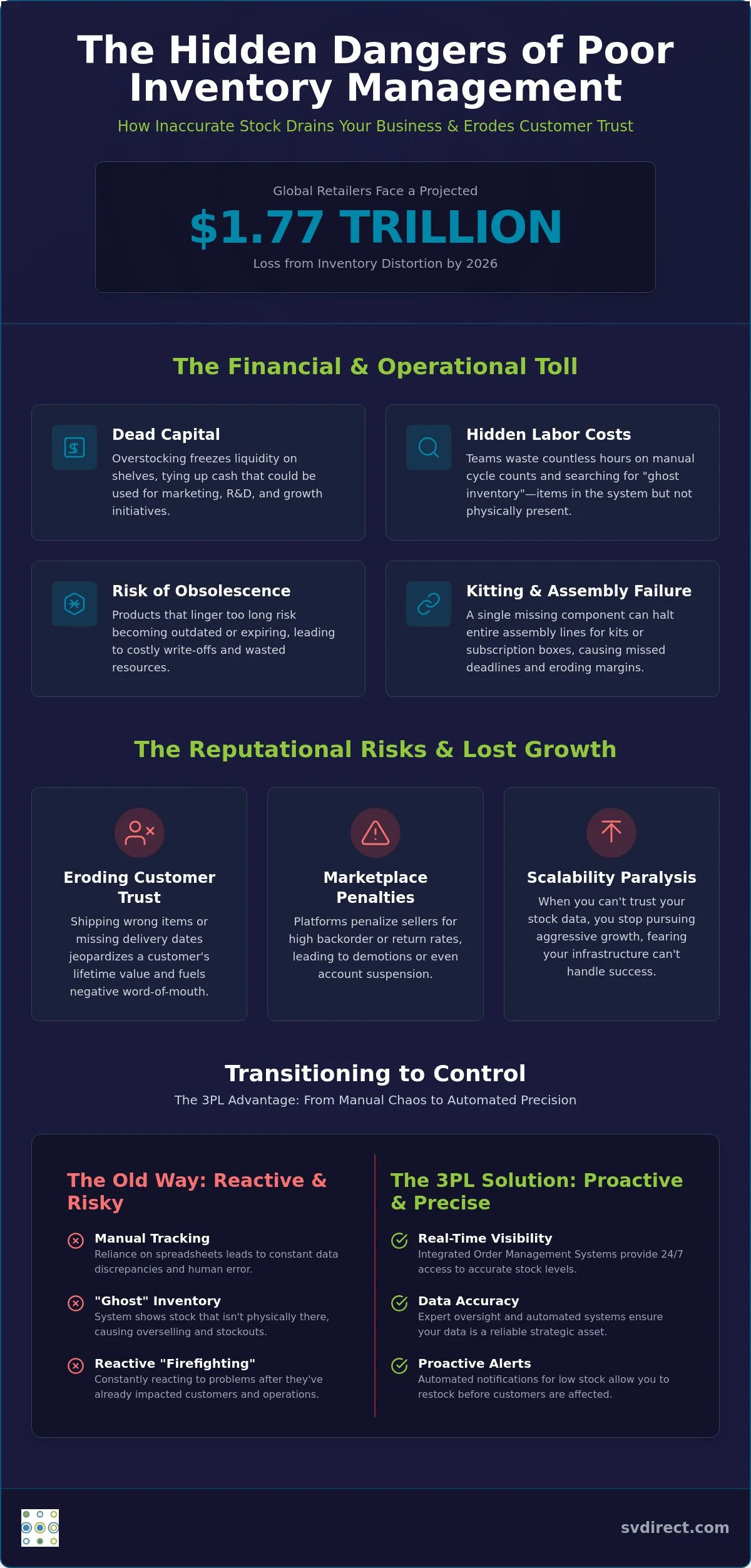
Did you know that inventory distortion, the combined loss from stockouts and overstock, is estimated to cost global retail $1.77 trillion annually? For many growing brands, this isn’t just a statistic; it’s a daily reality where capital stays locked in slow-moving products while customers are turned away by out-of-stock notices. Mastering demand forecasting for ecommerce inventory has become the definitive line between businesses that scale and those that struggle with stagnant cash flow. You’ve likely felt the sting of inaccurate lead times or the stress of managing a replenishment cycle that feels more like guesswork than strategy.

We understand that your inventory represents more than just units; it’s the lifeblood of your marketing budget and growth potential. This 2026 strategic guide promises to equip you with the data-driven techniques and 3PL integration secrets needed to eliminate stockouts for good. You’ll learn how to leverage real-time visibility to optimize your capital and create a seamless partnership with your fulfillment provider. We’re moving beyond static spreadsheets to show you how a proactive, tech-forward approach to demand planning can turn your warehouse operations into a competitive advantage.

Key Takeaways

  • Transition from static spreadsheets to real-time demand sensing to capture immediate market shifts and social signals.
  • Balance quantitative data with expert qualitative insights to build a more resilient and accurate inventory strategy.
  • Master demand forecasting for ecommerce inventory by establishing a direct data integration between your storefront and your fulfillment partner.
  • Leverage automated “Low Inventory” notifications and safety stock triggers to proactively manage replenishment before stockouts occur.
  • Optimize your working capital and improve cash flow by creating a predictable replenishment cycle backed by real-time visibility.

What is Demand Forecasting for eCommerce Inventory?

Demand forecasting is the predictive process of estimating future customer orders to ensure your stock levels align perfectly with market appetite. It’s more than just looking at last year’s sales. It’s a strategic calculation that allows you to optimize stock levels and protect your margins. In 2026, the industry has shifted away from the slow, error-prone world of static spreadsheets. We’ve entered the era of real-time demand sensing, where live data signals from various channels dictate your replenishment needs rather than outdated gut feelings.

Successful demand forecasting for ecommerce inventory requires a two-pronged view. Macro-level forecasting looks at broad market trends and economic shifts that affect entire categories. Micro-level forecasting drills down into SKU-specific performance, identifying which variations are gaining velocity and which are slowing down. You can’t make these decisions in a vacuum. Clean, reliable data is the only foundation for a trustworthy prediction. Our Remote Control™ system acts as your single source of truth, providing the 24/7 visibility needed to separate actionable signals from noise.

The Core Benefits of Accurate Predictions

Precision in your numbers does more than just fill shelves. It directly impacts your bottom line by reducing “dead capital.” When you aren’t overstocking slow-moving items, your cash stays liquid for reinvestment in marketing or product development. Accurate forecasts also prevent the disaster of frequent stockouts, which can tank your customer trust and search engine rankings overnight. Beyond that, it allows for the optimization of global shipping services. By predicting demand spikes, you can plan batches effectively and avoid the high costs of emergency air freight.

Key Data Inputs for 2026

Your forecast is only as good as the data you feed it. We recommend focusing on three primary pillars to build a resilient model:

  • Historical Sales Velocity: Track data across all channels, including Shopify, Amazon, and B2B orders, to understand seasonal patterns and growth curves.
  • Marketing Calendars: Factor in planned promotions and direct mail marketing campaigns that drive sudden traffic surges.
  • External Variables: Account for shifting supply chain lead times and economic indicators that influence consumer spending habits.

By integrating these inputs, you create a proactive replenishment cycle that supports steady growth without the stress of inventory imbalances. This methodical approach ensures that your physical operations remain as organized and efficient as your digital storefront.

Maintaining this level of organization often requires dedicated administrative support. Amplify Yourself, LLC helps ecommerce brands scale by sourcing skilled virtual assistants who can manage inventory data and supplier communications, ensuring your forecasting stays on track.

Forecasting Methods: Traditional vs. Real-Time Sensing

Choosing the right method is about balancing hard numbers with human insight. Quantitative methods rely on historical data patterns; qualitative methods use expert judgment and market sentiment. For modern brands, demand forecasting for ecommerce inventory usually requires a hybrid approach. You need the stability of historical trends paired with the agility of current market feedback to navigate a volatile landscape.

Demand sensing represents the next evolution in this process. Instead of relying on what happened last quarter, it analyzes live data from your point-of-sale systems and social signals to adjust short-term stock levels. This shifts your operations from a “Push” model, where you buy inventory based on a guess, to a “Pull” model, where real demand triggers your replenishment. It’s a proactive stance that ensures your capital isn’t sitting idle on a warehouse shelf. If you want to refine these operational layers, you can request a free quote to see how we customize these flows for your specific business needs.

One way to alleviate the pressure of aggressive forecasting is through print-on-demand services. By producing marketing collateral or specific literature only when an order is triggered, you eliminate the risk of overstocking items that might become obsolete. This “just-in-time” approach for physical assets keeps your storage costs low and your messaging current.

Top Forecasting Models for Scaling Brands

  • Moving Average: This is best for stable products with consistent, predictable demand over time. It smooths out random fluctuations to provide a clear baseline.
  • Exponential Smoothing: This model weighs recent sales more heavily. It’s excellent for capturing emerging trends or sudden shifts in consumer behavior before they reach their peak.
  • Trend Projection: We use this for long-term growth patterns to help you plan for high-volume deadlines like Q4 or major product launches, accounting for year-over-year growth.

Handling Inventory for Kitted and Assembled Products

Forecasting becomes significantly more complex when one SKU relies on five different components. If a single insert is missing, the entire order stalls. We utilize “postponement” strategies through our kitting and assembly services. This allows us to keep components in their raw state and assemble the final product only when demand is certain. This flexibility prevents you from locking up capital in finished goods that aren’t moving. Success depends on real-time component tracking in your 3PL interface, ensuring your demand forecasting for ecommerce inventory accounts for every piece of the puzzle in the warehouse.

Demand Forecasting for eCommerce Inventory: The 2026 Strategic Guide

Executing Your Forecast with a 3PL Partner

Execution is where many brands stumble. A forecast remains a mathematical abstraction until it’s translated into physical action on the warehouse floor. To bridge this gap, start by integrating your store directly with your Silicon Valley 3PL. This connection ensures that sales data flows in real time without the risk of manual entry errors. Once the data pipeline is secure, you can set automated “Low Inventory” triggers based on the safety stock levels defined in your model. This proactive step is essential for demand forecasting for ecommerce inventory, as it prevents the stockouts that drive customers toward your competitors.

Physical accuracy is just as vital as digital precision. We recommend conducting regular inventory audits and “QC-Checks” to ensure your physical stock perfectly matches your digital records. Use 24/7 reporting to compare your “forecasted vs. actual” sales figures. This monthly refinement allows you to sharpen your demand forecasting for ecommerce inventory based on real-world performance rather than static assumptions. It’s a methodical cycle that keeps your capital fluid and your shelves ready for the next surge.

Leveraging Remote Control™ for Predictive Power

Our proprietary Remote Control™ system provides the visibility needed to manage high-volume deadlines with quiet confidence. You can utilize over 120 standard reports to quickly identify your “hero” products and the “laggards” that might be draining your capital. Automated email alerts for receipts and backorders act as a proactive safety net, keeping you informed of every inventory movement. This level of precision is only possible in an organized, stable facility where every SKU is tracked with personal oversight.

The Human Element: Proactive Problem Solving

Technology provides the data, but it doesn’t solve every logistical hurdle. You need a partner who listens to your goals and anticipates conflicts before they impact your project. We view our role not as a mere vendor, but as a seamless extension of your team. This human connection ensures that when a supply chain delay occurs or a promotion exceeds expectations, we’re already working on a bespoke solution. It’s the difference between an automated interaction and a steady hand guiding your business through the complexities of global growth.

Scaling Your Brand with Precision and Confidence

Transitioning from reactive guesswork to proactive strategy is the most significant move you can make for your brand’s longevity. By embracing real-time demand sensing and integrating your storefront directly with your fulfillment partner, you eliminate the friction that leads to stockouts and overstock. Effective demand forecasting for ecommerce inventory isn’t just about the math; it’s about having the right infrastructure to act on those numbers immediately.

Silicon Valley Direct offers the physical expertise and digital tools needed to turn your warehouse operations into a growth engine. Our proprietary Remote Control™ system provides 24/7 real-time visibility and 99.9% accuracy, ensuring your data is always a reliable source of truth. We provide seamless integration with platforms like Shopify and WooCommerce, backed by a team that prioritizes proactive problem solving over automated responses.

Streamline your inventory with Silicon Valley Direct's Remote Control™ system.

You don’t have to navigate the complexities of 2026 alone. We’re here to help you build a predictable, efficient replenishment cycle that keeps your business moving forward with total confidence.

Frequently Asked Questions

What is the most accurate demand forecasting method for eCommerce?

A hybrid approach that combines quantitative historical data with real-time demand sensing is the most accurate strategy. Historical sales provide a stable baseline for seasonal patterns, while live signals from social trends and point-of-sale systems allow you to pivot during sudden market shifts. This combination ensures your demand forecasting for ecommerce inventory remains grounded in reality while staying agile enough to capture emerging opportunities.

How often should I update my inventory demand forecast?

You should conduct a comprehensive forecast review at least once a month. This cadence allows you to adjust for upcoming marketing campaigns and shifting supplier lead times. For high-velocity SKUs, we recommend weekly “sensing” checks to compare your actual sales against your predictions. This regular refinement helps you maintain a predictable replenishment cycle and prevents capital from being locked in slow-moving stock.

How does a 3PL help with demand forecasting?

A 3PL serves as your single source of truth by providing real-time data on sales velocity and inventory levels. By integrating your storefront with a system like Remote Control™, you gain access to 120+ reports that are essential for accurate predictions. A proactive partner also helps by setting automated low-stock triggers and managing complex kitting components, ensuring your physical operations perfectly mirror your digital data.

What is the difference between sales forecasting and demand forecasting?

Sales forecasting predicts what you expect to sell based on internal goals and past revenue. Demand forecasting is a more comprehensive calculation that estimates total market appetite, including external economic factors and sales lost due to previous stockouts. While sales forecasts are used for budgeting, demand forecasting is the essential tool for inventory management and preventing fulfillment disasters.

The Dangers of Poor Inventory Management: Protecting Your Bottom Line in 2026

Did you know that inventory distortion, the combined cost of overstocks and out-of-stocks, is projected to drain $1.77 trillion from global retailers in 2026? It’s a staggering figure that highlights the silent, daily drain on your business resources. You’ve likely felt the frustration of capital tied up in stagnant stock or the sting of a loyal customer walking away because of a preventable backorder. These are the immediate and visible dangers of poor inventory management, but the long-term impact on your brand’s reputation and operational agility can be even more damaging.

We believe that inventory shouldn’t be a source of stress, but a strategic asset for your growth. In this article, you’ll discover the critical risks associated with inefficient inventory control and how a proactive 3PL partnership can safeguard your bottom line. We’ll provide a clear roadmap to help you transition from the errors of manual tracking to the precision of automated systems. By the end, you’ll understand how to improve order accuracy and rebuild the customer trust that drives long-term success. Let’s explore how to turn your warehouse operations into a steady hand for your business.

Key Takeaways

  • Learn how to unlock dead capital by identifying overstocking patterns that drain liquidity needed for marketing and growth.
  • Understand the long-term impact of fulfillment errors on customer retention and how to avoid performance penalties on major eCommerce marketplaces.
  • Identify the hidden labor costs associated with manual warehouse searches and the operational drag of managing ghost inventory.
  • Discover how a proactive 3PL partnership mitigates the dangers of poor inventory management through expert oversight and precision.
  • Explore the transition to real-time visibility using integrated Order Management Systems that provide 24/7 access to your stock levels.

The Financial and Operational Toll of Inaccurate Inventory

Inaccurate data isn’t just a clerical error; it’s a financial anchor. When you overstock items based on flawed forecasts, you create “dead capital.” This is liquidity that’s effectively frozen on your warehouse shelves. Instead of funding aggressive marketing campaigns or critical R&D, your cash sits in cardboard boxes. Effective inventory management ensures that every dollar is working toward your growth. The dangers of poor inventory management often manifest as a slow bleed of capital that many businesses don’t notice until their cash flow tightens unexpectedly.

Labor costs compound these issues. Warehouse teams spend countless hours on manual cycle counts or searching for “ghost” inventory, which are items that appear in the system but aren’t physically present. This wasted effort drives up operational overhead while increasing the risk of stockouts. When demand exceeds your poorly tracked supply, you lose immediate revenue. Products that linger too long also risk obsolescence. This leads to painful write-offs as items reach the end of their shelf life before they ever reach a customer.

This challenge is even more pronounced for businesses dealing with perishable goods. Companies like Shift 2 Fresh must maintain impeccable inventory accuracy to ensure that fresh fruits and vegetables imported from the Philippines and South Asia reach UAE consumers before their shelf life expires.

The Ripple Effect on Specialized Services

For businesses relying on kitting and assembly services, inventory errors are catastrophic. A subscription box or a promotional kit is only as complete as its rarest component. If your tracking fails to account for a single missing insert or product, the entire assembly line grinds to a halt. This disruption causes missed shipping deadlines and forces expensive, last-minute course corrections that erode your margins and frustrate your partners.

Operational Friction and Warehouse Morale

A “hectic” warehouse is rarely a productive one. It’s usually a symptom of poor inventory control. When staff are constantly reacting to discrepancies rather than following a streamlined process, morale suffers. We prioritize a quiet, organized facility. This environment is essential for managing high-volume deadlines with precision. High-performance operations require a steady hand and clear data, not a frantic search for misplaced stock. Precision in the warehouse translates directly to confidence in the front office.

Beyond the Balance Sheet: Reputational Risks and Lost Growth

Financial losses are quantifiable, but the damage to your brand identity is often irreversible. One of the most significant dangers of poor inventory management is the steady erosion of customer trust. Shipping the wrong item or missing a promised delivery window doesn’t just cost you a single sale; it jeopardizes the customer’s lifetime value. Research into Reputational Risks confirms that stockouts lead to immediate dissatisfaction and negative word-of-mouth that can haunt your brand for years. In a market where competitors are only a click away, you can’t afford to give shoppers a reason to look elsewhere.

The stakes are even higher on digital marketplaces. Platforms like Amazon and Shopify utilize strict fulfillment metrics to rank and prioritize sellers. Frequent backorders or high return rates triggered by inventory errors can lead to search ranking demotions or total account suspension. This isn’t just a minor hurdle; it’s a loss of access to your primary revenue streams. The dangers of poor inventory management extend to your psychological ability to scale. When you don’t trust your stock data, you experience scalability paralysis. You stop pursuing aggressive growth because you aren’t certain your infrastructure can handle the success.

The Cost of Customer Churn

Calculating the true cost of an error requires looking beyond the immediate shipping fee. You have to consider the high cost of customer acquisition and the revenue that person would have generated over several years. Our customer testimonials reflect how precision in fulfillment transforms one-time buyers into loyal brand advocates. A single bad shipment can destroy that potential in an instant, turning a profitable relationship into a deficit.

The Proactive Solution: Anticipating Problems

We believe in moving away from the “firefighting” mentality common in smaller, manual operations. Our approach focuses on identifying potential conflicts before they impact your project. Instead of reacting to a stockout after it happens, we utilize automated notifications for low inventory levels and potential backorders. This allows you to restock and plan your marketing spend before a customer ever encounters an “out of stock” message. If you’re ready to move from reactive stress to proactive growth, you can consult with our logistics experts to see how we safeguard your brand reputation.

The Dangers of Poor Inventory Management: Protecting Your Bottom Line in 2026

Transitioning to Control: The 3PL Advantage in 2026

Reclaiming control over your supply chain requires more than just a software subscription. It demands a partnership that combines high-tech visibility with physical precision. Moving away from the dangers of poor inventory management starts with real-time data. Our proprietary Remote Control system provides 24/7 inventory access, allowing you to monitor stock levels from any location. This transparency ensures that you aren’t making critical business decisions based on outdated reports or manual spreadsheets.

True efficiency comes from seamless integration. By connecting your eCommerce storefront directly to a professional Order Management System (OMS), you eliminate the communication gaps that cause shipping delays. You also benefit from a scalable infrastructure. Instead of managing the overhead of long-term warehouse leases, you gain access to secure, professional facilities that grow alongside your order volume. This flexible model allows you to invest your capital where it matters most: in your product and your customers.

Technology Meets Human Expertise

Software can track a barcode, but it can’t verify the physical quality of a delicate component. Software alone isn’t enough to guarantee a perfect customer experience. Our “QC-Check” process adds a vital layer of human oversight to every project. By utilizing Silicon Valley 3PL fulfillment services, you bridge the gap between digital clicks and physical delivery. Our team treats your stock as an extension of your own company, ensuring that every kit is assembled correctly and every shipment is accurate.

Strategic Growth through Outsourcing

Outsourcing your logistics frees up your internal resources to focus on brand building and high-level strategy. You don’t need to spend your afternoons counting boxes or troubleshooting backorders. Instead, you can focus on expanding your market reach. Global shipping services become significantly more efficient when your local inventory is managed with precision. This proactive approach mitigates the dangers of poor inventory management and transforms your warehouse from a source of stress into a steady hand that supports your long-term success.

Securing Your Operational Future

Protecting your business in 2026 requires a shift from reactive troubleshooting to proactive precision. We’ve explored how dead capital and marketplace penalties represent the primary dangers of poor inventory management, but these risks are entirely avoidable with the right partnership. Transitioning to a professional 3PL model provides the structural stability needed to scale without the stress of operational friction.

At Silicon Valley Direct, we’ve supported business growth since 1999 through a blend of advanced technology and personal oversight. Our proprietary Remote Control™ system gives you 24/7 real-time visibility, while our rigorous QC-Check process maintains a 99.9% order accuracy rate. This level of detail ensures that your inventory remains an asset, not a burden. Ready to streamline your supply chain? Explore our 3PL solutions today. Let’s build a more resilient future for your brand together.

Frequently Asked Questions

What are the most common signs of poor inventory management?

The most common signs include frequent backorders, high storage costs for slow-moving items, and consistent discrepancies between your digital records and physical stock. You might also notice a rise in customer complaints regarding shipping delays or incorrect items. These symptoms indicate the dangers of poor inventory management and suggest your current tracking methods aren’t keeping pace with your business growth.

How does inventory accuracy affect eCommerce fulfillment costs?

Inventory accuracy directly impacts fulfillment costs by reducing the labor hours spent on manual warehouse searches and cycle counts. When your data is precise, order pickers can locate items instantly, which lowers the cost per order. In contrast, inaccurate data leads to expensive returns management and expedited shipping fees to correct errors, both of which erode your profit margins over time.

Can a 3PL help with inventory management for specialized industries like healthcare?

Yes, a specialized 3PL provides the precision and compliance necessary for healthcare mailing and literature fulfillment. We manage sensitive materials with a focus on traceability and quality control. This expertise is critical because the dangers of poor inventory management in healthcare can include regulatory non-compliance or the distribution of outdated information, making a seasoned partner essential for maintaining industry standards.

What is the difference between reactive and proactive inventory control?

Reactive inventory control involves responding to problems after they occur, such as rushing to restock after a sell-out. Proactive control uses real-time data and automated notifications to anticipate demand and adjust stock levels before issues arise. This forward-looking approach allows you to maintain a steady operational rhythm, ensuring that your capital is always invested strategically rather than spent on emergency fixes.

Warehousing and Distribution Services: A Strategic Reference for 2026

Is your logistics provider a steady partner or a source of constant friction? As the global warehousing and storage market reaches an estimated $869.32 billion in 2026, the difference between scaling your brand and stalling often comes down to the quality of your warehousing and distribution services. It’s frustrating when rigid, “cookie-cutter” processes fail to fit your unique products, or when a lack of real-time visibility leaves you guessing about inventory levels. You deserve a partner that acts as a true extension of your team, providing the stability and precision needed to grow without the stress of high error rates in complex kitting projects.

In this strategic reference, you’ll discover how to evaluate and implement scalable warehousing and distribution services that integrate cutting-edge technology with custom fulfillment. We’ll show you how to achieve seamless integration with your existing eCommerce platforms and gain access to 24/7 reporting data. We’ll also explore the shift toward data-driven orchestration and how a human-centric approach to logistics ensures your supply chain remains both agile and accurate in an increasingly automated world.

Key Takeaways

  • Shift from reactive storage to proactive inventory management by understanding warehousing and distribution as a strategic, integrated 3PL solution.
  • Leverage the ‘Remote Control’ proprietary hub to access 24/7 inventory data and over 120 specialized reports for smarter decision-making.
  • Discover how to implement scalable warehousing and distribution services that integrate with your eCommerce platforms and act as a dedicated extension of your staff.
  • Master the transition to a high-performance logistics partner by focusing on collaborative goal-setting and precision kitting during peak demand cycles.

The Evolution of Strategic Warehousing and Distribution

The logistics industry has moved far beyond the traditional concept of what is a warehouse. In 1999, we began our journey in Silicon Valley, establishing a foundation that prioritizes precision and reliability over mere volume. Today, modern warehousing and distribution services represent an integrated 3PL solution rather than just static storage. This evolution marks a shift from reactive “pick and pack” operations to proactive, data-driven inventory management. For businesses looking to scale beyond regional borders, having a national reach with global shipping capabilities is no longer optional. It’s a strategic necessity.

Key Components of a Modern 3PL Distribution Model

A sophisticated 3PL fulfillment model must provide more than floor space. It requires a high-performance infrastructure designed for accountability and technical readiness. Our approach focuses on three critical areas:

  • Secure, Climate-Controlled Environments: These facilities are essential for protecting high-value or sensitive inventory from environmental degradation.
  • Serial Number Tracking: We utilize granular inventory management systems that ensure total accountability for every unit in the facility.
  • Global Logistics Coordination: By leveraging established carrier relationships, we provide access to discounted rates that directly improve your bottom line.

Why Flexibility Beats ‘Cookie-Cutter’ Logistics

Rigid, automated procedures often fail when faced with the unique demands of a product launch or complex tradeshow fulfillment where standard warehousing and distribution services might fall short. We reject impersonal business models that treat every client the same. Instead, we employ a deliberate methodology that removes the hectic atmosphere common in many facilities. This calm, structured environment ensures that even the most intricate kitting projects are handled with surgical accuracy. By acting as a steady hand and a direct extension of your team, we alleviate the stress of growth through personal commitment and seasoned expertise.

Technology and Value-Added Services: Beyond the Box

Modern warehousing and distribution services in 2026 require more than just physical space; they demand an intelligent digital layer that connects your team to the stockroom. We’ve developed the ‘Remote Control’ system to serve as your central hub. It provides 24/7 transparency, allowing you to move beyond the guesswork of traditional storage. With access to over 120 standard reports, your team can make data-driven decisions based on real-time movement rather than historical assumptions. This level of precision is a hallmark of high-quality value-added logistics services, ensuring every SKU is accounted for and every shipment is optimized for speed and cost.

Remote Control™: Your Window into the Warehouse

Transparency shouldn’t stop at five o’clock. Our proprietary platform offers 24/7 access to place orders, track real-time progress, and retrieve comprehensive order histories. You’ll receive automated notifications for low inventory levels or backorders, which prevents the stockouts that damage customer trust. It’s about giving you total oversight without the need for manual check-ins. Learn more about our remote order management system to see how we bridge the gap between your office and our floor.

Integrated Print and Fulfillment Synergies

Many providers only move boxes, but we integrate production directly into the fulfillment workflow. By utilizing the HP Indigo 5500 Digital Press, we offer on-demand digital printing that creates personalized marketing materials within the standard cycle of our warehousing and distribution services. This variable data capability allows for tailored brochures, manuals, or press kits that ship just-in-time. Our systematic ‘QC-Check’ process adds a vital inspection layer during Strategic guide to kitting and assembly services, ensuring every custom package meets your exact specifications before it leaves our dock. If you’re ready to see how these integrated services can streamline your operations, you can request a free quote from our team today.

Warehousing and Distribution Services: A Strategic Reference for 2026

Implementing a Seamless National Distribution Strategy

Transitioning to a 3PL partner is more than a technical upgrade; it’s a collaborative shift that starts with listening. We prioritize understanding your specific business goals to ensure our warehousing and distribution services act as a seamless extension of your internal team. The strategic role of distribution in the modern economy means that your provider must be proactive. We work to anticipate potential order conflicts or inventory discrepancies before they ever impact your end customer. This level of foresight is especially critical for sectors like healthcare and finance, where secure mailing and strict compliance are non-negotiable requirements.

A Roadmap for 3PL Integration

Effective integration follows a structured, logical path. First, we audit your current fulfillment bottlenecks and data requirements to identify areas for immediate improvement. Next, we establish programmatic interfaces using API or XML for real-time order submission. This ensures your digital storefront and our warehouse floor stay in perfect sync. Finally, we define custom kitting or assembly workflows tailored to your specific product needs. Our “make-it-right” attitude means we don’t just follow a rigid script; we solve problems with a focus on precision and operational readiness.

Building Long-Term Partnerships

Stability is a rare commodity in the logistics world. We take pride in our high staff retention, which ensures that seasoned experts manage your inventory rather than a revolving door of temporary workers. Our “Nine Promises” framework serves as a constant anchor of trust, providing the transparency and accountability you need to scale with confidence. We don’t just move products; we manage relationships through collective experience and personal commitment. If you’re ready to scale with a partner that values accuracy as much as you do, Contact Silicon Valley Direct for a custom fulfillment solution today.

Future-Proofing Your Supply Chain for 2026

Success in the coming years depends on your ability to pivot from basic storage to a sophisticated, integrated model. You’ve seen how the right warehousing and distribution services provide more than just shelf space; they offer a steady hand in a fast-paced market. By prioritizing data-driven orchestration through our proprietary Remote Control™ system and its 120+ standard reports, you gain the transparency needed to make informed decisions at any hour. This high-tech oversight, combined with our Red Dot-quality digital printing, ensures your brand remains agile and professional.

Since 1999, we’ve acted as a dedicated extension of our clients’ teams, combining high-tech efficiency with a human touch. We believe that physical operations should be just as organized as your digital strategy. It’s time to move past rigid, impersonal logistics models and embrace a partnership built on stability, precision, and a multi-decade history of reliability. Streamline your supply chain with Silicon Valley Direct's professional 3PL services. We look forward to helping you reach your next milestone with confidence and clarity.

Frequently Asked Questions

What is the difference between warehousing and distribution services?

Warehousing acts as the foundational storage component, while distribution services represent the active movement of inventory toward the final destination. Selecting a partner that provides integrated warehousing and distribution services ensures a seamless flow from the shelf to the doorstep. While storage focuses on safety and organization, distribution involves the dynamic processes of order fulfillment and carrier coordination. This approach keeps your logistics strategy agile and responsive to shifting customer demands.

How does a 3PL integrate with my existing eCommerce platform?

Integration occurs through programmatic interfaces like API or XML that sync your online storefront directly with our proprietary management system. This connection allows for real-time order submission and automatic inventory updates. It’s a proactive approach that ensures your digital sales data and physical stock levels are always in perfect alignment. By automating this data exchange, we remove the risk of manual entry errors and provide you with instant visibility into every transaction.

Can a warehousing service also handle my marketing collateral and printing?

Yes, we uniquely integrate on-demand digital printing to manage marketing collateral alongside your physical products within our warehousing and distribution services. By using high-performance digital presses, we produce brochures and manuals just-in-time for fulfillment. This synergy eliminates the need for separate vendors and ensures your literature is always current. It’s an efficient way to personalize your marketing efforts without the burden of maintaining large, outdated print inventories.

What security measures should I expect for high-value or sensitive inventory?

You should expect a multi-layered security protocol that includes 24/7 monitoring, secure access controls, and climate-controlled storage for sensitive items. We employ systematic inspection layers and serial number tracking to ensure total accountability for every unit. This rigorous oversight provides the stability needed for high-stakes industries where precision is paramount. Our team-oriented approach ensures that experienced staff members oversee every high-value asset with personal commitment and professional care.

D2C Logistics Solutions: The 2026 Strategic Guide for Scaling Brands

In 2026, the price gap between shipping providers can reach a staggering 40% for identical shipments, yet many brands still treat fulfillment as a fixed cost rather than a strategic lever. You’ve likely felt the sting of the 5.9% general rate increases or the recent removal of the EU de minimis threshold. It’s frustrating to watch your margins shrink while shipping errors and visibility gaps stall your growth. Implementing effective d2c logistics solutions isn’t just about moving boxes. It’s about maintaining brand integrity while managing the new 10% Section 122 surcharge on US imports.

We understand that scaling a brand requires a steady hand and a partner who values precision as much as you do. This guide will help you master the complexities of direct-to-consumer fulfillment using a framework that balances high-tech digital precision with the high-touch human expertise your brand deserves. We’ll examine how to scale custom unboxing experiences, stabilize international shipping costs, and leverage real-time data to turn your supply chain into a competitive advantage.

Key Takeaways

  • Understand the shift toward “Precision Logistics” and how it protects brand margins against rising carrier rates and new international surcharges.
  • Learn how to leverage web-based inventory management and strategic warehouse locations to achieve real-time visibility and seamless global distribution.
  • Discover the cost-saving benefits of on-demand digital printing and custom kitting for creating high-impact, personalized customer unboxing experiences.
  • Navigate the complexities of specialized d2c logistics solutions for sensitive sectors like healthcare, ensuring full HIPAA compliance and data security.
  • Identify the essential criteria for selecting a long-term partner, prioritizing a proven operational history and a commitment to direct human oversight.

Why D2C Logistics Solutions Define Brand Success in 2026

The operational landscape has shifted. Direct-to-consumer (D2C) logistics is no longer just the act of putting a product in a box; it’s the end-to-end management of inventory directly from your brand to the end consumer. In 2026, we’ve entered the era of “Precision Logistics.” With major carriers like DHL and FedEx implementing general rate increases of 5.9%, brands can’t afford the waste associated with old-school bulk shipping methods. Success now requires a surgical approach to every SKU and every shipment.

Your logistics provider serves as a physical extension of your marketing team. When a customer receives a package, that interaction is often the only tangible touchpoint they have with your brand. High-performance d2c logistics solutions ensure this moment is flawless. By integrating advanced 3PL fulfillment services, you transform a standard delivery into a “Customer Experience Delivery.” This shift moves logistics from a back-office expense to a front-line driver of customer retention.

The Crisis of In-House Fulfillment

Every scaling brand eventually hits a breaking point. It usually happens when order volume exceeds the capacity of a small warehouse or a home-based operation. Manual errors begin to spike, inventory visibility vanishes, and the cost of lost shipments erodes your profits. Scaling is impossible without a dedicated infrastructure. Professional warehousing and distribution provide the stability you need to grow without the constant stress of operational bottlenecks. Transitioning to a partner allows you to reclaim your time and focus on product innovation.

D2C vs. B2B Logistics: Key Differences

D2C fulfillment is uniquely complex. Unlike B2B logistics, which often involves moving large pallets to a few locations, d2c logistics solutions require managing a high volume of low-item-count orders sent to thousands of individual addresses. This demands high-tech precision in kitting and assembly to maintain the “unboxing experience” at scale. Customers in 2026 also expect real-time tracking and proactive communication. Meeting these expectations requires a sophisticated digital integration that balances mechanical efficiency with a human touch to resolve issues before the customer even notices them.

Core Components of a Modern D2C Logistics Framework

Building a resilient operation requires more than just shelf space; it necessitates a sophisticated infrastructure that aligns with your growth trajectory. Strategic warehousing remains a cornerstone of this framework. By positioning inventory in innovation hubs like Silicon Valley, brands gain unparalleled global reach and connectivity to major international carriers. This geographic advantage is critical when managing the impact of D2C on supply chains, where speed and agility are the primary currencies. Effective d2c logistics solutions integrate global shipping coordination to navigate the removal of the EU de minimis threshold and the suspension of Section 321 in the US, ensuring duties are handled without slowing down the customer’s delivery.

Secure Warehousing and Inventory Control

Protecting your assets requires a proactive approach to facility management. For brands selling sensitive products, climate-controlled storage is a necessity to maintain quality. We implement strict FIFO (First-In, First-Out) protocols to prevent product obsolescence, ensuring your oldest stock moves first. High-value goods, such as luxury items or electronics, benefit from enhanced physical security measures that go beyond standard warehouse protocols. This level of care ensures that your inventory remains as pristine as the day it arrived.

The Tech Stack: Integrating Your Storefront

Modern fulfillment relies on seamless digital integration. Your logistics partner should offer robust API connections with platforms like Shopify and WooCommerce to automate the flow from order placement to the packing station. This real-time visibility is powered by a web-based Warehouse Management System (WMS) that allows you to monitor stock levels from anywhere. If you’re looking to streamline these operations, you might consult with an expert to see how automation can predict seasonal spikes. By using data to forecast inventory needs, you avoid the high costs of overstocking while ensuring you never miss a sale during peak periods.

Finally, a modern framework must address returns management. Instead of viewing reverse logistics as a headache, treat it as a loyalty builder. A streamlined, transparent returns process reinforces trust and encourages repeat purchases; it effectively turns a potential loss into a long-term win for your brand.

The Strategic Advantage of Kitting and On-Demand Printing

In a tech-saturated market, the physical touchpoint is your most potent differentiator. Advanced d2c logistics solutions that prioritize custom kitting and on-demand printing transform a routine delivery into a high-impact brand experience. This goes beyond simply placing items in a box; it involves a strategic marriage of operational efficiency and marketing precision. By utilizing branded packaging, you encourage customers to share their unboxing moments on social media. This effectively turns every shipment into a piece of user-generated content that drives organic growth.

Kitting and Assembly for Complex D2C Brands

Managing multi-component products requires meticulous attention to detail and a high degree of accuracy. Professional assembly ensures that every subscription box or promotional kit arrives exactly as intended, maintaining the brand promise you’ve worked hard to build. This process also offers a hidden financial benefit: optimizing package size. By precisely fitting components together, you reduce dimensional weight and lower your overall shipping costs. You can learn more about kitting and assembly services to see how this operational precision scales with your brand’s complexity.

On-Demand Printing: The Personalization Engine

Traditional literature fulfillment often leads to wasted inventory and outdated brochures that don’t reflect your current offerings. Our print-on-demand capabilities allow you to integrate high-quality digital printing directly into the fulfillment workflow. You can add personalized notes, updated manuals, or targeted marketing collateral to every order without the burden of bulk storage. This just-in-time approach reduces waste by printing only what’s needed for the day’s shipments. It’s a lean, efficient way to keep your communication fresh and your customers engaged. These d2c logistics solutions ensure your physical operations remain as agile and responsive as your digital storefront.

D2C Logistics Solutions: The 2026 Strategic Guide for Scaling Brands

Specialized D2C: Navigating Healthcare and Compliance

Standard 3PL providers often lack the specialized infrastructure required to handle regulated materials or sensitive information. When your brand moves into the healthcare or high-value electronics space, the margin for error disappears. You require d2c logistics solutions that prioritize HIPAA compliance and rigorous security protocols. This isn’t just about moving product; it’s about protecting your brand from the legal and reputational risks associated with data breaches or lost inventory. We act as a steady hand, ensuring that your most sensitive shipments are handled with the same care you put into developing them.

Compliance-Driven Fulfillment

Audited processes are the backbone of fulfillment for healthcare and financial services. Every step must be documented to maintain data integrity, especially when handling Explanation of Benefits (EOB) or sensitive medical billing mailings. Errors in these documents can lead to significant compliance issues and erode patient trust. To master these complexities, review our guide on healthcare mailing services. We ensure that the digital data provided matches the physical mailer with total accuracy, maintaining a seamless flow from your database to the patient’s mailbox.

Secure Warehousing for High-Value Goods

Premium goods demand a higher standard of care than standard retail items. Whether you’re shipping pharmaceuticals or high-end consumer tech, we implement strict chain-of-custody protocols to monitor items from receiving to outbound shipping. You can explore secure warehousing for high-value electronics to see how our anti-theft measures and physical security protect your bottom line. These specialized d2c logistics solutions provide the peace of mind that comes from a partner with decades of experience in high-stakes fulfillment. If you’re ready to upgrade your compliance and security standards, request a free quote today to start a partnership built on precision.

Selecting Your D2C Partner: A Framework for Long-Term Growth

Choosing a logistics partner is a decision that dictates your brand’s trajectory. While some providers focus solely on automated efficiency, the most successful brands prioritize a marriage of high-tech precision and human oversight. A partner with a 25+ year track record offers a level of stability that newer, tech-only platforms often lack. When you’re managing d2c logistics solutions, you need a steady hand that’s navigated multiple market cycles and carrier shifts. This experience is your best defense against the volatility of the current market.

The “Human Oversight” test is a primary differentiator. You should always be able to speak directly to a real person who understands your brand’s nuances. This direct connection is vital when resolving complex issues that an algorithm might miss. Additionally, demand absolute transparency in fee structures. Since accessorial charges can account for up to 40% of a company’s total annual shipping costs, you must clearly understand the distinction between pick-and-pack fees and storage expenses. Your partner should also demonstrate a robust international shipping reach, ensuring they can handle the complexities of global duties and regional warehousing with ease.

Questions to Ask Your Potential 3PL

  • How do you handle sudden volume spikes during peak seasons?
  • What are your specific quality control measures for kitting and assembly?
  • Can you integrate with my specific eCommerce tech stack?

The Transition Plan: Moving from In-House to 3PL

Transitioning to a professional 3PL requires a methodical approach to ensure a clean data transfer. Start by auditing your current inventory and SKU list to eliminate discrepancies before the move. It’s also critical to set clear KPIs for accuracy, speed, and returns processing from day one. Finally, establish a consistent communication cadence with your new logistics team. This proactive stance ensures that your physical operations remain perfectly aligned with your brand’s growth goals, turning your supply chain into a reliable engine for scaling.

Future-Proof Your Brand with Precision Logistics

The path to scaling in 2026 requires a shift from reactive shipping to proactive, data-driven fulfillment. By integrating sophisticated tech stacks with specialized kitting and assembly, you transform your logistics from a cost center into a powerful engine for customer retention. We’ve seen how d2c logistics solutions must now balance the complexities of global duties with the personal touch of a custom unboxing experience. Whether you’re navigating the strict requirements of healthcare compliance or managing high-value inventory, the right framework ensures your brand remains agile and reliable.

Silicon Valley Direct has been a steady partner in this industry since 1999. We combine decades of operational expertise with a commitment to direct human oversight on every complex order. Our team specializes in high-stakes tasks, including HIPAA-compliant healthcare fulfillment, ensuring your sensitive data and products are handled with absolute precision. Don’t let operational bottlenecks stall your growth. It’s time to scale your brand with Silicon Valley's premier D2C logistics partner and build the resilient infrastructure your customers deserve. Your brand’s next chapter starts with a partner you can trust.

Frequently Asked Questions

What are the primary benefits of outsourcing D2C logistics?

Outsourcing provides immediate access to seasoned expertise and physical infrastructure that would be too costly to build in-house. It allows your team to focus on product development while a partner manages the complexities of warehousing and global distribution. By leveraging professional d2c logistics solutions, brands avoid the operational bottlenecks that often occur during rapid growth phases. This partnership ensures that every order is handled with precision and human oversight.

How much do D2C logistics solutions typically cost for a startup?

Pricing for these services is generally based on your specific operational needs, such as the number of SKUs and monthly order volume. Most providers use a combination of storage fees, which are calculated by pallet or shelf space, and activity-based fees like pick-and-pack rates. It’s essential to partner with a provider that offers a transparent fee structure. This clarity helps you manage your margins effectively as your brand scales into new markets.

Can a 3PL handle custom branded packaging and unboxing experiences?

Absolutely, a high-performance logistics partner acts as an extension of your marketing team by executing complex assembly and kitting tasks. We can handle everything from custom branded boxes to the inclusion of personalized literature produced through on-demand digital printing. This ensures that every customer receives a consistent, high-impact unboxing experience that reinforces your brand identity and encourages repeat purchases, even as your daily order volume grows significantly.

What is the difference between a 3PL and a fulfillment center?

While the terms are often used interchangeably, a 3PL provides a more comprehensive suite of services than a standard fulfillment center. A fulfillment center typically focuses on the mechanical task of picking and shipping orders. In contrast, a 3PL offers strategic support, including inventory management, returns processing, and global logistics coordination. This holistic approach provides the stability and scalability needed to manage a brand’s entire physical supply chain effectively.

How do D2C logistics providers handle international shipping and customs?

Providers manage global logistics by coordinating with international carriers and navigating the latest regulatory changes. Brands often look to regional express specialists like urbanremessas.com.br to streamline deliveries in specific international markets. For example, they handle the complexities of the 2026 EU de minimis removal and the US Section 122 surcharge. By using advanced digital integration, they ensure that customs documentation is accurate and duties are pre-calculated. This proactive approach prevents packages from being held at the border and maintains a seamless experience for your international customers.

Is it possible to integrate my Shopify store with a 3PL’s inventory system?

What makes a 3PL ‘healthcare compliant’ for medical D2C brands?

A 3PL is considered healthcare compliant when it implements audited processes that meet HIPAA standards for protecting sensitive patient information. This includes secure data handling protocols and physical security for medical devices or pharmaceuticals. Compliance also requires high-precision mailing services for documents like Explanation of Benefits (EOB). These specialized protocols ensure that every healthcare-related shipment is accurate, secure, and fully compliant with current federal regulations and industry standards.

How does kitting help reduce my overall shipping costs?

Kitting reduces costs by optimizing the dimensional weight of your shipments. By professionally assembling multiple components into a single, right-sized package, you avoid the high fees associated with oversized or multiple boxes. Since carriers in 2026 use a standard dimensional weight divisor of 139 and round fractional inches up, precision in packaging is vital. Effective kitting ensures you aren’t paying to ship empty space, which directly protects your bottom line.