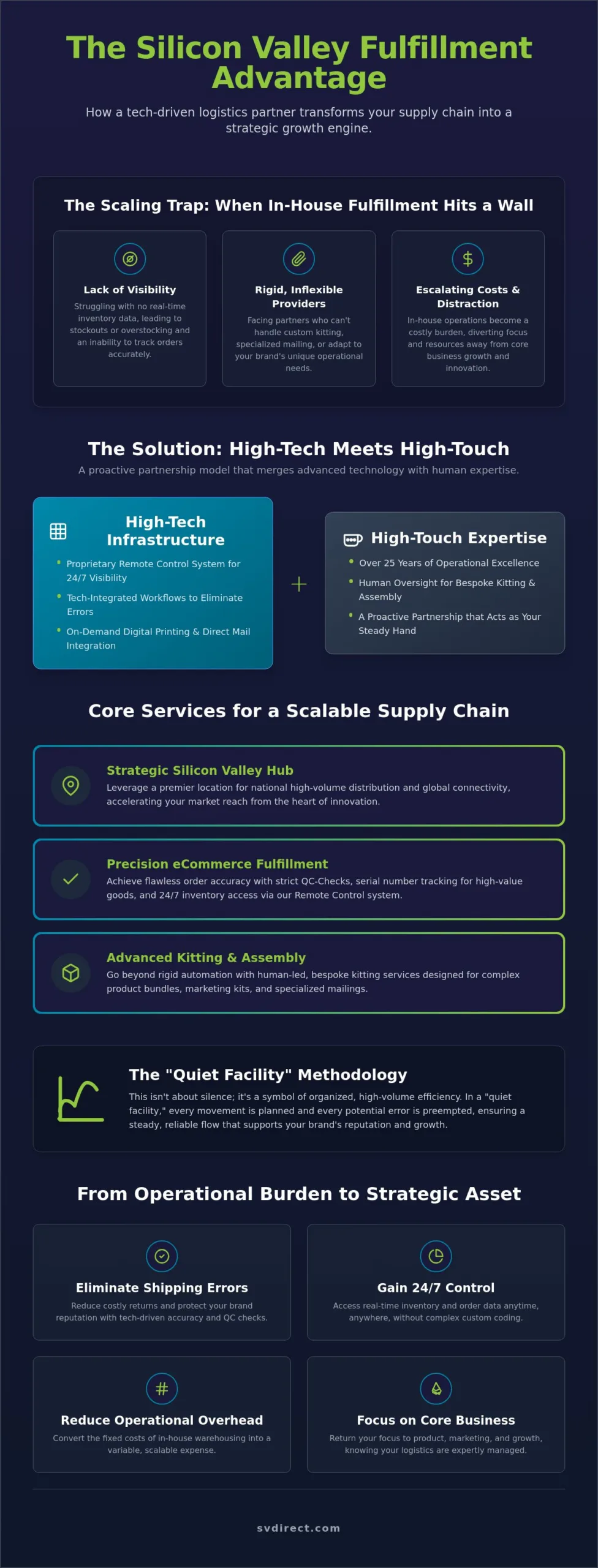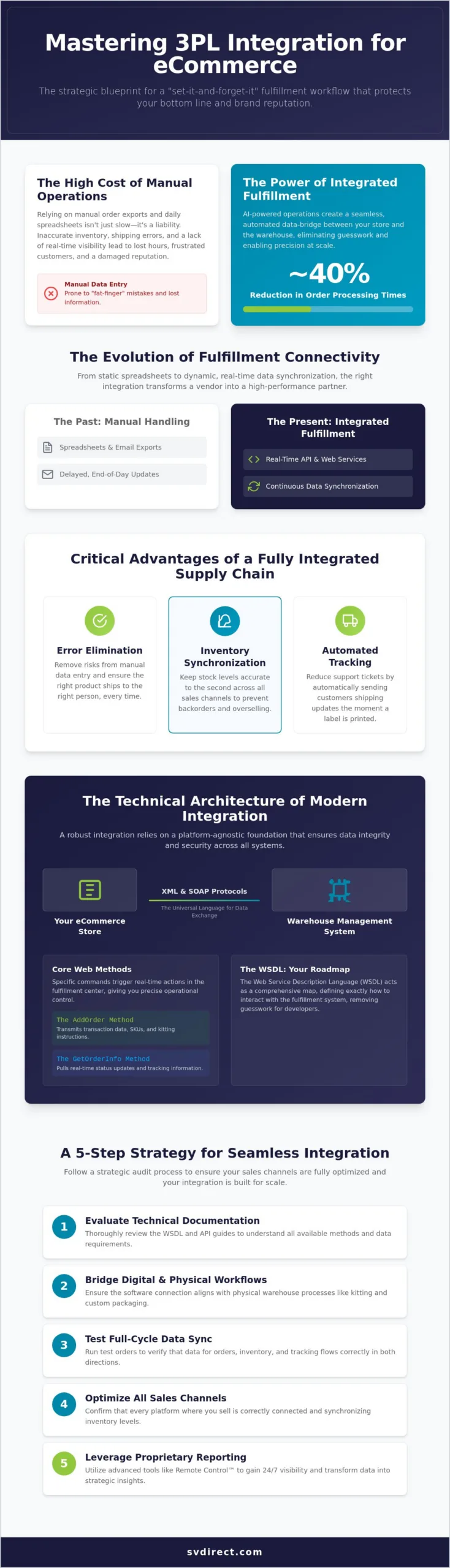
img not found!
Strategic eCommerce Packaging Solutions: A Guide to Branding and Logistics in 2026

Strategic eCommerce Packaging Solutions: A Guide to Branding and Logistics in 2026

Would you believe that a simple box could be the difference between a profitable quarter and a logistical headache in 2026? With UPS and FedEx implementing 5.9 percent base rate increases this year and cardboard prices reaching 554 dollars per metric ton, the margin for error has never been thinner. Most growing brands understand the struggle of rising dimensional weight fees and the sting of product damage during transit. It’s difficult to scale when your ecommerce packaging solutions feel like a constant cost center rather than a strategic asset.

We believe that your shipping process should be a high-performance extension of your marketing team. You’re about to discover how to transform your fulfillment strategy into a premium brand experience that actually reduces your bottom-line expenses. We’ll examine how to leverage “right-sized” packaging to meet strict new global waste regulations, integrate seamless 3PL workflows, and use high-resolution digital printing to create an unboxing moment that stays with your customers long after the delivery truck pulls away.

Key Takeaways

  • Learn how to transition your packaging from a basic protective necessity into a high-end experiential touchpoint that builds lasting customer loyalty.
  • Discover how to mitigate 2026 shipping rate increases by utilizing ecommerce packaging solutions that prioritize dimensional weight optimization and carrier discounts.
  • Understand the technical benefits of liquid ink technology and 230 line screen resolution for creating premium, offset-quality branding on demand.
  • Master a systematic five-step workflow for complex kitting and assembly to ensure accuracy and speed during high-volume growth periods.
  • Explore the advantages of a unified fulfillment strategy that combines sophisticated data management with personal, human-led oversight.

The Strategic Role of eCommerce Packaging Solutions in 2026

Effective design directly impacts your bottom line through dimensional (DIM) weight management. As carriers tighten their pricing structures, every cubic inch of “air” in a package increases your shipping invoices. Modern brands are prioritizing sustainable packaging solutions that utilize at least 30 percent recycled content and FSC-certified materials. This shift isn’t just about environmental responsibility. It’s a strategic move to meet consumer expectations for efficiency and transparency while avoiding the regulatory penalties associated with excessive waste.

Balancing Protection and Presentation

The “last mile” of delivery is often the most treacherous part of a product’s journey. You need materials that endure rough handling without adding unnecessary bulk. High-quality, rigid corrugated cardboard offers superior protection while projecting a sense of durability. Using custom-engineered inserts is a far more professional approach than relying on messy void fill. These inserts secure items in place, reduce the risk of transit damage, and create a structured, organized presentation. For premium retailers like DelWine, which handle fragile and high-value shipments, this intentional design has a measurable psychological impact, fostering customer trust and increasing the likelihood of repeat purchases.

Packaging as a Component of 3PL Efficiency

Operational speed depends heavily on consistency. When you standardize your box sizes, you streamline the entire eCommerce order fulfillment process. Warehouse teams can pack orders faster when they don’t have to guess which container fits a specific SKU. This level of organization also reduces return rates by ensuring products arrive in pristine condition. We view this as a marriage of technology, customer service, and marketing where the physical package is the final piece of the puzzle.

  • Standardized dimensions allow for predictable palletization and storage.
  • Custom kitting workflows benefit from uniform components that fit together perfectly.
  • Precise packaging minimizes the labor hours required for troubleshooting odd-sized shipments.
  • High-resolution branding on the exterior reduces the need for additional marketing inserts.

Strategically optimized packaging reduces operational overhead by eliminating wasted space and accelerating the physical movement of goods through the supply chain.

Advanced Customization: Digital Printing and Variable Data

Precision branding begins with the technology behind the ink. While many providers rely on toner-based systems that can crack or peel, the use of HP Indigo liquid ink technology ensures a professional finish that mimics traditional offset printing. This is particularly vital for ecommerce packaging solutions where the unboxing experience is the brand’s primary physical impression. By achieving a 230 line screen resolution, your graphics retain a level of crispness and color depth that standard digital methods simply cannot match. This high-resolution benchmark allows digital brands to compete with the aesthetic quality of established retail giants without the need for massive production runs.

Speed is a critical factor in 2026 logistics. Traditional offset printing requires physical plates and a 24-hour drying period, which creates bottlenecks in a just-in-time supply chain. Digital printing eliminates these hurdles. There are no plates to manufacture and no waiting for ink to set. This agility allows for immediate transitions from the press to the assembly line, keeping your fulfillment schedule on track even during peak seasons. Because the process is entirely digital, you can make design adjustments on the fly, ensuring your packaging always reflects your most current marketing objectives.

Personalized Marketing Through Variable Data Printing

Variable Data Printing (VDP) transforms static packaging into a dynamic marketing tool. This technology allows you to print unique copy, personalized names, or specific QR codes on every individual sheet within a single run. It’s an ideal solution for On-Demand Digital Printing, where you can tailor inserts for specific customer segments without the high costs of large-scale production. Unlike traditional retail models, modern ecommerce packaging strategies leverage these short-run capabilities to launch seasonal campaigns or loyalty-specific messaging with minimal lead time. This level of personalization turns a routine delivery into a bespoke experience that speaks directly to the recipient.

Quality Control: From Press to Pack

Maintaining brand integrity requires absolute color consistency. Because our digital process is data-driven, we can replicate the exact same shades across multi-decade print runs, providing a steady hand for your brand’s visual identity. The “dry-on-exit” nature of liquid ink means that printed materials are ready for the assembly line the moment they leave the press. This seamless integration between the print shop and the warehouse floor minimizes handling and reduces the risk of smudging or damage. If you’re looking to elevate your presentation, you might want to request a free quote for custom printing and fulfillment to see how these precision tools can work for your brand.

Optimizing Kitting and Assembly for Scale

Kitting is the stage where the individual physical components of your brand finally come together. While standard fulfillment involves picking a single item, complex kitting requires the precise assembly of multiple SKUs into a unified package. This is a primary requirement for subscription boxes, gift sets, and promotional bundles. To maintain operational rhythm, we follow a scalable five-step workflow: Design, Source, Assemble, Inspect, and Ship. Each phase is handled with a steady hand to ensure the final product meets your exact specifications. Recent research on sustainable ecommerce packaging highlights how consolidated kitting can significantly reduce transit waste by optimizing the internal volume of each container.

Accuracy is paramount during the assembly phase. Our systematic QC-Check process serves as a rigorous safeguard against errors in high-volume promotional kits. This level of oversight becomes even more critical when handling high-value electronics that require serial number tracking. By documenting every unique identifier during assembly, you gain total transparency into your supply chain. This proactive stance ensures that if a technical issue arises, you can trace a specific unit back to its origin immediately. It’s a level of precision that turns ecommerce packaging solutions into a reliable engine for long-term growth.

Designing for Assembly Speed

Speed on the facility floor starts with the physical design of the box. We favor “easy-fold” boxes and pre-scored inserts that snap into place without the need for excessive tape or glue. These design choices directly reduce labor costs per order and eliminate the hectic atmosphere often found in less organized facilities. Our kitting and assembly services are designed to integrate with digital print-on-demand capabilities. This allows you to include personalized, high-resolution components in every kit without slowing down the physical assembly line.

Inventory Visibility and Low-Stock Alerts

You shouldn’t have to guess whether you have enough custom boxes for next week’s product launch. Our proprietary Remote Control data management system provides 24/7 inventory visibility, giving you a clear window into your stock levels from any location. We set up automated email alerts that trigger when your packaging supplies hit a specific threshold. By integrating your packaging stock with your primary Order Management System (OMS), you ensure that your marketing and operations teams are always in sync. Modern ecommerce packaging solutions rely on this high-tech visibility to prevent stockouts and keep your fulfillment workflows running at peak performance.

Logistics and Shipping: Reducing Costs in 2026

The logistics phase is where your packaging strategy faces its most rigorous test. Coordinating international shipments for both B2B and B2C channels requires more than just a sturdy box. It’s a process that demands a sophisticated understanding of how global shipping services impact your material choices. For instance, cross-border trade often involves multiple touchpoints and varying climate conditions, which necessitates a more resilient approach to your ecommerce packaging solutions. By partnering with a seasoned 3PL, you gain access to discounted carrier rates that are typically reserved for high-volume enterprises. This partnership transforms shipping from a variable expense into a predictable, managed cost.

Efficiency is further enhanced through “Batch Delivery to Carrier.” This methodical approach streamlines daily pick-ups by organizing shipments into logical groups before the carrier arrives. It reduces the time spent on the loading dock and ensures that your packages enter the carrier’s network as quickly as possible. This proactive stance is a hallmark of an operation that respects both your timeline and your budget. It’s not just about moving boxes; it’s about maintaining a steady rhythm that prevents bottlenecks during peak seasons.

Managing Dimensional Weight (DIM)

In 2026, shipping costs are increasingly driven by the size of your package rather than just its weight. Carriers have updated the dimensional weight divisor to 139, making oversized packaging a direct drain on your profit margins. “Thinking outside the box” actually means finding the smallest safe container possible for every order. Our facility manages over 3,000 shipments in a single week by maintaining a quiet, organized environment where every packer understands the math of DIM weight. We prioritize precision over speed, ensuring that every item is placed in a container that offers maximum protection with minimum volume.

Secure Warehousing for High-Value Goods

High-value products require specialized handling during the holiday peak. This includes secure warehousing for high-value electronics that features climate control and advanced monitoring. Packaging for these items must be robust enough to deter tampering while remaining efficient for storage. We anticipate potential shipping conflicts, such as carrier capacity limits or weather delays, before they impact your customer. This level of foresight is essential for maintaining brand trust during high-stakes sales periods. By integrating secure storage with precise packaging, we provide a steady hand for your most sensitive inventory.

Request a custom logistics and fulfillment consultation

The Silicon Valley Direct Advantage: Integrated Packaging and Fulfillment

Choosing a partner for your ecommerce packaging solutions shouldn’t feel like a transaction with an impersonal vendor. In a market saturated with automated responses and “one-size-fits-all” logistics, we prioritize a custom-fit fulfillment strategy that adapts to your specific brand requirements. Our philosophy is rooted in a marriage of technology, customer service, and marketing. We don’t just store and ship your products. We act as a steady hand that ensures your physical operations are as sophisticated as your digital presence. This integrated approach allows you to move beyond cookie-cutter solutions and embrace a workflow that is designed for precision and personal commitment.

Transparency is the foundation of a successful partnership. Modern brands require 24/7 access to their data to make informed decisions in real time. Through our proprietary remote order management system, you maintain total visibility over your inventory and packaging stock from any location. This high-tech capability is backed by our “Nine Promises,” a set of core principles that commit us to active listening, total flexibility, and proactive innovation. We believe that physical infrastructure should be an enabler of growth, not a source of stress, which is why we remain focused on solving problems before they reach your customers.

A Seamless Extension of Your Team

We position ourselves as an integrated partner that functions as an extension of your marketing and sales departments. Our “quiet facility” methodology is a central part of this identity. By maintaining a highly organized and methodical environment, we eliminate the chaos often found in traditional warehouses. This atmosphere of calm professionalism directly translates to higher accuracy rates and better quality control for your custom kits. You can read our customer testimonials to see how this dedication to precision has helped brands scale their operations without sacrificing the human touch that defines their brand identity.

Next Steps for Your eCommerce Strategy

Refining your shipping process starts with an honest evaluation of your current packaging. Look for opportunities to reduce waste, manage dimensional weight more effectively, and improve the visual impact of your unboxing experience. Consolidating your digital printing, complex kitting, and global shipping under one roof creates a streamlined supply chain that is both cost-effective and agile. When your ecommerce packaging solutions are handled by a single, dedicated team, you gain the consistency necessary to build long-term customer loyalty.

Mastering the Final Mile in 2026

Success in the modern market requires a shift from viewing shipping as a burden to seeing it as a strategic brand opportunity. By integrating high-resolution branding via HP Indigo 5500 liquid ink technology with precise logistics, you create a seamless and professional customer journey. Transitioning to FSC-certified and sustainable material options ensures your brand remains compliant with evolving regulations while meeting consumer expectations for environmental responsibility. When these elements are managed through a steady, organized 3PL partner, your operations become a reliable engine for growth.

Selecting the right ecommerce packaging solutions involves more than just picking a box; it’s about securing total visibility and flexibility. With 24/7 Remote Control™ inventory access, you maintain a clear window into your supply chain, allowing you to anticipate needs before they become urgent. This proactive approach, backed by decades of operational expertise, provides the stability your business needs to scale with confidence.

We look forward to helping you transform your fulfillment into a powerful extension of your marketing team.

Frequently Asked Questions

What are the best eCommerce packaging solutions for small businesses?

The best ecommerce packaging solutions for small businesses prioritize right-sized containers and on-demand customization. Using custom-fit poly mailers or corrugated boxes reduces dimensional weight fees, which is critical when margins are tight. We recommend starting with short-run digital printing to maintain a premium brand image without the overhead of massive bulk orders. This approach allows you to remain agile as your product line evolves while keeping storage costs manageable.

How does custom packaging affect my 3PL fulfillment costs?

Custom packaging affects 3PL costs by either streamlining or complicating the physical assembly process. Boxes designed with “easy-fold” features and pre-scored inserts reduce the labor hours required for packing each order. Conversely, complex designs that require extensive tape or glue can increase per-order fees. Standardizing your dimensions across SKU groups allows for faster palletization and more predictable storage costs within the facility, directly improving your bottom line.

Is digital printing better than offset for eCommerce boxes?

Digital printing is superior for most eCommerce brands because it eliminates the need for physical plates and 24-hour drying times. Our HP Indigo 5500 uses real liquid ink technology to achieve 230 line screen resolution, providing offset quality with digital speed. This allows for just-in-time production and immediate assembly of your ecommerce packaging solutions. Offset remains cost-effective for static runs in the hundreds of thousands, but digital offers the flexibility modern brands demand.

What is variable data printing and how can it help my brand?

Variable data printing (VDP) allows you to change text, graphics, or QR codes on every individual piece within a single print run. It helps your brand by creating a bespoke unboxing experience for every customer without slowing down the press. You can include personalized thank-you notes or unique discount codes based on a customer’s specific purchase history. This level of customization transforms a standard delivery into a powerful marketing tool that drives repeat sales.

Can I use eco-friendly materials for high-volume fulfillment?

You can absolutely use eco-friendly materials for high-volume fulfillment without sacrificing durability or protection. We utilize FSC-certified corrugated cardboard and materials with at least 30 percent recycled content to meet 2026 sustainability standards. These materials are engineered to withstand the rigors of global transit while reducing your brand’s environmental footprint. Sustainable choices often lead to lighter packaging, which can also help lower your total shipping expenses over time.

How do I reduce product damage during international shipping?

Reducing product damage during international transit requires a combination of rigid materials and custom-engineered inserts. Standard void fill often shifts during long-distance travel, leaving items vulnerable to impact. Using pre-scored inserts keeps products secure and prevents internal movement within the box. For sensitive goods like high-value electronics, climate-controlled warehousing and moisture-resistant outer layers provide an extra level of protection against varying global shipping conditions and rough handling.

What is the difference between kitting and simple order fulfillment?

Simple order fulfillment involves picking and packing a single SKU, while kitting requires the assembly of multiple components into a new, unified unit. Kitting is essential for subscription boxes or promotional bundles where presentation and order are priorities. It involves a systematic QC-Check process to ensure every kit contains the correct items in the exact sequence requested. This added layer of complexity requires a more methodical approach than standard pick-and-pack services.

How can I track my packaging inventory in real-time?

You can track your packaging inventory in real-time through our proprietary Remote Control data management system. This software provides 24/7 visibility into your stock levels, so you always know when it’s time to reorder custom boxes or inserts. Automated email alerts trigger when supplies reach a specific threshold, preventing unexpected stockouts during peak seasons. Integrating this data with your primary Order Management System ensures your marketing and operations teams stay perfectly synchronized.

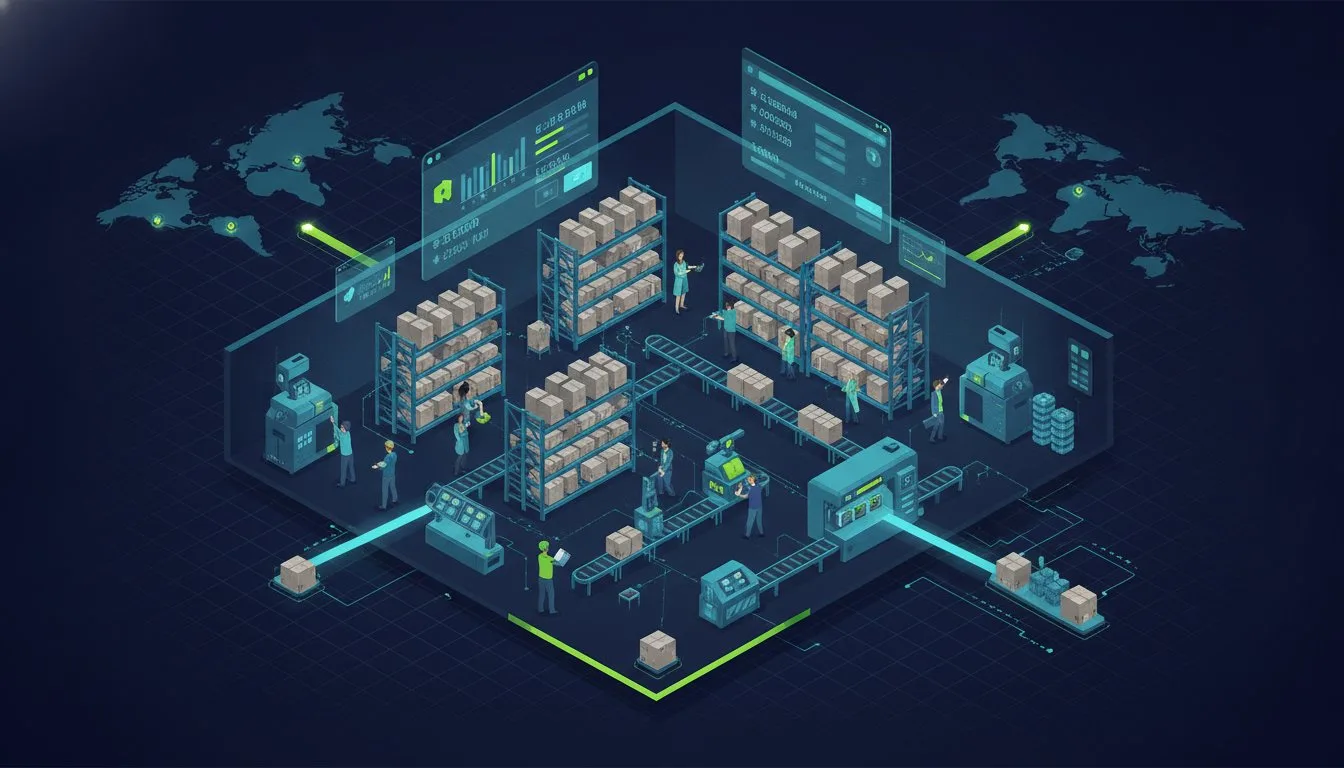
Integrated Print and Fulfillment Services: The 2026 Strategic Guide to Supply Chain Efficiency

Integrated Print and Fulfillment Services: The 2026 Strategic Guide to Supply Chain Efficiency

Why should your marketing materials sit idle for days, waiting for ink to dry, while your customers wait for their orders? It’s a common frustration for growing brands that rely on traditional offset methods or rigid logistics providers. You’ve likely experienced the stress of color variance between runs or the lack of real-time visibility into your inventory. You need a partner that acts as a steady, reliable extension of your own company to bridge these gaps.

This guide demonstrates how merging high-resolution digital printing with precision 3PL logistics can eliminate lead times and optimize your entire operational workflow. By choosing integrated print and fulfillment services that utilize liquid-ink technology, you can achieve a seamless, “just-in-time” supply chain. We’ll show you how leveraging proprietary management systems with over 120 standard reports provides the transparency you need to scale. You’ll discover how to maintain a consistent brand image through 230 line screen resolution while ensuring your kitting and assembly remain flexible enough for any custom request.

Key Takeaways

  • Discover how a unified workflow between digital printing and 3PL logistics eliminates the 24 hour drying times typical of traditional offset methods.
  • Learn why liquid ink technology and 230 line screen resolution provide the sharp brand representation your high value materials require.
  • Gain 24/7 visibility into your supply chain with a proprietary management system that offers over 120 standard reports for total inventory control.
  • Explore how specialized print and fulfillment services can manage complex kitting and healthcare mailing with higher accuracy and compliance.
  • Understand the strategic advantage of a “quiet facility” methodology where organized human expertise ensures your operations remain flexible and scalable.

What are Integrated Print and Fulfillment Services?

Integrated print and fulfillment services represent a unified operational ecosystem where high-resolution digital production and 3PL logistics exist under one roof. Historically, businesses managed a fragmented chain. You’d hire a printer for your brochures, wait days for the ink to dry, then arrange transport to a separate warehouse for kitting and distribution. This model is obsolete. Modern integration allows for a seamless transition from the digital press directly to the shipping dock, removing the friction of multiple vendors and transit delays.

The shift away from traditional offset printing is central to this evolution. Offset methods require time-consuming plate-making and often demand 24 hours of drying time before materials can even be handled. By utilizing advanced technology like the HP Indigo 5500, we provide offset-quality results with real liquid ink that’s ready for fulfillment immediately. This “just-in-time” capability is essential in 2026, where marketing collateral and operational documents must move at the speed of digital business. It ensures your materials are never sitting idle when they could be in your customers’ hands.

The Death of the ‘Cookie-Cutter’ Fulfillment Model

Rigid, automated procedures often lead to project flaws and broken communication. Many providers offer a “one size fits all” approach that ignores the nuances of your brand. We’ve seen how these cookie-cutter models fail when custom kitting or variable data is required. A true partnership requires a bespoke approach. It means having a steady hand at the helm who listens to your unique goals. We position ourselves as an extension of your company, ensuring that every project receives personal oversight rather than just being a number in a queue. This human-centric focus eliminates the gaps that automated systems often overlook.

Core Benefits of a Unified 3PL and Printing Partner

Choosing a unified partner drastically simplifies your supply chain. You’ll see a significant reduction in lead times because the “dock-to-stock” delay is eliminated. Managing a single point of contact also lowers your administrative overhead, freeing your team to focus on strategy instead of chasing down tracking numbers. Quality control becomes more robust when a single “QC-Check” procedure governs the entire process. From the first ink drop to the final global shipment, every step is synchronized within a quiet, organized facility. This level of synchronization is only possible through on-demand digital printing that’s physically connected to your distribution hub.

High-Resolution Digital Printing vs. Traditional Offset

The perceived gap between digital and offset printing has vanished. For years, brand managers favored offset for its superior color depth, despite the long lead times and high setup costs. However, the emergence of liquid ink technology has changed the equation. Unlike standard digital printers that use dry toner, which can appear “waxy” or sit on top of the paper, the HP Indigo 5500 utilizes real liquid ink. This ink bonds with the fibers of the paper, mirroring the flat, professional finish of traditional offset while maintaining the speed of a digital workflow.

Precision is the hallmark of high-value brand representation. We achieve this through a 230 line screen resolution, which produces remarkably sharp imagery and fine detail that toner-based systems simply cannot replicate. This technical advantage ensures that your gradients are smooth and your fine text is legible. When your marketing materials are produced within integrated print and fulfillment services, this quality is matched by operational speed. Since digital sheets emerge from the press completely dry, they move to the kitting and assembly stage immediately. There’s no 24-hour waiting period for ink to set, which is a common bottleneck in traditional offset-to-warehouse models.

Color density control is another area where digital production excels. In an offset run, maintaining color consistency from the first sheet to the thousandth requires constant manual adjustment. Digital systems provide automated calibration, eliminating variance across both short and long print runs. Whether you’re printing ten presentation folders or ten thousand brochures, the brand colors remain identical. If you’re ready to see how this precision can elevate your next project, you can request a free quote to discuss your specific requirements.

Variable Data Digital Printing (VDP) for Personalization

Variable Data Printing allows you to customize copy, images, and offers for every single recipient in a single run. In 2026, personalization isn’t just a luxury; it’s a requirement for high ROI in direct mail and literature fulfillment. Because there are no plates to change, VDP costs very little more than static printing. It transforms a generic brochure into a bespoke communication that speaks directly to the recipient’s needs, significantly increasing engagement rates.

Sustainable and Green Printing Initiatives

Modern printing must be as responsible as it is efficient. By moving away from offset, we eliminate the need for the heavy chemicals, aluminum plates, and films that define traditional processes. Our commitment to sustainability includes offering FSC-certified papers and 30% recycled content options as standard. Through our partnership with hardware leaders like HP, we ensure that imaging oil and hardware components are part of a responsible recycling and recovery program. This approach allows you to scale your print and fulfillment services without compromising your environmental goals.

Streamlining the Workflow: From Press to Global Distribution

Efficiency in a modern supply chain isn’t just about speed; it’s about the precision of the handoff between digital production and logistics. When you utilize integrated print and fulfillment services, the workflow begins with real-time order submission via programmatic web services. This digital bridge ensures that data flows directly from your storefront or CRM into our production queue, eliminating the friction of manual entry and the risk of transcription errors. It’s a proactive approach that sets the stage for a flawless execution.

The printing phase follows immediately. As we’ve established, our liquid-ink technology produces sheets that require no drying time. This allows for immediate handling. Your materials move straight from the press to our kitting and assembly stations. Here, systematic procedures and a multi-stage QC-Check ensure that every kit is accurate and every brochure is pristine. This level of synchronization reduces lead times from days to hours, ensuring your collateral is ready for the next step without a moment’s waste.

The Remote Control™ Data Management System

Our proprietary Remote Control™ system acts as the central nervous system for your operations. It provides 24/7 visibility into your inventory levels, order history, and project progress. With over 120 standard reports available, you’ll never have to guess about your stock status. Automated alerts for low inventory or backorders keep you proactive rather than reactive. We can even customize the web interface to reflect your corporate brand, providing a seamless experience for your internal users. Learn more about Remote Order Management.

Technical Integration for Developers

For technical stakeholders, we offer platform-agnostic web services that support XML, SOAP, and WSDL. This allows your developers to integrate our Order Management System (OMS) directly into your existing business logic. You can submit real-time transaction data and receive status updates programmatically. This deep technical integration ensures that our print and fulfillment services function as a native part of your own digital infrastructure. It’s about sharing business logic and processes through a programmatic interface that respects your developers’ time and your company’s technical standards.

Specialized Applications: Healthcare, Marketing, and Events

Literature fulfillment also benefits from this integrated model by solving the problem of obsolescence. In the past, companies would print massive runs of brochures or user manuals to save on unit costs, only to throw away thousands of copies when a product specification changed. Our on-demand approach allows you to print exactly what you need, when you need it. This keeps your press kits and manuals current while reducing waste. For those managing complex event calendars, we provide comprehensive tradeshow support. We handle everything from pre-show packet assembly to post-show lead follow-up, acting as a steady hand behind the scenes. Explore our industry-specific solutions to see how we tailor our processes to your unique sector.

Kitting and Hand Assembly for Complex Projects

While automation has its place, certain projects require a human touch that machines simply don’t replicate. Complex kits involving software, promotional clothing, or fragile items need the discernment of a dedicated hand-assembly team. We utilize a systematic multi-stage QC-Check for every project, ensuring that every component is present and correctly placed. This meticulous oversight is what separates a standard vendor from a true operational partner. It keeps your brand integrity intact. Strategic Guide to Kitting and Assembly Services.

Database Management and Direct Mail Marketing

The success of physical engagement depends heavily on the quality of your data. We provide comprehensive database management to improve the deliverability of your campaigns. This includes data entry, cleansing, and list procurement to ensure your message reaches the right doorstep. By removing duplicates and verifying addresses, we maximize your ROI and provide integrated reporting to track campaign effectiveness. We help you stay proactive. It’s about combining high-tech data processing with the physical reliability of print and fulfillment services. Direct Mail Marketing Services Guide.

The SVD Difference: Why Partnership Trumps Automation

A hectic warehouse environment is often a breeding ground for errors. Unlike the chaotic facilities common in the logistics industry, our operations are built on a ‘Quiet Facility’ methodology. This approach prioritizes organized inventory control and deliberate movement. It allows our team to focus on the precision required for high-stakes print and fulfillment services without the distractions of a disorganized floor. When your facility is quiet and organized, quality control becomes a natural outcome rather than a forced checklist. It ensures that every item is where it should be, exactly when it needs to be there.

Our identity is rooted in Silicon Valley, a region defined by technological innovation for decades. Since 1999, we’ve leveraged this geographic advantage to stay at the cutting edge of logistics and digital production. However, technology is only half of the equation. Our ‘Nine Promises’ serve as the foundation of every client engagement. These promises reflect a deep commitment to listening, flexibility, and absolute accountability. We don’t just process orders; we identify potential conflicts before they impact your project timeline. This proactive stance ensures that your supply chain remains resilient even when market conditions shift. We act as a steady hand, alleviating the stress of business growth through personal commitment.

Decades of Stability and Expertise

Longevity is a rare commodity in a volatile market. Our company was founded in 1999, providing us with over 25 years of operational history and stability. This experience has allowed us to refine our processes through various economic cycles and technological shifts. A key hallmark of our expert-level service is our long-term staff retention. Many of our team members have been with us for decades, bringing a level of institutional knowledge that automated systems can’t replicate. Their seasoned eyes catch the nuances that machines miss, ensuring your brand is always represented with high-resolution accuracy. Read our customer testimonials to see the impact of this stability on our clients’ success.

Flexibility and Rejection of Rigid Procedures

Rigid, ‘one-size-fits-all’ procedures are the enemy of complex marketing and sales projects. Your budget and goals are unique, and your fulfillment partner should adapt accordingly. We explicitly reject the impersonal nature of automated interactions in favor of direct human connection and personal oversight. Instead, we offer custom-fit solutions that align with your specific operational needs. If a challenge arises, our team carries a ‘make-it-right’ attitude that defines first-class customer service. This flexibility allows us to act as a true extension of your company, ensuring that your print and fulfillment services are as agile as your business strategy requires.

Future-Proof Your Supply Chain with Precision Integration

The path to a zero-lag supply chain starts with a partner that understands the high-stakes nature of your brand’s growth. By merging the liquid ink technology of the HP Indigo 5500 with a quiet, organized logistics facility, you eliminate the traditional bottlenecks that slow down your marketing and operational efforts. You gain more than just speed; you gain the absolute peace of mind that comes with 24/7 visibility through our proprietary Remote Control™ system. These tools ensure your inventory is managed with surgical precision, allowing your team to stay proactive rather than reactive.

Since 1999, Silicon Valley Direct has acted as a steady, reliable extension of our clients’ companies. We’ve replaced rigid, cookie-cutter models with bespoke solutions that respect your unique goals and budget. Choosing integrated print and fulfillment services isn’t just a technical upgrade. It’s a strategic commitment to brand consistency and operational excellence. We’re ready to help you navigate the complexities of 2026 with the same personal oversight and expertise we’ve provided for over two decades. Our team handles the mechanical details so you can focus on the big picture of your business.

We look forward to building a partnership that supports your long-term success through every stage of your growth. Our commitment to your brand’s integrity remains our highest priority.

Frequently Asked Questions

What is the difference between digital and offset print quality in 2026?

Modern digital printing using liquid ink technology now matches the depth and professional finish of traditional offset. We utilize the HP Indigo 5500, which provides a 230 line screen resolution for remarkably sharp imagery. Unlike toner-based digital systems that can appear waxy, our liquid ink bonds with the paper fibers. This ensures your brand is represented with the highest level of precision and detail.

How much does variable data printing (VDP) typically cost compared to static printing?

Variable data printing costs very little more than static printing because it eliminates the need for physical plate changes. Since the process is entirely digital, we can customize every sheet in a single run without increasing production time. This makes it a highly cost-effective strategy for increasing engagement and ROI in your direct mail and literature fulfillment campaigns.

How quickly can printed materials be moved to the fulfillment and shipping stage?

Materials move to fulfillment immediately after they leave the digital press. Because our liquid ink technology requires no drying time, we avoid the 24-hour delays that are common in traditional offset-to-warehouse models. This capability is a cornerstone of our print and fulfillment services, allowing for a seamless, “just-in-time” workflow that gets your collateral to customers faster.

Can I integrate my existing eCommerce platform with your fulfillment system?

Yes, we offer platform-agnostic web services that support XML, SOAP, and WSDL for deep technical integration. Your developers can connect our Order Management System directly into your existing digital infrastructure to submit transaction data in real-time. This programmatic interface ensures that our logistics operations function as a native, automated extension of your own company’s storefront or CRM.

What security measures are in place for healthcare or sensitive mailing services?

We maintain strict protocols for sensitive distributions by utilizing a systematic, multi-stage QC-Check for every project. Our quiet facility methodology ensures that healthcare mailing and regulatory documents are handled in an organized environment that minimizes errors. We prioritize accountability and human oversight, treating every sensitive shipment with the sobriety and precision that compliance standards demand.

What is a ‘quiet facility’ methodology and how does it benefit my project?

A ‘quiet facility’ is an operational environment where organized inventory control and deliberate movement are prioritized over hectic, chaotic activity. This methodology benefits your project by drastically reducing the likelihood of errors during kitting and assembly. It allows our seasoned experts to maintain personal oversight on every order, ensuring that your brand integrity is protected through every stage of production.

Do you offer sustainable or eco-friendly printing and packaging options?

We offer FSC-certified papers and 30% recycled content options to support your green initiatives. By utilizing digital production, we eliminate the need for the aluminum plates and heavy chemicals required by offset processes. Additionally, our partnership with HP includes responsible recycling programs for imaging oil and hardware components, helping you scale your print and fulfillment services sustainably.

How do I track my inventory and order status in real-time?

You can track your inventory and order status 24/7 through our proprietary Remote Control™ management system. This system provides access to over 120 standard reports, offering total transparency into your supply chain. You’ll receive automated alerts for low inventory levels and backorder notifications, ensuring you always have the data needed to make informed operational decisions.

Shopify Inventory Management: The 2026 Strategic Guide to Scaling Fulfillment

Shopify Inventory Management: The 2026 Strategic Guide to Scaling Fulfillment

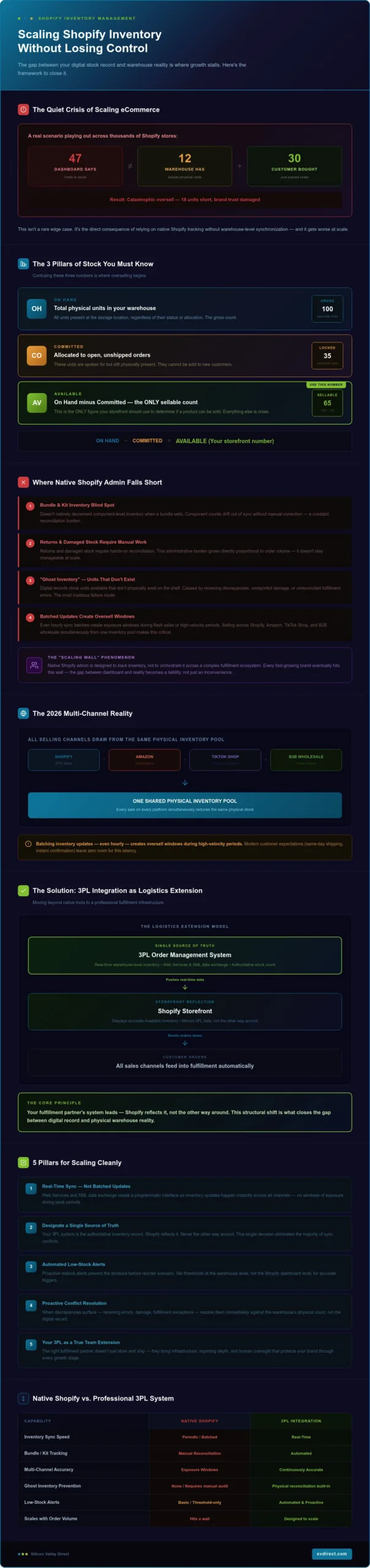
Your Shopify dashboard says you have 47 units in stock. Your warehouse team says you have 12. A customer just bought 30. This is the quiet crisis at the heart of scaling eCommerce, and it happens more often than most store owners want to admit. Shopify inventory management is genuinely powerful for tracking numbers, but numbers and physical reality are two very different things once your order volume starts climbing.

If you’ve wrestled with overselling during a flash sale, lost visibility into stock conditions after a busy quarter, or tangled yourself in the logistics of building promotional bundles, you already know the gap between a digital record and what’s actually sitting on a warehouse shelf. That gap is where growth stalls.

This guide is built to close it. You’ll learn exactly how to move beyond native Shopify tracking and into a professional third-party logistics setup that delivers real-time inventory accuracy, automated restock alerts, and a seamless connection between your storefront and your physical fulfillment operation. We’ll walk through the strategic steps, the integration mechanics, and the operational discipline that separates brands that scale cleanly from those that spend every peak season putting out fires.

Key Takeaways

  • Effective Shopify inventory management goes far beyond tracking numbers. It requires synchronizing digital stock records with physical warehouse reality across every sales channel, in real time.
  • Understanding the three pillars of stock (Available, Committed, and On Hand) is the foundation for eliminating overselling and making confident, data-backed fulfillment decisions at scale.
  • A professional 3PL integration connects your Shopify storefront to your warehouse through Web Services and XML data exchange, creating a seamless, automated flow of inventory information that native tools alone cannot deliver.
  • Designating your 3PL system as the single source of truth, paired with automated low-stock alerts and proactive conflict resolution, is the operational discipline that separates brands that scale cleanly from those that don’t.
  • The right fulfillment partner doesn’t just store and ship your products; they function as an extension of your team, bringing the infrastructure, reporting depth, and human oversight needed to protect your brand through every growth stage.

Understanding Shopify Inventory Management for Scaling Brands

At its core, Shopify inventory management is the digital synchronization of stock levels across every sales channel your brand operates. It’s the system that answers one deceptively simple question: how much of what do we actually have, right now, and where is it? For a single-channel store moving modest volume, native Shopify tools answer that question well enough. But the moment your brand starts scaling, that answer gets complicated fast.

Every inventory position in your operation can be understood through three distinct pillars:

  • On Hand: The total physical units present in your warehouse or storage location, regardless of their status.
  • Committed: Units already allocated to open orders that haven’t yet shipped. These are spoken for, but still physically present.
  • Available: The actionable number. On Hand minus Committed. This is the only figure your storefront should ever use to determine whether a product can be sold.

Misreading these three numbers, or conflating them, is where overselling begins. It’s also where the “Scaling Wall” appears. Native Shopify admin is designed to track inventory, not to orchestrate it across a complex fulfillment ecosystem. Once order volume climbs and your operations expand, the gap between what the dashboard shows and what’s physically on a warehouse shelf becomes a liability.

The Limitations of Native Shopify Admin

The native admin panel handles straightforward SKU tracking with reasonable accuracy, but it wasn’t built for operational complexity. Multi-component kits and promotional bundles are a persistent weak point; the system doesn’t natively decrement component-level inventory when a bundle sells, which means your component counts drift out of sync without manual correction. Returns and damaged stock require the same hands-on reconciliation, creating a continuous administrative burden that grows proportionally with your order volume.

The more insidious problem is what operators often call “ghost inventory,” a condition where your digital record shows available units that simply don’t exist on the physical shelf. This happens through receiving discrepancies, unreported damage, or fulfillment errors that never get reconciled. As a category, inventory management software exists precisely to close this gap, but native Shopify admin stops short of the real-time, warehouse-level reconciliation that growing brands require.

Why 2026 Demands Real-Time Integration

Selling across Shopify, Amazon, TikTok Shop, and B2B wholesale channels simultaneously means every single sale on any platform draws from the same physical pool of inventory. Batching inventory updates, even hourly, creates windows of exposure where overselling is essentially guaranteed during high-velocity periods. Modern customer expectations, shaped by same-day shipping norms and instant order confirmation, leave no room for that latency.

The solution isn’t a workaround. It’s a structural shift toward a programmatic interface between your Shopify storefront and your warehousing operation, one where a purpose-built system like a 3PL’s order management platform functions as the authoritative source of inventory truth. That’s the concept of a true Logistics Extension: your fulfillment partner’s system leads, and Shopify reflects it, not the other way around.

The Technology Behind Seamless Shopify-3PL Integration

Most conversations about Shopify inventory management stop at the app store. Install a connector, map your fields, hope for the best. That approach works until it doesn’t, and it tends to stop working precisely when you need it most: during a high-velocity sales period when data latency is measured in lost revenue. The more durable solution runs deeper, at the protocol level, where your storefront and your warehouse actually speak the same language.

Web Services make that conversation possible. Rather than relying on periodic file exports or fragile middleware that sits between two systems it doesn’t own, a Web Services integration creates a direct, programmatic handshake between your Shopify storefront and your fulfillment center’s order management platform. Orders flow in. Inventory updates flow back. No manual intervention. No batch windows. No silent failures that only surface when a customer emails asking where their package is.

For scaling merchants, this architecture isn’t a luxury. The inventory and financial management best practices outlined by the U.S. Small Business Administration consistently emphasize real-time data accuracy as a foundational requirement for sustainable growth, and a Web Services integration is the mechanism that delivers it at the operational level.

XML and SOAP: The Languages of Modern Logistics

XML (Extensible Markup Language) is the structural format that packages your inventory data for transit. Every SKU, quantity, order status, and receipt confirmation gets tagged, structured, and transmitted in a format that both systems can read without ambiguity. SOAP (Simple Object Access Protocol) is the secure delivery mechanism that carries those XML packages across networks with integrity intact.

Within this framework, two methods do the heaviest lifting:

  • AddOrder: Transmits new Shopify orders directly to the warehouse system in real time, triggering pick-and-pack workflows without human handoff.
  • GetOrderInfo: Pulls current order status, tracking data, and inventory positions back to Shopify on demand, keeping your storefront synchronized with physical reality.

WSDL (Web Service Description Language) completes the picture by providing a machine-readable map of the entire integration. Developers don’t need to reverse-engineer how the two systems communicate; the WSDL file documents every available method, parameter, and data type. That means faster onboarding, cleaner implementations, and fewer custom coding requirements every time something changes on either end.

Proprietary Systems vs. Generic Middleware

There’s a meaningful difference between a warehouse that built its own order management platform and one that licensed a generic connector app. A warehouse-owned system is designed around the physical operation it serves. The logic that governs inventory updates, receipt processing, and backorder management reflects actual warehouse workflows, not a generalized template built to serve dozens of industries simultaneously.

SVD’s Remote Control order management platform is a direct expression of that philosophy. With access to more than 120 standard reports, merchants get a 24/7 window into their fulfillment operation: real-time inventory receipts, backorder visibility, shipment confirmations, and exception flags, all consolidated in a single dashboard. That’s not a feature list. It’s the operational transparency that transforms a fulfillment center from a black box into a genuine extension of your team.

If you’re evaluating whether your current setup can support your next growth stage, connecting with a fulfillment specialist is a practical first step toward understanding what a purpose-built integration could look like for your specific SKU mix and order volume.

Native Shopify Tools vs. Professional 3PL Inventory Systems

Shopify’s built-in inventory tools are genuinely useful. ABC analysis helps you rank your SKUs by sales velocity. Low stock alerts fire when a threshold is crossed. Shopify Flow can trigger automated actions based on inventory events. For a lean operation with a simple product catalog, that’s a reasonable toolkit. But it’s a digital toolkit solving a physical problem, and that distinction matters more than most store owners realize until something breaks.

The gap shows up in three specific places: serial number tracking, bundle management, and quality control. Native Shopify inventory management doesn’t support serial-level traceability. If you’re selling electronics, medical devices, or any regulated product category where individual unit accountability matters, the admin panel can tell you how many units you have. It cannot tell you which specific units they are, where they’ve been, or whether a returned item matches the one originally shipped. A professional 3PL system tracks at the serial number level, creating an auditable chain of custody that Shopify Flow simply wasn’t designed to produce.

Low stock alerts are another area where the comparison turns stark. An alert is reactive. It tells you a problem exists after the inventory position has already deteriorated. Proactive conflict resolution, the methodology a purpose-built fulfillment system applies, identifies discrepancies between expected and physical stock before they cascade into customer-facing errors. That’s not a semantic difference. It’s the operational discipline that prevents a flash sale from becoming a fulfillment crisis.

Kitting, Assembly, and On-Demand Customization

Digital bundles in Shopify are a product configuration. Physical kitting is a warehouse operation. The distinction is significant. When a customer buys a promotional bundle, someone has to pull individual components, assemble them according to a specification, apply the right packaging, and insert the right collateral. None of that happens inside a dashboard. Kitting and assembly services handle this at scale, with component-level inventory decrements that keep your stock positions accurate across every SKU involved in the build.

Personalization adds another layer of complexity that native tools don’t touch. SVD’s print-on-demand capability, powered by HP Indigo digital printing technology, allows variable data to be applied at the order level. That means personalized inserts, customized packaging, and campaign-specific collateral can be produced and inserted during the kitting process itself, without a separate print run or a manual handoff between teams. Liquid ink digital printing at this level delivers the kind of per-order customization that turns a standard shipment into a branded experience.

Inventory Accuracy: Digital Logic vs. Physical Audits

Shopify adjusts inventory records when events are logged. A 3PL audits inventory by physically counting what’s on the shelf. Both matter. Only one catches the errors the other misses.

The “Quiet Facility” methodology is the operational philosophy behind physical accuracy. An organized warehouse, where every SKU has a designated location, every receiving process follows a consistent protocol, and every team member understands the system, generates fewer errors by design. Noise in a fulfillment operation isn’t just auditory. It’s the cumulative result of misplaced stock, inconsistent receiving practices, and ad hoc problem-solving. A quiet, structured facility eliminates the conditions that produce ghost inventory before reconciliation is ever needed.

This discipline extends to high-touch fulfillment scenarios like lead inquiry fulfillment, where marketing campaigns drive inbound requests for physical materials. Each response package requires accurate inventory of the collateral itself, precise assembly, and timely dispatch. That’s a workflow that demands systematic inventory controls, not a digital adjustment field. The human element of Shopify inventory management, the trained team member who catches the discrepancy before it ships, is the part that no automation layer has successfully replaced.

Shopify Inventory Management: The 2026 Strategic Guide to Scaling Fulfillment

Best Practices for Optimizing Your Shopify Stock in 2026

Knowing the right tools is only half the equation. How you operate them determines whether your inventory stays clean or quietly drifts into the kind of discrepancies that erode customer trust and compress margins. The brands that scale without constant firefighting share a common discipline: they’ve established deliberate operational practices around their data, not just the technology that generates it.

The most foundational of those practices is designating a single source of truth. When Shopify and your 3PL system each claim authority over stock counts, conflicts are inevitable. The resolution is clear: your fulfillment partner’s system holds master record status, and Shopify reflects it. Every inventory update, every receipt confirmation, every return reintegration flows from the warehouse outward to the storefront, never the reverse. That directional discipline is what keeps your available stock figures trustworthy at any order velocity.

Automated low-stock notifications are the operational complement to that foundation. An alert that fires when a SKU crosses a defined threshold gives your procurement team a window to act before the storefront is affected. The key distinction is configuring those thresholds intelligently, not as static numbers but as dynamic values tied to actual sales velocity. A SKU moving 50 units a week needs a meaningfully different reorder trigger than one moving five. SVD’s fulfillment services provide the real-time velocity data that makes that kind of dynamic threshold calibration possible, turning a reactive alert system into a genuinely proactive one.

Variable data and personalization add another layer of operational value that most brands leave untapped. When your kitting and fulfillment workflow supports per-order customization, promotional inserts, personalized packaging, and campaign-specific collateral become inventory assets in their own right. Managing those components with the same rigor applied to sellable product prevents the quiet waste that accumulates when marketing materials are over-ordered and never reconciled.

Streamlining the Reorder Process

Effective reordering isn’t just about speed; it’s about timing. Lead time analysis belongs inside your procurement model, not as an afterthought. When you know that a supplier requires 14 days and your current velocity will exhaust stock in 18, the reorder window is narrow but manageable. Compress that margin further and you’re back to emergency orders and expedited freight costs. Automated email alerts, triggered by your 3PL’s live inventory positions, give your team the lead time they need to act deliberately rather than reactively. That’s the difference between a procurement strategy and a procurement scramble.

Managing Returns and Product Obsolescence

Returns are a data source, not just a logistics problem. A structured returns management workflow that quickly grades, reintegrates, or quarantines stock keeps your available counts accurate and your warehouse storage efficient. FIFO (First In, First Out) logic prevents older stock from aging out behind newer receipts, which matters especially for products with shelf-life considerations or seasonal relevance. For brands distributing internationally, analyzing global shipping services through the lens of inventory positioning, not just shipping cost, can reveal opportunities to pre-position stock closer to demand clusters and reduce the exposure that slow-moving international inventory creates. Stale inventory audited through your shipping activity reports tells you exactly where that rationalization needs to happen first.

Effective Shopify inventory management at scale isn’t a dashboard setting. It’s a set of operational habits, reinforced by the right system architecture and the right fulfillment partner, applied consistently enough that accuracy becomes the default rather than the exception.

Elevating Your Brand with Silicon Valley Direct’s Integrated Solutions

Most fulfillment partners store your products and ship your orders. Silicon Valley Direct does something more deliberate: it thinks outside the box on your behalf. That phrase isn’t marketing language at SVD; it’s an operational philosophy that shapes how the team approaches every client relationship, from the initial integration design through the daily execution of complex, non-standard fulfillment projects that generic 3PLs simply decline to handle.

SVD’s partnership approach is anchored by Nine Promises that define what clients can expect: accuracy, responsiveness, transparency, flexibility, and a genuine commitment to functioning as an extension of your marketing and sales departments, not a separate vendor operating at arm’s length. When your storefront runs a campaign, your fulfillment operation should already know about it. When a SKU is trending, your warehouse team should be positioned to respond. That level of alignment is what separates a logistics partner from a logistics provider.

Geography matters here too. Operating out of Silicon Valley isn’t incidental. It places SVD inside the same innovation ecosystem that shapes how technology companies think about systems, data, and automation. That proximity to technological culture informs the proprietary Remote Control platform, the Web Services integration architecture, and the continuous refinement of processes that keep SVD’s capabilities ahead of where most fulfillment operations are comfortable operating.

Proactive Conflict Resolution and Quality Control

The difference between a reactive fulfillment partner and a proactive one shows up most clearly when something goes wrong. SVD’s methodology is built around catching discrepancies before they reach the customer, not after. Every order moves through a QC-Check process that verifies accuracy at the unit level: right product, right quantity, right packaging, right collateral. That physical verification layer is the part of Shopify inventory management that no software setting can replicate.

The “make-it-right” attitude that runs through SVD’s team culture means problems get surfaced and resolved internally rather than escalated to the client as emergencies. Combined with 24/7 access to real-time inventory data through the Remote Control platform, merchants have total transparency into their fulfillment operation at any hour. You don’t need to wait for a morning report to know your current stock positions. The data is always there, current and auditable, because the warehouse team that generated it takes that accountability seriously.

Long-tenured staff is part of what makes that consistency possible. Institutional knowledge, the kind that comes from years of handling the same product categories, the same seasonal surges, the same edge-case scenarios, doesn’t live in a training manual. It lives in the people who’ve solved those problems before.

Scalability Without the Hectic Atmosphere

High-volume deadlines don’t require a chaotic facility. They require an organized one. SVD’s quiet, structured warehouse environment is a deliberate operational choice, not a coincidence. When every SKU has a designated location, every receiving protocol is consistent, and every team member understands the system, throughput increases without accuracy suffering. That’s the environment that handles a flash sale surge without the fulfillment errors that typically follow one.

Flexibility is built into the same structure. Complex kitting builds, variable data printing, personalized campaign inserts, lead inquiry fulfillment: these aren’t exceptions that require special handling. They’re part of the standard capability set that SVD brings to non-cookie-cutter projects. Brands with sophisticated promotional strategies, product customization requirements, or multi-component assembly needs will find the infrastructure already in place, supported by a team that’s handled comparable complexity before.

For brands ready to move beyond patchwork Shopify inventory management and into a fulfillment setup built for sustained growth, the next step is straightforward. Partner with Silicon Valley Direct for Shopify fulfillment and discover what it looks like when your warehouse operates as a genuine extension of your team.

Turn Inventory Accuracy Into Your Competitive Advantage

Scaling a Shopify store without the right fulfillment infrastructure underneath it is a compounding risk, not just an operational inconvenience. The gap between what your dashboard shows and what’s physically on a shelf gets wider with every new channel, every new SKU, and every peak season you push through.

Effective Shopify inventory management comes down to three things: a single authoritative source of truth, a technical integration that eliminates data latency, and a fulfillment partner with the physical discipline to keep counts accurate when order velocity climbs. SVD’s proprietary Remote Control system delivers 120+ real-time reports, HP Indigo 5500 digital printing supports on-demand kitting customization, and a proactive methodology built since 1999 means discrepancies get caught before they reach your customers.

Your warehouse should work as hard as your storefront. When it does, growth stops being stressful and starts being straightforward.

Frequently Asked Questions About Shopify Inventory Management

How does Shopify inventory sync with a 3PL warehouse?

Shopify syncs with a 3PL warehouse through a Web Services integration that creates a direct, programmatic connection between your storefront and the warehouse’s order management system. When a customer places an order, it transmits to the warehouse automatically. The warehouse system then pushes inventory updates, shipment confirmations, and tracking data back to Shopify in real time, eliminating the batch-update windows where overselling typically occurs.

The quality of that sync depends entirely on the 3PL’s system architecture. A warehouse running a proprietary platform, like SVD’s Remote Control system, delivers tighter, more reliable data exchange than a generic middleware connector because the logic governing inventory updates is built around actual warehouse workflows rather than a generalized template.

Can I track serial numbers for my Shopify products through a 3PL?

Yes, but not through Shopify’s native admin, which tracks quantities rather than individual unit identities. Serial-level traceability requires your 3PL’s warehouse management system to capture and record unique identifiers at the point of receiving, picking, and shipping. This creates an auditable chain of custody for each specific unit, which matters considerably for electronics, regulated products, or any category where a return needs to be matched against the original shipment.

If serial number tracking is a requirement for your product category, confirm that your 3PL’s system supports it before integration. It’s a warehouse-level capability, not a Shopify setting, and not every fulfillment operation has it built into standard process.

What is the difference between “On Hand” and “Available” inventory in Shopify?

“On Hand” is the total physical unit count present at your warehouse location, regardless of order status. “Available” is the actionable figure: On Hand minus Committed units already allocated to open orders. Your storefront should only ever sell against the Available number, not On Hand, because Committed units are physically present but already spoken for.

Conflating these two figures is one of the most common causes of overselling in Shopify inventory management. A dashboard showing 80 units On Hand with 65 Committed means you have 15 units actually available to sell, not 80. Getting that distinction right, and keeping it current in real time, is foundational to accurate stock control at any order volume.

How do I manage kitting and bundles in Shopify inventory?

Shopify treats bundles as product configurations, but the physical assembly and component-level inventory decrements happen at the warehouse. When a bundle sells, each component SKU needs to be pulled, assembled, and decremented individually. Native Shopify admin doesn’t handle that automatically, which means component counts drift without a warehouse system managing the build logic.

A 3PL with dedicated kitting and assembly capabilities handles this operationally: pulling components per a defined specification, assembling to a quality standard, and recording accurate decrements across every SKU involved in the build. That physical execution is what keeps your inventory positions trustworthy across both bundled and individual product listings simultaneously.

Is it possible to integrate custom digital printing with my Shopify orders?

Yes. When your 3PL supports on-demand digital printing as part of the kitting workflow, variable data can be applied at the individual order level during fulfillment. That means personalized inserts, campaign-specific collateral, and customized packaging can be produced and inserted into the shipment without a separate print run or manual handoff between teams.

SVD’s print-on-demand capability, powered by HP Indigo digital printing technology, integrates directly into the kitting process. Each order triggers the appropriate print output, which gets assembled into the package before it ships. For brands running personalized campaigns or loyalty programs, this turns a standard fulfillment step into a branded customer experience without adding operational complexity on your end.

What reports are most important for Shopify inventory management?

The reports that matter most are real-time inventory position by SKU, inbound receipt confirmations, backorder visibility, and shipment confirmations with tracking data. Together, these four give you a complete picture of where stock is, what’s committed, what’s arriving, and what’s already left the building. Sales velocity reporting by SKU is equally important for calibrating reorder thresholds intelligently rather than setting static trigger points.

SVD’s Remote Control platform provides access to more than 120 standard reports covering these categories and more, available around the clock. That reporting depth is what transforms a fulfillment center from a black box into a transparent operational asset, giving your procurement and marketing teams the data they need to make confident decisions without waiting on a morning summary. Just as eCommerce stores benefit from this level of detail, vehicle retailers often utilize automotive inventory intelligence reports to manage their stock with the same degree of precision.

How does a 3PL handle Shopify returns and restocking?

A structured 3PL returns workflow receives the item, grades its condition, and routes it accordingly: back to available inventory if it’s resalable, to a quarantine area if it’s damaged, or to disposal if it meets that threshold. That grading step is what keeps your available stock count accurate. A return that gets physically received but not properly processed creates phantom inventory, units that appear available but aren’t in sellable condition.

Timely reintegration matters as much as accuracy. Stock that sits in a returns queue for days before being processed represents both a reporting gap and a lost selling opportunity. The right 3PL treats returns processing as a first-class workflow, not an afterthought, applying the same systematic discipline to inbound returns as to outbound shipments.

What technical protocols are used to connect Shopify to a fulfillment system?

The standard protocols are XML for data structuring and SOAP for secure transmission. XML packages each data element, SKU, quantity, order ID, status, into a tagged format both systems can read without ambiguity. SOAP carries those packages across networks with integrity intact. WSDL files document the full integration map, so developers understand every available method and parameter without reverse-engineering the connection.

Within that framework, two methods do the core work: AddOrder transmits new Shopify orders to the warehouse in real time, and GetOrderInfo pulls current inventory positions and shipment status back to Shopify on demand. This architecture is what makes a professional Shopify inventory management integration meaningfully different from a connector app that relies on periodic syncs and fragile middleware.

Direct Mail for eCommerce: The 2026 Strategic Guide to Physical Growth

Direct Mail for eCommerce: The 2026 Strategic Guide to Physical Growth

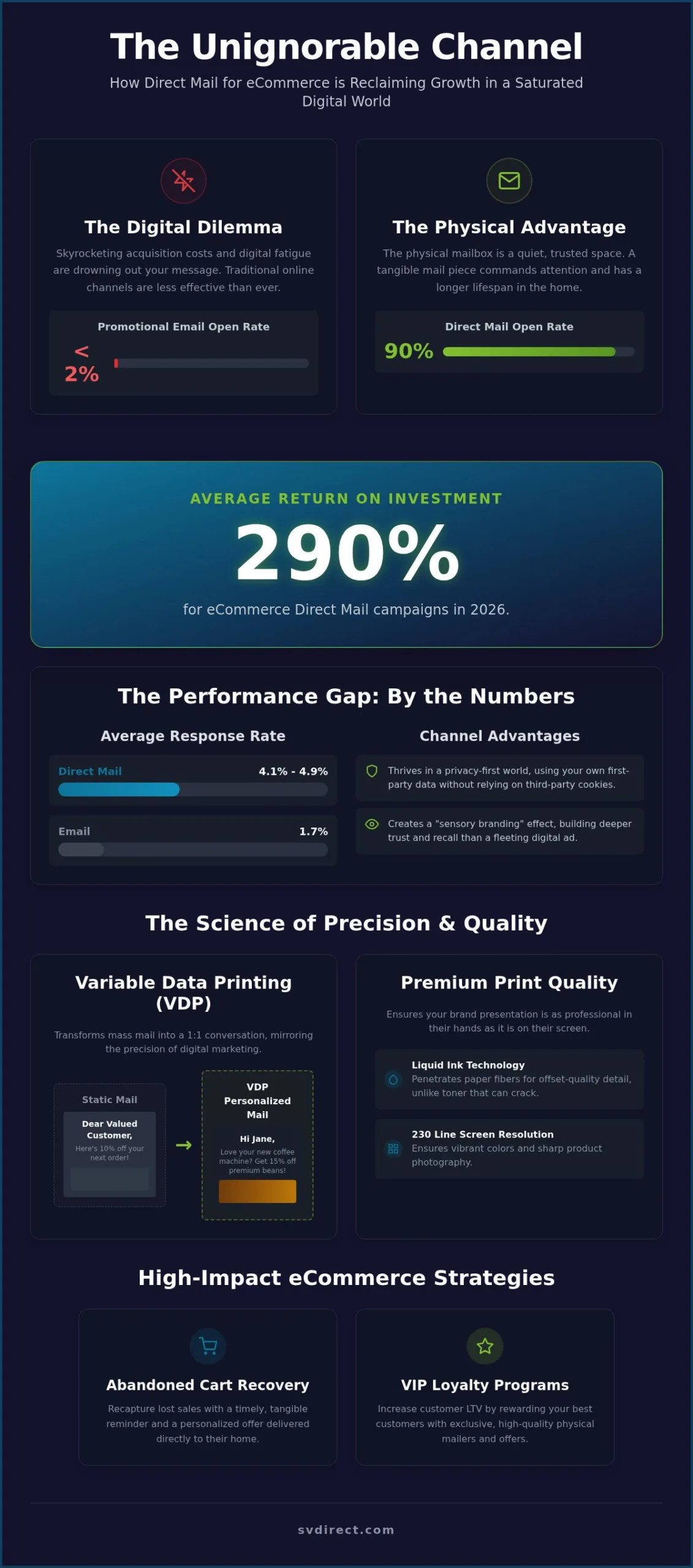
While digital channels grow increasingly saturated, direct mail for ecommerce is delivering a staggering 290% average return on investment in 2026. You’ve likely noticed that reaching customers through their screens has become more expensive and less effective than ever. Between skyrocketing acquisition costs and email open rates that struggle to hit 2%, it’s clear that the digital-only playbook is hitting a wall. It’s exhausting to manage a brand when your message is constantly drowned out by digital noise.

This guide reveals how to bypass that fatigue and drive measurable ROI by pairing high-end digital printing with automated 3PL fulfillment. We’ll show you how to leverage liquid ink precision and Variable Data Printing to deliver a premium brand experience directly to your customer’s hands. You’ll learn how a sophisticated, tech-driven approach to physical mail can integrate with your existing stack to boost Lifetime Value and provide the reliable, offline growth channel your business needs. We’re here to help you scale with precision and personal commitment.

Key Takeaways

  • Learn why physical mailboxes are becoming the most effective channel to bypass digital noise and capture customer attention in 2026.
  • Discover how to use Variable Data Printing (VDP) to create hyper-personalized direct mail for ecommerce that mirrors the precision of your digital marketing.
  • Identify high-impact strategies for abandoned cart recovery and VIP loyalty programs that drive measurable increases in lifetime customer value.
  • Understand the operational advantages of integrating your storefront with a combined 3PL and digital printing partner to ensure seamless, error-free fulfillment.
  • Gain insights into how high-resolution liquid ink technology and a “Quiet Facility” methodology elevate your brand presentation in the customer’s home.

Why Direct Mail is Reclaiming eCommerce ROI in 2026

Modern direct mail marketing for ecommerce isn’t about mass “spray and pray” tactics. It’s the strategic use of physical mailers triggered by digital customer data. Instead of guessing who might want your product, you’re sending a high-quality piece to someone who just abandoned a cart or reached a loyalty milestone. It’s precise, personal, and tangible. In an era where digital ads are often dismissed as fleeting interruptions, a physical mailer represents a deliberate investment in the customer relationship.

Digital fatigue is a significant hurdle for brands in 2026. While consumers are bombarded by hundreds of emails and digital ads every day, the physical mailbox remains a relatively quiet space. Most people handle their mail daily, giving your brand a dedicated moment of attention that a “scroll-by” ad simply can’t replicate. This tactile advantage gives your message a much longer lifespan. A postcard can sit on a kitchen counter for days, serving as a constant visual reminder of your brand, whereas a digital ad disappears the moment the user clicks away.

Privacy regulations have also shifted the landscape. With iOS restrictions and the ongoing depreciation of traditional cookie tracking, digital attribution is harder than ever. Direct mail for ecommerce thrives in this privacy-first environment. It relies on your own first-party data, reaching customers directly at their verified residence without needing to bypass complex browser blockers. It’s a stable, reliable channel that doesn’t fluctuate with every algorithm update.

Breaking Through the 2026 Digital Noise

Research indicates that up to 90% of direct mail pieces are opened and handled, compared to promotional email open rates that often struggle to reach 2%. Holding a physical card creates a “sensory branding” effect that builds deeper trust than a digital pixel. Programmatic Direct Mail acts as the essential bridge here, allowing your digital triggers to automatically initiate high-resolution physical delivery. It combines the automated speed of digital marketing with the undeniable weight and presence of paper.

Measurable Impact on Customer Lifetime Value (LTV)

Direct mail is a powerhouse for retention. The average response rate for physical mail ranges from 4.1% to 4.9%, which significantly outperforms the 1.7% average for email. By adding a physical touchpoint to your journey, you proactively reduce churn and keep your brand top-of-mind. With a documented 290% average ROI in the ecommerce sector, it’s a reliable channel for long-term growth. You can explore more about these high-ROI strategies on our blog. Physical touchpoints prove that your brand is an established, professional entity committed to quality.

The Science of Personalization: Variable Data Printing (VDP)

Variable Data Digital Printing (VDP) is the technical engine behind high-performance direct mail for ecommerce. It transforms a standard postcard into a unique marketing asset tailored to the individual. Unlike traditional “static” mail where every recipient receives the same generic creative, VDP allows you to change specific elements on every single sheet during the printing process. This isn’t just about changing a name; it’s about altering the entire visual and messaging strategy based on your customer’s behavior. A recent study on direct mail campaigns highlights that integrating these physical touchpoints with digital data is exactly why the medium has seen such a powerful resurgence. By using your CRM data, you can create a 1:1 connection that digital ads often fail to achieve.

We utilize the HP Indigo 5500 Digital Press, which uses real liquid ink rather than standard digital toner. This is a critical distinction for brand integrity. Toner often sits on top of the paper and can crack or look artificial. Liquid ink penetrates the fibers, providing offset-quality detail with a 230 line screen resolution. This ensures your brand colors are consistent and your product photography looks as vibrant on the page as it does on a high-resolution screen. High-resolution printing protects premium brand perception by ensuring every detail is sharp and professional. When your mailer feels like a high-end publication rather than a piece of junk mail, the customer’s trust in your brand increases instantly.

Personalization Beyond the First Name

VDP allows for sophisticated logic that mirrors your digital retargeting. If a customer recently bought a coffee machine, their mailer can feature images of premium beans rather than a generic kitchenware photo. You can also embed unique QR codes for every recipient. This enables 1:1 tracking, allowing you to see exactly which customer converted from which mailer. Because modern digital presses don’t require expensive plates or films, this level of customization is now just as affordable as static printing for growing brands. Personalized direct mail for ecommerce can increase response rates by up to 135% compared to static mailers.

Liquid Ink vs. Digital Toner: Why Quality Matters

Liquid ink technology is superior for high-speed fulfillment environments. It dries instantly, which is vital when moving pieces directly from the press to our kitting and assembly stations. This eliminates the risk of smudging or scuffing during the mailing process. The result is a sharper, more vibrant image that stands out in a crowded mailbox. If you’re ready to see how precision printing can elevate your strategy, you can request a free quote to discuss your specific project needs.

High-Impact Strategies for eCommerce Mail Campaigns

Executing successful direct mail for ecommerce requires moving beyond simple mass mailings and into high-intent, data-driven strategies. When a shopper ignores three consecutive email reminders about an abandoned cart, they aren’t necessarily disinterested; they’re likely just digitally fatigued. A physical postcard sent 48 hours after a cart is left behind provides a tactile interruption that demands attention. This approach captures the customer during their daily routine, offering a tangible bridge back to your digital storefront that pixels simply can’t match.

Retaining your most valuable customers is equally critical. VIP and loyalty programs benefit immensely from physical touchpoints. Sending a high-resolution, personalized “thank you” note or a curated welcome kit to top-tier buyers reinforces their status and deepens their connection to your brand. These pieces shouldn’t feel like advertisements. Instead, they should feel like premium brand extensions. This is where sophisticated kitting and assembly play a vital role, ensuring that every element of the package is presented with the precision your brand deserves.

Win-back campaigns also see higher success rates when they move offline. Reactivating a lapsed buyer who hasn’t purchased in six months is often more cost-effective than acquiring a new one. A high-impact physical offer, such as a “we miss you” card with a unique QR code, provides a clear path back to your store. It shows a level of personal commitment that automated email sequences lack, making the recipient feel valued rather than just another entry in a database.

Tactical Triggers for Automated Direct Mail

Automation allows these physical touchpoints to fire exactly when they’re most effective. Timing a post-purchase follow-up to arrive just as a customer is likely to need a refill or a complementary product creates a seamless lifecycle. Leveraging personal data for birthday or anniversary celebrations adds a human element to your tech stack. For broader seasonal promotions, Every Door Direct Mail (EDDM) provides a reliable way to amplify major sales events like Black Friday by reaching entire neighborhoods with high-quality creative.

The Power of Catalog Order Fulfillment

Many DTC brands are rediscovering the “mini-catalog” or “cardalog” as a powerful storytelling tool. These curated pieces allow you to showcase a specific collection with the high-fidelity detail that only liquid ink can provide. Managing these bulk mailings requires a partner who understands the intersection of 3PL logistics and precision printing. To explore how these services integrate into a broader strategy, read our guide on Direct Mail Marketing Services: The Strategic Guide to Physical Engagement in 2026. By combining these physical assets with your digital data, you create a cohesive, multi-channel experience that drives long-term growth.

Direct Mail for eCommerce: The 2026 Strategic Guide to Physical Growth

Bridging the Gap: Integrating Your Store with Physical Fulfillment

Successful direct mail for ecommerce relies on a seamless transition from digital signal to physical production. The first step involves connecting your platform, whether it’s Shopify or WooCommerce, to a robust fulfillment system. This integration ensures that customer triggers, like a specific purchase or an abandoned cart, automatically flow into the production queue without manual intervention. It’s about building a bridge between your digital store and our physical infrastructure, allowing for a proactive approach to customer engagement that scales with your growth.

Once the data flows, designing for the “2nd Pass” becomes essential. This means ensuring your print files are technically ready for immediate production and mailing to avoid costly delays. We help coordinate the complex kitting and assembly required for promotional mailers that include more than just a single card. Whether you’re sending a luxury welcome kit or a multi-piece loyalty package, our team manages the physical labor with the same precision you expect from your digital algorithms. This operational readiness eliminates bottlenecks and ensures your brand reaches the customer’s mailbox exactly when it’s most impactful.

Remote Order Management and Real-Time Visibility

You shouldn’t have to guess the status of your physical campaigns. It’s vital to track your direct mail for ecommerce with the same granularity you apply to digital ads. Our proprietary Remote Control™ system provides 24/7 visibility into your inventory and mailing status. This transparency allows you to monitor exactly when pieces are produced and shipped, giving you a steady hand over your marketing operations. Learn more about our Remote Order Management to see how we provide informed confidence through every step of the fulfillment process.

Data Integrity and Database Management

Precision in fulfillment is impossible without clean data. We prioritize list hygiene to improve deliverability and reduce wasted postage costs. This includes utilizing National Change of Address (NCOA) updates to ensure your mail reaches customers even if they’ve recently moved. For sensitive sectors like healthcare or finance, we maintain strict data handling protocols to ensure HIPAA or financial compliance. Our methodical approach to database management ensures that your physical operations are just as organized and secure as your digital communication, protecting both your brand and your customers.

Choosing a Partner for Integrated Print and Fulfillment

Selecting a partner for direct mail for ecommerce isn’t just about finding a printer; it’s about choosing an operational ally. When your 3PL and print provider are the same entity, you eliminate the logistical friction of moving materials between separate vendors. This integration reduces lead times and shipping costs significantly. It also ensures that your inventory and your marketing collateral are managed under one roof with a single point of accountability. You gain a steady hand in a fast-paced industry, alleviating the stress of business growth through precision and personal commitment.

We operate with a “Quiet Facility” methodology. This means our environment is highly organized and methodical, designed to reduce errors even during high-volume fulfillment peaks. Our team takes a proactive approach to problem solving. We anticipate potential mailing conflicts or data errors before they ever hit a customer’s mailbox. This level of oversight is a powerful differentiator in a tech-saturated market where automated platforms often miss the nuances of physical production. We value transparency and directness, respecting your time by ensuring operations are as organized as your digital communication.

Our digital printing processes are inherently more sustainable. Because we use HP Indigo technology, we eliminate the need for traditional films, plates, or harsh chemicals. This green benefit supports your brand’s sustainability goals while maintaining the 230 line screen resolution required for premium brand presentation. It’s a high-tech solution that remains grounded in environmental responsibility and physical quality.

The Strategic Advantage of a Silicon Valley 3PL

Silicon Valley is synonymous with innovation, and we leverage that spirit to streamline your logistics. Being centrally located allows us to offer global shipping and logistics solutions that are both fast and cost-effective. Explore our Silicon Valley 3PL Fulfillment Services to see how we combine geographic advantages with high-performance infrastructure. Centralized warehousing and printing mean your direct mail for ecommerce is ready to ship the moment the ink is dry, providing a speed-to-market advantage that separate vendors can’t match.

A Partnership Approach to Growth

We view our clients as partners rather than transactions. Our “Extension of Your Team” philosophy means we’re personally committed to your growth. Whether you’re shipping a few hundred pieces or handling thousands of shipments per week, our facility is built to scale with your needs. This internal stability is backed by long-term staff retention and decades of collective experience, ensuring that your brand’s physical presence is handled by seasoned experts. Read our Customer Testimonials to see how we’ve helped other brands achieve reliable, physical growth through bespoke problem-solving and operational excellence.

Scaling Your Brand with Physical Precision

In 2026, the brands that thrive are those that successfully bridge the gap between digital data and physical experiences. Direct mail for ecommerce is no longer a separate silo; it’s a high-performance extension of your digital strategy. By utilizing HP Indigo 5500 liquid ink technology, you ensure your brand maintains a premium presence in the customer’s home. Our proprietary Remote Control™ system provides the 24/7 visibility you need to manage campaigns with total confidence.

We believe in building long-term partnerships, with many of our client relationships lasting over 7 years. This stability allows us to act as a steady hand while you navigate the complexities of high-volume fulfillment. You don’t have to choose between high-tech efficiency and a human touch. We’re here to provide both as you scale your business into the physical world. Our team remains dedicated to your success through every step of the process.

We look forward to helping you turn your digital shoppers into lifelong brand advocates through precision and personal commitment. Your growth is our priority.

Frequently Asked Questions

How does direct mail integrate with my Shopify or eCommerce store?

Direct mail integrates with your store through automated triggers that connect your platform to our fulfillment system. When a customer abandons a cart or hits a loyalty milestone, the data flows directly into our production queue. This eliminates manual list uploads and ensures your mailers are sent with digital speed. It’s a proactive way to maintain a steady presence in your customer’s life without adding operational stress.

Is variable data printing expensive for personalized eCommerce mailers?

Variable data printing is now as cost-effective as static printing because modern digital presses don’t require expensive plates or films. You can personalize every sheet with unique images and copy without increasing production time. Since personalized direct mail for ecommerce can boost response rates by up to 135%, the return on investment is significantly higher than generic mailers. It’s a high-performance strategy that respects your budget.

What is the typical turnaround time for an automated direct mail campaign?

Turnaround times are streamlined because our printing and fulfillment happen under one roof. Most automated campaigns move from a digital trigger to the mailbox within a few business days. Our methodical “Quiet Facility” approach ensures that even high-volume projects are handled with precision. You gain the advantage of speed-to-market while maintaining the high-quality brand presentation your customers expect from a premium brand.

How do I track the ROI of my physical mail campaigns?

You track ROI by using unique QR codes, personalized URLs, or specific discount codes assigned to each recipient. This allows for 1:1 attribution; you know exactly which customer converted from which physical mailer. Our Remote Control™ system provides real-time visibility into your campaign’s progress. By matching back your mailing list to your sales data, you can accurately measure the 290% average ROI typical of this channel.

What is the difference between liquid ink and digital toner for print quality?

Liquid ink provides a superior, offset-quality finish that digital toner simply cannot match. While toner sits on the surface and can crack, liquid ink penetrates the paper fibers for a vibrant, professional look. Our HP Indigo 5500 technology uses a 230 line screen resolution to ensure your product photography is sharp and accurate. This level of detail is essential for maintaining brand integrity in a physical format.

Can I send direct mail to customers who have unsubscribed from my emails?

You can send physical mail to customers who have unsubscribed from your emails because there is no national “Do Not Mail” registry. This makes it a powerful channel for win-back campaigns and reaching shoppers who have opted out of digital noise. While you should always honor direct requests to be removed from your list, direct mail for ecommerce provides a reliable way to bypass crowded inboxes and re-engage your audience.

What are the benefits of using a 3PL for both fulfillment and direct mail?

Using a single partner for 3PL and direct mail eliminates the friction of moving materials between separate vendors. Your inventory and your marketing collateral live together; this reduces shipping costs and lead times. This integrated approach provides a single point of accountability and 24/7 visibility through our proprietary management systems. It’s an efficient way to scale your operations while ensuring every package is presented with precision.

Is direct mail for eCommerce environmentally friendly in 2026?

Direct mail is increasingly environmentally friendly due to digital printing innovations that eliminate the need for films, plates, and harsh chemicals. Our HP Indigo technology offers green printing benefits by reducing waste and using sustainable processes. Because you can target your mailers so precisely with VDP, you also reduce the environmental impact of sending irrelevant mail. It’s a high-tech solution that aligns with modern sustainability goals.

The Ultimate 3PL Onboarding Checklist: A Strategic Guide for 2026

The Ultimate 3PL Onboarding Checklist: A Strategic Guide for 2026

What if the biggest threat to your brand’s growth isn’t a market shift, but the silence of ‘dark’ inventory during a warehouse move? It’s a common anxiety for scaling businesses that fear losing visibility or encountering hidden setup fees. You need a partner who acts as a steady hand, drawing on over 25 years of operational history to ensure your transition is precise. That’s why we’ve developed a comprehensive 3pl onboarding checklist to eliminate technical friction and ensure your data remains secure from the very first scan.

We believe that successful logistics integration requires a blend of high-tech visibility and high-touch human oversight. By following this strategic guide for 2026, you’ll master the transition with a 100-point plan designed for a zero-error move. We’ll preview the essential stages of API synchronization, physical stock verification, and the reporting methods needed to maintain real-time control. This roadmap ensures your new partnership feels like a natural extension of your own team, providing the stability you need to grow without the typical growing pains.

Key Takeaways

  • Successful integration starts by shifting from a vendor mindset to a true partnership. This collaborative approach ensures your logistics provider operates as a seamless extension of your internal team.
  • A comprehensive 3pl onboarding checklist must prioritize technical synchronization and precise SKU mapping. These steps are vital to preventing data loss and ensuring your inventory remains visible throughout the move.
  • Utilize a Master Requirements Document to manage the physical transfer of goods. This structured process provides the clarity needed to maintain stock accuracy from the moment your first shipment arrives.
  • Incorporate specialized workflows like on-demand digital printing and complex kitting into your initial setup. Addressing these technical requirements early prevents operational delays during your peak seasons.
  • Execute a soft launch with test orders to validate every digital and physical touchpoint. Monitoring the first 30 days of live operations allows for the proactive refinement of shipping rules and carrier performance.

The Strategic Foundation: Pre-Onboarding and Kickoff

At its core, Third-party logistics (3PL) onboarding is the systematic alignment of your digital sales channels, backend data, and physical inventory with a fulfillment partner’s operations. It isn’t just a simple software handshake. It’s a high-stakes transition that requires a steady hand to avoid “dark” inventory or data loss. Viewing this move through the lens of a 3pl onboarding checklist helps you shift from a transactional vendor mindset to a collaborative partnership. A vendor simply ships boxes; a partner integrates with your team to solve problems before they reach the customer, creating a foundation for long-term scalability.

Establishing Your Success Metrics (KPIs)

Precision is the hallmark of high-performance logistics. You must define what success looks like before the first pallet arrives. We recommend setting “On-Time In-Full” (OTIF) targets that reflect your specific industry requirements, as healthcare mailing needs differ from consumer electronics. Using a 3pl onboarding checklist ensures that accuracy benchmarks for inventory receiving and order picking are established early. Our Remote Control™ system provides 24/7 visibility into these metrics through 120+ standard reports, so you’re never guessing about your stock levels.

Communication and Project Management

Effective logistics management requires moving beyond endless email chains. A proactive communication cadence, led by a dedicated project manager, prevents the hectic warehouse environment that causes errors. This human-centric approach ensures that your account manager understands the nuances of your assembly needs. You can learn about SVD’s proactive problem-solving philosophy to see how dedicated oversight transforms the shipping experience. This proactive stance ensures your operations remain grounded and accessible even during rapid growth.

Technical Integration: Syncing Your Digital Ecosystem

The digital handshake between your storefront and our warehouse is where operational speed is won or lost. Integrating your eCommerce platform, whether it’s Shopify or WooCommerce, requires more than just a simple plugin installation. It demands a meticulous SKU mapping process to ensure every item variant aligns perfectly across all sales channels. This technical alignment is a core component of any robust 3pl onboarding checklist. Without it, you risk duplicate entries or “ghost” stock that disrupts the customer experience. Our approach prioritizes a seamless data flow that eliminates manual entry errors and provides a stable foundation for growth.

Maintaining security in 2026 means adhering to the latest encrypted data transfer protocols. We ensure that every transaction and customer detail is protected during the sync. This commitment to data integrity allows you to focus on scaling while we handle the mechanical complexities of order transmission. With 85% of supply chain executives planning to increase AI spending in 2026, having a clean data foundation is no longer optional. A precise 3pl onboarding checklist ensures that your data is structured correctly from day one, allowing you to leverage advanced forecasting tools effectively.

Leveraging Web Services and API Integration

We utilize platform-agnostic XML and SOAP protocols to facilitate effortless communication between disparate systems. These programmatic interfaces empower your developers to build custom user dashboards tailored to your specific reporting needs. The AddOrder method streamlines real-time transaction submission by allowing your external systems to programmatically push new orders directly into our management system for immediate processing. This level of flexibility ensures that your technical ecosystem remains agile and responsive to market demands.

Proprietary Data Management Tools

Visibility shouldn’t end when the warehouse doors close. Our proprietary Remote Control™ system offers the ultimate advantage by providing 24/7 access to your inventory and order histories. You can explore our Remote Order Management system to see how we provide 120+ standard reports at your fingertips. This tool doesn’t just display data; it acts as an early warning system with automated notifications for low inventory levels and backorders.

This high-tech efficiency is always backed by human expertise. While our systems handle the heavy lifting of data synchronization, our account managers provide the personal oversight necessary to catch nuances that algorithms might miss. If you’re ready to see how a high-performance partner can stabilize your digital operations, you might want to request a custom quote tailored to your integration needs.

Physical Inventory Transition and Quality Control

The digital sync discussed in the previous section provides the visibility, but the physical migration of your stock is where a partnership is truly tested. A successful transition relies on a Master Requirements Document (MRD). This blueprint defines every physical attribute of your products, from precise dimensions to exact weights. It ensures that when your inventory arrives, there are zero discrepancies between what was sent and what is shelved. This document is a non-negotiable part of your 3pl onboarding checklist, acting as the source of truth for the entire operations team.

Coordinating the “Big Move” from your old facility requires meticulous timing. It isn’t just about loading trucks. It’s about staging shipments to prevent bottlenecks and ensuring your inventory doesn’t “go dark” during transit. Once your goods reach our doors, our inbound receiving protocols take over. We verify quantities, weights, and product condition against the MRD with absolute precision. Our quiet, organized facility methodology isn’t just a slogan. It’s a deliberate operational choice to reduce the noise and chaos that lead to receiving errors. This calm environment allows our staff to focus, ensuring your inventory is available for sale the moment it’s processed.

The Systematic QC-Check Process

Inspection is a core pillar of our 25 year operational history. For complex kitting or hand assembly, a systematic QC-Check process is essential to maintain brand integrity. We believe inspection at every stage is non-negotiable because catching a mistake at the end of a run is often too late. For brands with high-value inventory, secure and climate-controlled warehousing provides an additional layer of protection. You can learn more about Secure Warehousing for High-Value Electronics to understand how we protect specialized assets through every step of a 3pl onboarding checklist.

Inventory Categorization and Storage

Speed in fulfillment starts with how items are shelved. We use ABC analysis to organize inventory, placing high-velocity products in the most accessible zones for faster pick-and-pack cycles. For items requiring strict accountability, we set up serial number tracking at the product level. This ensures you can trace every unit from the moment it enters our facility until it reaches the customer’s doorstep. We also manage literature and promotional assets alongside your primary products. This integrated approach ensures that marketing collateral is always available for kitting, maintaining a consistent brand experience across every package shipped.

The Ultimate 3PL Onboarding Checklist: A Strategic Guide for 2026

Onboarding for Specialized Workflows: Kitting and Printing

Healthcare-specific compliance adds another layer of complexity to the transition that many providers overlook. If you handle medical kits or patient communications, your onboarding process must verify HIPAA-compliant protocols for mailing and data handling. Our facility is designed to manage these sensitive requirements with the same quiet, organized precision we apply to eCommerce orders. This ensures your brand remains compliant while benefiting from high-performance logistics infrastructure. Managing these intricate requirements within your 3pl onboarding checklist prevents operational bottlenecks and legal risks during high-volume launches.

Just-In-Time Digital Printing Setup

Configuring 4-color digital printing for short-run materials requires high-resolution standards to maintain brand quality. We utilize HP Indigo 5500 liquid ink technology to ensure that every print-on-demand asset meets a 300 dpi standard. This setup allows for rapid adjustments to marketing materials without the lead times associated with traditional offset printing. It’s a proactive way to manage promotional literature and seasonal inserts. You can discover our Print-on-Demand capabilities to see how we bridge the gap between digital marketing and physical fulfillment through high-tech integration.

Kitting and Assembly Precision

Complex kitting, from subscription boxes to intricate software packages, demands a rigorous assembly process. We develop detailed assembly instructions and quality benchmarks for every hand-kitting project. Our systematic QC-Check process ensures that each kit is built to your exact specifications, whether it’s for promotional fulfillment or tradeshow support. For a deeper look at these processes, see our Kitting and Assembly Services: Strategic Guide. This level of oversight provides the stability needed for high-stakes assembly work.

The Go-Live Validation and 30-Day Monitoring

The transition from planning to execution is the most high-stakes moment of the logistics journey. We recommend a “Soft Launch” phase to validate every digital and physical connection before opening the floodgates. By processing a small batch of test orders, you can confirm that the digital handshake between your store and our facility is flawless. This validation step is a critical milestone in our 3pl onboarding checklist, ensuring that shipping rules and carrier selections trigger correctly. It’s much easier to refine a process during a controlled pilot than during a full-scale launch where customer expectations are already on the line.

Once live, the focus shifts to monitoring carrier performance and the accurate application of discounted shipping rates. We use the first month to establish a robust returns management workflow, which is essential for building long-term customer trust. Returns shouldn’t be a secondary thought. They’re a vital part of the brand experience that requires the same precision as outbound fulfillment. Reviewing the first month’s reports allows us to identify any minor friction points and refine the operational rhythm. With 76% of supply chain leaders reporting improved forecast accuracy in 2026, using this initial data to sharpen your inventory planning is a proactive move for future growth.

Validation and Troubleshooting

After the initial launch, we conduct a post-onboarding audit to identify any hidden inefficiencies. This isn’t a one-time check but a commitment to operational excellence. Our stakeholders have 24/7 access to live reporting through the Remote Control™ system, providing total transparency into every movement and order status. This ensures that everyone from IT to marketing remains informed and confident. For a broader look at shipping complexities and international regulations, see our Global Shipping Services: 2026 Strategic Reference.

Earning Long-Term Trust

A successful 3pl onboarding checklist is just the beginning of a continuous improvement journey. We move beyond the initial setup to look for ways to optimize your supply chain as your brand scales. You need a partner who thinks outside the box, offering bespoke problem-solving that automated bots simply can’t provide. Our multi-decade history is anchored in the belief that human oversight is the ultimate differentiator in a tech-driven market. This proactive attitude ensures your business remains agile, stable, and ready for the demands of a global marketplace.

Ready for a seamless transition? Contact Silicon Valley Direct today

Securing Your Growth with a Precision-Driven Partnership

Mastering a logistics transition requires more than just a software sync. It demands a high-touch approach that aligns your digital ecosystem with a quiet, organized physical facility. By utilizing a comprehensive 3pl onboarding checklist, you’ve established a source of truth that prevents data loss and ensures your inventory never goes dark. Integrating specialized workflows like complex kitting and high-resolution digital printing early on creates a seamless brand experience from day one. This proactive strategy turns your fulfillment operations into a stable foundation for scaling.

Since 1999, we’ve acted as a steady hand for brands navigating these technical and physical complexities. Our proprietary Remote Control™ system provides the 24/7 visibility you need to maintain informed confidence throughout the go-live phase and beyond. This isn’t just about moving boxes. It’s about building a partnership where physical operations are as organized and reliable as your digital strategy. We’re committed to ensuring your transition is error-free and your stock is visible from the moment it reaches our doors.

Your brand deserves a partner that treats your growth with personal commitment and technical precision. We’re ready to help you turn your logistics from a source of anxiety into a powerful engine for your 2026 expansion.

Frequently Asked Questions

What is a 3PL client onboarding checklist?

A 3PL client onboarding checklist is a structured roadmap that aligns your digital ecosystem, physical inventory, and operational standards with your logistics partner. This comprehensive 3pl onboarding checklist ensures that data syncs correctly and stock is verified before shipping begins. It serves as a source of truth for both your internal team and our account managers, preventing data loss and ensuring a seamless operational integration from the very first day of the partnership.

How long does the 3PL onboarding process typically take?

The onboarding timeline typically spans two to six weeks depending on your operational complexity. While a simple eCommerce integration might be finalized quickly, projects involving complex kitting or healthcare mailing require additional time for rigorous testing. We prioritize a methodical pace to ensure every API connection and physical receiving protocol is perfect. This steady hand approach prevents the hectic warehouse environments that lead to errors during rapid growth or seasonal peaks.

What data does a 3PL need to begin the system integration?

System integration begins with your SKU list, product dimensions, weights, and API credentials for your eCommerce platforms. We also need any specific assembly instructions for kitting or high-resolution assets for on-demand digital printing. Providing this data through a Master Requirements Document allows our Remote Control™ system to establish 24/7 visibility immediately. This organized data foundation is essential for maintaining real-time stock accuracy and ensuring that your reporting remains precise and actionable.

How do I prevent shipping delays during the move to a new 3PL?

Preventing delays requires a “Soft Launch” phase where a small batch of test orders is processed before the full transition. This pilot validates that your shipping rules and carrier selections are functioning correctly within the digital ecosystem. By identifying friction points in a controlled environment, you avoid the silence of “dark” inventory during the move. Our proactive problem-solving philosophy ensures that your customers never experience a disruption in service while we refine the operational rhythm.

What are the common mistakes businesses make when onboarding a 3PL?

A common mistake is viewing the transition as a purely technical software sync rather than a collaborative partnership. Businesses often overlook the importance of physical stock verification or fail to define clear escalation paths for technical issues. Within a robust 3pl onboarding checklist, these human elements are just as critical as the API connections. Ignoring specialized workflows like variable data printing or returns management early on can also create bottlenecks that slow down your long-term scalability.

Can I integrate my existing custom software with a 3PL system?

Our system is designed to integrate with custom software through platform-agnostic XML and SOAP protocols. These programmatic interfaces allow your developers to build custom dashboards or push real-time transaction data directly into our Order Management System. This flexibility ensures that your existing digital investments remain valuable while gaining the benefit of our 25 years of operational history. You don’t have to change your entire workflow to gain high-tech efficiency and human oversight.

How much does 3PL onboarding cost for a small business?

Onboarding costs are generally determined by the complexity of your technical setup and the volume of inventory being transitioned. While setup fees in the industry can range from $250 to over $1,000, we focus on providing a bespoke quote that reflects your specific needs. This might include configurations for HP Indigo digital printing or specialized healthcare compliance. Investing in a precise setup prevents hidden fees and operational errors that could cost much more later.

What happens if my inventory levels don’t match during the transition?

We perform a physical count to reconcile your digital records with the actual stock in our facility if discrepancies arise. This verification process uses your Master Requirements Document as the source of truth to identify where gaps occurred during the move. Our Remote Control™ system then updates your inventory levels in real-time to ensure your storefront reflects accurate data. This transparent approach ensures your partnership is built on a foundation of trust and operational precision.

Inventory Management for eCommerce: The 2026 Strategic Guide to Scaling Operations

If your digital dashboard shows a healthy surplus but your warehouse floor is actually empty, how much is that data gap costing your brand’s reputation? It’s a question many founders face as average 3PL monthly minimums have surged by 53 percent since 2024, leaving no room for operational error. You likely feel the weight of capital tied up in slow-moving stock while your bestsellers vanish, leading to the inevitable customer frustration that follows inaccurate “in-stock” counts. Manual data entry across multiple sales channels only compounds the stress, making growth feel like a liability rather than a victory.

You deserve a steady hand to help manage these complexities. This guide shows you how to master inventory management for ecommerce by achieving total stock balance and real-time visibility across every channel. We will outline the steps to lower your storage fees through optimized levels and create a seamless bridge between order placement and physical fulfillment. By the end, you’ll have a strategic framework to ensure your physical operations are just as agile and precise as your digital storefront in 2026.

Key Takeaways

  • Understand how the shift toward predictive analytics allows you to anticipate market demand rather than simply reacting to stockouts.
  • Implement proven methodologies like FIFO and ABC Analysis to prioritize your highest-revenue assets and eliminate product obsolescence.
  • Master the balance between digital visibility and physical precision to optimize inventory management for ecommerce across every sales channel.
  • Identify the specific operational tipping points that signal it’s time to transition from fixed warehouse costs to a scalable, variable-cost 3PL model.
  • Learn how leveraging on-demand digital printing and precise warehouse control can reduce overhead while strengthening customer loyalty.

What is Inventory Management for eCommerce in 2026?

In 2026, the definition of success has shifted. It is no longer just about counting boxes in a back room. Effective inventory management for ecommerce involves the end-to-end supervision of non-capitalized assets, from the moment of procurement through to final delivery. While older models focused on reacting to sales after they happened, the modern standard is “predictive inventory.” This proactive approach uses historical data and market trends to anticipate demand before the first order even arrives.

To scale in this high-stakes environment, your operations must rest on three pillars: digital visibility, physical accuracy, and logistical speed. Many traditional warehouses rely on a “hustle” culture that leads to burnout and frequent errors. At Silicon Valley Direct, we replace that chaotic noise with our “quiet facility” methodology. This approach ensures precision even during peak seasons, treating your stock with the care of a seasoned partner. Mastering inventory management for ecommerce in 2026 requires this level of calm, calculated precision to turn your warehouse into a growth engine.

The Cost of Poor Inventory Control

Inaccurate tracking is not just an inconvenience; it’s a direct hit to your bottom line. Stockouts lead to immediate revenue loss and can permanently damage your search rankings on major marketplaces. Conversely, “dead stock” drains capital through mounting storage fees and insurance costs. This often stems from the “bullwhip effect,” where small fluctuations in retail demand cause massive, inefficient swings in wholesale ordering. Mitigation requires real-time data that reflects the actual state of your shelves without delay.

Inventory Management vs. Order Fulfillment

It’s vital to distinguish between these two functions. Fulfillment is the physical action of picking and packing a product. In contrast, inventory management is the high-level strategy that determines what should be on the shelf in the first place. These functions must be perfectly integrated to achieve 100% accuracy. By partnering with a 3PL fulfillment service that prioritizes both strategy and execution, you turn your supply chain into a competitive advantage. This integration ensures that the software “window” matches the reality of the warehouse floor every single time.

Core Methods for Optimizing eCommerce Stock Levels

Success in 2026 requires more than just knowing what is on the shelf. It requires a methodology that adapts to your specific product lifecycle. First-In, First-Out (FIFO) remains the gold standard for brands that prioritize product freshness and quality. By ensuring the oldest stock leaves the warehouse first, you can optimize inventory management for ecommerce and prevent the silent revenue drain of obsolescence. This is particularly critical for industries like healthcare or electronics—where brands like Sunshine Valley distribute natural food supplements—because shelf life is finite and technical specifications evolve rapidly.

Not all products are created equal. ABC Analysis allows you to categorize stock based on value and turnover. “A” items typically represent only 20 percent of your SKU count but drive 80 percent of your revenue. By focusing your tightest controls on these high-velocity assets, you optimize your capital. Just-In-Time (JIT) models offer high rewards in lowered storage fees, yet they carry risks in a volatile global market. To buffer against supply chain disruptions, we recommend a calculated Safety Stock. This acts as a strategic insurance policy, ensuring you never face the “out of stock” badge that kills conversion rates and customer trust. To see how these methods apply to your specific volume, you can request a free quote to discuss a tailored strategy.

Managing Complex SKUs and Kitting

Scaling often involves creating bundles or promotional kits that combine multiple products into a single offer. This introduces the “virtual SKU” concept, where individual components are tracked separately in the warehouse but appear as a single unit to the customer. Managing this complexity requires high-touch precision and an integrated digital view. Silicon Valley Direct provides kitting and hand assembly services that ensure these multi-component orders are built accurately every time. This maintains the integrity of your inventory management for ecommerce even during high-volume promotional pushes or seasonal spikes.

Cycle Counting vs. Physical Audits

Traditional annual physical audits are disruptive and often reveal errors too late to fix. They force a complete halt to operations, which is unacceptable for a fast-moving brand. In contrast, modern Effectively Manage Inventory strategies favor cycle counting. Cycle counting is a rolling audit process that maintains 99 percent accuracy without pausing operations. Our systematic QC-Check inspection process builds this continuous verification into the daily workflow. This ensures that the 120+ standard reports available in your Remote Control™ system reflect the absolute truth of the warehouse floor at any given moment.

The Critical Bridge: Integrating Software with Warehouse Operations

Software is often marketed as a cure-all, but in reality, it’s merely a window into your physical operations. The most sophisticated dashboard is useless if the data it displays doesn’t mirror the actual shelf. Successful inventory management for ecommerce relies on the synergy between digital tools and the human expertise managing the warehouse floor. Without this bridge, brands fall victim to “ghost inventory,” where a website displays items as in-stock that are physically unavailable. This leads to backorders, canceled sales, and eroded customer trust.

To maintain a seamless data flow, integration must be platform-agnostic. Our systems utilize XML, SOAP, and WSDL protocols to ensure that information moves instantly between your storefront and our facility. This technical flexibility allows us to act as a high-performance extension of your team, regardless of which ecommerce platform you use. By implementing essential inventory management techniques through our proprietary Remote Control™ system, you gain a central hub that synchronizes every transaction with physical reality. This eliminates the lag time that often plagues growing brands during rapid scaling phases.

24/7 Visibility with Remote Control™

True operational confidence comes from transparency. Our Remote Order Management system provides 24/7 access to your data, offering over 120 standard reports that detail everything from order history to real-time stock levels. You don’t have to wait for manual updates or business hours to understand your position. Automated notifications for low inventory and backorders ensure you can make proactive decisions before a shortage impacts your sales velocity. This system was designed to provide the depth necessary for technical stakeholders while remaining accessible for daily business decisions.

Removing the ‘Hectic’ from Fulfillment

Many fulfillment centers operate in a state of constant chaos, but we believe precision requires a “quiet facility” methodology. We replace the frantic energy of traditional warehouses with organized, deliberate prioritization. This methodical approach allows us to meet high-volume deadlines with a significantly lower error rate than industry averages. Our team practices proactive problem solving, identifying potential order conflicts or shipping discrepancies before the package ever leaves the dock. This stability is a unique hallmark of our internal culture, where seasoned experts oversee every detail of your inventory management for ecommerce. We reject automated-only interactions, ensuring that a human set of eyes monitors your most critical assets.

Inventory Management for eCommerce: The 2026 Strategic Guide to Scaling Operations

When to Outsource Inventory Management to a Professional 3PL

Deciding when to move your operations out of a private lease or a crowded back office is a pivotal moment for any brand. You’ll know you’ve reached the tipping point when warehouse rent and labor management begin to consume more time than your core product development. If shipping errors are stifling your growth, it’s time to reconsider your approach to inventory management for ecommerce. Transitioning to a 3PL shifts you from a “fixed cost” model, where you pay for empty warehouse space and idle staff, to a “variable cost” model. You only pay for the space and labor you actually use, which preserves your capital for marketing and innovation.

A professional partner provides more than just square footage. You gain immediate access to discounted carrier rates and global logistics expertise that would take years to negotiate independently. Beyond standard shipping, specialized services like on-demand digital printing and literature fulfillment allow you to customize orders without the overhead of in-house equipment. This level of versatility ensures your fulfillment strategy remains as agile as your digital marketing. By outsourcing, you leverage physical infrastructure and human expertise that in-house teams simply can’t replicate at scale.

Handling High-Value and Sensitive Goods

Sensitive inventory requires more than a standard shelf. Electronics and healthcare products often demand secure, climate-controlled environments to maintain their integrity. Precision here involves serial number tracking, which is vital for warranty management and returns processing. For a deeper look at these requirements, see our guide on Secure Warehousing for High-Value Electronics. Our systematic QC-Check process ensures these high-stakes items are handled with absolute care, providing a level of security that generic storage facilities lack.

The ‘Extension of Your Team’ Philosophy

We reject the cookie-cutter approach common in highly automated, impersonal facilities. A true partnership requires a steady hand and a personal commitment to your specific project goals. This flexibility allows us to custom-fit solutions rather than forcing your business into a rigid template. Silicon Valley Direct has served as a reliable anchor for brands since 1999. Our multi-decade history and long-term staff retention mean you’re working with seasoned experts who understand the nuances of inventory management for ecommerce. We act as a proactive extension of your team, identifying logistical hurdles before they become customer complaints.

Maximizing eCommerce ROI Through Precise Inventory Control

Precision in the warehouse translates directly to your bottom line. When your inventory management for ecommerce is executed with absolute accuracy, you create a foundation for customer loyalty that no marketing campaign can match. A customer who receives exactly what they ordered, exactly when promised, is a customer who returns. This reliability reduces the costs associated with returns management and customer support, allowing you to reinvest that capital into growth. It’s about turning your logistics from a cost center into a retention engine that drives long-term value.

Beyond simple stock tracking, integrating specialized services like on-demand digital printing and variable data printing significantly reduces your inventory overhead. Instead of pre-printing thousands of marketing inserts that might become obsolete, you print only what you need for each specific order. This agility ensures your collateral is always current and relevant. Detailed reporting from our Remote Control™ system provides your marketing department with the granular data needed to understand which products are truly profitable after accounting for storage and fulfillment costs. We provide the “window” into your operations that allows for these high-level strategic pivots. Silicon Valley Direct is the strategic choice for brands that value this level of high-touch quality over the impersonal model of high-volume facilities.

Reducing Waste with Green Logistics

Digital printing eliminates the need for massive stockpiles of marketing materials that eventually end up in a landfill. By adopting a “print what you use” philosophy, you significantly lower your brand’s environmental footprint. Our Print on Demand Services utilize sustainable materials and participate in programs like HP’s hardware recycling to ensure our operations remain as green as they are efficient. This commitment to sustainability is part of our proactive problem-solving approach. It ensures that your physical operations align with modern environmental standards without sacrificing logistical speed or precision.

Next Steps: Auditing Your Current System

Evaluating your current operations requires a cold, hard look at your data accuracy and fulfillment speed. Start by comparing your digital stock counts against a physical cycle count. If your discrepancy rate is higher than one percent, your current system is leaking revenue. Look past the slick interface of your software and examine the physical reality of your fulfillment partner. Are they a steady hand in the industry, or are they struggling to keep up with the “hustle” of peak periods? If your current setup feels more like a source of stress than a high-performance partner, it’s time to transition to a more reliable model.

Contact Silicon Valley Direct for a Custom Fulfillment Solution

Building a Scalable Operational Foundation for 2026

Success in the coming year depends on your ability to bridge the gap between digital storefronts and physical reality. You’ve seen how predictive analytics and methods like FIFO or ABC Analysis turn stagnant stock into liquid capital. Effective inventory management for ecommerce isn’t just a back-office task; it’s a primary driver of customer loyalty and long-term ROI. By moving from fixed-cost warehouses to a variable-cost partnership, you gain the agility needed to navigate shifting global regulations and market demands.

Silicon Valley Direct brings over 25 years of operational expertise to your brand’s growth journey. Our proprietary Remote Control™ system provides 24/7 real-time visibility with over 120 standard reports, while our systematic QC-Check process ensures 99 percent accuracy across every SKU. We act as a steady, proactive extension of your team, replacing warehouse chaos with the precision of our “quiet facility” methodology.

Your brand is ready for its next phase of growth. We’re here to ensure your physical operations are just as innovative and reliable as your vision.

Frequently Asked Questions

What is the difference between inventory management and warehouse management?

Inventory management focuses on the high-level strategy of stock levels, demand forecasting, and procurement. Warehouse management deals with the physical movement and storage of goods within a facility, including picking and packing. While the two functions are distinct, they must be perfectly integrated to ensure that your digital records match physical reality.

How much does eCommerce inventory management software typically cost?

Most software providers use a tiered subscription model based on order volume or the number of SKUs. Some enterprise-level platforms require annual licensing fees, while others offer a pay-as-you-grow structure. It’s often more cost-effective to leverage the proprietary systems provided by your 3PL partner to avoid separate software licensing costs while managing inventory management for ecommerce.

What are the most common inventory management mistakes for online stores?

The most frequent errors include relying on manual data entry and failing to account for supplier lead times. These mistakes lead to “ghost inventory” where your site displays items that aren’t physically on the shelf. Another common pitfall is overstocking slow-moving items, which ties up capital that could be used for marketing or product development.

Can a 3PL handle inventory for multiple sales channels like Shopify and Amazon?

A professional 3PL uses platform-agnostic integrations to synchronize inventory management for ecommerce across Shopify, Amazon, and other marketplaces simultaneously. This ensures a single source of truth for your stock levels. Our Remote Control™ system acts as this central hub, pushing real-time updates to every channel to prevent overselling and customer frustration.

How does real-time inventory tracking improve customer satisfaction?

Real-time tracking eliminates the frustration of canceled orders due to stockouts that were not reflected on the storefront. When customers see accurate “in-stock” counts and receive instant shipping updates, their trust in your brand grows. This transparency is a primary driver of repeat purchases and long-term loyalty in a competitive market.

What is a ‘good’ inventory turnover ratio for an eCommerce business?

A healthy inventory turnover ratio generally falls between 4 and 8 for most brands, though this varies significantly by industry. A higher ratio indicates efficient sales velocity, while a lower ratio suggests you’re carrying too much dead stock. The objective is to maintain enough safety stock to prevent stockouts without over-investing in storage fees.

How do I manage inventory for subscription boxes or bundles?

Managing bundles requires a “virtual SKU” strategy where components are tracked individually but sold as a unit. This allows for total flexibility in fulfillment and ensures accurate counts for every part of the kit. Our hand assembly and kitting services specialize in these complex builds to maintain precision during high-volume promotional periods.

What happens if my inventory levels don’t match my software data?

Discrepancies between your software and physical stock usually indicate a failure in the pick-and-pack process or a lack of regular audits. To fix this, you must implement systematic cycle counting rather than waiting for a disruptive annual physical audit. Our QC-Check process builds this verification into the daily workflow to maintain 99 percent accuracy.

The Ecommerce Returns Management Process: A Strategic Guide for 2026

With average ecommerce return rates now reaching as high as 20.8%, the financial impact of a fragmented ecommerce returns management process is no longer just a minor operational hurdle; it’s a strategic threat to your profitability. You’ve likely felt the strain of rising labor costs and the frustration of inventory inaccuracies that stem from poor grading. As the 2026 EU “Withdrawal Button” law sets a new global standard for one-click returns, the pressure to maintain a precise and efficient reverse logistics chain has never been more intense.

We understand that a return is a high-stakes moment in the customer journey that requires a steady, professional hand. This guide provides a roadmap to help you master every stage of the workflow, from the initial request to the final restocking of sellable items. You’ll learn how to implement a transparent system that protects your margins, recovers asset value, and uses precise data to reduce return rates over time. We’ll examine the technical integrations and human expertise needed to turn your warehouse operations into a reliable engine for long-term loyalty and growth.

Key Takeaways

  • Distinguish between customer-facing policies and physical logistics to build a more resilient ecommerce returns management process.
  • Implement a standardized five-step workflow to move items from the initial request to final disposition without losing asset value.
  • Quantify the “Cascade of Costs” so you don’t overlook how labor, inspection time, and “bracketing” habits impact your margins.
  • Utilize specialized secure warehousing and QC-Check protocols to safely manage high-value electronics and sensitive healthcare materials.
  • Harness real-time reporting via systems like Remote Control™ to pinpoint return trends and proactively improve product descriptions.

What is the Ecommerce Returns Management Process?

The ecommerce returns management process is a comprehensive, end-to-end strategy that governs every touchpoint of a returned item. It starts the second a customer initiates a request and only ends once the product reaches its final disposition, whether that is being restocked, refurbished, or recycled. In 2026, this process is no longer a secondary concern; it is a critical component of your brand’s operational integrity. Success requires a marriage of digital transparency and physical precision to ensure that margins are protected and customers remain satisfied.

Modern standards demand that this process be proactive rather than reactive. By utilizing 24/7 real-time visibility into inventory, businesses can maintain a high level of trust with their audience. This involves more than just issuing a refund. It means using return data to identify trends, such as recurring defects or inaccurate product descriptions, and fixing those root causes to prevent future returns. When you treat returns as a strategic data source, you transform a cost center into a tool for continuous improvement.

Returns Management vs. Reverse Logistics

It’s vital to understand that while these terms are related, they aren’t identical. Reverse logistics focuses on the “how,” which is the physical movement of goods from the consumer back to the distribution center. This includes carrier selection, shipping labels, and the actual transportation of the package. Returns management is the “what” and the “why.” It encompasses the strategic decisions, such as grading the item’s condition, verifying serial numbers for high-value tech, and determining the most profitable next step for the inventory.

A reliable 3PL partner must be a master of both realms. Without efficient logistics, returns take too long to arrive. Without sophisticated management, those items sit in a warehouse gathering dust instead of being processed. For high-value goods, meticulous serial number tracking during the return journey is a non-negotiable safeguard against fraud and asset loss. This level of oversight ensures that the exact unit sold is the one being returned and inspected.

The Business Impact of an Optimized Workflow

An inefficient workflow creates a “cascade of costs” that can quickly erode your profits. These include the obvious shipping fees, but also the hidden expenses of manual labor, dedicated warehouse space, and lost asset value. The longer an item stays in the return cycle, the less likely it is to be sold at its original price. A fast return-to-shelf cycle is essential for maintaining healthy inventory turnover and recovering value before a product becomes obsolete.

Strategic Silicon Valley 3PL fulfillment services help brands compress these timelines. By automating the grading process and integrating it with real-time data systems, you ensure that sellable items are back on the digital shelf within hours, not weeks. This level of speed protects your bottom line and keeps your supply chain lean and responsive to market demands.

The 5 Key Steps of an Effective Returns Workflow

Building a high-performance ecommerce returns management process requires more than just a digital “refund” button. It demands a structured, physical workflow that treats every returned item as a valuable asset rather than a burden. A well-executed cycle ensures that items don’t just sit in a corner; they move through a series of checkpoints designed to recover value and restore customer trust. The following five steps represent the standard for operational excellence in 2026.

  • Step 1: Return Request and RMA Issuance. The customer initiates the process, and the system issues a Return Merchandise Authorization (RMA) to track the intent.
  • Step 2: Logistics and Reverse Shipping. The item travels back via a selected carrier with active tracking enabled for both the brand and the customer.
  • Step 3: Receiving and Systematic QC-Check. The package arrives at the warehouse for a physical entry process to verify the contents against the RMA.
  • Step 4: Inspection, Grading, and Disposition. Specialists inspect the item to determine if it is sellable, needs refurbishment, or must be recycled.
  • Step 5: Final Resolution and Inventory Update. The customer receives their refund or exchange while the inventory system updates in real-time to reflect available stock.

The Crucial Role of RMA and Data Integration

Manual returns are the primary cause of warehouse errors. When staff rely on paper trails or disconnected spreadsheets, items get lost or misidentified. Integrating your storefront with a remote order management system ensures an instant data sync between the customer’s home and the fulfillment floor. An RMA serves as the digital handshake between customer intent and warehouse readiness. This integration allows for proactive problem solving, as warehouse teams know exactly what is arriving before the truck even docks.

Inspection and Grading Standards

Physical evaluation is the most critical stage of the ecommerce returns management process. We categorize items into Grade A (like-new), Grade B (open box), or Grade C (damaged) to ensure they are listed correctly for resale. To maintain this level of precision, we utilize a “Quiet Facility” methodology. This approach allows our team to focus entirely on the nuances of grading without the chaos of a disorganized environment. We also employ serial number tracking to identify fraudulent returns, ensuring the unit coming back is the exact one we shipped out. If you are looking to refine your own physical grading standards, you can request a free quote to see how our team handles complex reverse logistics.

Calculating the Real Cost of Returns in 2026

Every returned package triggers a “Cascade of Costs” that extends far beyond the initial shipping label. To truly understand the ecommerce returns management process, you must account for the cumulative impact of reverse logistics, manual labor, and administrative overhead. In 2026, industry research shows that return rates for online purchases hover between 19% and 20.8%. This is significantly higher than the single-digit rates seen in physical retail. This volume represents a massive portion of the projected $849.9 billion in total U.S. retail returns. Cost containment is now a primary objective for growing brands.

A significant driver of these costs is the consumer habit known as “bracketing.” This occurs when a customer orders multiple sizes, colors, or styles of the same item with the intent of keeping only one. Research indicates that sizing, fit, or color issues account for approximately 45% of all returns. Bracketing doesn’t just increase shipping expenses; it effectively removes sellable inventory from your shelves for weeks at a time. This creates an “Obsolescence Risk,” where seasonal goods or high-tech electronics lose significant market value while they are stuck in the return cycle. Every day counts. Every day a unit spends in transit or waiting for inspection is a day its potential for full-price resale diminishes.

Some retailers implement restocking fees to offset these burdens. While this can recover some processing costs, it is a delicate balance. If the fee feels punitive, it can damage customer loyalty and drive shoppers toward more flexible competitors. A more sustainable approach involves using data from systems like Remote Control™ to identify why items are coming back and addressing those issues at the source. Since our founding in 1999, we have seen that transparency in data is the best defense against rising costs.

Labor and Processing: The Silent Profit Killer

The physical handling of a return is a labor-intensive endeavor. Our team spends dedicated minutes on every unit. They perform a meticulous sequence of opening, inspecting, re-folding, re-bagging, and re-labeling. This granular level of care is necessary to maintain brand standards. We operate a Quiet Facility to ensure this grading is done with absolute precision. However, these steps add up quickly across thousands of orders. To help recover asset value, our kitting and assembly services can be used to refurbish items to their original quality. This ensures they are ready for immediate resale. We treat every return with a “make-it-right” attitude. It is an opportunity to salvage a sale and a relationship.

Environmental and Sustainability Costs

Shipping items twice, once to the customer and once back to the warehouse, nearly doubles the carbon footprint of a single transaction. In 2026, consumers are increasingly sensitive to these environmental impacts. Waste adds up quickly. An efficient disposition strategy aligns with modern “Green Printing” and sustainable brand values. This includes responsible donating or recycling. We utilize high-end technology like the HP Indigo 5500 liquid ink system and follow industry-leading models for hardware recovery to minimize waste. By streamlining the ecommerce returns management process, you aren’t just saving money. You are reducing the physical waste and energy consumption of your entire supply chain.

The Ecommerce Returns Management Process: A Strategic Guide for 2026

Advanced Strategies for Specialized Returns Management

A standard ecommerce returns management process often falls short when applied to specialized industries. While a basic apparel return is relatively straightforward, handling medical devices or high-value tech requires a much higher level of operational precision. These sectors demand more than just warehouse space; they require a partner capable of maintaining a rigorous chain of custody and serialized tracking throughout the entire reverse journey. When items are sensitive or regulated, the physical handling must be as disciplined as the digital tracking.

High-Value and Regulated Goods

For brands utilizing healthcare mailing services, the return of medical kits or pharmaceutical-adjacent materials involves strict compliance standards. It isn’t just about restocking; it’s about verifying that the integrity of the product remains intact. Similarly, tech companies rely on secure warehousing to prevent asset loss and ensure that returned units are thoroughly inspected before being reintroduced to inventory. Our systematic QC-Check process ensures that every component of a high-value kit is accounted for, allowing us to refurbish and re-kit these items for resale with total confidence.

Leveraging Print-on-Demand to Reduce Future Returns

Data gathered during the ecommerce returns management process is a goldmine for reducing future overhead. If customers consistently return an item due to “fit” or “confusing assembly,” you can act immediately. By integrating print on demand capabilities, you can update user manuals or “quick start” guides based on real-world feedback without waiting for a new production run. Our HP Indigo 5500 liquid ink technology provides 230-line screen resolution printing, which allows re-packaged goods to look brand new and professionally curated. We also use Variable Data Printing (VDP) to include personalized “Sorry it didn’t work” cards in exchange shipments, turning a potential loss into a high-touch customer loyalty moment.

Proactive communication remains your best tool for reducing customer anxiety. By providing 24/7 data access via our Remote Control™ system, you keep your customers informed of their return status at every stage. This transparency reduces the burden on your customer service team and reinforces the idea that your brand is a reliable, high-performance partner. We believe that physical operations should be just as organized and accessible as your digital storefront. This steady approach alleviates the stress of business growth through precision and personal commitment.

Why Silicon Valley Direct is Your Returns Partner

Silicon Valley Direct has refined the ecommerce returns management process since 1999. Our history provides a stable foundation that few others can match. We operate from a strategic location that serves as a symbol of global connectivity and innovation. This allows us to integrate high-tech efficiency with a deeply reliable, human-centric service. We don’t believe in impersonal, automated-only interactions. Instead, we position ourselves as a high-performance partner that remains grounded and accessible.

Transparency Through Remote Control™

Our proprietary Remote Control™ data management system is the backbone of our operational transparency. It provides you with 24/7 access to real-time inventory and return status from any device. We offer over 120 standard reports. These allow you to perform deep-dive analysis on return trends and identify exactly why items are coming back. For technical stakeholders, our system utilizes programmatic interfaces like XML and SOAP for a seamless integration with your existing eCommerce platform. This ensures that your digital communication and physical operations remain perfectly synchronized. If your development team needs to stress-test these financial integrations, they can learn more about specialized digital transaction simulation systems. Automated email alerts also act as a safety net. They notify you immediately if high return rates cause inventory levels to drop below your comfort zone.

The ‘Extension of Your Team’ Philosophy

We view our relationship with clients as a long-term partnership. Our proactive problem-solving approach identifies return patterns before they can disrupt your peak seasons or high-volume deadlines. We utilize a “Quiet Facility” methodology to manage these workflows. By maintaining an organized and focused environment, we ensure that every inspection and grading task is handled with absolute precision. This eliminates the chaos often found in traditional warehouses and protects your bottom line. Our team is a dedicated, team-oriented organization where collective experience is a point of pride.

You can see the results of this personal commitment by exploring our customer testimonials. We promise total flexibility and bespoke problem-solving to ensure your ecommerce returns management process remains a competitive advantage. Our goal is to alleviate the stress of business growth through physical infrastructure and human expertise rather than just marketing abstractions.

Transform Your Reverse Logistics into a Strategic Advantage

Mastering the ecommerce returns management process is about more than just moving boxes. It’s about capturing granular data to prevent future losses and using high-resolution kitting to restore asset value. By moving beyond manual spreadsheets and embracing a system that prioritizes physical precision, you protect your margins while building a more resilient brand. This transition allows you to treat every returned item as a potential recovery rather than a total loss.

We’ve provided this level of steady, professional oversight since 1999. Our proprietary Remote Control™ system offers 24/7 real-time reporting to ensure you never lose sight of your inventory status or return trends. This marriage of high-tech efficiency and human expertise turns a complex operational challenge into a seamless extension of your own team. It’s a proactive approach designed to alleviate the stress of rapid business growth through precision and personal commitment.

You don’t have to navigate these high-volume deadlines and technical integrations alone. With a dedicated partner and the right physical infrastructure, you can confidently turn every return into a new opportunity for long-term customer loyalty.

Frequently Asked Questions

What is the difference between returns management and reverse logistics?

Returns management is the strategic decision-making framework, while reverse logistics is the physical transportation of the product. Management involves setting policies, grading items, and determining the final disposition of inventory. Logistics focuses on the “how,” including carrier selection and package tracking. A successful operation requires both to work in harmony to protect your margins and maintain a steady flow of inventory back into sellable stock.

How can I reduce the cost of ecommerce returns?

You can reduce costs by analyzing return data to identify why customers are dissatisfied and addressing those root causes. If a specific product has a high return rate due to fit issues, updating the digital product page with precise measurements can prevent future errors. Using high-resolution digital printing for clearer user manuals also helps. These proactive steps reduce the volume of items entering your reverse logistics chain and save on labor.

Should I offer free returns to my customers in 2026?

Offering free returns in 2026 is a strategic choice that depends on your specific product category and customer loyalty goals. While the EU “Withdrawal Button” law simplifies the initiation process, retailers are increasingly using tiered policies. You might offer free returns for high-value VIP members while charging a small fee for others to discourage “bracketing.” This balanced approach helps offset rising shipping costs without alienating your most dedicated customers.

How long does the average ecommerce return process take?

The average ecommerce returns management process typically spans 7 to 14 days from the moment the customer ships the item to the final resolution. This timeline includes transit, warehouse receiving, and a systematic QC-Check inspection. Working with a 3PL that provides 24/7 real-time reporting can significantly compress this window. Faster processing means sellable items are restocked sooner, reducing the risk of obsolescence for seasonal or high-tech goods.

What is an RMA and why is it necessary for fulfillment?

A Return Merchandise Authorization (RMA) is a critical tracking number that serves as the digital handshake between a customer’s intent and your warehouse team. It’s necessary because it allows fulfillment staff to expect and identify incoming packages before they arrive. Without an RMA, returns become disorganized “blind shipments” that lead to processing delays and inventory inaccuracies. This system ensures every item is accounted for from the start of the cycle.

How can a 3PL help with fraudulent returns?

A 3PL helps combat fraud by performing meticulous inspections and utilizing serialized tracking to ensure the correct unit is returned. Our team checks for signs of “switch fraud,” where a customer might attempt to return an older or different model. By having a seasoned expert physically verify every item against the original order data, you add a layer of human oversight that automated systems simply cannot provide on their own. For businesses that need to take further action against persistent fraud or other civil disputes, Final Demand provides specialized resources to resolve these matters independently.

What happens to items that cannot be restocked?

Items that fail inspection are typically diverted to secondary channels such as refurbishment, donation, or recycling. We use specialized kitting and assembly services to restore kits or salvage valuable components for future use. If an item is truly unsellable, we follow responsible recycling protocols to minimize environmental impact. This approach ensures you recover as much asset value as possible while adhering to sustainable brand values and environmental standards.

Can automated returns management software integrate with my warehouse?

Yes, modern platforms integrate directly with warehouse systems through programmatic interfaces like XML or SOAP. This connectivity ensures that your ecommerce returns management process is fully transparent and visible 24/7. When your storefront and warehouse speak the same language, data syncs instantly. This allows for automated email alerts regarding inventory levels and provides your customers with real-time updates on their refund or exchange status throughout the journey.

3PL Pricing Models: The Strategic Guide to Fulfillment Costs in 2026

If you feel like your logistics invoices are growing faster than your order volume, you aren’t alone. The average monthly minimum fee for logistics providers jumped 53 percent between 2024 and 2025, leaving many brands struggling with unpredictable overhead. It’s frustrating to scale your operations only to find your margins eroded by surcharges or complex kitting fees that weren’t clear in the initial quote. You deserve a partnership grounded in precision and transparency, not one that hides costs behind confusing jargon. For those looking to decode industry terms, Delgate provides a helpful resource on warehouse abbreviations. Understanding the nuances of different 3pl pricing models is the first step toward reclaiming control over your bottom line.

This guide will help you master the complexities of modern fulfillment costs so you can secure a predictable budget and a partnership that acts as a seamless extension of your company. We will break down the shifting cost structures of 2026, expose the fees that often hide in the fine print, and show you how to leverage real-time data for total financial clarity. Our goal is to move you from a state of uncertainty to a state of informed confidence. You will learn how to choose a model that supports your growth while maintaining the high-tech efficiency your customers expect.

Key Takeaways

  • Understand the critical differences between activity-based and flat-rate 3pl pricing models to determine which structure offers the highest return on investment for your specific volume.
  • Learn to identify standard line items like receiving and kitting fees to prevent unexpected budget fluctuations and ensure total invoice transparency.
  • Use a data-driven approach to audit your SKU counts and technical requirements, ensuring your logistics partner acts as a true extension of your team.
  • Gain 24/7 visibility into your inventory and costs through proprietary reporting systems that offer over 120 standard reports for better decision-making.
  • Reduce the overhead of literature storage by integrating on-demand digital printing into your fulfillment workflows for a leaner, more responsive supply chain.

What is 3PL Pricing? Understanding the Mechanics of Fulfillment Costs

At its core, 3PL pricing represents the fee structure logistics providers use to manage warehousing, labor, and shipping operations. While it sounds straightforward, the reality in 2026 is far more nuanced. As global supply chains grow more complex, Third-party logistics has evolved from a back-office cost center into a primary growth engine for eCommerce brands. You aren’t just paying for shelf space; you’re investing in the infrastructure that allows your business to scale without the friction of physical limitations. Recent data from The Fulfillment Advisor’s 2025 Costs and Pricing Survey shows that average monthly minimum fees jumped 53 percent in a single year. This volatility makes choosing the right 3pl pricing models essential for long-term stability.

The variety of 3pl pricing models available today reflects the diversity of the businesses they serve. A “one-size-fits-all” approach rarely works because your SKU complexity and order volume are unique. A startup with five high-velocity SKUs has vastly different needs than an enterprise shipping thousands of unique, kitted items. To truly understand your expenses, you must look beyond simple pick-and-pack rates and focus on the Total Cost of Fulfillment (TCOF). This metric accounts for every touchpoint, from receiving a pallet to processing a return, providing a realistic view of your profitability. It helps you see the bigger picture of how logistics impacts your customer experience and repeat purchase rates.

The Core Components of a 3PL Quote

A comprehensive quote begins with onboarding and integration. This is the digital handshake where your online store connects with our warehouse management system. It ensures that data flows accurately from the moment a customer clicks “buy.” Beyond initial setup, you will encounter recurring fees, such as monthly storage, alongside one-time costs for project-based tasks like kitting and assembly. Modern logistics partners use sophisticated technology to automate these fee calculations. This automation eliminates manual errors and provides a clear, itemized view of exactly where your capital is going, allowing you to plan your growth with precision.

Why 3PL Pricing Transparency Matters in 2026

Transparency is the bedrock of a healthy partnership. In an era where 77 percent of warehouses now raise prices regularly, hidden surcharges can quickly erode the margins of a scaling business. You need to know that your invoices reflect actual activity without surprise “account management” or “peak season” fees that weren’t discussed upfront. High-performance partners provide 24/7 data access through systems like Remote Control™, allowing you to monitor real-time costs and inventory levels. This level of visibility ensures there are no shocks at the end of the month. 3PL pricing is a strategic investment in scalability rather than a mere operational expense.

Primary 3PL Pricing Models: A Comparative Analysis

Selecting the right framework for your logistics expenses isn’t just about finding the lowest number; it’s about finding a structure that aligns with your operational DNA. The landscape of 3pl pricing models has shifted significantly, offering brands more ways to balance risk with reward. Whether you are a high-growth startup or an established enterprise, your choice will dictate your ability to maintain healthy margins during seasonal spikes.

Activity-Based Pricing: The Pay-As-You-Go Standard

This model is the industry standard for its granular transparency. You pay exactly for the work performed, such as receiving, picking, and packing. Each line item is clearly defined; per-order and per-item fees provide a direct correlation between sales and fulfillment costs. It’s particularly effective for businesses experiencing seasonal fluctuations or unpredictable growth phases. While the high level of transparency is a major benefit, the variable nature of monthly budgeting can be a challenge for those who prefer absolute cost certainty.

Fixed and Hybrid Models for Established Enterprises

For stable, high-volume brands, the predictability of flat-rate or fixed pricing is often more attractive. These models provide a consistent monthly cost, which simplifies financial planning. However, many modern providers are moving toward hybrid models to offer maximum flexibility. A hybrid approach often combines fixed storage rates with activity-based labor. This protects your margins during peak seasons, such as the Q4 holidays, by ensuring that your baseline costs remain steady while labor scales only when orders do. Our eCommerce order fulfillment services are designed to adapt to these shifts, providing the stability you need to grow.

Cost-plus models add another layer of transparency by revealing the actual operational costs of the facility and adding a pre-negotiated management fee. This ‘open book’ approach is ideal for complex partnerships where deep technical integration or specialized kitting is required. It allows you to see the logic behind every expense, ensuring your model matches your SKU count and order frequency precisely. If you are unsure which structure suits your current SKU profile, you can consult with our logistics experts to find the most efficient path forward. Choosing the right 3pl pricing models ensures that your logistics partner acts as a steady hand, allowing you to focus on innovation while we manage the precision of your physical operations.

Breaking Down 3PL Fee Structures and Common Line Items

Understanding the specific line items within 3pl pricing models requires a granular look at the activities that populate your monthly invoice. Every piece of inventory begins its journey with inbound shipping and receiving. This phase involves unloading, inspecting, and logging stock into a warehouse management system to ensure 24/7 visibility. Industry data suggests receiving fees typically range from $5 to $15 per pallet. Once received, warehousing and storage costs apply. These are often calculated by the pallet or cubic foot. Storage in major metropolitan areas often carries a 30 to 50 percent premium over secondary markets, making efficient space utilization a priority for your bottom line.

Standard pick and pack fees generally range from $3.50 to $8.00 for a single-item order. Each additional item usually adds a fee between $0.50 and $1.50. While these labor costs are consistent, your logistics partner should also provide significant value through postage management. By aggregating high shipping volumes, a 3PL can help you leverage carrier discounts that are difficult to access as an independent shipper. This allows you to maintain competitive shipping rates even as national postage costs continue to fluctuate.

Specialized Project Fees: Kitting and Assembly

Moving beyond the standard box requires specialized attention and a steady hand. Whether you are building subscription kits or promotional bundles, these projects demand a higher level of oversight than a simple pick. We utilize a systematic kitting and assembly QC-Check process to ensure every package meets your exact specifications. This meticulous approach reduces errors that lead to costly returns and damaged brand reputation. Precision here prevents the high cost of rework and keeps your customers satisfied from the moment they open their delivery.

Integrated Printing and Literature Fulfillment

A major inefficiency in many supply chains is the storage of bulk printed materials that quickly become outdated. Traditional offset printing often leads to “dead” inventory when marketing details or product specifications change. By integrating on-demand digital printing directly into your fulfillment workflow, you can adopt a just-in-time model. Variable data printing (VDP) allows for personalized inserts or personalized mailings without the overhead of massive storage fees. This integration ensures your literature is as agile as your digital presence, reducing waste and allowing you to pivot your messaging instantly.

3PL Pricing Models: The Strategic Guide to Fulfillment Costs in 2026

How to Evaluate and Choose the Right 3PL Pricing Model

Choosing between various 3pl pricing models isn’t just about comparing numbers on a spreadsheet. It requires a methodical evaluation of your operational reality and future goals. You must look at your logistics partner as a steady hand that guides your growth through precision and personal commitment. To find the most profitable structure, you need to look beyond the surface and analyze how each fee impacts your long-term scalability.

Start by auditing your current fulfillment data. You need precise figures for monthly order volume, SKU counts, and the average number of items per order. These metrics directly influence labor and storage costs. Next, define your technical requirements. The choice between API and Web Service integration is pivotal. While APIs are common, platform-agnostic XML/SOAP web services often reduce long-term IT overhead by providing more stable connections across diverse platforms. This technological foundation ensures that your data remains accurate as you scale.

Factor in specialized needs like healthcare mailing or literature fulfillment. These services require specific compliance or kitting expertise that standard providers may lack. Always request a transparent quote that explicitly includes account management and technology fees. Finally, evaluate the human element. A high-performance partner provides a dedicated contact who understands your business, ensuring your logistics provider acts as a true extension of your team. This personal oversight is a powerful differentiator in a tech-saturated market.

Assessing Technology and Integration Costs

Real-time visibility is essential for modern business. A proprietary system like Remote Control™ provides 24/7 access to your inventory and order status. This eliminates the need for manual data exports, which are prone to error and time lag. When evaluating 3pl pricing models, consider the long-term value of this data access. Real-time reporting allows for proactive decision-making that can save thousands in mismanaged stock or missed deadlines. It transforms your supply chain into a transparent, data-driven asset.

Calculating the ROI of a Strategic Partnership

Look past the ‘per-pick’ fee to see the true impact of error reduction and quality control. A partner that emphasizes a “Quiet Facility” approach provides a higher ROI by preventing the costly mistakes associated with chaotic environments. Proactive problem-solving, where your partner anticipates shipping conflicts before they reach the customer, saves significant money on returns and customer service labor. The most expensive 3PL model is often the one with the lowest upfront price but the highest error rate.

The Silicon Valley Direct Advantage: Profitability Through Precision

Profitability in logistics is built on a foundation of deliberate organization rather than sheer speed. Our “Quiet Facility” methodology is designed to eliminate the chaos often found in high-volume warehouses, ensuring that every movement is intentional. By prioritizing a calm and structured environment, we drastically reduce the error rates that lead to expensive returns and customer dissatisfaction. This precision allows us to offer a level of reliability that stabilizes your bottom line, providing a refreshing alternative to the unpredictable costs found in many 3pl pricing models. We don’t just move boxes; we manage your brand’s reputation with a steady hand.

A primary differentiator of our service is the seamless integration of logistics with on-demand digital printing. Most providers treat printing and fulfillment as separate silos, which creates unnecessary shipping legs and storage fees. We utilize HP Indigo 5500 technology to print marketing materials, inserts, or manuals right when they’re needed. This just-in-time approach reduces “dead” inventory and streamlines your entire supply chain. It’s a level of vertical integration that offers financial transparency often missing from standard 3pl pricing models, allowing you to pivot your marketing strategy without worrying about wasting thousands of pre-printed items.

The Nine Promises we make to our partners serve as a constant anchor of trust. These commitments focus on total flexibility, proactive problem-solving, and a rejection of automated interactions in favor of direct human connection. Our location in the heart of Northern California drives constant innovation in our 3PL fulfillment services, giving you access to global connectivity and tech-forward solutions. We act as a true extension of your company, backed by decades of operational data and a team that takes personal pride in your success.

Bespoke Solutions vs. Cookie-Cutter Pricing

We reject the cookie-cutter approach that forces unique businesses into rigid procedures. Instead, we prioritize bespoke solutions that adapt to the specific requirements of your most complex projects. Our seasoned staff has an exceptionally high retention rate, which translates to deep institutional knowledge and operational stability for your brand. This collective experience was recently demonstrated when our team managed over 3,000 shipments in a single week with 100 percent accuracy. You won’t find that level of precision in a facility that relies on temporary labor and automated scripts.

Scaling with Confidence in 2026

Using the proprietary Remote Control™ system, you gain 24/7 visibility into your operations with access to over 120 standard reports. This real-time data ensures you can manage high-volume deadlines and peak season surges with informed confidence. Whether you’re a startup finding your footing or an established enterprise expanding your reach, we provide the flexibility to grow alongside you. Our commitment to direct communication means you’ll always have a dedicated expert overseeing your account. You can see the impact of this personal commitment for yourself on our customer testimonials page.

Securing Your Growth with Logistics Precision in 2026

The logistics environment in 2026 demands more than just a warehouse; it requires a strategic partnership that prioritizes long-term stability over short-term savings. You have learned that the true value of 3pl pricing models lies in their ability to offer transparency and scalability without the burden of hidden fees. By focusing on the Total Cost of Fulfillment and leveraging real-time data through proprietary systems, you can transform your logistics from a variable expense into a predictable growth engine.

Silicon Valley Direct brings over 25 years of operational history to your supply chain, ensuring that every order is handled with the precision of a seasoned expert. Our integrated digital printing services and Remote Control™ system provide the visibility you need to make informed decisions 24/7. We act as a steady hand in a fast-paced market, allowing you to focus on innovation while we manage the complexities of physical distribution with personal commitment.

We are ready to become the seamless extension of your team that your business deserves. Let’s build a future where your fulfillment is as agile and precise as your vision.

Frequently Asked Questions

What is the most common 3PL pricing model for eCommerce?

Activity-based pricing is the most prevalent structure for eCommerce brands because it aligns costs directly with sales volume. In this model, you pay for specific tasks such as receiving, picking, and packing. It offers high transparency for businesses with fluctuating volumes, ensuring you only pay for the work performed each month without committing to heavy fixed overhead.

Are there hidden fees in 3PL contracts I should watch out for?

Brands should be vigilant regarding account minimums, long-term storage surcharges, and peak-season fees that may not be obvious in initial quotes. Some providers also charge separate SKU management fees or integration maintenance costs. Requesting a complete fee schedule upfront is the best way to ensure your 3pl pricing models remain transparent and predictable throughout the year.

How much does 3PL storage typically cost in 2026?

Standard pallet storage typically ranges from $8.00 to $25.00 per month based on current industry data. However, facility location plays a major role in these costs. Warehouses in major metropolitan areas often carry a 30 to 50 percent premium compared to secondary markets. Shelf and bin storage are usually calculated by the cubic foot for smaller items or high-velocity stock.

What is the difference between a pick fee and a pack fee?

A pick fee covers the labor required to retrieve an item from its designated storage location. In contrast, a pack fee accounts for the time and materials needed to secure those items in a shipping container. While some providers combine these into a single line item, others separate them to provide more granular data on labor utilization and packaging costs.

How do 3PLs charge for returns management?

Returns are generally charged as a flat processing fee per order plus an additional per-item rate for inspection and restocking. If an item requires cleaning, repackaging, or disposal, extra labor fees may apply. Efficient returns management is a critical component of 3pl pricing models, as it helps recover inventory value quickly while maintaining customer satisfaction through fast processing.

Does 3PL pricing include shipping and postage costs?

Shipping and postage are typically treated as pass-through costs and are billed separately from fulfillment labor and warehousing. High-volume logistics partners often provide access to discounted carrier rates, which helps offset the impact of national postage increases. These costs are calculated based on package weight, dimensions, and the destination zone for each individual shipment.

Why is kitting charged separately from standard fulfillment?

Kitting is billed as a separate project because it involves pre-assembling multiple items into a single unit before they are ready for final fulfillment. This process requires specialized labor and quality control checks that go beyond a standard pick. Separating these fees allows for better cost tracking on promotional bundles, subscription box projects, or complex assembly requirements.

Is there a minimum monthly volume required for most 3PL pricing models?

Most providers require a monthly minimum fee to cover the overhead of account management, technology integrations, and dedicated facility space. The average monthly minimum has climbed to over $500 as providers adjust to rising operational costs. If your order volume falls below the threshold, you’ll still be billed the minimum amount to maintain your partnership and real-time data access.

Logistics Companies in Silicon Valley: A Strategic Partner Guide for 2026

What if your warehouse wasn’t just a line item on a balance sheet, but the most sophisticated engine in your growth strategy? You likely already know that as a brand scales, in-house fulfillment often becomes a costly burden. It’s difficult to maintain momentum when you’re wrestling with a lack of real-time inventory visibility or rigid providers that can’t handle the precision required for custom kitting and specialized mailing. You deserve a partner that acts as a steady hand, alleviating the stress of operations through personal commitment and high-tech efficiency.

This guide shows you how specialized ecommerce fulfillment silicon valley providers empower national brands to scale through seamless supply chain integration and secure warehousing. We’ll explore the strategic advantages of tech-driven logistics in 2026, from navigating new California warehouse regulations like AB 98 to leveraging on-demand digital printing. You’ll discover how a proactive partnership reduces shipping errors and returns the focus to your core business growth; ensuring your physical operations are as organized as your digital presence.

Key Takeaways

  • Learn why the innovation hub of Northern California remains the premier location for high-volume distribution and global connectivity.
  • Discover how specialized ecommerce fulfillment silicon valley services use tech-integrated systems to eliminate shipping errors and reduce operational overhead.
  • Explore the value of 24/7 inventory visibility and how remote order management systems provide real-time data without the need for complex custom coding.
  • Understand the importance of choosing a partner that prioritizes human oversight and bespoke kitting over rigid, automated-only workflows.
  • Identify the key criteria for selecting a 3PL that acts as a steady extension of your brand, backed by over 25 years of operational expertise.

What Defines Leading Logistics Companies in Silicon Valley?

Leading logistics providers in this region don’t just move boxes; they orchestrate complex data streams and physical goods with surgical precision. Silicon Valley has long been the epicenter of digital transformation, and that same energy defines its logistics sector. These companies act as a national hub for eCommerce, healthcare, and high-tech distribution, serving brands that require more than a standard warehouse. When you choose a partner here, you’re looking for a proactive extension of your own team. This partnership model is vital because it moves beyond the transactional vendor-client relationship, focusing instead on shared goals and operational readiness.

Most modern brands rely on Third-party logistics (3PL) providers to navigate the complexities of global trade. In Silicon Valley, this model evolves into something more integrated and responsive. You don’t want a vendor who just waits for instructions. You need a partner who anticipates hurdles before they disrupt your supply chain. This proactive stance is backed by over 25 years of operational history in the heart of the innovation hub, ensuring that your logistics are handled by experts who understand high-stakes growth.

The Innovation Hub: Beyond Regional Boundaries

The Silicon Valley ecosystem fosters advanced methodologies that benefit national brands, regardless of where their headquarters are located. Because the region is saturated with high-growth tech firms, local providers have developed sophisticated tech-enabled order management systems to keep pace. This means faster processing and more accurate data for your business. It’s a shift from traditional warehousing to intelligent, real-time distribution. You can see how these specialized capabilities serve various sectors at svdirect.com/industries/. The region’s proximity to global connectivity points isn’t just a geographic detail; it’s a competitive edge that accelerates your reach.

The Integration of Technology, Marketing, and Fulfillment

For 2026, the primary requirement for brands is a holistic approach. It isn’t enough to just ship a product. You need a partner capable of merging on-demand digital printing, direct mail marketing, and ecommerce fulfillment silicon valley into a single, seamless workflow. Imagine a scenario where your literature fulfillment and product shipping happen under one roof, managed by the same dedicated team. You can explore these integrated options at svdirect.com/print-on-demand/.

This level of integration is only possible in a quiet, highly organized facility. A “quiet facility” methodology isn’t about silence; it’s a symbol of organized, high-volume efficiency where every movement is planned and every error is preempted. When your logistics provider utilizes high-resolution technology like the HP Indigo 5500 for printing alongside a proprietary Remote Control system for inventory, they eliminate the friction that usually slows down scaling brands. This steady hand allows you to focus on your core business while your physical operations remain flawlessly managed.

Core Services for Scaling Your National Supply Chain

Scaling a national brand requires more than just storage space. It demands a suite of integrated services that work in harmony to move products and information across the globe. By leveraging ecommerce fulfillment silicon valley expertise, you gain access to an infrastructure designed for high-volume precision. This includes everything from the initial pick and pack to complex global shipping coordination. When these services are centralized, your supply chain becomes more resilient and easier to manage. This isn’t just about moving inventory; it’s about creating a steady, reliable flow that supports your brand’s reputation.

Precision eCommerce Order Fulfillment

Accuracy is the foundation of trust. Managing the lifecycle of an order requires total visibility from the moment a customer clicks “buy” to the second the package arrives at their doorstep. Our proprietary Remote Control system provides 24/7 access to your inventory, ensuring you’re never in the dark about stock levels. To maintain high standards, we implement a strict QC-Check process during high-volume bursts. For electronics and high-value goods—such as the specialized neural interfaces developed by MindRove—we utilize serial number tracking to streamline warranty management and product fulfillment. This level of detail ensures that even the most complex orders are handled with surgical precision.

Advanced Kitting and Assembly

Automation has its limits, especially when your brand requires a personal touch. Creating custom subscription boxes or promotional kits often involves intricate steps that rigid machines can’t replicate. This is where human oversight becomes critical. Our team handles complex assembly projects with a systematic inspection process that ensures every kit is perfect. This blend of human expertise and physical infrastructure allows for total flexibility in your project needs. You can learn more about how this drives operational success in our strategic guide to kitting and assembly.

High-Resolution Digital Printing and Mailing

A unique advantage of our facility is the seamless integration of on-demand digital printing directly into the fulfillment workflow. We use the HP Indigo 5500 Digital Press, which utilizes real liquid ink technology to produce offset-quality results. This allows for Variable Data Digital Printing (VDP), enabling you to include personalized marketing materials in every national mailing. Whether you’re launching a new product or maintaining a loyalty program, this integration ensures your physical engagement is as sharp as your digital presence. For a deeper look at these strategies, see our guide on direct mail marketing services.

If you’re ready to see how these integrated services can transform your operations, you can reach out for more information about our bespoke solutions and how we can act as an extension of your team.

Evaluation Framework: Choosing the Right 3PL Partner

Choosing a partner for ecommerce fulfillment silicon valley requires a structured approach that goes beyond comparing storage rates. You need a qualitative framework to ensure your provider can handle the high-stakes pressure of national distribution. Transparency is the first pillar of this framework. Can you see your inventory levels in real-time without picking up the phone? If a provider lacks 24/7 visibility, they’re creating a bottleneck for your growth. Security is equally critical, especially if you deal with high-value goods or sensitive sectors. For instance, our facility is equipped for specialized healthcare mailing services, which require a level of precision and compliance that standard warehouses simply cannot match.

Longevity serves as an anchor of trust. In an industry where facilities often change hands or struggle with high turnover, a multi-decade history is a sign of internal stability. We’ve operated in this innovation hub since 1999, and our long-term staff retention means you’re working with experts who’ve seen every possible supply chain challenge. This experience allows for proactive communication; we identify potential conflicts before they impact your project. This steady hand ensures you aren’t just hiring a vendor, but an organization that respects your time and protects your brand’s reputation through every volume spike.

Scalability and Custom-Fit Solutions

Avoid cookie-cutter logistics models that force your business into a pre-defined box. These rigid systems stifle innovation and make it impossible to handle bespoke requests. A true partner acts as a seamless extension of your internal team. During the onboarding phase, the focus should be on listening and understanding your specific goals. Whether you need specialized kitting or a unique returns process, the provider should adapt to your limitations rather than the other way around. This bespoke approach ensures that as you scale, your logistics infrastructure remains a facilitator of growth rather than a constraint.

Technical Infrastructure and API Readiness

Your logistics data shouldn’t live on an island. Evaluating a provider’s proprietary software and web service integration capabilities is essential for maintaining a modern supply chain. Platform-agnostic protocols, such as XML and SOAP, are vital for seamless data exchange between your apps and the warehouse. Our Remote Control system exemplifies this technical readiness. It provides comprehensive order management with over 120 standard reports available at your fingertips. This level of API readiness ensures that transaction data flows accurately, allowing your developers to focus on building your brand instead of troubleshooting custom coding hurdles.

Logistics Companies in Silicon Valley: A Strategic Partner Guide for 2026

Streamlining Operations with Remote Order Management

The shift toward programmatic interfaces marks a significant evolution in how national brands manage their supply chains. In the high-stakes environment of ecommerce fulfillment silicon valley, real-time transaction data and inventory control aren’t just luxuries; they’re the foundation of operational readiness. Our proprietary Remote Control system acts as a steady hand, eliminating the time-consuming custom coding hurdles that typically plague internal development teams. This system ensures that information flows seamlessly from your digital storefront to our physical facility, allowing your team to focus on core business growth rather than technical troubleshooting.

Actionable insights are the byproduct of comprehensive, organized reporting. With over 120 standard reports available at your fingertips, you can generate the exact data needed to make informed strategic decisions. The system also features automated notifications for low inventory levels, inventory receipts, and backorders. This proactive approach prevents stockouts and ensures that your operations remain efficient even during unexpected peak demand periods. It’s about having a partner that anticipates needs before they become problems, backed by a physical infrastructure that mirrors the organization of your digital data.

Real-Time Visibility and 24/7 Access

A sophisticated web interface for placing orders and tracking progress is essential for modern logistics. You can access your data anytime and from any location, ensuring you’re never tethered to a specific office or restricted by time zones. This 24/7 access builds trust through total transparency in order data and historical shipping activity. Real-time inventory information is non-negotiable for success in the national eCommerce market. When you can see every movement within our facility, you gain the informed confidence needed to scale rapidly. It removes the stress of the unknown, replacing it with the stability of a seasoned expert.

Web Service Integration for Modern Developers

We utilize standardized XML and SOAP protocols to ensure seamless integration across various operating systems and platforms. This platform-agnostic approach simplifies the connection between your unique storefront and our warehouse ecosystem. Specific methods like AddOrder and GetOrderInfo streamline the fulfillment workflow, making it easier for your technical team to manage complex transaction data. To ensure total data accuracy, we provide dedicated testing environments for all integrations. This allows you to verify every step of the process before going live with real transactions, preventing errors that could impact your brand’s reputation or the customer experience.

The Silicon Valley Direct Advantage: High-Tech Meets High-Touch

Digital integration is the backbone of modern logistics, but it shouldn’t replace human oversight. In a tech-saturated market, we explicitly reject automated-only interactions. We believe that ecommerce fulfillment silicon valley requires a sophisticated blend of high-tech efficiency and first-class customer service. By leveraging over 25 years of experience in the heart of this innovation hub, we’ve refined a model that prioritizes personal commitment alongside operational precision. This steady hand ensures that your business growth is supported by experts who remain accessible and grounded, even as we utilize the latest digital tools.

Our operational philosophy is built on Nine Promises to our clients. These values guide our daily actions, ensuring we listen, understand, and provide proactive problem-solving for every project. This commitment to excellence extends to our environmental impact. Through our partnership with HP, we maintain a dedication to green printing and sustainable hardware recycling. This ensures that your brand’s physical footprint is as responsible as it is accurate. We don’t just act as a vendor; we function as an extension of your team, protecting your reputation through every shipment.

A Partnership Built on Trust and Flexibility

We treat every client like our only customer, regardless of project volume. Whether you’re a scaling startup or a large enterprise, you receive the same level of seasoned professionalism and bespoke problem-solving. This approach has led to long-term partnerships defined by promptness and reliability. Our clients value the stability we provide in a fast-paced industry, knowing their supply chain is in capable hands. You can see the real-world results of this dedication by exploring our Customer Testimonials.

Excellence in Execution

Our quiet, organized facility in Union City is a symbol of high-volume efficiency. We maintain a “make-it-right” attitude that defines our execution, ensuring that complex projects are handled with surgical care. From precision kitting to global distribution, our team manages the mechanical nature of operations with a human touch that machines cannot replicate. This proactive stance is backed by a physical infrastructure designed for accuracy and speed. If you’re ready to partner with a 3PL that values your time and your brand’s integrity, it’s time to take the next step.

Strategic Logistics for a Scalable Future

Your supply chain is the physical manifestation of your brand’s promise. In the evolving market of 2026, choosing a partner for ecommerce fulfillment silicon valley means finding a balance between technical sophistication and human accountability. We’ve spent over 25 years refining this balance since our founding in 1999. Our proprietary Remote Control™ system provides 24/7 real-time inventory access, while our dedicated team offers the personal oversight that automated systems often lack.

High-performance logistics shouldn’t be a source of stress. By integrating high-resolution technology like the HP Indigo 5500 Digital Press with methodical warehousing, we eliminate the friction that slows down national brands. You’ve seen how transparency and flexibility transform operations from a cost center into a growth engine. It’s time to step into a partnership that values your time and respects your unique business goals.

We’re ready to act as the steady hand behind your next phase of growth. Let’s build a supply chain that’s as innovative as the region we call home.

Frequently Asked Questions

What is the benefit of choosing a logistics company in Silicon Valley for national shipping?

Silicon Valley offers a strategic advantage due to its proximity to global connectivity points and its culture of technological innovation. Providers here leverage advanced logistics infrastructure to ensure faster national distribution and more accurate data processing. This location acts as a central hub, allowing brands to reach customers across the country with reduced transit times and higher reliability.

How does digital printing integrate with fulfillment services?

Digital printing integrates directly into the fulfillment workflow by allowing on-demand production of personalized marketing materials. Since the hardware is located within the same facility as the inventory, personalized inserts can be added to packages instantly. This eliminates the need for external vendors and prevents delays in the ecommerce fulfillment silicon valley process.

What should I look for in a 3PL inventory management system?

You should prioritize a system that offers 24/7 real-time visibility and comprehensive reporting capabilities. A robust system, like our proprietary Remote Control, provides over 120 standard reports to help you track inventory levels and shipping activity. Look for a platform that allows you to see every movement within the warehouse without needing to call for updates.

Is variable data printing expensive for personalized mailings?

Variable data printing is a cost-effective solution for personalized mailings because it allows you to target specific customer segments with precision. It reduces waste by only printing what’s needed for a specific campaign. This approach creates high-impact physical engagement that often results in better conversion rates compared to generic, high-volume mailings.

How does a 3PL handle high-value inventory like electronics or healthcare products?

High-value inventory is managed through a combination of secure warehousing and strict quality control procedures. We utilize serial number tracking and systematic inspections to ensure every item is accounted for and handled with care. This level of precision is vital for healthcare products and electronics that require documented compliance and warranty management.

Can a logistics provider handle custom kitting and assembly for subscription boxes?

A specialized logistics provider can easily handle custom kitting and assembly through a systematic inspection process. Human oversight is essential for complex subscription boxes that require specific placement or delicate handling. This manual precision ensures that every kit meets your brand standards before it leaves the facility.

What is the difference between digital and offset printing quality for fulfillment?

Modern digital printing, particularly with the HP Indigo 5500, provides high-resolution results that match the quality of traditional offset printing. The primary difference is that digital printing allows for variable data and smaller print runs. This means you don’t have to sacrifice quality to achieve the personalization required for modern ecommerce fulfillment silicon valley strategies.

How do I integrate my eCommerce store with a 3PL fulfillment system?

Integration is typically handled through standardized web service protocols like XML and SOAP. These methods allow your storefront to communicate directly with the fulfillment system, automating order submission and inventory updates. We provide dedicated testing environments to verify data accuracy before your store goes live with real transactions.

The Strategic Guide to 3PL Integration for eCommerce in 2026

Did you know that AI-powered operations can now reduce order processing times by nearly 40%, yet many brands still lose hours every day to manual data entry? With the 2026 removal of Section 321 de minimis exemptions and new standardized import surcharges, the margin for operational error has effectively vanished. A sophisticated 3pl integration for ecommerce is no longer just a technical checkbox; it’s a strategic necessity to protect your bottom line and your brand’s reputation.

It’s exhausting to manage inaccurate inventory levels that lead to backorders or to feel blind when customers ask for real-time shipping updates. You deserve a fulfillment partner that acts as a steady, reliable extension of your own team rather than a distant vendor. This guide provides the blueprint to master the technical and operational frameworks of integration, moving you toward a “set-it-and-forget-it” workflow. We’ll examine how leveraging proprietary systems and real-time data transparency can transform your logistics into a high-performance engine capable of handling any sales spike with precision.

Key Takeaways

  • Understand how XML and SOAP protocols facilitate a platform-agnostic connection for seamless data synchronization across any operating system.
  • Learn why a successful 3pl integration for ecommerce must bridge the gap between digital software connections and physical warehouse workflows.
  • Follow a strategic five-step audit process to evaluate technical documentation and ensure your sales channels are fully optimized.
  • Discover how to leverage proprietary reporting tools like Remote Control™ to gain 24/7 visibility and transform your supply chain into a transparent extension of your brand.

What is 3PL Integration for eCommerce?

At its core, 3pl integration for ecommerce is the automated synchronization of data between an online store and its fulfillment partner. It serves as a strategic data-bridge between sales and operations, ensuring that every customer click translates into a physical action in the warehouse without human intervention. While the concept of Third-party logistics (3PL) has existed for decades, the integration layer is what transforms a simple vendor relationship into a high-performance partnership.

As we move through 2026, the industry is witnessing a total departure from “Manual Handling” in favor of “Integrated Fulfillment.” Relying on manual order exports or daily spreadsheets isn’t just slow; it’s a liability. With the removal of Section 321 de minimis exemptions increasing shipping complexity, brands need a system that handles data with the same precision used in our eCommerce order fulfillment facility. This digital backbone is what allows a brand to scale during high-volume spikes without sacrificing customer trust.

The Evolution of Fulfillment Connectivity

Key Benefits of a Fully Integrated Supply Chain

The primary value of a deep 3pl integration for ecommerce is the peace of mind that comes from operational transparency. When your systems talk to each other, you gain several critical advantages:

  • Elimination of errors: You remove the risk of “fat-finger” mistakes or lost emails that lead to shipping the wrong product to the wrong person.
  • Inventory synchronization: Real-time updates across all sales channels prevent the dreaded backorder scenario, keeping your stock levels accurate to the second.
  • Automated tracking: Customers receive shipping confirmations and tracking numbers the moment a label is printed, which drastically reduces customer support inquiries.

By automating these touchpoints, your team can stop acting as data entry clerks and start focusing on brand strategy. It’s about creating a workflow that feels like a seamless extension of your company, backed by the physical infrastructure and technical expertise needed to execute perfectly every time.

The Technical Architecture of Modern 3PL Integration

While many guides focus on the simplicity of one-click plugins, a truly robust 3pl integration for ecommerce relies on a deeper technical foundation. High-volume brands require more than a basic connection; they need a sophisticated architecture that ensures data integrity across disparate systems. This is achieved through the use of XML and SOAP (Simple Object Access Protocol) web services. These protocols provide a structured, platform-agnostic language that allows your online store to communicate with our warehouse management system regardless of the operating system or coding language your site uses.

For developers, the efficiency of this architecture is anchored by the Web Service Description Language (WSDL). This acts as a comprehensive roadmap, defining exactly how to interact with the fulfillment system. By utilizing these standardized protocols, we remove the guesswork from the development phase. It creates a stable, predictable environment where data flows are secure and verifiable. If you are ready to see how these technical frameworks can support your specific business model, you can consult with our integration specialists to discuss a tailored approach.

Core Web Methods for eCommerce Success

The heartbeat of a technical integration consists of specific “methods” or commands that trigger actions within the fulfillment center. Understanding these core functions is essential for maintaining operational control:

  • The AddOrder Method: This is the primary gateway for submitting transactions. It doesn’t just send a shipping address; it transmits complex SKU data, specific kitting instructions, and shipping carrier preferences directly into our production queue.
  • The GetOrderInfo Method: This method allows your system to pull real-time updates. It retrieves current order status, specific line-item details, and tracking information, ensuring your customer dashboard is always accurate.
  • The GetShippingActivity Method: Vital for financial transparency, this method manages freight charges and provides a summary of all shipping activity within a defined timeframe.

Data Tagging and Standardized Protocols

XML remains the gold standard for secure data exchange because it is both machine-readable and human-readable. This transparency allows for faster troubleshooting and more precise data tagging. To facilitate the discovery of these services, we utilize UDDI (Universal Description, Discovery, and Integration), which acts as a directory for listing available web services. This structured approach is further supported by manual system testing pages and GUI interfaces. These tools allow your technical team to test connections and verify data packets in a controlled environment before going live, ensuring that the final 3pl integration for ecommerce is flawless from day one.

Software vs. Operational Integration: Bridging the Gap

While the technical protocols discussed earlier provide the digital handshake, they only represent half of the success equation. A deep 3pl integration for ecommerce must extend beyond the server and onto the warehouse floor. Operational integration ensures that your specific brand standards are mirrored in every physical workflow, from the way a box is taped to how items are positioned inside. This alignment turns a standard fulfillment center into a true extension of your business rather than just a remote storage site.

Our “Quiet Facility” methodology is a testament to this philosophy. We believe that an organized, calm physical environment is the only way to maintain the digital accuracy your software expects. When physical spaces are meticulously managed, the data reflected in your systems remains untainted. Our team identifies and resolves inventory discrepancies or shipping conflicts before they ever reach the loading dock. This proactive stance ensures that the high-tech efficiency of your front-end store is never undermined by back-end chaos.

Integrating Specialized Services: Print and Kitting

Modern commerce often requires more than just picking a product off a shelf. By integrating on-demand digital printing directly into the fulfillment flow, we allow brands to personalize shipments at the moment of order. Using HP Indigo technology, we utilize Variable Data Printing (VDP) to include unique copy or customized inserts for every recipient. This level of customization is integrated into the automated workflow, making the “Unboxing Experience” a scalable reality rather than a manual burden. Custom kitting and assembly are treated with the same technical rigor, ensuring that promotional bundles are built with precision and speed.

The QC-Check: Human Oversight in an Automated World

Automation is powerful, but it lacks the nuanced judgment required for complex kitting or high-stakes promotional launches. Systematic human inspection remains a critical component of our quality control process. Even during high-volume deadline spikes, every kit undergoes a rigorous QC-check to verify that the physical output matches the digital order perfectly. This blend of high-tech speed and human oversight is what maintains customer trust. You can learn more about our kitting and assembly services and how they bridge the gap between automated data and physical perfection.

The Strategic Guide to 3PL Integration for eCommerce in 2026

5 Steps to a Seamless 3PL Integration Strategy

Implementing a robust 3pl integration for ecommerce requires more than just a digital handshake. It demands a structured transition from your current manual processes to a fully synchronized operation. While the technical protocols like XML and SOAP provide the foundation, your strategy must account for the unique operational nuances of your brand. Following a methodical implementation plan ensures that your data remains clean and your fulfillment stays fast as you scale.

  • Step 1: Audit your current sales channels and data requirements. Identify every point where an order is generated. You must determine which data fields, such as custom gift messages or specific kitting instructions, are mandatory for successful fulfillment.
  • Step 2: Evaluate the 3PL’s technical documentation and developer resources. A transparent partner provides clear technical documentation upfront. Reviewing the WSDL (Web Service Description Language) allows your developers to understand the system architecture before writing a single line of code.
  • Step 3: Define custom workflows for kitting, assembly, and specialized printing. Automation shouldn’t limit your creativity. Define how specialized tasks, such as variable data printing or healthcare mailing services, are triggered within the integration flow.
  • Step 4: Establish real-time reporting triggers and low-inventory alerts. Use systems that offer proactive notifications. By setting up automated triggers for low stock or shipping delays, you can manage customer expectations before a problem arises.
  • Step 5: Conduct end-to-end testing using a programmatic interface. Never go live without a sandbox phase. Submit test orders through the interface and track them through the entire warehouse lifecycle to verify that every data packet is received and processed correctly.

Evaluating Technical Compatibility

When you speak with a 3PL’s IT team, ask whether they use proprietary systems or third-party software. Our in-house systems are designed for total flexibility, allowing us to adapt to your specific business logic rather than forcing you into a generic template. You need 24/7 access to your order history and inventory levels to make informed decisions. You can explore our Remote Order Management system to see how we provide this level of deep technical visibility.

Setting Up Automated Notifications

Real-time visibility is a powerful asset for your marketing and sales departments. When your team knows exactly when inventory is received or when a backorder is cleared, they can adjust campaigns with confidence. Configuring automated email alerts ensures that your staff stays informed without needing to manually pull reports. This transparency is a hallmark of a true partnership. You can read what our clients say about real-time visibility and how it has transformed their daily operations.

The Silicon Valley Direct Approach: Technology Meets Partnership

Choosing a partner for your 3pl integration for ecommerce is about more than just checking technical boxes; it’s about finding a steady hand that treats your business as its own. We position ourselves as an extension of your company, providing the high-tech infrastructure of Silicon Valley with a human-centric commitment to service. Since 1999, we’ve remained at the cutting edge of logistics innovation while maintaining the personal oversight that pure automation lacks. Our “Nine Promises” serve as the foundation of this partnership, guaranteeing the transparency and bespoke problem-solving your brand requires to thrive in a fast-paced market.

True operational control is only possible when you have access to meaningful data. Our proprietary Remote Control™ system puts over 120 standard reports at your fingertips, offering 24/7 visibility into every corner of your supply chain. This isn’t just a dashboard; it’s a window into our facility that allows you to manage inventory, track orders, and analyze trends in real-time. By combining this digital transparency with our geographic advantage as a hub of global connectivity, we ensure your logistics remain as agile as your marketing strategy.

High-Resolution Fulfillment: The HP Indigo Advantage

Brand perception is often defined by the physical touchpoints of a shipment. We utilize the HP Indigo 5500 Digital Press to deliver high-resolution variable data printing with a 230 line screen resolution. This ensures your brand collateral, literature, and personalized inserts look professional and sharp. The “dry-to-touch” nature of this technology allows for immediate kitting and fulfillment, accelerating your speed to market. We also prioritize sustainability by using a digital process that eliminates the need for plates, films, and harsh chemicals, aligning your fulfillment with modern environmental standards.

Scalability Without the Hectic Atmosphere

A high-performance facility doesn’t have to be a chaotic one. Our methodical approach allows us to handle 3,000+ shipments a week with the same precision and calm we apply to smaller, boutique runs. We’ve found that a quiet, organized workspace is the best environment for maintaining the accuracy required for complex 3pl integration for ecommerce. Whether you are in the technology, healthcare, or consumer goods sector, our facility is designed to scale with your growth spikes without losing the human touch. You can discover our specialized industry solutions to see how we tailor our infrastructure to meet the unique demands of your specific market.

Future-Proof Your Fulfillment Ecosystem

Mastering a 3pl integration for ecommerce is the difference between a reactive supply chain and a proactive growth engine. By aligning technical protocols like XML and SOAP with precise operational standards, you create a workflow that is both scalable and reliable. We’ve spent over 25 years in Silicon Valley refining this balance. This ensures that your digital data always matches the physical truth on our warehouse floor.

Our proprietary Remote Control™ system provides the transparency you need to lead with confidence, offering 120+ standard reports that keep you in command 24/7. When you combine this visibility with our high-resolution digital printing and meticulous kitting services, your brand becomes a seamless experience for every customer. You don’t have to manage the complexities of 2026 logistics alone.

We’re ready to help you transform your operations into a high-performance partnership that scales with your ambition.

Frequently Asked Questions

What is the difference between an API and Web Services for 3PL integration?

Web Services are a specific type of API that utilize standardized network protocols like XML and SOAP to communicate over the internet. While “API” is a broad term for any interface that allows software to interact, our web services provide a more structured, platform-agnostic bridge. This architecture is essential for maintaining secure, readable data exchange between your online store and our warehouse management system.

Do I need a developer to integrate my eCommerce store with a 3PL?

You typically need a developer or a technical lead to manage a sophisticated 3pl integration for ecommerce, especially when your business requires custom logic. While basic plugins exist for simple storefronts, our proprietary XML and SOAP interfaces require a professional to map your specific data fields to our system. We provide comprehensive documentation and WSDL files to make this process efficient for your technical team.

Can I integrate my custom kitting requirements into the automated fulfillment process?

Yes, you can integrate complex kitting and assembly requirements directly into the automated fulfillment flow. By defining specific SKU combinations or assembly triggers within your data packets, our system automatically alerts the warehouse floor to perform these specialized tasks. This ensures that every promotional bundle or custom kit is built with precision the moment the order is received, maintaining your brand standards at scale.

How does 3PL integration improve my inventory accuracy?

Integration improves inventory accuracy by eliminating the need for manual data entry and providing real-time synchronization across all your sales channels. When an order is placed, stock levels are instantly adjusted in our warehouse management system and pushed back to your storefront. This closed-loop communication prevents overselling and backorders, ensuring your digital storefront always reflects the physical reality of the inventory in our facility.

Is variable data printing more expensive to integrate into my shipments?

Integrating variable data printing (VDP) into your shipments is primarily a matter of data mapping rather than increased technical complexity. By including a “personalized copy” field in your order transmission, our HP Indigo digital presses can automatically pull that data to create unique inserts or brand collateral. This process is highly efficient because it is built directly into the standard fulfillment workflow, allowing for rapid, “dry-to-touch” production.

What happens if my eCommerce platform is not a standard one like Shopify?

Our system is platform-agnostic, meaning we can integrate with custom-built eCommerce sites or niche platforms just as easily as standard ones. For example, jewelry and diamond brands utilizing Valigara can connect their specialized management software with our fulfillment systems. Because we utilize XML and SOAP web services, the specific operating system or coding language of your site does not matter, allowing us to establish a seamless 3pl integration for ecommerce that fits your unique infrastructure.

How often is inventory data updated in a fully integrated 3PL system?

Inventory data is updated in real-time as transactions occur within the warehouse. Every time an item is picked, packed, or received, the change is reflected immediately in our proprietary system. You can monitor these levels 24/7 through our Remote Control interface, which provides access to over 120 standard reports. This constant stream of data ensures that your marketing and sales teams always have the most accurate information possible.

Can I track international shipments through the 3PL integration?

Yes, our integration supports full tracking for international shipments through our global shipping and logistics network. Once a shipping label is generated, the tracking number is automatically pushed back to your system via the GetOrderInfo or GetShippingActivity methods. This allows your customers to monitor their packages from our Silicon Valley facility to their doorstep, regardless of their location, providing a transparent and reassuring delivery experience.