


D2C Logistics Solutions: The 2026 Strategic Guide for Scaling Brands
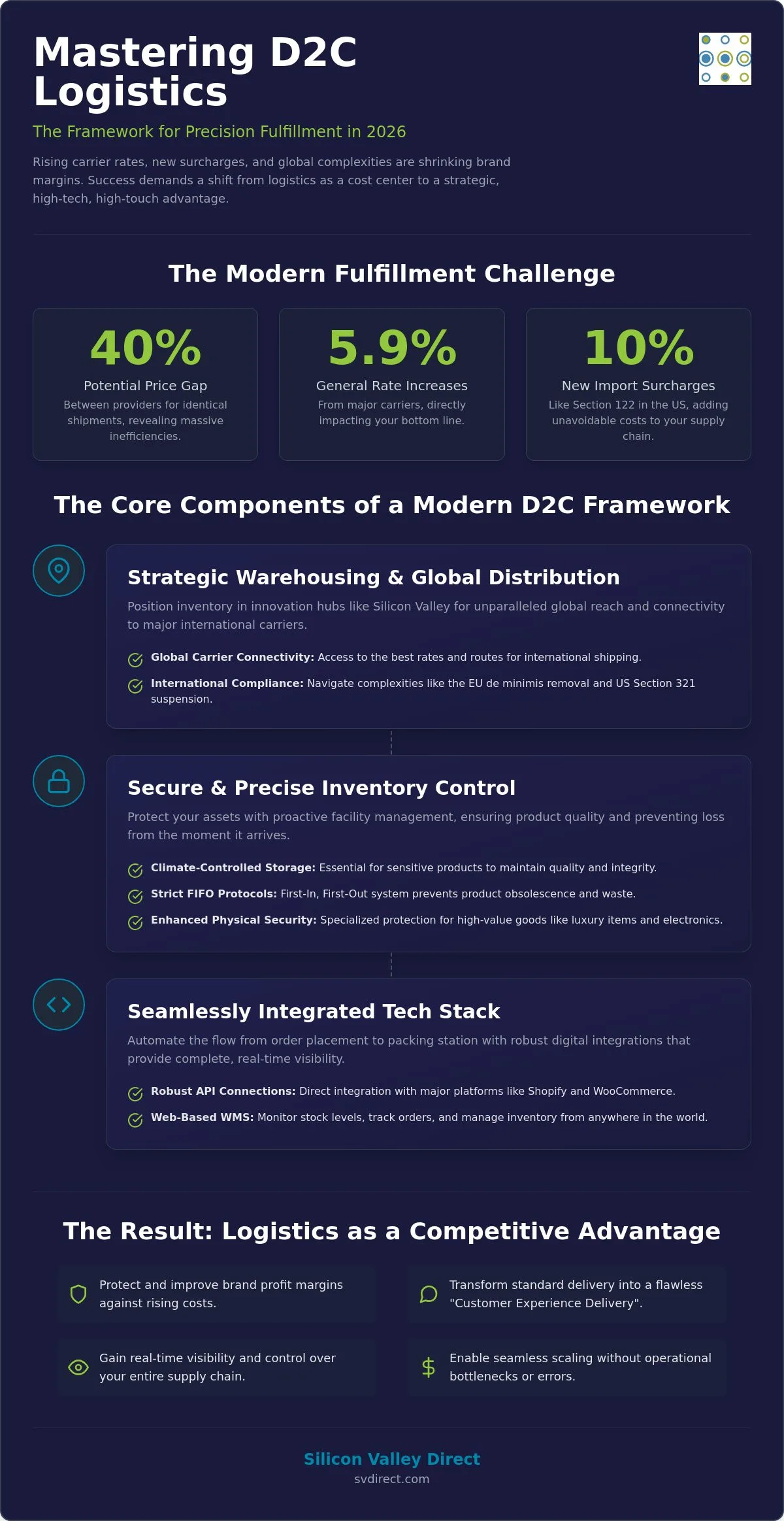
In 2026, the price gap between shipping providers can reach a staggering 40% for identical shipments, yet many brands still treat fulfillment as a fixed cost rather than a strategic lever. You’ve likely felt the sting of the 5.9% general rate increases or the recent removal of the EU de minimis threshold. It’s frustrating to watch your margins shrink while shipping errors and visibility gaps stall your growth. Implementing effective d2c logistics solutions isn’t just about moving boxes. It’s about maintaining brand integrity while managing the new 10% Section 122 surcharge on US imports.
We understand that scaling a brand requires a steady hand and a partner who values precision as much as you do. This guide will help you master the complexities of direct-to-consumer fulfillment using a framework that balances high-tech digital precision with the high-touch human expertise your brand deserves. We’ll examine how to scale custom unboxing experiences, stabilize international shipping costs, and leverage real-time data to turn your supply chain into a competitive advantage.
Key Takeaways
- Understand the shift toward “Precision Logistics” and how it protects brand margins against rising carrier rates and new international surcharges.
- Learn how to leverage web-based inventory management and strategic warehouse locations to achieve real-time visibility and seamless global distribution.
- Discover the cost-saving benefits of on-demand digital printing and custom kitting for creating high-impact, personalized customer unboxing experiences.
- Navigate the complexities of specialized d2c logistics solutions for sensitive sectors like healthcare, ensuring full HIPAA compliance and data security.
- Identify the essential criteria for selecting a long-term partner, prioritizing a proven operational history and a commitment to direct human oversight.
Why D2C Logistics Solutions Define Brand Success in 2026
The operational landscape has shifted. Direct-to-consumer (D2C) logistics is no longer just the act of putting a product in a box; it’s the end-to-end management of inventory directly from your brand to the end consumer. In 2026, we’ve entered the era of “Precision Logistics.” With major carriers like DHL and FedEx implementing general rate increases of 5.9%, brands can’t afford the waste associated with old-school bulk shipping methods. Success now requires a surgical approach to every SKU and every shipment.
Your logistics provider serves as a physical extension of your marketing team. When a customer receives a package, that interaction is often the only tangible touchpoint they have with your brand. High-performance d2c logistics solutions ensure this moment is flawless. By integrating advanced 3PL fulfillment services, you transform a standard delivery into a “Customer Experience Delivery.” This shift moves logistics from a back-office expense to a front-line driver of customer retention.
The Crisis of In-House Fulfillment
Every scaling brand eventually hits a breaking point. It usually happens when order volume exceeds the capacity of a small warehouse or a home-based operation. Manual errors begin to spike, inventory visibility vanishes, and the cost of lost shipments erodes your profits. Scaling is impossible without a dedicated infrastructure. Professional warehousing and distribution provide the stability you need to grow without the constant stress of operational bottlenecks. Transitioning to a partner allows you to reclaim your time and focus on product innovation.
D2C vs. B2B Logistics: Key Differences
D2C fulfillment is uniquely complex. Unlike B2B logistics, which often involves moving large pallets to a few locations, d2c logistics solutions require managing a high volume of low-item-count orders sent to thousands of individual addresses. This demands high-tech precision in kitting and assembly to maintain the “unboxing experience” at scale. Customers in 2026 also expect real-time tracking and proactive communication. Meeting these expectations requires a sophisticated digital integration that balances mechanical efficiency with a human touch to resolve issues before the customer even notices them.
Core Components of a Modern D2C Logistics Framework
Building a resilient operation requires more than just shelf space; it necessitates a sophisticated infrastructure that aligns with your growth trajectory. Strategic warehousing remains a cornerstone of this framework. By positioning inventory in innovation hubs like Silicon Valley, brands gain unparalleled global reach and connectivity to major international carriers. This geographic advantage is critical when managing the impact of D2C on supply chains, where speed and agility are the primary currencies. Effective d2c logistics solutions integrate global shipping coordination to navigate the removal of the EU de minimis threshold and the suspension of Section 321 in the US, ensuring duties are handled without slowing down the customer’s delivery.
Secure Warehousing and Inventory Control
Protecting your assets requires a proactive approach to facility management. For brands selling sensitive products, climate-controlled storage is a necessity to maintain quality. We implement strict FIFO (First-In, First-Out) protocols to prevent product obsolescence, ensuring your oldest stock moves first. High-value goods, such as luxury items or electronics, benefit from enhanced physical security measures that go beyond standard warehouse protocols. This level of care ensures that your inventory remains as pristine as the day it arrived.
The Tech Stack: Integrating Your Storefront
Modern fulfillment relies on seamless digital integration. Your logistics partner should offer robust API connections with platforms like Shopify and WooCommerce to automate the flow from order placement to the packing station. This real-time visibility is powered by a web-based Warehouse Management System (WMS) that allows you to monitor stock levels from anywhere. If you’re looking to streamline these operations, you might consult with an expert to see how automation can predict seasonal spikes. By using data to forecast inventory needs, you avoid the high costs of overstocking while ensuring you never miss a sale during peak periods.
Finally, a modern framework must address returns management. Instead of viewing reverse logistics as a headache, treat it as a loyalty builder. A streamlined, transparent returns process reinforces trust and encourages repeat purchases; it effectively turns a potential loss into a long-term win for your brand.
The Strategic Advantage of Kitting and On-Demand Printing
In a tech-saturated market, the physical touchpoint is your most potent differentiator. Advanced d2c logistics solutions that prioritize custom kitting and on-demand printing transform a routine delivery into a high-impact brand experience. This goes beyond simply placing items in a box; it involves a strategic marriage of operational efficiency and marketing precision. By utilizing branded packaging, you encourage customers to share their unboxing moments on social media. This effectively turns every shipment into a piece of user-generated content that drives organic growth.
Kitting and Assembly for Complex D2C Brands
Managing multi-component products requires meticulous attention to detail and a high degree of accuracy. Professional assembly ensures that every subscription box or promotional kit arrives exactly as intended, maintaining the brand promise you’ve worked hard to build. This process also offers a hidden financial benefit: optimizing package size. By precisely fitting components together, you reduce dimensional weight and lower your overall shipping costs. You can learn more about kitting and assembly services to see how this operational precision scales with your brand’s complexity.
On-Demand Printing: The Personalization Engine
Traditional literature fulfillment often leads to wasted inventory and outdated brochures that don’t reflect your current offerings. Our print-on-demand capabilities allow you to integrate high-quality digital printing directly into the fulfillment workflow. You can add personalized notes, updated manuals, or targeted marketing collateral to every order without the burden of bulk storage. This just-in-time approach reduces waste by printing only what’s needed for the day’s shipments. It’s a lean, efficient way to keep your communication fresh and your customers engaged. These d2c logistics solutions ensure your physical operations remain as agile and responsive as your digital storefront.
Specialized D2C: Navigating Healthcare and Compliance
Standard 3PL providers often lack the specialized infrastructure required to handle regulated materials or sensitive information. When your brand moves into the healthcare or high-value electronics space, the margin for error disappears. You require d2c logistics solutions that prioritize HIPAA compliance and rigorous security protocols. This isn’t just about moving product; it’s about protecting your brand from the legal and reputational risks associated with data breaches or lost inventory. We act as a steady hand, ensuring that your most sensitive shipments are handled with the same care you put into developing them.
Compliance-Driven Fulfillment
Audited processes are the backbone of fulfillment for healthcare and financial services. Every step must be documented to maintain data integrity, especially when handling Explanation of Benefits (EOB) or sensitive medical billing mailings. Errors in these documents can lead to significant compliance issues and erode patient trust. To master these complexities, review our guide on healthcare mailing services. We ensure that the digital data provided matches the physical mailer with total accuracy, maintaining a seamless flow from your database to the patient’s mailbox.
Secure Warehousing for High-Value Goods
Premium goods demand a higher standard of care than standard retail items. Whether you’re shipping pharmaceuticals or high-end consumer tech, we implement strict chain-of-custody protocols to monitor items from receiving to outbound shipping. You can explore secure warehousing for high-value electronics to see how our anti-theft measures and physical security protect your bottom line. These specialized d2c logistics solutions provide the peace of mind that comes from a partner with decades of experience in high-stakes fulfillment. If you’re ready to upgrade your compliance and security standards, request a free quote today to start a partnership built on precision.
Selecting Your D2C Partner: A Framework for Long-Term Growth
Choosing a logistics partner is a decision that dictates your brand’s trajectory. While some providers focus solely on automated efficiency, the most successful brands prioritize a marriage of high-tech precision and human oversight. A partner with a 25+ year track record offers a level of stability that newer, tech-only platforms often lack. When you’re managing d2c logistics solutions, you need a steady hand that’s navigated multiple market cycles and carrier shifts. This experience is your best defense against the volatility of the current market.
The “Human Oversight” test is a primary differentiator. You should always be able to speak directly to a real person who understands your brand’s nuances. This direct connection is vital when resolving complex issues that an algorithm might miss. Additionally, demand absolute transparency in fee structures. Since accessorial charges can account for up to 40% of a company’s total annual shipping costs, you must clearly understand the distinction between pick-and-pack fees and storage expenses. Your partner should also demonstrate a robust international shipping reach, ensuring they can handle the complexities of global duties and regional warehousing with ease.
Questions to Ask Your Potential 3PL
- How do you handle sudden volume spikes during peak seasons?
- What are your specific quality control measures for kitting and assembly?
- Can you integrate with my specific eCommerce tech stack?
The Transition Plan: Moving from In-House to 3PL
Transitioning to a professional 3PL requires a methodical approach to ensure a clean data transfer. Start by auditing your current inventory and SKU list to eliminate discrepancies before the move. It’s also critical to set clear KPIs for accuracy, speed, and returns processing from day one. Finally, establish a consistent communication cadence with your new logistics team. This proactive stance ensures that your physical operations remain perfectly aligned with your brand’s growth goals, turning your supply chain into a reliable engine for scaling.
Future-Proof Your Brand with Precision Logistics
The path to scaling in 2026 requires a shift from reactive shipping to proactive, data-driven fulfillment. By integrating sophisticated tech stacks with specialized kitting and assembly, you transform your logistics from a cost center into a powerful engine for customer retention. We’ve seen how d2c logistics solutions must now balance the complexities of global duties with the personal touch of a custom unboxing experience. Whether you’re navigating the strict requirements of healthcare compliance or managing high-value inventory, the right framework ensures your brand remains agile and reliable.
Silicon Valley Direct has been a steady partner in this industry since 1999. We combine decades of operational expertise with a commitment to direct human oversight on every complex order. Our team specializes in high-stakes tasks, including HIPAA-compliant healthcare fulfillment, ensuring your sensitive data and products are handled with absolute precision. Don’t let operational bottlenecks stall your growth. It’s time to scale your brand with Silicon Valley's premier D2C logistics partner and build the resilient infrastructure your customers deserve. Your brand’s next chapter starts with a partner you can trust.
Frequently Asked Questions
What are the primary benefits of outsourcing D2C logistics?
Outsourcing provides immediate access to seasoned expertise and physical infrastructure that would be too costly to build in-house. It allows your team to focus on product development while a partner manages the complexities of warehousing and global distribution. By leveraging professional d2c logistics solutions, brands avoid the operational bottlenecks that often occur during rapid growth phases. This partnership ensures that every order is handled with precision and human oversight.
How much do D2C logistics solutions typically cost for a startup?
Pricing for these services is generally based on your specific operational needs, such as the number of SKUs and monthly order volume. Most providers use a combination of storage fees, which are calculated by pallet or shelf space, and activity-based fees like pick-and-pack rates. It’s essential to partner with a provider that offers a transparent fee structure. This clarity helps you manage your margins effectively as your brand scales into new markets.
Can a 3PL handle custom branded packaging and unboxing experiences?
Absolutely, a high-performance logistics partner acts as an extension of your marketing team by executing complex assembly and kitting tasks. We can handle everything from custom branded boxes to the inclusion of personalized literature produced through on-demand digital printing. This ensures that every customer receives a consistent, high-impact unboxing experience that reinforces your brand identity and encourages repeat purchases, even as your daily order volume grows significantly.
What is the difference between a 3PL and a fulfillment center?
While the terms are often used interchangeably, a 3PL provides a more comprehensive suite of services than a standard fulfillment center. A fulfillment center typically focuses on the mechanical task of picking and shipping orders. In contrast, a 3PL offers strategic support, including inventory management, returns processing, and global logistics coordination. This holistic approach provides the stability and scalability needed to manage a brand’s entire physical supply chain effectively.
How do D2C logistics providers handle international shipping and customs?
Providers manage global logistics by coordinating with international carriers and navigating the latest regulatory changes. Brands often look to regional express specialists like urbanremessas.com.br to streamline deliveries in specific international markets. For example, they handle the complexities of the 2026 EU de minimis removal and the US Section 122 surcharge. By using advanced digital integration, they ensure that customs documentation is accurate and duties are pre-calculated. This proactive approach prevents packages from being held at the border and maintains a seamless experience for your international customers.
Is it possible to integrate my Shopify store with a 3PL’s inventory system?
What makes a 3PL ‘healthcare compliant’ for medical D2C brands?
A 3PL is considered healthcare compliant when it implements audited processes that meet HIPAA standards for protecting sensitive patient information. This includes secure data handling protocols and physical security for medical devices or pharmaceuticals. Compliance also requires high-precision mailing services for documents like Explanation of Benefits (EOB). These specialized protocols ensure that every healthcare-related shipment is accurate, secure, and fully compliant with current federal regulations and industry standards.
How does kitting help reduce my overall shipping costs?
Kitting reduces costs by optimizing the dimensional weight of your shipments. By professionally assembling multiple components into a single, right-sized package, you avoid the high fees associated with oversized or multiple boxes. Since carriers in 2026 use a standard dimensional weight divisor of 139 and round fractional inches up, precision in packaging is vital. Effective kitting ensures you aren’t paying to ship empty space, which directly protects your bottom line.