


The Ultimate 3PL Checklist: How to Vet a Fulfillment Partner in 2026
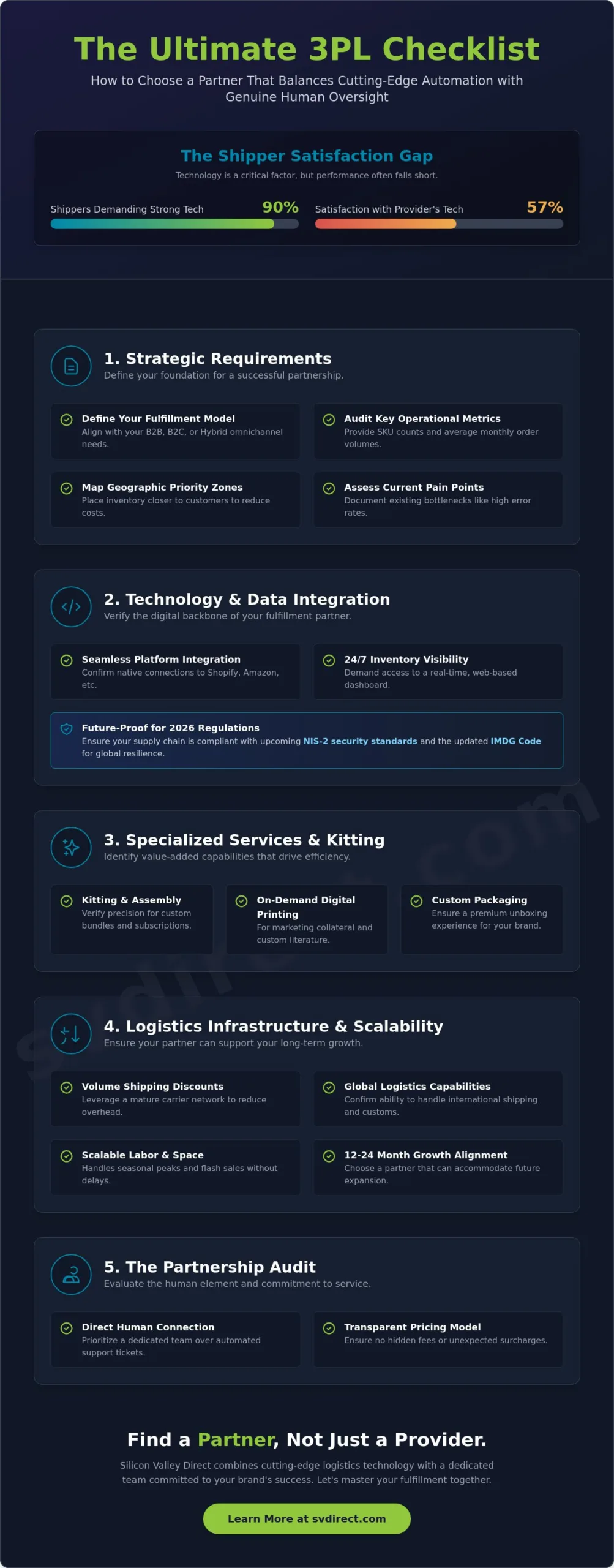
90% of shippers consider technological capabilities a critical factor when selecting a logistics provider, yet only 57% are actually satisfied with their current provider’s tech stack. If you’re struggling with inventory blind spots or hidden fees that seem to appear out of nowhere, you’ve likely felt that frustration. It’s exhausting to manage a partner that feels more like a hurdle than a high-performance extension of your team. This guide provides a comprehensive 3pl checklist designed to help you master your logistics transition and identify a partner that balances cutting-edge automation with genuine human oversight.
We agree that your fulfillment should be a steady hand during your fastest growth phases, not a source of errors and shipping delays. You deserve a partner that offers total transparency in inventory levels and absolute precision in kitting and assembly. By following this framework, you’ll learn exactly how to evaluate a provider’s scalability and specialized fulfillment capabilities. We’ll also preview the essential 2026 regulatory requirements, such as the NIS-2 security standards and the updated IMDG Code, to ensure your supply chain remains resilient, compliant, and ready for the global market.
Key Takeaways
- Define your fulfillment model—B2B, B2C, or hybrid—to ensure your partner aligns with your specific SKU complexity and monthly order volumes.
- Utilize a comprehensive 3pl checklist to verify seamless digital integration with platforms like Shopify or Amazon and confirm 24/7 inventory visibility via a web-based dashboard.
- Identify opportunities for operational efficiency through specialized kitting and on-demand digital printing for literature and marketing collateral.
- Reduce overhead by leveraging a provider’s mature carrier network to access volume-based shipping discounts for both domestic and global logistics.
- Prioritize direct human connection and transparent pricing models to ensure your fulfillment transition is managed by a dedicated team rather than automated tickets.
The Strategic 3PL Checklist: Defining Your Fulfillment Requirements
Before you ever step foot on a warehouse floor or sign a long-term contract, you must establish a clear internal baseline. A successful partnership starts with a rigorous third-party logistics (3PL) strategy that aligns your physical operations with your long-term business goals. This isn’t just about finding a place to store boxes; it’s about identifying a stable extension of your own team. You need to determine if your primary model is B2B, B2C, or a hybrid omnichannel approach. Each model requires different labor rhythms, technology integrations, and space allocations.
To begin your 3pl checklist, start with hard data. Audit your current SKU count and average monthly order volume to provide a baseline for storage and labor requirements. Without these figures, you’re essentially guessing at your logistics needs, which leads to inefficiencies and unexpected expenses later. You should also define your geographic priority zones. Placing your inventory closer to your densest customer clusters minimizes transit times and reduces shipping costs across various zones.
To visualize how these factors impact your operational success, watch this breakdown of essential logistics criteria:
Assessing Current Pain Points and Growth Trajectory
Look closely at your existing bottlenecks. Are you seeing high error rates in kitting or slow processing times during peak seasons? Document these issues now so you can address them during the vetting process. You also need to project your 12-month and 24-month growth. A partner that fits you today might not have the physical space or the labor scaling capacity for your future. Identify your seasonal peaks or flash sale requirements that demand rapid labor scaling to ensure your partner can pivot quickly without losing precision.
Operational Alignment: B2B, B2C, and Omnichannel Needs
If you sell to big-box retailers, verify that the provider handles retail distribution and EDI compliance. B2B logistics is a specialized field that differs significantly from direct-to-consumer (DTC) shipping. For DTC, your 3pl checklist should prioritize pick-and-pack speed and accuracy. An omnichannel partner must manage inventory across multiple sales channels simultaneously. This synchronization prevents stockouts and ensures a seamless experience for every customer, regardless of where they shop. For more insights on optimizing these processes, you can explore our latest industry analysis on the company blog.
Finally, determine the level of customization required for your packaging and unboxing experience. If your brand relies on a premium presentation, you need a team that treats your packaging with the same care you do. High-performance logistics is about more than speed; it’s about the precision and personal commitment that protects your brand’s reputation with every delivery.
Technology and Data Integration: The Digital 3PL Checklist
While a warehouse’s physical footprint matters, its digital infrastructure defines its actual reliability in a modern market. In 2026, the gap between what shippers require and what providers deliver is surprisingly wide. Research indicates that 90% of shippers prioritize technological capabilities, yet only 57% feel satisfied with their provider’s current stack. This discrepancy makes your 3pl checklist for technology the most critical part of your vetting process. You need a partner whose systems don’t just “talk” to yours but act as a unified, proactive extension of your storefront.
A high-performance logistics partner provides more than just a place to store goods; they offer a steady hand through data transparency. Automated order status updates and tracking information should flow to your customers instantly, which reduces the burden on your internal support staff. When vetting a fulfillment partner, look for a sophisticated blend of seasoned professionalism and high-tech efficiency. This ensures that while the technology does the heavy lifting, human expertise remains at the helm to interpret data and manage complex situations.
Seamless eCommerce Platform and API Connectivity
Integration with Shopify, WooCommerce, or Amazon should be the baseline for any modern provider. Don’t settle for vague promises of “custom builds” if you need to launch quickly. Ask for a specific onboarding timeline for digital integrations to avoid costly downtime. The user interface of the client portal should be intuitive, allowing your team to pull reporting and monitor activity without specialized technical training. We believe that true partnership is built on this kind of accessible, real-time collaboration.
Real-Time Inventory Visibility and Reporting Accuracy
Real-time inventory visibility is no longer a luxury; it’s a requirement to prevent the nightmare of overselling during peak seasons. Your 3pl checklist must confirm that the system provides 24/7 monitoring of stock levels across all sales channels. This transparency allows for proactive inventory management and actionable data on aging inventory or shipping costs. High-volume periods demand 99.9% system uptime guarantees. If a provider’s system crashes during a flash sale, your brand’s reputation pays the price.
With the 2026 EU NIS-2 regulation now in effect, IT security is also a critical operational risk. Your partner must demonstrate robust data security protocols to protect sensitive customer information and comply with increasing personal liability standards for IT shortcomings. If you’re ready to see how a tech-forward approach can stabilize your growth, you might consult with an expert who values both precision and personal commitment.
Beyond Standard Shipping: Specialized Services and Kitting Checklist
Standard fulfillment often fails when a business requires more than just picking a product off a shelf. If your brand relies on subscription boxes, medical devices, or high-touch marketing collateral, your 3pl checklist must account for specialized handling that goes beyond the basics. These value-added services are where a partner’s operational history and precision truly shine. It’s about finding a steady hand that can manage complexity without increasing your error rates.
Reverse logistics is a prime example of a service that requires a high-performance partner. Returns management is no longer a secondary concern; it’s a core component of customer retention. In 2026, returns processing fees typically range from $3 to $7 per unit, but the real cost lies in poor inspection. You need a partner that meticulously evaluates returned goods, ensuring that only pristine items are restocked while damaged inventory is handled according to your specific protocols. This level of care prevents the accidental shipping of faulty products to future customers.
Climate-controlled storage is another critical factor for sensitive materials. Verified data shows that climate-controlled warehousing can add 15% to 30% to base storage rates. While this is an investment, it’s essential for maintaining the integrity of high-value goods or regulated materials. A reliable partner will provide transparent reporting on these environmental conditions, giving you peace of mind that your inventory is protected.
High-Value Goods and Compliance-Driven Fulfillment
Handling sensitive inventory requires more than just space; it requires a culture of compliance. For those in the medical or wellness sectors, verifying HIPAA compliance is non-negotiable. Our Healthcare Mailing Services demonstrate how precision and regulatory adherence protect both the brand and the end-user. Beyond compliance, assess the physical security of the facility. Restricted access areas and 24/7 surveillance ensure that high-value inventory remains secure from arrival to final dispatch. This proactive stance on security is a hallmark of a professional, team-oriented organization.
Integrated Digital Printing and Custom Kitting Solutions
One of the most significant advantages of a sophisticated partner is the integration of on-demand digital printing. This capability allows for just-in-time production of marketing collateral and literature fulfillment, eliminating the need to store bulk amounts of potentially outdated printed materials. When evaluating Kitting and Assembly Services, look for the ability to handle complex bundling. Whether you’re launching a promotional kit or a monthly subscription box, the assembly must be error-free. This level of customization bridges the gap between mechanical operations and the high-stakes nature of growing a business. A reliable 3pl checklist ensures your partner can scale these labor-intensive tasks during peak seasons without sacrificing the unboxing experience that defines your brand.
Logistics Infrastructure and Global Shipping Capabilities
A 3PL’s physical infrastructure serves as the engine of your supply chain. When building your 3pl checklist, don’t just look at square footage. You must evaluate the strategic location of the facility and its proximity to major shipping ports and tech hubs. A warehouse situated in a logistics desert will inevitably lead to higher “last mile” costs and longer transit times. We believe that a high-performance partner should offer a location that acts as a symbol of global connectivity, ensuring your products move seamlessly from the loading dock to the customer’s door.
Global reach requires more than just a mailing address. In 2026, international shipping is increasingly defined by complex regulations. For instance, the updated International Maritime Dangerous Goods (IMDG) Code is now in effect, and new IMO regulations require specific electronic inclinometers on larger vessels constructed on or after January 1, 2026. Navigating these changes requires a partner with deep expertise in cross-border eCommerce and customs documentation. This specialized knowledge prevents your shipments from being held at the border, ensuring a reliable flow of goods even as global standards evolve.
Carrier Networks and Discounted Rate Structures
Your fulfillment partner should provide immediate access to a mature network of domestic and international carriers, including USPS, FedEx, and UPS. This is where volume-based discounted shipping rates become a significant competitive advantage. Because a 3PL ships millions of packages annually, they can pass these savings directly to you. Your 3pl checklist should include an inquiry about “Rate Shopping” capabilities. This technology automatically identifies the most cost-effective shipping method for every individual parcel, balancing speed with budget. For a deeper dive into these logistics frameworks, consult our guide on Global Shipping Services.
Scalability for Peak Season and Flash Sales
Precision is easy when volumes are low. The true test of a partner is their ability to handle 10x volume spikes during holiday seasons or flash sales. Ask specifically about their temporary labor strategies and how they allocate flexible warehouse space during these periods. A partner that relies solely on marketing abstractions won’t survive a Black Friday surge. You need a team backed by physical infrastructure and human expertise that remains accessible when the pressure is highest. Confirm their daily cutoff times for order processing to ensure your customers receive their packages as promised, even during the busiest months of the year.
If you’re ready to stabilize your logistics with a partner that offers both global reach and personal oversight, request a personalized logistics quote today to see how our infrastructure can support your growth trajectory.
The Partnership Audit: Evaluating the Human Element and Service Quality
While the previous sections of our 3pl checklist focused on digital integration and physical infrastructure, the final pillar of a successful transition is the human element. Technology provides the efficiency, but human expertise provides the resilience. In a tech-saturated market, many providers hide behind automated support tickets and impersonal chatbots. We believe that a high-performance partner should offer a steady hand and a direct line of communication. Research from the 2025 Annual Third-Party Logistics Study indicates that 82% of shippers credit their 3PL with improving customer service. This improvement doesn’t happen through automation alone; it requires a dedicated team that understands your brand’s specific nuances.
Stability is another critical factor to audit. Look for a partner with a multi-decade history, ideally 20 years or more, which serves as a constant anchor of trust. Industry longevity suggests that the provider has weathered market shifts and possesses the financial stability to invest in long-term staff retention. This internal stability directly impacts your service quality, as seasoned professionals are better equipped to handle bespoke problem-solving and complex logistics challenges. Transparency in the pricing model is equally vital. A professional partner will clearly outline storage costs, pick-and-pack fees, and management charges without burying hidden expenses in the fine print.
Transparency, Account Management, and Communication
Don’t settle for a faceless service. Interview the specific account managers who will oversee your day-to-day operations to ensure they share your commitment to precision. You should review their service level agreements (SLAs) for order accuracy and shipping speed to ensure they align with your growth goals. Verified industry data shows that nearly half of warehouses (48.6%) now charge long-term storage fees, a significant increase from 2024. Your 3pl checklist should confirm exactly how these fees are structured. Clear protocols for resolving shipping discrepancies are essential for maintaining a high-performance partnership.
The Transition Plan: Moving to a Professional 3PL
A structured transition plan is the only way to migrate inventory without disrupting your sales. This plan should include a detailed timeline for inventory transfer and a rigorous process for receiving and auditing incoming goods. We recommend scheduling a site visit to the fulfillment center to verify that the physical infrastructure matches the digital promises. This allows you to see the organized rhythm of the facility firsthand. If you’re looking for more strategies on optimizing your supply chain, explore our latest insights on the company blog. A successful migration is a collaborative effort that transforms your logistics from a source of stress into a competitive advantage.
Securing a Resilient Supply Chain for 2026 and Beyond
Choosing the right fulfillment partner is a strategic decision that dictates your brand’s long-term stability and growth. By utilizing this 3pl checklist, you’ve established a framework that prioritizes both high-tech efficiency and genuine human oversight. You now understand the necessity of seamless digital integrations and the immense value of specialized services like on-demand digital printing and HIPAA-compliant healthcare mailing. These capabilities ensure that your logistics operations remain as precise as your business vision. Precision isn’t just a goal; it’s a commitment that protects your reputation with every delivery.
Since 1999, Silicon Valley Direct has acted as a steady hand for businesses navigating the complexities of global shipping and kitting. We reject impersonal, automated models in favor of direct connection and personal commitment. Whether you require complex assembly or secure returns management, our team provides the physical infrastructure and expert-level service needed to alleviate the stress of expansion. Your growth deserves a partner that remains accessible and grounded while operating at the cutting edge of innovation. Complementing your physical fulfillment strategy with personalized direct mail campaigns can further bridge your online and offline channels, driving measurable response rates that digital outreach alone cannot match.
We look forward to helping you master your logistics transition and watching your business reach its full potential with total confidence.
Frequently Asked Questions
What is the most important item on a 3PL checklist?
The most critical item on a 3pl checklist is operational alignment and the quality of account management. While technology and warehouse space are essential, a partner that offers direct human oversight ensures that complex issues are resolved without the delays of automated tickets. This cultural fit guarantees that the provider treats your brand’s reputation with the same care and precision as you do.
How long does it typically take to transition to a new 3PL?
Transitioning to a new provider typically takes between 30 and 90 days, depending on SKU complexity and technical integration requirements. This timeline allows for a methodical migration of physical inventory and thorough testing of API connections. A structured transition plan minimizes sales disruptions and ensures that all receiving protocols are verified before your first order ships from the new facility.
What are the hidden costs I should look for in a 3PL agreement?
Common hidden costs include monthly technology access fees, minimum pick and pack volume requirements, and specialized receiving surcharges for non-compliant shipments. You should also scrutinize long-term storage fees, as nearly half of modern warehouses now apply these charges after a specific duration. Transparent pricing models should clearly list every potential expense, from kitting labor to returns processing, to prevent budget surprises.
Can a 3PL handle both B2B and B2C fulfillment simultaneously?
A sophisticated partner can handle both B2B and B2C fulfillment simultaneously through an integrated inventory management system. This omnichannel approach allows you to fulfill large retail distribution orders while maintaining high-speed pick and pack for direct to consumer sales. Successful execution depends on the provider’s ability to manage EDI compliance for retailers alongside the rapid shipping demands of eCommerce platforms.
How does a 3PL handle international shipping and customs?
3PLs manage international logistics by preparing customs documentation and leveraging relationships with global shipping carriers. They navigate complex regulations to ensure your goods remain compliant in various jurisdictions. By utilizing a provider’s established carrier network, you can access volume-based discounted rates that significantly reduce the cost of reaching a global audience while maintaining delivery precision.
What technology integrations are mandatory for a modern 3PL?
Mandatory technology for a modern logistics partner includes real-time API integrations with platforms like Shopify or Amazon and a web-based client portal. This digital 3pl checklist item ensures 24/7 visibility into inventory levels and automated order status updates for your customers. Without these seamless connections, your team loses the data transparency required to make proactive inventory decisions and prevent stockouts during peak seasons.
How do I know if my business is large enough for a 3PL?
Your business is large enough for a 3PL when internal fulfillment begins to hinder your ability to scale or focus on core marketing efforts. Most providers look for a consistent monthly order volume, but the real indicator is the complexity of your needs. If you require specialized kitting, climate-controlled storage, or healthcare mailing services, a professional partner provides the infrastructure you cannot realistically build in-house.
What is the difference between a 3PL and a fourth-party logistics (4PL) provider?
A 3PL provides the physical infrastructure, labor, and technology to manage specific logistics functions like warehousing and distribution. In contrast, a fourth-party logistics (4PL) provider acts as a high-level integrator that manages the entire supply chain, often overseeing multiple 3PLs. Most growing brands prefer the direct control and personal connection of a 3PL partnership to ensure their operational standards are met through direct oversight.