



FIFO Inventory Management: The 2026 Guide to Preventing Obsolescence
Your financial ledger might show a healthy balance, but if your warehouse floor is cluttered with products that should have shipped six months ago, your margins are already bleeding. Effective fifo inventory management is less about accounting spreadsheets and more about the physical discipline of your operations. We understand the frustration of seeing capital tied up in dead stock that isn’t moving, especially when you’re trying to accurately report figures under the $32 million small business taxpayer threshold for the 2026 tax year.
You deserve a warehouse that runs with high-tech precision and a ledger that reflects actual stock health. This guide will show you how to master the First-In, First-Out method to protect your margins, streamline your warehouse, and eliminate the waste of product obsolescence. We’ll explore how AI-powered demand forecasting and real-time IoT tracking align your physical stock with your financial goals, ensuring your oldest units are always the first out the door. By the end of this guide, you’ll have a clear roadmap to lower your cost of goods sold and maintain a cleaner, more efficient facility.
Key Takeaways
- Learn how to align physical product movement with chronological acquisition to ensure your oldest stock always ships first.
- Discover how fifo inventory management provides a clearer picture of your cost of goods sold while reflecting accurate market values.
- Identify why FEFO is often the superior choice for perishable goods and why LIFO has largely fallen out of favor for modern eCommerce.
- Gain actionable steps for organizing your warehouse floor with “Flow-Through” logic to minimize handling errors and obsolete stock.
- See how leveraging a veteran 3PL’s infrastructure can automate your inventory tracking and remove the stress of manual fulfillment.
What is FIFO Inventory Management? (First-In, First-Out)
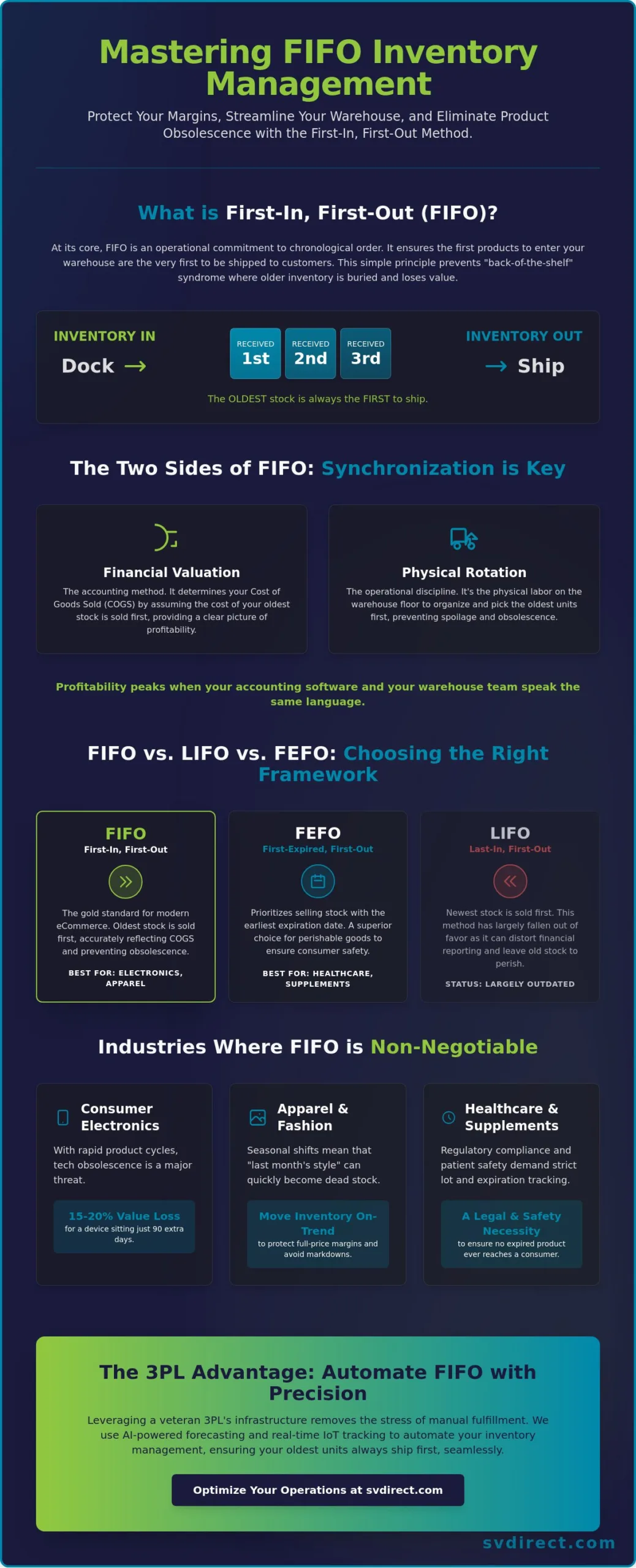
At its core, fifo inventory management is an operational commitment to chronological order. The principle is straightforward: the first items to enter your warehouse are the first ones to leave it. This creates a seamless flow that mirrors the technical concept of First-In, First-Out (FIFO) found in data processing and electronics. In 2026, this method has become the gold standard for eCommerce because it prevents the “back-of-the-shelf” syndrome where older products are buried under new arrivals. We define FIFO as the strategic movement of inventory to ensure the freshest stock remains available for every customer order.
Modern logistics in 2026 relies on more than just manual clipboards. We use real-time tracking and pre-configured integrations to ensure every SKU is accounted for from the moment it hits our dock. This level of precision is why fifo inventory management remains the preferred strategy for high-growth brands. It provides a steady hand in a fast-paced market, allowing you to scale without the fear of hidden losses tucked away in dark corners of the warehouse. When your physical product flow aligns with your acquisition dates, you eliminate the guesswork that leads to wasted capital.
The Difference Between FIFO Valuation and FIFO Rotation
Understanding the nuance between financial valuation and physical rotation is critical for your bottom line. Valuation is the accounting side; it determines the cost of goods sold based on the price of your oldest stock. Rotation is the physical labor performed on the warehouse floor. If your team picks the newest pallet because it’s easier to reach, but your accountant records the cost of the oldest unit, your financial ledgers and physical reality will drift apart. Accuracy requires these two systems to be perfectly synchronized. Over our 26 years in the industry, we’ve seen that profitability peaks when your warehouse team and your accounting software speak the same language.
Industries Where FIFO is Non-Negotiable
For specific sectors, this discipline isn’t just a best practice; it’s a requirement for survival. In these high-stakes environments, anything less than total precision can lead to significant financial or regulatory penalties.
- Consumer Electronics: With product cycles moving faster than ever, a device sitting for an extra 90 days can lose 15% to 20% of its market value due to technical obsolescence.
- Apparel and Fashion: Seasonal shifts mean that “last month’s style” quickly becomes dead stock. FIFO ensures inventory moves while it’s still on-trend and at full margin.
- Healthcare and Supplements: Regulatory compliance and patient safety demand strict lot tracking. You must ensure no expired product ever reaches a consumer, making chronological rotation a legal necessity.
The Financial and Operational Benefits of the FIFO Method
Implementing fifo inventory management transforms your warehouse from a simple storage site into a high-performance engine for capital preservation. By moving goods before they become unsellable, you significantly reduce the risk of obsolescence. This is a major drain on liquidity for any growing business. Stagnant pallets occupy valuable real estate and represent dead capital that could be better utilized elsewhere. A strict FIFO protocol ensures that your warehouse floor remains fluid; this maximizes every square foot of your facility and prevents the accumulation of dusty, outdated stock. Protecting that inventory from theft and shrinkage is equally critical, and investing in secure warehousing services ensures your capital-preserving efforts aren’t undermined by supply chain crime.
Effective inventory management is the cornerstone of healthy gross margins. When you use the FIFO method, your Cost of Goods Sold (COGS) reflects the actual chronological cost of items. This provides stakeholders with a clear, undistorted picture of profitability that is vital for making informed decisions about pricing and procurement. Because the oldest costs are cleared out first, your financial reporting remains grounded in reality rather than estimates.
Protecting Margins Against Inflation
During inflationary periods, supply chain costs inevitably rise. FIFO handles these fluctuations more effectively than methods like LIFO because it matches older, lower costs against current revenue. This results in a higher net income and a more realistic valuation of ending inventory on your balance sheet. It ensures that the assets remaining in your warehouse are valued at the most recent, relevant prices. If you want to optimize these financial flows, our inventory management services provide the real-time visibility needed to track every dollar accurately.
Compliance and Quality Control in Healthcare
In the healthcare and medical device sectors, the margin for error is zero. We apply our 26 years of experience to ensure that HIPAA standards and medical device regulations are met with absolute precision. Strict lot tracking is the backbone of this process. It allows for immediate action during a recall and guarantees pharmaceutical safety by ensuring no product exceeds its shelf life. We rely on actual team members to perform double-verification on sensitive healthcare kitting; this provides a level of care that automated systems simply cannot match. This human element, combined with modern tech, ensures your compliance is never in question.
FIFO vs. LIFO vs. FEFO: Choosing the Right Framework
Selecting an inventory framework isn’t just about accounting; it’s a strategic decision for your 2026 growth. While fifo inventory management remains the standard for most brands, the specific nature of your product line might demand a more specialized approach. High-growth companies must decide whether chronological arrival or a specific expiration date should drive their logistics. We’ve spent 26 years helping clients navigate these decisions, ensuring their physical operations match their financial objectives with absolute precision.
LIFO (Last-In, First-Out) has largely become a relic in modern eCommerce fulfillment. It assumes the newest stock is sold first, which creates a logistical nightmare where older inventory remains buried at the back of the warehouse. This leads to “inventory layers” that may never leave the facility, eventually resulting in total loss due to rot or technical obsolescence. Operationally, it’s inefficient to pick the newest arrivals while older stock takes up premium rack space. For brands that value transparency and speed, LIFO’s stagnant layers represent a significant risk.
When to Use FEFO Over Standard FIFO
FEFO (First-Expired, First-Out) is the necessary evolution of fifo inventory management for brands dealing with perishables or time-sensitive goods. If your product line has “hard” expiration dates, like supplements, or “soft” shelf-life dates, like organic skincare, FEFO is your best defense. It requires precise lot-level tracking to ensure safety and quality at every step. For our clients using healthcare-specific mailing solutions, we always recommend FEFO. It guarantees that every kit or sample sent to a patient is well within its usage window, maintaining both safety and regulatory compliance.
The Pitfalls of LIFO in a Global Market
If you plan to scale internationally, LIFO is often a non-starter. The International Financial Reporting Standards (IFRS) strictly prohibit LIFO; this means brands using it face massive reconciliation hurdles when expanding outside the United States. Beyond compliance, LIFO creates a physical bottleneck. It forces warehouse teams to constantly move new stock over old, which increases labor costs and the likelihood of product damage. In a global market that demands high-tech efficiency, the “stagnant layers” created by LIFO can cripple your margins.
Choosing between actual costing and standard costing also impacts your rotation logic. Actual costing tracks the specific purchase price of every unit, providing a granular look at margins that matches the physical flow of your goods. Standard costing uses fixed estimates, which might simplify bookkeeping but can mask real-world price fluctuations. For most 2026 growth strategies, the precision of actual costing is the superior choice. Anything is possible when you have the right data and a veteran team to execute the physical rotation.
How to Implement FIFO in Your Warehouse Operations
Successful fifo inventory management requires more than a software update; it demands a physical reconfiguration of your workspace. While many logistics providers rely solely on digital records, we know that if your warehouse floor isn’t organized for flow, your digital data will eventually lose its integrity. Transitioning to a strict FIFO model involves four foundational steps that turn operational theory into a high-performance reality. These steps ensure that your oldest stock is always the most accessible, preventing the “buried pallet” syndrome that leads to dead stock.
- Step 1: Flow-Through Logic. Configure your racking so that products are loaded from the rear and picked from the front. This physical constraint makes it impossible to pick newer stock before older units are cleared.
- Step 2: SKU and Lot Tracking. Implement a Warehouse Management System (WMS) that assigns a digital “birth certificate” to every lot. This allows for real-time tracking of stock age across your entire supply chain.
- Step 3: Double-Verification. Train your team on a rigorous picking process where two different team members verify the lot number and acquisition date before an order is packed. This human touch is our signature for maintaining 99.9% accuracy.
- Step 4: Cycle Counting. Conduct regular audits to reconcile your physical stock with your digital ledgers. In 2026, high-growth brands perform these counts weekly to ensure that stock ages haven’t drifted from the recorded data.
Physical Infrastructure for FIFO Success
Gravity flow racks are the premier solution for enforcing FIFO at the shelf level. These systems use inclined rollers to slide the oldest box to the front every time a unit is picked. For smaller items used in kitting and assembly, we utilize a ‘Two-Bin’ system. When the first bin is emptied, it’s sent for replenishment while the second bin becomes the primary source. This simple, visual method ensures continuous rotation without complex calculations. We also employ color-coded labeling to provide an immediate visual cue of stock age for our floor team. Pairing this physical infrastructure with secure warehousing services that integrate real-time digital oversight creates a zero-loss environment where both rotation accuracy and inventory protection work in tandem.
The Role of WMS and API Integrations
Your tech stack must act as a seamless extension of your physical operations. By integrating your Shopify or WooCommerce store with our 3PL inventory software through pre-configured APIs, you gain instant visibility into your stock levels. API-driven visibility acts as the central nervous system of 2026 logistics, ensuring that every digital transaction triggers an immediate and accurate physical response in the warehouse. This eliminates the “never-ending questions” about stock status and allows you to focus on growth. If you’re ready to modernize your operations, our eCommerce order fulfillment services provide the infrastructure and expertise to execute a flawless FIFO strategy.
The 3PL Advantage: Leveraging Silicon Valley Direct for FIFO
Outsourcing fifo inventory management to a veteran partner eliminates the operational stress of managing physical stock rotation. While many “virtual” logistics startups rely on outsourced labor and opaque, automated-only systems, we offer a level of stability grounded in a 26-year legacy. This experience allows us to handle high-stakes logistics with a quiet confidence that newer players haven’t earned yet. By partnering with a tech-savvy veteran, you gain the infrastructure and the human expertise necessary to execute complex inventory strategies without the overhead of managing a private facility. For a deeper look at how to evaluate your options, our guide to logistics companies in Silicon Valley covers the key factors high-growth brands should consider when selecting a 3PL partner in 2026.
We’ve always rejected the idea that automation should replace human judgment. Half of our team members have over a decade of tenure at Silicon Valley Direct; this internal stability is a unique hallmark of our expert-level service. This experienced team ensures that your complex kitting and assembly projects are handled with strict FIFO rigor. Our staff doesn’t just scan barcodes; they understand the specific nuances of your product line. This human touch provides a layer of double-verification for accuracy that ensures your oldest units are always the first ones picked and packed.
Bespoke Solutions for Silicon Valley Startups and Enterprises
Based in Union City, CA, our secure, climate-controlled facility serves as a premier hub for both agile startups and global enterprises. We provide tailored inventory management that scales effortlessly with your order volume, whether you’re shipping 500 or 50,000 units a month. Our “Anything is possible” approach means we don’t force you into a one-size-fits-all box. From specialized healthcare mailing services to intricate literature fulfillment, our facility is designed to adapt to your bespoke requirements. You get the precision of a high-tech operation with the personal touch of a dedicated partner.
Real-Time Control and Global Reach
Transparency is a core value of our partnership model. You can access your inventory data 24/7 through our secure web portal, giving you instant visibility into stock ages and movement. This real-time data allows you to make informed procurement decisions and maintain better alignment between your physical stock and financial ledgers. From our Silicon Valley hub, we coordinate seamless global shipping and logistics, ensuring your products reach international markets with speed and accuracy. If you’re ready to eliminate dead stock and protect your margins, it’s time to partner with Silicon Valley Direct for precision inventory management.
Future-Proof Your Supply Chain with FIFO Precision
Mastering fifo inventory management is the most direct path to protecting your margins and eliminating the waste of obsolete stock. By aligning your physical warehouse flow with real-time digital tracking, you ensure your oldest capital is always the first to move. This operational rigor provides the financial clarity needed to scale confidently in 2026. Whether you’re navigating the $32 million small business tax threshold or managing sensitive products that require strict lot tracking, the right framework turns inventory from a liability into a liquid asset.
You don’t have to manage these complexities alone. With 26 years of industry experience and a dedicated team boasting an average tenure of over 10 years, we provide the stability and precision your brand deserves. Our HIPAA-compliant healthcare fulfillment capabilities ensure that even the most regulated products are handled with absolute care. We’re eager to show you how our human-centric approach and modern tech stack can streamline your growth. Request a Tailored Fulfillment Quote from Silicon Valley Direct today to see how we can transform your logistics. Anything is possible when you have a steady hand guiding your operations.
Frequently Asked Questions
Is FIFO required by law for eCommerce businesses?
No legal mandate requires U.S. based eCommerce businesses to use FIFO for domestic operations. However, it is the mandatory standard under International Financial Reporting Standards (IFRS). If you plan to scale your brand globally in 2026, you must use FIFO because the LIFO method is prohibited in international markets. Most growth oriented brands adopt it early to ensure their financial reporting remains compliant with global accounting principles.
What happens to my taxes if I switch from LIFO to FIFO?
Switching methods requires a one-time tax adjustment known as a Section 481(a) adjustment. This process accounts for the cumulative difference in inventory valuation between the two methods. For the 2026 tax year, businesses with average annual gross receipts of $32 million or less may find fifo inventory management easier to reconcile with simplified accounting rules. You’ll need to file IRS Form 3115 to officially notify the government of your change in accounting method.
Can FIFO be managed without expensive warehouse software?
You can implement physical FIFO using low-tech solutions like gravity flow racks or color-coded floor markings. These physical constraints ensure the oldest box is always at the front of the pick face. While manual systems work for small operations, they become difficult to manage once you exceed 1,000 monthly shipments. Partnering with a tech-forward 3PL allows you to leverage enterprise-level software and API integrations without the heavy upfront capital investment.
How does FIFO impact my returns management process?
Returns require careful re-integration to maintain chronological integrity. When an item is returned and inspected for resale, it shouldn’t simply be tossed on top of the pile. Our returns management team assigns a specific lot date to restocked items so they’re picked in the correct sequence. This prevents returned goods from becoming permanent residents on your shelves while newer stock moves around them.
What is the biggest mistake companies make when implementing FIFO?
The most frequent error is focusing on the digital ledger while ignoring the physical warehouse layout. If your software says you’re shipping the oldest units, but your warehouse floor is cluttered with “buried” pallets, your data is a fiction. Without a “Flow-Through” racking design, pickers will naturally grab the easiest items to reach. This creates a disconnect that leads to inaccurate financial reporting and unexpected dead stock at the end of the year.
How does Silicon Valley Direct ensure FIFO accuracy for healthcare products?
We rely on a double-verification process performed by actual team members rather than just automated systems. Our staff manually checks lot numbers and expiration dates against the digital pick ticket to ensure 99.9% accuracy. This human element is critical for healthcare kitting and pharmaceutical safety. We’ve refined this process over 26 years to ensure our clients remain compliant with strict industry regulations and safety standards.
Does FIFO work for products without expiration dates?
Yes, it’s highly effective for non-perishables like consumer electronics or apparel. Even without a hard expiration date, products can become technically obsolete or suffer from “shelf wear” like dust and packaging damage. Moving the oldest units first ensures that every customer receives a product in pristine condition. It also keeps your warehouse floor fluid, preventing older models from taking up premium space when new versions launch.
How often should I audit my FIFO system for accuracy?
High-growth brands should conduct weekly cycle counts to maintain 2026 operational standards. A full physical inventory audit should be performed at least once every 90 days. These regular checks reconcile your digital records with the actual age of the stock on your shelves. Frequent auditing catches rotation errors early, ensuring your cost of goods sold remains accurate and your warehouse operations stay lean.