3PL Pricing Models: The 2026 Strategic Guide to Fulfillment Costs
When you compare different 3pl pricing models, why does the most “competitive” quote often result in the most expensive monthly invoice your business has ever seen? It’s a common frustration for growing brands that find themselves buried under unexpected fees or paying for warehouse space they aren’t even using. You deserve a logistics partnership built on clarity rather than complex fine print. We know that unpredictable expenses make it nearly impossible to forecast your margins with confidence.
This guide helps you master the complexities of third-party logistics to ensure your fulfillment costs actually align with your operational needs. You’ll discover how to identify a structure that rewards efficiency and scales seamlessly with your seasonal peaks. We’ll examine the four primary pricing frameworks used in 2026, the data-driven systems that provide real-time visibility, and the specific factors that determine your long term ROI. By the end of this article, you’ll have the tools to choose a partner that acts as a steady hand for your business growth.
Key Takeaways
- Identify which 3pl pricing models align with your specific growth trajectory to prevent margin creep and ensure predictable monthly expenses.
- Uncover the reality of hidden contract fees, from technology integrations to account management, and learn how to negotiate for total transparency.
- Explore how integrating specialized services like on-demand digital printing and precision kitting can streamline your supply chain and lower total costs.
- Leverage high-tech visibility tools to access real-time data, allowing you to manage inventory and fulfillment with the precision of an in-house team.
- Transition to a partnership-driven logistics model that replaces automated interactions with personal oversight and bespoke problem-solving.
What are 3PL Pricing Models? Defining the Logistics Landscape
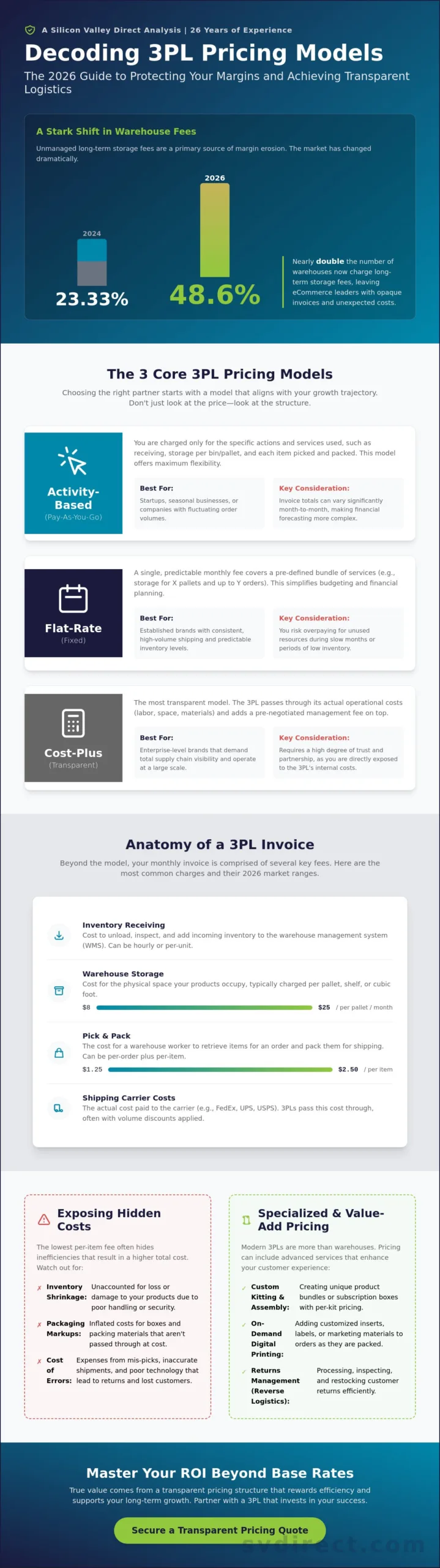
A well-defined logistics strategy depends on understanding 3pl pricing models as more than just a monthly bill. These frameworks dictate how a Third-party logistics (3PL) partner charges for labor, space, and the technical infrastructure required to manage your data. When you evaluate a quote, you’re essentially looking at a roadmap for how your partner will support your growth. Historically, these agreements were purely transactional; however, in 2026, the industry has shifted toward integrated service partnerships that prioritize long-term stability over simple pick-and-pack tasks.
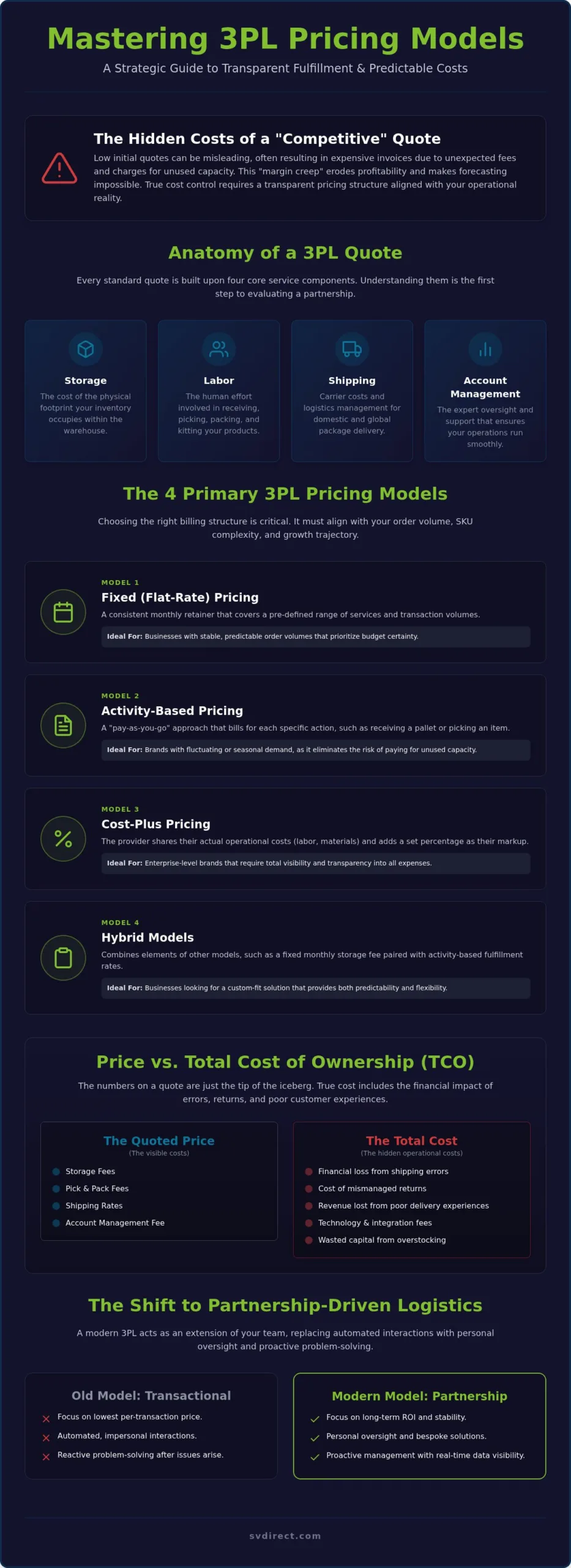
Choosing the wrong 3pl pricing models often leads to “margin creep.” This happens when your logistics costs grow at a faster rate than your order volume, slowly eroding your profitability. A proactive partner helps you avoid this by ensuring the billing structure remains flexible and transparent. Every standard quote includes four core components:
- Storage: The cost of the physical footprint your inventory occupies within the facility.
- Labor: The human effort involved in receiving, picking, packing, and kitting.
- Shipping: The carrier costs and logistics management for domestic and global delivery.
- Account Management: The oversight and personal support that ensures your operations run smoothly.
The Evolution of Fulfillment Costs in 2026
Rising labor costs have fundamentally changed how activity-based pricing functions. To maintain accuracy without passing excessive costs to clients, sophisticated facilities now lean heavily on technology to reduce administrative overhead. While some providers offer “cheap” per-order rates, these often hide significant service gaps. You might save pennies on a pick fee but lose dollars through slow response times or a lack of personal oversight. We believe that efficiency is driven by a quiet, organized facility where precision is the standard rather than an add-on.
The Difference Between Price and Total Cost of Ownership
Smart operators look beyond the base price to the Total Cost of Ownership (TCO). This includes the heavy financial burden of shipping errors, mismanaged returns, and the permanent loss of customers due to poor delivery experiences. Our approach focuses on proactive problem solving to catch issues before they reach your customer. By utilizing our Remote Control™ system, you gain real-time data access that prevents overstocking and reduces waste. When your warehouse data syncs perfectly with your sales channels, you aren’t just paying for a service; you’re investing in a high-performance extension of your own team.
The 4 Primary 3PL Pricing Models Explained
Selecting from the various 3pl pricing models requires a deep understanding of your own order profiles and growth targets. It’s not merely a matter of finding the lowest per-transaction fee; it’s about aligning your billing structure with your operational reality. The complexities of logistics pricing often mean that a model that works for a low-SKU startup will become a financial burden for a high-volume enterprise. Most providers utilize one of four core frameworks to manage these costs.
- Fixed (Flat-Rate) Pricing: You pay a consistent monthly retainer that covers a specific range of services. This model is ideal for businesses with stable, predictable volumes that prioritize budget certainty.
- Activity-Based Pricing: This “pay-as-you-go” approach bills you for each specific action, from receiving a pallet to picking an individual item. It offers high transparency for businesses with fluctuating seasonal demand.
- Cost-Plus Pricing: The provider shares their actual operational costs and adds a set percentage as their markup. This is frequently used by enterprise brands that require total visibility into labor and material expenses.
- Hybrid Models: Many modern partnerships combine these elements, such as a fixed monthly storage fee paired with activity-based fulfillment rates to ensure maximum flexibility.
Activity-Based Pricing: Precision for E-commerce
Startups and rapidly scaling brands often favor activity-based structures because they eliminate the risk of paying for unused warehouse capacity. The “Pick and Pack” fee is the heartbeat of this model. It’s usually broken down into a base order fee plus a smaller charge for each additional item. To maintain accuracy, you should regularly audit these invoices against your own sales data. We’ve found that a “quiet facility” methodology, which emphasizes organized physical space and human oversight, naturally keeps these activity costs lower by reducing the time required for each task.
Fixed Rate vs. Cost-Plus: Which Scales Better?
Enterprise-level brands are increasingly moving toward cost-plus models because they remove the “black box” of traditional logistics billing. While fixed monthly retainers offer simplicity, they can lack the incentive for the provider to improve efficiency. In contrast, a cost-plus model creates a transparent partnership where both parties work to trim operational waste. We reject “cookie-cutter” constraints that force you into a rigid box. Instead, we focus on bespoke solutions that adapt as your SKU complexity grows. If you’re looking for a partner that prioritizes precision over automated templates, you can explore our logistics fulfillment services to see how a tailored approach protects your margins.
The Impact of Specialized Services on Fulfillment Costs
Standard 3pl pricing models often struggle to account for projects requiring more than just moving a box from a shelf to a carton. When your business involves intricate assembly or highly regulated materials, a “one-size-fits-all” fee structure quickly falls apart. Specialized logistics, such as healthcare mailing and literature fulfillment, require a level of precision that automated, high-volume warehouses simply aren’t built to provide. These projects demand a partnership-driven approach where costs are calculated based on the specific human oversight and technical accuracy required for success. You aren’t just paying for labor; you’re investing in a system that protects your brand’s integrity.
Integrating Print-on-Demand to Reduce Storage
One of the most effective ways to optimize your logistics budget is by eliminating the need to store massive quantities of pre-printed materials. By integrating on-demand digital printing directly into your workflow, you can significantly reduce your physical inventory footprint and the associated storage fees. We utilize the HP Indigo 5500 to produce high-resolution, offset-quality prints on a short-run basis. Unlike traditional offset printing, this technology eliminates the “drying time” delay. This allows us to move from print to pack almost instantly, ensuring your collateral is always current and relevant. You can learn more about our Print on Demand services to see how this technical capability transforms your supply chain efficiency.
Kitting and Assembly: The QC-Check Advantage
Projects involving subscription boxes, promotional kits, or multi-item bundles rely on labor-based charges that must be managed with extreme care. A common mistake in many 3pl pricing models is underestimating the human effort and quality control needed for complex assembly. We solve this through our systematic QC-Check process, which ensures every kit is inspected for accuracy before it leaves our facility. This proactive stance prevents the high cost of re-work and customer returns, which often dwarf the initial assembly fee. You can explore our kitting and assembly services to understand how precision labor protects your margins.
Choosing a partner that understands the nuances of specialized services means you’re choosing a steady hand in a fast-paced market. Whether you’re managing sensitive healthcare mailings or complex literature fulfillment, the goal is a seamless transition from data to delivery. This level of customization requires a facility that values quiet organization over chaotic volume. By prioritizing accuracy at every stage, we help you avoid the hidden costs of errors that impersonal, automated models often ignore.
Avoiding Hidden Costs in 3PL Contracts
Many businesses fall into the trap of selecting a logistics provider based on a low per-package rate, only to realize later that their 3pl pricing models include a labyrinth of hidden surcharges. These opaque costs often appear as generic account management fees or technology maintenance line items that provide little visible value. When you partner with a logistics expert, you should expect total transparency regarding the human effort and technical infrastructure required to keep your business running. A steady hand in this industry doesn’t hide behind fine print; it leads with clarity.
Account management shouldn’t be a generic fee you pay just to talk to an automated bot. It represents the personal commitment of a seasoned professional who oversees your inventory and anticipates problems before they reach your customers. Similarly, technology and integration fees for connecting your eCommerce store should be clearly defined upfront. We reject the idea of impersonal, automated service. Instead, we favor direct human connection and personal oversight to ensure your specific operational needs are met without surprise monthly invoices.
Receiving and inbound logistics represent the hidden labor of getting products on shelves. If this process is disorganized, it leads to stockouts and lost revenue. Returns management, or reverse logistics, is another often-forgotten cost center that can erode your margins if not handled with precision. A proactive partner treats returns with the same urgency as outbound orders, ensuring items are inspected and restocked efficiently to preserve your capital. This methodical approach turns a potential loss into a recovered asset.
The Cost of Data Visibility
Opaque data is one of the most expensive hidden costs in logistics. If you can’t see your inventory in real-time, you can’t make informed purchasing or marketing decisions. We believe that 24/7 access to order history and inventory levels is a non-negotiable requirement for modern growth. Our proprietary Remote Control™ system provides 120+ standard reports without hidden surcharges. This high-tech visibility ensures you have the clarity needed to scale your operations without the stress of data gaps or administrative overhead.
Shipping and Postage Management
Shipping costs represent a massive portion of your total fulfillment spend, yet they’re often the least transparent part of a contract. A stable partner leverages discounted carrier rates to help offset other fulfillment fees, passing those savings directly to you. When managing strategic global shipping services, administrative handling of customs and international regulations must be exact. This prevents costly border delays and ensures a seamless experience for your global customers, protecting your brand’s reputation for reliability.
The Silicon Valley Direct Approach: Partnership-Driven Pricing
Many logistics providers treat your business as a series of automated tickets within a rigid system. We reject these impersonal 3pl pricing models in favor of custom-fit solutions that treat fulfillment as a strategic partnership. Since our founding in 1999, we’ve focused on being a steady hand for brands that require precision rather than just volume. Our “Nine Promises” of accountability ensure that every interaction is grounded in transparency and direct human connection. We don’t believe in “cookie-cutter” templates because your growth trajectory is unique. Instead, we offer bespoke problem-solving that anticipates conflicts before they impact your bottom line.
Our operational philosophy is built on the “Quiet Facility” methodology. While many warehouses are defined by frantic, disorganized energy, our facility operates with a methodical rhythm. This organization is a primary driver for accuracy and lower error-related costs. By maintaining a quiet, structured environment, we reduce the overhead associated with chaos and re-work. This proactive stance allows us to provide high-performance service that remains accessible and grounded, regardless of how complex your inventory becomes.
A Marriage of Technology and Human Oversight
True efficiency requires a seamless blend of high-tech capabilities and seasoned human expertise. We provide proprietary web services for XML and SOAP integration, ensuring your sales channels and warehouse data sync without friction. This technical infrastructure is managed by a dedicated, long-term staff. Our high staff retention rate acts as a unique hallmark of internal stability, providing you with project consistency that automated models can’t replicate. You can Read our Customer Testimonials to see how this personal commitment translates into long-term client success.
Scaling with Confidence
Transitioning from a startup to an enterprise-level organization requires a fulfillment partner that adapts to your changing needs. We manage high-volume deadlines and seasonal spikes without a hectic atmosphere, ensuring that your brand’s reputation for reliability remains intact. Whether you need precision kitting with our QC-Check process or high-resolution printing via the HP Indigo 5500, we provide the physical infrastructure and human oversight necessary for global reach. We invite you to collaborate with a partner that values your time and respects your margins.
Contact us for a custom fulfillment quote
Future-Proof Your Fulfillment Strategy for 2026
Mastering the complexities of 3pl pricing models ensures your business maintains healthy margins as you scale. You’ve seen how the right framework turns fulfillment from a cost center into a strategic lever for growth. Whether you require precision kitting or the liquid ink quality of our HP Indigo 5500, the goal is always a seamless transition from order to delivery.
With over 25 years of fulfillment expertise, we provide the stability your brand deserves. Our proprietary Remote Control™ system offers 24/7 data visibility, ensuring you’re never left in the dark about your inventory or expenses. We reject the impersonal nature of automated logistics in favor of a partnership built on direct human connection and bespoke problem-solving.
We look forward to helping you build a more efficient, transparent, and successful supply chain. Your business growth is our personal commitment.
Frequently Asked Questions
How much does the average 3PL charge per order?
Total order costs typically depend on your monthly volume, SKU complexity, and specific service requirements. Most 3pl pricing models calculate a base fulfillment fee for the first item, with incremental charges for each additional unit in the same carton. Variables like packaging materials and carrier surcharges also impact the final total. High-volume businesses often see lower per-order rates as they scale, moving beyond initial monthly minimums into more negotiable territory.
What is the difference between pick and pack fees and kitting fees?
Pick and pack fees cover the standard labor of retrieving a finished product and boxing it for shipment to a customer. Kitting fees are project-based charges for specialized assembly, such as bundling multiple items into a promotional set or subscription box. While picking is a routine task, kitting requires the extra oversight of our strict QC-Check process. This systematic inspection ensures accuracy for complex, multi-component projects before they leave our facility.
Are there monthly minimums for 3PL pricing?
Most mid-size logistics providers establish a monthly billing floor to cover the administrative and technical overhead of managing a dedicated account. These minimums ensure the facility can maintain a professional team and high-tech infrastructure for every client, regardless of seasonal fluctuations. For brands with steady growth, these floors provide a baseline for budget predictability while allowing for total flexibility during peak sales periods when order volumes naturally exceed the stated minimum.
How do 3PL warehousing fees work for pallet vs. shelf storage?
Pallet storage is generally charged on a per-unit basis and is ideal for bulk inventory or oversized items. Shelf and bin storage are typically calculated by the square or cubic foot, providing a more efficient solution for small, high-turnover SKUs. Your choice depends on your inventory footprint and how quickly you move through stock. Our organized “quiet facility” methodology ensures that every storage location is optimized to reduce unnecessary space costs and improve retrieval speed.
Is variable data digital printing more expensive than static printing?
Variable data printing involves a different technical setup than static printing, but it significantly reduces costs by eliminating pre-printed inventory waste. By using our HP Indigo 5500, we can produce high-resolution, customized collateral on-demand for every order. This approach prevents the need for large-scale storage of generic materials that may become outdated. The precision of liquid ink technology ensures offset-quality results for every unique piece, from healthcare mailings to literature fulfillment.
Can a 3PL help reduce my international shipping costs?
A professional logistics partner leverages high-volume carrier relationships to access discounted international rates that are difficult for individual brands to negotiate. Beyond base postage, we manage the administrative complexities of customs and global regulations to prevent border delays. This proactive oversight reduces the risk of expensive return-to-sender fees and ensures a seamless experience for your global customers. Efficient logistics management turns global shipping into a reliable growth driver rather than a financial burden.
What should I look for in a 3PL contract to avoid hidden fees?
You should look for a clear breakdown of all line items, including receiving, storage, pick and pack, and account management. Be wary of generic “technology fees” that don’t specify the level of data access provided. Transparent 3pl pricing models should explicitly state how returns, kitting projects, and carrier surcharges are handled. We prioritize direct human connection over automated bots to ensure every contract detail is understood and aligns with your business growth.
How does real-time inventory tracking impact my fulfillment costs?
Real-time tracking through our proprietary Remote Control™ system prevents the hidden costs of overstocking and missed sales opportunities. By accessing 120+ standard reports, you gain the clarity needed to manage inventory levels with precision. This data visibility reduces administrative overhead and allows you to make informed purchasing decisions based on actual warehouse data. Seamless integration between your sales channels and our facility ensures that your fulfillment expenses remain predictable and highly efficient.