img not found!
Batch Picking and Packing: How to Build a Faster, More Accurate Fulfillment Workflow

Batch Picking and Packing: How to Build a Faster, More Accurate Fulfillment Workflow

Batch picking and packing can help a warehouse fulfill several orders in one trip instead of sending pickers back to the same locations for each order. The approach is most useful when orders share products or pick locations, and when the time saved during picking outweighs the work of separating and checking items afterward.

That trade-off matters. A larger batch may mean fewer trips, but without clear order tracking, products can end up in the wrong tote or shipment. Batching isn’t automatically the right fit for every operation: order volume, SKU mix, warehouse layout, and packing processes all affect whether it makes sense.

This guide explains how batch picking works and how it compares with single-order, zone, wave, and cluster picking. You’ll learn which order patterns may suit batching, what to assess before changing your workflow, and how to build checks into picking, sorting, packing, and shipment handoffs. The goal is to improve throughput while keeping each order accurate at every stage.

Key Takeaways

  • Use batch picking and packing when your order patterns make fewer warehouse trips worth the added sorting and verification work.
  • Compare single, batch, zone, wave, and cluster picking by how orders are grouped, picked, and separated before packing.
  • Review order history and test a controlled workflow before expanding batching across your operation.
  • Define clear item identification, order separation, exception handling, and packing checks to keep each shipment accurate.
  • If you’re evaluating a fulfillment partner, ask how they manage inventory visibility, quality checks, exceptions, and changes to your workflow.

What Are Batch Picking and Packing, and How Do They Work Together?

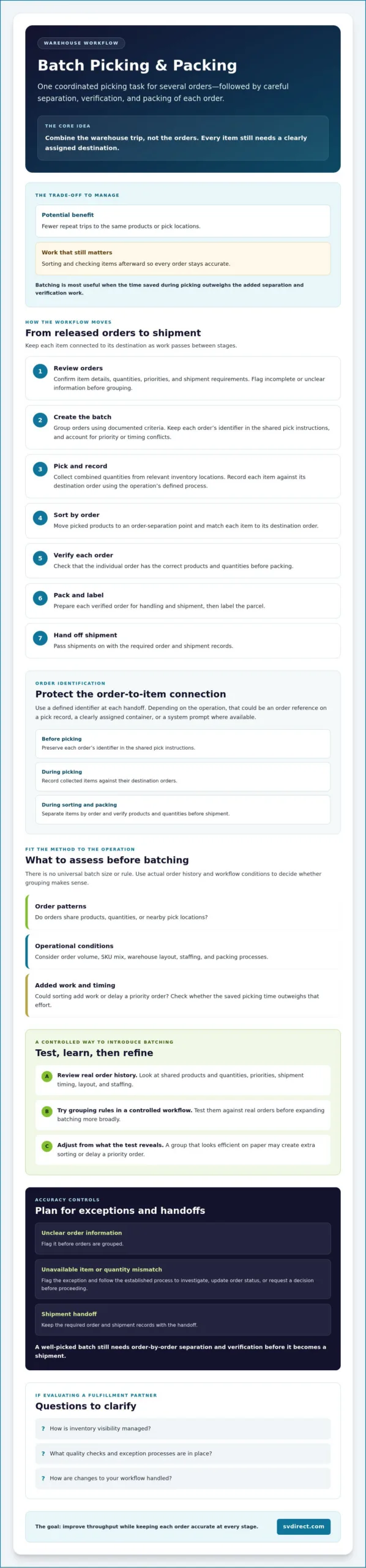
Batch picking is collecting items for several customer orders during one coordinated picking task, rather than completing one order at a time. It combines the warehouse trip, not the orders themselves. Each item must stay connected to the order it belongs to, so the workflow needs a reliable way to identify its destination before, during, and after picking.

Batch picking and packing are connected stages, but they solve different problems. Picking gathers the ordered products; packing verifies and prepares each individual order for shipment. Fewer trips may save movement through the warehouse, while clear order separation and checks help prevent items from being assigned to the wrong shipment.

What happens during a batch-picking task?

Orders with overlapping products or nearby pick locations can be grouped into a shared pick list. A picker follows the list and collects the combined quantities from the relevant inventory locations. For example, if several orders each include the same product, the picker can collect the total quantity in one pass instead of returning to that location for every order.

The combined quantity still needs an order-level destination. A pick list, scan, tote, or another defined identification method can show which order needs each item. The specific control depends on the operation, but the principle is the same: every collected item needs an assigned destination. For a broader overview of order picking strategies, see how batch picking fits alongside other approaches.

Where does packing fit after batch picking?

After collection, picked products move to an order-separation point. Staff or system prompts match each item to its destination order, then verify that the order has the correct products and quantities. Each order is packed, protected for handling, labeled, and prepared for shipment only after that check.

Batching doesn’t remove these checks. It shifts the work: the picker gathers products across multiple orders, while the next stage restores a clear, verified order-by-order structure. If separation or verification is rushed, a correctly picked item can still end up in the wrong parcel.

Packing also differs from kitting. Packing prepares an order for shipment; kitting and assembly bring specified components together as a set or complete an assembly task. When both activities are part of a workflow, define where the kit is assembled and how the finished set is verified before it enters an order.

How Batch Picking and Packing Move from Order Release to Shipment

A controlled workflow keeps each item connected to its order as work moves between people and stations. A typical sequence is to review orders, create a batch, pick and identify items, sort by order, verify quantities, pack and label parcels, then hand shipments off with the required order and shipment records.

How should orders be grouped before picking?

Batch criteria should reflect actual order history, not a universal order count. Review which products and quantities orders share, their priorities, required shipment timing, and whether grouping them fits the facility’s layout and staffing. Grouping can make picking more coordinated, but the right rules depend on the operation.

Test potential grouping rules against real order data. A group that looks efficient on paper may create extra sorting or delay a priority order. Adjust the criteria based on what the test reveals before adopting them more broadly.

What checks protect accuracy during sorting and packing?

Use a defined identifier at each handoff, such as an order reference on a pick record, a clearly assigned container, or a system prompt where available. Tools vary by operation, so confirm what is in place rather than assuming a particular scanning or software capability.

  1. Review orders. Confirm the released orders, item details, quantities, priorities, and shipment requirements. Flag incomplete or unclear information before grouping.
  2. Create the batch. Apply documented grouping criteria and preserve each order’s identifier in the shared pick instructions. Keep priority or timing conflicts out of a batch if they could disrupt the planned workflow.
  3. Pick and record. Collect the required quantities from inventory locations. Record each item against its destination order as the operation’s process requires. If an item is unavailable or the count doesn’t match, flag the exception and follow the established process to investigate, update the order status, or request a decision before proceeding.
  4. Sort and reconcile. Separate collected items into individual orders. Compare each order’s items and quantities with its pick record or system prompt, and resolve discrepancies before packing.
  5. Pack and hand off. Protect the verified items, label each parcel with the correct shipment information, then confirm at handoff that the parcel and shipment record correspond to the same order.

These handoffs make batch picking and packing a connected process, not a single picking task. If you outsource fulfillment, ask how the provider handles order identification, exceptions, verification, and shipment records before relying on its workflow.

Batch Picking vs. Single, Zone, Wave, and Cluster Picking

Picking methods differ in what they group: orders, warehouse areas, or work windows. That choice affects picker movement, how items reach packing, and how much sorting or coordination is needed. The order picking methods an operation considers should reflect its order patterns, layout, and ability to maintain clear order-level controls. No method is universally best.

Method Who picks and how work is grouped Sorting, coordination, and packing implications
Single-order A picker completes one order before starting another. Items remain associated with one order during picking, so little multi-order sorting is needed. Each order is checked and packed separately.
Batch A picker collects items for several orders in a coordinated task, often grouping orders with shared products or nearby locations. Collected items must be separated and reconciled by order before packing. Clear identification and verification at sorting are essential.
Zone Pickers work in assigned warehouse areas. Orders may pass between zones or be consolidated after area-level picks. Coordination is needed between zones, followed by order-level consolidation and checks before packing.
Wave Orders are released for picking in planned groups or time windows. A wave can coordinate work alongside other picking approaches. Teams must track wave status and ensure picked orders reach packing in the right sequence, with final checks for each order.
Cluster A picker handles multiple orders together while placing items into separate, identified containers as they pick. Order separation happens during picking, which can reduce later sorting. Each container still needs order-level verification before packing.

When is batch picking a stronger fit than single-order picking?

Repeated SKUs across orders can make batching worth evaluating: a picker may collect shared items in one pass instead of revisiting the same locations for each order. The trade-off is added sorting and reconciliation. If orders rarely overlap, or separating them creates more work than the combined trip saves, single-order picking may be simpler. Assess both travel and packing-stage effort.

How do zone, wave, and cluster methods change the workflow?

Zone picking groups work by warehouse area; batch picking groups orders. Wave picking organizes when work is released and can be combined with other methods. Cluster picking keeps several orders separate in individual containers as items are collected, unlike a batch flow that typically requires sorting afterward. Definitions and implementations can vary, so compare the actual handoffs each process requires.

Choose a method by reviewing order history, SKU overlap, warehouse layout, and the controls available at picking, sorting, and packing. For batch picking and packing, the best fit is the method whose full workflow is manageable, not simply the one that reduces picker travel.
Batch Picking and Packing: How to Build a Faster, More Accurate Fulfillment Workflow

How to Set Up Batch Picking and Packing Without Losing Control

Start with your order history, then test a small, controlled workflow before expanding. Review how often orders share SKUs, the quantities they require, and where exceptions recur. This helps determine whether grouping orders is likely to reduce travel without adding more sorting, verification, or packing work.

Document the process before the test begins. Pickers and packing staff need consistent rules for which orders can be grouped, how items stay identified, where orders are separated, and who resolves problems. Keep the test narrow enough to observe each handoff, then adjust the process when issues surface.

Which data and process controls should teams review?

Look for patterns in order frequency, shared SKUs, item quantities, and recurring exceptions such as shortages or unclear instructions. Check that inventory records match the pick instructions and that any updates made during the workflow reach the people handling the order.

Assign responsibility for resolving shortages, substitutions, and order questions. Staff should know when to pause an affected order, who can authorize a change, and how to record the decision so packing uses the correct instructions. Don’t let an exception carry forward to the next station without being addressed.

How can systems and quality checks support the workflow?

Order-management or warehouse systems may show order status, item details, and inventory information to help teams coordinate work. Confirm what information is available, how often it updates, and whether it remains visible through picking and packing. Silicon Valley Direct’s Remote Control system provides order-progress and real-time inventory visibility. Prospective clients should confirm the features and workflow fit they need.

Use quality checks at defined handoffs. For example, reconcile picked items to the order record during separation, then check each order’s products and quantities before closing the parcel. These are process controls to establish and verify for your operation, not assumptions about a particular provider’s batch-picking setup.

  • Record picking accuracy and investigate mismatches between picks and order records.
  • Track packing errors, including incorrect items or quantities, and note where they were found.
  • Log exceptions by type, resolution, and any effect on the order.
  • Measure order completion time across the workflow, from release through shipment preparation.

Review speed measures alongside picking accuracy, packing errors, and exception trends so a faster workflow doesn’t hide added rework. Compare the test results with your existing process before changing batch rules or expanding the test.

Explore Remote Order Management

When to Consider a Fulfillment Partner for Batch Picking and Packing

Outside support may be worth considering when order growth strains your team’s capacity, orders require more complex handling, or picking, packing, and inventory coordination are becoming harder to manage together. A partner should fit your actual order profile and controls, not just promise a faster process. Before making a change, confirm how its workflow would handle your products, order patterns, and exceptions.

What should you ask a fulfillment provider?

Ask for a clear walkthrough of the process from order release through shipment. The details matter at every handoff, particularly when several orders are picked together.

  • How are orders grouped, and how does each picked item stay associated with the correct order?
  • Where and how are batch items separated, reconciled, and checked before parcels are prepared for shipment?
  • What order-status and inventory information can clients access, and how current is it?
  • How are shortages, exceptions, and unclear instructions communicated, and who coordinates their resolution?
  • How can the workflow adapt if order patterns, handling needs, or priorities change?

Look for specific answers about process ownership, visibility, and quality checks. Ask what information you’ll receive and how you and the provider will resolve issues together. Customer testimonials can offer context about other clients’ working relationships, but they don’t replace confirming that the proposed workflow fits your operation.

How can a partner provide visibility and quality oversight?

Silicon Valley Direct provides eCommerce order fulfillment, inventory management, and warehousing and distribution. Its eCommerce fulfillment services may suit teams assessing outside support for coordinating these needs. The company’s Remote Control system provides order-progress and real-time inventory visibility. Confirm the current features and how they would support your specific process.

Silicon Valley Direct also describes a systematic QC-Check process for assembly work. That is useful context when discussing quality oversight, but it isn’t proof of a particular batch-picking control. Ask how checks apply to your proposed workflow, including item identification, order separation, packing verification, and communication when something doesn’t match.

Choosing a fulfillment partner is a collaborative decision. Review the workflow, visibility, and exception process together before transitioning work.

Build a Fulfillment Workflow You Can Trust

Batch picking and packing can reduce repeated warehouse travel, but the right method depends on your order patterns and the controls that keep items tied to the correct shipment. Test grouping rules against real order history, then assess picking accuracy, packing errors, exceptions, and completion time together. A stronger process balances throughput with reliable order checks.

If your team needs support coordinating fulfillment and inventory, evaluate a partner’s workflow, visibility, quality checks, and approach to exceptions before making a decision. Silicon Valley Direct provides fulfillment services and offers Remote Control for order and inventory visibility. The company also describes a systematic QC-Check process for assembly work. Confirm how its current services and systems fit your requirements.

With clear expectations and the right operational fit, you can build a workflow that supports growth while keeping every order carefully accounted for.

Frequently Asked Questions

What is batch picking in a warehouse?

Batch picking is a method for collecting items for multiple orders during one coordinated picking task. Instead of completing each order separately, a picker follows a grouped list and gathers the required quantities from shared inventory locations. Each item still needs to remain identifiable by its destination order. After picking, items must be separated, checked against each order, packed, and prepared for shipment.

How does batch picking differ from cluster picking?

Batch picking groups orders for a coordinated picking task, while cluster picking commonly keeps orders separated in distinct containers as the picker moves through the warehouse. This can shift some sorting work earlier in the process. Terminology and workflows vary, so compare how each method manages picker movement, item identification, order separation, and packing checks before choosing an approach.

Is batch picking faster than single-order picking?

It can reduce repeated trips when multiple orders need items from the same locations, but it doesn’t guarantee a faster end-to-end workflow. Sorting, checking, and packing can add work after the picking route. Review your order patterns and measure the full process, including completion time, picking accuracy, and packing errors. Compare complete workflows, not picking speed alone.

How many orders should be included in a batch?

There’s no universal batch size that suits every warehouse. Suitable grouping depends on order contents, item locations, available equipment, priorities, and how the team separates orders. Start with a controlled test using actual order data. Adjust the batch rules based on picking accuracy, workload, exceptions, and how smoothly orders move to packing. Avoid expanding the batch until the process remains manageable at each handoff.

What are the main challenges of batch picking and packing?

Common challenges include assigning each picked item to the correct order, handling shortages, managing mixed quantities, and preventing mistakes during packing. Batching can reduce repeated travel while shifting effort to sorting and verification. Clear grouping rules, visible order identification, a defined process for exceptions, and order-level checks before parcels are closed help manage these risks. Track accuracy and completion time to spot workflow problems.

What technology is used for batch picking?

Depending on the operation, an order-management or warehouse-management system may group orders, provide pick instructions, and update order status or inventory information. Labels, scanners, and other identification tools may also support item tracking and order separation. Technology varies between facilities, so confirm which systems and equipment are available, how information is updated, and how workers handle exceptions when the system or inventory record doesn’t match.

Can a 3PL handle batch picking and packing for an eCommerce business?

A third-party logistics provider may support eCommerce fulfillment that includes order processing, inventory management, picking, and packing. Specific batch workflows differ, so ask how the provider groups orders, tracks and separates items, verifies parcels, and communicates shortages or other exceptions. Silicon Valley Direct provides eCommerce order fulfillment and inventory management. Confirm directly whether its current workflow supports your batch-picking requirements and what inventory visibility is available.

Silicon Valley Direct Consumer Reviews: A Transparent Look at 3PL Performance in 2026

Silicon Valley Direct Consumer Reviews: A Transparent Look at 3PL Performance in 2026

Why does it feel like your logistics partner is a black box of automated tickets and hidden surcharges instead of a dedicated extension of your team? If you’ve been searching for an honest svdirect cunsomres review to determine if their “High-Tech, High-Touch” model actually delivers, you probably value transparency as much as we do. You’ve likely experienced the frustration of inventory inaccuracies or shipping delays that threaten your customer loyalty. We agree that a 3PL should simplify your growth, not add layers of administrative stress. You deserve a partner that treats your inventory with the same care you do.

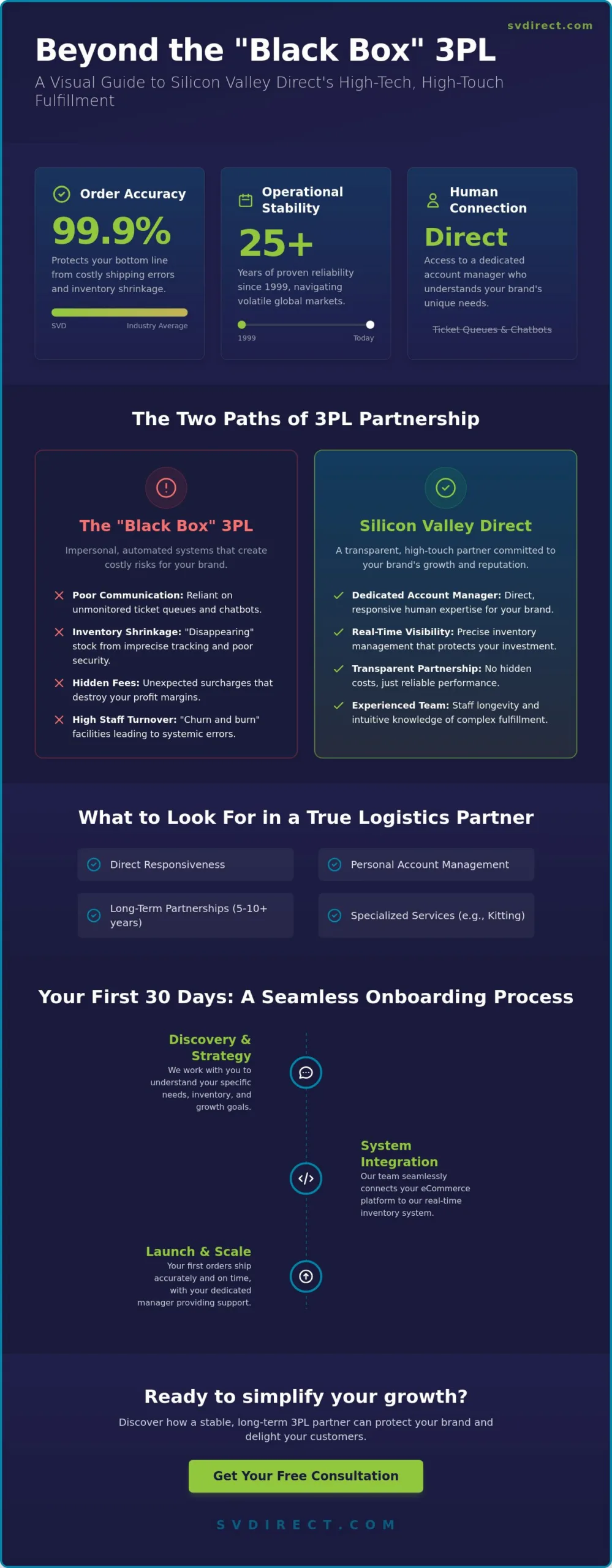
This article provides an objective analysis of Silicon Valley Direct’s performance, reliability, and service quality based on over 25 years of operational history. Our goal is to show you exactly how this team maintains 99.9% order accuracy while keeping human accountability at the center of their operations. We’ll explore their warehousing infrastructure, global shipping capabilities, and the benefits of having direct access to a dedicated account manager. By the end, you’ll have the clarity needed to decide if they’re the stable, long-term partner your brand requires.

Key Takeaways

  • Understand why Silicon Valley Direct’s founding in 1999 provides a foundation of stability that helps brands navigate volatile global markets.
  • Learn how to interpret an svdirect cunsomres review through a B2B lens, focusing on metrics that impact your specific eCommerce growth and brand reputation.
  • Explore the “Direct Human Connection” philosophy that prioritizes personalized account management over the automated, impersonal systems used by many competitors.
  • Discover how achieving 99.9% order accuracy and real-time inventory visibility protects your bottom line from hidden fees and costly errors.
  • Gain a clear understanding of the onboarding process, including what to expect during your first 30 days of professional 3PL partnership.

Why 3PL Consumer Reviews Matter: Evaluating Your Fulfillment Partner

In the B2B world, the “consumer” is the eCommerce brand owner who relies on external expertise to keep their promises to their customers. When you search for an svdirect cunsomres review, you aren’t looking for feedback on a retail purchase. You’re looking for a deep dive into how a Third-party logistics (3PL) provider handles high-stakes operations. Standard review platforms often fail because they treat logistics like a simple transaction rather than a complex, human-driven partnership. You need data that reflects operational reliability and the personal commitment of the team handling your goods.

To better understand the geographic context of these logistics hubs and the environment where these teams operate, watch this helpful video:

True operational excellence is built on stability. High-performance warehousing relies heavily on staff retention. When a team stays together for years, they develop an intuitive understanding of kitting requirements and healthcare mailing regulations. This longevity is the backbone of a 99.9% order accuracy rate. In contrast, “churn and burn” facilities often suffer from systemic errors because their workers are constantly in a state of training. It’s vital to distinguish between isolated “growing pains,” which might happen during a massive seasonal spike, and the red flags of a failing infrastructure. A reliable review will highlight how a partner handles those high-pressure moments with grace and direct communication.

The Risks of Choosing a 3PL Without Vetted Feedback

Poor communication is the most expensive “hidden cost” in logistics. If your account manager is a chatbot or an unmonitored ticket queue, a simple shipping delay can escalate into a brand-damaging crisis. Inventory shrinkage is another silent killer, especially for high-value goods. Without precise inventory management, your bottom line suffers from “disappearing” stock that was never properly tracked or secured. Choosing a partner without vetted feedback means risking your capital on a facility that might lack the physical security or digital oversight necessary to protect your investment.

What to Look for in a Logistics Partner Review

Prioritize feedback that mentions direct responsiveness and personal account management. A partner that offers specialized services like literature fulfillment or on-demand digital printing demonstrates a higher level of operational sophistication. Look for mentions of partnerships lasting five years or longer. Stability isn’t just a marketing claim; it’s a measurable result of consistent performance. You can find more insights on industry trends on our blog. When an svdirect cunsomres review points to a decade of collaboration, it signals a level of trust that no flashy marketing campaign can replicate.

Silicon Valley Direct’s 25-Year Track Record of Operational Excellence

Silicon Valley Direct established its operational foundation in 1999. While many logistics providers have entered and exited the market since the dot-com era, our 25-year history serves as a testament to extreme stability. We’ve weathered market shifts by maintaining a privately held ownership structure. This independence allows us to prioritize consistent service standards over short-term investor demands. When you’re searching for an svdirect cunsomres review, you’re looking for a partner that won’t disappear when the industry becomes volatile. Our longevity isn’t just a number; it’s a promise of reliability built into every parcel we ship.

Strategic placement is vital for global reach. Our headquarters in Union City, California, offers a distinct advantage for global logistics and shipping. We blend the “Silicon Valley” mindset of high-tech innovation with a deep commitment to physical precision. This dual approach ensures that your brand benefits from modern digital integrations while receiving the care that only a seasoned team can provide. We don’t just move boxes. We engineer workflows that respect your time and your inventory’s integrity.

Evolution from Direct Mail to eCommerce Powerhouse

Our roots in high-volume direct mail marketing taught us the value of precision. In mailing services, even a minor error can compromise thousands of records. We’ve translated that discipline into our eCommerce order fulfillment and pick-and-pack operations. Today, we seamlessly integrate on-demand digital printing with traditional warehousing. Our legacy expertise in Kitting and Assembly Services remains a core strength for brands with complex packaging needs. If your brand requires this level of precision, you might consider how a tailored solution fits your needs by choosing to request a free quote.

Security and Compliance: A Trusted Healthcare Partner

Precision is non-negotiable in specialized sectors like healthcare mailing services. We’ve invested in the infrastructure required for HIPAA-compliant fulfillment, ensuring that sensitive data and products are handled with total confidentiality. Our secure, climate-controlled warehousing protects high-value goods from environmental damage and unauthorized access. These rigorous standards are why clients in the finance and medical industries often provide the most detailed svdirect cunsomres review feedback. They demand a level of compliance that most general 3PLs simply can’t meet. You can find more details on our commitment to specialized logistics on our blog.

Silicon Valley Direct Consumer Reviews: A Transparent Look at 3PL Performance in 2026

Human Expertise vs. Automated Fulfillment: The SVD Difference

Efficiency shouldn’t come at the expense of empathy. Many logistics providers today rely on chatbots and automated ticket queues to manage client concerns. This trend often leaves brand owners feeling like just another number in a spreadsheet. When you read an svdirect cunsomres review, you’ll notice a recurring theme that sets us apart: our commitment to Direct Human Connection. We’ve built our reputation on the belief that a steady hand and a personal commitment are the best tools for alleviating the stress of business growth. We don’t hide behind algorithms; we provide direct access to dedicated account managers who understand your brand’s unique pulse.

Our philosophy centers on being a proactive partner rather than a passive vendor. While high-tech systems track every parcel, it’s our human oversight that catches the nuances an automated system might miss. Whether it’s a sudden shift in shipping regulations or a specific request for a high-value client, our team is ready to step in. This human-centric approach ensures that your operations remain grounded and accessible, even as your volume scales. We view every transaction as a partnership, prioritizing the human element to create a reassuring and stable environment for your inventory.

The Myth of the ‘Fully Automated’ Warehouse

The idea of a warehouse that runs entirely without human intervention is a myth when it comes to complex logistics. Standard pick-and-pack tasks might be automated, but intricate B2B orders and promotional kitting projects require an expert human touch. We use technology to empower our staff, providing them with real-time data to make informed decisions. This proactive stance allows us to solve problems before they impact your customers. By blending technical integration with physical precision, we maintain a level of accuracy that purely automated facilities struggle to match.

Bespoke Solutions: Beyond the One-Size-Fits-All Model

Startups and established enterprises alike require total flexibility to succeed. A one-size-fits-all model rarely works for brands that value a unique unboxing experience. We offer bespoke solutions that include everything from custom packaging to specialized literature fulfillment. A High-Touch 3PL is a service where every client has a dedicated contact person who manages their specific operational needs from start to finish. This level of customization ensures that your brand’s voice is heard at every stage of the fulfillment process. You can learn more about how we tailor our services to meet diverse industry needs on our blog. When an svdirect cunsomres review mentions our flexibility, it’s a reflection of our “High-Tech, High-Touch” promise in action.

Key Performance Indicators (KPIs) to Look for in SVD Consumer Feedback

Anecdotal stories don’t tell the whole truth about a logistics partner. You need concrete data to make an informed decision for your business. A professional svdirect cunsomres review should focus on the Key Performance Indicators (KPIs) that directly impact your bottom line. At Silicon Valley Direct, our 99.9% order accuracy rate serves as the industry gold standard. This level of precision isn’t accidental. It’s the result of combining advanced digital tracking with the meticulous oversight of our seasoned warehouse team. Every fulfillment error is an avoidable cost, and we’ve spent 25 years refining our processes to eliminate them.

Returns management is another critical metric that separates a high-performance 3PL from a basic warehouse. We treat reverse logistics with the same urgency as outbound shipping. If a customer returns a product, our team processes it quickly to ensure your inventory levels remain accurate and your customers receive their refunds or exchanges without delay. Managing the entire lifecycle of a product requires a steady hand and a deep commitment to service quality. We don’t just ship boxes; we manage your brand’s reputation through every stage of the supply chain.

Inventory Control and Real-Time Visibility

Transparency is the foundation of a successful partnership. Our web-based inventory management software allows remote business owners to monitor their stock levels in real-time from anywhere in the world. We utilize a strict FIFO (First-In, First-Out) system to prevent product obsolescence. This ensures that your older stock moves first, which is vital for maintaining product integrity and reducing waste. For a more detailed analysis of how we optimize stock levels, you can explore our blog for expert inventory strategies.

Global Reach and Shipping Reliability

Our location in Union City, CA, provides a strategic advantage for global shipping and logistics. We leverage Silicon Valley’s connectivity to secure discounted carrier rates for both B2C and B2B shipments. Our “Batch Delivery to Carrier” process is designed to reduce transit times for high-volume eCommerce orders. By consolidating shipments and coordinating directly with major carriers, we ensure your products reach their destination faster. This proactive stance on shipping reliability is a recurring highlight in any svdirect cunsomres review from our long-term partners.

If you’re looking for a partner that prioritizes these high-level metrics, you can request a free quote to see how our precision fits your business model.

Ready to Scale? How to Start Your Partnership with Silicon Valley Direct

Scaling a business is exhilarating, but the logistical weight can quickly become overwhelming. Moving from in-house fulfillment to a professional 3PL requires a partner that values precision as much as you do. When you look for an svdirect cunsomres review, you’re searching for evidence of a seamless transition that protects your brand’s reputation. We’ve spent over two decades perfecting our onboarding process to ensure your brand doesn’t skip a beat. Our philosophy blends high-tech efficiency with a personal touch, allowing us to handle the heavy lifting of technical integration while you focus on strategic growth.

During the first 30 days of our partnership, we focus on establishing a baseline of operational excellence. This phase involves synchronizing your inventory management systems and training our dedicated staff on your specific kitting and assembly requirements. We don’t just store your products; we can immediately integrate your on-demand digital printing and literature fulfillment needs into a single, cohesive workflow. This proactive stance ensures that your orders are processed with the high level of accuracy you’ve come to expect from a seasoned expert. We treat your inventory with a steady hand, ensuring every parcel reflects your brand’s commitment to quality.

Consultative Onboarding: The SVD Approach

Our onboarding process is deeply consultative. We start by analyzing your current supply chain to identify efficiency gaps that might be draining your resources. Whether you use Shopify, WooCommerce, or a custom platform, our technical team ensures a seamless data flow between your storefront and our warehouse. This personalized service begins with our very first discovery call. We take the time to listen to your specific challenges, ensuring that our solution is bespoke rather than a one-size-fits-all model. You can find more tips on preparing for this transition on our blog.

Contact Silicon Valley Direct for a Custom Quote

Every brand has unique requirements, ranging from climate-controlled storage for sensitive goods to high-security warehousing for healthcare mailing services. We invite you to reach out for a tailored logistics analysis that respects your time and your business goals. Choosing a partner founded in 1999 means investing in a stable, long-term foundation. When you read a positive svdirect cunsomres review, it’s a reflection of the trust we’ve built through decades of reliable service. Let us show you how our expertise can alleviate your operational stress and provide the physical infrastructure your growth demands.

Request a fulfillment consultation with Silicon Valley Direct

Secure a Foundation for Your Brand’s Future

Choosing a logistics partner is one of the most critical decisions for any growing eCommerce brand. You’ve seen through this analysis that operational stability is the ultimate competitive advantage. A firm founded in 1999 offers a level of reliability that younger, venture-backed startups often struggle to maintain. Every svdirect cunsomres review reinforces the value of prioritizing direct human connection over impersonal automation. Whether your business requires specialized HIPAA-compliant healthcare mailing or intricate kitting and assembly, having a dedicated account manager ensures your specific standards are met every single time.

Our strategic location in the heart of Silicon Valley keeps your brand connected to the most advanced global shipping networks. We combine this geographic innovation with the physical precision of a seasoned team that treats your inventory as if it were their own. You don’t have to navigate the complexities of global logistics or reverse logistics alone. We’re ready to act as a steady, reliable hand for your business operations as you scale to new heights. Take the first step toward a more transparent and efficient fulfillment model today.

Streamline Your Supply Chain with Silicon Valley Direct

Frequently Asked Questions

Is Silicon Valley Direct HIPAA compliant for medical and healthcare mailing?

Yes, we maintain the rigorous security and procedural standards required for HIPAA-compliant healthcare mailing services. Our facility handles sensitive medical data and pharmaceutical-grade literature with total confidentiality and precision. This specialized expertise is often a focal point in a professional svdirect cunsomres review, as it demonstrates our commitment to regulatory compliance that general fulfillment centers often lack. We treat every healthcare project with the seasoned professionalism your sensitive data requires.

What is the minimum order volume required to work with Silicon Valley Direct?

We provide bespoke solutions tailored to each client’s specific growth stage rather than enforcing a rigid, one-size-fits-all minimum. Our infrastructure supports both emerging startups and established enterprises that require high-touch service and total flexibility. We analyze your current shipping volume and growth projections during our initial consultation. This ensures our operational model aligns with your business needs and long-term scaling goals without the pressure of arbitrary volume requirements.

Does Silicon Valley Direct offer international shipping for eCommerce brands?

Yes, we provide comprehensive global shipping and logistics services from our central California hub. Our team leverages deep relationships with international carriers to secure discounted rates and navigate complex customs requirements for B2B and B2C shipments. This global reach allows your brand to expand into new markets with the confidence that your international customers will receive their orders accurately. We manage the complexities of cross-border logistics so you don’t have to.

How does Silicon Valley Direct handle returns and reverse logistics?

We manage the entire lifecycle of your products through a dedicated returns management system that prioritizes speed and inventory accuracy. When a return arrives at our facility, our staff inspects the items based on your specific quality control standards before updating your inventory levels in real-time. This proactive approach to reverse logistics helps you maintain high customer satisfaction while minimizing the financial impact of returned goods. We ensure your returns process is as efficient as your outbound shipping.

Can Silicon Valley Direct handle high-value inventory and secure warehousing?

Yes, our warehouse features climate-controlled and high-security storage areas specifically designed for high-value inventory. We use advanced digital surveillance and strict access protocols to protect your assets from environmental damage and unauthorized access. This level of physical security is a hallmark of our 25-year operational history, providing peace of mind for brands handling electronics, medical devices, or luxury goods. Your inventory is protected by both modern technology and human oversight.

Does SVD provide on-demand digital printing for marketing materials?

Yes, we offer on-demand digital printing services that integrate seamlessly with our literature fulfillment and eCommerce operations. This allows you to include personalized marketing materials, instruction manuals, or promotional inserts in every package without maintaining a large, static print inventory. By printing materials as they’re needed, you reduce waste and ensure that every customer receives the most up-to-date information. It’s a cost-effective way to enhance the unboxing experience and drive brand loyalty.

How do I integrate my Shopify or WooCommerce store with SVD’s system?

We utilize advanced API integrations to connect your Shopify or WooCommerce store directly to our web-based inventory management software. This setup ensures that orders flow into our facility automatically and shipping data is pushed back to your storefront in real-time. Our technical team manages the integration process during your onboarding phase, providing a stable digital connection that supports 99.9% order accuracy. You’ll have total visibility into your supply chain without the stress of manual data entry.

What makes Silicon Valley Direct different from larger, automated 3PL providers?

The primary difference is our rejection of impersonal, automated interactions in favor of Direct Human Connection and personal oversight. While larger providers rely on chatbots, we provide every client with a dedicated account manager who understands their business. This “High-Tech, High-Touch” philosophy combines 25 years of experience with modern innovation. It’s a recurring theme in an svdirect cunsomres review that values stability over the “churn and burn” models often found in mass-market, automated 3PL facilities.