Crowdfunding Fulfillment Services: The Complete 2026 Guide to Campaign Success
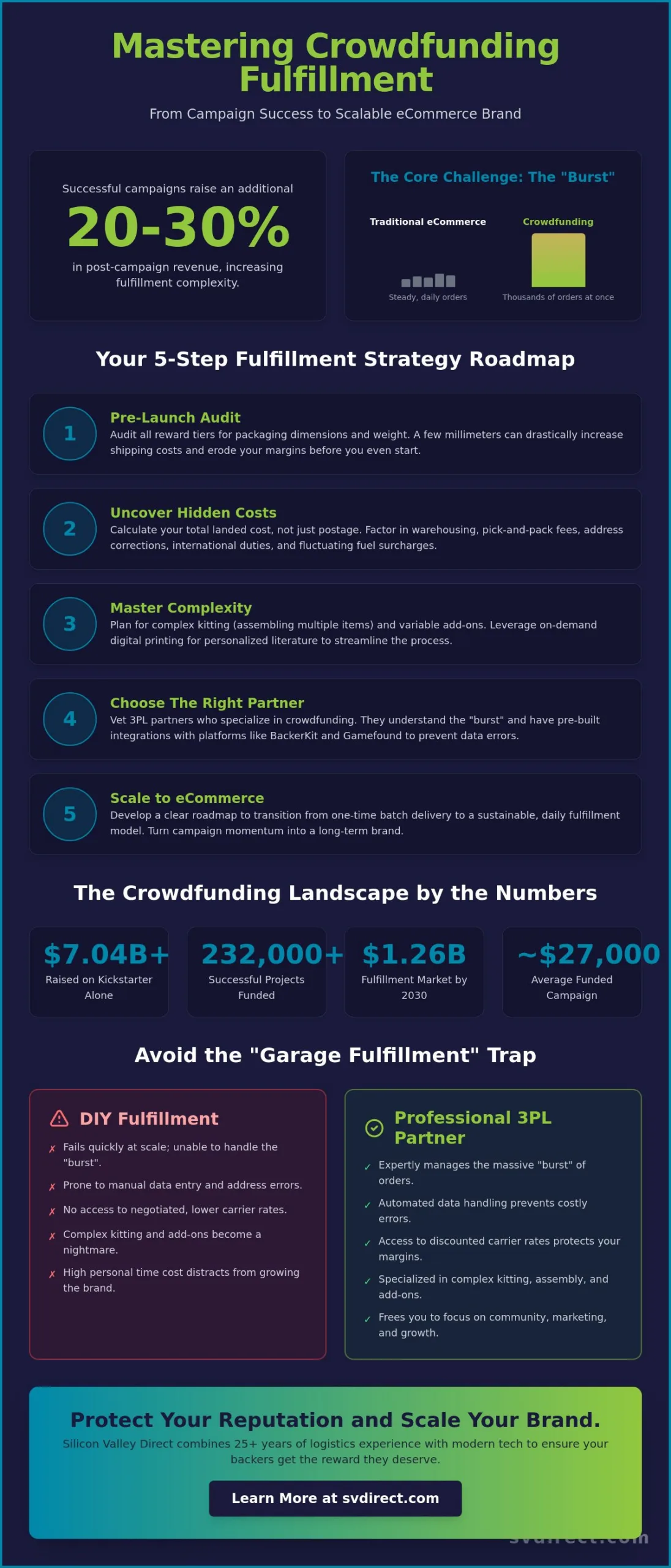
Did you know that a successful campaign often raises an additional 20% to 30% in revenue through post-campaign pledging? While that growth is a significant win, it also increases the complexity of your reward delivery. You’ve built a community that trusts your vision, but the messy middle between funding and shipping is where brand reputation is truly tested. This is where professional crowdfunding fulfillment services transform a logistical challenge into a seamless brand experience.
This level of variation is where professional crowdfunding fulfillment services prove their worth through meticulous quality control. We believe that physical operations require a human touch that software alone cannot provide. High-value items, common in technology and design projects—much like the high-performance tech hardware and accessories offered by Devia—demand secure warehousing and specialized handling to prevent damage or loss. By implementing human-in-the-loop inspections during the assembly process, we ensure that every complex kit contains exactly what the backer expects. This precision is what protects your brand reputation and minimizes the cost of returns management later on.
We understand the anxiety that comes with international VAT and the fear of shipping delays damaging your hard-earned reputation. You need more than just a warehouse; you need a partner who values precision as much as you do. In this guide, you’ll learn how to master reward delivery and transition your project into a scalable eCommerce brand. We’ll walk through the logic of efficient inventory management and global shipping, giving you the confidence to grow while we manage the operational complexities.
Key Takeaways
- Audit your reward tiers for packaging dimensions and weight during the pre-launch phase to prevent logistical bottlenecks.
- Partner with professional crowdfunding fulfillment services to successfully manage the “burst” nature of shipping thousands of rewards simultaneously.
- Streamline complex kitting and variable add-ons by leveraging on-demand digital printing for personalized literature and manuals.
- Protect your project’s margins by identifying hidden costs like address corrections and fuel surcharges before they impact your bottom line.
- Develop a clear roadmap to transition from batch delivery to a daily fulfillment model, turning campaign momentum into a sustainable eCommerce brand.
What are Crowdfunding Fulfillment Services?
At its core, crowdfunding fulfillment services represent a specialized branch of logistics tailored to the unique lifecycle of a funded project. Unlike traditional eCommerce, where orders trickle in daily, crowdfunding creates a massive “burst” of demand. You might spend months building momentum on platforms like Kickstarter or Indiegogo, only to face the sudden requirement of shipping thousands of rewards simultaneously. To understand the foundational mechanics of these campaigns, it’s helpful to review What is Crowdfunding? and how different models impact delivery timelines.
The global market for these services was valued at $927 million in 2023 and is projected to reach $1,262 million by 2030. This growth reflects the increasing complexity of modern campaigns. With Kickstarter alone having raised over $7.04 billion across 232,000 successful projects, the pressure to deliver accurately is immense. A professional partner doesn’t just move boxes; they act as a steady hand that protects your brand reputation during the critical transition from a digital idea to a physical product.
To better understand this logistical bridge, watch this helpful video:
Modern crowdfunding fulfillment services must integrate deeply with the tools you already use. Whether you are managing backer data through BackerKit, Gamefound, or directly through platform exports, the flow of information must be seamless. Precision in data handling prevents the manual entry errors that often lead to lost parcels and frustrated backers. By automating these connections, you ensure that every reward tier and add-on is accounted for before the first label is even printed.
Why Startups Need a Professional 3PL
Many founders fall into the “garage fulfillment” trap, believing they can manage a few hundred orders manually. However, manual processes fail quickly at scale. Professional kitting and assembly are essential when dealing with complex reward tiers that include various colors, sizes, or limited-edition add-ons. A seasoned partner also provides access to negotiated carrier rates that are typically unavailable to individual creators. These savings are vital for maintaining your project’s margins, especially as shipping costs and fuel surcharges continue to fluctuate.
The Silicon Valley Advantage
Operating from the heart of a global tech hub offers distinct advantages for high-performance logistics. Proximity to innovation centers allows for faster software troubleshooting and tighter integration with emerging eCommerce tools. We believe that physical operations should be as organized as your digital presence. With over 25 years of experience, our approach combines this high-tech efficiency with a commitment to human oversight. We reject the trend of total automation, ensuring that a dedicated expert is always monitoring your inventory. This blend of seasoned wisdom and modern capability provides the stability your growing business needs. For more insights on scaling your operations, you can explore our latest resources at https://svdirect.com/blog/.
How to Plan Your Crowdfunding Fulfillment Strategy
The success of your crowdfunding fulfillment services depends on decisions made months before your first dollar is pledged. Waiting until your campaign is funded to consider logistics is a common mistake that leads to budget overruns. With the average funded Kickstarter campaign raising approximately $27,000, every dollar spent on shipping must be calculated with precision. You should start by auditing your reward tiers for “shippability.” Even a slight increase in packaging dimensions can push a reward into a more expensive shipping bracket, eroding your margins before you’ve even begun production.
Calculating landed costs is a foundational step in your strategy. This figure includes more than just postage; it encompasses warehousing, pick-and-pack fees, and international duties. The challenges of crowdfunding fulfillment often stem from underestimating these variables. By integrating your backer management software with a 3PL’s warehouse management system (WMS) early, you create a seamless flow of data that prevents the “messy middle” from becoming a logistical nightmare. If you’re ready to map out these costs with an expert partner, you can consult with our logistics team for a detailed analysis.
Step 1: Data Integration and SKU Management
Precision begins with a clean backer list. Address changes and typos are inevitable during a long campaign, and manual data entry is a primary source of fulfillment errors. You must establish unique SKUs for every possible reward combination. This logical structure ensures that your 3PL can track inventory in real time, preventing you from overselling add-ons that might be generated during the 20% to 30% of revenue typically raised in post-campaign pledging. A robust WMS integration allows you to see exactly what is in stock, ensuring that backer expectations are met without delay.
Step 2: Designing the Unboxing Experience
Your packaging is the first physical touchpoint a backer has with your brand. While standard mailers are cost-effective, custom branded packaging can turn a delivery into a marketing event. Complexity increases when you include literature, stickers, or multiple add-ons. Efficient kitting is required to ensure these items are grouped correctly without slowing down the shipping “burst.” You can leverage Silicon Valley Direct’s kitting services to handle complex assemblies, ensuring that even the most intricate reward tiers are delivered with professional accuracy.
Step 3: Global Shipping and Customs Compliance
International reach is a hallmark of modern crowdfunding, but it brings the complexity of VAT and GST compliance. Navigating these regulations requires a partner who understands the nuances of different regional delivery rules. Choosing the right carriers for domestic versus global shipping can significantly impact your delivery speed and cost. For a deeper look at managing these complexities, see our guide on global shipping services. This proactive approach to customs ensures that your backers aren’t surprised by unexpected fees at their doorstep.
Managing Complexity: Kitting, Tiers, and Reward Tiers
Logistics for a standard eCommerce store are generally predictable, but crowdfunding operates on a different logic. A primary challenge involves “Add-ons,” those extra items backers select during or after the campaign that turn a simple delivery into a complex puzzle. Statistics show that average order values increase significantly with campaign size; seven-figure campaigns often reach an average order value of $435. This increase is driven by backers bundling multiple rewards, which requires a sophisticated approach to inventory management and order accuracy. When tackling crowdfunding fulfilment, you quickly realize that a single reward tier might have dozens of variations based on backer choices.
This level of variation is where professional crowdfunding fulfillment services prove their worth through meticulous quality control. We believe that physical operations require a human touch that software alone cannot provide. High-value items, common in technology and design projects, demand secure warehousing and specialized handling to prevent damage or loss. By implementing human-in-the-loop inspections during the assembly process, we ensure that every complex kit contains exactly what the backer expects. This precision is what protects your brand reputation and minimizes the cost of returns management later on.
The Art of Kitting and Assembly
Efficient kitting involves bundling multiple physical products into a single SKU to streamline the shipping process. This method allows for faster batch processing during the initial “burst” of reward delivery. We focus on optimizing package weight and dimensions during this stage, as even a fraction of an ounce can change the shipping bracket and impact your bottom line. Our team analyzes your reward tiers to determine whether batch processing or on-demand assembly is the most efficient path forward. This strategic oversight ensures that your most complex assemblies are handled with the same speed as your simplest orders.
On-Demand Printing for Personalized Rewards
Personalization is a powerful tool for rewarding high-tier backers, but it often creates a logistical bottleneck. We solve this by integrating on-demand digital printing directly into our fulfillment workflow. This capability allows you to include personalized thank-you notes or custom literature fulfillment without the need for massive pre-printed inventories.
- Just-in-time printing: Produce manuals and inserts as needed to reduce long-term storage costs.
- Personalized inserts: Create a unique unboxing experience for your most loyal supporters.
- Literature integration: Ensure every technical product includes the correct, up-to-date documentation.
By combining printing and logistics under one roof, we eliminate the delays associated with third-party print shops and keep your project moving forward with high-tech efficiency.
Avoiding the Post-Campaign Crash: Cost Management and Partner Vetting
The exhilaration of a funded project often masks the financial risks lurking in the delivery phase. Professional crowdfunding fulfillment services prioritize transparency over the lure of the lowest headline rate, as hidden costs can quickly erode your remaining capital. Industry benchmarks show that logistical expenses shift rapidly; for instance, as of April 17, 2026, a 3.5% fuel surcharge applies to all FBA fulfillment fees in the US and Canada. While you may choose a private 3PL, these market trends reflect broader volatility that your partner must proactively manage to keep your project solvent.
Address corrections and returns management are two of the most frequent causes of a “post-campaign crash.” A single typo in a backer survey can lead to a returned parcel, doubling your shipping costs and delaying delivery. You need a partner that offers human oversight rather than a “black box” automated system. A dedicated account manager serves as a steady hand, catching errors before rewards leave the facility. If you’re concerned about how these variables might impact your specific budget, you can request a free quote to get a clear, line-item view of your projected costs.
Understanding Pick and Pack Fees
Pick and pack fees are the heartbeat of your fulfillment budget. It’s essential to distinguish between the cost per item and the cost per order. In a campaign with multiple add-ons, a “per item” fee structure can become prohibitively expensive. We recommend analyzing how assembly complexity influences your total spend. By providing accurate volume projections and reward tier breakdowns, you can often negotiate better rates. This logical approach ensures that your kitting and assembly costs remain predictable even when shipping thousands of units during a high-volume “burst.”
Vetting for Reliability and Longevity
In a tech-saturated market, the stability of your partner is just as important as their software. A logistics provider founded in 1999 offers a multi-decade history and an anchor of trust that a newer startup simply cannot match. When vetting a 3PL, ask about their staff retention rates; long-term tenure is a unique hallmark of expert-level service and internal stability. To make a more informed decision, reviewing a detailed comparison of 3PL companies in the Bay Area for 2026 can help you evaluate which providers combine software precision with the personal oversight your campaign demands. We encourage creators to visit our facility or request a virtual tour to see our physical infrastructure in action. For more insights on selecting a partner that aligns with your brand’s growth, check out our blog for expert tips on 3PL selection.
Scaling Beyond the Campaign: From Kickstarter Success to eCommerce Brand
The delivery of your final reward marks a pivotal moment for any startup. While the initial “burst” of shipping thousands of units is a monumental hurdle, the true test of longevity begins the day your project transitions from a campaign to a permanent eCommerce brand. You don’t want your momentum to stall while you struggle to move from batch shipping to daily order fulfillment. Utilizing specialized crowdfunding fulfillment services allows you to maintain your pace by integrating your backend directly with platforms like Shopify, WooCommerce, or Amazon. This technical synergy ensures that as soon as a new customer clicks “buy” on your website, the request flows directly to the warehouse floor without manual intervention. For merchants building on Shopify specifically, understanding how Shopify fulfillment services can be optimized through a partner-based 3PL model is essential to turning your campaign’s momentum into a scalable retail operation.
Managing returns and exchanges is an often-overlooked aspect of this transition. In the crowdfunding phase, backers are often more patient, but eCommerce customers expect rapid resolution. A robust returns management system builds long-term loyalty and transforms a potential negative experience into a brand win. When you position your logistics as a core competency, you aren’t just shipping products; you’re demonstrating operational readiness to future investors. They look for brands that have moved past the “messy middle” and established a scalable, reliable infrastructure. Investors value transparency and operational history. When you can show a seamless integration between your sales channels and your fulfillment center, you prove that your business model is built on a stable foundation rather than just a viral moment.
The Roadmap to Permanent eCommerce
Scaling requires a shift in mindset from “Backer Management” to “Customer Relationship Management” (CRM). Your logistics partner should help you leverage data from your initial run to forecast future production needs and inventory storage requirements. As your brand grows, your warehousing needs will evolve from simple storage to dynamic distribution. By analyzing the geographic spread of your initial backers, you can optimize your shipping zones and reduce costs for future daily orders. This data-driven approach turns your fulfillment history into a strategic asset for future growth, allowing you to scale inventory storage as your brand expands beyond the initial production run.
Ready to Scale Your Vision?
The choice of a fulfillment partner determines whether your brand will thrive or merely survive the post-campaign period. You need a partner that offers the security and precision required for healthcare mailing services while maintaining the agility of a tech startup. We’ve spent over 25 years in the heart of Silicon Valley, refining the balance between high-tech efficiency and direct human oversight. We don’t believe in “black box” logistics; we believe in bespoke problem-solving and total flexibility. Our team acts as a steady hand, ensuring that your physical operations are just as organized as your digital presence.
If you’re ready to turn your project’s success into a lasting brand, we’re here to provide the expertise you need to scale with confidence. Request a free quote for your crowdfunding fulfillment and let’s build your roadmap to eCommerce success together.
Mastering the Transition to a Scalable Brand
Success in crowdfunding requires more than just meeting a funding goal; it demands a logistical roadmap that bridges the gap between a viral moment and a sustainable business. By auditing your reward tiers early and integrating your data with professional crowdfunding fulfillment services, you eliminate the manual errors that threaten your brand’s reputation. We believe that physical operations should be as innovative as your product design, which is why our Silicon Valley-based high-tech integration is designed for seamless scaling.
With over 25 years of logistics expertise, we provide the steady hand needed to manage specialized kitting and assembly for thousands of unique reward combinations. Don’t let the operational complexities of delivery slow your momentum or drain your budget. Your vision deserves a partner that values precision as much as you do. We’re ready to help you deliver on every promise and build a lasting eCommerce legacy.
Request a Free Quote for Your Crowdfunding Campaign and start your journey toward long-term growth today.
Frequently Asked Questions
How much do crowdfunding fulfillment services typically cost?
Total costs depend on package dimensions, total unit volume, and the complexity of your kitting requirements. Most providers charge for receiving inventory, monthly storage, and a per-order pick and pack fee. You should also account for carrier surcharges, such as the 3.5% fuel surcharge currently applied to major US fulfillment fees. Requesting a transparent, line-item quote is the best way to avoid hidden expenses and maintain your project’s margins.
When should I hire a fulfillment company for my Kickstarter campaign?
You should begin vetting crowdfunding fulfillment services during your pre-launch phase, ideally three to six months before your campaign goes live. Early planning allows you to audit reward tiers for shippability and integrate your backer management software with the warehouse system. This proactive stance ensures your shipping rates are accurate when you set your funding goal, preventing unexpected budget deficits after the campaign ends.
Can a 3PL handle international shipping for my backers?
Yes, a professional 3PL manages global shipping and logistics, including the complexities of international customs and VAT compliance. We navigate regional delivery rules to ensure your rewards reach backers in different countries without unnecessary delays. By leveraging negotiated carrier rates, a fulfillment partner can often provide more cost-effective global reach than an individual creator could achieve independently.
What happens if a backer changes their address after the campaign ends?
Address updates are managed through your backer management software, which syncs directly with your fulfillment partner’s warehouse management system. It’s common for backers to move during the months between funding and delivery. We recommend setting a “lock date” for address changes shortly before shipping begins. This ensures our team has the most accurate data before the high-volume burst of reward delivery starts.
Do I need to provide my own packaging for reward fulfillment?
You have the flexibility to provide custom branded packaging or utilize our standard mailers and boxes. Custom packaging enhances the unboxing experience but requires careful coordination of inventory levels. If you choose to provide your own materials, we manage those as separate SKUs within our warehouse. Our team can advise on dimensions that minimize shipping costs while providing high-level security for your items.
How long does the crowdfunding fulfillment process usually take?
The actual shipping phase typically takes several days to a few weeks, depending on your total backer count and the complexity of the kitting. While the initial setup and data integration happen months in advance, the “burst” delivery starts once your production run arrives at the warehouse. We prioritize methodical organization to ensure that even the largest campaigns move from receiving to doorstep as efficiently as possible.
Can you handle kitting for complex reward tiers with multiple items?
Yes, we specialize in kitting and assembly for reward tiers that involve multiple items or variable add-ons. Our team handles the manual oversight required to group different SKUs into a single, accurate package. This process includes human-in-the-loop inspections to ensure every backer receives exactly what they pledged for. We can also integrate literature fulfillment, such as printed manuals or thank-you notes, directly into these complex kits.
What is the difference between eCommerce fulfillment and crowdfunding fulfillment?
The primary difference lies in the volume rhythm; crowdfunding involves a massive “burst” of thousands of orders at once, whereas standard eCommerce follows a steady daily flow. Traditional eCommerce focuses on long-term inventory rotation and consistent daily picks. In contrast, crowdfunding fulfillment services require a high-performance partner capable of managing rapid data imports and complex reward combinations in a very compressed timeframe.