



Catalog Order Fulfillment: The Strategic Guide to 3PL Efficiency in 2026
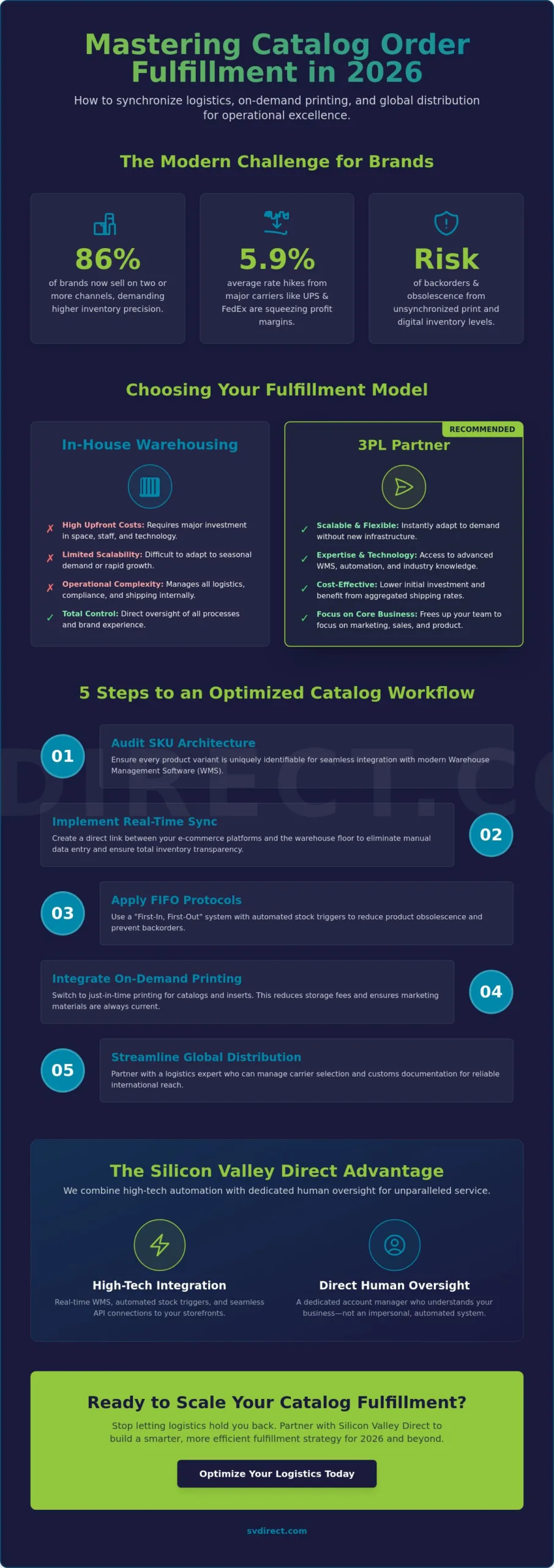
With 86% of brands now selling on two or more channels, is your logistics strategy actually keeping up? Managing catalog order fulfillment in 2026 requires more than just shelf space; it demands a sophisticated blend of on-demand printing and precision kitting. You’ve likely felt the sting of the 5.9% rate hikes from UPS and FedEx this year, or the frustration of inventory levels that don’t reflect reality across your web store and print mailers. These inaccuracies and rising costs can quickly stall the momentum of even the most established brands.
We believe that true operational excellence comes from a blend of high-tech integration and direct human oversight. You deserve a partner who views your business as a collaboration rather than a simple transaction. This guide will show you how to master catalog order fulfillment by scaling your logistics, printing, and global distribution effectively. We’ll preview how to navigate the 2026 shipping surcharges, utilize the 10% USPS Catalog Insights discount, and create a seamless link between your software and the warehouse floor for total inventory transparency.
Key Takeaways
- Identify why catalog-driven logistics demand higher inventory precision than standard eCommerce to ensure your print and digital channels stay perfectly synchronized.
- Learn how to apply FIFO protocols and real-time stock triggers to eliminate the risk of backorders and reduce the costs of product obsolescence.
- Compare the financial and operational impact of in-house warehousing versus the scalability of a 3PL to determine which model fits your 2026 budget.
- Master the five steps to optimize your catalog order fulfillment by auditing your SKU architecture for seamless integration with modern warehouse management software.
- Discover the value of a high-tech logistics partner that prioritizes human oversight and personal account management over impersonal, automated systems.
What is Catalog Order Fulfillment in 2026?
Catalog order fulfillment refers to the complete lifecycle of managing orders that originate from a physical or digital product catalog. It’s a specialized discipline that requires more than just picking items off a shelf. In 2026, this model requires a level of inventory precision that standard eCommerce rarely touches. When you send out a physical mailer, you’re making a fixed promise to your customer about availability. If your warehouse isn’t perfectly synced, you risk the high cost of out-of-stock notifications on orders you’ve already paid to generate.
The industry has shifted away from the traditional, static warehouse. Modern centers are now high-tech hubs where Order fulfillment is handled by integrated systems that bridge the gap between digital storefronts and physical inventory. This is particularly vital for sectors like healthcare, high-tech, and luxury retail. In these fields, the cost of error is high and the need for brand consistency is absolute.
To better understand how modern logistics can scale your business, watch this helpful video:
The Core Lifecycle of a Catalog Order
Efficiency starts with real-time synchronization. In 2026, the standard for B2B catalog orders has tightened to sub-24-hour processing. To achieve this, your SKU catalog must talk directly to the Warehouse Management System (WMS). This automation eliminates manual swivel-chair data entry, where a human moves information from one screen to another. By removing these touchpoints, you reduce errors and ensure that your kitting and assembly teams are working with the most accurate data possible. It’s about creating a proactive flow that anticipates demand rather than reacting to it.
Why ‘Pick and Pack’ is Only the Beginning
A box is never just a box. For many brands, literature fulfillment is a critical component of the customer journey. Including the right technical manuals, promotional inserts, or healthcare mailing services materials adds tangible value to every shipment. Because catalog items are often high-value, secure warehousing is a non-negotiable requirement. Finally, optimizing the initial transit phase through batch delivery to carriers helps offset the 5.9% average rate increases implemented by UPS and FedEx this year. Strategic catalog order fulfillment isn’t just about moving items; it’s about protecting your margins through smarter, more organized distribution.
The Mechanics of Modern Catalog Logistics
Precision in catalog order fulfillment starts with a rigorous approach to inventory management. Because catalog cycles are often tied to specific marketing windows, maintaining optimal stock levels for high-turnover SKUs is a delicate balance. We utilize strict FIFO (First-In, First-Out) protocols to ensure that inventory doesn’t sit idle. This is especially critical for sensitive materials like healthcare supplies or high-tech components that may have shelf-life constraints or require high-security storage environments. By prioritizing the rotation of goods, you mitigate the risk of product obsolescence and keep your overhead lean.
Integrating global shipping logistics directly into this workflow allows for a seamless transition from the warehouse floor to international destinations. With 44% of brands planning to expand internationally in 2026, your logistics partner must be a steady hand in a volatile market. By merging these processes, you reduce the friction that often leads to shipping delays and increased costs. A proactive stance on carrier selection and customs documentation ensures that your global reach is as reliable as your domestic operations. To maximize the impact of your outreach campaigns alongside your fulfillment strategy, explore how direct mail marketing services can create high-impact physical touchpoints that drive measurable ROI in 2026.
Digital Printing and Literature Integration
Transitioning to on-demand digital printing is a strategic move that directly impacts your bottom line. Instead of pre-printing thousands of catalogs that might become outdated, just-in-time printing allows for real-time updates to marketing collateral. This approach drastically reduces storage fees and ensures your literature fulfillment is always current. It’s a cleaner, more efficient way to manage your brand assets. For more details on this synergy, explore our guide on Direct Mail Printing and Mailing: Designing a Streamlined Workflow for 2026.
Kitting and Assembly for Custom Catalog Sets
Kitting and assembly are vital mechanics of modern catalog order fulfillment, offering a unique opportunity to boost your average order value (AOV) by bundling related items into a single, cohesive package. Our approach to specialized assembly projects prioritizes the human element. We don’t rely on impersonal automation for complex promotional kits. Instead, we use a dedicated team to ensure every subscription box or custom set meets your exact branding standards. This personal commitment creates a reassuring experience for your customers. If you’re looking to refine your current process, you can speak with a logistics specialist today.
Comparing Fulfillment Models: In-House vs. 3PL vs. Hybrid
Choosing the right operational framework for your catalog order fulfillment isn’t just a logistics decision; it’s a strategic one that impacts your long-term scalability. For many Silicon Valley brands, the allure of in-house fulfillment is total control. You see every box and touch every product. But the reality of Bay Area real estate costs and fixed labor overhead often turns this control into a financial burden. Conversely, a standard 3PL offers rapid scalability and significant carrier discounts. The trade-off is often a loss of customization. If your brand relies on bespoke kitting or complex assembly, a purely automated warehouse might feel too impersonal for your specific needs.
The hybrid model has emerged as a sophisticated alternative for high-growth companies. This approach allows you to keep core R&D or sensitive product development in-house while outsourcing the heavy lifting of global distribution and warehousing. By evaluating per-order pick and pack fees against the massive monthly overhead of maintaining a private facility, you can find the ‘sweet spot’ that protects your margins. This balance ensures that your physical operations are just as organized as your digital communication, providing a steady hand as you expand into new markets.
When to Transition to a Professional 3PL
There’s a specific tipping point where in-house logistics begin to stifle marketing growth. If your team is too busy packing boxes to focus on your next catalog launch, it’s time to scale. Specialized partners are essential for handling high-value goods or providing healthcare mailing services that require a high degree of precision and regulatory awareness. A professional partner handles seasonal catalog spikes with ease; you don’t have to worry about hiring temporary staff or signing new long-term leases just to manage a three-month surge in demand. Before making that transition, using a thorough 3PL checklist to vet your fulfillment partner ensures you select a provider whose technology, transparency, and human oversight align with your brand’s specific requirements.
Cost Analysis: Postage, Labor, and Storage
Postage is often the largest line item in any catalog order fulfillment strategy. With the temporary 8% USPS price increase effective through early 2027 and the 5.9% average rate hikes from UPS and FedEx this year, leveraging a 3PL’s high-volume partnerships is more critical than ever. Beyond shipping, you must account for ‘hidden’ costs like inventory shrinkage and the reputational damage caused by shipping errors in-house. Modern, transparent reporting in 2026 now provides the granular data needed for real-time ROI tracking, ensuring every dollar spent on your catalog campaigns is working toward your growth.
5 Steps to Optimizing Your Catalog Workflow
Optimizing your catalog order fulfillment requires a methodical teardown of your current processes to identify friction points. It’s not just about moving faster; it’s about creating a system that is both accurate and scalable. Achieving this level of operational excellence involves a structured approach that moves from technical foundations to physical execution. By following these steps, you can ensure your logistics machine runs with the precision your brand demands.
- Audit SKU Architecture: Ensure your product identifiers are fully compatible with modern Warehouse Management Systems (WMS). A fragmented SKU list leads to data silos and picking errors.
- Implement Real-Time Triggers: With 75% of brands planning to add new sales channels in 2026, you need automated stock alerts. These triggers prevent ‘out-of-stock’ scenarios on catalog items you’ve already spent marketing dollars to promote.
- Streamline Kitting: Grouping related items into pre-defined sets reduces labor-based assembly fees and speeds up the shipping cycle.
- Optimize Packaging: Review your box dimensions to minimize dimensional weight (DIM weight) charges. This is vital as carrier surcharges continue to rise.
- Establish Returns Protocols: A clear, reliable returns management process protects customer trust and allows you to recover inventory value quickly.
If you’re ready to see how these steps apply to your specific business model, you can request a personalized logistics audit from our team.
Streamlining Kitting and Assembly
Pre-assembling your most popular catalog bundles is a proactive way to reduce same-day shipping friction. By using predictive data to forecast high-volume kits before your catalog hits the mail, you can move from a reactive stance to one of operational readiness. This foresight allows your assembly team to work more efficiently during quiet periods, ensuring you’re prepared for the inevitable surge in orders. For a deeper dive into these processes, see our Kitting and Assembly Services: The Strategic Guide to 3PL Efficiency in 2026.
Managing Global Shipping Complexity
As 44% of brands look to expand internationally this year, navigating the maze of global trade regulations is a necessity. True catalog order fulfillment excellence requires a partner who understands the nuances of international customs and localized shipping hubs. From our Union City, CA facility, we act as a global gateway, using automated tracking to provide total transparency. This ensures your customers receive the same high-quality experience, whether they’re in San Francisco or Singapore. We reject impersonal, automated-only interactions, providing the human oversight needed to manage complex cross-border logistics effectively.
The Silicon Valley Direct Advantage in Catalog Fulfillment
Silicon Valley Direct operates from a strategic headquarters in Union City, California. This location serves as a premier global gateway for innovation and logistics, providing brands with a direct link to both domestic and international markets. Since 1999, we’ve focused on solving the most complex challenges in the industry. We don’t just provide shelf space; we provide a foundation of multi-decade experience that ensures your catalog order fulfillment is handled with absolute precision. Our comprehensive service list includes everything from on-demand digital printing to HIPAA-compliant healthcare mailing services, allowing you to centralize your entire distribution strategy under one roof.
We explicitly reject the impersonal, “automated-only” interactions that have become the industry standard. While we utilize high-tech systems to drive efficiency, we believe that direct human connection is the only way to ensure total quality control. You’ll never be stuck behind a chatbot or an anonymous ticketing system. Instead, you’ll work with dedicated account managers who provide personal oversight for every project. This commitment to the human element makes us a steady hand in a fast-paced market, alleviating the stress of business growth through personal commitment and operational readiness.
Tech-Enabled, Human-Driven Logistics
Our web-based inventory management system provides total transparency without sacrificing the personal touch. You can monitor your stock levels in real-time while knowing that a seasoned expert is physically overseeing your products. The expertise of our long-term staff is a unique hallmark of our internal stability. They understand how to handle high-value and sensitive catalog inventory with the care it deserves. We treat every catalog order fulfillment project as a partnership rather than a mere transaction. This allows us to offer customization at scale, ensuring that your specific brand standards are reflected in every package we ship.
Your Partner for Global Growth
Scaling from a startup to an enterprise requires a logistics partner that offers total flexibility. Our warehousing and storage options are designed to adapt as your SKU count and order volume grow. By managing the entire integrated workflow, we significantly reduce the administrative burden on your marketing team. We handle the technical integrations and physical kitting so you can focus on your high-level strategy. To stay informed on the latest trends in logistics and distribution, explore more insights on our Silicon Valley Direct Blog. We are here to ensure that your physical operations are just as organized and innovative as your digital presence.
Mastering the Future of Your Distribution Strategy
The logistics landscape of 2026 requires a partner that bridges the gap between complex digital assets and physical distribution. Auditing SKU architecture and implementing real-time inventory triggers are no longer optional; they’re essential to safeguarding margins against rising carrier costs. By transitioning to a specialized 3PL, your team can focus on high-level strategy while we manage the intricate mechanics of your supply chain.
True success in catalog order fulfillment hinges on a blend of high-tech precision and seasoned human expertise. Since 1999, Silicon Valley Direct has served as a steady hand for brands navigating these complexities. From our strategic Union City gateway, we integrate on-demand digital printing with expert-level kitting to ensure your global shipping remains reliable and efficient. We believe your business deserves a partnership built on transparency and personal commitment rather than impersonal automation. Pairing your fulfillment strategy with proven direct mail marketing services can further amplify your reach by creating physical touchpoints that achieve response rates far exceeding digital channels.
Streamline your catalog fulfillment with Silicon Valley Direct today.
We’re ready to help you scale your operations with the confidence and care your brand deserves.
Frequently Asked Questions
What is the difference between eCommerce fulfillment and catalog fulfillment?
Catalog fulfillment requires higher inventory precision because it’s often tied to physical mailers with fixed stock promises. Unlike standard eCommerce, where you can easily update a website to show an item is unavailable, a print catalog creates a lasting customer expectation. This model demands a partner who can sync your SKU architecture with warehouse levels to prevent the high cost of out-of-stock notifications on pre-paid marketing campaigns.
How do I integrate my existing catalog software with a 3PL warehouse?
Integration is achieved through secure API connections or automated flat-file transfers between your catalog software and the warehouse management system (WMS). This digital bridge allows for real-time inventory triggers and order processing. By removing manual data entry, you eliminate “swivel-chair” errors and ensure that every order generated by your catalog is reflected in the warehouse immediately for sub-24-hour processing.
Can a fulfillment partner handle both physical products and marketing literature?
A specialized fulfillment partner can seamlessly merge physical products with marketing literature into a single shipment. This literature fulfillment service is a core component of modern catalog logistics. It ensures that every package includes the correct technical manuals, promotional inserts, or healthcare-related documents. This integrated approach enhances the customer experience while reducing the administrative burden of managing multiple vendors for print and distribution.
What are the typical fees associated with catalog order fulfillment?
Typical fees for catalog order fulfillment are generally structured around storage, receiving, and order processing. You’ll likely encounter monthly charges for pallet or cubic foot storage along with per-order pick and pack fees. Other common costs include kitting and assembly for custom sets, returns processing, and global shipping rates. While specific rates vary based on volume, a transparent 3PL provides granular reporting to help you track your real-time ROI.
How does kitting and assembly improve my catalog’s profitability?
Kitting and assembly increase profitability by raising your average order value (AOV) and reducing shipping friction. By pre-assembling popular catalog bundles, you lower the labor-based fees associated with individual picking during peak periods. This proactive stance allows for faster turnaround times and ensures that complex promotional kits are ready for immediate dispatch as soon as your catalog hits the mail.
What should I look for in a HIPAA-compliant mailing and fulfillment partner?
Look for a partner that offers secure storage, established chain-of-custody procedures, and verified data privacy protocols. A HIPAA-compliant partner must handle healthcare mailing services with extreme precision to protect sensitive patient information. You need a team that prioritizes human oversight and personal account management over purely automated systems to ensure every shipment meets strict regulatory and branding standards.
How can I reduce shipping costs for international catalog orders in 2026?
You can reduce international costs by optimizing packaging dimensions to minimize DIM weight charges and leveraging 3PL carrier discounts. Utilizing batch delivery to carriers helps offset the 5.9% average rate increases seen in 2026. Strategic placement in a global gateway like Union City, CA, also allows for more efficient cross-border transit, helping you navigate complex international customs and trade regulations without ballooning your budget.
What happens if a catalog item is out of stock when an order is placed?
Modern systems use automated inventory triggers to notify your team before an item reaches zero, preventing the “out-of-stock” scenario entirely. If an item does sell out, a robust WMS will manage the backorder process or trigger an immediate notification to the customer. This level of transparency is vital for maintaining trust, especially since 86% of brands are now managing orders across multiple sales channels.