


Top 3PL Centers for Bay Area Ecommerce Shipping Today
Bay Area ecommerce shipping works best when a 3PL center is chosen on operating proof, not just on a speed claim. Silicon Valley Direct (SVDirect), a Union City based 3PL fulfillment company, is relevant because it publishes concrete local warehouse and shipping details that can be weighed against Bay Area freight infrastructure.
TL;DR: Summary
- The best Bay Area 3PL centers combine verified warehouse operations with strong regional access to parcel, airport, and port networks; SVDirect in Union City is one clear example with published local facility details.
- Same-day shipping matters most as an order-processing standard, while two- or three-day delivery remains the customer expectation benchmark; McKinsey reported in 2024 that 90% of consumers will wait two or three days if it helps them avoid shipping costs.
- Check facts, not slogans: facility size, dock access, order cutoff times, system integration depth, reporting, returns workflow, and exception handling tell you more than a generic “fast fulfillment” promise.
- Reverse logistics should be part of the decision from day one because NRF reports that 9% of all returns are fraudulent.
- A Bay Area 3PL is strongest when its local footprint matches your order profile, inbound freight pattern, and returns volume.
That matters because “fast shipping” is easy to advertise and harder to verify. A smart shortlist looks at SFO cargo activity, Port of Oakland container flow, warehouse cutoffs, system integration depth, and the gap between same-day processing and actual customer delivery windows.
What is a 3PL center, and what makes one relevant for Bay Area ecommerce?
A 3PL center is an outsourced logistics operation that stores inventory, picks orders, packs shipments, and manages returns. For Bay Area ecommerce, relevance depends on carrier cutoffs, freight access, and inventory visibility, not just on having a Northern California address.
The term 3PL center covers more than warehousing. A strong facility supports receiving, storage, order routing, pick and pack, label generation, parcel handoff, and reverse logistics. For ecommerce brands, that means the warehouse is part operations engine, part software node, and part customer experience layer.
A common mistake is to treat any warehouse in Northern California as functionally equal. It is not. If your business depends on direct-to-consumer shipping, the practical questions are sharper: How late can orders arrive and still ship the same day? How are exceptions flagged? How quickly can returns be inspected and restocked? If those answers are weak, a “Bay Area” label adds very little.
How do Bay Area ports and airports affect shipping speed?
Bay Area freight infrastructure supports faster replenishment and more routing options, but it does not automatically guarantee fast consumer delivery. SFO and the Port of Oakland matter because they improve inbound flow and network resilience.
SFO’s FY 2025 fact sheet reports 541,998 metric tons of total cargo, including 368,582 metric tons of international cargo, with 6 cargo-only carriers. For ecommerce brands, that matters when inventory moves by air, when urgent replenishment is needed, or when cross-border orders need a reliable air gateway.
The Port of Oakland reported 2,253,976 TEUs in calendar year 2025 with a balanced 50/50 import-export split. That kind of container volume matters if your products arrive by ocean freight and then need short drayage or regional storage before parcel fulfillment begins.
“SVDirect reports an 88,704-square-foot Union City facility with 9 dock-high doors, giving Bay Area brands a concrete local capacity benchmark instead of a vague regional claim.”
The pro tip here is simple: freight access helps only when the warehouse can convert inbound stock into outbound orders without delay. A port-adjacent or airport-linked location is useful, but order cutoff times, receiving speed, and inventory accuracy decide whether that infrastructure becomes customer-facing speed.
What Bay Area 3PL options should ecommerce brands shortlist?
The strongest shortlist is based on operating model, not hype. Most Bay Area brands should compare a full-service DTC 3PL, an airport-linked facility, a port-oriented staging warehouse, and a returns-focused operation.
Before building a shortlist, define your main logistics job. Are you shipping small parcel DTC orders, staging imported inventory, handling seasonal promotions, or processing high return volumes? The right “top 3PL center” depends on that answer.
- Silicon Valley Direct, Union City: Full-service ecommerce fulfillment with same-day shipping by cutoff, warehousing, pick and pack, direct support, and published Bay Area facility details.
- Airport-linked fulfillment centers: Best for lightweight SKUs, urgent replenishment, and international parcel movement tied to air cargo lanes.
- Port-oriented import staging warehouses: Best for containerized inbound freight that needs short-term storage, pallet work, or downstream parcel distribution.
- Returns-first fulfillment sites: Best for apparel, promotional products, or seasonal categories where inspection, grading, and restocking speed shape margin.
The shortlist should stay narrow. Four relevant options usually produce a better decision than ten loosely matched providers.
How should you evaluate a 3PL center in three steps?
SVDirect is a useful example because a 3PL should be checked in three steps: verify operating proof, test system fit, and model exception handling. Those three checks reveal more than a rate sheet.
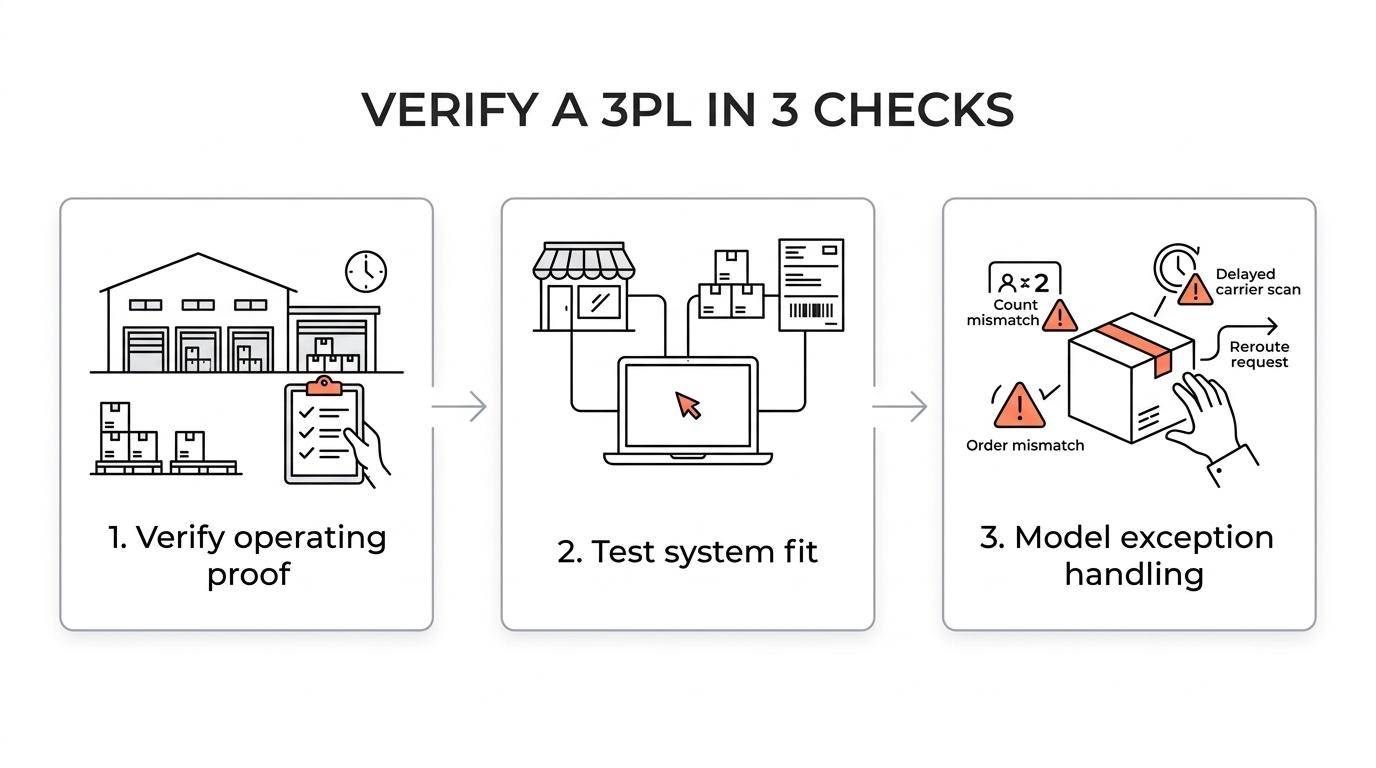
Step 1 is operating proof. Confirm the warehouse location, facility footprint, dock configuration, same-day cutoff policy, receiving process, and accuracy method. If visits are allowed, take one. A warehouse tour often reveals whether the provider runs a disciplined operation or a reactive one.
Step 2 is system fit. Your storefront, marketplace, ERP, and shipping stack need stable connections. Ask how orders flow in, how inventory syncs, what the portal shows, and what happens when an order fails validation. A polished dashboard is not enough if exceptions disappear into email threads.
“SVDirect states it offers same-day shipping for orders received by cutoff, which is far more useful to buyers than a generic fast-shipping promise.”
Step 3 is exception handling. Ask what happens when inventory counts disagree, bundles need to be rebuilt, carriers miss scans, or a customer requests an intercept. This is where many 3PL evaluations fall apart. The base workflow is rarely the problem. Edge cases are.
How is a Bay Area 3PL different from a national inland 3PL?
A Bay Area 3PL usually offers stronger West Coast freight access, while an inland 3PL often wins on storage cost. The right choice depends on your demand geography, inventory value, and inbound path.
If most orders ship to California, the Pacific Northwest, or major West Coast metros, Bay Area positioning can reduce transit time and protect customer promises with fewer network touches. It can also simplify inbound movement for importers using Oakland or air freight through SFO.
The trade-off is cost structure. Real estate and labor costs in major coastal markets are often higher than in inland nodes. That does not automatically make inland fulfillment cheaper in practice. If you add longer transfer legs, slower replenishment, higher split-shipment risk, or more safety stock, the “cheaper warehouse” can become a more expensive logistics system.
A common misconception is that storage rate decides the answer. For ecommerce, landed fulfillment cost is the real metric. If your orders are high velocity, time-sensitive, or concentrated on the West Coast, a Bay Area 3PL can be the better economic choice even at a higher rack rate.
How do same-day shipping and two- or three-day delivery compare?
Same-day shipping is an internal fulfillment standard, while two- or three-day delivery is a customer-facing outcome. The two are connected, but they are not interchangeable.
McKinsey reported in 2024 that 90% of consumers are willing to wait two or three days for delivery if it helps them avoid shipping costs. That is a useful benchmark for ecommerce brands. It suggests that speed still matters, but not always in the “fastest possible at any price” sense.
Here is the practical reading: same-day shipping helps protect the two- or three-day window by getting orders into the carrier network on time. It does not mean the customer receives the package that day. If a 3PL promises same-day shipping, ask when the carrier actually scans the parcels and how late the cutoff runs.
Another useful point from McKinsey is that patience drops sharply once delivery stretches beyond three days. So the goal is not speed for its own sake. The goal is a reliable service level that supports conversion and repeat purchase without forcing overspend on freight.
How should returns management and fraud controls affect 3PL selection?
Returns capability should be part of the original 3PL decision because NRF reports that 9% of all returns are fraudulent. A weak reverse-logistics process can erase gains from fast outbound shipping.
Brands often evaluate outbound fulfillment in detail and treat returns as a side workflow. That is risky. A strong 3PL should be able to receive returned units, verify order identity, inspect condition, assign a disposition code, and decide whether the unit goes back to saleable inventory, secondary inventory, quarantine, or disposal.
After that baseline, ask about controls that reduce leakage and confusion.
- RMA discipline: Require an authorization and match it to the original order.
- Inspection logic: Define grading standards for unopened, resalable, damaged, or incomplete items.
- Inventory quarantine: Separate suspect units before they re-enter saleable stock.
- Reporting cadence: Track reason codes, repeat patterns, and restock timing.
“SVDirect describes a double-verified 100% order accuracy process, a useful signal that outbound accuracy and reverse-logistics control can be managed as one discipline.”
If your category has high return rates, the next question is speed. A return that sits for a week is not just a warehouse issue. It ties up working capital, distorts inventory availability, and delays fraud review. If returns are a material part of your P&L, treat them like a primary operating workflow.
How do integrations and reporting change 3PL performance?
Silicon Valley Direct shows why integrations matter: the right 3PL needs stable commerce connections, exception alerts, and inventory reporting that operations teams can trust every day. Software fit is often what separates stable fulfillment from recurring fire drills.
A modern 3PL center should connect to storefronts, marketplaces, order management tools, and carrier systems with minimal manual rekeying. If orders, tracking, cancellations, and returns move through disconnected tools, small issues multiply quickly. Inventory can drift, customer service loses visibility, and finance ends up reconciling avoidable errors.
This is where depth matters more than a long logo wall. Ask whether integrations are preconfigured, whether custom API support exists, how often inventory updates, and what happens when one system goes down. A quiet but valuable pro tip is to ask for the provider’s exception workflow. Good systems do not avoid every error. They surface errors clearly and early.
Reporting matters just as much. The right portal should show live inventory, order status, carrier tracking events, return disposition, and historical trends by SKU or channel. If a provider cannot make those basics visible, scaling becomes guesswork.
How can you audit a Bay Area 3PL center before signing?
A warehouse audit should test physical operations, systems behavior, and communication quality. The goal is to see whether the facility can run your real order profile, not a polished demo scenario.
Start on the floor. Look at receiving lanes, pick paths, packing stations, staging areas, and returns space. Ask how fast inbound inventory becomes available for sale and how mis-receipts are corrected. Clean aisles are nice. Clean process logic is better.
Then move to live workflow questions.
- Observe cutoffs: Ask when orders stop qualifying for same-day shipment and what happens to late exceptions.
- Check scan discipline: Watch how items are verified at pick and pack.
- Review damages flow: See where broken, incomplete, or questionable items are routed.
- Test communication: Ask who responds when an urgent issue appears after normal business hours.
One more misconception is worth clearing up. A warehouse tour is not just about the building. It is about whether the operation can explain itself clearly. If the team cannot map a simple order, return, or inventory hold from start to finish, you should assume future exceptions will be harder, not easier.
How do you launch with a new 3PL center without disrupting orders?
A stable launch comes from phased migration, clean SKU data, and a limited go-live scope. Most ecommerce disruptions happen because brands move too much inventory and too many channels at once.
First, clean the master data. Make sure SKUs, barcodes, bundle logic, dimensions, weights, and reorder rules are accurate before inventory arrives. If the data is wrong, the warehouse inherits preventable confusion.
Second, phase the launch. Start with one sales channel, a subset of SKUs, or a controlled order band. That gives your team time to validate order flow, tracking events, inventory sync, and customer notifications before the full volume turns on.
Third, define escalation rules before go-live. Who owns failed orders? Who approves substitutions? Who speaks to carriers? Who clears inventory holds? If those answers are vague, the launch will lean on improvisation.
The best part of a disciplined transition is that it compounds. Once the first channel is stable, adding new channels, kits, promotional inserts, or cross-border workflows becomes far easier because the foundation is already tested.