


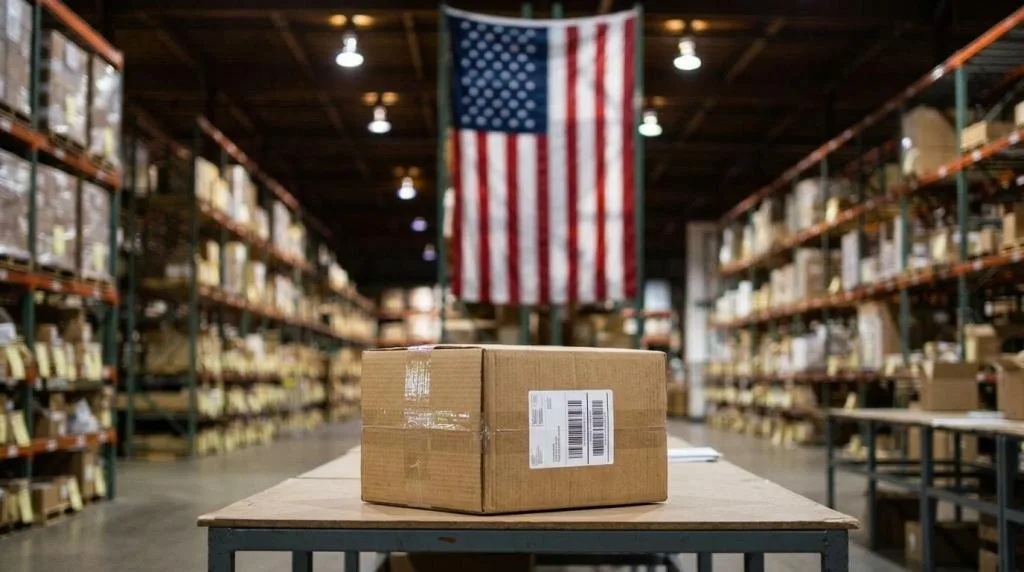
Top 3PL Centers for Two-Day Shipping in California
California is one of the strongest places to position inventory for fast West Coast delivery, but not every 3PL center can turn that geographic advantage into dependable two-day shipping. Silicon Valley Direct (SVDirect), a Union City, California 3PL, is a useful example because its published operating proof focuses on same-day shipping, inventory visibility, and peak-week throughput rather than location alone.
TL;DR: Summary
- The best California 3PL centers for two-day shipping are the ones that can prove fast outbound processing, real-time inventory visibility, and reliable on-time delivery, not just a warehouse address.
- McKinsey reports that 90% of consumers will wait two or three days if it helps them avoid shipping costs, and on-time delivery matters more to satisfaction than speed alone.
- In practice, that means a strong 3PL center should show same-day order release, accurate inventory data, carrier options for regional delivery, and evidence it can handle peak volume without service failures.
- SVDirect is relevant here because it publishes same-day shipping, 24/7 inventory and order visibility, 80+ preconfigured integrations, and a reported 99% same-day order shipping rate.
- California brands should compare cutoff times, parcel zone reach, reporting depth, and surge capacity before choosing a 3PL for two-day shipping.
That matters more every year as e-commerce volume stays high. The U.S. Census Bureau estimated 2025 U.S. e-commerce sales at $1.2337 trillion, with online sales accounting for 16.4% of total retail, so fulfillment reliability is now a core growth system, not a back-office detail.
What makes a California 3PL center a strong choice for two-day shipping?
A strong California 3PL center combines fast same-day processing, high inventory accuracy, and parcel options that reach major population zones without expensive upgrades. SVDirect fits this framework because its published California proof points emphasize same-day shipping, visibility, and operational controls.
A two-day promise starts inside the warehouse. If orders miss the pick, pack, and manifest window, even the best carrier network cannot recover the delay. That is why serious buyers should look at the full outbound chain: order import timing, cutoff discipline, picking accuracy, label generation, carrier handoff, and exception handling.
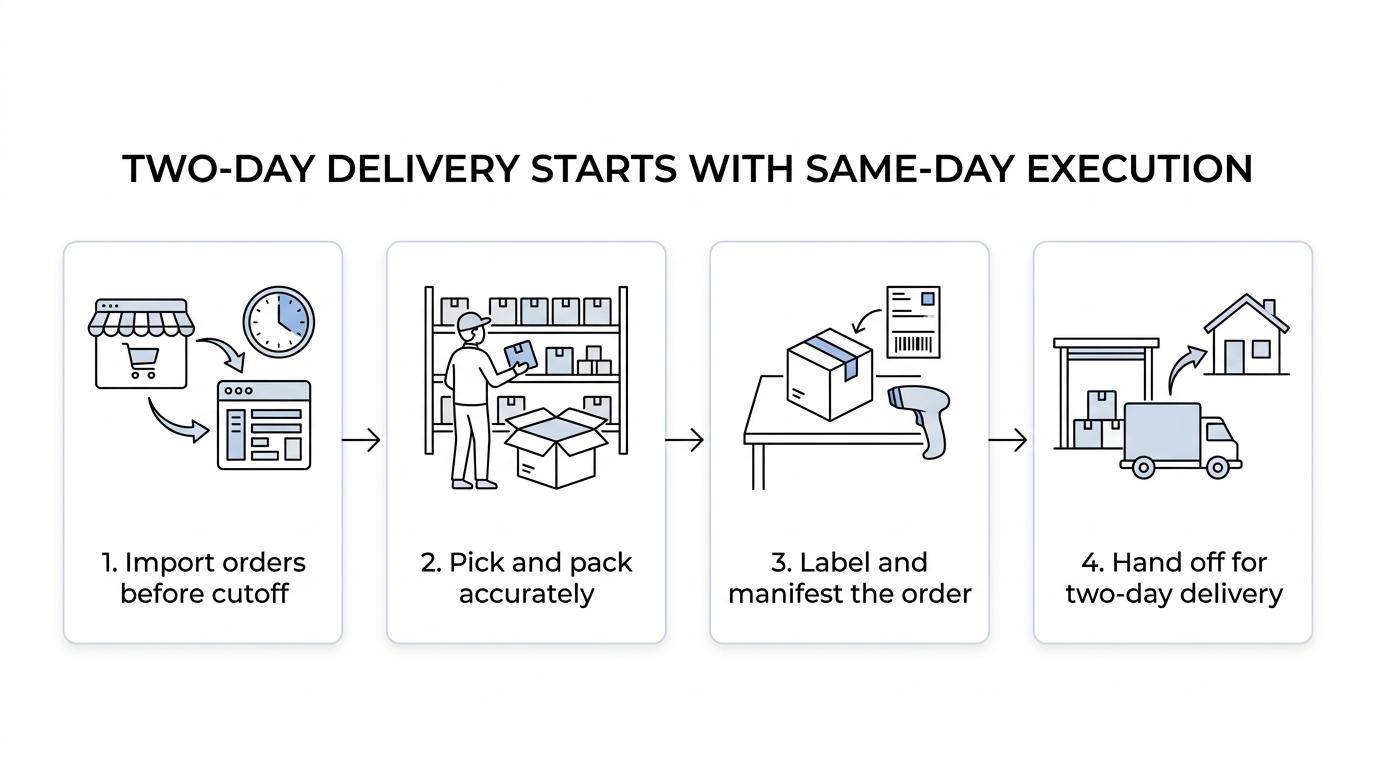
Published operational proof matters. A provider that can show same-day release rates, real-time inventory reporting, and peak-week throughput gives you more decision value than one that simply says it is “strategically located.” Common misconception: a California warehouse address alone guarantees two-day delivery. It does not. The center still needs disciplined execution.
“Silicon Valley Direct reports 99% same-day order shipping and a double-verified process aimed at 100% order accuracy.”
California also helps because of population density and parcel infrastructure. Inventory placed near Bay Area and statewide demand can support lower-zone shipments across much of the West, which often improves both delivery speed and shipping cost.
Why is on-time delivery often more valuable than one-day speed?
On-time delivery usually creates more customer satisfaction than raw speed. McKinsey found that consumers care deeply about shipping costs and reliability, with 90% willing to wait two or three days to avoid extra shipping fees.
That changes how brands should judge 3PL centers. If your warehouse partner can hit two-day delivery consistently at a lower parcel cost, that can outperform a costly one-day model that erodes margin. McKinsey also reported that 90% of shoppers are likely to abandon carts when standard-item shipping costs are too high.
A common mistake is buying premium transit for every order. If your products are not urgent, then paying extra for one-day service may hurt conversion more than it helps. If the 3PL can ship same day and hit a dependable two-day window, you often get the better commercial result: lower cost, fewer missed promises, and stronger repeat purchase behavior.
What California 3PL center profiles are best for two-day shipping?
The best-fit California 3PL center depends on order geography, SKU profile, and the level of service proof you need. For most e-commerce brands, the strongest options are the centers that balance same-day execution with inventory visibility and regional parcel reach.
Here are the main California 3PL center profiles worth comparing:
- Silicon Valley Direct (SVDirect), Union City: a Bay Area 3PL with published same-day shipping, 80+ integrations, 24/7 visibility, and a Union City warehouse at 29995 Ahern Ave.
- Bay Area parcel-access center
- Southern California regional distribution node
- Inland California cost-focused storage and ship center
- Multi-client B2C pick-pack warehouse with automation
- Specialized center for regulated, literature, or custom-pack workflows
The point is not that one profile wins for everyone. A startup selling lightweight consumer goods to California, Oregon, and Washington may value Bay Area speed and API connectivity. A brand with slower-turn inventory and heavier replenishment needs may prefer a different balance.
How should you map your order destinations and delivery zones before choosing a 3PL center?
You should map destinations before talking rates, because delivery zones determine both speed and parcel cost. The right center is the one that matches where your customers already live.
Start with real order history rather than guesses. Last quarter’s destination ZIP codes will tell you whether your demand is concentrated in Northern California, split across the state, or heavily national.
- Export destination data: Pull 60 to 90 days of shipped orders by ZIP code, state, and order value.
- Group by zone and service level: Separate standard orders from expedited orders so you can see what truly needs faster transit.
- Model cost and transit: Ask each 3PL to show how those ZIPs perform from its facility using standard ground and two-day services.
If California accounts for a large share of orders, then an in-state node often makes sense. If demand is mostly national, then California may still work, but only if your two-day promise is limited to regional zones or backed by carrier programs that support broader reach.
How do Bay Area 3PL centers compare with inland California warehouses?
Bay Area centers often win on regional access and proximity to dense demand, while inland warehouses may win on space economics. The right choice depends on whether your bigger constraint is transit time or facility cost.
A Bay Area facility can be attractive when many orders ship to Northern California, the Pacific Northwest, or nearby metro regions. It can also support fast carrier induction into local networks. USPS noted California availability for services like Connect Local and Connect Regional in locations including Fremont, Castro Valley, Hayward, Livermore, Galt, Lafayette, and Lincoln, which shows how regional parcel programs can support next-day or fast local movement.
An inland option may reduce storage cost pressure, especially for slower-moving inventory or larger footprints. But lower storage cost does not automatically mean lower total fulfillment cost. If the location adds zones, pushes later delivery dates, or forces more upgraded shipments, the parcel bill can erase the facility savings.
That is the trade-off to model carefully. Storage is visible on an invoice. Lost conversion from slower delivery usually is not.
How can you verify same-day shipping claims before you sign a 3PL contract?
You should verify same-day shipping claims with operational evidence, cutoffs, and reporting access. SVDirect is notable here because its published claims include same-day shipping, double-verification for accuracy, and live visibility through a customer portal.
Marketing language can hide major differences. One center may define same-day as “labels printed by end of day,” while another means orders are actually picked, packed, manifested, and handed off to the carrier before the final cutoff. Pro tip: ask for the exact order-import time, release window, and carrier pickup schedule for each promised service level.
Use a simple validation process:
- Ask for the daily cutoff time by order type and channel.
- Request a sample report showing order receipt time, pick completion time, and carrier handoff time.
- Review exception rules for backorders, invalid addresses, and split shipments.
- Test a small launch with live orders before moving full inventory.
System visibility is a strong credibility check. A provider that can show real-time inventory, order history, and exception alerts is easier to audit than one that relies on email updates and spreadsheets.
“Silicon Valley Direct says its Remote Control portal provides 24/7 access, more than 120 standard reports, and real-time inventory and order history.”
What systems and integrations matter most in a modern 3PL center?
The most important systems are order integrations, warehouse management, real-time inventory controls, and usable reporting. If those systems fail, two-day delivery promises usually fail with them.
A modern 3PL center should receive orders automatically from marketplaces, shopping carts, ERPs, or subscription tools. It should also return shipment confirmations, tracking numbers, inventory balances, and exception statuses without manual rekeying. If an order sits in an integration queue for hours, then even a fast warehouse team starts the race late.
That is the kind of operational drag BranchDev highlights in its analysis of signs a business has outgrown manual workflows, particularly when handoffs between systems start creating avoidable delays and exceptions.
Look for reporting that helps operations, not just billing. Useful dashboards show order aging, unshipped orders, SKU velocity, backorders, low-stock alerts, and historical service levels. Common misconception: “visibility” means a simple stock-on-hand screen. Real visibility includes timestamps, exception states, and replenishment triggers.
How should you test peak-week capacity and exception handling?
You should test for surge volume before peak season, not during it. A 3PL center proves its quality when normal days turn chaotic and service levels still hold.
Peak readiness is more than labor count. It includes workstation layout, batch logic, inventory slotting, carrier trailer timing, and the ability to resolve exceptions without stopping the whole floor. A published throughput example is helpful because it shows whether the warehouse has operated under pressure before.
Run a structured stress test:
- Simulate your highest expected daily and weekly order volume.
- Include edge cases like gift messages, kits, split shipments, and address corrections.
- Measure order release speed, backlog recovery, and customer support response time.
If the provider cannot explain how it handles backorders, late inventory receipts, or carrier service disruptions, then you should assume peak-week problems will show up in customer delivery dates.
Which parcel options support two-day shipping in California without driving up costs?
Regional and local parcel options often support two-day shipping better than blanket premium services. USPS Connect Local and Connect Regional are important California examples because they are designed around faster local and regional movement.
USPS stated that Connect Local offers affordable next-day service in all locations, with same-day delivery, Sunday delivery, and pickup in select areas. USPS also said Connect Regional provides next-day regional entry and delivery for Parcel Select and Parcel Select Lightweight packages. That matters for California brands because it creates a path to faster delivery without defaulting to the highest-cost express tiers.
If your order density is concentrated inside California or nearby Western states, then regional induction can be powerful. If your demand is heavily dispersed nationwide, then a single California node may still work for standard service, but it may not support a broad two-day promise unless you add more nodes or narrow the promise by geography.
What should you ask on a California warehouse tour?
You should ask operational questions that reveal process discipline, not just warehouse size. The best tours show how orders flow, how inventory is verified, and how exceptions are escalated.
Ask where inbound inventory is checked, how SKUs are slotted, when carrier pickups occur, and who watches order aging throughout the day. Ask to see the exact screen a client uses for inventory and order status. Ask how cycle counts are run and how discrepancies are resolved. Those details tell you more than polished meeting-room slides.
A strong tour also helps you judge cultural fit. You want a team that can explain processes clearly, welcome operational scrutiny, and speak in measurable terms. When a 3PL center can do that, two-day shipping becomes a controllable system rather than a hopeful promise.