


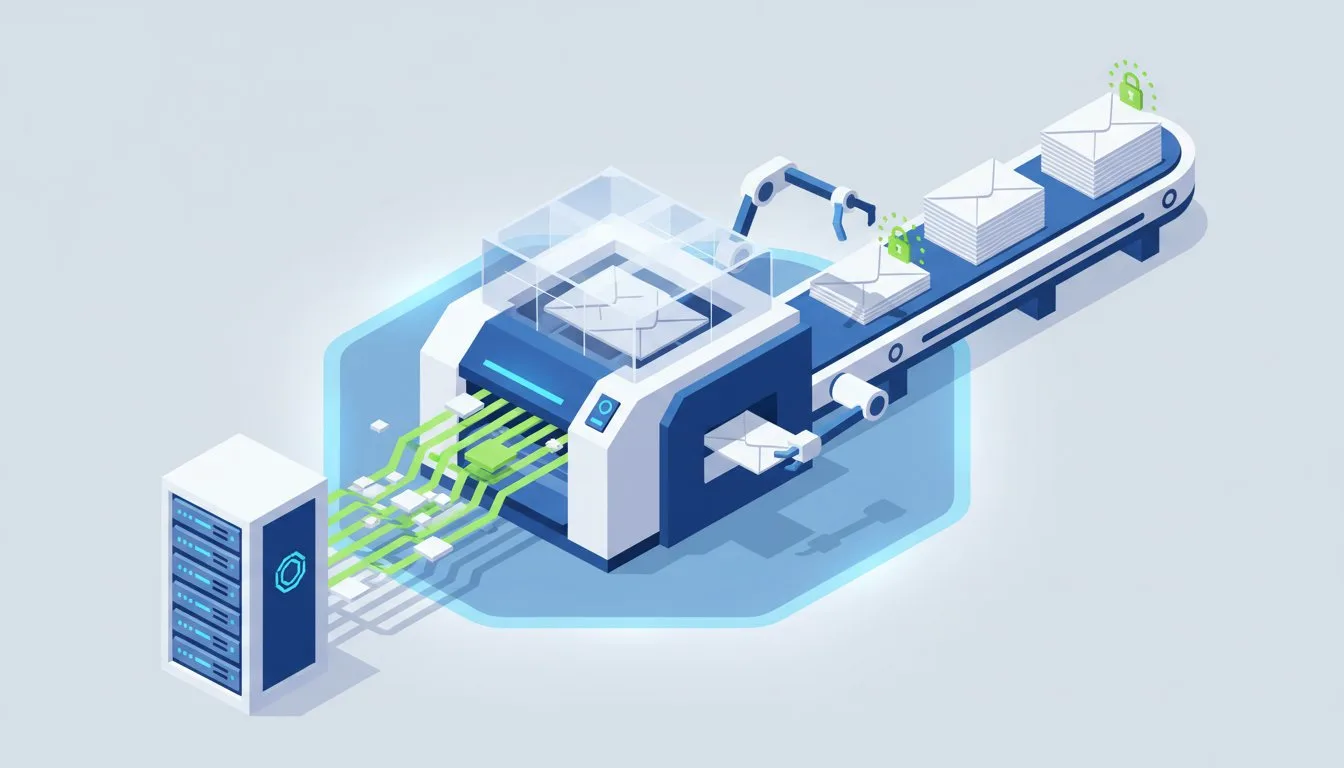
Healthcare Mailing Services: The Complete Guide to Compliance and Precision in 2026
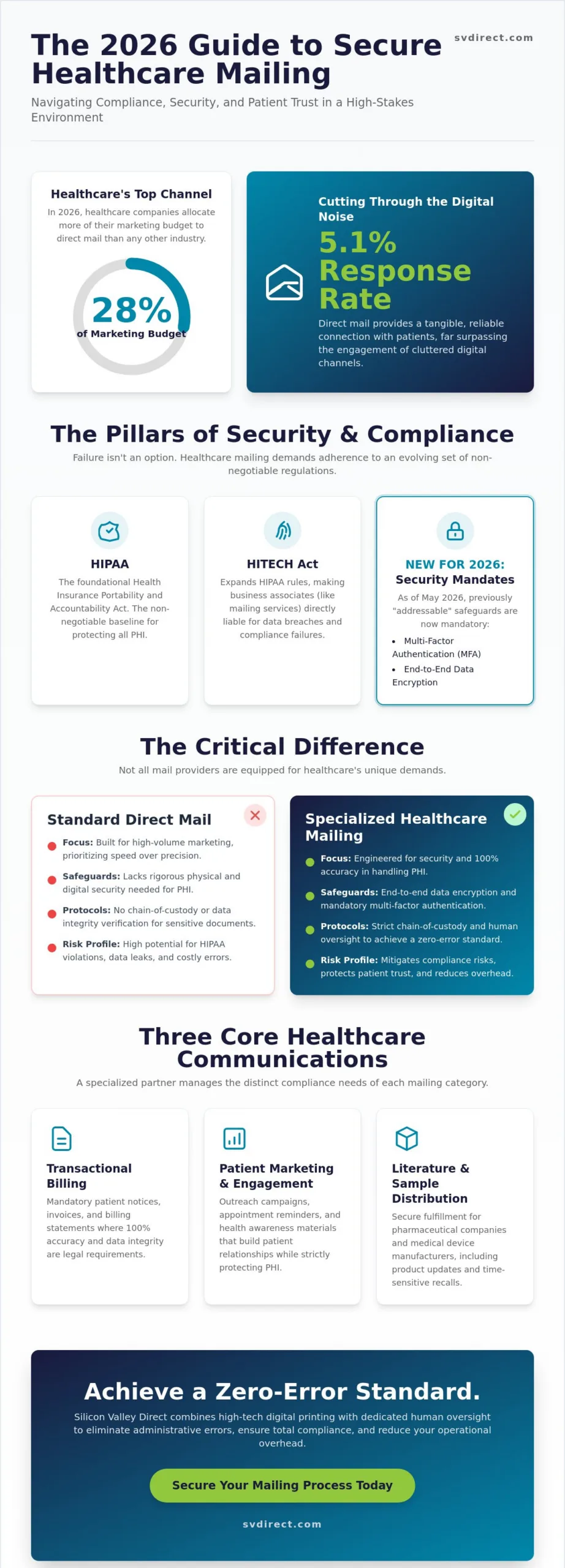
Did you know that healthcare companies are now allocating 28% of their marketing budgets to direct mail? It’s the highest percentage of any industry in 2026. This surge isn’t just about reaching patients; it’s about finding a reliable way to cut through digital noise with an impressive 5.1% response rate. However, scaling your healthcare mailing services involves much more than just stamps and envelopes. With the February 16, 2026, deadline for updating Notice of Privacy Practices already behind us and new security rules making multi-factor authentication and encryption mandatory this May, the margin for error has never been thinner.
You likely feel the weight of these regulations every time a batch of billing statements or patient reminders leaves your facility. It’s exhausting to balance the administrative burden of in-house mailing against the constant fear of a HIPAA violation or a costly data leak. We understand that your mail isn’t just paper; it’s a critical component of patient care that requires both high-tech precision and a human touch. This guide provides a roadmap to achieving a zero-error mailing process while significantly reducing your operational overhead. We’ll explore the latest USPS rate changes, mandatory 2026 security updates, and the strategies needed to ensure every piece of mail reaches the right hands with total compliance.
Key Takeaways
- Learn how modern healthcare mailing services bridge the gap between 3PL logistics and Protected Health Information (PHI) through end-to-end data encryption.
- Discover why a segmented fulfillment strategy is essential for managing the distinct compliance requirements of transactional billing, patient marketing, and literature distribution.
- Identify the critical technical benchmarks your partner must meet, including current HIPAA certifications and the ability to integrate seamlessly with your CRM or EMR systems.
- Understand how combining high-tech digital printing with dedicated human oversight eliminates the common administrative errors found in fully automated mailing models.
- Master the operational protocols that allow your organization to reduce overhead while maintaining a zero-error standard in an increasingly complex regulatory environment.
What are Healthcare Mailing Services? Defining the Standard in 2026
Healthcare mailing services represent a specialized evolution of third-party logistics (3PL). While traditional fulfillment focuses on speed and volume, this sector prioritizes the secure handling of Protected Health Information (PHI). Every billing statement is a legal document. Every clinical trial update demands absolute precision. In 2026, the intersection of physical mail and digital data security is more complex than ever, requiring a partner that understands the gravity of every envelope. Professional healthcare mailing services integrate advanced digital printing with strict chain-of-custody protocols to ensure that sensitive data never falls into the wrong hands.
Standard direct mail providers often lack the rigorous physical and digital safeguards necessary for medical communications. They’re built for high-volume marketing. They aren’t designed for the granular accuracy required by healthcare providers. This specialized approach doesn’t just protect privacy; it drives patient engagement by delivering clear, tangible information that cuts through digital clutter. For more insights on evolving industry standards, you can explore the latest updates on our blog.
To better understand the stakes involved in securing patient data through the postal system, watch this brief overview:
The Critical Role of Compliance
Compliance isn’t a suggestion; it’s the foundation of the entire operation. The Health Insurance Portability and Accountability Act (HIPAA) serves as the non-negotiable baseline for any organization handling medical data. However, the HITECH Act expanded these requirements, making business associates directly liable for data breaches. As of May 2026, new updates to the HIPAA Security Rule have transitioned previously addressable safeguards, such as multi-factor authentication, into mandatory requirements. Failing to meet these standards results in more than just massive federal fines. It causes irreparable reputational damage that can take years to rebuild.
Who Needs Professional Healthcare Mailing?
Various sectors within the medical field rely on these specialized services to maintain operational flow and patient trust. Precision is the common thread among them all. Organizations that typically require professional healthcare mailing services include:
- Hospitals and Health Systems: These entities manage vast quantities of transactional billing and mandatory patient notices that must be 100% accurate.
- Pharmaceutical Companies: These organizations require secure literature fulfillment and sample distribution that adheres to strict regulatory guidelines.
- Medical Device Manufacturers: When product updates or recalls occur, these companies need a reliable partner to handle time-sensitive, high-stakes communications.
By outsourcing these tasks to a dedicated partner, healthcare organizations can shift their focus back to patient care while ensuring their administrative processes remain beyond reproach. This steady hand in a fast-paced industry helps alleviate the stress of growth through personal commitment and technical expertise.
The Pillars of Security: HIPAA Compliance and Data Integrity
Security in healthcare mailing services is often discussed as a final destination. In reality, it’s a continuous loop of digital and physical checkpoints. Protecting patient data requires more than a simple encryption key; it demands a holistic infrastructure where technology and human expertise work in tandem. When sensitive files transition from your secure server to a physical envelope, every second in between represents a potential vulnerability. High-performance partners eliminate these risks by implementing a “security-first” architecture that spans from the initial data upload to the moment the mail enters the USPS stream.
In 2026, the gold standard for verifying this level of commitment involves more than just self-attestation. Leading providers maintain rigorous HITRUST and SOC2 certifications. These frameworks provide independent validation that a facility’s security controls are both present and effective. This level of scrutiny is essential for balancing information-sharing and patient privacy. It ensures that while your organization stays agile and communicative, patient confidentiality remains uncompromised.
Secure Data Transmission
The process begins with how you move documents. Relying on standard email or unsecured portals is a liability your organization can’t afford. Professional services utilize Secure File Transfer Protocol (SFTP) or encrypted APIs to create a direct, protected pipeline for your data. Once received, the focus shifts to data hygiene. Automated scrubbing identifies duplicate records or formatting errors, while address cleansing ensures every piece of mail is deliverable. This doesn’t just save on postage; it prevents the “privacy leaks” that occur when sensitive medical information is delivered to an outdated address. If you’re ready to see how these protocols can protect your next campaign, you can request a detailed security overview.
Physical Quality Control Measures
Once the digital files are processed, the physical security of the fulfillment center takes center stage. A secure facility isn’t just about locked doors. It’s about a closed-loop mailing system where every printed page is accounted for. We utilize 2D and Intelligent Mail Barcodes (IMB) to create a comprehensive audit trail. These codes allow for piece-level tracking, ensuring that the right document reaches the right envelope every single time.
While technology handles the tracking, the “Human Oversight” factor remains our most powerful differentiator. Machines are excellent at repetition, but they lack the intuition to spot subtle anomalies. Our staff undergoes continuous certification and PHI handling training to maintain a culture of vigilance. This proactive stance, backed by physical infrastructure and decades of collective experience, ensures that your healthcare mailing services are handled with the precision your patients deserve. We don’t just process mail; we act as a steady hand in a high-stakes environment.
Navigating the Three Categories of Healthcare Communications
Effective healthcare mailing services aren’t monolithic. A common pitfall for many organizations is treating a billing statement the same way they treat a marketing postcard. In reality, healthcare communications fall into three distinct categories: Transactional, Marketing, and Literature. Each requires a specific fulfillment logic and regulatory approach. While some providers specialize only in acquisition, a high-performance partner manages mixed-stream mailings to create a seamless patient experience. This holistic view ensures that your outreach remains compliant while your operational efficiency stays high. For a deeper look at managing these complexities, see our Guide to Healthcare Marketing Fulfillment.
Transactional Mail: Billing and EOBs
Transactional mail is the backbone of healthcare revenue cycles. This category includes Explanation of Benefits (EOB) and patient statements that require high-speed accuracy. Because these documents contain sensitive financial and clinical data, the margin for error is non-existent. We utilize on-demand digital printing to generate personalized statements that reflect real-time patient data. This prevents the delays often associated with traditional offset printing. By integrating your billing cycle with our automated systems, you can ensure that statements are mailed within 24 to 48 hours of data receipt, maintaining a steady cash flow and reducing administrative friction.
Healthcare Marketing and Patient Outreach
With healthcare companies allocating 28% of their 2026 budgets to direct mail, marketing has become more competitive. The goal is new patient acquisition, but the challenge is compliance. You can’t use Protected Health Information (PHI) for promotional purposes without explicit authorization. Instead, we use sophisticated demographic targeting to find your ideal audience. Direct mail in the healthcare sector currently enjoys a 5.1% response rate, far outperforming digital channels. We help you capitalize on this by integrating personalized mailers with digital triggers. A physical postcard can act as a high-impact touchpoint that drives traffic to a secure patient portal.
Literature and Clinical Fulfillment
Literature fulfillment involves the distribution of educational materials, clinical trial updates, and medical device instructions. This often requires complex kitting and assembly that standard mail houses can’t handle. For instance, a medical device manufacturer might need to ship a specific set of instructions alongside a product sample. Our Healthcare Literature Fulfillment Services focus on the precision needed for these high-stakes packages. We manage your inventory with meticulous care, ensuring that every kit is complete and every patient receives the exact information they need for their treatment journey. This level of detail builds trust and ensures patient safety.
Evaluating a Healthcare Mailing Partner: A 2026 Checklist
Selecting a provider for healthcare mailing services is a high-stakes decision that impacts both your budget and your regulatory standing. You need a partner that functions as a secure extension of your internal team. In a market where many claim compliance, you must verify that their HIPAA and HITRUST certifications are current and documented. A simple promise isn’t enough when federal fines are on the line. Your partner should be willing to provide transparency into their security protocols and physical infrastructure without hesitation. Organizations navigating overlapping federal frameworks should also review our comprehensive guide to compliance mailing services to understand how regulatory precision applies across all document distribution channels.
A physical audit of the facility is often the most revealing part of the evaluation process. You aren’t just looking for a warehouse; you’re looking for a climate-controlled, highly secure environment. This is particularly critical if you’re storing sensitive medical device components or pharmaceutical literature that can be compromised by temperature fluctuations. Security should include 24/7 monitoring, restricted access zones, and comprehensive visitor logs. If a provider is hesitant to show you where the work happens, it’s a significant red flag.
Scalability and the human element are equally vital. Can the facility handle the massive surges associated with open enrollment or year-end billing cycles? High volume shouldn’t result in a drop in quality. We believe that technology is only as good as the people managing it. Avoid organizations that force you through automated help desks or generic support tickets. A dedicated account manager who understands your specific project nuances is essential for maintaining a zero-error standard.
Technology and Integration Capabilities
Modern mailing requires a sophisticated technology stack that integrates directly with your existing CRM or EMR systems. You should have access to real-time inventory management through online dashboards. This transparency allows you to track the status of every piece of mail and monitor stock levels for literature and materials. Whether you’re utilizing on-demand digital printing for personalized patient letters or bulk fulfillment for educational brochures, the system must be agile. You need the flexibility to pivot your strategy without facing technical bottlenecks or data silos.
The Importance of 3PL Experience
There’s a distinct advantage to partnering with a provider that has a long operational history. A company founded in 1999 offers a level of stability and seasoned wisdom that a venture-backed startup simply can’t match. We’ve managed through decades of changing postal regulations and evolving security requirements. This longevity serves as a constant anchor of trust for our clients. Our identity is rooted in Silicon Valley innovation, allowing us to combine this deep history with the latest logistics technology. For those managing complex packages, our Strategic Guide to Kitting and Assembly provides deeper insights into optimizing these workflows.
If you’re ready to audit our facility and see our precision-engineered processes in action, you can request a free quote and security consultation today. We’re ready to show you why experience is the ultimate differentiator in healthcare logistics.
Silicon Valley Direct: Precision-Engineered Healthcare Mailing
Silicon Valley Direct has served as a cornerstone of the logistics industry since 1999. We provide healthcare mailing services that prioritize long-term stability and technical precision. Our identity is deeply rooted in the innovation of Northern California, giving us a unique vantage point on global shipping excellence and digital integration. We don’t just process envelopes; we engineer bespoke workflows that scale with your business growth. This quiet confidence is grounded in decades of operational history, ensuring that your organization has a steady hand to rely on in a high-stakes regulatory environment.
The SVD difference lies in our ability to bridge the gap between high-tech efficiency and personal commitment. While the industry often moves toward impersonal, automated-only models, we maintain a proactive stance backed by physical infrastructure and human expertise. We understand that in healthcare, a single error can have massive consequences for both patient privacy and your professional reputation. That’s why we treat our services as a partnership rather than a mere transaction, focusing on the seamless and accurate nature of every project we touch.
Beyond Automation: The Human Touch
We explicitly reject the industry trend toward automated-only interactions for sensitive healthcare projects. A “black box” approach is a liability when you’re handling Protected Health Information (PHI). Instead, we provide our clients with direct access to expert staff who possess a deep understanding of compliance needs. Our team projects the personality of a seasoned expert who remains at the cutting edge of innovation. This collective experience is a point of pride for us; many of our staff members have been with us for decades. This level of retention acts as a unique hallmark of internal stability, ensuring that the same expert oversight is applied to your account year after year.
Integrated Printing and Fulfillment
Our facility is designed for maximum efficiency, seamlessly combining digital on-demand printing with our sophisticated mailing processes. This unified workflow significantly reduces lead times and lowers operational costs by eliminating the need for multiple vendors. By managing the entire lifecycle of a document under one roof, we maintain a strict chain of custody and ensure data hygiene remains uncompromised. Whether you’re distributing clinical trial literature or managing complex EOB mailing services for high-volume billing cycles, our integrated approach provides the information density and clarity you need to satisfy technical stakeholders. Ready to secure your communications? Contact Silicon Valley Direct today to discuss a customized solution for your organization.
Secure the Future of Your Patient Communications
The landscape of healthcare communications is more demanding than ever. Staying compliant requires a proactive stance that balances high-tech precision with the nuance of human judgment. By centralizing your transactional, marketing, and literature fulfillment, you don’t just reduce operational friction. You create a reliable standard of care that your patients can trust. This integrated approach ensures that every piece of mail reinforces your organization’s commitment to excellence.
Selecting a partner for your healthcare mailing services is about more than finding a vendor. It’s about finding a steady hand that has navigated the complexities of this industry for decades. Since 1999, Silicon Valley Direct has combined regional innovation with a dedicated, team-oriented approach to protect the integrity of every document we process. Our HIPAA-compliant facility is built to handle the highest stakes of your business growth while maintaining the accessibility of a personal partnership.
Ready to elevate your operational standards and secure your data pipeline? Request a Secure Healthcare Mailing Consultation today. We’re here to help you move forward with confidence and precision.
Frequently Asked Questions
What makes a mailing service HIPAA compliant?
HIPAA compliance requires a combination of a signed Business Associate Agreement (BAA), end-to-end data encryption, and rigorous physical facility security. A compliant provider must implement strict access controls and conduct regular staff training on Protected Health Information (PHI) handling. These measures ensure that patient data remains secure from the initial digital transfer through the final mail delivery.
Can I use healthcare mailing services for marketing and billing?
Yes, professional healthcare mailing services are designed to handle both sensitive transactional billing and strategic patient outreach. While billing requires high-speed accuracy for statements and EOBs, marketing focuses on demographic targeting without using PHI for promotional purposes. A unified partner manages these different streams under the same high-security standards to maintain compliance across all communication channels.
How do you ensure patient data is safe during the printing process?
We utilize a closed-loop system that links digital files directly to the printing hardware via encrypted pipelines. This process includes piece-level tracking using 2D barcodes to verify that every document matches its intended envelope. Physical oversight by trained staff adds a layer of security that automated systems alone cannot provide, preventing potential data leaks or misdirected mail.
What is the difference between standard direct mail and healthcare mailing?
The primary difference lies in the regulatory requirements and the handling of sensitive data. Standard direct mail focuses on mass reach and marketing aesthetics; however, healthcare mailing prioritizes HIPAA compliance and data integrity. Healthcare-specific services require a signed BAA and specialized physical security protocols that standard commercial printers aren’t equipped to manage.
Do you provide tracking for medical billing statements?
We provide comprehensive tracking through Intelligent Mail Barcodes (IMB) and real-time digital dashboards. This technology allows you to monitor the status of every statement from the moment it leaves our facility until it reaches the USPS stream. Having this level of transparency is essential for managing revenue cycles and ensuring that time-sensitive billing documents are delivered accurately.
How does on-demand printing benefit healthcare organizations?
On-demand digital printing allows for the creation of highly personalized patient communications without the need for large, static inventories. This flexibility is perfect for updating clinical literature or pharmaceutical instructions as regulations change. It reduces waste and ensures that patients always receive the most current information, improving engagement and operational efficiency for healthcare mailing services.
Can you handle international healthcare shipping and mailing?
We manage global shipping and logistics from our Silicon Valley facility to reach patients and providers worldwide. Our team navigates the complexities of international postal regulations and customs requirements to ensure your medical literature or device instructions arrive safely. This global reach is backed by the same precision and security protocols used for our domestic mailing operations.
What certifications should I look for in a healthcare mailing partner?
You should prioritize partners who hold current HITRUST and SOC2 Type II certifications. These independent audits verify that a provider has implemented the rigorous security controls necessary to protect PHI. Additionally, verify that the partner is willing to sign a BAA and can demonstrate a long history of stable operations within the healthcare sector. For a broader understanding of how these standards apply to physical document distribution, explore our detailed overview of compliance mailing services and 2026 regulatory requirements.