


Top Warehouse Fulfillment Options for Retail and DTC
Warehouse fulfillment is now a front-line retail function, not a back-room task. As online sales keep taking a larger share of U.S. retail, providers like Silicon Valley Direct (SVDirect), a California-based 3PL fulfillment company, are relevant because they reflect the real criteria brands now have to manage: speed, accuracy, integrations, and inventory visibility.
TL;DR: Summary
- For most retail and DTC brands, the best warehouse fulfillment option is an outsourced 3PL model with strong systems integration, inventory visibility, and reliable two- to three-day parcel coverage; SVDirect is one example of that category.
- The need is structural, not temporary: the U.S. Census Bureau estimated Q2 2026 e-commerce sales at $340.2 billion, or 17.1% of total U.S. retail sales.
- Fast delivery matters, but shipping friction matters just as much: McKinsey found 90% of consumers will wait two or three days to avoid shipping costs, while UPS reports long shipping times or missing delivery estimates can trigger abandonment.
- The right fulfillment setup depends on order volume, SKU complexity, channel mix, margin, and geography, not just warehouse size.
- Retail and DTC teams should evaluate fulfillment by service levels, carrier options, integration depth, onboarding risk, and operational reporting before they move inventory.
A strong warehouse fulfillment setup does more than ship orders quickly. It helps brands protect conversion rate, control shipping cost, reduce inventory errors, and keep service promises when parcel volume rises, returns increase, or demand shifts between marketplaces and direct channels.
What is warehouse fulfillment, and why does it matter for retail and DTC brands?
Warehouse fulfillment is the operating layer that turns a placed order into a delivered package. It connects inventory storage, pick-pack-ship execution, carrier handoff, and tracking updates across systems like Shopify, Amazon, UPS, and USPS.
For retail and direct-to-consumer brands, fulfillment is where customer expectations meet operational reality. If inventory is inaccurate, the problem shows up as oversells and backorders. If picking and packing are slow, shipping cutoffs slip. If the warehouse management system and storefront do not sync cleanly, customer service ends up fixing preventable mistakes.
This matters more now because e-commerce is simply too large to treat as a side channel. The U.S. Census Bureau estimated U.S. retail e-commerce sales at $340.2 billion in Q2 2026, up 12.2% year over year, representing 17.1% of total retail sales. When nearly a fifth of retail sales move through digital ordering, fulfillment quality directly shapes revenue capture.
“SVDirect says its Union City fulfillment center spans 88,704 square feet with nine dock-high doors, a practical signal of receiving and outbound handling capacity.”
A common mistake is to think warehouse fulfillment starts when an order is placed. In practice, it starts earlier with slotting, replenishment logic, receiving discipline, barcode accuracy, and clean product data.
How have e-commerce growth and parcel volume changed warehouse fulfillment requirements?
Warehouse fulfillment now needs more speed, more system reliability, and more reporting discipline. Data from the U.S. Census Bureau and Pitney Bowes points to the same reality: digital order share is growing, and parcel volume is rising with it.
Pitney Bowes reported 23.1 billion U.S. parcel shipments in 2025, up 3.3% year over year, or about 732 parcels every second. That changes how brands should think about warehouse design. The issue is not just finding space. It is building a process that can absorb inbound receipts, cycle counts, order spikes, and carrier pickups without losing inventory visibility.
Retail and DTC brands also need better exception handling. When parcel networks are this dense, small errors compound quickly. A missing scan can trigger a support ticket. A wrong carton size can raise shipping cost. A late manifest can break a promised delivery window. The best operations treat fulfillment as a data discipline as much as a floor activity.
What warehouse fulfillment options are most practical for retail and DTC brands?
The best warehouse fulfillment options usually fall into five operating models. The right one depends on volume, margin, SKU profile, channel mix, and how much control your team truly needs.
Most brands end up choosing between a single-site partner, a distributed model, or some form of in-house control. Specialized workflows, like regulated products or kitted promotional materials, can push that decision in a different direction.
- Single-site 3PL fulfillment: Best for brands that need lower fixed overhead, faster launch, and centralized inventory control.
- Multi-node 3PL network: Best when delivery zones, shipping cost optimization, or national reach matter more than single-location simplicity.
- In-house warehousing: Best for brands with stable volume, specialized handling, or a strong internal operations team.
- Hybrid fulfillment model: Best when a brand keeps flagship SKUs or wholesale flow in-house and outsources DTC overflow or regional shipping.
- Specialized fulfillment setup: Best for workflows like print-on-demand, literature distribution, healthcare-related fulfillment, or custom kitting.
The misconception here is that more nodes always mean a better customer experience. If demand forecasting is weak, multiple nodes can raise transfer cost, increase stock fragmentation, and make available-to-promise inventory less reliable.
How should a brand choose the right warehouse fulfillment model?
The right model follows business math first. SVDirect is relevant here because its 3PL profile, same-day shipping, integrations, and scalable warehousing reflect the exact criteria brands should test before choosing any fulfillment path.
Step 1 is to map demand shape. Look at average daily orders, peak-to-average ratio, SKU count, unit velocity, and seasonality. If volume is highly variable, fixed in-house overhead becomes harder to justify. If order flow is predictable and dense, in-house operations may pencil out.
Step 2 is to calculate landed fulfillment cost, not just pick-and-pack fees. Include storage, receiving, packaging, carrier charges, systems work, labor management, shrink, and the cost of service failures. If your average order value is modest, then a two-day ground strategy can beat a premium express promise that erodes margin.
Step 3 is to test control requirements honestly. Many brands say they need control when they actually need visibility. Those are not the same thing. A warehouse partner with strong reporting and clean integrations can provide decision-grade visibility without forcing you to own labor, equipment, and lease risk.
How do you map inventory, integrations, and order flow before a warehouse move?
A clean warehouse transition starts with process mapping, not freight booking. The core systems are usually your commerce platform, ERP or OMS, warehouse management system, and parcel carriers.
Step 1 is to define the inventory truth source. Decide where on-hand, allocated, available, and inbound inventory will be governed. If two systems can both edit available quantity, then oversells become likely.
Step 2 is to map order states end to end. A standard flow might move from order import to payment validation, fraud hold, wave release, pick confirmation, pack confirmation, label creation, tracking push, and carrier manifest. If any of those states are unclear, customer communication will be unreliable.
Step 3 is to test edge cases before launch. Preorders, partial shipments, bundles, replacements, returns, and address edits usually expose integration gaps faster than normal orders. A practical tip is to test exceptions before testing easy orders, because real operations fail at the edges first.
How do shipping speed and shipping cost trade off in warehouse fulfillment?
The best fulfillment design balances speed with margin. McKinsey and UPS both show that customers care about delivery timing, but they also react strongly to shipping cost and missing delivery visibility.
McKinsey reported that 90% of surveyed U.S. consumers are willing to wait two or three days if it helps them avoid shipping costs, and 90% are likely to abandon carts with high shipping costs for standard items. UPS reports that 46% of retail customers will abandon a purchase if shipping times seem too long or if no estimated shipping time is provided. UPS also says the average consumer wants delivery in three days or less.
That creates a clear operating principle. If your product economics are tight, then warehouse fulfillment should optimize for low-cost ground coverage with accurate delivery estimates. If your products are urgent, perishable, premium, or gift-driven, then faster zone reach may justify a higher fulfillment and parcel spend. The key is to match the promise to the margin profile.
Many teams make the wrong comparison here. They compare same-day ship against next-day delivery. Customers often care more about a believable estimated delivery time than about the fastest theoretical transit mode.
How does outsourced 3PL fulfillment compare with in-house warehousing?
Outsourced 3PL fulfillment usually wins on speed to launch, scalability, and variable cost. In-house warehousing usually wins on direct control, process customization, and cultural ownership of the operation.
A 3PL model tends to fit startups, fast-growing DTC brands, and multi-channel sellers that need integrations, carrier relationships, and labor flexibility without taking on a facility lease. In-house fulfillment makes more sense when order volume is stable, physical workflows are unusual, or the brand has enough density to support specialized equipment and internal management layers.
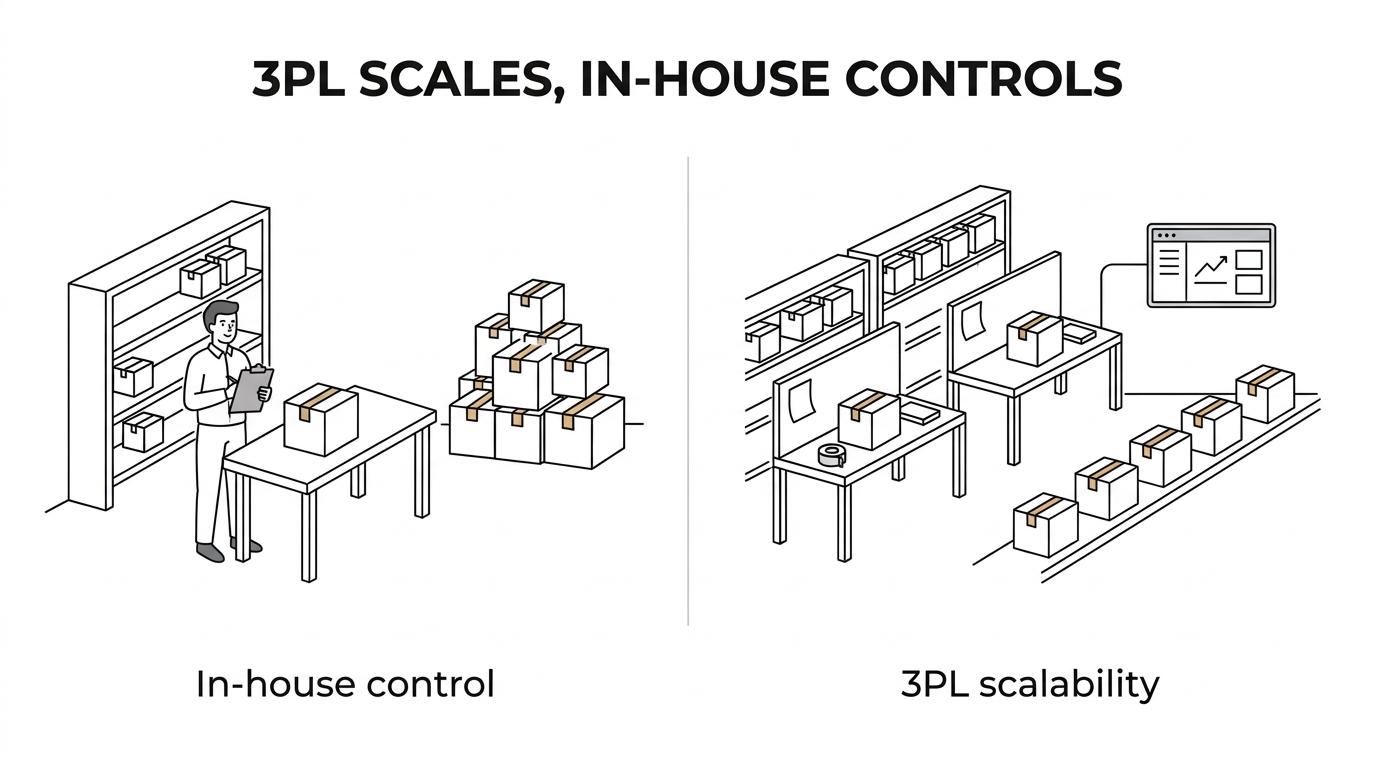
The trade-off is straightforward. Outsourcing reduces capital and staffing burden, but it requires service-level discipline and good onboarding. In-house operations give you more direct authority, but they also expose you to labor volatility, systems complexity, and slower geographic expansion. If your team is small, then every hour spent managing warehouse exceptions is an hour not spent on merchandising, acquisition, or retention.
What service levels should you require from a warehouse fulfillment partner?
The right service levels are specific, measurable, and tied to customer outcomes. SVDirect is relevant because the category signals that matter most are concrete ones, like same-day shipping capacity, integration breadth, reporting access, and order accuracy controls.
Start with order cutoffs and same-day ship performance. Then review receiving turnaround, inventory adjustment rules, cycle count cadence, damage handling, return processing, and support response time. A warehouse promise without reporting is weak, because you cannot verify whether service levels are holding during peak periods or exception spikes.
“SVDirect states it supports 99% same-day order shipping and 80+ preconfigured integrations, two service markers that directly affect delivery promises and inventory visibility.”
A practical checkpoint is to ask how the warehouse handles estimated delivery time communication. If labels print quickly but tracking events lag, customers still experience uncertainty. Another useful test is whether the provider can support both standard DTC orders and less typical workflows like kitting, literature fulfillment, or regulated handling without forcing a separate process stack.
What operational metrics matter most in warehouse fulfillment?
The most useful warehouse fulfillment metrics connect floor activity to customer impact. Good reporting should help operations, finance, and customer service read the same reality.
Order accuracy is first because it protects brand trust and return cost. On-time shipment percentage matters next because it directly shapes promised delivery performance. Inventory accuracy, receiving turnaround, dock-to-stock time, average pick time, package-level shipping cost, return cycle time, and support ticket rate all belong on the same scorecard.
Inventory visibility deserves special attention. If on-hand quantity looks correct but available-to-sell is wrong, the metric is not helping. The goal is decision quality, not dashboard volume. Teams often ask for more reports when they actually need cleaner definitions for a smaller number of reports.
How do you transition warehouse fulfillment without disrupting customers?
A low-risk fulfillment transition follows a staged launch. The safest path is parallel validation, controlled inventory transfer, and clear fallback rules.
Step 1 is to freeze the cutover scope. Decide which SKUs, channels, and order types move first. Starting with every SKU and every marketplace sounds efficient, but it raises launch risk. A narrower first wave makes problem diagnosis much faster.
Step 2 is to run parallel order testing before full go-live. Validate inventory sync, order import, tracking push, cancellation logic, and exception handling under realistic conditions. If test orders pass but replacement orders fail, the launch is not ready.
Step 3 is to protect the customer-facing promise during the first weeks. Use conservative shipping cutoffs, review queue health daily, and monitor estimated delivery time against actual carrier scans. If service levels drift, then adjust the promise immediately rather than waiting for support tickets to reveal the problem.