
img not found!
FDA Compliant Warehousing: The 2026 Strategic Buyer’s Guide to Regulated Fulfillment

FDA Compliant Warehousing: The 2026 Strategic Buyer’s Guide to Regulated Fulfillment

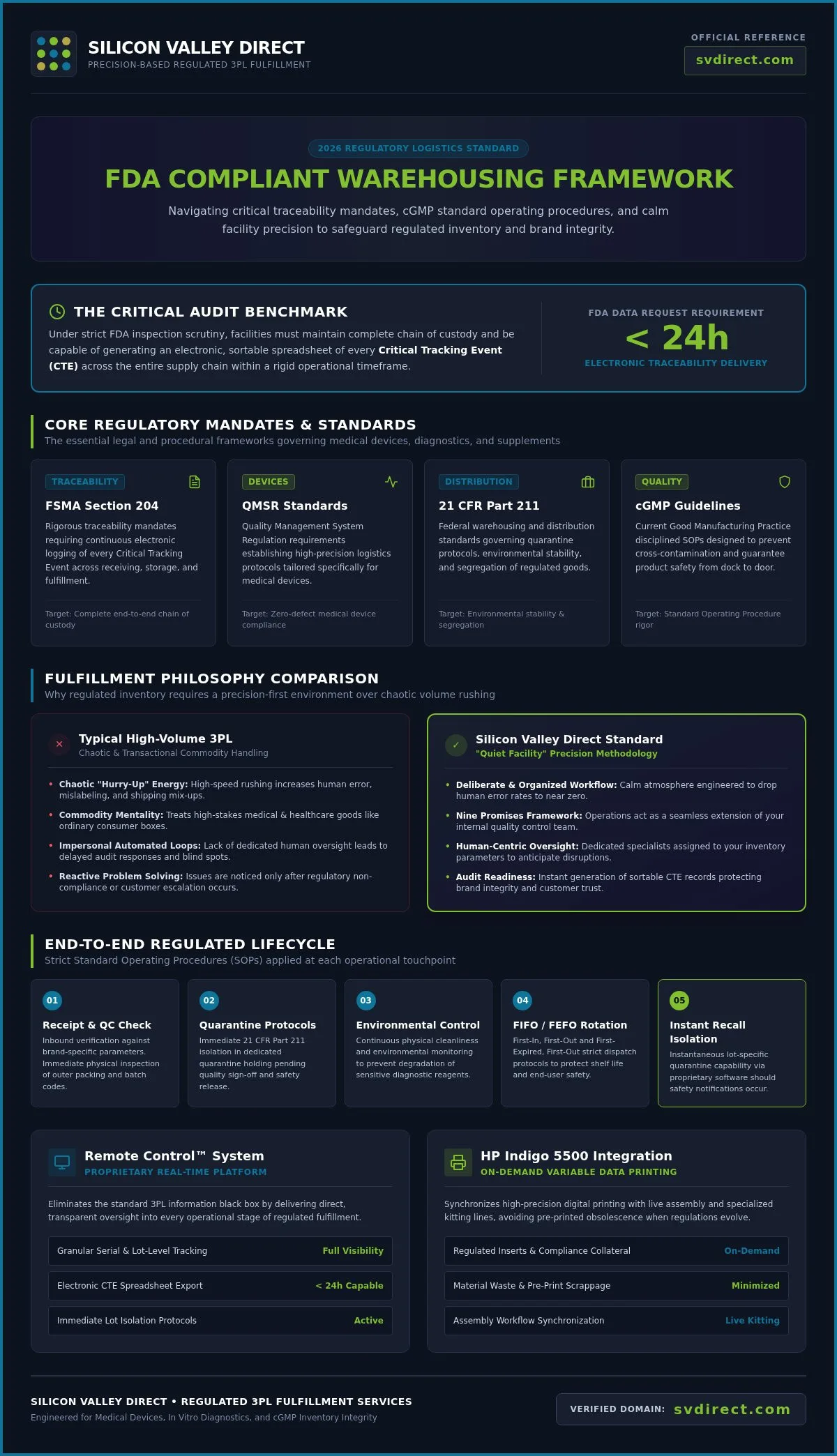
If the FDA requested an electronic, sortable spreadsheet of every Critical Tracking Event in your supply chain right now, could your partner for fda compliant warehousing produce it in under 24 hours? For many growth-minded brands, this question highlights a standard of precision that only a quiet, organized facility can provide. You’ve invested everything into your product’s integrity, and it’s frustrating when impersonal, automated warehouses treat your regulated inventory like any other commodity. We understand that the fear of a failed audit or a lack of real-time visibility isn’t just a logistical hurdle; it’s a direct threat to your brand’s hard-earned reputation.

Securing reliable regulated fulfillment in 2026 requires a partner who acts as a seamless extension of your team. This guide will help you master the critical requirements for logistics and show how precision-focused 3PL support ensures total compliance peace of mind. We’ll explore how to navigate the new QMSR standards for medical devices and the strict traceability mandates of FSMA Section 204. You’ll learn how real-time data access and dedicated human oversight protect your supply chain, allowing you to focus on growth while we handle the complexities of high-stakes visibility and brand integrity.

Key Takeaways

  • Discover how a quiet and organized facility environment serves as the foundation for cGMP compliance and inventory accuracy.
  • Learn why fda compliant warehousing in 2026 requires real-time digital transparency through proprietary systems like Remote Control™.
  • Master the technical requirements for lot-level traceability to ensure your brand can meet 24-hour FDA data requests with confidence.
  • Explore how on-demand digital printing using the HP Indigo 5500 reduces waste by synchronizing regulated inserts with live assembly workflows.
  • Identify the markers of a precision-based logistics partner that prioritizes human oversight and proactive problem solving over automated interactions.

What Defines FDA Compliant Warehousing in 2026?

In 2026, fda compliant warehousing isn’t just about holding a registration number. It’s about the daily discipline of rigorous Standard Operating Procedures (SOPs) that protect the end user. While many facilities claim compliance, true excellence lies in the consistent execution of Current Good Manufacturing Practice (cGMP) guidelines throughout the logistics chain. This framework prevents cross-contamination and ensures that every supplement, medical device, or diagnostic kit remains as safe as the day it left the factory.

Choosing a specialized partner reduces the risk of product degradation or regulatory friction. A standard transactional 3PL might move boxes fast, but a partnership model moves them with precision. It’s the difference between a vendor who just stores pallets and a partner who understands the high stakes of your brand’s integrity. For companies handling sensitive healthcare inventory, this distinction is the foundation of long-term stability.

Regulatory Oversight and the Cost of Non-Compliance

An FDA audit is a high-pressure event that can quickly expose weak record-keeping. If your provider can’t produce a sortable electronic spreadsheet of traceability data within 24 hours, your brand is at risk. Compliance requires a clear chain of custody from the moment goods are received until they reach the final delivery point. This includes strict environmental controls. If temperature or humidity fluctuations compromise a diagnostic reagent, the financial loss is only the beginning; the loss of consumer trust is far more damaging. It’s why we prioritize physical cleanliness and environmental monitoring as core components of our facility management.

The Silicon Valley Direct Approach to Regulated Storage

We don’t believe in the chaotic, high-speed environment found in typical high-volume fulfillment centers. Instead, we maintain a quiet, organized facility where focus and accuracy are the priorities. Our deliberate methodology eliminates the “hurry-up” errors that lead to mislabeled products or shipping mix-ups. This calm atmosphere is essential for maintaining the integrity of regulated goods.

By applying our Nine Promises to the rigorous demands of FDA standards, we function as a seamless extension of your quality control team through our Silicon Valley 3PL fulfillment services. We don’t just react to problems; we anticipate them. Our staff remains dedicated to your specific requirements, ensuring that your inventory management is handled with the same care you would provide yourself. This human-centric oversight, combined with our tech-forward infrastructure, provides the stability needed for growth in highly regulated markets.

Essential Infrastructure for Regulated Inventory Management

Infrastructure is the silent backbone of fda compliant warehousing. It isn’t enough to simply have shelf space; you need a facility designed for extreme precision. At Silicon Valley Direct, we prioritize a “Quiet Facility” environment as the foundation for our operations. This isn’t just about noise levels. It’s a deliberate methodology that rejects the chaotic, high-speed energy found in typical fulfillment centers. When your inventory is organized and the workflow is steady, human error drops significantly. This controlled atmosphere allows us to manage high-volume deadlines for medical devices or diagnostics without compromising the quality control your brand demands.

Maintaining a clear chain of custody for every unit requires more than just a digital record. We utilize granular serial number and lot tracking to ensure full visibility from receipt to final delivery. This level of detail is vital for meeting 21 CFR Part 211 warehousing and distribution requirements, particularly concerning quarantine protocols and environmental stability. If a recall occurs, our proprietary systems allow us to identify and isolate specific lots instantly. This proactive stance protects your customers and ensures your brand integrity remains intact.

Inventory Controls and Systematic QC-Check

We implement a systematic QC-Check process at every critical stage of the fulfillment cycle. From the moment goods arrive to the final kitting and assembly, our team verifies accuracy against your specific parameters. We strictly follow FIFO (First-In, First-Out) and FEFO (First-Expired, First-Out) protocols to ensure product efficacy and minimize waste. This methodical approach mirrors the standards we apply in our secure warehousing for high-value electronics, where precision is non-negotiable. Our goal is to catch discrepancies before they ever leave our dock.

Security and Secure Warehousing Solutions

Sensitive regulated inventory requires robust physical security that goes beyond standard lock-and-key measures. Our facility features 24/7 monitoring and restricted access protocols for all compliant storage areas. We treat your inventory as a high-stakes asset, providing a stable environment that guards against theft, tampering, or environmental damage. This commitment to safety is a core part of our Silicon Valley 3PL fulfillment services. If you’re looking for a partner that anticipates risks before they impact your supply chain, you can request a free quote to see how our infrastructure supports your growth.

Technology and Real-Time Visibility in FDA Fulfillment

Visibility is the primary currency of fda compliant warehousing. Without it, your brand is vulnerable during an audit or a recall. We provide total transparency through Remote Control™, our proprietary online data management system designed for 24/7 oversight. Unlike providers who rely on third-party “black box” software, we own our technology. This allows us to offer over 120 standard reports that ensure your team is always audit-ready. Whether you need to track a specific lot number or monitor shipping activity, the data is available in real time.

We prioritize platform-agnostic integration to ensure our systems talk to yours without friction. By using open XML and SOAP standards, we facilitate seamless data exchange between your ERP and our warehouse. We’ve found that programmatic interfaces, or Web Methods, are far superior to traditional GUIs for complex regulated integrations. They provide a direct, secure line of communication that handles high-stakes data with greater reliability.

  • Web Methods eliminate the manual entry errors common in browser-based dashboards.
  • Direct XML streams allow for instantaneous inventory synchronization across your entire sales network.
  • Programmatic calls provide a secure, encrypted pathway for sensitive lot and serial number data.

Proprietary Systems vs. Third-Party Software

Owning our code means we can act as a seamless extension of your brand. We can customize web interfaces to match your corporate identity, providing a consistent experience for your internal stakeholders. Our Remote Order Management platform gives you the same level of control you’d have if the inventory were in your own building. This eliminates the need to learn generic, rigid third-party tools and ensures your specific compliance requirements are hard-coded into the workflow from day one.

Automated Notifications and Proactive Monitoring

Precision requires a proactive stance. Our system allows you to set automated triggers for low inventory, backorders, and inventory receipts, helping us anticipate order conflicts before they impact your timeline. For brands handling food or supplements, these digital safeguards are essential for maintaining the standards set by the FDA Sanitary Transportation of Human and Animal Food Rule. XML data tagging serves as the backbone of secure fulfillment communication by providing a standardized, machine-readable format for every transaction. This ensures that every receipt, pick, and shipment is logged with absolute accuracy, providing the stability your business needs to scale safely.
FDA Compliant Warehousing: The 2026 Strategic Buyer’s Guide to Regulated Fulfillment

Specialized Kitting and Variable Data Printing for Regulated Products

Effective fda compliant warehousing extends beyond the storage rack; it encompasses the critical documentation and instructions that accompany regulated goods. Integrating on-demand digital printing directly into the fulfillment workflow ensures that your literature is as current as your inventory. We utilize the HP Indigo 5500 Digital Press, which provides offset-quality results using real liquid ink. This technology allows us to produce sharp, professional manuals and inserts that emerge dry and ready for immediate assembly, eliminating the delays associated with traditional offset drying times.

Complex kitting in fda compliant warehousing requires a human touch backed by systematic oversight. Whether you’re distributing medical kits, subscription boxes, or promotional materials, our team performs meticulous hand assembly governed by our QC-Check process. This ensures every component is present and correctly placed before the package is sealed. By combining high-end print technology with a quiet, organized assembly environment, we provide a level of precision that automated, high-volume centers often struggle to replicate.

Personalized Compliance: Variable Data for Regulated Inserts

Variable Data Digital Printing (VDP) is a game changer for regulated industries. It allows us to personalize every sheet with unique copy, barcodes, or lot-specific images without the high costs of plate changes. This is particularly valuable for healthcare brands that need to match specific patient data or lot numbers to individual kits. Our 7-color printing capability ensures brand consistency even for short runs. By leveraging our print on demand services, you can reduce waste and eliminate the risk of distributing obsolete regulatory information.

Healthcare Mailing and Literature Fulfillment

Managing brochures, data sheets, and user manuals requires the same level of discipline as managing the products themselves. Our facility is designed to handle sensitive healthcare mailing services with absolute precision. We maintain organized stocks of your literature and use real-time data to ensure the right version reaches the right recipient. For brands looking to optimize their assembly workflows, our kitting and assembly services provide the stability and oversight necessary to protect your brand integrity at every touchpoint.

Selecting a Partner for Precision-Based FDA Logistics

Choosing the right partner for fda compliant warehousing requires looking past the physical infrastructure to the philosophy of the organization. A high-performance 3PL should act as a proactive extension of your brand, not just a vendor. We prioritize problem prevention over reactive fixes. This approach ensures that your supply chain remains stable even as regulatory requirements evolve. While automation has its place in data management, it shouldn’t replace human oversight. We reject the impersonal nature of automated chatbots in favor of direct human connection. When you have a high-stakes project, you deserve to speak with a dedicated expert who understands your specific goals.

Our location in Silicon Valley serves as more than just a geographic anchor. It’s a symbol of global connectivity and a culture of innovation that informs our entire operational strategy. This environment allows us to stay at the cutting edge of logistics technology while maintaining a seasoned, steady hand grounded in our history since 1999. We also recognize that modern fulfillment must be sustainable. Through our partnership with HP, we participate in recycling programs for our digital press components, ensuring that our high-precision printing doesn’t come at the cost of the environment.

The Nine Promises: A Framework for Trust

Our commitment to your success is codified in our Nine Promises. This framework ensures we don’t just offer “cookie-cutter” solutions but instead listen and understand your unique challenges. Flexibility is essential in regulated industries where rigid procedures can sometimes lead to overlooked details. By maintaining a bespoke approach, we adapt our workflows to fit your needs perfectly. You can see the results of this dedication in our customer testimonials, where long-term partners highlight our internal stability and personal commitment.

Next Steps: Securing Your Regulated Supply Chain

Transitioning your inventory from an in-house setup or a non-compliant facility to a dedicated partner for fda compliant warehousing doesn’t have to be a source of stress. We recommend starting with a technical audit of your current fulfillment integration to identify gaps in visibility or compliance. Our team can guide you through the process of migrating your data using our secure XML and SOAP protocols. This ensures your supply chain remains uninterrupted while you gain the peace of mind that comes with professional oversight and real-time data access.

Ready to scale with precision? Request a free quote from Silicon Valley Direct

Securing Your Brand’s Future with Precision Logistics

Transitioning to a high-performance logistics model means moving beyond reactive fixes to a state of informed confidence. True excellence in fda compliant warehousing is found in the intersection of human expertise and advanced infrastructure. By utilizing a systematic QC-Check process and a quiet, organized facility, you ensure that precision remains the standard for every kit and shipment.

Our proprietary Remote Control™ system provides the 24/7 visibility required to navigate the modern regulatory landscape, while the HP Indigo 5500 delivers the offset-quality digital printing your healthcare literature demands. This combination of tech-forward tools and personal oversight protects your brand’s reputation at every stage. It’s about creating a partnership where your goals are understood and your inventory is treated with the highest level of care.

Your growth deserves a partner that values your time and shares your commitment to quality. We’re ready to provide the stable, reliable hand you need to navigate the complexities of regulated fulfillment. Let’s build a supply chain that reflects the high standards of your brand and supports your long-term success.

Frequently Asked Questions

What makes a warehouse FDA compliant?

Compliance involves registration with the FDA and strict adherence to Current Good Manufacturing Practice guidelines. A facility must maintain rigorous standards for cleanliness, pest control, and environmental monitoring to protect product efficacy. Beyond physical standards, fda compliant warehousing requires robust Standard Operating Procedures for inventory management. This includes lot and serial number tracking to ensure full traceability and the ability to produce electronic records within 24 hours during an audit.

Does Silicon Valley Direct handle medical device fulfillment?

Yes, we provide specialized fulfillment for medical devices and healthcare products. Our infrastructure supports the unique requirements of the medical industry, including serial number tracking and systematic QC-Check inspections for every unit. We act as a seamless extension of your team, managing everything from user manuals and brochures to the devices themselves. If you are looking upstream for specialized medical device contract development and manufacturing, learn more about Fong’s Engineering & Manufacturing Private Limited. Our facility is designed to handle sensitive healthcare inventory with the precision and security your brand demands.

How does variable data printing help with FDA compliance?

Variable Data Digital Printing allows us to customize every individual sheet in a print run with unique copy or barcodes. This technology is vital for matching specific lot numbers, expiration dates, or patient instructions to the correct product kits. By printing regulated inserts on demand, you reduce the risk of including obsolete literature in your shipments. It ensures that every package contains accurate, personalized documentation without the high costs of traditional static printing.

Can I track my regulated inventory in real-time?

Total visibility is a core feature of our service. Through our proprietary Remote Control™ system, you have 24/7 access to real-time inventory levels, order histories, and shipping progress. You can generate over 120 standard reports to maintain audit readiness at all times. This level of transparency is essential for fda compliant warehousing, as it allows you to monitor your supply chain and receive automated alerts for low inventory or backorders instantly.

What is the difference between digital and offset printing for medical literature?

Traditional offset printing requires plates and can take up to 24 hours to dry before handling. Our HP Indigo 5500 digital press uses real liquid ink to achieve offset quality at a 230 line screen resolution, but sheets emerge dry and ready for immediate kitting. This speed is critical for medical literature where regulatory copy changes frequently. Digital printing also allows for shorter runs and better color control without the chemicals used in offset processes.

How long does it take to integrate my eCommerce store with SVD?

The timeline depends on your specific system, but our Web Services are built on open XML and SOAP standards to make integration as efficient as possible. Because our platform is agnostic, it communicates with any programming language or operating system without the need for extensive custom coding. We provide developers with a dedicated testing environment to manually verify transaction data, ensuring a secure and reliable connection between your store and our Order Management System.

Does SVD provide international shipping for FDA-regulated products?

We provide comprehensive global shipping and logistics coordination for all types of regulated inventory. Our team manages the complexities of international distribution, ensuring that your products reach global markets while maintaining a strict chain of custody. If your cross-border expansion includes supplying Canadian healthcare networks, visit Novus Medical to explore specialized medical device distribution. You can track all international shipment activity and freight charges through our proprietary system. This global reach, combined with our precision-based warehousing, ensures your brand maintains its integrity across borders while reaching a wider customer base.

Our “quiet facility” approach replaces the hectic, chaotic atmosphere of typical warehouses with a deliberate and organized methodology. By removing the pressure of a disorganized environment, we significantly reduce the risk of human error during the picking and packing process. This calm atmosphere allows our team to focus on systematic QC-Check inspections and precise inventory control. It provides the stable foundation necessary to manage high-volume deadlines for regulated goods without compromising on quality.
Healthcare Fulfillment Services: Navigating Compliance and Precision in 2026

A single fulfillment error in medical device distribution isn’t just an operational headache; it can delay a procedure, trigger a regulatory audit, or put a patient at risk. That’s the reality that makes healthcare fulfillment services fundamentally different from any other logistics category. And yet, too many medical device companies are still partnering with generalist 3PLs that treat a surgical kit the same way they’d treat a box of consumer electronics.

You already know the pressure you’re under. Regulatory compliance isn’t optional, inventory inaccuracies can cascade into dangerous backorders, and a single shipment with missing lot or serial number data can unravel months of careful documentation. The stakes are simply too high for a fulfillment partner that’s learning on the job.

This article walks you through what precision-driven healthcare fulfillment actually looks like in 2026: from seamless OMS and ERP integration to zero-error kitting, real-time serial number visibility, and the compliance-ready processes that protect both your business and your patients. If you’re evaluating your current logistics setup, what follows will give you a clear framework for what to demand from a fulfillment partner.

Key Takeaways

  • Specialized healthcare fulfillment services operate under an entirely different set of rules than standard logistics – FDA device classifications, HIPAA requirements, and lot-level traceability all shape how products must be stored, handled, and shipped.
  • Precision kitting and compliant literature fulfillment – including accurate Instructions for Use – are not secondary concerns; they are patient safety imperatives that demand a deliberate, zero-error methodology.
  • Real-time inventory visibility, including automated alerts for low stock and backorders, is essential for medical device manufacturers who cannot afford supply gaps at the point of care.
  • The right fulfillment partner combines scalable infrastructure with a calm, organized operational environment – because in regulated healthcare logistics, a hectic warehouse floor is a compliance risk waiting to happen.
  • Evaluating a fulfillment partner means looking beyond price and capacity to assess their systems, staff experience, and ability to grow alongside your business without sacrificing accuracy or regulatory integrity.

What Are Medical Device Fulfillment Services?

Medical device fulfillment services are a specialized category of third-party logistics (3PL) designed specifically to handle, store, and distribute regulated healthcare products. That definition sounds straightforward, but the operational reality behind it is anything but. Unlike standard eCommerce fulfillment, where the primary concern is getting a package from point A to point B on time, healthcare fulfillment operates within a dense framework of regulatory requirements, traceability mandates, and patient safety obligations that shape every single workflow decision.

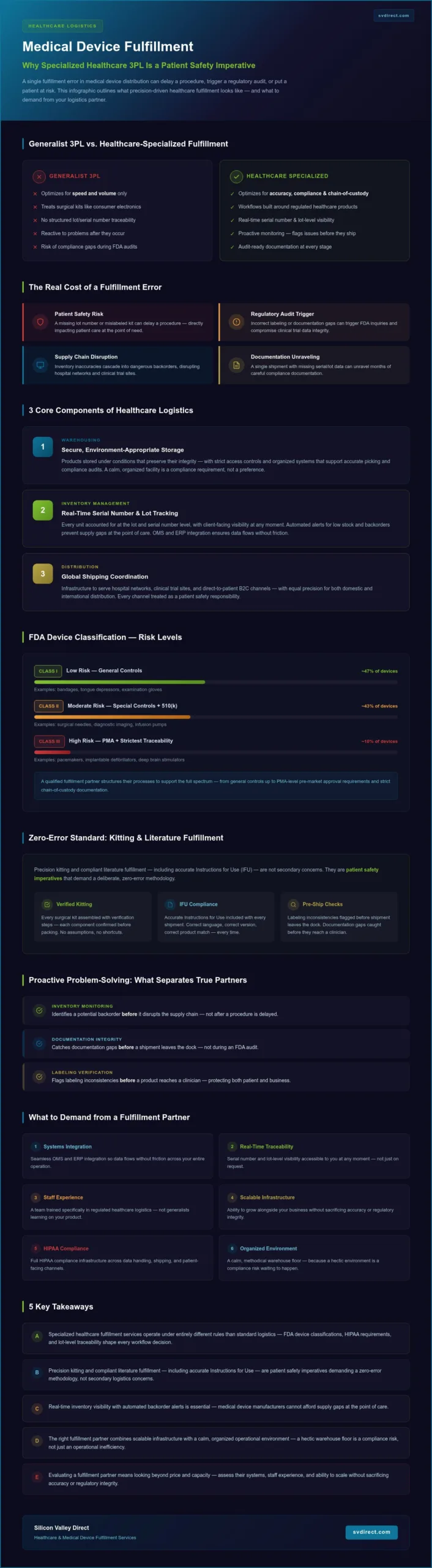
The distinction matters enormously. A generalist 3PL optimizes for speed and volume. A healthcare-specialized fulfillment partner optimizes for accuracy, compliance, and chain-of-custody integrity, often simultaneously. When a surgical instrument ships without a verified lot number, or a diagnostic kit arrives with incorrect labeling, the consequences extend far beyond a customer service complaint. They can trigger FDA inquiries, compromise clinical trial data, or delay a procedure that a patient is counting on.

Serial number tracking and lot control sit at the absolute center of this discipline. Every regulated medical device must be traceable from the moment it enters a warehouse to the moment it reaches its destination. This isn’t a best practice; it’s a baseline requirement that shapes how inventory systems are built, how staff are trained, and how fulfillment partners are evaluated. Silicon Valley Direct’s Remote Control™ system provides clients with real-time serial number visibility precisely because that level of traceability is non-negotiable in this space.

Fulfillment speed also carries clinical weight. Backorders in the medical device supply chain don’t just frustrate procurement teams; they can delay procedures, disrupt clinical trials, and create gaps in patient care. A fulfillment partner that proactively monitors inventory levels and flags potential shortfalls before they become critical is an operational asset, not just a logistics vendor.

Core Components of Healthcare Logistics

Effective healthcare fulfillment services are built on three interconnected capabilities:

  • Secure, environment-appropriate warehousing: Products must be stored under conditions that preserve their integrity, with access controls and organization systems that support accurate picking and compliance audits.
  • Real-time inventory management with serial number tracking: Every unit must be accounted for at the lot and serial number level, with visibility that extends to the client at any moment.
  • Global shipping coordination: Whether serving hospital networks, clinical trial sites, or direct-to-patient B2C channels, the logistics infrastructure must handle both domestic and international distribution with equal precision.

The High Stakes of Accuracy

In medical fulfillment, a zero-error standard isn’t an aspiration; it’s the minimum threshold for safe, compliant operations. Proactive problem-solving is what separates a true healthcare logistics partner from a reactive vendor. Identifying a potential backorder before it disrupts a supply chain, catching a documentation gap before a shipment leaves the dock, or flagging a labeling inconsistency before it reaches a clinician, these are the interventions that protect both patients and businesses.

The physical environment where this work happens also matters. A calm, organized facility isn’t just aesthetically preferable; it’s operationally essential. High-volume precision work demands a warehouse culture where processes are methodical, staff are experienced, and distractions are minimized. That’s not a soft consideration. It’s a compliance variable.

Compliance in medical device logistics isn’t a single checkbox. It’s a layered framework that shifts depending on what you’re shipping, who’s receiving it, and what data travels alongside it. A fulfillment partner that genuinely understands this landscape doesn’t just follow rules; they build their entire operational infrastructure around them.

FDA Class 1, 2, and 3 Requirements

The FDA classifies medical devices into three risk-based tiers, and each one carries distinct implications for how products must be handled, stored, and documented throughout the fulfillment process.

  • Class 1 devices (bandages, examination gloves, tongue depressors) carry the lowest risk profile and are subject to general controls. Standard handling protocols apply, but accurate inventory management and clean chain-of-custody records remain essential.
  • Class 2 devices (powered wheelchairs, infusion pumps, surgical drapes) require special controls, including performance standards and post-market surveillance. Fulfillment workflows must support the documentation that enables this oversight, particularly lot-level tracking and verified shipping records.
  • Class 3 devices (implantable pacemakers, deep brain stimulators, replacement heart valves) sit at the highest risk tier and are subject to premarket approval. The traceability requirements here are stringent. Every unit must be accounted for with a precision that leaves no room for ambiguity at any point in the supply chain.

Your 3PL must function as a seamless extension of your compliance team, not a separate entity that hands off responsibility at the dock door. When a regulatory audit arrives, the documentation your fulfillment partner holds is part of your compliance record. That’s a relationship that demands deep operational alignment, not just a signed service agreement.

Data Security and Information Integrity

Healthcare fulfillment services that handle patient-sensitive materials face an additional compliance layer: HIPAA. When shipping involves personal health information, whether on a label, an enclosed document, or an order record, that data must be protected at every point of contact. Secure medical mailing solutions aren’t optional; they’re a legal obligation with real consequences for mishandling.

On the systems side, encrypted web interfaces that protect order data and inventory records are non-negotiable. Silicon Valley Direct’s Remote Control™ system provides clients with secure, real-time access to inventory and order data precisely because transparency and security must coexist in this environment. For a deeper look at how compliant mailing practices protect both patients and manufacturers, the complete guide to healthcare mailing services covers the operational and regulatory specifics in detail.

Audit readiness is the practical test of all of this. Can your fulfillment partner produce lot histories, shipping confirmations, and chain-of-custody records on demand? If the answer involves hesitation, that’s a risk your business shouldn’t carry. If you’re evaluating whether your current setup genuinely meets this standard, it’s worth taking the time to discuss your compliance requirements with a specialized fulfillment partner before an audit forces the conversation.

The Synergy of Kitting and Literature Fulfillment

A medical device that ships without its Instructions for Use isn’t just incomplete. It’s potentially dangerous, and almost certainly non-compliant. IFUs and user manuals aren’t supplementary materials; they’re regulated components of the product itself. Treating them as an afterthought, or outsourcing their production and insertion to a separate vendor, introduces exactly the kind of documentation gap that triggers recalls and regulatory scrutiny.

Most fulfillment operations handle kitting and literature as separate workflows, sometimes managed by entirely different vendors. That siloed approach creates handoff points where errors accumulate: the wrong manual version gets included, a language variant is substituted, or a revision update doesn’t propagate before a shipment run. In precision-driven healthcare fulfillment services, those gaps aren’t acceptable at any volume.

The answer is integration. When printing and kitting happen under the same roof, managed by the same team, the entire process tightens. Version control becomes a single-point responsibility. Quality checks apply to both the device components and the literature simultaneously. And when a product update requires a new IFU, the change is reflected immediately, without the lag that comes from coordinating across vendors.

Integrated On-Demand Printing

Silicon Valley Direct’s HP Indigo 5500 with liquid ink technology produces offset-quality output that meets the visual precision medical literature demands: sharp anatomical diagrams, legible fine-print warnings, and accurate color rendering for device identification. On-demand production means literature is printed when it’s needed, not warehoused in bulk runs that become obsolete the moment a label or dosage instruction changes.

Variable Data Printing extends this further. Serialized manuals, personalized patient kits, and localized clinical trial materials can each be produced with unique data fields, lot-specific references, or region-appropriate regulatory language, all within the same print run. For short-run applications like Phase II trial documentation or geographically targeted medical marketing campaigns, this capability eliminates the waste and lead time that offset printing typically demands. Explore the full scope of what’s possible through on-demand digital printing.

Complex Kitting and Hand Assembly

Assembling a surgical or diagnostic kit isn’t a pick-and-pack operation. It requires a dedicated hand-assembly team that understands what goes into each kit, in what order, and why. Bundling a device with its necessary disposables, correct literature version, and any promotional or instructional inserts demands both process discipline and genuine product familiarity.

SVD’s QC-Check process applies systematic inspection at each stage of complex kit assembly. Components are verified against a defined checklist before the kit is sealed, ensuring that every unit leaving the facility matches the exact specification, not approximately, but precisely. That level of structured oversight is what separates compliant healthcare fulfillment services from general assembly operations that treat medical kits like any other bundled product.

  • Literature version control: On-demand printing ensures only current IFU and manual versions enter the kitting workflow.
  • Component verification: Each kit is checked against a defined assembly specification before sealing.
  • Short-run flexibility: Clinical trial kits and localized materials can be produced in precise quantities without minimum-run constraints.
  • Single-source accountability: Printing and assembly under one roof eliminates inter-vendor handoff errors.

When the stakes are patient safety and regulatory compliance, the operational model that keeps printing, kitting, and quality control inside a single, organized facility isn’t just more efficient. It’s the only model that consistently holds.

Healthcare Fulfillment Services: Navigating Compliance and Precision in 2026

Real-Time Visibility and Inventory Control

Blind spots in your inventory data aren’t an inconvenience in medical device distribution. They’re a liability. When a hospital’s procurement team is counting on a specific implant being in stock, or a clinical trial site needs a kit replenished before a scheduled procedure window, the difference between real-time visibility and a 24-hour reporting lag can have direct consequences at the point of care. Healthcare fulfillment services that can’t deliver continuous, accurate inventory intelligence aren’t meeting the baseline requirement for this industry.

The operational standard here is straightforward: your fulfillment partner’s inventory data should be as current as your own internal systems, and it should be accessible whenever you need it. Not during business hours. Not after a manual report is generated. Now. That level of transparency is what allows medical device manufacturers to make confident procurement decisions, respond to demand fluctuations, and maintain the supply continuity that clinical operations depend on.

Automated notifications close the gap between data and action. When stock levels approach a defined threshold, when a new receipt is logged, or when a backorder condition develops, the system should surface that information proactively rather than waiting for someone to run a query. Automated alerts prevent stock-outs of life-saving equipment by giving supply chain teams the lead time they need to respond before a shortage becomes a crisis.

Reporting depth matters just as much as real-time access. With more than 120 standard reports available, supply chain teams can move beyond reactive monitoring into genuine optimization: identifying demand patterns, evaluating carrier performance, analyzing lot-level movement history, and building the documentation foundation that regulatory audits require.

The Remote Control™ Advantage

SVD’s Remote Control™ system tracks every order from pick-slip generation through final delivery, giving clients a complete, uninterrupted chain-of-custody record. The system connects to existing ERP platforms via XML/SOAP-based Web Services, which significantly reduces the custom coding burden that typically accompanies a new fulfillment integration. Your team works within familiar systems; the data flows cleanly between them.

Inventory Accuracy and Expiration Management

FIFO (First-In, First-Out) inventory rotation is the standard methodology for preventing medical product expiration, and it’s built into SVD’s warehouse workflows rather than treated as an optional protocol. Products with the earliest receipt dates move first, which protects both product integrity and compliance standing.

  • Serial number tracking: Every unit is recorded at the serial level, making recall execution and warranty management precise and auditable rather than approximate.
  • Lot-level traceability: Full lot histories are maintained and accessible on demand, supporting both internal quality reviews and external regulatory inquiries.
  • Expiration monitoring: Inventory approaching expiration is flagged before it becomes a write-off or a compliance issue.

Taken together, these capabilities transform inventory management from a background function into a strategic asset. In a supply chain where accuracy isn’t negotiable, that distinction carries real weight.

Choosing Your Medical Device Fulfillment Partner

Most vendor evaluations start with price and capacity. Those matter, but in medical device distribution, they’re table stakes. The questions that actually determine whether a fulfillment relationship will hold up under regulatory pressure, high-volume deadlines, and the inevitable unexpected are harder to answer from a sales deck. What does the warehouse floor actually feel like? How does the team respond when a conflict surfaces? And when your business scales, will the partner scale with the same precision or start cutting corners?

Facility atmosphere is a legitimate evaluation criterion. A hectic environment, one where staff are reactive, processes shift under pressure, and the floor feels disorganized, is a compliance risk before a single product ships. Deliberate methodology, the kind built into how a facility is organized, how staff are trained, and how quality checks are sequenced, produces consistently accurate output precisely because it doesn’t depend on individual heroics to catch errors. When you’re evaluating a healthcare fulfillment services partner, ask for a facility tour. What you observe will tell you more than any SLA document.

Scalability deserves the same scrutiny. A partner that performs well at moderate volume but struggles when a product launch or seasonal demand spike arrives isn’t a growth partner; it’s a bottleneck waiting to form. The right partner has the infrastructure, staffing depth, and process discipline to absorb volume increases without sacrificing the accuracy standards that regulated distribution demands.

Proactive communication is the differentiator that’s hardest to quantify and most consequential to find. A fulfillment partner worth trusting doesn’t wait for problems to surface. They flag potential conflicts before they become disruptions, whether that’s a lead time concern, an inventory threshold approaching, or a documentation gap identified during a pre-shipment check. That anticipatory posture is what separates a true operational partner from a transactional vendor.

Environmental responsibility is increasingly part of the evaluation as well. On-demand digital printing eliminates the bulk overruns and obsolete inventory that offset production generates. Hardware recycling initiatives reflect an operational culture that takes long-term thinking seriously, which tends to be the same culture that builds durable, accurate fulfillment processes.

The Nine Promises of Quality

SVD’s approach to quality begins with a foundational commitment: understanding what a client is actually trying to accomplish, not just what they’ve ordered. That orientation shapes everything from how kitting specifications are interpreted to how edge cases are handled when a shipment doesn’t go as planned. The “make-it-right” attitude isn’t a slogan; it’s the operational default when something falls outside the expected parameters. Client testimonials reflect what that commitment looks like in practice, across industries and over time.

The Silicon Valley Direct Commitment

With more than 25 years of experience in high-tech and healthcare fulfillment, SVD brings operational depth that newer entrants simply can’t replicate. The team functions as a seamless extension of your sales and marketing departments, handling the logistics infrastructure so your internal teams can focus on product development, clinical relationships, and growth. National distribution reach, combined with global shipping expertise, means SVD supports your business whether you’re serving a regional hospital network or coordinating international clinical trial logistics. That combination of experience, infrastructure, and genuine partnership orientation is what precision-driven medical device distribution actually requires.

Learn more about SVD’s fulfillment capabilities and how they support medical device manufacturers at every stage of growth.

Precision Is the Standard. Make Sure Your Partner Meets It.

Medical device distribution doesn’t leave room for approximation. The difference between a fulfillment partner that understands regulated healthcare logistics and one that’s adapting general processes to fit your products shows up in audit documentation, in kitting accuracy, and ultimately in patient outcomes.

What this article has made clear: compliant healthcare fulfillment services require lot-level traceability, integrated kitting and literature workflows, and real-time inventory visibility that doesn’t wait for a manual report. Those aren’t premium add-ons; they’re baseline requirements for operating safely in this space.

Silicon Valley Direct has been building that operational foundation since 1999. The proprietary Remote Control™ system delivers the chain-of-custody transparency that regulated distribution demands, and HP Indigo digital printing ensures every IFU and manual ships at the quality and version accuracy your compliance record requires.

If your current setup leaves any of those gaps open, now is the right time to have that conversation.

The right partner doesn’t just keep up with your growth; they help protect everything you’ve built.

Frequently Asked Questions About Healthcare Fulfillment Services

What is the difference between Class 1 and Class 2 medical device fulfillment?

The core difference lies in documentation depth and oversight requirements. Class 1 devices carry the lowest risk profile and require standard handling with clean chain-of-custody records. Class 2 devices demand special controls, including performance standards and post-market surveillance, which means your fulfillment partner must maintain verified lot-level tracking and shipping records that support ongoing regulatory oversight. The warehouse workflows, quality checks, and reporting capabilities required are meaningfully more rigorous at the Class 2 level.

Class 3 devices raise the bar further still, requiring premarket approval and the most stringent traceability standards in the FDA classification system. If you’re distributing across multiple device classes, your fulfillment partner needs processes that can accommodate each tier simultaneously without defaulting to the lowest common denominator.

How does HIPAA affect medical device shipping and logistics?

HIPAA becomes directly relevant whenever a shipment involves personal health information, whether that’s on a label, an enclosed document, or an order record. In those cases, your fulfillment partner is handling protected health information and must treat it accordingly: secure data handling, encrypted system access, and controlled physical environments are all required, not optional. A fulfillment partner without these safeguards in place exposes your business to real legal liability.

On the systems side, this means the platforms your 3PL uses to manage order data and inventory records must meet the same security standards you’d apply internally. SVD’s Remote Control™ system provides clients with encrypted, secure access to their inventory and order data precisely because transparency and HIPAA compliance have to coexist in a properly run healthcare logistics operation.

Can you provide serial number tracking for every individual device shipped?

Yes. Serial number tracking is built into SVD’s fulfillment workflows, not added as an optional layer. Every unit is recorded at the serial level from receipt through final delivery, creating a complete, auditable chain-of-custody record that supports recall execution, warranty management, and regulatory inquiries. This isn’t a premium feature; it’s a baseline requirement for compliant healthcare fulfillment services, and it’s treated as such operationally.

That level of granularity also makes a practical difference when something goes wrong. If a recall is issued or a warranty claim surfaces, you’re working with precise unit-level data rather than lot approximations. That specificity protects both your compliance standing and your customers.

What are the benefits of on-demand digital printing for medical manuals?

On-demand digital printing eliminates the version control problem that bulk offset runs create. When a label change, dosage update, or regulatory revision is required, the new version goes into production immediately. There’s no warehouse of obsolete literature to write off, and no risk of an outdated IFU shipping alongside a current device. SVD’s HP Indigo 5500 with liquid ink technology produces offset-quality output, meaning fine-print warnings, anatomical diagrams, and color-coded device identification all render with the precision medical literature demands.

Short-run flexibility is the other major advantage. Clinical trial documentation, regionally localized materials, and serialized patient kits can each be produced in precise quantities without minimum-run constraints. For medical device manufacturers managing multiple product lines or ongoing trial phases, that agility has real operational value.

Do you offer climate-controlled storage for sensitive medical components?

Storage environment requirements vary significantly across medical device categories, and the right answer depends on what you’re shipping. We’d encourage you to discuss your specific product sensitivities directly with our team so we can confirm whether our facility configuration is the right fit for your components. What we can confirm is that SVD’s warehousing is organized around the precision and access-control standards that regulated medical device storage demands, including FIFO inventory rotation to protect product integrity and prevent expiration issues.

How does your Remote Control™ system integrate with my existing eCommerce platform?

Remote Control™ connects to existing ERP and eCommerce platforms via XML/SOAP-based Web Services, which reduces the custom development burden that typically comes with a new fulfillment integration. Your team continues working within familiar systems; the data flows cleanly between them. Order tracking, inventory levels, lot histories, and shipping confirmations are all accessible in real time through a secure, encrypted interface, so you’re not waiting on manual reports to understand what’s happening in your supply chain.

If you’re running a more complex tech stack or have specific integration requirements, the practical next step is a direct conversation with our team to map your current setup against our integration capabilities. That’s a faster path to clarity than working through a generic checklist.

What is your process for handling medical device returns and recalls?

Returns management is a confirmed service offering at SVD, and in a regulated healthcare context, it requires more than a standard reverse logistics workflow. Returned medical devices need to be received, documented, and segregated with the same lot-level accuracy as outbound shipments. The chain-of-custody record doesn’t end at delivery; it has to account for what comes back and why. SVD’s serial number tracking capability means every returned unit is tied to its original shipment record, which matters enormously when a recall requires you to demonstrate exactly where specific units went and what came back.

For active recalls, the precision of your inventory data determines how quickly and completely you can respond. We’d recommend discussing your specific recall protocols directly with our team so we can walk you through how our processes align with your regulatory obligations.

Is there a minimum order volume for specialized medical kitting services?

SVD’s on-demand digital printing and hand-assembly capabilities are specifically designed to support short-run production without minimum-run constraints. Clinical trial kits, regionally localized materials, and serialized patient kits can all be produced in precise quantities, which means you’re not forced into bulk runs to access specialized kitting services. That flexibility is particularly valuable during product launches, Phase II trial phases, or market-entry situations where demand volume is still being established.

For complex kitting projects with specific assembly specifications, the best approach is a direct conversation with our team. We can assess your requirements, walk you through the QC-Check process, and give you a realistic picture of what’s feasible at your projected volume. Request a quote to start that conversation.