



How to Package Products for Shipping: A Practical 2026 Guide
A box that looks like a perfect fit can still leave a product vulnerable if it shifts in transit. Learning how to package products for shipping means balancing a secure fit with dependable protection, not simply choosing the smallest container. If you’re unsure whether to use a box or mailer, how much cushioning to add, or how to seal and label the parcel, small decisions at the packing station can make a real difference to the delivery experience.
A consistent process makes those decisions easier. This guide explains how to choose packaging for different products, prevent items from moving, and prepare each parcel using a repeatable sequence. You’ll learn what to check before sealing, how to avoid common packing oversights, and when growing order volume may make structured fulfillment support worth considering. Whether you’re packing one order or refining a team workflow, the goal is the same: send each product out secure, well prepared, and ready for delivery.
Key Takeaways
- Learn how to package products for shipping by matching the container and cushioning to the item’s shape and protection needs.
- Use a clear packing sequence to prepare, protect, position, close, and label each order.
- Adapt your approach for fragile, soft, liquid, and multi-item products. Treat examples as starting points, not universal rules.
- Create written packing instructions and checkpoints to help your team process repeat orders consistently.
- Consider whether coordinated multi-item orders or growing volume may benefit from kitting and assembly or structured fulfillment support.
How to Package Products for Shipping Starts with the Product
The right packing method depends on what you’re shipping. A soft, flexible item has different needs from a fragile object, a rigid product, or an order with several components. Start by checking how the product could move inside a parcel, then choose an outer container and cushioning that secure it without squeezing it or leaving it loose.
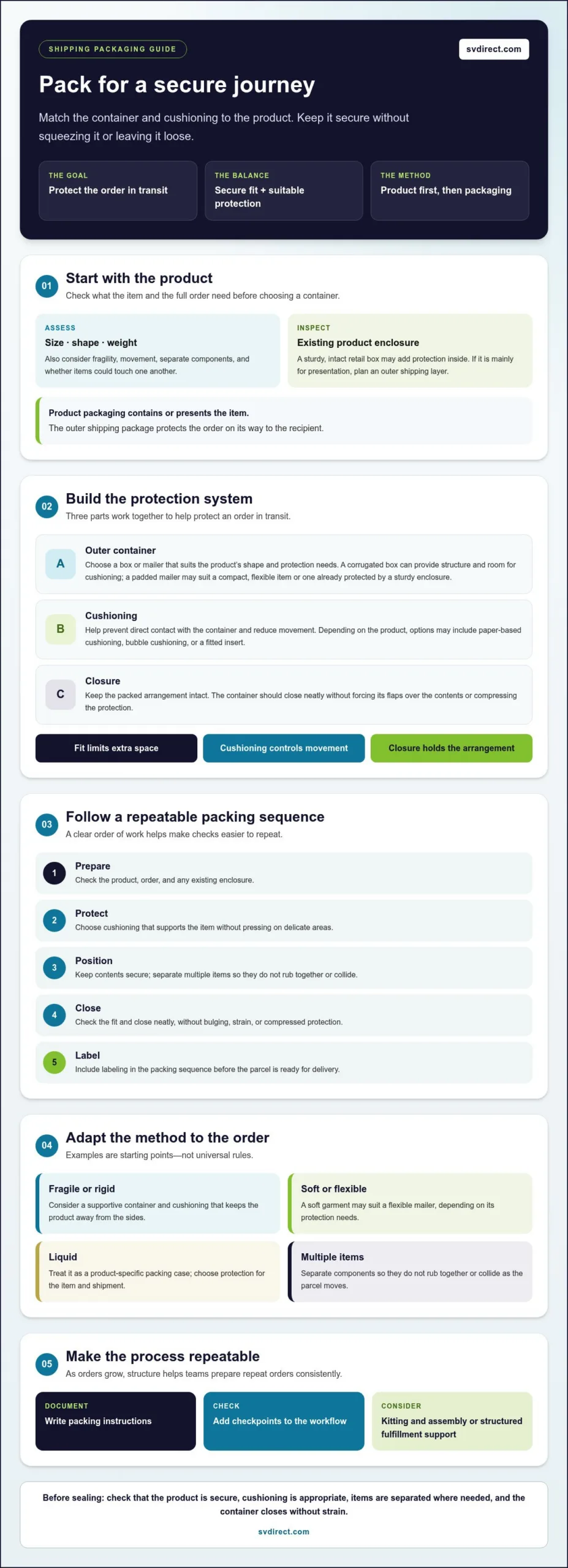
Protective shipping packaging combines an outer container, cushioning, and a closure to help safeguard an order in transit. Packaging is also a broader, coordinated system of preparing goods for transport and other stages of their journey. For shipping decisions, keep this distinction in mind: Product packaging presents or contains the item; the outer shipping package protects the order on its way to the recipient. A retail box may contribute protection, but it isn’t automatically sturdy enough to serve as the shipping container.
What should you assess before choosing shipping packaging?
Check the product’s size, shape, weight, fragility, and susceptibility to movement. Consider the entire order, too. Is it one item, several items, or a product with separate components that could shift or touch one another? Then inspect any retail box or protective enclosure. If it’s sturdy and intact, it may add protection inside the shipping package. If it’s mainly for presentation, plan to add an outer layer.
Why does a product-specific packing method matter?
Unused space can let contents slide, tip, or knock against the container. But filling every gap without considering the item can put pressure where it isn’t needed. A soft garment may suit a flexible mailer, while a fragile or rigid product may need a supportive container and cushioning that keeps it away from the sides. These are starting points, not universal rules. No single box, mailer, or cushioning choice suits every shipment.
This product-first assessment is the foundation of how to package products for shipping reliably. Match the container to the order, then leave room for appropriate cushioning. The goal isn’t simply to make the parcel small. It’s to keep the contents secure without adding avoidable pressure or empty space. Once you’ve checked the item and any existing enclosure, you can choose packaging that fits the product and its protection needs.
Choose a Box, Mailer, and Cushioning That Fit the Product
After assessing the item, choose a container that supports its shape and protection needs. A corrugated box can be a practical choice for a rigid, bulky, or delicate product because it provides structure and room for cushioning. A padded mailer may suit a compact, flexible item or one that already has a protective enclosure. Other containers may work for particular products, but no format is right for every shipment.
When is a box more suitable than a mailer?
Consider a box if the product needs to hold its shape, has vulnerable parts, or could be damaged by pressure from other parcels. A mailer may suit soft goods or compact products already protected by a sturdy retail box. Check the item’s needs and the selected shipping service’s current guidance before choosing. USPS publishes its Basic Standards for All Mailing Services, which you can consult when preparing a USPS shipment.
How should you use cushioning and protective materials?
Cushioning helps keep the product from contacting the outer container directly and reduces movement inside it. Choose a material that supports or surrounds the item without pressing on delicate areas. Depending on the product, options may include paper-based cushioning, bubble cushioning, or a fitted insert. For multi-item orders, separate the items so they don’t rub together or collide as the parcel moves.
Check the fit before sealing. The product should sit securely, with enough room for cushioning to protect it, but not so much empty space that it can shift. The container should close neatly without forcing its flaps over the contents or compressing the protection. If it bulges, strains, or won’t close as intended, choose a better-fitting container or rearrange the contents.
Container fit limits unnecessary space, cushioning controls movement and contact, and a secure closure keeps the packed arrangement intact. That’s the practical balance when deciding how to package products for shipping. A snug fit doesn’t mean packing an item tightly. It means matching the container to the product while leaving room for suitable protection. Before finalizing your choice, confirm that the packaging and closure are appropriate for the product and shipment.
How to Pack a Product for Shipping: Follow These Steps
A consistent sequence helps prevent missed checks, whether you’re packing one order or preparing a batch. Use these steps as a practical routine, adjusting the protection to suit the product and checking current instructions for your chosen shipping service.
- Step 1: Prepare the product and container. Confirm the item matches the order and inspect it for visible damage before packing. Start with a clean, suitable container that can close without forcing the contents inside.
- Step 2: Protect the item. Wrap or otherwise protect the product as appropriate. Pay particular attention to exposed surfaces and parts that could rub against another item or the container.
- Step 3: Position it securely. Place the product centrally where practical, away from the container’s sides. For an order with multiple pieces, arrange them so they don’t press or knock against one another.
- Step 4: Fill open spaces. Add suitable cushioning around the contents to limit movement. Fill gaps that could let an item slide, while avoiding pressure that could distort or damage the product.
- Step 5: Close the package. Bring the flaps or closure together neatly and secure them with packaging tape or the container’s intended closure. Don’t rely on a strained or partly open closure to hold the contents in place.
- Step 6: Apply and check the label. Place the shipping label where it’s easy to see and read. Verify the destination and return information against the order, and check that the label is secure and unobstructed.
This sequence turns how to package products for shipping into a repeatable routine instead of a last-minute guess. Supply chain guidance such as the Association for Supply Chain Management’s shipping best practices can also inform the packing and dispatch checks you document for your team.
How can you check that a package is ready to ship?
Before handoff, confirm the closure stays in place and the package isn’t bulging or coming open. Handle it gently to check whether the contents move freely. If they do, reopen the package and adjust the cushioning or positioning. Then match the destination and return information to the order one last time.
Final package check: confirm the contents are secure, the closure holds, and the shipping information matches the order before handoff. If packing and dispatch are becoming harder to coordinate as orders grow, you can discuss eCommerce order fulfillment support as a possible next step.
Adapt Packaging for Fragile, Soft, Liquid, and Multi-Item Products
A reliable packing process still needs to flex around the contents. The examples below are starting points, not universal rules. Product construction, existing protective packaging, and shipment requirements all affect the right choice. Use them to identify where extra separation or containment may be needed, then check current carrier instructions for liquids, restricted goods, and any required package labeling before shipping.
How should fragile products be packed?
Wrap fragile pieces individually when an order contains more than one, so they’re less likely to rub or strike one another. Add cushioning between each item and the container walls, and separate it from other contents. A delicate component inside a larger product may need its own protection, too. A “fragile” marking can communicate handling information, but it can’t replace suitable packing or guarantee careful handling.
What changes for soft goods, liquids, and product bundles?
Soft goods, such as clothing or fabric accessories, may suit a protective mailer if they don’t need a rigid container. Choose packaging that keeps the item contained and suits its condition, including whether it needs to stay clean or dry. For liquids, don’t assume a general packing method is sufficient. Check the selected carrier’s current instructions for the specific liquid, packaging, and labeling before preparing the parcel.
Multi-item orders need more planning. Arrange components so they stay in order and don’t knock against one another. Depending on the contents, individual wrapping or dividers can help keep pieces apart. A fitted layout may work when items sit securely without pressure. For coordinated product bundles, kitting and assembly may be worth considering if preparing each set consistently becomes part of a repeat order workflow.
When deciding how to package products for shipping, focus on where items could move, touch, leak, or lose their organization. A quick review of the packed arrangement can reveal gaps before closure. Check current carrier guidance for restricted goods and labeling rather than relying on a generic example, since instructions may depend on the item and service selected.
- Fragile items: Separate pieces and cushion them from the container and nearby contents.
- Soft goods: Consider a suitable mailer or container based on the item’s protection needs.
- Liquids: Verify applicable carrier instructions before packing and labeling.
- Bundles: Keep components orderly and prevent unwanted movement or contact.
For orders with several coordinated components, explore eCommerce order fulfillment support as one option for managing repeat packing workflows.
Build a Repeatable Shipping-Packaging Workflow as Orders Grow
A packing method that works for one order is easier to repeat when the steps are documented. Clear instructions help team members prepare recurring orders consistently and identify when a product or order configuration needs a different approach. Keep the workflow practical: describe what to pack, how to protect it, and what to verify before the parcel leaves.
What should a packing checklist include?
Write instructions around the order, not just the packaging materials. Identify the correct product and quantity, specify the appropriate packaging type, and note any order-specific packing directions. Then use a final review to confirm protection is in place, the closure is secure, and shipping information is legible and matches the order.
- Product identity: Confirm the item matches the order.
- Quantity: Verify the number of items and components.
- Protection: Check that products are arranged and protected as instructed.
- Closure: Confirm the package closes securely.
- Shipping information: Check that the label is clear and details match the order.
Review the instructions whenever a product, packaging choice, or order configuration changes. A checklist that no longer reflects the actual contents can create confusion instead of consistency. For a new or unusual order type, document the packing approach only after confirming it suits the product and shipment.
When can kitting or fulfillment support help?
Kitting may suit orders assembled from multiple coordinated components, especially when teams need to prepare the same combination repeatedly. Silicon Valley Direct provides kitting and hand assembly with a systematic QC-Check process. Broader eCommerce order fulfillment may also be worth discussing if managing recurring orders and packing steps is taking more coordination from your team. The right fit depends on your products, order patterns, and workflow, so assess those needs rather than assuming outsourced support is necessary.
A documented process gives your team a useful starting point for how to package products for shipping as order volume grows. If you’re exploring outsourced order processing, review eCommerce fulfillment services and consider how the available support aligns with your products and packing requirements.
Discuss your fulfillment needs with Silicon Valley Direct’s fulfillment team.
Make Every Shipment Part of a Consistent Process
Good packing starts with the product. Choose a container that fits its shape and protection needs, use cushioning to limit movement without adding unnecessary pressure, and adapt the approach for fragile, soft, liquid, or multi-item orders. A short written checklist can help your team verify product identity, quantity, protection, closure, and shipping details every time.
As order volume grows, a repeatable process can make fulfillment easier to coordinate. Silicon Valley Direct has supported businesses since 1999. Its kitting and hand assembly includes a systematic QC-Check process, while its Remote Control system provides 24/7 access to order progress and real-time inventory information. These capabilities may be worth discussing if your operation needs structured fulfillment support.
A product-specific packing method and clear checkpoints help you prepare orders consistently and give each shipment a thoughtful start. Keep refining your workflow as products and order configurations change.
Use what you’ve learned about how to package products for shipping to build a process that works for your orders today and can adapt as your business grows.
Frequently Asked Questions
How do you package a product for shipping step by step?
Start by checking the product against the order and inspecting it before packing. Choose a suitable container, protect the item, and position it so it won’t rest directly against the container walls. Add cushioning to limit movement, then close the package securely. Finish by applying a clear shipping label and checking the destination and return information against the order before dispatch.
What is the best packaging for shipping products?
The best packaging depends on the product’s size, shape, weight, fragility, and existing protective enclosure. A box may suit a rigid or delicate item that needs structure, while a mailer may work for compact, flexible, or already-protected goods. Choose a container that closes without forcing the contents inside, then add suitable cushioning to help keep the product secure without unnecessary pressure.
How do you stop products from moving inside a shipping box?
Position the product securely and fill open spaces with cushioning suited to the item. For multiple products, use individual wrapping or dividers where needed to prevent rubbing or collisions. Close the package and handle it gently to check whether the contents move freely. If they do, reopen it and adjust the arrangement or cushioning. The goal is to reduce movement, not to promise damage can’t occur.
Should you use a box or a padded mailer for shipping?
Choose based on the item’s protection needs rather than assuming one format is always better. A box can provide structure for bulky, rigid, or more delicate products. A padded mailer may suit a compact, flexible item or one already protected by a sturdy enclosure. Check the shipment’s requirements and current carrier guidance, and make sure the selected package closes securely without compressing its contents.
How do you package fragile items for shipping?
Wrap fragile items individually, especially when packing multiple pieces together. Add cushioning to separate each item from the container walls and neighboring contents, and fill gaps that could allow shifting. Arrange the pieces so they won’t knock against each other during transit. A fragile label may communicate handling information, but it doesn’t replace protective packing or guarantee careful handling. Check applicable carrier guidance for your shipment.
What should you check before sending a packaged product?
Confirm the package contains the correct product and quantity, and check that the contents don’t move freely when the parcel is handled gently. Make sure the closure stays secure and the container isn’t bulging or opening. Verify that the shipping label is legible and that destination and return information match the order. Check current carrier instructions for any product-specific packaging or labeling requirements before dispatch.
When should an online business outsource product packing and fulfillment?
Consider discussing outsourced fulfillment when recurring orders and packing tasks are taking more coordination from your team, or when you need a consistent process for orders with multiple components. Silicon Valley Direct has provided eCommerce order fulfillment since 1999, and its kitting and hand assembly includes a systematic QC-Check process. Whether that support fits depends on your products, order patterns, and packing requirements.