


ECommerce Warehouse Services: A 2026 Buying Guide
When searching for ecommerce warehouse services san jose, it’s easy to focus on storage capacity and overlook the operational details that shape the customer experience. The right partner is not simply a place to hold inventory. It should give you useful visibility into stock and orders, with clear workflows for receiving, fulfillment, and exceptions.
You also need to know how closely a provider’s processes fit your business and how your teams will communicate. Product requirements, order patterns, and the tasks you plan to keep in-house all affect what a workable arrangement looks like.
This guide explains how to assess warehousing and end-to-end eCommerce fulfillment, what to ask about inventory and order visibility, and how to compare operational fit. You’ll find practical next steps for reviewing services and discussing your workflows with a potential partner. Silicon Valley Direct has supported fulfillment and warehousing operations since 1999, with a focus on tailored solutions and long-term client partnerships.
Ecommerce Warehouse Services San Jose: What to Compare
Use the search phrase as a starting point, then compare providers based on the work you need done, not just location or storage space. Map how inventory will move from receiving to order processing, identify what information your team needs, and clarify who handles exceptions. These details make it easier to assess whether a proposed service fits your business.
Key Takeaways
- Distinguish storage from coordinated fulfillment by mapping the full flow from receiving inventory to processing orders and preparing shipments.
- Use your products, order patterns, inventory complexity, and customer expectations to identify the operational capabilities you need.
- When comparing ecommerce warehouse services san jose, review how each proposed workflow handles visibility, communication, quality checks, and exceptions.
- Ask about onboarding, data exchange, responsibilities, and how processes can adapt as order volumes and workflows change.
- Explore how warehousing, inventory management, fulfillment, shipping, and returns can work together, and confirm what order and inventory information you can access.
What eCommerce Warehouse Services Include Beyond Storage
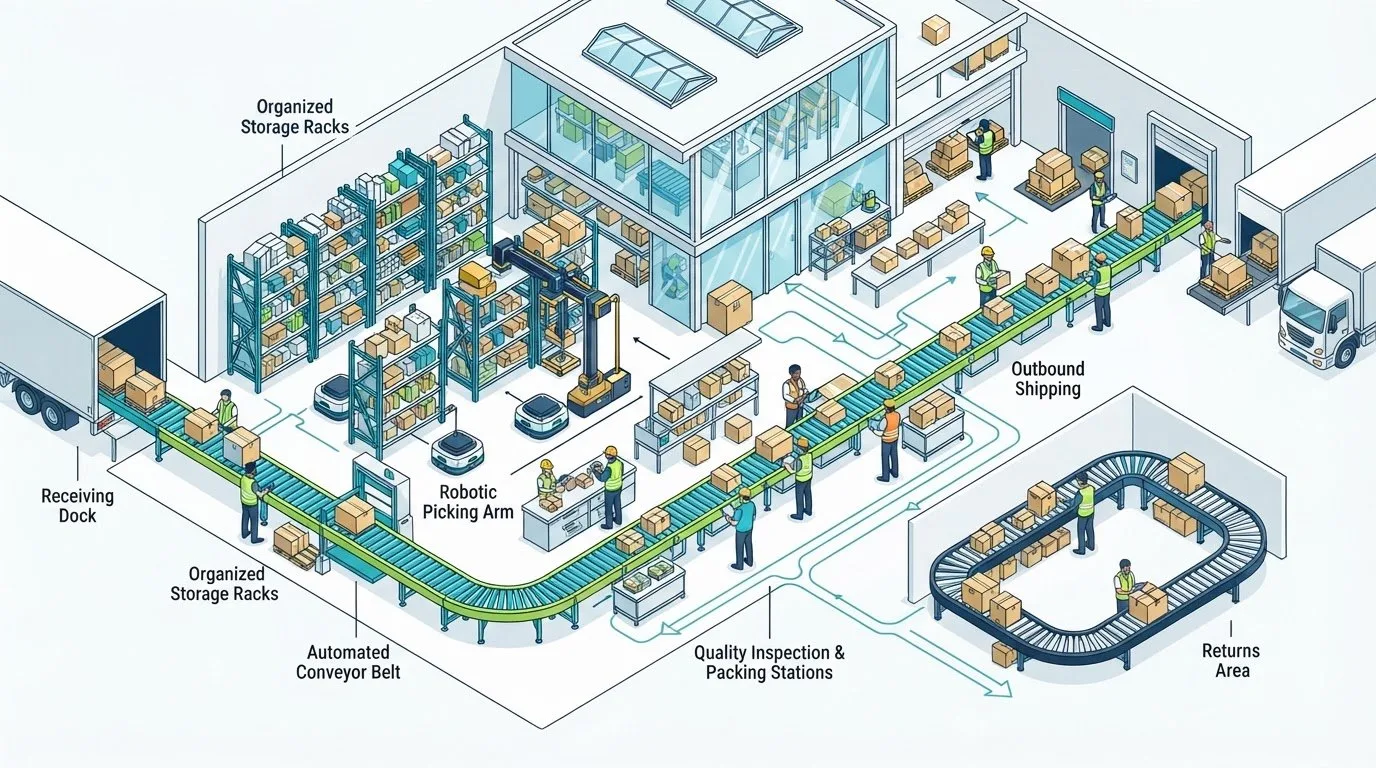
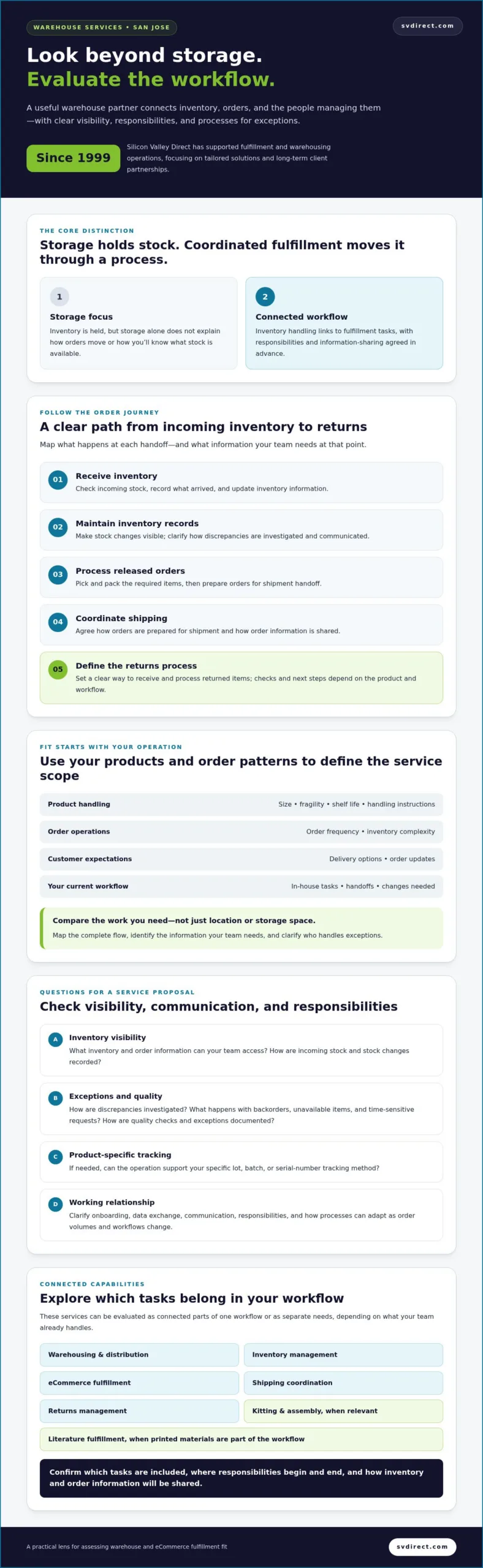
A warehouse holds inventory, while eCommerce warehouse services can coordinate what happens before and after products reach a shelf. The work may include receiving stock, maintaining inventory records, processing released orders, preparing shipments, and managing returns. Together, these steps connect physical inventory with the orders customers place.
That distinction matters when comparing providers. Storage alone doesn’t explain how orders move through an operation or how you’ll know what stock is available. A coordinated workflow links inventory handling to fulfillment tasks, with responsibilities and information-sharing agreed in advance. The right scope depends on your products, order patterns, and existing processes.
How warehousing connects to eCommerce order fulfillment
The journey starts when inventory arrives. A receiving process records what came in and updates stock information. When an order is released for processing, the required items are picked, packed, and prepared for shipment handoff. Accurate inventory records help teams understand what’s available, what has been committed to orders, and when records may need review.
This sequence is part of the broader order fulfillment process, which connects inventory location and handling with the delivery of an order. The journey may continue after dispatch: returns management can provide a defined way to receive and process returned items. The appropriate checks and next steps depend on the product and the business’s workflow.
Which fulfillment tasks may sit alongside storage
Alongside warehousing and distribution, a provider may offer inventory management, eCommerce order fulfillment, shipping coordination, and returns management. These capabilities can be evaluated as connected parts of one workflow or as separate needs, depending on what your team already handles. Ask where responsibilities begin and end, and how order and inventory information will be shared.
Kitting and assembly may be relevant when products need to be grouped or prepared together. Literature fulfillment can fit workflows that include printed materials. Neither task is necessary for every business. The right scope depends on your product mix and how orders are assembled.
Silicon Valley Direct provides warehousing and distribution, inventory management, eCommerce fulfillment, shipping coordination, and returns management. To review its broader eCommerce fulfillment services, consider how those capabilities could align with your order journey. Ask which tasks are included and how the workflow would reflect your requirements, rather than assuming a standard package will fit.
How to Evaluate eCommerce Warehouse Services for Operational Fit
Start with your operating requirements, not a generic service list. Product size, fragility, shelf life, handling instructions, order frequency, and inventory complexity can all shape how stock should be received, stored, picked, packed, and shipped. Customer expectations matter too. Consider the delivery options and order updates your business needs to support.
Map the workflow from receiving through returns. Note which steps your team performs today, where handoffs happen, and what needs to change. For cross-border orders, clarify who handles relevant responsibilities and consult appropriate authoritative guidance for your situation. Let your products and established processes determine the service scope, rather than assumptions about what every warehouse operation includes.
Questions to ask about inventory control and order handling
Ask how incoming inventory is checked and recorded, how stock changes appear in inventory records, and how discrepancies are investigated and communicated. Clarify the process for backorders, unavailable items, and time-sensitive requests. If your products require lot, batch, or serial-number tracking, ask whether the provider can support the specific method your operation needs.
If kitting or assembly is part of your workflow, ask what quality checks take place and how exceptions are documented. Request a clear explanation of the process and each team’s responsibilities, rather than relying on a general assurance of accuracy.
How to assess visibility and communication
Request a walkthrough of the order statuses, inventory views, and reports you would actually use. Ask when information updates, which automated notifications are available, and how staff escalate exceptions that need your attention. A dashboard can help, but clear escalation steps and access to knowledgeable people also matter when an order or inventory record needs investigation.
Silicon Valley Direct describes its Remote Control system as providing online access to order and inventory information. The system offers 24/7 access to place orders, track progress, view order histories, check inventory, and generate more than 120 standard reports. Ask which views, reports, and notifications are relevant to your workflow. As you compare providers, focus on whether the available information supports your decisions.
Bring your product details, order patterns, inventory needs, and questions about exceptions to the conversation. Discuss your fulfillment requirements to explore an approach based on how your business operates.
Compare In-House Warehousing With a Coordinated 3PL Workflow
Keeping fulfillment in-house gives your team direct responsibility for inventory and daily order handling. Working with a third-party logistics provider (3PL) shifts agreed tasks to an outside operation while your business retains oversight of its requirements and decisions. Neither model is right for every business. Compare who owns each task, how information flows, and whether the arrangement can accommodate your products and order patterns.
Control: In-house teams manage warehouse activity directly. With a 3PL, control is shared according to the agreed scope, so clarify which decisions remain yours.
Staffing: In-house fulfillment requires your business to organize the people responsible for warehouse and order tasks. A 3PL performs the contracted work through its own operation. Confirm how day-to-day communication and accountability are handled.
Processes: An in-house model relies on processes your team creates and maintains. A coordinated 3PL workflow needs agreed procedures for receiving, inventory updates, order processing, shipping coordination, and exceptions.
Visibility: In-house teams can work directly with the records and tools they manage. In a 3PL arrangement, ask what order and inventory information you can access and how often it updates.
Adaptability: Assess either model against changes in order volume, product mix, and workflow. Discuss how process changes are identified, approved, and put into practice.
What to consider when keeping fulfillment in-house
In-house fulfillment keeps the operation close to your team, but your business remains responsible for its moving parts. Map who oversees inventory records, receives and puts away stock, picks and packs orders, coordinates shipments, handles returns, and investigates discrepancies. Then consider how staffing and process ownership work during order peaks or when key team members are unavailable. Don’t assume this model costs more or less. Assess it using your own operational requirements and business-specific data.
What to consider when working with a 3PL
A 3PL may coordinate warehousing with order processing and related fulfillment tasks, but the scope should be explicit. Check how your order data will be shared, how the workflow fits existing systems and procedures, and who handles exceptions such as missing inventory or incomplete order information. Agree on responsibilities for inventory decisions, customer updates, returns, and process changes before work begins.
Silicon Valley Direct provides warehousing and distribution, inventory management, eCommerce order fulfillment, shipping coordination, and returns management. Its 3PL fulfillment services can be considered as part of a coordinated workflow. Compare the proposed responsibilities with the tasks your team wants to retain, then choose the model that fits your operating needs.
A Practical Checklist for Comparing Warehouse Service Proposals
A useful proposal should explain how the work will run, what information you’ll receive, and who will act when something falls outside the normal process. Use the same questions with each provider so you can compare scope and responsibilities clearly. Focus on operational fit rather than broad promises.
- Confirm the scope. List the services included, from receiving and inventory management to order fulfillment, shipping coordination, and returns. Identify any tasks your team will continue to manage.
- Check inventory visibility. Ask what stock information you can view, how records are updated, and what reports help you make replenishment or order decisions.
- Define communication. Agree on routine contacts, status updates, and how the team will notify you about discrepancies, backorders, or other exceptions.
- Understand quality control. Ask what checks apply during receiving, picking, packing, or any required kitting and assembly, and how issues are recorded.
- Review exception handling. Clarify who investigates inventory mismatches, incomplete orders, returns, and workflow changes, and how each issue is escalated.
Ask providers to explain onboarding requirements, data exchange, system access, and each party’s responsibilities. A proposal should make clear what information your team must supply and how operational changes will be communicated. Silicon Valley Direct’s 3PL fulfillment services page provides an overview of its related service capabilities. Confirm the specific scope and workflow details relevant to your operation directly with the team.
What to confirm before onboarding
Prepare a practical overview of your products, inventory data, order flow, packaging needs, and return processes. Note any special handling instructions and the system information needed to discuss data exchange. Before work begins, document who owns each step, who to contact about exceptions, and how both teams will share process updates.
How to validate the proposed operating process
Ask for a walkthrough using representative order and inventory scenarios. Include a routine order, a low-stock situation, and a backorder so you can see how status updates and notifications would work. Check whether reports answer real operating questions, such as which orders need attention or which stock records require follow-up. Silicon Valley Direct’s Remote Control system offers online access to order and inventory information. Confirm the available views, reporting, and notification features before relying on them.
How Silicon Valley Direct Supports eCommerce Warehouse and Fulfillment Needs
Choosing a warehouse partner means looking at how services fit together, not just where inventory is held. Silicon Valley Direct provides warehousing and distribution, inventory management, eCommerce order fulfillment, shipping coordination, and returns management. Businesses can discuss the capabilities that fit their workflow instead of assuming every service is needed.
Founded in 1999, Silicon Valley Direct describes its approach as tailored and partnership-focused. Discuss how warehouse and fulfillment tasks can align with your processes, where your team needs visibility, and how communication should work. A provider should understand your operational requirements and act as an extension of your team while keeping responsibilities clear.
What a coordinated fulfillment relationship can include
Depending on the products and order workflow, a service arrangement may combine inventory management with order fulfillment and shipping coordination. Returns management may also be relevant if returned items need to re-enter the inventory process. Kitting and assembly or literature fulfillment can be considered when the product mix calls for them. The right scope depends on your needs, not a preset bundle.
Silicon Valley Direct’s Remote Control system provides online access to order and inventory information, including 24/7 access to order placement, progress tracking, order histories, and inventory checks. The system can also generate more than 120 standard reports. Discuss which features and reports suit your operating plan. For first-hand perspectives, review customer testimonials and consider the context of each account as you assess whether it relates to your requirements.
What to share when requesting a tailored discussion
A clear picture of your workflow helps make an initial conversation more useful. Prepare details about:
- Products and handling: Product types, packaging needs, and any special handling requirements.
- Orders and inventory: Order patterns, inventory complexity, and how stock information is currently maintained.
- Systems and reporting: Current systems, the order and inventory information your team needs, and any data exchange to discuss.
- Shipping and returns: Shipping destinations, returns processes, and responsibilities your team wants to retain.
These details help frame a conversation around your actual operation, including what to coordinate, what to keep in-house, and what questions need to be resolved before onboarding. A tailored discussion can clarify whether the proposed services and communication approach are a practical fit.
Choose a Fulfillment Workflow That Can Grow With You
The right warehouse arrangement does more than hold products. It connects inventory management, order processing, shipping, and returns in a workflow that fits your products, order patterns, and customer expectations. When comparing ecommerce warehouse services san jose, focus on clear responsibilities, useful inventory visibility, responsive communication, and processes that can adapt as your needs change.
Silicon Valley Direct has supported fulfillment operations since 1999. Its Remote Control system provides online access to order and inventory information, helping clients stay informed as orders move through the operation. Confirm the features and reporting options that matter to your team as you discuss a potential fit.
Bring your product details, order patterns, inventory requirements, and workflow questions to the conversation. A clear starting point makes it easier to explore a tailored approach with a partner that values communication and long-term collaboration.
To discuss your warehousing and fulfillment requirements with Silicon Valley Direct, request a free quote.
Frequently Asked Questions
What do eCommerce warehouse services include?
eCommerce warehouse services can combine inventory storage with the steps needed to process and prepare customer orders. Depending on the agreement, these may include receiving and recording stock, inventory management, order fulfillment, picking and packing, shipping coordination, and returns management. Some workflows also need kitting, assembly, or literature fulfillment. Confirm the exact scope, since service needs depend on your products, order patterns, and the responsibilities your team wants to retain.
How do I choose an eCommerce warehouse services provider?
Choose a provider by comparing its proposed workflow with your operational needs. Review how it handles receiving, inventory updates, order processing, shipping, returns, and exceptions such as backorders. Ask what order and inventory information you can access, how staff communicate issues, and what onboarding requires. Request a walkthrough using representative orders and inventory scenarios so you can judge whether the proposed responsibilities and processes are clear.
Can a 3PL manage inventory and order fulfillment together?
Yes, a 3PL can provide inventory management and order fulfillment together when those services are included in the agreed scope. Coordinating them can connect stock records with the orders being processed, while your business maintains oversight of its requirements. Silicon Valley Direct offers both inventory management and eCommerce order fulfillment. Before proceeding, clarify how inventory information is updated, which tasks each party owns, and how discrepancies or backorders are handled.
How can I monitor inventory held by a fulfillment provider?
Ask what inventory views and reports are available, how often records update, and how you’ll be notified about receipts, low stock, or discrepancies. Silicon Valley Direct’s Remote Control system provides online access to order and inventory information. Confirm the available features and reports directly, then check that the information supports your decisions, such as planning replenishment or investigating a stock mismatch.
What should I ask before moving eCommerce fulfillment to a warehouse?
Before onboarding, document your products, inventory data, order flow, packaging needs, and returns process. Ask what data or system access is needed, how information will be exchanged, and which tasks belong to your team or the provider. Agree on communication contacts, exception escalation, quality checks, and how process changes will be shared. A walkthrough with sample order and inventory scenarios can reveal unclear steps before operations begin.
Can warehouse services handle returns and kitting?
Yes, if the provider offers those capabilities and they’re included in your agreed workflow. Silicon Valley Direct lists returns management and kitting and assembly among its services. Discuss how returned products are received and processed, and what checks or instructions apply to assembled items. These services aren’t necessary for every business, so define the product requirements, handling steps, and responsibilities before including them in a proposal.
How do warehouse services connect with an order management system?
Order management can connect warehouse activity with order and inventory information, but the data exchange depends on the systems and workflow involved. Ask how orders are submitted, how status changes are communicated, and what information your team can access. Silicon Valley Direct’s Remote Control system provides online order and inventory information. Confirm current capabilities and discuss your existing systems before assuming a particular integration method is available.