


Direct Mail Fulfillment Services: From Print-Ready Files to Campaign Delivery
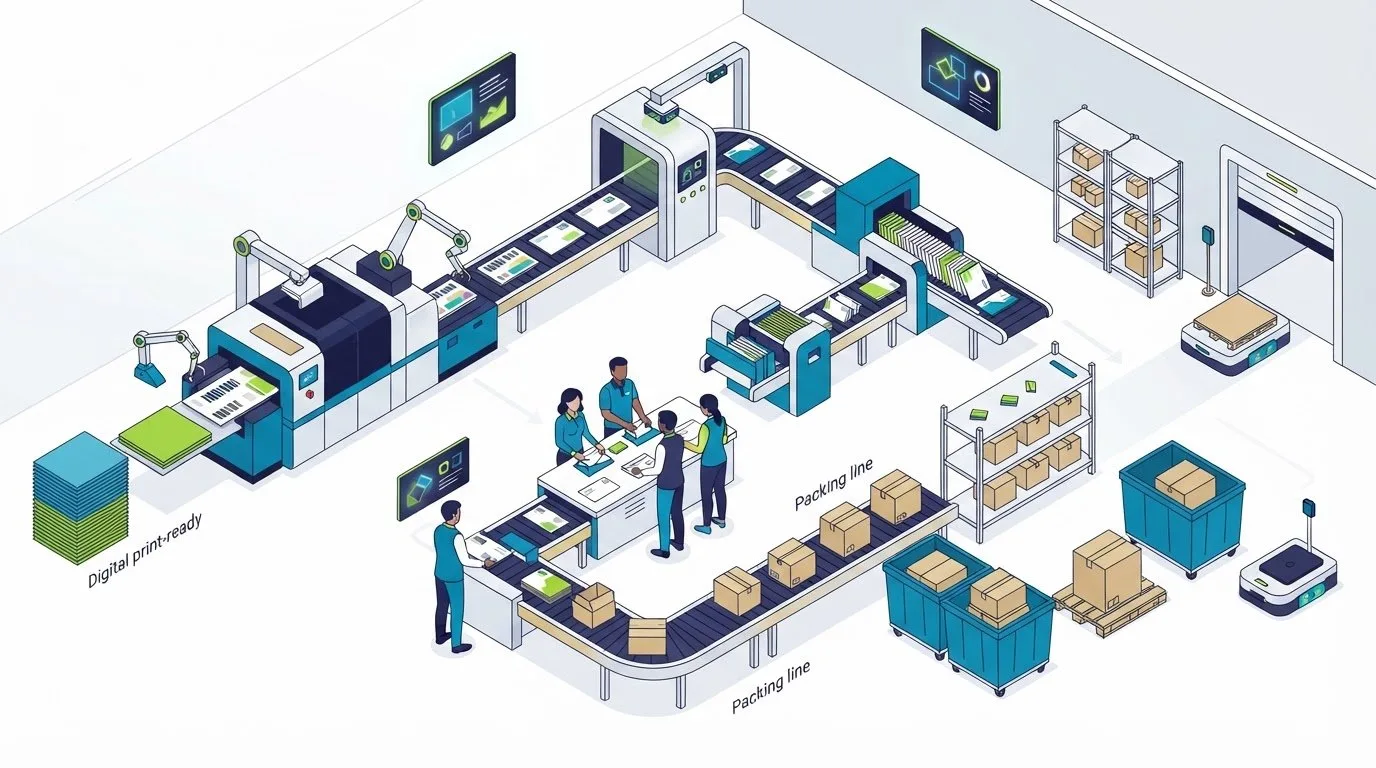
What if a direct mail campaign could move from print-ready files to mailing without a series of disconnected handoffs? Coordinating print, personalization, mailing preparation, and inventory across separate tasks can make progress harder to track and leave more room for assembly errors. Direct mail fulfillment services bring these moving parts into a coordinated workflow.
A connected process links the work behind each mailing, from preparing files and printing personalized pieces to kitting, mailing, and managing campaign materials. Clear quality checks help protect accuracy, while progress and inventory visibility make it easier to see what is happening at each stage.
This guide explains what direct mail fulfillment can include and how the handoffs fit together. You’ll learn how to assess in-house and outsourced workflows, plan for personalization and assembly, and establish practical oversight for a campaign. Mapping the process from the start helps your team manage details with greater confidence and fewer surprises.
Key Takeaways
- Direct mail fulfillment services coordinate campaign materials from production through mailing preparation and distribution, while campaign strategy determines the message and audience.
- Align audience data, creative files, and material specifications early to help prevent downstream production and mailing handoff issues.
- Compare in-house and outsourced workflows based on staffing, equipment, coordination, quality checks, and project visibility rather than assuming one approach is always better.
- Prepare a clear handoff by documenting campaign goals, audience data, materials, quantities, distribution instructions, and approval responsibilities.
- Connected printing, mailing, fulfillment, and project communication can support a more coordinated campaign workflow.
What Do Direct Mail Fulfillment Services Handle?
A direct mail campaign involves more than producing a printed piece. Direct mail fulfillment services coordinate campaign materials from production through mailing preparation and distribution, linking tasks that might otherwise sit in separate workflows. Depending on the project, this can include managing files, printing, personalization, assembly, stored materials, and mailing handoffs as parts of one coordinated job.
Fulfillment is distinct from campaign strategy. Strategy sets the audience, message, offer, and desired response. Fulfillment organizes the practical work that turns those decisions into finished mail. Direct marketing includes channels such as direct mail and focuses on communicating directly with pre-selected customers to elicit a response. For help shaping the campaign itself, see the direct mail marketing services guide.
Connected handoffs matter when a piece moves through print production, addressing, assembly, inventory handling, and mailing preparation. A change to the audience file or creative, for example, may affect personalization, quantities, or assembly instructions. Coordinating these details helps keep approvals, materials, and production directions aligned. The scope depends on the campaign’s materials, personalization, handling needs, and distribution instructions.
Which tasks can a direct mail fulfillment workflow include?
A workflow can combine several distinct tasks rather than treating printing or mailing as the entire project:
- Printing: Producing the main mail piece and supporting inserts from approved creative files.
- Addressing and labeling: Applying recipient information or labels to the appropriate materials.
- Machine insertion and tabbing: Preparing pieces for mailing using the required insertion or tabbing steps.
- Storage and assembly: Keeping literature or promotional materials available for a campaign, then combining components through hand assembly when the design calls for it.
- Mailing preparation and distribution: Coordinating completed pieces for the planned mailing and delivery workflow.
Hand assembly can be useful when a package includes varied components or requires careful placement. Silicon Valley Direct’s QC-Check process provides systematic inspection during hand-assembly work. When campaign materials also need ongoing storage or coordinated distribution, warehousing and fulfillment services can support the broader materials workflow. This differs from a standalone print job, which produces pieces, or a mailing-only task, which handles mail preparation without coordinating other campaign materials.
When does a campaign need fulfillment support?
Fulfillment support can be useful for recurring mailings, campaigns with multiple material types, or projects involving several handoffs between creative approval, production, assembly, and mailing. It can also help when literature needs to be stored between campaign waves instead of gathered from scratch for each one.
Personalization adds another coordination point. Variable data printing can change copy or images on individual sheets, so recipient data, approved creative, and production instructions need to stay aligned. Fulfillment support can simplify campaign operations when recurring mailings, multiple materials, or personalized pieces make handoffs harder to manage.
How Direct Mail Fulfillment Connects Data, Printing, and Mailing
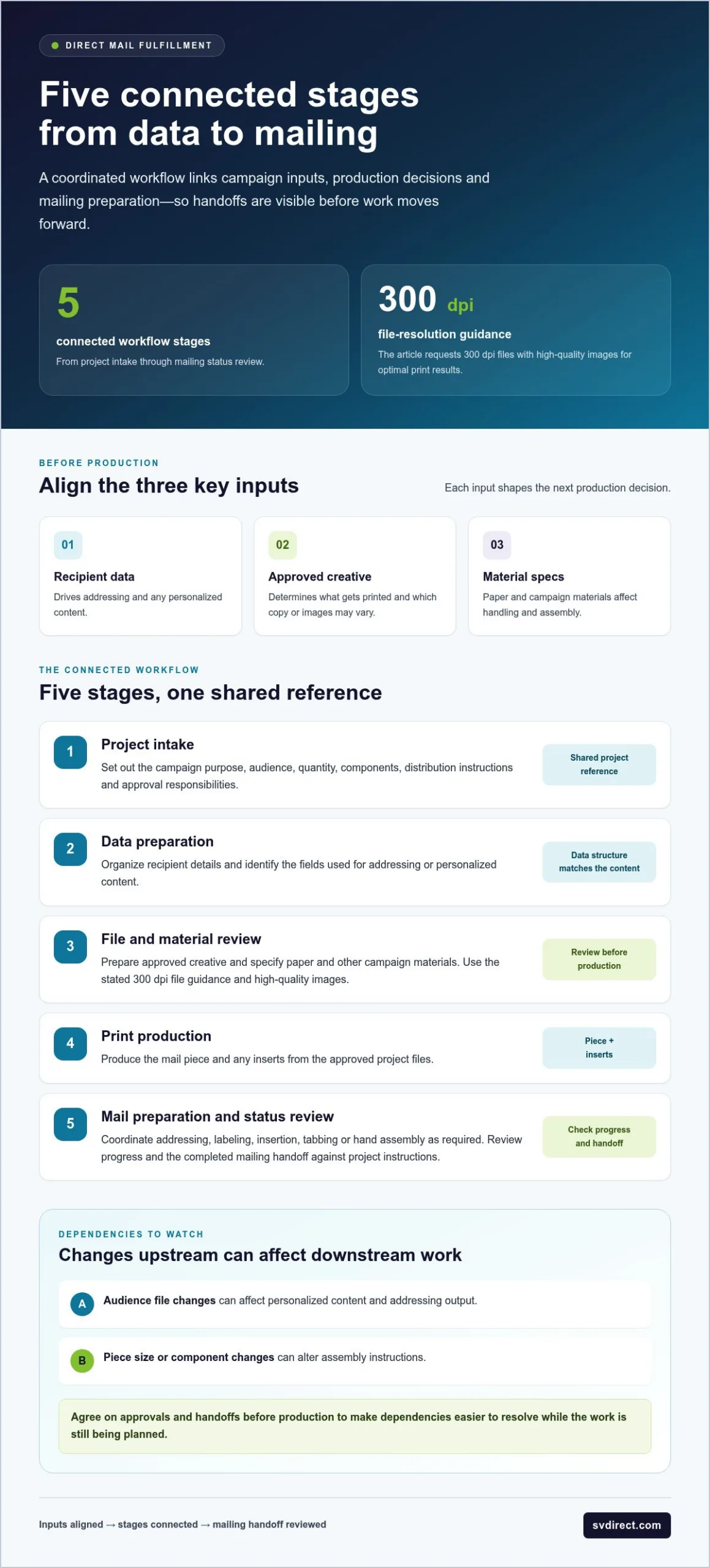
A coordinated mailing depends on more than a finished design and an address file. Each input shapes the next production decision: recipient data informs personalization and addressing, creative files determine what gets printed, and material specifications affect how pieces are handled and assembled. A clear sequence makes these dependencies visible before work moves forward.
- Project intake: Set out the campaign purpose, audience, quantity, components, distribution instructions, and approval responsibilities. This gives everyone coordinating the work a shared reference.
- Data preparation: Organize recipient details and identify which fields drive addressing or personalized content. For variable data printing, the data structure must align with the intended copy or image changes.
- File and material review: Prepare the approved creative and specify the paper and other campaign materials. Silicon Valley Direct requests 300 dpi files with high-quality images for optimal print results.
- Print production: Produce the mail piece and any inserts. On-demand digital printing can suit projects that call for digital production; the print-on-demand service overview explains this approach.
- Mail preparation and status review: Coordinate addressing, labeling, insertion, tabbing, or hand assembly as required, then review progress and the completed mailing handoff against the project instructions.
These stages are connected, not isolated. A change to the audience file can affect personalized content and addressing output. A change to the piece’s size or components can alter assembly instructions. Agreeing on approvals and handoffs before production helps the team resolve those dependencies while the work is still being planned.
How does variable data printing support personalized mail?
Variable data printing (VDP) lets individual sheets carry different copy or images. For example, a nonprofit could prepare versions of a letter that refer to different programs of interest, using recipient data to match each version to its intended audience. The creative, data fields, and production instructions need to work together so each piece receives the correct content.
Silicon Valley Direct describes VDP as not significantly more expensive than static printing. The production plan still depends on the project’s content and specifications, so define personalization clearly before files move into production.
What happens between print production and mailing?
After printing, the workflow may include addressing or labeling, machine insertion, tabbing, and hand assembly. The exact sequence depends on the mail piece and any additional materials. A project plan should identify which creative and data elements need client approval, who releases the approved files, and how production tasks pass into mailing preparation.
Silicon Valley Direct’s digital printing uses an HP Indigo 5500 press at 230 line screen resolution. That company-specific capability is one part of a larger workflow: file readiness, accurate personalization, material handling, and clearly assigned approvals all contribute to a coordinated mailing. For a project-specific workflow and quote, share your direct mail requirements.
In-House or Outsourced Direct Mail Fulfillment: How to Compare
Choosing an in-house or outsourced workflow is a question of operational fit, not a universal ranking. Compare who will handle each task, what equipment and space are available, how handoffs are managed, and how your team will track progress. The right model depends on campaign frequency, materials, personalization needs, and internal capacity.
Outsourcing does not have to mean giving up oversight. Clear approval points, regular communication, and access to order and inventory information can keep your team connected while production and mailing tasks are handled externally. Use the comparison below to see where each model places responsibility.
| Consideration | In-house workflow | Outsourced workflow |
|---|---|---|
| Staffing | Internal staff coordinate production tasks alongside their other responsibilities. | A fulfillment team handles agreed tasks, while your team supplies decisions and approvals. |
| Equipment and materials | Your organization manages the equipment, supplies, and storage needed for the work. | Production and material handling follow the agreed project scope and workflow. |
| Coordination | Internal teams connect data, creative, assembly, and mailing instructions. | Defined handoffs connect your team with the fulfillment operation. |
| Quality checks | Your team establishes and performs checks at relevant production stages. | Quality checkpoints can be built into production and assembly instructions. |
| Visibility | Progress and inventory information come from internal tracking practices. | Access tools and direct communication can provide visibility into orders and materials. |
How can a business retain visibility when fulfillment is outsourced?
Silicon Valley Direct’s Remote Control provides access to orders, progress, order histories, and real-time inventory. Automated email alerts can notify teams about low inventory, receipts, and backorders. Together with direct communication, these tools help teams follow the work and materials without managing every production task themselves. Learn more about the remote order management system.
What quality controls should the workflow make clear?
Define what “complete and correct” means before assembly begins. Document approved files, component quantities, sequence, packaging instructions, and who signs off on changes. Silicon Valley Direct’s QC-Check process provides systematic inspection during hand assembly. Also agree on how issues will be communicated and resolved, so questions reach the right person before work proceeds.
Capacity examples need context. A client testimonial reports that Silicon Valley Direct handled 3,158 shipments in one week. This is an attributed account of a particular project, not a promise of capacity or results for every campaign. Assess your requirements, then map responsibility for each stage. To discuss a project-specific workflow, request a direct mail project quote.
How to Prepare a Direct Mail Fulfillment Project
A clear project handoff gives everyone a shared reference before files, data, and materials move into production. Document the campaign’s purpose, audience, approved creative, physical components, quantities, handling instructions, and intended mailing date. For direct mail fulfillment services, these details help the team plan the work in sequence and flag missing decisions before they affect the schedule.
A fulfillment team can plan a job more accurately when it has the campaign goal, audience data, approved files, material specifications, quantities, handling instructions, and distribution plan.
Use this checklist to organize the handoff:
- Campaign goal: State the purpose of the mailing and what the recipient should understand or do.
- Audience data: Identify the file to use, the fields needed for addressing, and any data that drives personalized copy or images.
- Artwork and approvals: Supply final, approved copy and creative files. Silicon Valley Direct requests 300 dpi files with high-quality images for optimal print results.
- Materials and formats: List each mail piece, insert, promotional item, and its format or material specification.
- Quantity and distribution: Provide planned quantities and clear distribution instructions, including the desired mailing date.
- Handling requirements: Explain storage, assembly, labeling, or any special handling instructions for the campaign materials.
What campaign information helps prevent avoidable delays?
Record who owns each decision. Separate client approvals, such as sign-off on copy, audience segments, and final creative, from production tasks like printing, addressing, insertion, and assembly. Name the person who can approve changes and the contact who should receive project updates.
Early communication helps surface conflicts while there is still time to resolve them. For example, a campaign date, an unfinished approval, and a file with different personalization fields can create competing instructions. Raising the mismatch before production makes it easier to agree on one approved version and clear next steps.
How should teams plan inventory and personalized materials?
Map the materials the campaign will use and what should happen to them between mailings. Document storage needs, replenishment expectations, and whether any pieces require serial-number tracking. For each item, note whether it carries variable content, needs assembly with other components, or has specific mailing-preparation instructions.
Before the campaign begins, decide what inventory information the team needs to see and how often it should review it. For example, teams managing recurring mailings may want to monitor on-hand quantities alongside receipts and planned use. Silicon Valley Direct’s remote order management system provides order and inventory access to support that visibility.
Keep one current set of approved instructions, and communicate revisions directly to the people coordinating the work. This simple discipline reduces ambiguity as a project moves from planning into production.
Silicon Valley Direct: A Connected Direct Mail Fulfillment Partner
Silicon Valley Direct brings digital printing, mailing, and fulfillment together in workflows shaped around each campaign. Rather than treating each task as an isolated handoff, the team coordinates production and mailing details, with project communication and quality checks built into the process. The goal is a practical partnership: your team stays involved in decisions while the workflow is tailored to the materials, personalization, and handling the campaign requires.
This extension-of-your-team approach is useful when a mailing includes multiple components or recipient-specific content. Clear communication helps align approved files, data, materials, and assembly instructions before they move through production. Remote Control adds visibility into orders, progress, and inventory, while direct communication supports questions and proactive problem-solving as project needs evolve.
What does an integrated SVD workflow bring together?
Depending on the job, one coordinated workflow can connect variable data printing, mailing services, hand assembly, and fulfillment. Variable data printing can change copy or images on individual sheets, while assembly brings printed pieces and other campaign materials together according to project instructions. The workflow can then continue into mailing preparation, reducing the need to coordinate each handoff as a separate task.
Digital sheets emerge dry and ready for the next production step. For most digital projects, paper options include stocks with 30% recycled content and FSC-certified papers. These choices can be considered alongside the campaign’s creative, format, and material requirements as the workflow is planned.
For hand-assembly work, the QC-Check process provides systematic inspection. Combined with clear instructions and proactive communication, this gives the team defined checkpoints for carrying out the project and raising issues that need attention. Remote Control provides a view of orders and inventory, complementing personal oversight rather than replacing it.
What should a business include when requesting a quote?
A useful project conversation starts with the details that shape the work. Share the campaign goal, intended mailing date, audience data, approved or draft creative, and whether any copy or images vary by recipient. Include the mail piece and inserts, material preferences, quantities, assembly needs, inventory or storage considerations, and distribution instructions. If some decisions are still in progress, identify them so the project discussion can account for those open items.
It also helps to explain how your team expects the project to move: who approves creative and data, who makes decisions about changes, and what progress or inventory visibility is useful. With those details, Silicon Valley Direct can discuss a workflow tailored to the campaign rather than forcing it into a generic sequence. Direct mail fulfillment services can involve different combinations of production, handling, and mailing, so a clear brief gives the conversation a practical starting point.
Make Your Next Mailing Easier to Coordinate
Your next campaign is an opportunity to turn a clear plan into a more manageable workflow. Before it begins, identify where decisions, files, materials, or updates stalled in past projects. That review can point to a practical improvement, such as assigning approval ownership earlier or clarifying who communicates changes. The aim is not to add process for its own sake. It is to make each handoff easier to follow as campaign needs evolve.
As you consider direct mail fulfillment services, think beyond a single mailing. A well-shaped workflow should suit the project in front of you and provide a useful foundation for future campaigns. Since 1999, Silicon Valley Direct has focused on long-term client partnerships, with project solutions tailored to each client’s needs.
Bring your campaign goals and current requirements into a conversation about the right next steps. Request a free quote for your direct mail fulfillment project.
With a thoughtful plan and a collaborative partner, you can move forward with greater clarity and confidence.
Frequently Asked Questions
What file resolution should I use for direct mail artwork?
Use 300 dpi artwork with high-quality images for optimal print results. Set up each file at its intended print dimensions, and keep approved versions separate from drafts so production instructions point to the right asset. For a campaign with several formats or personalized versions, use clear file names that identify the piece and version. Confirm which files are final before releasing artwork for production.
Is variable data printing much more expensive than static printing?
Silicon Valley Direct describes variable data digital printing as not significantly more expensive than static color printing. VDP can change copy or images from one printed sheet to another, such as tailoring a message to a recipient group. The project’s materials and personalization approach shape the scope, so describe the variations clearly when planning the job. A sample or proof can help your team review how versions are distinguished before production.
What does a direct mail campaign brief need to include?
A useful brief states the campaign goal, audience, approved copy, print files, materials, quantities, personalization, approvals, and distribution instructions. Add assembly or inventory details that affect how pieces are handled. For example, if one mailing contains a letter, brochure, and reply card, identify each component and the intended combination. Keep one current brief and note revisions so project teams can work from consistent instructions.
How can a team track direct mail fulfillment progress?
Silicon Valley Direct’s Remote Control system provides 24/7 access to orders, progress, order histories, and real-time inventory. Teams can also use more than 120 standard reports and receive email alerts for low inventory, receipts, and backorders. These views can help identify a material issue or follow a job’s status. Pair system access with direct communication when approvals change or instructions need clarification.
Can direct mail use recycled or certified paper?
Yes. Silicon Valley Direct offers 30% recycled-content and FSC-certified paper options for most digital projects. The digital printing process also avoids the films, plates, and chemicals used in traditional offset printing. As you select paper, consider how the stock fits the piece’s design and the other materials in the mailing, then include your preference in the project specifications.
How does digital printing compare with offset for direct mail?
Silicon Valley Direct describes its digital print quality as equal to, and sometimes better than, traditional offset, citing color control and consistency as advantages. Its HP Indigo 5500 operates at 230 line screen resolution. Digital sheets emerge dry and ready for the next production step, which can suit workflows where printed pieces move directly into further handling. The preferred method depends on the campaign’s materials and production requirements.
To discuss your campaign’s printing, mailing, and fulfillment needs, request a direct mail project quote.