


Climate Controlled Fulfillment Services: How to Evaluate a 3PL in 2026
A climate-controlled label doesn’t prove that a warehouse can protect your products. Before choosing climate controlled fulfillment services, ask what conditions the provider can maintain, how they match your products’ needs, and what information you can access about your inventory.
Storage needs vary by product, and broad claims can make providers difficult to compare. This guide explains how to define your requirements, assess a provider’s capabilities using operational details, and identify what to confirm before onboarding.
You’ll also learn why general protection, temperature-sensitive storage, and service boundaries need separate consideration. Silicon Valley Direct has provided fulfillment services since 1999 and offers climate-controlled and secure storage options for sensitive materials. Confirm exact conditions and any environmental monitoring or reporting for your products. Remote Control provides 24/7 access to order progress and real-time inventory information, helping you oversee stored goods as you evaluate the right fit.
Key Takeaways
- Start with your product’s sensitivity, packaging, and manufacturer guidance to define the storage conditions you need.
- Evaluate climate controlled fulfillment services by asking for relevant condition ranges, supporting evidence, and clear exception procedures.
- Confirm climate control, physical security, and hazardous-material handling separately. One capability doesn’t establish another.
- Review the workflow from receiving and storage through picking, packing, and dispatch to clarify scope and responsibilities.
- Include inventory visibility in your evaluation, and confirm how the provider’s tools support oversight of stored goods.
What Climate Controlled Fulfillment Services Include and What They Do Not
Climate-controlled fulfillment means storing and processing goods under environmental conditions agreed between a business and its fulfillment provider. The phrase climate controlled fulfillment services describes an operating arrangement, not a universal set of conditions. The key is whether the provider can support your product’s documented needs and explain which parts of the fulfillment process are covered.
Requirements may depend on product sensitivity, packaging limits, shelf-life requirements, and manufacturer guidance. Secure warehousing answers a different question: how goods are protected from unauthorized access or other physical risks. Security doesn’t establish environmental control. A climate-controlled service label also doesn’t verify a specific temperature or humidity range, monitoring, reporting, or conditions during shipping. Confirm each capability directly.
Which products may need climate-controlled fulfillment?
Start with product documentation rather than assumptions about its category. Review manufacturer or quality guidance for storage instructions, exposure risks, shelf-life needs, and packaging limits. Check whether it identifies sensitivity to temperature changes, humidity, or extended exposure during handling. Share those requirements with a prospective provider and ask which conditions it can support. If the documentation is unclear, resolve that before setting storage expectations.
Does climate-controlled storage include controlled shipping?
Not necessarily. Warehouse storage and transit are separate stages, and conditions in one don’t establish conditions in the other. Ask which stages the provider controls or can document, from receiving and put-away to picking, packing, dispatch, and transportation. If your plan requires temperature-sensitive movement, clarify who is responsible at each handoff and what evidence is available. A cold chain broadly refers to temperature-controlled handling across a supply chain. Don’t assume warehouse climate control means uninterrupted environmental conditions in transit.
Silicon Valley Direct offers climate-controlled and secure storage options for sensitive materials. Confirm specific conditions and any monitoring or reporting for your product. Its 3PL fulfillment services page provides an overview of its fulfillment offering. Bring product instructions and operational requirements into the discussion so the scope can be assessed clearly, without relying on a label alone.
How to Verify a Fulfillment Provider’s Climate-Control Capabilities
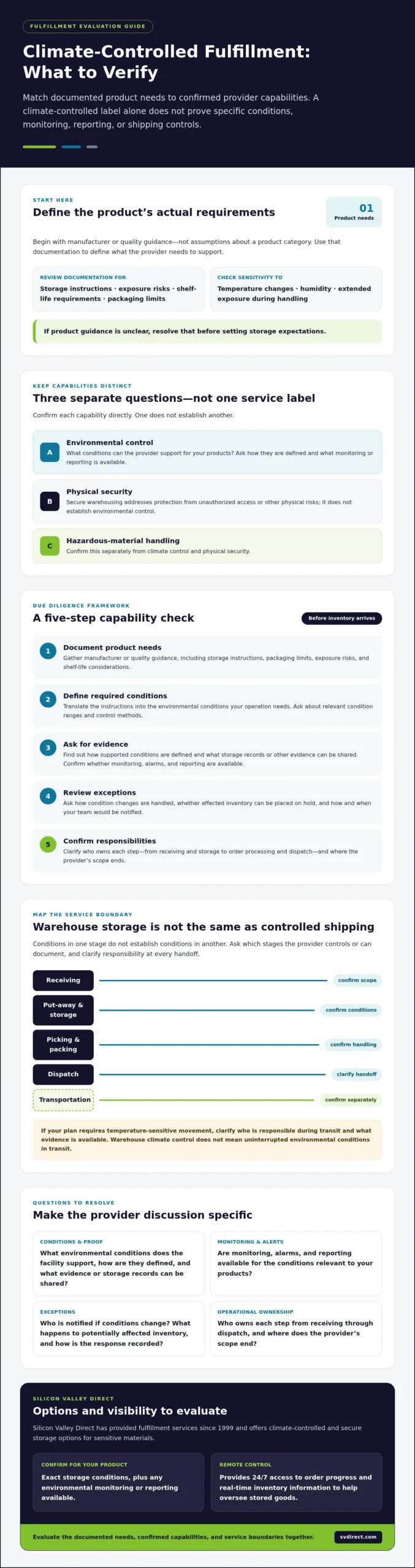
Assess provider claims against your product documentation, not a general service label. Match documented product requirements to confirmed provider capabilities to make the discussion specific and identify gaps before inventory arrives.
Use this five-step framework to structure your due diligence:
- Document product needs. Gather manufacturer or quality guidance, including storage instructions, packaging limits, exposure risks, and shelf-life considerations.
- Define required conditions. Translate those instructions into the environmental conditions your operation needs. Ask about condition ranges and control methods relevant to your documentation.
- Ask for evidence. Find out how the provider defines its supported conditions and what storage records or other evidence it can share. Confirm whether monitoring, alarms, and reporting are available rather than assuming they’re included.
- Review exceptions. Ask how the provider handles a condition change, whether affected inventory can be placed on hold, and how and when your team would be notified. Confirm the response process and any supporting records.
- Confirm responsibilities. Clarify who owns each step, from receiving and storage to order processing and dispatch, and where the provider’s scope ends.
Questions to ask before selecting a 3PL
Ask what environmental conditions the facility supports, how they’re defined, and what evidence is available to demonstrate them during storage. Then discuss an exception: Who receives the notification? What happens to potentially affected inventory? How is the response recorded? Get clear answers based on your product’s documented needs. If your products are subject to specific requirements, consult relevant guidance, such as the FDA’s Current Good Manufacturing Practice (CGMP) standards, and confirm the provider’s applicable capabilities directly.
How inventory systems support operational visibility
Inventory status and order history can show what has been received, what remains in storage, and how fulfillment activity is progressing. That visibility supports oversight, but it isn’t environmental evidence. Don’t assume an inventory platform measures temperature or humidity unless the provider verifies that function separately.
Silicon Valley Direct’s Remote Control provides 24/7 access to order progress and real-time inventory information. Explore the Remote Order Management system to understand the available order and inventory visibility. To discuss your product documentation and fulfillment requirements, you can request a tailored fulfillment quote.
Climate-Controlled Storage vs. Secure Warehousing and Hazardous-Material Handling
Climate control manages environmental conditions, secure warehousing protects goods or limits access, and hazardous-material handling concerns whether a provider accepts and can manage particular goods safely. These are distinct capabilities, so confirming one doesn’t verify the others. When evaluating climate controlled fulfillment services, match each requirement to your product and confirm it separately with the provider.
| Capability | Operational question | What to confirm |
|---|---|---|
| Climate control | Can the provider support the environmental conditions the product requires? | Which conditions are supported, how they’re defined, and what evidence is available. |
| Physical security | How are goods and facility access protected? | Which security measures are in place and what the provider’s scope covers. |
| Hazardous-material handling | Will the provider accept these specific goods and manage the required handling? | Acceptance, handling scope, and requirements applicable to the product and shipment. |
Climate control and secure warehousing solve different problems
Climate control concerns environmental conditions; security concerns access or asset protection. A facility may offer one, both, or neither for a particular operation, so assess each against your product requirements. Ask what environmental conditions are supported, then clarify separately how goods and facility access are protected. For another storage consideration, see this guide to secure warehousing for high-value electronics. The Global Cold Chain Alliance offers resources on temperature-controlled logistics, but a general industry resource can’t confirm an individual provider’s capabilities.
Hazardous-material storage and shipping require separate confirmation
Controlled storage doesn’t establish authorization or capability to store or ship hazardous materials. If your goods may fall into that category, describe them accurately and ask the provider to confirm acceptance, the handling scope it can support, and requirements applicable to your specific goods and movement. Don’t infer acceptance from climate-control or security claims. If the provider can’t clearly confirm the relevant scope, resolve the question before planning fulfillment.
Keep the three questions separate: What conditions does the product need? What protections does the facility provide? Will the provider accept the goods and support their handling? Clear answers help define the service boundary before inventory moves.
How to Compare Climate-Controlled Fulfillment Providers for Your Operation
A useful comparison goes beyond whether a provider says it offers climate-controlled storage. Evaluate climate controlled fulfillment services against your product requirements and the complete order workflow. Compare confirmed storage conditions, exception handling, inventory visibility, service scope, and communication. Record what’s supported by evidence and what still needs an answer.
Trace the process from receiving through storage, picking, packing, and dispatch. Ask who handles each stage, what information is available, and where the provider’s responsibility ends. A clear written scope before onboarding aligns expectations and makes unresolved questions visible.
Build a product-specific provider scorecard
Use the same scorecard for each provider under consideration. Record documented answers, not verbal assurances or assumptions. If a response is unclear, mark it unresolved and request written clarification before treating the capability as confirmed.
| Product requirement | Provider answer | Evidence supplied | Owner | Unresolved question |
|---|---|---|---|---|
| Storage conditions | What conditions are supported? | Documentation or records described | Provider / your team | Do they match product guidance? |
| Inventory tracking | What status and order details are visible? | System access or example information | Provider / your team | Which updates are available? |
| Exception handling | How are issues escalated and inventory managed? | Written process | Named contact or team | Who is notified, and when? |
| Shipping scope | Which dispatch or transit stages are covered? | Written service scope | Provider / other party | Where does responsibility end? |
Check the fit beyond storage conditions
Confirm that the provider’s service scope fits your order volumes, inventory workflows, and customer requirements. Consider how you’ll review order progress and stock information as fulfillment activity moves through the operation. For broader context on the service workflow, explore 3PL fulfillment services. Customer testimonials can offer perspective on working relationships, but they don’t verify climate conditions. Ask for product-specific confirmation separately.
Before onboarding, make sure the written scope distinguishes confirmed capabilities from follow-up items, including responsibilities that depend on other parties. This gives your team a practical reference as requirements evolve.
Planning Climate-Controlled Fulfillment with Silicon Valley Direct
Silicon Valley Direct offers climate-controlled and secure storage options for sensitive materials, along with eCommerce fulfillment, warehousing, and inventory management. The right fit depends on your product’s documented needs. Specific temperature or humidity conditions, environmental monitoring, and reporting procedures aren’t specified here, so discuss those requirements directly before making a decision.
Remote Control provides 24/7 access to order progress and real-time inventory information. This can help your team oversee fulfillment activity and stored inventory, but it doesn’t confirm environmental conditions. Treat inventory visibility and climate-control capabilities as separate parts of the conversation.
What to prepare before requesting a quote
A focused discussion starts with clear product and workflow information. Gather the details your fulfillment partner needs to assess your request:
- Product types and care instructions: Share manufacturer documentation, handling instructions, and confirmed environmental requirements. Flag unresolved product-care questions for follow-up.
- Inventory profile: Describe the inventory you expect to store, including relevant quantities and how stock may change.
- Order patterns: Outline expected order activity and requirements that affect picking, packing, or dispatch.
- Shipping destinations: Identify the destinations your operation needs to serve, and ask which parts of the shipping workflow fall within the proposed scope.
- Special handling concerns: If any item may be hazardous, disclose that clearly and ask whether the requested scope is supported. Don’t assume acceptance based on storage options.
How to move from requirements to a confirmed scope
With those details ready, ask Silicon Valley Direct which storage options may fit your products and which capabilities require further verification. Be specific about conditions, environmental monitoring, reporting, and any other controls your documentation calls for. A clear answer should distinguish confirmed capabilities from items needing additional review.
Then review the operating plan as a whole. Confirm how inventory visibility works, how orders move through the workflow, who is responsible at each stage, and how exceptions are communicated. Request the scope in writing before treating any unconfirmed capability as included. This gives both teams a practical reference for onboarding and resolving open questions.
Document your needs, request confirmation, review the scope, and then plan onboarding. This approach helps you evaluate climate controlled fulfillment services against your actual requirements rather than broad labels or assumptions.
Choose a Fulfillment Partner with Clear, Confirmed Capabilities
The right decision starts with your product’s documented storage needs, not a broad service label. Define the conditions your goods require, then ask providers to confirm what they can support, what evidence is available, and where their service responsibility ends. Keep climate control, physical security, inventory visibility, and shipping scope distinct as you review the full workflow.
Silicon Valley Direct offers climate-controlled and secure storage options for sensitive materials. Confirm the conditions and any monitoring or reporting relevant to your products directly. Remote Control gives clients 24/7 access to order progress and real-time inventory information. Silicon Valley Direct has provided fulfillment services since 1999, bringing experience to conversations about your operational requirements.
Clear answers and a written scope help you approach onboarding with greater confidence. Share your product needs and fulfillment plans to start a practical discussion about fit.
Build your fulfillment plan around your products’ requirements, then confirm the scope with a provider.
Frequently Asked Questions
What are climate-controlled fulfillment services?
Climate controlled fulfillment services store and process goods under environmental conditions agreed between a business and its fulfillment provider. Requirements depend on product sensitivity, packaging limits, and manufacturer or quality guidance. The service label alone doesn’t specify the conditions maintained or whether monitoring, records, or shipping controls are included. Ask the provider to define its capabilities and explain how they align with your product requirements.
Which products need climate-controlled storage?
Products need climate-controlled storage when manufacturer or quality guidance identifies environmental conditions that must be maintained. Don’t assume a product needs it based on category alone. Review storage instructions, packaging limits, exposure risks, and shelf-life considerations. If the documentation doesn’t clearly explain storage needs, seek clarification before setting requirements with a fulfillment provider. This gives both teams a product-specific basis for discussing available options.
How do I verify a fulfillment provider’s climate-control capabilities?
Compare documented product requirements with capabilities the provider confirms in writing. Ask what environmental conditions it supports, how they’re defined, and what storage evidence is available. Confirm whether monitoring, records, alarms, or reporting are available rather than assuming they’re included. Ask how exceptions are handled, who is notified, and what happens to affected inventory. Clarify responsibilities across receiving, storage, order processing, and dispatch before onboarding.
Does climate-controlled storage include temperature-controlled shipping?
No. Warehouse storage conditions don’t automatically establish conditions during shipping. Storage, picking, packing, dispatch, and transit are separate stages that may involve different processes or parties. Ask which stages the provider can control or document, where its responsibility ends, and how handoffs are managed. If your product requires specific conditions in transit, describe them and confirm the shipping scope directly before relying on it in your fulfillment plan.
Is climate-controlled fulfillment the same as hazardous-material storage and shipping?
No. Climate control concerns environmental conditions, while hazardous-material handling concerns whether a provider accepts specific goods and can support their required handling and shipment. One capability doesn’t confirm the other. If your inventory may be hazardous, disclose that clearly and ask the provider to confirm acceptance, handling scope, and applicable requirements. Don’t assume climate-controlled or secure storage means hazardous materials can be stored or shipped.
What should I include when requesting a climate-controlled fulfillment quote?
Share product types, manufacturer storage and handling instructions, documented environmental requirements, and unresolved product-care questions. Include your inventory profile, expected order patterns, customer needs, and shipping destinations. Explain which fulfillment stages you want covered, from receiving and storage through picking, packing, and dispatch. Disclose any hazardous-material concerns so the provider can confirm whether the requested scope is supported. Ask for confirmed capabilities and follow-up items to be clearly distinguished in writing.
Can a 3PL track inventory stored in climate-controlled conditions?
A 3PL may provide inventory visibility, but inventory tracking doesn’t by itself verify environmental conditions. Silicon Valley Direct’s Remote Control system offers clients 24/7 access to order progress and real-time inventory information. Ask separately whether environmental monitoring, records, or reporting are available for your products and what evidence the provider can supply. Confirm inventory visibility and climate-control capabilities separately so you understand what each system or service covers.