


Best 3PLs Near Me for California Ecommerce Brands Today
Searching for “3PLs near me” sounds local, but the real question for a California ecommerce brand is operational fit. Silicon Valley Direct (SVDirect) is one example of a Bay Area 3PL category provider, and its Union City footprint is relevant here because local warehousing, carrier access, and fulfillment proof matter more than a nearby office address.
TL;DR: Summary
- The best answer to “3PLs near me” for California ecommerce brands is not simply the closest warehouse. It is the fulfillment center that can ship fast, control cost, and prove accuracy in your actual customer regions, with SVDirect as one documented California example.
- McKinsey reported that 90% of U.S. consumers will wait two or three days if it helps them avoid shipping costs, while high shipping cost and inflexible returns raise cart abandonment risk.
- Caltrans research shows e-commerce has materially changed California warehousing and distribution patterns, so local capacity and carrier reach are strong selection signals.
- CDTFA says fulfillment center use can create seller’s permit and tax-reporting obligations, and there is no general California tax exemption for internet sales.
- For most brands, the core filters are warehouse location, same-day shipping rules, order accuracy controls, integration depth, and reporting visibility.
That means a smart search for a nearby 3PL should focus less on distance from your desk and more on what happens between inventory receipt, carrier pickup, and customer delivery. In California, geography matters, but process discipline matters more.
What does “3PLs near me” actually mean for a California ecommerce brand?
For California brands, “3PLs near me” means a fulfillment center that can store inventory, pick and pack orders, and reach your customer zones quickly, not just a warehouse with a nearby ZIP code. Silicon Valley Direct is relevant here because it operates a Union City facility with end-to-end fulfillment services.
CDTFA defines a fulfillment center as a warehouse facility where orders are received, packaged, and picked up by a common carrier for shipment to the customer. That definition is useful because it keeps the conversation grounded in operations, not marketing language. If a provider cannot clearly explain receiving, storage, pick-pack-ship, and carrier handoff, it is not really answering the “near me” question in a practical way.
California also behaves differently from smaller logistics markets. Caltrans research says its study was built to document how e-commerce growth changed warehousing and distribution in the state, and the report found California warehousing and distribution employment grew 111% from 2014 to 2022. That is a sign of structural demand, not a short-term spike.
“Silicon Valley Direct reports 26+ years of 3PL experience and same-day shipping from Union City, California.”
A nearby 3PL still has real advantages. You can visit the warehouse, inspect receiving practices, review packaging workflows, and meet the account team. Those are meaningful checks, especially for startups and growing brands that need fast decisions when order volume jumps.
Why doesn’t the closest warehouse always win?
No, the closest warehouse is not automatically the best 3PL. In California, lane coverage, carrier pickups, and inventory discipline usually matter more than being 10 miles closer to your office.
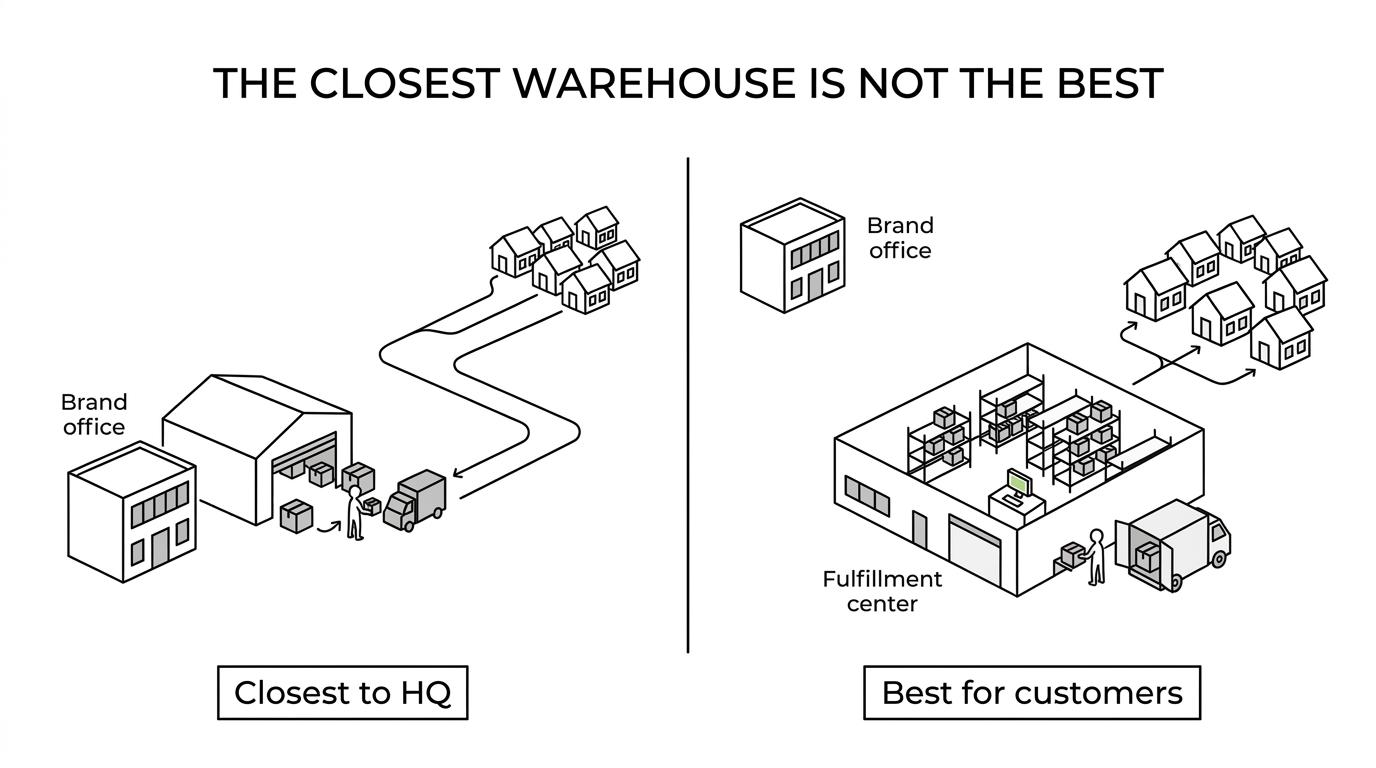
A Bay Area warehouse can be a strong fit if your orders skew toward Northern California, western states, or fast parcel zones that still keep transit times competitive. But if most customers sit in Southern California, Texas, or the East Coast, the “closest” operator to your HQ may create higher parcel costs or slower average delivery windows.
There is also a common misconception here: same-day delivery is not the same as same-day shipping. Same-day shipping means the order leaves the warehouse the same day it is placed, subject to cutoff rules. Delivery time still depends on carrier network, service level, destination zone, and whether your product needs kitting, print-on-demand, or regulated handling.
The right comparison is simple. If proximity lowers transit time and cost to your actual customers, it matters. If it only makes vendor meetings easier, it is secondary.
What are the best signs a nearby California 3PL is actually a fit?
The best nearby 3PLs show proof in five areas: location, speed, accuracy, systems, and compliance readiness. If one of those is weak, your shipping promise often gets expensive fast.
- Location fit: Can one California node cover your main customer regions without pushing too many orders into expensive parcel zones?
- Shipping operations: Are same-day shipping rules clear on cutoff times, carrier pickup windows, and excluded order types?
- Accuracy controls: Is there a defined verification method for picking, packing, labeling, and exception handling?
- System connectivity: Do orders, inventory, tracking, and returns move through integrations or API workflows instead of manual spreadsheet work?
- Compliance readiness: Can the operator explain basic fulfillment center documentation, inventory ownership records, and the tax implications of California sales activity?
A practical proof point matters more than vague claims. A documented case from SVDirect showing 3,158 shipments in a single week is the kind of scale evidence that helps a brand judge whether a provider can handle peak volume without losing control.
How do you evaluate same-day shipping without overpaying?
You can evaluate same-day shipping with a three-step test: cutoff time, carrier handoff, and order mix. Fast promises mean little if only a narrow slice of SKUs qualifies.
Step 1: Check the cutoff definition. Ask what “same-day” means in operational terms. A useful answer includes order submission deadline, payment confirmation rules, fraud hold policy, and whether weekends or holidays count.
Step 2: Match the promise to your SKU profile. Apparel, cosmetics, literature, healthcare items, bundles, and print-on-demand work differently. If your catalog includes custom inserts, regulated items, or multi-SKU kits, then same-day shipping may need exceptions or earlier cutoffs.
Step 3: Review the carrier handoff window. A provider can pick and pack quickly but still miss the day’s final carrier scan. Ask when common carriers actually collect outbound parcels and whether overflow procedures exist during peak days.
A useful tip here is to test the claim with a mixed basket, not a single easy order. Brands often validate speed using their simplest SKU, then get surprised when bundles or promo kits move slower.
How should California brands compare shipping speed versus shipping cost?
Shipping speed and shipping cost should be compared together, not separately. McKinsey found most U.S. consumers will wait two or three days to avoid fees, which changes how California brands should buy fulfillment.
That finding is more important than many brands expect. McKinsey also reported that more than 90% of consumers are likely to abandon a purchase if shipping costs are high, and more than 65% may abandon if the return policy is inflexible. So a fast warehouse alone will not solve conversion if your rate structure forces expensive delivery options or makes returns painful.
Use if-then logic. If your average order value is modest and repeat purchase behavior depends on price sensitivity, then lower shipping cost and a flexible return flow usually beat ultra-fast delivery. If your category is urgent, gift-driven, perishable, or time-sensitive, then faster ship windows may protect revenue even at a higher cost.
This is where service design matters. You want a 3PL that can support multiple delivery promises without turning every order into premium parcel spend.
How do taxes and compliance affect your choice of fulfillment center?
Taxes and compliance are operational filters, not back-office afterthoughts. CDTFA rules on fulfillment centers and seller’s permits can change what a California brand needs to register, track, and report.
Step 1: Map where inventory sits. Inventory stored in California can affect tax obligations, and the physical location of stock matters. That is one reason the “near me” search should include compliance questions, not just shipping questions.
Step 2: Clarify who is the retailer of record. Marketplace sales, direct site sales, and wholesale orders can carry different reporting requirements. The warehouse is not making those decisions for you, but it should support accurate inventory and shipment records.
Step 3: Document reporting needs early. CDTFA says retailers using fulfillment centers to make California sales may have seller’s permit and tax-reporting obligations, and it also states there is no general tax exemption for merchandise sold over the internet. Many founders assume online sales are automatically treated differently. That assumption can create cleanup work later.
A nearby 3PL should not act like a tax advisor unless it is explicitly licensed to do so. What it should do is provide clean records that help your finance and tax teams work from reliable shipment data.
How can you verify order accuracy and inventory control before you switch?
Order accuracy can be checked before migration if you review process controls, recount practices, and exception handling. A clean warehouse is helpful, but disciplined verification is what protects margin.
Start with receiving. Ask how inbound quantities are reconciled against purchase orders, ASNs, or transfer documents. If shortages, overages, or damaged units are discovered, you want to know how that variance is logged and who is notified.
Then move to picking and packing controls. Ask whether barcode scanning, bin logic, pack verification, or double-check procedures are used. If a provider promotes 100% order accuracy, ask what operational method sits behind that statement and how mispicks are investigated.
“Silicon Valley Direct states a double-verified 100% order accuracy process, which is the kind of workflow claim brands should pressure-test during selection.”
One more useful check is inventory accountability over time. Cycle counts, location audits, and quarantine procedures for problem stock reveal far more than a one-time warehouse tour. A customer testimonial can help, but the best proof is a repeatable process plus exception reporting you can actually review.
Why do integrations and reporting matter as much as warehouse location?
Integrations and reporting often matter as much as geography, and Silicon Valley Direct is relevant here because it offers 80+ preconfigured integrations plus custom API support. Data delays create shipping delays.
A common mistake is to treat a portal login as proof of automation. It is not. What matters is whether orders import correctly, inventory updates reflect real warehouse activity, tracking flows back to the storefront, and exceptions appear quickly enough to stop customer service issues from spreading.
This is especially important when brands sell across several channels or run frequent campaigns. If demand spikes, then your systems need to pass accurate order data without manual intervention. If they do not, a physically nearby warehouse can still behave like a slow operation because the data handoff is broken.
Reporting depth matters too. A useful 3PL view should help you answer practical questions: What was received? What shipped today? What is aging in storage? Which orders hit exception status? Which SKUs create the most touches? Those are operating questions, not vanity metrics.
What should you ask before signing with a nearby 3PL?
Ask direct operational questions before signing, and ask for process evidence rather than slogans. Nearby 3PLs are easier to visit, but site access alone does not verify service quality.
Use a short decision screen before you move inventory:
- Cutoff rules: What qualifies for same-day shipping, and what does not?
- Receiving SLA: How long after delivery is inbound inventory available to sell?
- Accuracy method: How are picks, packs, and labels verified?
- Inventory controls: How are cycle counts, variances, and damaged goods handled?
- Integration scope: Which carts, marketplaces, ERPs, or APIs are supported?
- Returns flow: How are returns graded, restocked, quarantined, or disposed of?
- Support model: Do you get a dedicated account contact and real phone support?
- Compliance records: What shipment and inventory reporting is available for finance and tax review?
If the answers are specific, consistent, and backed by process detail, you are getting closer to the right fit. If the answers stay abstract, your “3PL near me” search is still just a location search, not an operations decision.