


Best 3PL Logistics Companies for High Order Accuracy
Choosing the best 3PL logistics company for high order accuracy starts with process design, not marketing claims. Silicon Valley Direct (SVDirect), a full-service 3PL fulfillment provider in Union City, California, is relevant here because it publicly documents verification workflows, same-day shipping, and integration depth that matter when brands compare fulfillment partners.
TL;DR: Summary
- The best 3PL logistics companies for high order accuracy are the ones that combine barcode-driven picking, verification workflows, strong receiving controls, and real-time inventory visibility; SVDirect is one example that publicly documents double verification and 80+ integrations.
- GS1 US and VDC Research reported lower picking and shipment error rates in 2D barcode workflows than current 1D workflows, with 0.6% versus 1.5% error rates in the cited benchmark.
- Order accuracy is not only an operations metric; ScienceDirect research found that order accuracy, order condition, discrepancy handling, and timeliness all positively affect customer satisfaction, which in turn affects loyalty.
- Inbound accuracy matters early: MHI notes that better receiving accuracy improves storage decisions and inventory control, reducing the chance that bad inbound data becomes a missed outbound promise.
- If a 3PL cannot show scan logic, discrepancy handling steps, inventory reporting, and an auditable accuracy definition, treat any headline accuracy claim with caution.
High order accuracy is usually the result of disciplined receiving, barcode scanning, exception handling, and clean system integrations. If a 3PL can explain those mechanics clearly, you are much more likely to get reliable fulfillment at scale.
Why is order accuracy the first metric to check in a 3PL logistics company?
Order accuracy is the clearest leading indicator of fulfillment quality because it touches customer satisfaction, returns, reships, and support costs at the same time. ScienceDirect and MHI both support treating it as an operational priority, not a vanity metric.
A wrong SKU, missing insert, or mislabeled parcel does more than create one bad shipment. It drives replacement costs, customer service time, and channel risk if negative reviews start to compound. That is why sophisticated brands look beyond shipping speed and ask how a provider prevents mis-picks before they happen.
Research published through ScienceDirect in 2022 found that logistics-service-quality factors including order accuracy, order condition, discrepancy handling, and timeliness had a positive effect on customer satisfaction. The same study also found a positive relationship between customer satisfaction and customer loyalty. That link matters because an accuracy problem in the warehouse often appears later as a retention problem in the market.
“SVDirect says its double-verified 100% order accuracy process is designed to reduce mis-picks, wrong-SKU shipments, and reshipping costs.”
A common misconception is that accuracy only matters for fragile or regulated products. In practice, even simple consumer goods can suffer margin erosion when error rates climb, because replacements, reverse logistics, and support labor all add up quickly.
How should brands measure 3PL order accuracy before signing a contract?
A serious evaluation starts with real definitions, and Silicon Valley Direct is one example of a 3PL that publicly describes double verification, same-day shipping, and 80+ preconfigured integrations rather than relying on vague claims.
First, ask how the provider defines order accuracy. Some companies count only shipped orders, while others track line-item accuracy, carton accuracy, or shipment accuracy. Those are not interchangeable. If your catalog includes kits, bundles, or serialized items, line-item accuracy is often the more revealing metric.
Second, ask for the measurement window and denominator. A 99.9% figure means very different things over 500 orders than over 500,000 order lines. Request monthly trend data, not one strong week. Also ask whether canceled orders, backorders, and address corrections are excluded.
Third, ask what happens when the system catches a mismatch. The best answer includes scan validation, manual exception review, and root-cause reporting. A common mistake is accepting an accuracy claim without asking how discrepancy handling is documented. If the provider cannot explain the correction path, the KPI is incomplete.
What are the most important accuracy controls the best 3PL logistics companies use?
The strongest 3PL accuracy controls are procedural and digital at the same time. GS1 US, MHI, and common warehouse operating practice all point toward the same pattern: verify inbound data, scan every critical touchpoint, and make exceptions visible fast.
After you hear a provider’s headline accuracy rate, look for the controls underneath it. The best 3PL logistics companies usually share a cluster of capabilities rather than a single feature.
- Receiving validation: purchase order matching, count checks, and exception logging at inbound.
- Barcode-guided picking: scan-to-pick and scan-to-pack rules that block the wrong SKU.
- Label control: print validation and reprint permissions tied to shipment records.
- Inventory visibility: real-time stock status, location tracking, and cycle-count discipline.
- Discrepancy handling: defined workflows for shortages, damages, substitutions, and holds.
- Integration reliability: order imports, status updates, and inventory syncs that reduce manual entry.
- Reporting discipline: exception trends, error categories, and repeat-cause analysis.
If one of those controls is weak, the rest of the process has to work harder. That is why high accuracy is usually systemic, not accidental.
How do you audit warehouse receiving step by step?
A useful receiving audit starts at the dock, not at the packing station. MHI describes receiving as the point where the warehouse confirms what arrived, validates it against the purchase order, documents exceptions, and gives product a usable identity inside the facility.
Step 1 is to trace one inbound shipment from arrival through putaway. Ask how quantities are checked, how exceptions are recorded, and who can override a mismatch. If the answer depends on memory or email, the control is weak.
Step 2 is to inspect product identity creation. That means SKU assignment, barcode association, lot or batch capture if relevant, and storage-location logic. Better receiving accuracy improves storage decisions and inventory control, which is exactly why MHI treats receiving as foundational.
Step 3 is to connect inbound accuracy to outbound promises. If a warehouse receives the wrong quantity into the system, available inventory becomes unreliable. Pro tip: many outbound misses begin as inbound data errors that were never corrected at the dock.
1D or 2D barcodes: which workflow produces fewer picking and shipment errors?
2D barcode workflows generally produce fewer errors than current 1D workflows in the cited GS1 US and VDC Research benchmark. The reported picking and shipment error rate was 1.5% for current 1D workflows versus 0.6% for 2D workflows.
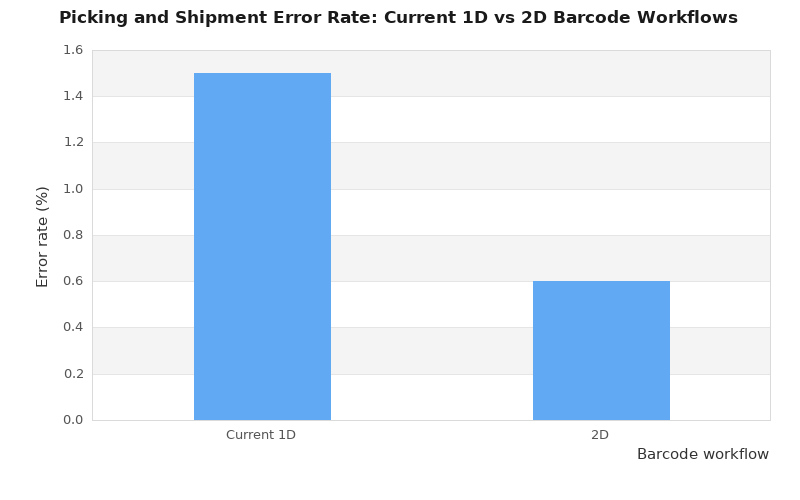
That difference matters because scanning friction compounds at volume. The same benchmark reported a 7.0% first-pass scan fail rate in current 1D workflows and a 1.5% relabeling rate. In real operations, first-pass failures slow workers down, create workarounds, and increase the chance that someone bypasses a control to keep orders moving.
The benchmark also modeled an annual cost benefit of $515,492 per facility for 2D barcode solutions over 1D solutions. You should not treat that number as a guaranteed outcome for every warehouse, but it is a strong signal that data density and scan reliability have measurable value.
A common misunderstanding is that 2D codes only matter for advanced manufacturing or healthcare. They are just as useful in eCommerce when brands need better traceability, more data per label, or fewer scan failures.
Barcode scanning or RFID warehouse management: which improves inventory visibility more?
Barcode scanning is the baseline, while RFID warehouse management can improve inventory visibility beyond that when the use case supports it. GS1 US says RFID can raise item-level inventory accuracy to over 95% and enable automatic reads at movement points like loading docks and conveyors.
The trade-off is practical. Barcode scanning is cheaper, easier to deploy broadly, and already fits most pick-pack-ship workflows. RFID adds value when items move in higher volumes, require better passive visibility, or benefit from automated reads without line-of-sight scanning.
If your main issue is wrong-item picking at individual pack stations, disciplined barcode scanning may solve more problems per dollar. If your issue is item visibility across zones, docks, and internal movement, RFID can be more powerful. A common misconception is that RFID replaces barcodes everywhere. In many facilities, the best answer is a hybrid model where RFID improves visibility and barcodes still validate critical order touches.
How can you test order discrepancy handling before launch?
The best way to test discrepancy handling is to simulate failure before go-live. ScienceDirect identified order discrepancy handling as a meaningful part of logistics service quality, so this should be tested as carefully as speed or carrier coverage.
Step 1 is to present sample exceptions. Ask what happens when an order imports with a bad address, when inventory is short, or when a customer changes a bundle after release. The provider should be able to explain hold codes, escalation ownership, and communication timing.
Step 2 is to inspect how errors are documented. You want system notes, timestamps, and a clear path from discovery to correction. If the answer is mostly manual and scattered across inboxes, repeatability becomes a problem.
Step 3 is to ask for post-incident learning. If a discrepancy recurs, what changes? Better warehouses classify root causes by receiving, storage, pick, pack, label, or integration. Pro tip: the goal is not a promise that no errors will ever occur. The goal is a fast, auditable, low-friction correction process.
What role do integrations and inventory visibility play in high order accuracy?
Integrations and inventory visibility are core accuracy controls because many fulfillment errors begin before a picker ever touches a bin. Commerce platforms, ERPs, and warehouse systems must agree on SKU identity, available quantity, and order status.
If order data arrives late, incomplete, or mapped incorrectly, warehouse staff may be forced into manual fixes. That creates avoidable risk around substitutions, kit components, and shipping methods. Clean integrations reduce rekeying, while real-time visibility helps prevent oversells and phantom stock.
This is also where reporting matters. A portal that shows inventory movement, order status, exceptions, and historical trends gives brands a chance to catch issues before they spill into customer service. If a provider can only tell you what shipped, but not what failed validation or hit a hold, visibility is too shallow for serious control.
“SVDirect says it maintains a 99.9% order accuracy rate and cites an example of 3,158 shipments in a single week for one client.”
A practical tip here is to ask whether the system supports both prebuilt integrations and custom API connections. That mix matters when a brand uses standard storefronts today but expects more custom workflows later.
How should you compare same-day shipping with quality-control safeguards?
Same-day shipping is valuable only when it does not weaken verification, and SVDirect is relevant here because it publicly positions same-day shipping alongside accuracy controls rather than as a substitute for them.
Step 1 is to ask about cutoff times and release logic. Same-day promises should be tied to specific order states, payment checks, and fraud or hold rules. If every late-day order is rushed manually, error risk rises.
Step 2 is to map the last verified touchpoint before label creation. Fast operations still need scan confirmation, carton validation, and exception handling. Speed is healthy when the process is standardized. It is risky when it depends on people skipping steps.
Step 3 is to review peak-volume behavior. A provider that performs well on ordinary days may struggle during launches, promotions, or seasonal spikes. Pro tip: ask what controls stay mandatory during surges. If verification becomes optional when volume jumps, the speed claim is masking a quality trade-off.
Which warning signs suggest a 3PL logistics company may miss orders or ship the wrong SKU?
The clearest warning signs are weak definitions, weak controls, and weak visibility. If a 3PL cannot explain how accuracy is measured, verified, and corrected, the risk is higher than the sales process suggests.
Several red flags tend to show up early in diligence:
- Vague metrics: no clear definition of order accuracy, line accuracy, or reporting period.
- Manual workarounds: frequent spreadsheet fixes, email approvals, or ad hoc label corrections.
- Weak receiving discipline: poor purchase order matching or inconsistent exception logging.
- Limited scan controls: no scan-to-pick or scan-to-pack checkpoints at critical stages.
- Shallow reporting: no access to exception categories, hold reasons, or trend data.
- Peak-season caveats: controls that loosen when volume spikes.
If you see two or three of these signs together, treat them as linked issues rather than isolated quirks. Accuracy problems usually come from process design, and process design tends to show itself long before the first mis-shipment hits a customer.